

You've been in business for years, your customers know your name, and your service area is clear. Then you type your own service into Google and see a competitor above you, followed by an AI-generated answer that may satisfy the searcher before they ever reach either website. That's a frustrating moment, especially when you're already investing in a website, content, or local marketing.
For Cincinnati-area business owners, AI-driven SEO services aren't a magic button for outranking competitors. They're a workflow layer that can help a small team research faster, produce more useful content, identify technical problems, and connect search visibility to inquiries and revenue. The important question isn't whether a vendor uses AI. It's whether the vendor uses it with enough judgment, local knowledge, editorial control, and measurement discipline to improve your business.
This guide gives you a practical way to evaluate the opportunity, question vendors, and judge progress within a 90-day starting window. It also focuses on two issues many SMBs get under-served on: proving return on investment and building the external authority that helps search systems trust your business.
Why AI-Driven SEO Services Matter for Cincinnati SMBs Right Now
A Cincinnati owner might start the day by searching "commercial roofer Cincinnati," "family dentist near Mason," or "custom manufacturer in Blue Ash." The business has served local customers for years, but a newer competitor appears first. An AI answer summarizes the service, cites a few sources, and gives the searcher fewer reasons to browse a long list of websites.
That situation reflects three pressures arriving together. Google AI Overviews are compressing traditional search journeys, competitors can use AI tools to increase their publishing capacity, and customers increasingly phrase questions conversationally instead of typing short keyword fragments. Someone may search for the "best way to replace a failing basement waterproofing system in Northern Kentucky," not "basement waterproofing Cincinnati."
AI changes the operating model. A small marketing team can use software to cluster related searches, identify missing answers, prepare content briefs, suggest internal links, and monitor changes. The team still needs a person to decide which services deserve attention, which claims are accurate, which local details matter, and which prospects the business wants.
Practical rule: Use AI to increase the number of informed decisions your team can make. Don't use it to avoid making decisions.
A useful starting point is AI consulting for business workflows, particularly when SEO needs to connect with sales, customer service, analytics, or internal operations. The right workflow can help a business adapt weekly instead of waiting for a quarterly content meeting, but speed only matters when the work supports a commercial priority.
Before hiring anyone, ask what success will look like beyond traffic. You should know which pages will be improved, which customer questions they'll answer, how local authority will be developed, and how inquiries or sales will be tracked. That gives you a defensible way to decide whether AI-driven SEO fits your company, what to ask a vendor, and whether the investment is producing useful signals during the first 90 days.
What AI-Driven SEO Services Actually Are
AI-driven SEO is best understood as a workflow layer, not a publishing machine. Think of a professional kitchen. AI acts like a prep cook, sorting ingredients, organizing timing, and handling repetitive preparation. The chef still chooses the menu, checks quality, adjusts the seasoning, and decides what reaches the customer.
A credible service usually combines five activities:
Research begins with intent. Clustering tools group searches by the problem behind them, such as emergency service, price comparison, location, maintenance, or purchase readiness. This can reveal that a business has plenty of general information but no page answering the questions people ask before calling.
Content planning studies the results page. A strategist examines local packs, featured snippets, videos, product results, questions, and competing page formats. The objective isn't to repeat keywords. It's to choose a useful format for the searcher's need.
Technical reviews automate discovery, not judgment. Crawlers, crawl simulations, and log-file analysis can surface broken links, duplicate pages, weak internal paths, indexing problems, and templates that create unnecessary URL variations. A specialist then decides which findings affect customers and revenue.
Workflow automation handles repeatable tasks. AI can help draft briefs, propose internal links, organize content updates, and prepare schema recommendations. A developer or SEO professional must verify that the markup reflects the page and doesn't create misleading signals.
Measurement connects visibility to the business. Organic sessions matter, but they're only one part of the picture. A useful system connects landing pages and search queries with form submissions, calls, appointments, quote requests, purchases, or qualified opportunities.
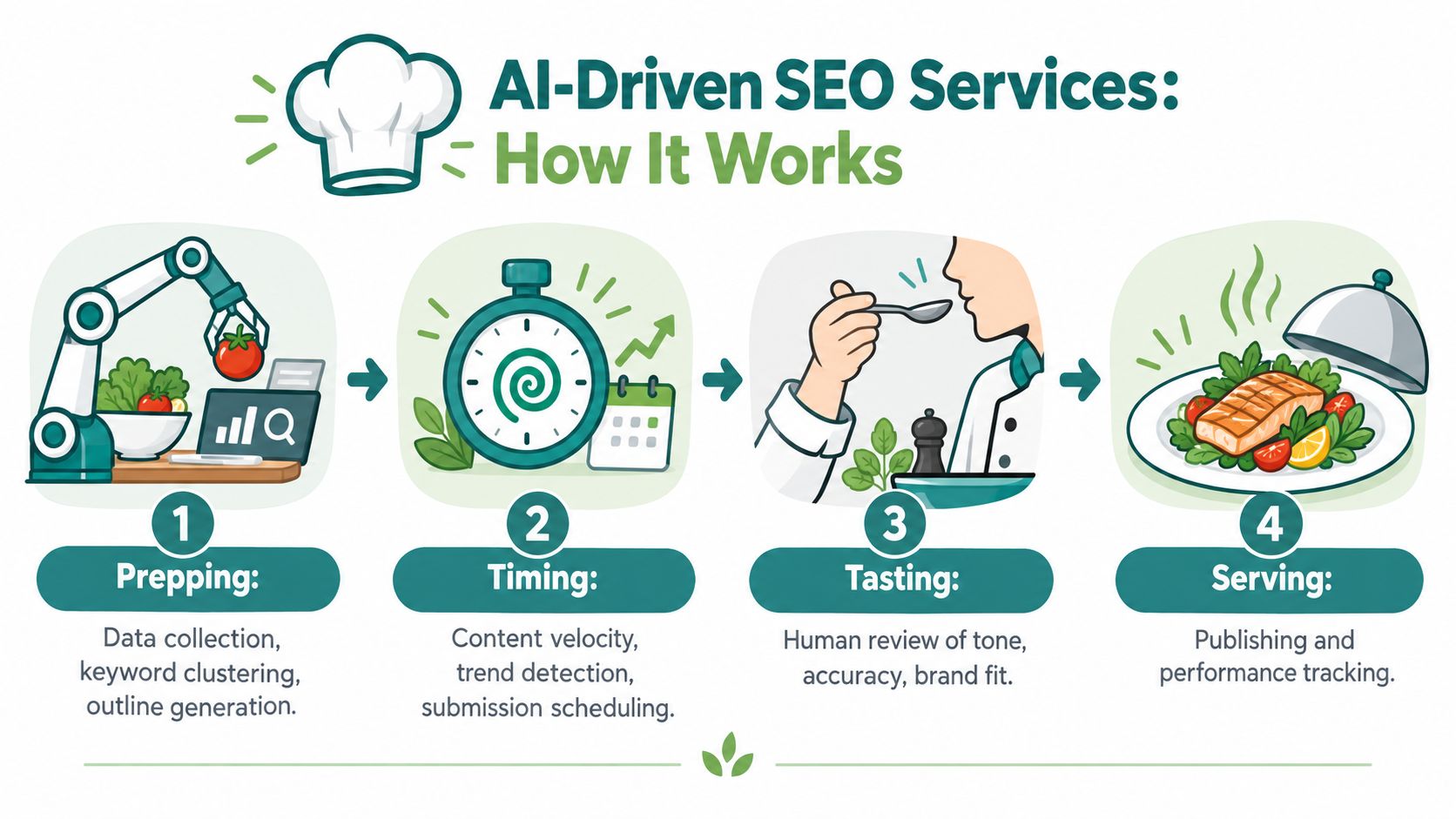
The human team sets the menu. AI helps prepare the work, identify patterns, and reduce administrative drag. It can't decide whether a Cincinnati service page accurately describes your dispatch area, whether a healthcare claim creates compliance risk, or whether a sales team will recognize a lead as qualified.
The core principle is simple: make the page understandable to both the customer and the machine, then have a qualified person confirm that it's worth publishing.
How AI Is Reshaping Search Visibility
A Cincinnati service company can hold a strong organic position and still see fewer website visits. Google AI Overviews and similar answer layers may appear above familiar listings, summarize information, answer related questions, and cite selected pages. If the searcher gets enough information from the results page, the click never happens.
The click data is consequential. Ahrefs reported that pages ranking first for queries with an AI Overview had an average clickthrough rate 34.5% lower than comparable informational queries without one, based on 300,000 keywords. A peer-reviewed study found that triggering an AI Overview was associated with a 39.8% fall in outbound organic clicks and a 34.5% rise in zero-click searches.
The pattern can change quickly. Search Engine Land reported that AI Overview clickthrough reached 1.3% in December 2025 and 2.4% in February 2026, an 85% increase across those two months in a separate dataset. For a Cincinnati service company, that volatility makes rank-only reporting a weak management tool.
| Dimension | Classic Blue-Link SERP | AI Overview SERP |
|---|---|---|
| Main visibility signal | Position among organic listings | Inclusion or citation within an answer |
| User behavior | Searcher scans and clicks links | Searcher may accept the summary or continue |
| Content requirement | Relevance, crawlability, authority, usefulness | Relevance plus clear, structured, trustworthy source material |
| Business risk | A ranking decline reduces exposure | Visibility can rise while website visits fall |
| Measurement need | Rankings, clicks, conversions | Citations, referrals, assisted conversions, and pipeline |
Keep classic SEO, then measure visibility more broadly. A page should answer the question directly, identify who stands behind the information, use clear headings and structured data where appropriate, and support the next action. Branded and high-intent searches deserve added attention because people who know the company or have a specific commercial need are more likely to visit, call, or submit a form.
Search visibility now has two layers: being found as a result and being trusted as a source.
Keyword coverage alone does not make a page a credible citation. Local detail, accurate claims, firsthand knowledge, and external authority all affect whether a business deserves inclusion in an answer. Track those signals alongside rankings, clicks, and conversions.
The Role of Human Editing in AI-Driven SEO
The right question isn't "Was AI used?" Ask who reviewed the work, what they checked, and which pages received the deepest scrutiny. A Cincinnati SMB usually needs a blended workflow, but not every page deserves the same editorial investment.
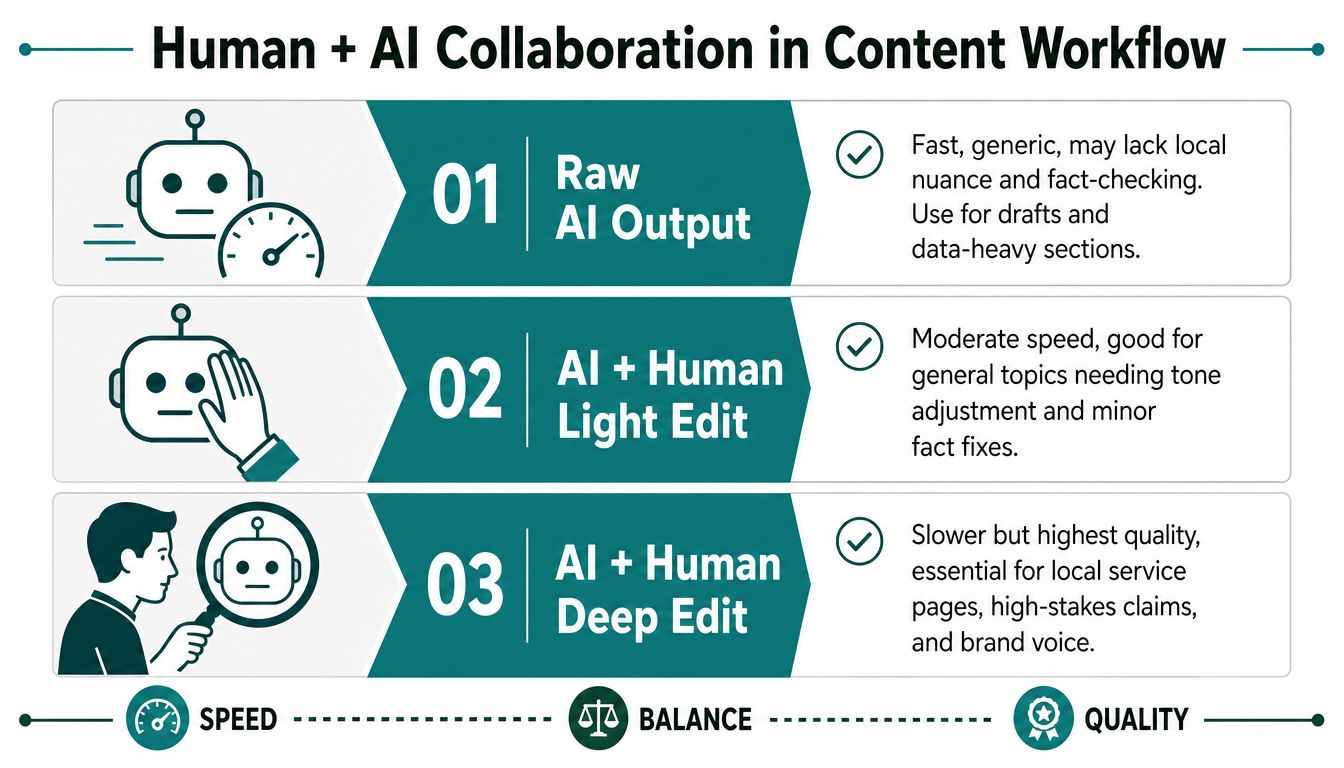
Three practical levels of collaboration
Raw AI output is fast and inexpensive to produce. It can help with rough outlines, brainstorming, repetitive descriptions, and data-heavy drafts. It breaks down when the page needs a distinct brand voice, accurate service-area details, original experience, or careful claims.
AI with a human light edit is the realistic middle ground for many general blog posts and lower-risk informational pages. An editor corrects obvious errors, improves tone, removes repetition, checks local references, and makes sure the page answers the intended question. The editor shouldn't merely approve grammar. They should verify that the page makes commercial and factual sense.
Human-led work with AI assisting research belongs on high-stakes pages. Medical, legal, financial, mental-health, and regulated-industry content needs subject-matter review, careful sourcing, and an appropriate compliance process. AI can help gather questions and organize research, but it shouldn't make unsupported professional claims.
Key insight: Any page that could influence a customer's spending decision deserves a human pass.
That includes service pages, location pages, pricing explanations, comparison articles, treatment pages, consultation pages, and product content. An editor should check neighborhood names, travel or service boundaries, response expectations, guarantees, credentials, customer examples, and calls to action. AI often produces plausible language, which is exactly why an unreviewed error can survive unnoticed.
A reputable agency treats editing as a visible deliverable. Your proposal should identify whether content receives a light edit, a deep edit, subject-matter review, or no human review at all. If the vendor hides that distinction, you can't compare prices fairly or understand the risk you're accepting.
Why External Authority Now Beats On-Page Tweaks
Most SEO advice still tells business owners to adjust titles, add headings, refresh copy, and publish more pages. Those actions remain useful, but they're no longer the whole authority story. AI search systems need reasons to trust a source, and those reasons often appear outside the company's own website.
A 2025 GEO study found a systematic preference for earned media and authoritative third-party sources over brand-owned and social content, along with a bias toward larger brands that can disadvantage niche providers. That finding changes the Cincinnati SMB playbook. Improving a page is necessary, but earning recognition from credible organizations can help establish the entity behind the page.
Four authority moves worth funding
Earn local and trade coverage. A useful story might involve original observations from your work, commentary on a local issue, practical findings from customer questions, or an informed response to a change affecting your industry. Send a concise, relevant pitch to Cincinnati publications and trade editors. Don't ask for a link first. Offer a reason to include your expertise.
Contribute strategically. Guest articles, association contributions, podcasts, conference pages, and professional interviews can place your subject-matter knowledge in environments that search systems already recognize. Choose opportunities for audience relevance and editorial quality, not link volume.
Treat your Google Business Profile as an authority anchor. Keep services, categories, contact information, hours, photos, and business details accurate. Connect the profile to a website that clearly explains what you do and where you serve. Local consistency reinforces the relationship between the business, its services, and its market.
Build reviews systematically. Ask genuine customers for feedback after a completed job or meaningful interaction. Make the process easy, respond professionally, and never pressure customers to use specific wording. Reviews should reflect real service experiences and reinforce the language customers naturally use to describe your work.
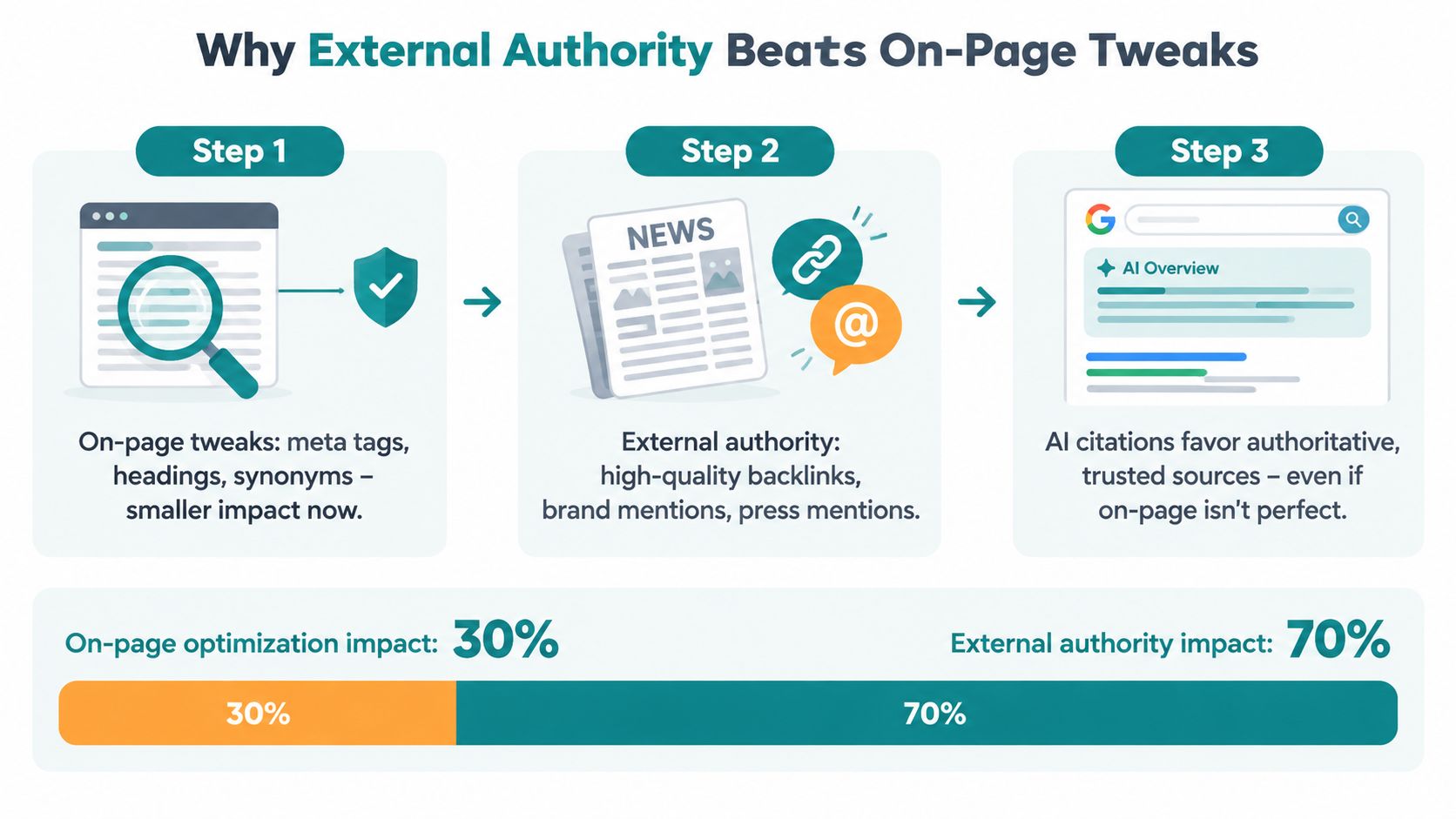
Don't treat external authority as a replacement for technical quality, useful content, or conversion design. Treat it as an earned-media investment that complements those foundations.
How to Evaluate an AI-Driven SEO Services Vendor
A vendor that wraps generic prompts in a monthly package isn't automatically providing an SEO strategy. You need to see how the provider makes decisions, controls risk, and demonstrates commercial value.
Five filters for a serious buying decision
Tool transparency. Ask which platforms support research, content drafting, crawling, reporting, and automation. You don't need a proprietary dashboard for its own sake. You need to know what the system does, what data it uses, and where a human reviews the output.
Pricing clarity. Retainers, projects, and performance-based arrangements all create different incentives. Request a written list of included deliverables, revision limits, publishing responsibilities, technical work, reporting, and third-party costs. A low price can become expensive when editorial review, development, or analytics implementation appears as an extra.
Outcome-based reporting. Reports should connect search activity with qualified calls, forms, bookings, quote requests, ecommerce actions, or pipeline stages. Rankings and impressions can provide context, but they shouldn't be the entire monthly conversation.
Compliance knowledge. A dental, medical, or mental-health practice needs an appropriate HIPAA-aware process. A company generating reviews needs to understand FTC disclosure expectations and avoid misleading incentives or fabricated endorsements. Legal content needs qualified review, and every industry has its own boundaries.
Measurement proof. Ask for case studies that show before-and-after baselines, the work performed, the time period, and the business outcome. If a vendor can't explain how it measured change, it can't credibly promise accountability.
| Evaluation Criterion | What to Ask For | Red Flag to Watch |
|---|---|---|
| AI workflow | Tool names, uses, review stages | "Proprietary AI" with no explanation |
| Scope and pricing | Deliverables and exclusions in writing | Vague monthly promises |
| Editorial quality | Named reviewer and approval process | Content published without review |
| Compliance | Industry-specific safeguards | One process for every industry |
| Reporting | Leads, revenue actions, and attribution | Vanity charts without business context |
| Proof | Baselines, work performed, and outcomes | Guaranteed rankings or unsupported lifts |
Before a Cincinnati agency signs, use this interview script:
- Which AI tools do you use, and what does each one handle?
- Who reviews content before publication?
- How do you verify local facts and service-area details?
- What does the monthly fee include?
- Which tasks cost extra?
- How will you track calls, forms, bookings, or sales?
- How will you monitor AI citations?
- What compliance process applies to my industry?
- Can you show a case study with baselines?
- What would make you change the strategy?
HDM is one Cincinnati-area option that combines SEO, analytics, content strategy, development, and AI consulting, but you should evaluate it by the same standards as any other provider.
Measuring Real ROI and Your First 90 Days
Traffic is still useful, but it's no longer a sufficient definition of SEO success. AI answers can increase visibility while reducing clicks, so a Cincinnati business should track whether search exposure contributes to recognition, assisted conversions, qualified conversations, bookings, purchases, and pipeline.
Start with a baseline in the first week. Record current organic landing pages, Search Console queries, branded and non-branded demand, conversion events in GA4, phone calls where tracking is appropriate, and the stages that turn inquiries into opportunities. Create a manual log for important AI Overview and generative search queries. Record whether your business appears, which sources are cited, whether competitors appear, and whether the answer accurately represents your company.
The metrics that belong in the owner's report:
- AI citation frequency: How often does your business or content appear as a cited source for commercially relevant questions?
- Generative-AI referral traffic: Do AI systems send visitors to the site, and do those visitors take meaningful actions?
- Assisted conversions: Did organic or AI-influenced content support a later call, booking, quote, or sale?
- Share of model: How often does an AI system mention your company compared with your three most important competitors?
- Pipeline contribution: Which opportunities can be connected to organic discovery, assisted discovery, or branded search?
A workable 90-day sequence
| Timeframe | Primary Focus | Key Metrics to Track | Minimum Progress Signal |
|---|---|---|---|
| Weeks 1–2 | Technical audit and schema cleanup | Indexing issues, page health, conversion tracking, Core Web Vitals | Tracking works, critical errors have owners, priority pages are technically accessible |
| Weeks 3–6 | Topical content sprint and internal linking | Relevant queries, impressions, engagement, assisted actions, citation checks | Priority questions have useful answers with measurement attached |
| Week 7 onward | Digital PR and authority building | Mentions, relevant referrals, review activity, citation frequency, competitor share | The business earns credible external visibility and appears in more answer checks |
| Day 90 | Measurement review and strategy adjustment | Qualified leads, calls, bookings, purchases, pipeline, assisted conversions | The owner can identify what produced commercial signals and what needs changing |
Set thresholds based on your baseline and sales cycle, not on a universal promise. Progress may mean accurate tracking, better coverage of high-intent questions, qualified actions from priority pages, credible citations, or a clearer connection between search activity and open opportunities. If only impressions rise while calls, forms, bookings, and pipeline remain unmeasurable, the program needs adjustment.
Review performance at day 30 for technical and tracking problems, at day 60 for content and authority signals, and at day 90 for commercial outcomes. Don't cancel a sound strategy because every ranking hasn't moved. Do demand evidence that the work is improving the path from discovery to action.
Technical experience remains part of that path. A page passes Google's Core Web Vitals assessment only when all three metrics meet the good thresholds at the 75th percentile of real-user sessions: Largest Contentful Paint at 2,500 milliseconds or less, Interaction to Next Paint at 200 milliseconds or less, and Cumulative Layout Shift at 0.1 or less. A fast, stable page won't guarantee an AI citation, but a slow, unstable page can undermine every channel that sends people to it.
HDM provides Cincinnati-area businesses with SEO, local SEO, technical SEO, answer engine optimization, analytics, content strategy, custom development, and AI consulting. If you want a measurable 90-day plan that connects search visibility with qualified leads and revenue, visit HDM to discuss your website and growth goals.