A lot of Cincinnati owners are having the same week right now. Foot traffic is softer, leads are slower, and the first instinct is to trim ad spend, pause SEO, or put the website refresh on hold. That can feel responsible in the moment, but history shows that brands which disappear from view often give up ground that's hard to win back, especially when competitors keep showing up.
The better move is usually more disciplined, not smaller by default. In recession marketing, the winners tend to keep a visible presence, move budget toward channels that still convert, and test messages fast enough to learn what buyers still care about. The reason is simple, cutting media investment during a recession led to an average 18% loss in incremental sales, and long-term losses can climb to well over $300 million when the broader effects are included, according to Analytic Partners' ROI Genome research summarized in a 2025 industry brief source. For a local business, the scale is smaller, but the logic is the same. Going dark makes it easier for someone else to become the familiar name in your category.
Introduction to Recession-Resilient Marketing
A Cincinnati café owner, boutique retailer, or law firm partner usually doesn't need a grand theory during a slowdown. They need to know whether their website is still generating calls, whether paid ads are still paying back, and whether the message still feels relevant to buyers who are hesitating. That's where marketing in a recession becomes practical, not abstract. The goal is to protect the revenue you already have while finding the pockets of demand that still move.
The historical pattern is consistent. Research summarized in a Canadian advertising brief says that increasing marketing communications expenditure in a downturn is a profitable strategy for recovery because media costs and competitor activity often fall source. In plain English, the same budget can buy more attention when others pull back. For a Cincinnati business, that might mean a stronger search presence for local service queries, steadier visibility in your neighborhood market, or a cleaner path from ad click to appointment request.
Practical rule: In a downturn, don't ask, "How do we spend less?" Ask, "Which dollars still create demand, and which dollars just create noise?"
That's the playbook HDM tends to use with local businesses, keep the channels that still produce measurable results, remove waste, and tighten the message so it matches what buyers are willing to consider. The rest of this article follows that order, diagnosis first, then budget shifts, message testing, retention, sector-specific tactics, and measurement.
Conduct a Recession-Readiness Diagnosis
Start with the business, not the media plan. A downturn workflow begins with brand and service triage, which means deciding which offers should be stabilized, which should be cut back, and which deserve more attention source. That matters because not every service or product line deserves the same level of support when demand tightens. A seasonal retail line, a premium add-on, and a staple service can't all be treated the same way.
Sort offers before you sort channels
The cleanest way to do this is to review each offer through three questions. Does it still sell without heavy persuasion? Does it produce a healthy lead or order flow? Does it align with what customers are trying to preserve, delay, or replace right now? If an offer fails all three, it may need to be paused rather than promoted harder.
If your team can't explain why a service still matters in a tighter market, your ads won't fix that problem.
After the offer review, audit the channel data. Look at website analytics, paid search reports, lead forms, phone calls, and appointment requests. You're looking for the channels that still create real customer action, not just traffic. Industry guidance also favors search-related advertising over banners in a downturn, because search catches people already expressing intent, while broad display often becomes easier to ignore source.
For Cincinnati businesses, that often means checking whether people are finding you by neighborhood terms, service terms, or branded searches, then deciding which terms deserve more budget. If the site gets clicks but not calls, the issue may be the landing page or the offer, not the ad itself. If one service line still books well, protect it first.
Read the numbers as a funnel, not a vanity report
A recession audit works best when it connects traffic to outcome. Ask where leads drop off, where calls are missed, and which pages fail to move a visitor toward a quote or consultation. That's the kind of diagnosis that turns marketing from guesswork into portfolio management.
Reallocate Budget and Optimize Channel Mix
Once the weak spots are visible, shift budget like a portfolio, not a hammer. The most useful rule from recession guidance is to reduce but don't eliminate poor performers, keep efficient campaigns funded, and ramp them back up when demand improves source. That avoids the common mistake of cutting too deep and then trying to restart momentum from zero when conditions improve.
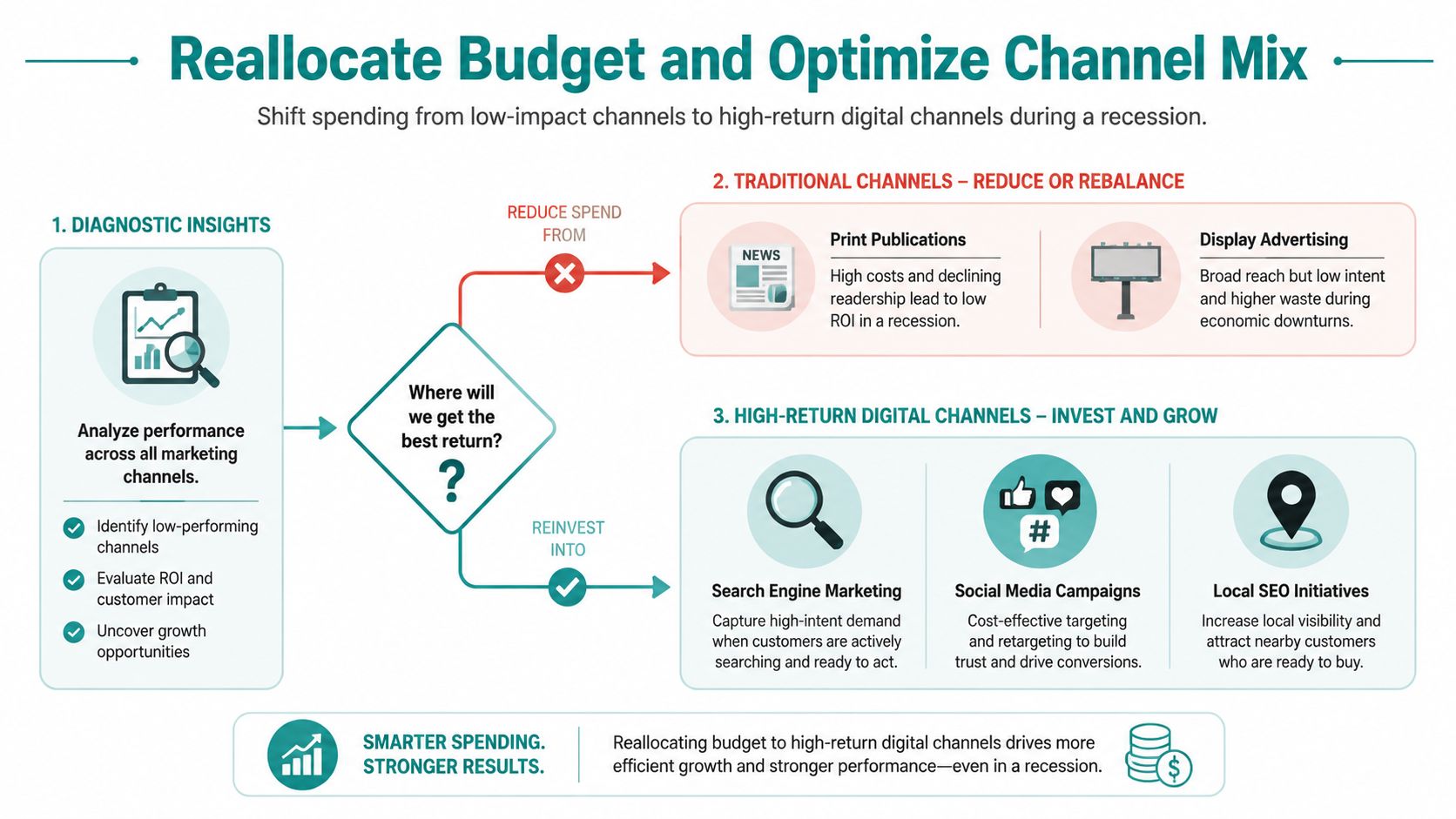
The best place to move money is usually where the buyer intent is clearest. Search, local listings, and high-converting social campaigns often deserve more attention than broad display or expensive placements that don't show up in the lead path. A practical Cincinnati example is a service business that cuts back on low-response awareness ads and puts more into search terms tied to immediate need, then watches whether calls and form fills improve.
Keep the buying process tight
If you're negotiating media, aim for flexibility. Avoid locking into long commitments before you know how demand is shifting, because recession pricing can move quickly. The budget should stay adjustable enough that you can pull back from weak campaigns and reinvest in the ones that still book work.
A useful resource here is the guide for ad spend data quality, especially if your reports don't always agree with what the sales team is seeing. If attribution is sloppy, you'll cut the wrong channel and keep the wrong one.
For teams that want a structured paid-media workflow, keep your internal planning tied to the channel mix you can measure through paid media strategy. That's where budget reallocation stops being theory and starts becoming weekly decision-making.
The main takeaway is simple. Don't chase volume for its own sake. Chase the channels that still convert, then keep a little budget in reserve so you can move quickly when the data changes.
Refine Messaging with Testing and AI Assistance
When buyers are cautious, messaging has to work harder. Price-only language usually compresses margin and trains customers to wait, while stronger proof points help a business defend value. That's why recession guidance emphasizes proof-driven messaging, like guarantees or case studies, instead of blanket price cuts source. The offer doesn't always need to get cheaper. Sometimes it just needs to sound safer, clearer, and more believable.
Test the claim before you scale the claim
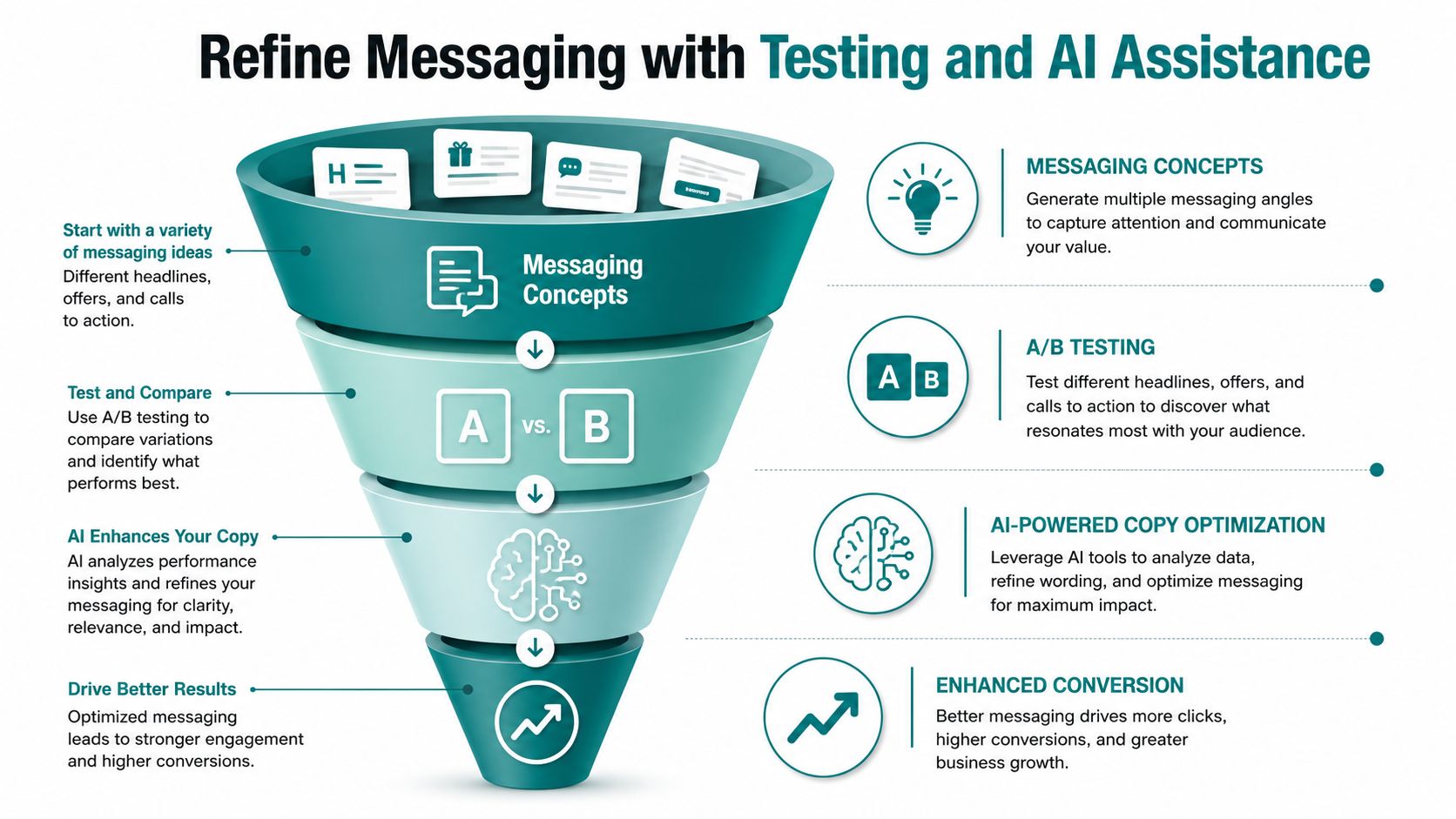
A strong process starts with one message, one audience, and one action. Test the headline, the offer, or the call to action, not all three at once. Then use AI to draft variations faster, so your team can compare plain language, proof-based language, and urgency-based language without spending days on copy drafts.
That kind of workflow matches a high-precision model described in recession marketing guidance, where teams convert data into insights, hypothesize why users drop off, then run controlled tests to validate those ideas and adjust budgets in real time source. In practice, that means watching where prospects stall, then changing the message at that exact step. If a form starts too early, shorten it. If the page feels generic, add local proof. If the CTA is soft, make the next step more specific.
Use AI for speed, not guesswork
AI tools are best when they accelerate iteration. They can produce headline variants, email subject lines, chatbot responses, and landing-page drafts, but the business still has to decide what sounds credible. That's where human judgment matters. A Cincinnati healthcare practice won't want the same tone as a home services brand or a law office, and AI should adapt to that reality, not flatten it.
For a broader look at how AI fits into practical marketing workflows, the AI digital marketing 2025 trends resource is a useful companion. The point isn't to automate judgment. It's to test more ideas, faster, with less waste.
Strengthen Customer Retention and Loyalty
When new acquisition gets more expensive or less predictable, the most reliable growth often comes from the customers you already have. That doesn't mean pushing discounts harder. It means giving people a reason to come back, refer a friend, or buy a related service because the value is obvious. Recession-era marketing works better when it protects margin instead of eroding it.
A good retention plan usually starts with segmentation. Split your email list by recent buyers, inactive customers, repeat customers, and high-value clients, then tailor the message to each group. A recent customer might get a follow-up education email, while a lapsed client might get a reminder tied to a practical need. If you run recurring visits or appointments, software for tracking loyalty and repeat behavior can help you make that process easier, and software for increasing repeat visits is one option businesses often explore.
Practical rule: If you can reward relevance, you won't have to lean so hard on price.
Keep value visible without cheapening the brand
The strongest recession messaging says, "Here's why this is worth it," not "We're desperate to be the cheapest." That aligns with the guidance to use guarantees, case studies, and proof-driven messaging instead of blanket price cuts source. For a service business, a short testimonial or a clear guarantee can do more than a flashy discount. For an e-commerce store, bundling related products can protect margin while still helping the customer feel they're getting more.
If you want a deeper framework for repeat business, this customer retention program guide is useful for turning a loose follow-up habit into a repeatable process. The best retention systems are simple enough that a small team can run them every week.
Tailor Strategies to Your Industry
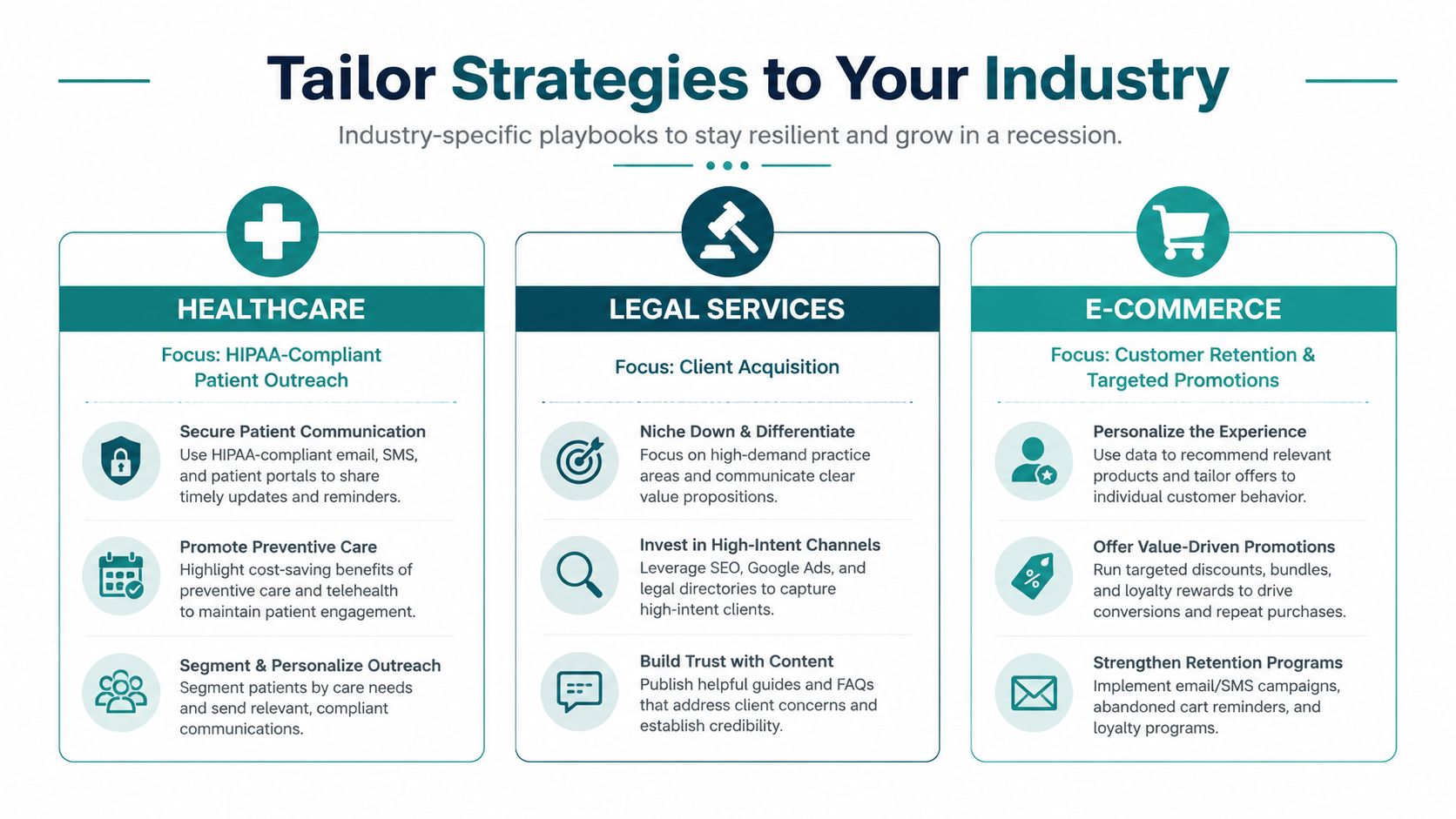
Not every recession playbook belongs in every business. Healthcare, legal services, and e-commerce face different buying patterns, different trust hurdles, and different pressure points. The right strategy depends on whether the customer needs reassurance, expertise, convenience, or a better value equation. A single discount tactic won't solve all three.
| Industry | Key Tactics | HDM Example |
|---|---|---|
| Healthcare | HIPAA-compliant patient outreach, reminder campaigns, educational content tied to common concerns | A Cincinnati practice can use email and search campaigns to keep appointments visible while protecting trust |
| Legal Services | Expertise-led landing pages, case-type specific ads, referral follow-up, credibility proof | A boutique firm can separate family law, injury, or business law messaging so each audience sees the right fit |
| E-commerce | Bundles, shipping thresholds, product education, loyalty follow-up, cart recovery | A local retailer can trade blunt discounting for value framing and targeted offers |
Healthcare needs confidence first
Medical buyers usually want reassurance that the practice is organized, responsive, and easy to contact. Search ads, website updates, and patient education content work well when they answer immediate concerns without sounding promotional. For Cincinnati providers, the right message often feels calm and practical.
Legal services need specificity
Law firms win when they speak to the exact problem the client is trying to solve. Broad promises rarely perform as well as clear service pages, case-type targeting, and credibility markers that show the firm understands the issue. That's especially important when prospects are comparing multiple firms before they call.
E-commerce needs value without a discount trap
For online stores, the pressure is often margin. Bundles, shipping incentives, and repeat-purchase workflows can create value without training customers to wait for markdowns. The goal is to preserve revenue quality while still giving shoppers a reason to complete the order.
Measure Results and Plan Next Steps
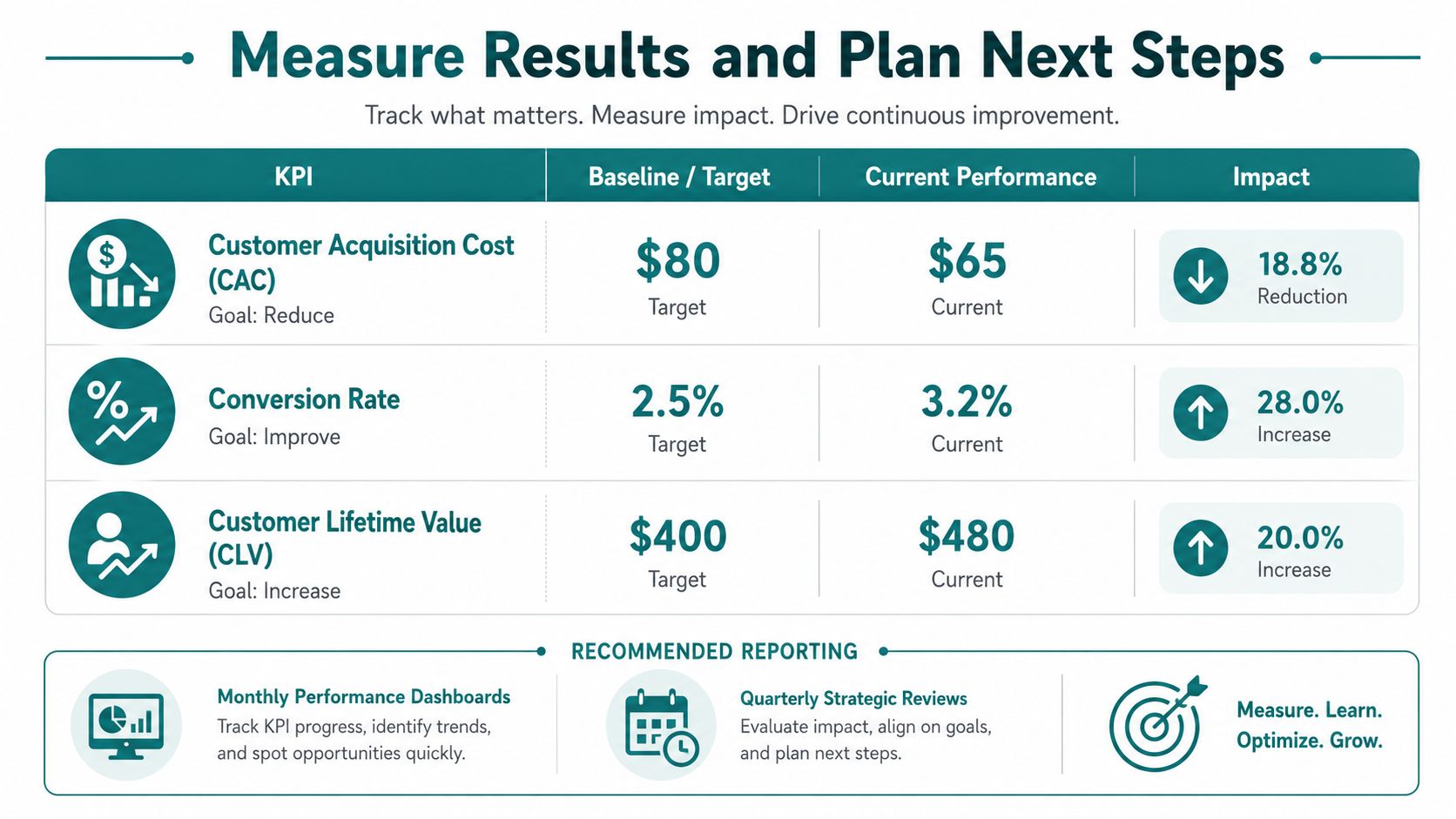
A recession plan only works if you keep score. The most useful KPIs are Customer Acquisition Cost, conversion rate, and Customer Lifetime Value, because they show whether you're buying growth efficiently and whether that growth is worth keeping. Recession guidance also recommends monitoring those numbers on a weekly or biweekly cadence so you can move money quickly to better campaigns source.
Read the trend, not just the snapshot
A single week rarely tells the full story. If CAC rises but conversion improves, the campaign may still be worth keeping. If conversion falls and leads get cheaper, the channel may be attracting the wrong audience. That's why incrementality testing and Marketing Mix Modeling matter, they help prove what drives sales instead of over-crediting weak channels source.
Monthly dashboards and quarterly strategy reviews are a sensible rhythm for most SMBs. The monthly view keeps the tactical changes honest. The quarterly review tells you whether the new mix is stronger than the old one.
Recession marketing's value is not panic spending or panic cutting. It's the discipline to keep the useful parts of your funnel alive, improve the message, and document what works so the next slowdown doesn't catch you flat-footed.
If you're deciding where to cut, where to invest, and what to test next, talk with HDM. HDM can help you turn recession pressure into a clearer marketing plan, stronger web performance, and faster decisions that keep your Cincinnati business visible when it matters most.