


Most advice about Node.js vs React.js starts with the wrong question. Business owners in Cincinnati do not need a trivia contest about JavaScript tools, they need a decision about what their site or app has to do, who will use it, and which layer of the stack should own that job.
That's the key point, Node.js and React.js are not direct substitutes. Node.js is a server-side JavaScript runtime launched in 2009 by Ryan Dahl on Google's V8 engine, while React.js was introduced by Meta in 2013 as a front-end UI library for interactive interfaces, and that timeline matters because it explains why one is tied to backend work and the other to the browser Simform. If you're hiring talent, it's also worth knowing that a useful resource for finding skilled Node.js developers in Latin America can help when you need backend capacity without overbuilding locally.
| Criteria | Node.js | React.js |
|---|---|---|
| Where it runs | Server | Browser |
| Main job | Backend logic, APIs, server operations | User interface and interactive experience |
| What it shares | JavaScript | JavaScript |
| Best fit | Forms, logins, payments, business rules, request handling | Buttons, menus, dashboards, live updates |
| Business role | Powers what happens behind the scenes | Shapes what customers see and click |
| Stack strategy | Commonly used with React in full-stack builds | Commonly used with Node.js in full-stack builds |
Why the Node.js vs React.js Question Is Misleading
The usual nodejs vs reactjs debate starts with the wrong assumption. It treats two different layers of a website like rivals for the same job. They are not. Node.js runs on the server, React runs in the browser, and the decision is which layer needs which tool.
The false choice business owners get sold
A lot of articles frame this as a buyer's dilemma. That makes sense if the goal is clicks, but it is poor advice if the goal is business growth. A service company owner, a clinic, or an e-commerce brand usually is not asking for a runtime or a component library. They are asking for a site that brings in leads, handles customers cleanly, and does not turn into a maintenance headache.
Node.js has real adoption behind it, too. It has been reported as used by 2% of all websites whose web servers are known, and another industry estimate puts it at about 4% of all websites in 2025 Simform. That does not mean every business needs it. It means Node.js is a mainstream infrastructure choice when backend work matters.
React's role is different. It is the front-end layer that shapes how the customer experiences your brand online. When people talk about "a modern website," they are usually talking about the interface behavior React is built to handle.
Practical rule: if the question is about customer interaction, think React. If the question is about server logic, think Node.js.
What owners are really trying to decide
When a Cincinnati owner asks whether they should choose Node.js or React, they are usually trying to solve one of three business questions. Do they need a marketing site that converts? Do they need an app with logins, data, and transactions? Or do they need a platform that can keep growing without being rebuilt every year?
That is why the smartest agencies, including teams like HDM, do not frame this as an either-or fight. They map the site requirements first, then decide where Node.js belongs and where React belongs. A content-heavy site, a portal, or a dashboard may need both. A simple brochure site may need neither.
The cleanest mental model is direct. Node.js powers the machine room. React powers the showroom. Pick the wrong tool for the wrong layer, and you force design to carry backend logic or ask the server to pretend it is a UI framework. That is where budgets go sideways.
What Node.js and React.js Actually Do in Plain English
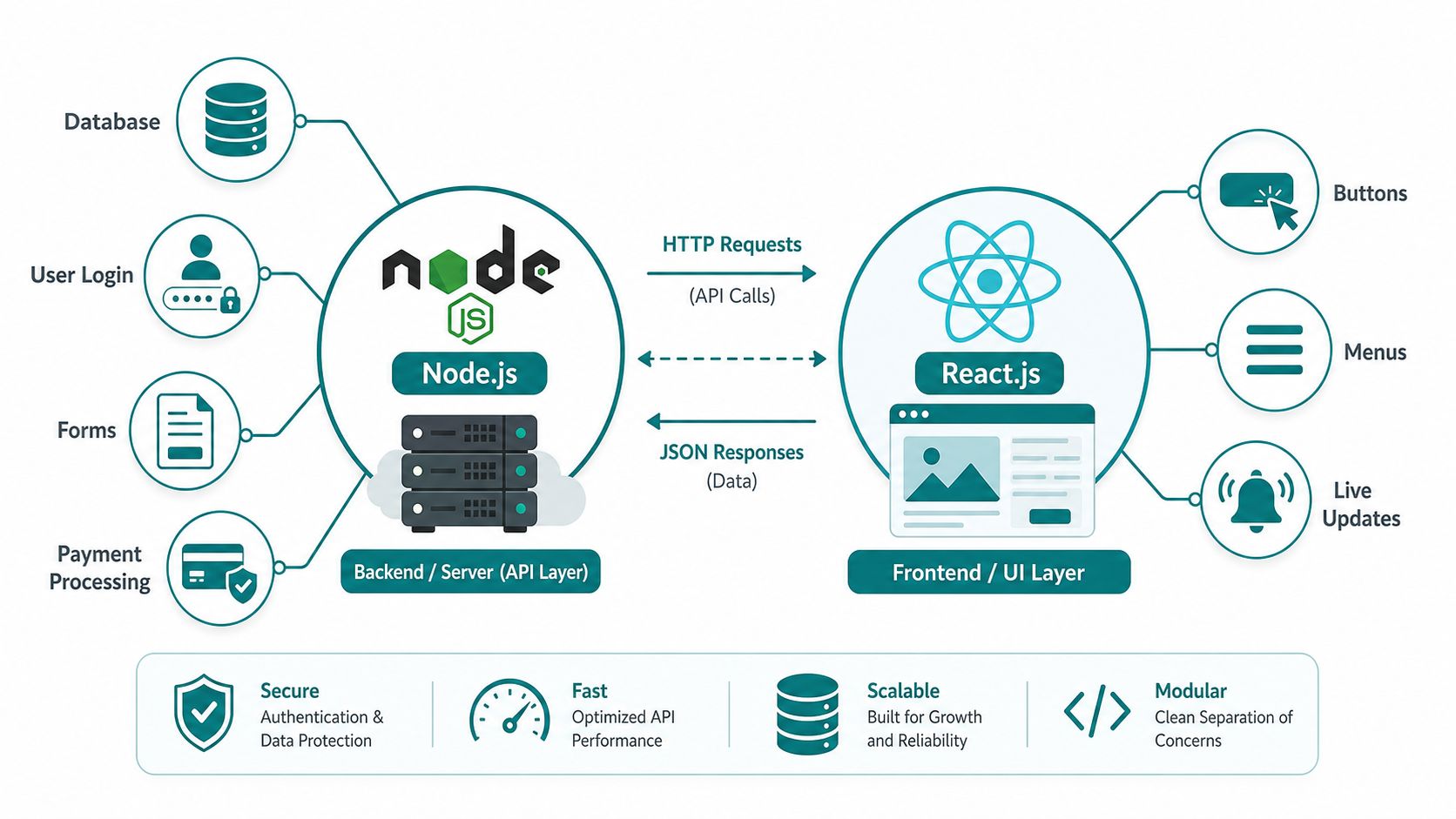
Think of a website like a restaurant. Node.js is the kitchen and the plumbing, it handles the work customers don't see, including database access, user logins, form submissions, payment processing, and the business rules that decide what happens next. React.js is the dining room and the decor, it shapes what visitors see, click, and interact with in the browser.
The simple version you can repeat in a meeting
If you have to explain it in one sentence, use this, Node.js runs the server side of the application, and React.js builds the interactive interface users see in the browser. That's the line your team can carry into vendor calls, planning sessions, and budget discussions without getting lost in jargon.
Node.js is not a "better website tool." It's the runtime that lets JavaScript run on a server so your site can process requests and return data. React is not a "backend replacement." It's a library for building user interfaces out of reusable components, so screens update smoothly when information changes.
A business-owner analogy that actually holds up
If your site only needed a brochure and a contact form, you wouldn't ask for a fancy kitchen system. If your project has account pages, checkout flows, dashboards, or live content updates, the kitchen matters a lot more. The customer only sees the plate, but the plate depends on what happened behind the counter.
That's why owners get tripped up by the debate. They're comparing visual polish to server power as if they're the same thing. They aren't. A strong build usually needs both, but not in the same way.
Plain-spoken version: React handles what people click. Node handles what the system does.
Once that clicks, the rest of the decision gets easier. You stop asking which technology is "best" and start asking which part of the customer experience or backend workflow needs the most support.
Side-by-Side Comparison of Node.js and React.js
| Criteria | Node.js | React.js |
|---|---|---|
| Core role | Server-side runtime | Front-end UI library |
| Main environment | Backend server | Web browser |
| Shared language | JavaScript | JavaScript |
| Best use | APIs, server logic, high-concurrency request handling | Interactive interfaces, reusable components, dynamic rendering |
| Best-fit projects | Forms-heavy systems, login flows, integrations, microservices | Dashboards, lead-capture pages, product browsing, user-facing tools |
| How it fits a stack | Often powers the backend layer | Often powers the interface layer |
Node.js and React.js are optimized for different performance layers, so they shouldn't be judged like they solve the same problem UXPin. Node.js is built for backend logic and request handling. React is built for browser-side interaction and interface rendering.
Where each one earns its keep
If your business needs an API, Node.js is doing real work the customer never sees. It receives requests, talks to systems, and sends back data fast enough to keep the application moving. If your business needs users to click through menus, filters, cards, and live updates without feeling friction, React owns that experience.
For non-technical owners, the easiest way to remember the split is this. Node.js supports what the application must do. React supports what the user must feel.
How to think about talent and architecture
This is also why hiring looks different. A strong Node.js developer is usually thinking about server workflows, data flow, and integrations. A strong React developer is thinking about interface states, component structure, and how to keep the user experience clean as the product grows. Many teams need both skill sets, not one person who guesses at both jobs.
A useful decision rule is to stop asking, "Which stack should we buy?" Ask instead, "Which layer is under pressure?" If your backend is complex, Node.js takes priority. If your interface is the hard part, React takes priority. If both matter, you're in full-stack territory, and that's normal.
Node.js and React are not rivals. They're different instruments in the same band.
That's the takeaway that matters for a Cincinnati owner trying to make a practical call. The best build isn't the one that chooses a winner, it's the one that assigns each layer to the tool that's good at the job.
Performance and Speed for Real Business Sites
Performance gets messy when people mix up layers that do different jobs. Node.js throughput measures how many backend requests it can process. React performance measures how quickly the interface updates and how responsive it feels to the user. Those are separate questions, so they need separate measurement.
Node.js benchmark summaries put simple API throughput in the 25k to 50k requests per second range, with roughly 2 to 6 ms average latency under load Clustox. That is backend territory. It matters when your site takes a traffic spike, a campaign goes live, a product drops, or forms start coming in fast.
React's front-end metrics are different. For UI work, performance summaries point to 3 to 5 ms component render and update time, 60+ FPS interaction sustainment, and roughly 1 to 2.5 seconds Time To Interactive for SPAs. That is the layer visitors feel while they scroll, filter, click, and wait for a page to become usable.
What those numbers mean in plain English
If the backend is slow, forms lag, logins crawl, and customers feel the delay when they submit a request. If the front end is slow, the site may still respond, but it feels clunky, jumpy, and annoying to use. That difference matters more than any vanity speed score.
The wrong question is whether Node.js is "faster" than React. One handles requests, the other renders interfaces. The key question is whether your API layer can absorb traffic and whether your UI layer stays smooth enough to keep visitors moving.
What to ask your developer
Use this checklist when you talk to an agency or in-house team:
- Backend throughput: Can the server handle traffic spikes during launches, promotions, or referral bursts?
- Backend latency: How quickly do forms, logins, and API calls respond?
- UI responsiveness: Does the interface stay smooth during clicks, filters, and dashboard updates?
- Time to interactive: How soon can a visitor use the page, not just stare at it loading?
If you want a marketing site reviewed, a performance audit such as website wellness performance is the right place to start. If you are building an app, the core question is whether the backend and front end are being tuned as separate layers.
The best teams do not chase one metric everywhere. They tune the server for request handling and the interface for perceived speed, because that is what the customer experiences.
Real Project Scenarios for Cincinnati Businesses
A lot of decision-making gets easier once you stop talking about abstract tools and start talking about actual projects. In Cincinnati, the same three builds come up over and over again, a service business site, an e-commerce store, and a custom portal or dashboard. Each one pushes a different layer harder.

Service-business marketing site
If you run a law firm, medical practice, home service company, or B2B agency, the site usually needs to load cleanly, rank well, and capture leads without friction. React can help if the interface needs more interactive elements, but the key advantage is usually simpler architecture, especially if the site is content-first. Node.js only becomes essential if the site has custom logic, API integrations, or data-heavy workflows.
For this kind of business, the result you want is straightforward, fewer drop-offs, clearer calls to action, and less friction between the visitor and the contact form. The tech should support conversion, not distract from it.
E-commerce store
E-commerce is where the split becomes obvious. React is strong on product grids, filters, carts, and checkout experiences because shoppers are constantly clicking and changing state. Node.js is the better fit behind the scenes for product data, inventory logic, order processing, and integrations with other systems.
If you're selling direct to consumer, the interface needs to feel easy, but the backend has to stay organized or operations get messy fast. The business result you should expect is smoother shopping and fewer technical surprises when sales start scaling.
Client portal or dashboard
Portals are where React and Node.js often work best together. Users log in, view their data, update records, and expect the interface to respond instantly. Node.js handles the server logic, authentication, and data exchange, while React handles the screens, controls, and live feedback.
That combination makes sense for appointment systems, account dashboards, internal tools, and SaaS products. If your product depends on repeated logins and ongoing interaction, this is not a place to cut corners.
A good Cincinnati agency won't sell you technology first. It'll map the workflow first, then pick the stack that fits the job.
Why Most Modern Sites Use Both Tools Together
The smartest modern builds usually don't force a choice. They use Node.js and React.js together because the stack gets stronger when each layer does its own job. That's especially true for businesses that expect the site to grow into something more than a brochure.
Common full-stack combinations that actually make sense
A classic setup is Node.js with React, which gives you a JavaScript-heavy workflow across backend and frontend. That's useful when your team wants one language across the application and you need both server logic and an interactive UI.
Another common path is Next.js for SEO-friendly React with built-in server capabilities. For content-heavy marketing sites, blogs, and web properties that still need app-like behavior, that mix is often a better fit than a plain single-page app. If you want a deeper look at how teams handle that kind of build, HDM's article on building scalable React applications is worth a read.
A third pattern is a headless CMS with Node.js powering the API and React rendering the front end. That's a strong option when your team needs flexible content management without giving up a modern interface.
When one tool is enough
Not every site needs the full stack treatment. A simple WordPress site rarely needs either Node.js or React. A static brochure-style marketing site usually doesn't need Node.js at all unless there's custom logic, integrations, or a more advanced user flow.
That's the part most agencies skip, because full-stack sounds impressive. But the right answer is often restraint. If the business goal is local visibility and a clean lead form, overengineering the stack wastes money and slows launch.
The rule is simple. Use both tools when the business problem spans both server work and interface complexity. Use one tool, or neither, when the project is simpler than the hype suggests.
How to Choose the Right Stack for Your Business
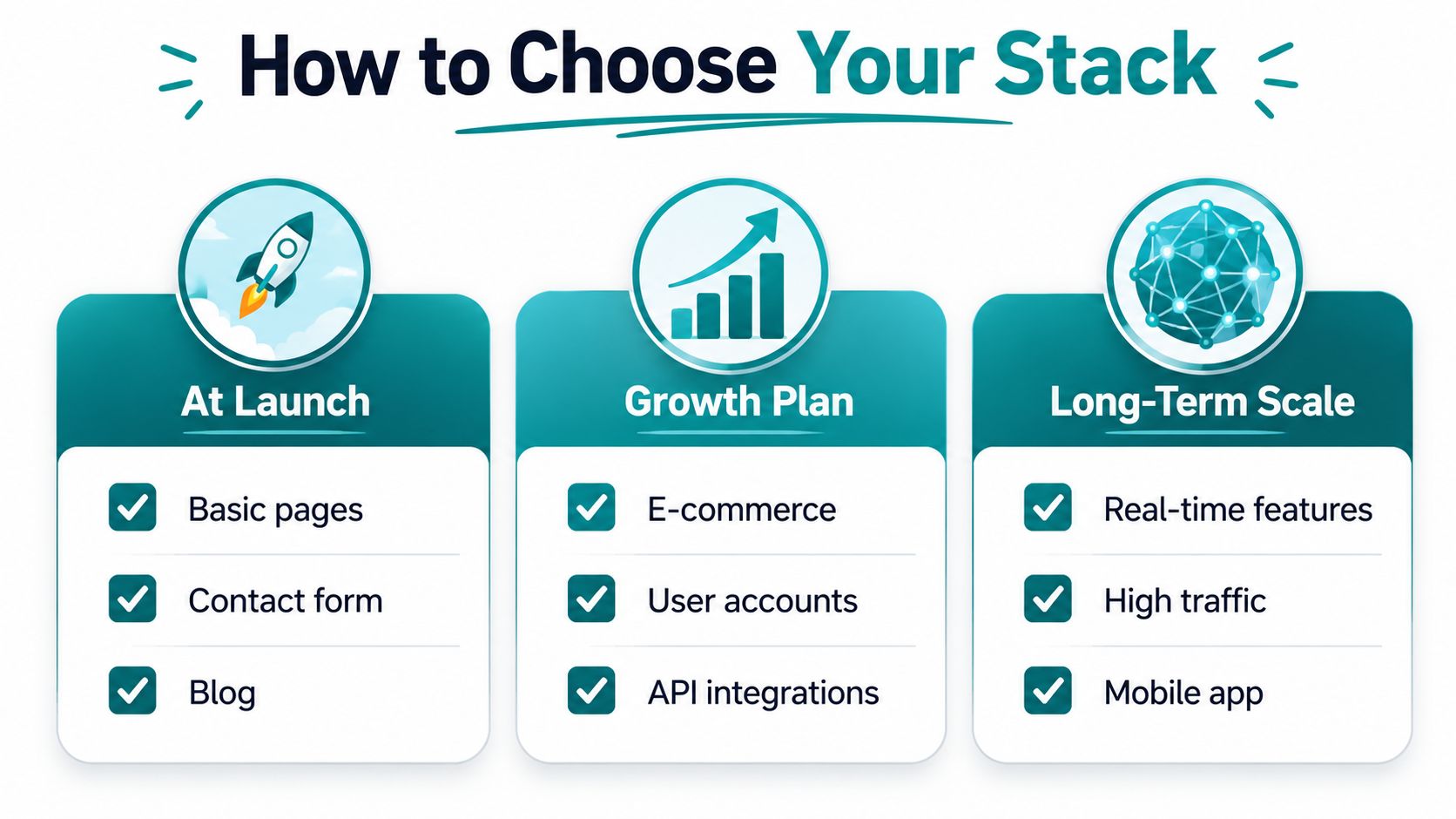
Start with the project, not the buzzwords. Ask what the site has to do at launch, what it needs to do in 18 months, who's using it, and how interactive it really needs to be. That short list will tell you more than any vendor pitch.
A simple decision checklist
- At launch: If you mostly need pages, a contact form, and a blog, keep the stack lean.
- Growth plan: If you're adding e-commerce, user accounts, or API integrations, Node.js and React become more attractive.
- Long-term scale: If your roadmap includes real-time features, high traffic, or app-like behavior, plan for both layers early.
A good conversation with an agency should sound practical, not technical. If the answer is "simple site now, more features later," build for clarity first and extensibility second. If the answer is "the interface is the product," React belongs in the conversation from day one. If the answer is "we need data, logins, and custom logic," Node.js belongs on the backend.
For more complex builds, HDM's web app development page is a useful reference point for what a custom stack looks like when the project outgrows a basic website.
Cost and timeline tradeoffs
A Node.js and React build makes sense when the business payoff is long-term flexibility. It's the right move when your site is becoming a product, a portal, or a serious lead engine. If you only need a straightforward marketing presence, a simpler stack will usually deliver better ROI and get you live faster.
That's how a Cincinnati-based agency should approach it. Start with revenue goals, map the workflow, then choose the stack that supports growth without adding baggage.
If you're trying to decide between Node.js, React, or a mix of both, talk to HDM and get a stack recommendation tied to your actual business goals, not a generic tech preference.


