


Boost Your Business: Voice Search Optimization in 2026
June 11, 2026
A customer is driving through Hyde Park, hands on the wheel, and asks their phone, "Find a family-friendly restaurant near me with a patio." Another is standing in their kitchen in Anderson Township asking, "Who fixes leaking water heaters today?" A third is walking out of a youth soccer game and says, "What dentist in Cincinnati takes new patients?"
In each case, the customer isn't browsing. They're asking for help like they would ask a good employee standing at the front counter.
That's why voice search optimization matters. It's the work of making your business the answer a device is most likely to surface when someone speaks a question out loud. For a local business, that often means being easier to find at the exact moment someone is ready to call, visit, book, or buy.
A lot of business owners still think of voice search as a side topic. It isn't. It's part of the broader shift from keyword stuffing and generic web pages toward clear answers, strong local signals, and fast mobile experiences. If your website and business listings don't support that, your competitors can win the question before a customer ever sees your name.
Are Customers Finding You by Voice
A typed search and a spoken search don't behave the same way.
When someone types, they often shorten the request. "Cincinnati roofer." "Best brunch Oakley." "Pediatrician near me." When they speak, they ask fuller questions. "Who's a good roofer near Cincinnati that can inspect storm damage?" "Where can I get brunch near Oakley with outdoor seating?" "Which pediatrician near me is taking new patients?"
That difference changes what kind of business gets found.
Voice search is a local decision tool
For most Cincinnati businesses, voice search shows up in practical moments:
-
Driving: A customer wants directions, a phone number, or hours.
-
Multitasking: A parent asks a smart speaker for a nearby service while cooking dinner.
-
On the go: A shopper asks a phone where to find a product before making another stop.
-
Urgent need: Someone asks for a lawyer, doctor, HVAC company, or auto repair shop right now.
These aren't casual searches. They often come with immediate intent.
Voice search works a lot like asking a helpful store employee a direct question. The businesses that win are the ones that give a clear, trustworthy answer fast.
What voice search optimization actually means
At a practical level, voice search optimization means your business does three things well:
-
Answers real questions in plain language
-
Shows clear local business information
-
Loads quickly and works cleanly on mobile
If your site buries answers under vague marketing copy, voice search won't favor it. If your hours are wrong, your phone number is inconsistent, or your mobile site is clunky, the experience breaks down before the customer ever reaches you.
For Cincinnati owners, that's the issue. This isn't about chasing a trend. It's about whether a person in Hyde Park, Blue Ash, Mason, or West Chester gets your business when they ask for help out loud.
Why Voice Search Matters for Your Cincinnati Business
A customer leaves work downtown, asks their phone for "a plumber near me open now," and calls the first business that sounds credible. That decision can happen in under a minute. If your business information is unclear, outdated, or buried under generic copy, you lose the call before the customer ever sees your homepage.
That is why voice search matters. It shortens the path between question and action.
For Cincinnati businesses, the payoff is practical. Voice search often sits close to the bottom of the funnel, where someone wants a phone number, directions, hours, pricing, availability, or the next step. A restaurant gets more direction requests. A dental office gets appointment calls. A law firm gets intake calls from people who want help now, and those calls need to route correctly without exposing confidential details. A medical practice has the same pressure, with the added need to keep content useful without creating HIPAA problems.
Voice search turns visibility into real-world action
Typed search gives people room to compare. Voice search often pushes them toward one clear answer.
That changes the stakes. If your Google Business Profile, location pages, and core service pages are accurate and easy to understand, you are in a better position to win:
-
Phone calls from nearby customers ready to ask a question
-
Direction requests from people planning a visit
-
Appointments and consultations from users who need a next step
-
Store visits from people making a local decision in real time
I tell local owners to treat voice search like a front-desk employee answering the same ten questions all day. If the answers are clear, consistent, and easy to access, more people show up.
It matters across industries, but the details differ
A Cincinnati HVAC company needs to be findable during urgent searches after hours. A family law firm needs location, practice area, and contact information to be precise, while avoiding sloppy page copy that could weaken trust. A healthcare practice needs strong local visibility, plain-language answers, and careful handling of anything that touches patient privacy.
Same channel. Different risks and rewards.
Voice search also rewards businesses that remove friction. If someone asks, "Who installs water heaters in Anderson Township?" or "Where can I get a same-day crown near Cincinnati?" they are not asking for a branding exercise. They want the right answer fast, on a phone that loads quickly and shows exactly how to contact you.
A stronger voice presence usually improves local SEO overall
The work that helps with voice search also helps your regular local visibility. Clear service pages, accurate business details, fast mobile performance, and well-structured local information all support standard Google searches too.
If you want the broader playbook, HDM's guide to getting your Cincinnati business found on Google is a useful companion.
<table> <thead> <tr> <th>Search style</th> <th>Customer behavior</th> <th>What your business needs</th> </tr> </thead> <tbody><tr> <td><strong>Typed search</strong></td> <td>Compares several listings and pages</td> <td>Strong relevance, solid rankings, clear service pages</td> </tr> <tr> <td><strong>Voice search</strong></td> <td>Asks for one direct answer and acts quickly</td> <td>Accurate local data, direct answers, mobile speed, easy contact options</td> </tr> </tbody></table>Practical rule: If a customer can ask the question out loud, your site should answer it clearly enough to earn the call or visit.
How to Create Content That Answers Questions
A customer standing in your parking lot might ask their phone, "Do you handle walk-ins?" "Can you see me today?" or "Do you serve West Chester?" Your site should answer those questions as clearly as your front desk would.
That is the standard for voice-focused content. Clear, direct answers win attention. Vague marketing copy loses calls.
The biggest mistake I see is content built around keyword fragments instead of customer conversations. Terms like "Cincinnati dentist" or "HVAC repair Cincinnati" still have a place, but voice searches sound more like requests made to a helpful employee. People ask full questions, often with urgency, and they expect a clear answer without digging.
Write the way customers ask
Voice search content works best when it mirrors real speech and gives the answer quickly. Search platforms often pull short, direct passages for spoken results and featured answers, as outlined in this guide to voice search strategies.
That changes how a local business should write.
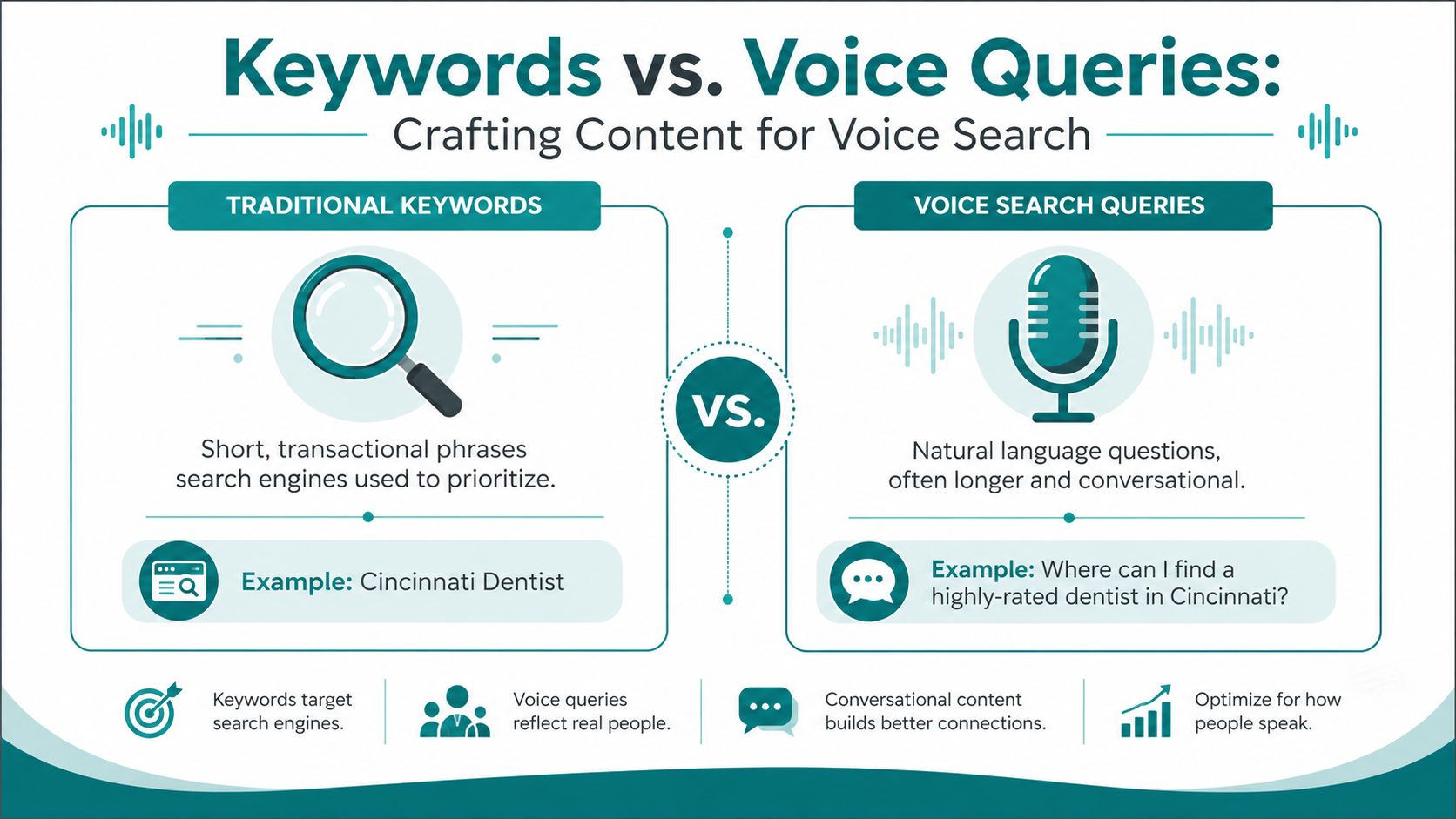
That shift matters because each question signals intent. "Who fixes home AC problems near Cincinnati today?" can turn into a phone call now. "What family-friendly restaurant in Hyde Park has a patio?" can turn into a same-day visit if your page answers it fast.
Build pages from the questions your staff already hears
Start with the conversations already happening in your business. Your receptionist, intake coordinator, office manager, sales rep, and technicians hear the raw material for voice search every week.
Pull questions from:
-
Front desk calls: What do people ask before they book?
-
Sales emails: What concerns slow down decisions?
-
Contact forms: What information do prospects want before they reach out?
-
In-person conversations: What does staff explain over and over?
Then place those questions where they belong. Service pages should answer high-intent buying questions. FAQ pages should handle logistics and objections. Location pages should answer neighborhood-specific questions. Blog posts should cover early research questions that build trust before someone is ready to call.
If your website still needs that structure, this SEO foundation every website needs will help you organize it.
Match the answer to the stakes of your industry
A Cincinnati med spa, dental office, or therapy practice should answer practical questions in plain language, but healthcare businesses also need to avoid publishing anything that creates privacy risk or sounds like personal medical advice. Clear service information, insurance basics, office locations, and scheduling details are fair game. Patient-specific scenarios belong in private conversations.
A law firm has a similar balance. Prospective clients ask urgent questions, but pages should inform without promising outcomes or exposing confidential details. Good voice-search content for law firms explains process, timing, and next steps clearly enough to earn the consultation.
Examples help:
A healthcare office might answer:
-
Insurance questions: "Do you accept my plan?"
-
Location questions: "Which office is closest to me?"
-
Service questions: "Do you treat this condition?"
A law firm might answer:
-
Urgency questions: "What should I do after a car accident in Ohio?"
-
Before hiring: "When do I need an employment lawyer?"
-
Process clarity: "How does a consultation work?"
The trade-off is simple. The more specific your answer, the more useful it is for search and for prospects. But regulated and high-trust industries need to stay within ethical, legal, and privacy boundaries.
Use a direct answer format
A strong page does not make people hunt for the point. Put the question in a heading. Answer it in the first sentence or two. Then add detail for people who want more context.
A strong voice-search answer usually starts with the plain answer first, then adds explanation underneath.
For example:
Question: Do you offer same-day water heater repair in Cincinnati?
Answer: Yes, we provide same-day water heater repair in the Cincinnati area when scheduling allows. Customers usually call us for leaking tanks, no-hot-water issues, and pilot light problems. You can contact our team to check today's availability and service area.
That format works because it serves both audiences. Search engines can identify the answer quickly. Customers can decide quickly.
Here's a useful walkthrough on how that style works in practice:
Put answers where they can drive action
You do not need to turn every page into a long FAQ. The better approach is to add answers where they help a prospect take the next step.
Use:
-
Service pages for questions tied to calls and bookings
-
FAQ pages for pricing factors, timing, availability, and policies
-
Location pages for neighborhood, suburb, and service-area questions
-
Blog posts for educational questions that build trust early
A weak page says, "We provide excellent service." A strong page says, "Yes, we install water heaters in Anderson Township and can often offer same-day appointments." One sounds like advertising. The other sounds like a business ready to help.
That is what voice search rewards. Clear answers. Local relevance. Fewer steps between the question and the call.
The Technical Foundation for Getting Found
Good content alone won't carry this.
Search engines need help understanding what your business is, where you are, what you offer, and which part of a page contains the answer. That's where the technical side comes in. For many owners, this is the part that sounds intimidating. It's more manageable when you think of it as labeling your business clearly instead of "doing SEO tricks."
Schema is your digital label maker
Voice search performs best when pages are engineered for answer extraction. Content that answers a query in about 50 to 60 words and is wrapped in structured data is more likely to surface as a featured snippet or spoken result, based on this explanation of answer extraction and structured data.
Structured data, often called schema markup, is the code that helps search engines read your site more confidently. It serves as a digital nutrition label. It tells Google what's on the page instead of forcing Google to guess.
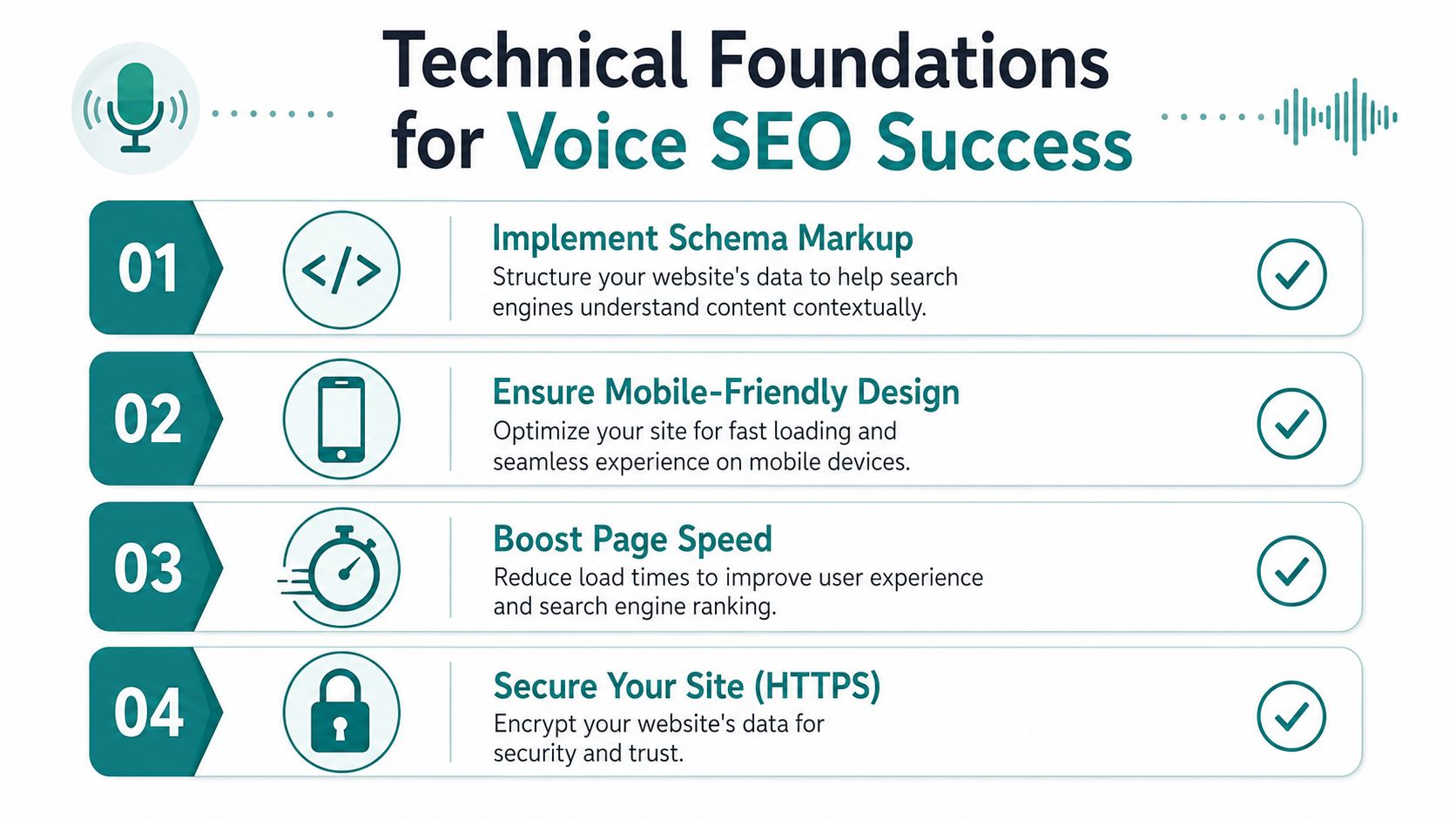
For local businesses, schema often supports details such as:
-
Business identity: Name, address, and phone
-
Operating details: Hours, service area, and business type
-
Content structure: FAQs, services, articles, and reviews
-
Specific page meaning: Whether a page is about a product, service, location, or question set
If your site says one thing in visible text but doesn't structure that information clearly, voice systems have less confidence pulling from it.
Your Google Business Profile has to be accurate
For local voice searches, your Google Business Profile often acts like your storefront sign online. If the sign is wrong, people don't walk in.
Review these basics:
-
Hours: Keep holiday and temporary hours current
-
Phone number: Use the main number customers should call
-
Services: List real services, not vague category stuffing
-
Address details: Make sure suite numbers and formatting are consistent
-
Photos: Clearly show the business, team, interior, and exterior
A surprising number of voice-search problems come from bad business data, not bad writing.
Mobile speed is not optional
Most spoken searches lead back to a mobile experience. If your site loads slowly, shifts around while loading, or buries the phone button, customers leave.
What usually hurts local sites most:
<table> <thead> <tr> <th>Problem</th> <th>What the customer experiences</th> </tr> </thead> <tbody><tr> <td><strong>Oversized images</strong></td> <td>The page drags before anything useful appears</td> </tr> <tr> <td><strong>Bloated themes or plugins</strong></td> <td>Taps lag and pages feel clunky</td> </tr> <tr> <td><strong>Tiny mobile buttons</strong></td> <td>Calling or booking becomes frustrating</td> </tr> <tr> <td><strong>Confusing page structure</strong></td> <td>The answer is buried under banners and filler</td> </tr> </tbody></table>If you want a stronger baseline for all of this, HDM's SEO foundation every website needs lays out the fundamentals clearly.
On real projects, the best technical fix is often simplification. Cleaner page structure, tighter mobile layouts, and accurate business data usually beat flashy features that slow everything down.
Security and trust still matter
A secure site also supports trust. If a business website throws warnings, feels outdated, or handles forms poorly, users hesitate. That matters even more in healthcare, legal, and financial services where privacy concerns shape whether someone contacts you at all.
For providers handling protected health information, voice-search-friendly pages should still route users into HIPAA-conscious workflows. For law firms, intake forms and page content should respect confidentiality and avoid promising outcomes. Visibility helps, but trust closes the lead.
Voice Search Strategies for Your Industry
The same core rules apply across industries, but the best implementation depends on what customers ask before they take action. A restaurant, law office, medical practice, and online retailer won't win with identical content.

Healthcare practices need clarity without compliance mistakes
Patients often ask practical questions first. They want to know location, services, insurance, hours, and whether a provider treats a specific need. That creates a good opportunity for voice search optimization, but healthcare sites need discipline.
A strong healthcare page can answer:
-
Service fit: "Do you treat sports injuries?"
-
Access questions: "Do you offer telehealth visits?"
-
Logistics: "Where is your office and how do I schedule?"
A weak one drifts into vague claims or collects too much sensitive information too early.
For healthcare, the right answer is clear and useful. It should never pressure patients to share protected details in a public or unsecured way.
Law firms should answer the first question a prospect asks
Legal searches often begin with uncertainty. The prospect doesn't want legal theory yet. They want the first practical step.
That's why law firm content often performs best when it answers questions like:
-
After an incident: "What should I do after a car accident in Ohio?"
-
Before hiring: "When do I need an employment lawyer?"
-
Process clarity: "How does a consultation work?"
This approach builds trust because it reduces confusion. It also respects confidentiality better than broad "call us now" messaging with no substance behind it.
Local retailers and e-commerce brands should remove buying friction
For retail and e-commerce businesses, voice searches often happen mid-decision. The shopper may already know roughly what they want. They just need a final detail before buying or visiting.
Good question targets include:
-
Availability: "Do you have this in stock?"
-
Pickup options: "Can I order online and pick up locally?"
-
Policies: "Do you offer returns or exchanges?"
-
Product fit: "Which size should I buy?"
If you sell online and locally, this overlap matters a lot. A customer might discover a product through search, then use voice to confirm a local pickup option before driving over. For broader online store strategy, HDM's complete guide to e-commerce SEO is worth reviewing.
Home services and hospitality need fast, obvious answers
Plumbers, roofers, HVAC companies, salons, spas, hotels, and restaurants all benefit from speed and clarity. These customers often ask for immediate details, not a deep brand story.
The pages that help most tend to answer:
-
Timing: Are you open now?
-
Area: Do you serve my neighborhood?
-
Service scope: Do you handle this specific issue?
-
Action path: How do I call, book, or get directions?
The more friction you remove, the more voice search turns into real-world business.
How to Test and Measure Your Voice Search Success
Voice search can feel hard to measure if you expect a neat report labeled "voice traffic." Most businesses won't get that. What you can do is test visibility directly and track the signals that matter.
Start by testing your own questions
Use your phone and speak the questions you want to win.
Try searches like:
-
Service-based: "Who repairs roofs near Cincinnati?"
-
Local intent: "What bakery near Hyde Park is open now?"
-
Trust-building: "What should I do after a car accident in Ohio?"
-
Action-ready: "Call a dentist near me"
Test on more than one device if possible. The goal isn't perfection. The goal is seeing whether your business is present, absent, or partially visible.
Watch the metrics tied to real business outcomes
Don't get lost in vanity metrics. Focus on signs that indicate customers are finding and choosing you.
A practical checklist:
-
Google Search Console: Look for growth in question-based queries and impressions around conversational searches.
-
Featured snippet visibility: Check whether your answer-style pages are starting to appear prominently.
-
Google Business Profile activity: Watch for phone calls, website clicks, and direction requests.
-
Lead quality: Ask callers how they found you. If they say "I asked Siri" or "my phone showed your business," note it.
If voice optimization is working, you should see more than rankings. You should hear it in your inbound calls and see it in local customer actions.
Compare the page to the query
When a page doesn't perform, ask two simple questions:
<table> <thead> <tr> <th>Question</th> <th>If the answer is no</th> </tr> </thead> <tbody><tr> <td><strong>Does the page clearly answer the spoken question?</strong></td> <td>Rewrite the opening and headings</td> </tr> <tr> <td><strong>Does the page make it easy to call, book, or visit?</strong></td> <td>Improve mobile layout and local details</td> </tr> </tbody></table>That's usually where the gap is. Either the answer isn't clear enough, or the action path isn't easy enough.
Your First Steps in Voice Search Today
Most Cincinnati businesses don't need a massive voice-search project to get started. They need a short list and follow-through.
If you do these first steps well, you'll already be ahead of many local competitors.
Start with the basics you can control
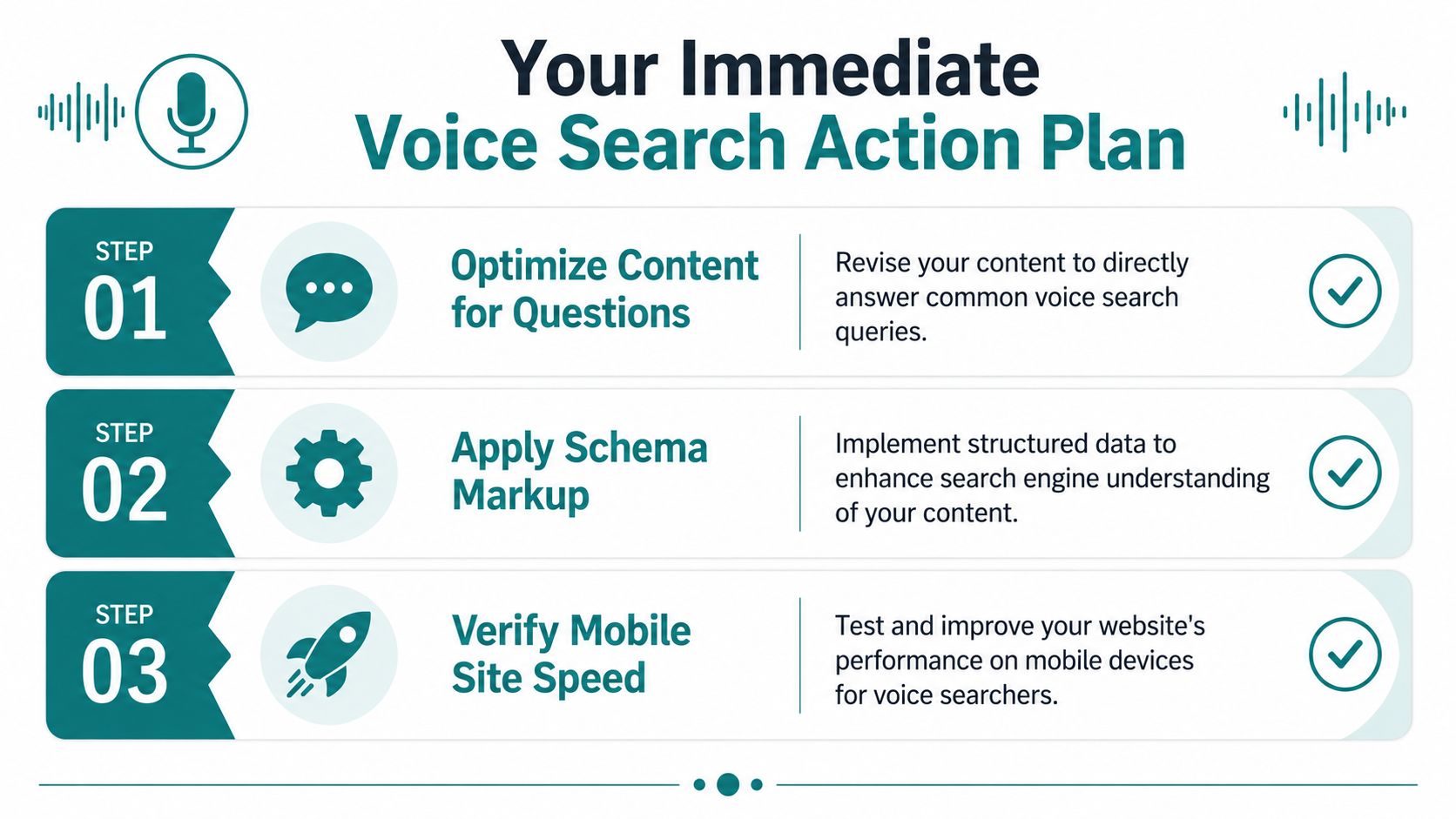
- Fully update your Google Business Profile
Check hours, phone number, services, address, categories, and photos. If a customer asks for a business "open now" and your listing is outdated, that's a preventable loss.
- Write down ten questions customers ask all the time
Use your front desk, sales inbox, and service team as your source. Then build or improve an FAQ page and add those answers to your key service pages.
- Test your mobile speed and usability
Run your site through Google PageSpeed Insights, then review it on your own phone. If the page is slow, cluttered, or hard to use, fix that before adding more content.
Keep your first round of changes practical
Don't overcomplicate this.
-
Pick one service page and rewrite it to answer a real spoken question.
-
Add one FAQ section that reflects how customers talk.
-
Tighten one mobile page so the phone button, hours, and location are easy to find.
-
Review one location listing for accuracy.
That kind of focused cleanup often produces better business results than broad, unfocused SEO activity.
Voice search optimization works best when it's tied to real customer behavior. If people ask for directions, make directions easy to find. If they ask whether you treat a condition, state that clearly. If they want to know whether you serve Hyde Park, Mason, or Blue Ash, don't make them guess.
If you want help turning those fixes into a stronger search strategy, HDM helps Cincinnati-area businesses improve visibility, tighten technical SEO, and build websites that turn searchers into calls, appointments, and customers.