Featured Snippet Optimization: A Cincinnati SMB Guide
June 9, 2026
You've probably seen this happen. You search a question related to your business, and before the normal blue links even start, Google puts a competitor in a highlighted answer box at the top of the page.
That box matters more than most business owners realize.
For a Cincinnati company trying to stand out, featured snippet optimization isn't some niche SEO trick. It's one of the clearest ways to earn visibility, build trust fast, and show up as the business that answers the question first. That's especially true for service businesses, healthcare practices, law firms, manufacturers, and local companies with long sales cycles, where authority matters as much as traffic.
The good news is that featured snippets usually don't go to the fanciest website. They go to the page that answers the question clearly, in the format Google wants, on a site that's already credible enough to compete.
What Is a Featured Snippet and Why Should You Care
A featured snippet is the answer box Google sometimes places above the standard organic results. It pulls a short passage, list, table, or video from a webpage and presents it as the direct answer to a search.
If someone searches "how often should a furnace be serviced," "what is occupational therapy," or "steps to form an LLC in Ohio," a featured snippet may appear before the regular listings. If your business owns that space, your brand becomes the first answer people see.
Why this matters for a local business
For a Cincinnati-area business owner, the value is simple. A featured snippet can put your expertise in front of a prospect before they visit your site, call your office, or compare you to competitors.
That's powerful if you sell a service people need explained before they buy. It's even more useful in regulated industries where trust and clarity carry real weight. If you run a healthcare practice, legal firm, or financial service, showing up as the direct answer can lower friction early in the buying journey.
One mobile stat tells the story well. Search Engine Watch reported that featured snippets can take up more than 50% of the screen on mobile devices in some cases, which gives them major above-the-fold visibility and pushes other results lower on the page (Search Engine Watch's featured snippet analysis).
Practical rule: If your customers ask the same question in sales calls, intake calls, or consultations, that question may be a snippet opportunity.
What featured snippets are not
They're not a shortcut for weak pages.
A lot of business owners assume they can create one FAQ page, toss in a few questions, and jump to the top. That usually doesn't work. Featured snippets are tied closely to pages that already rank well enough for Google to trust them.
They also aren't only for giant national brands. Local and regional businesses can win them when they answer narrow, useful questions better than broader competitors. That's often where smaller companies have an advantage. They know the actual questions their customers ask.
A local business that wants stronger Google visibility should think of featured snippets as one piece of the larger search picture. If you need that broader context, this Cincinnati guide to getting found on Google is a helpful starting point.
Why they influence more than clicks
A snippet doesn't just drive traffic. It shapes perception.
When Google highlights your page as the answer, searchers often assume your business knows the topic. For small and mid-sized companies, that kind of credibility is hard to buy through ads alone. You earn it by being clear, useful, and structurally easy for Google to extract.
The Four Types of Snippets and What Google Wants
Featured snippets aren't one thing. Google shows different formats depending on the question.
That matters because featured snippet optimization works best when your page matches the format Google already prefers for that query. If Google wants a list and your page offers a dense paragraph, you've made the job harder than it needs to be.
Ahrefs studied 112 million U.S. keywords and found that about 14 million keywords triggered a featured snippet, which shows this isn't a rare edge case. It's a meaningful part of search demand (Ahrefs' featured snippets study).
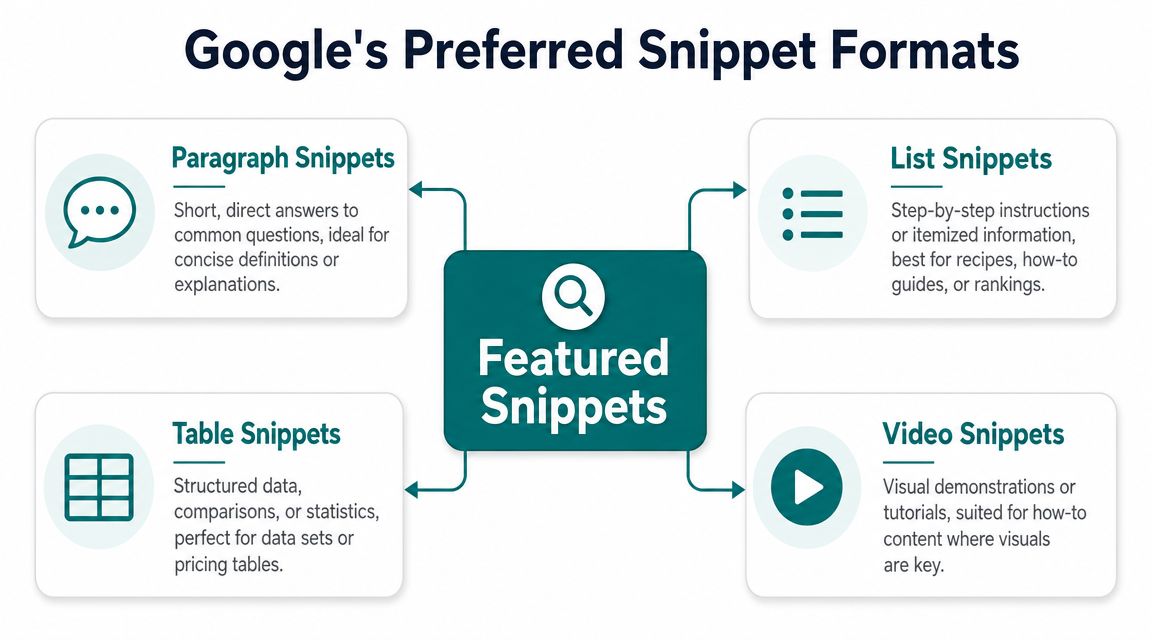
Paragraph snippets
This is the classic answer box. Google pulls a short block of text that directly answers a question.
A Cincinnati dentist might target a question like "What is a dental crown?" A healthcare provider might answer "What does physical therapy treat?" These work when the answer can be stated cleanly in a few sentences.
Google tends to like pages that define the topic plainly, without wandering into a long intro first.
List snippets
List snippets show steps, rankings, or itemized information. They're common for "how to," "best ways," and "steps" searches.
This format makes sense for queries like:
-
Process questions such as "steps to apply for a business loan in Ohio"
-
Service preparation questions like "how to prepare for a roof inspection"
-
Educational searches such as "signs your HVAC system needs repair"
If your business publishes practical guides, list snippets are often the easiest win because Google can pull headings or bullet points directly from the page.
Table snippets
Table snippets appear when someone wants comparisons. Pricing, features, timelines, service differences, or specification breakdowns can all fit.
For example, a manufacturer could compare material options. A lawn care company could compare service packages. A medical practice could compare treatment categories, if the content is reviewed carefully and presented responsibly.
A short comparison table often performs better than a long paragraph because it removes ambiguity.
<table> <thead> <tr> <th>Query style</th> <th>Better format</th> </tr> </thead> <tbody><tr> <td>"What is…"</td> <td>Paragraph</td> </tr> <tr> <td>"How to…"</td> <td>List</td> </tr> <tr> <td>"Difference between…"</td> <td>Table</td> </tr> <tr> <td>"How do I do this…" with a demo need</td> <td>Video</td> </tr> </tbody></table>Video snippets
Video snippets usually appear when the searcher wants to see the process. Think repairs, setup steps, software workflows, or demonstrations.
If your business has strong visual expertise, video can support snippet visibility. But for most SMBs, the fastest opportunities still come from written content that's easier to update, refine, and align with search intent.
If Google is already showing a specific snippet format for a query, don't fight it. Match it.
What Google wants is straightforward. It wants the clearest answer in the easiest format to extract. That's less about clever writing and more about disciplined formatting.
How to Structure Your Content to Win Snippets
At this stage, most pages either become snippet candidates or get ignored.
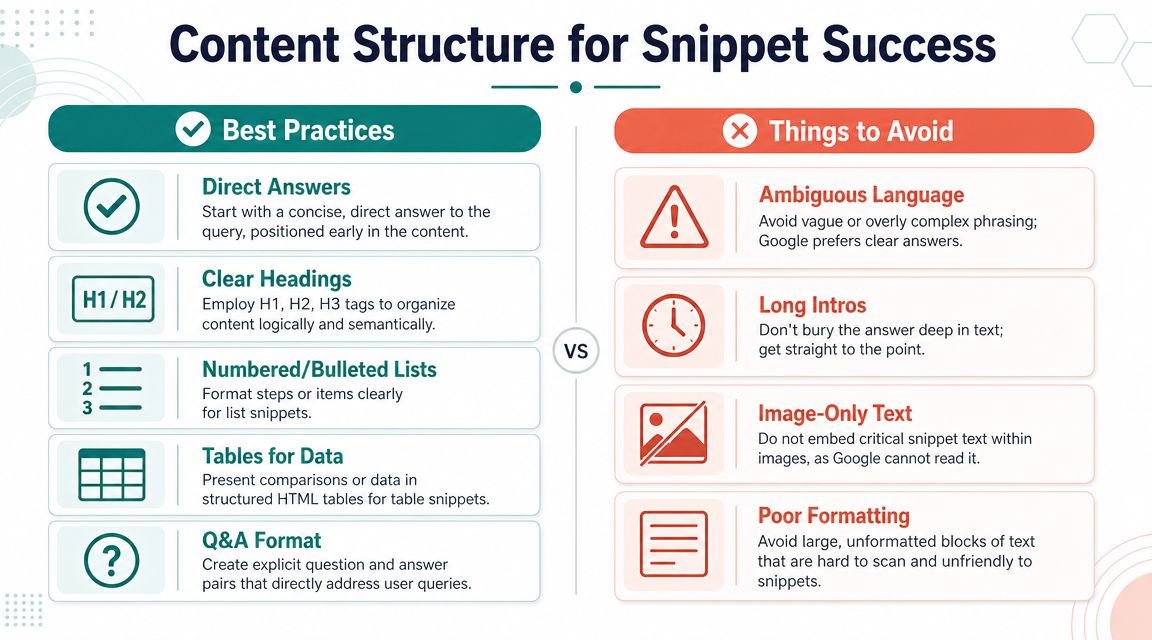
The strongest approach is simple. Use the customer's question as a heading, answer it immediately in plain language, then expand with supporting detail. That structure helps people scan the page and helps Google find the answer block it can lift into search.
Search Engine Land recommends a practical workflow: start with queries where your page already ranks in positions 2–5, filter for question-style informational queries, look at the snippet format Google currently shows, and then rewrite your page to match that format with a concise answer near the top (Search Engine Land's featured snippet workflow). If you want to build that kind of process into your broader publishing plan, a solid content strategy matters more than one-off blog posts.
Start with the question your customer actually asks
Don't write headings for your internal team. Write them for the searcher.
Good examples:
-
How long does workers' comp take in Ohio
-
What should I bring to my first physical therapy visit
-
How often should commercial roofing be inspected
Weak examples:
-
Our process
-
Helpful information
-
Everything you need to know
The first group gives Google a direct clue about the page section. The second group says almost nothing.
Put the answer right below the heading
A lot of pages lose snippet opportunities because they bury the answer under a long intro, sales copy, or throat-clearing.
A cleaner structure looks like this:
-
Question-based heading
-
Direct answer in a short paragraph
-
Supporting explanation
-
List, table, or examples if helpful
Here's the difference in practice.
Before:
A business owner often has many questions about selecting the right payroll provider, and the answer can depend on size, goals, budget, support expectations, integration requirements, and compliance needs across industries.
After:
How do you choose the right payroll provider?
Choose a payroll provider based on your company size, compliance needs, software integrations, support quality, and reporting requirements. The best option is the one that fits your workflow and reduces manual administrative work.
The second version gives Google something it can use.
Use formatting that supports the snippet type
If the search looks like a list query, use real list formatting. If it looks comparative, build a real table. Don't expect Google to reorganize a messy page for you.
That's especially important for industries where the content must be accurate and carefully reviewed. In healthcare, legal, and finance, concise answers still need proper context. The fix isn't to avoid direct answers. The fix is to give the direct answer first, then immediately follow it with clarifying detail and appropriate review.
A repeatable page pattern
This structure works well for many service pages and blog posts:
-
Lead with the core question
-
Answer it in plain English
-
Add a short list of key points
-
Expand with details, exceptions, or local context
-
Include a table if a comparison helps
-
Refresh the page when the information changes
Clear structure doesn't "game" Google. It makes your content easier for both people and search engines to use.
Businesses often think snippet-ready writing will sound robotic. It doesn't have to. The best pages sound natural, but they respect the reader's time.
The Technical Checklist for Snippet Success
Content does the heavy lifting, but the technical foundation still matters.
If your page is hard to load, hard to use on a phone, or confusing for search engines to interpret, your content has to work harder. Business owners don't need to become developers to understand this. You just need to know what your site should be doing behind the scenes.
Your page has to be usable on mobile
Many snippet opportunities happen on phones. If a visitor taps your result and lands on a page with clunky spacing, slow loading, or hard-to-read blocks of text, that weakens the overall experience.
A mobile-friendly site doesn't guarantee snippet visibility. But a poor mobile experience can undercut strong content. That's one reason routine site upkeep matters. If you haven't reviewed the basics in a while, this website wellness checklist is a practical place to start.
Structured pages are easier for Google to understand
Google doesn't want to guess where the answer is.
Pages with logical headings, clean HTML lists, real tables, and readable copy are easier to interpret than pages built from giant text blocks or visually styled content with weak semantic structure. A designer may make a page look polished, but if the structure underneath is messy, snippet potential drops.
That applies to schema markup too. Think of schema as a way to label parts of your content more clearly for search engines. It's not a magic button, but it can support understanding when it's implemented well.
Freshness matters more than many owners think
BrightEdge reports that featured snippets can earn a 35.1% click-through rate, and it also stresses that ranking alone isn't enough. The page has to be structurally snippet-ready, with question-based headings, concise answers, and frequent updates to stay eligible (BrightEdge on optimizing for featured snippets).
For SMBs, that has a practical takeaway. Don't publish a strong page and forget it for two years. Review it. Tighten the answer. Update outdated language. Clean up the formatting. Replace weak headings.
What to ask your developer or agency
Use this checklist in plain language:
-
Mobile usability: Does the page work cleanly on a phone?
-
Heading structure: Are H1, H2, and H3 tags used logically?
-
Readable formatting: Are lists and tables built as actual HTML elements?
-
Performance: Does the page load fast enough to avoid frustration?
-
Maintenance: Is someone reviewing important pages regularly?
Technical work won't save weak content. But weak technical foundations can absolutely hold back strong content.
How to Know If Your Snippet Strategy Is Working
You don't need a complicated analytics setup to tell whether your featured snippet optimization is moving in the right direction.
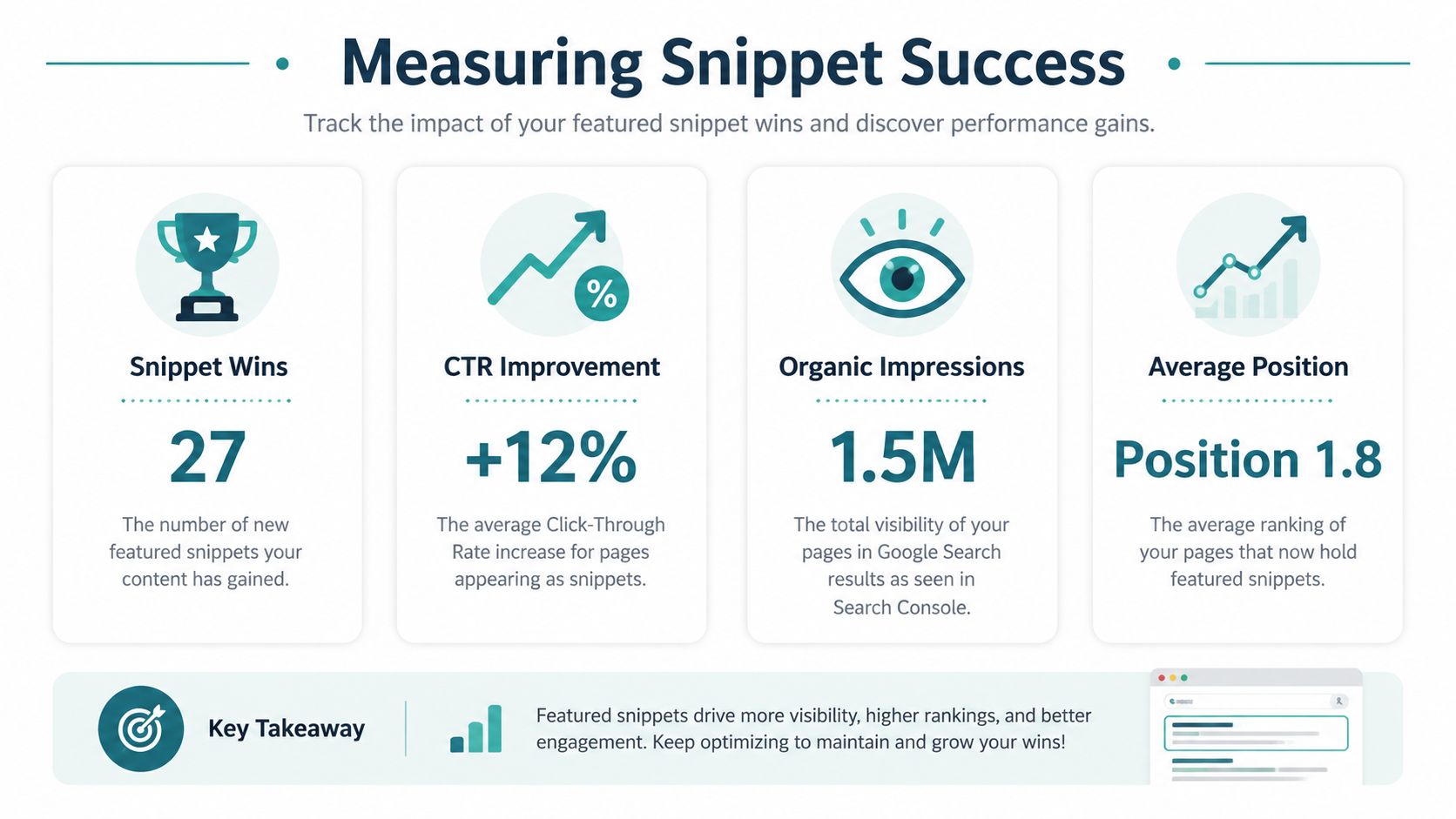
Start with Google Search Console. It's free, and for most small to mid-sized businesses, it gives enough visibility to spot progress. You can see which queries generate impressions, which pages are getting clicks, and where rankings are trending.
What you're looking for is pattern change, not one isolated blip.
What to watch in Search Console
A useful review usually starts with a handful of questions:
-
Are impressions rising for pages you restructured for snippet targets?
-
Are query variations increasing around the main topic?
-
Are certain pages earning stronger visibility even if clicks don't jump immediately?
-
Are you seeing more question-based searches tied to service pages or educational posts?
If the answer box appears and disappears over time, that's normal. Snippets can be volatile. Google tests results, and competitors update content too.
Why clicks aren't the only scorecard now
This part has changed.
Recent SEO commentary notes that featured snippets and AI Overviews now dominate zero-click search, which shifts the value proposition toward visibility and citation, not just raw clicks (Frase on featured snippets and AI Overviews). In plain English, your content can still do useful brand work even when a searcher doesn't visit your site right away.
That matters for Cincinnati businesses with longer decision cycles. A prospect may see your brand several times while researching. The first interaction might be a snippet. The second might be an AI Overview citation. The visit may come later.
Sometimes the win is that your business becomes the name attached to the answer.
When advanced tools help
As your content library grows, tools like Ahrefs, Semrush, and STAT become useful because they make it easier to isolate snippet opportunities and monitor who owns them over time. They're especially helpful if you manage many locations, service lines, or topic clusters.
For most SMBs, though, measurement should stay grounded in a few business questions:
<table> <thead> <tr> <th>Signal</th> <th>What it suggests</th> </tr> </thead> <tbody><tr> <td>More impressions on educational pages</td> <td>Google is surfacing your content more often</td> </tr> <tr> <td>Better visibility on question queries</td> <td>Your page structure is aligning with search intent</td> </tr> <tr> <td>Snippet ownership on high-intent topics</td> <td>Your brand is gaining authority earlier in the journey</td> </tr> </tbody></table>The goal isn't vanity reporting. The goal is to see whether your content is earning more search real estate and stronger pre-click trust.
Your Snippet Optimization Action Plan
If you want a practical path forward, keep it simple.
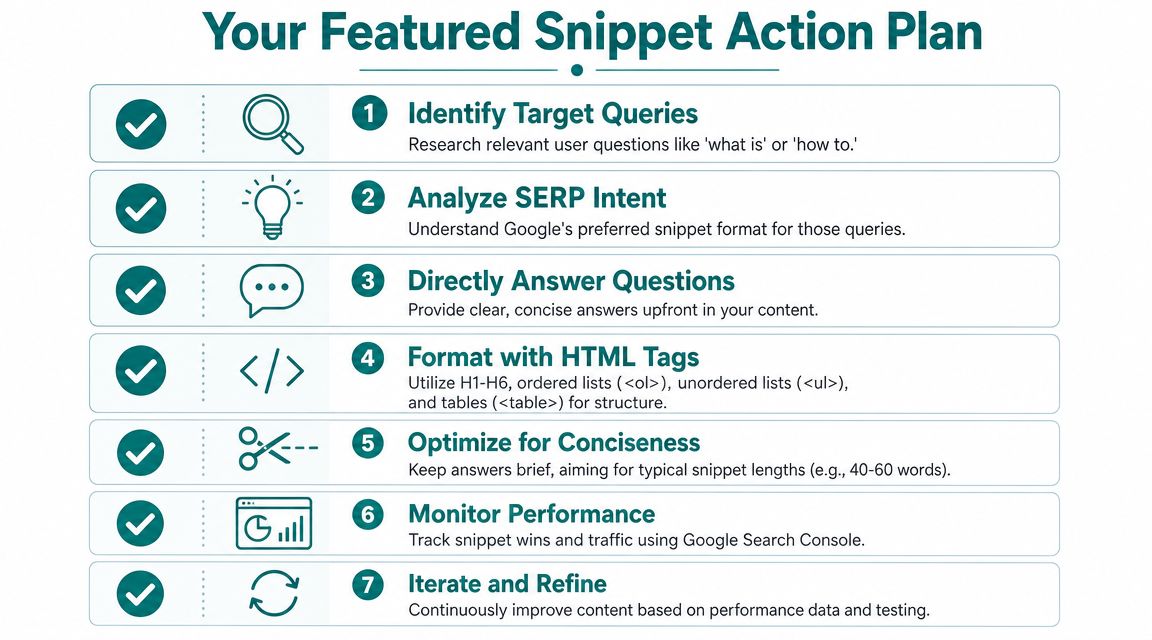
Most businesses don't need a massive featured snippet project. They need a disciplined process applied to the right pages. That usually means starting with questions your team already hears from customers, then improving the pages that have the best chance to win.
A focused plan for Cincinnati SMBs
- List your real customer questions
Pull them from sales calls, front-desk calls, intake forms, service emails, and customer conversations. If people ask the same question repeatedly, it deserves a page section or article.
- Check the current search results
Search the question and study what Google is already rewarding. Is it showing a paragraph, a list, a table, or video? That tells you how to frame your answer.
- Prioritize pages that already have traction
Don't start from scratch unless you need to. Existing pages with decent rankings are often the best candidates.
- Rewrite for clarity
Use the question as a heading. Put the answer directly beneath it. Then add details, examples, and local relevance.
- Support trust with strong review and accuracy
This is especially important for healthcare, legal, and other regulated industries. Direct answers are good. Careless answers are not. Review content with the right internal expert before publishing.
Why regulated industries can have an edge
Businesses in healthcare, legal, and similar spaces often hesitate to simplify content because they don't want to oversimplify the issue. That concern is valid.
But that same emphasis on accuracy can become an advantage. Google wants clear, trustworthy answers. If your practice or firm can explain a complex topic in plain language without losing accuracy, you're better positioned than a competitor that writes vague marketing copy.
What usually fails
A few patterns miss the mark:
-
Thin FAQ pages with one-sentence answers and no depth
-
Pages written for keywords instead of people
-
Long intros that delay the actual answer
-
Over-designed pages where structure is sacrificed for appearance
-
Set-it-and-forget-it content that never gets reviewed
Featured snippet optimization works when the page is useful first and optimized second. That order matters.
If you want help turning your service pages, blog content, and technical setup into a focused search visibility strategy, HDM works with businesses across Greater Cincinnati to build websites and growth marketing systems that are structured to perform. If your team would rather spend time running the business than rewriting headings and auditing Search Console, HDM can help you put the right process in place.