
A lot of healthcare teams are in the same spot right now. A clinic wants the time savings of AI, maybe for note drafting, intake support, or patient messaging, but the moment someone says "let's connect it to patient data," the room gets quiet.
That hesitation is healthy. If you run a practice, a therapy group, or a specialty clinic, you're not just buying software. You're deciding where protected health information goes, who can touch it, what gets stored, and how mistakes get caught before they affect patient care.
For Cincinnati-area healthcare organizations that are also modernizing websites, forms, chat tools, and digital workflows, this gets even more tangled. A new AI feature might live inside your patient portal, your intake forms, your chatbot, or a marketing-connected scheduling flow. That's why HIPAA-compliant AI isn't a separate IT issue sitting off to the side. It touches operations, compliance, vendor management, and digital infrastructure all at once.
Why HIPAA-Compliant AI Feels Risky for Healthcare Teams
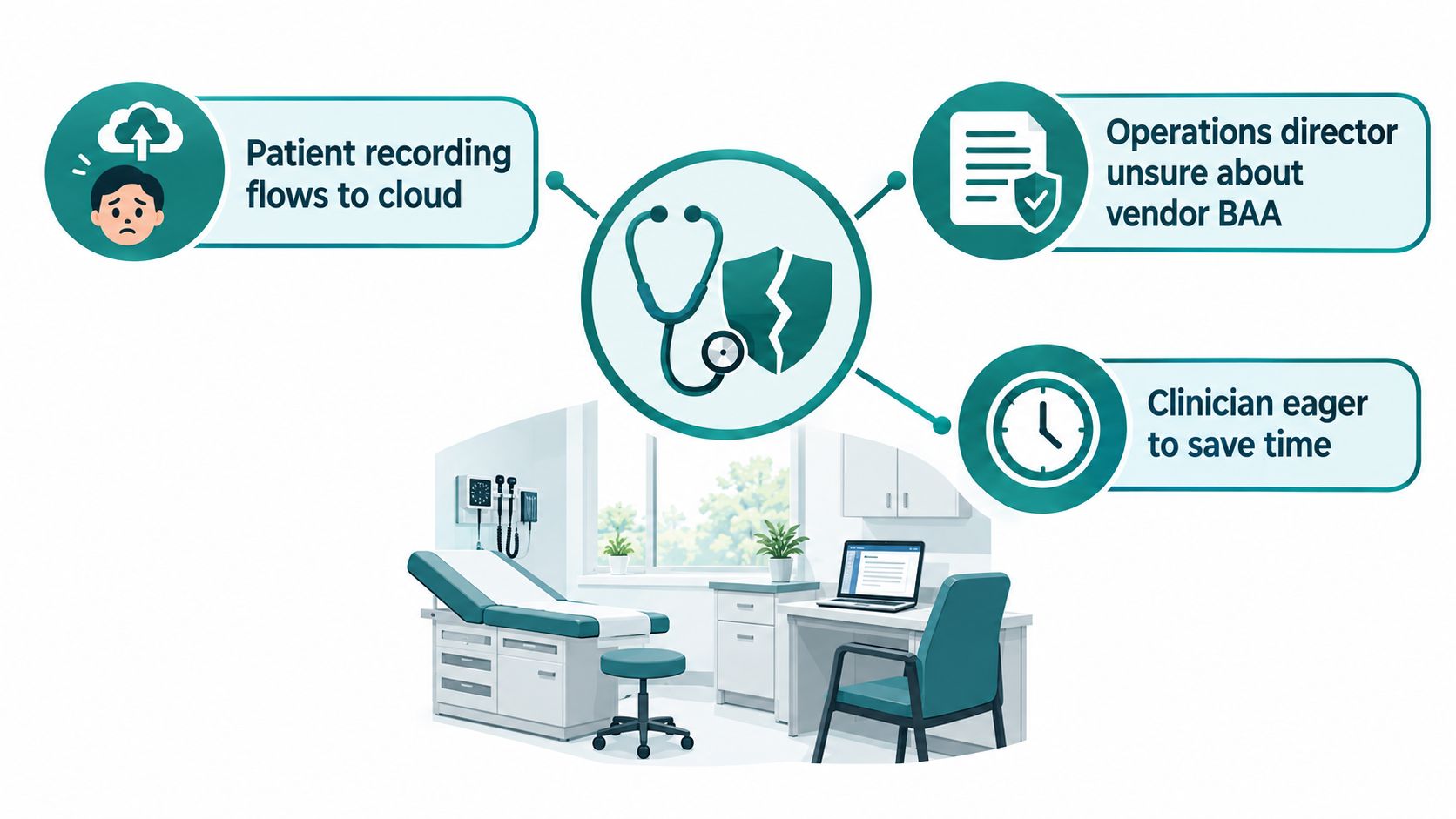
Take a mid-size medical practice evaluating an AI scribe. The clinicians are optimistic because they want less charting after hours. The operations director is less relaxed because patient conversations may be recorded, sent to a cloud service, processed by a model the team didn't build, and then turned into draft notes that land back in the chart.
That's where questions start. Did patient data leave the EHR? Will the vendor use transcripts to train another model? If there's a breach, who carries the legal burden? If the note is wrong, who catches it before a clinician signs it?
Why the fear is rational
Most of the anxiety around HIPAA-compliant AI isn't fear of AI itself. It's fear of unclear data movement and unclear accountability.
A clinic director usually isn't worried about the math inside a language model. They're worried about practical things. Who signed off on this workflow? Which staff members can see transcripts? What happens to temporary files, logs, prompts, and copied text in support tools?
Those concerns are valid because healthcare adoption has moved quickly. In a 2024 survey, more than 70% of respondents from healthcare organizations said they were already pursuing or had implemented generative AI capabilities, and a later 2024 survey found 85% were exploring or had already adopted it. By 2025, another survey reported 80% of health systems were taking action on GenAI for revenue cycle management, up 38% in less than two years, while more than one in five organizations still had not begun adoption, according to McKinsey's review of generative AI adoption in healthcare.
Practical rule: If a vendor says the product is "HIPAA compliant," treat that as the start of your review, not the end of it.
The confusion usually comes from one bad assumption
Teams often assume compliance is a product label, like "encrypted" or "cloud hosted." It isn't. In practice, HIPAA compliance comes from how the tool is deployed, configured, supervised, and documented inside your organization.
That distinction matters whether you're buying an AI scribe, adding a chatbot to a healthcare website, or connecting intake forms to an AI assistant. For clinic leaders, the safer mindset is simple: you're not purchasing compliance. You're building an operating model that has to hold up when staff use it every day.
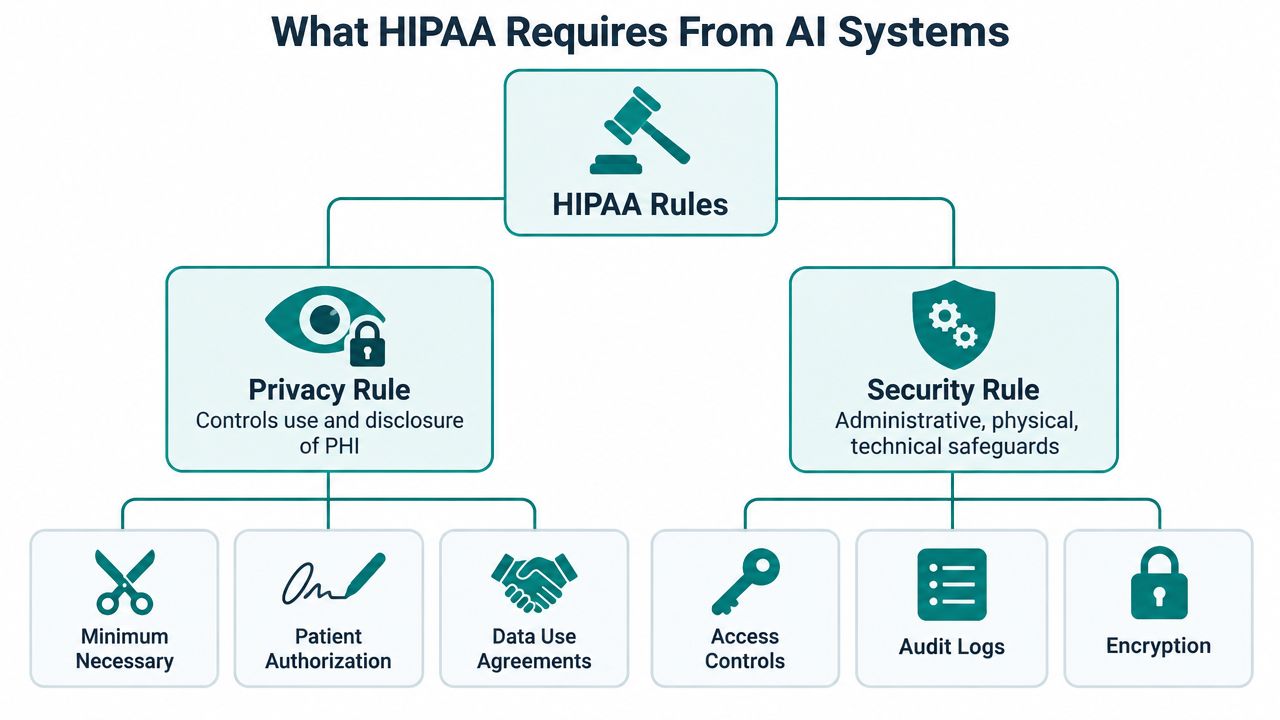
What HIPAA Actually Requires From AI Systems
HIPAA wasn't written for chatbots, scribes, or large language models. It was enacted on August 21, 1996, and its privacy framework was designed to be technology-neutral. Congress directed HHS to issue privacy regulations if Congress did not act within three years, which led to the HIPAA Privacy Rule governing covered entities and business associates that handle protected health information, as explained in this legal analysis of HIPAA's technology-neutral structure.
That's why AI doesn't sit outside HIPAA. If an AI system creates, receives, maintains, or transmits PHI, it falls into the same legal structure as other health IT.
Think of AI like a new employee
A helpful way to explain this to non-technical teams is to treat AI like a new staff member. You wouldn't hire someone, hand them patient charts, and never define their role, supervision, access limits, or documentation duties.
AI needs the same structure.
It needs access boundaries. The system should only touch the minimum patient data needed for the task. It needs supervision. Staff must know when AI output can be used directly and when a human has to review it. It needs accountability. Someone must be able to reconstruct what data went in, what came out, and who approved the result.
What counts as PHI in AI workflows
Readers often get tripped up here. They think PHI only exists in the final chart note or patient file.
In AI workflows, PHI can appear in many places, including prompts, transcripts, summaries, logs, retrieval snippets, and model outputs. If a staff member pastes a patient message into a chatbot, that text may be PHI. If a system stores a temporary summary tied to a patient, that may be PHI too.
Later, if you want a broader baseline on healthcare web and platform obligations, HDM's overview on how to comply with HIPAA is a useful companion for teams aligning websites, forms, and operational tools.
A short video can help make the legal framework easier to follow before you evaluate vendors or architectures.
HIPAA doesn't ask whether your algorithm is advanced. It asks whether your handling of patient information is controlled.
Core Technical Controls for AI Handling Patient Data
The safest way to assess an AI tool is to stop asking whether the interface looks polished and start asking where PHI travels. In most healthcare AI deployments, risk doesn't sit only in the front-end app. It sits in training pipelines, inference endpoints, caches, logs, and temporary processing layers.
According to AIQARUS guidance on HIPAA-compliant AI, systems touching PHI should apply encryption end-to-end across every PHI-touching component. Practical implementations commonly require AES-256 for data at rest, TLS 1.3 or stronger for data in transit, and FIPS-approved cryptographic modules for key management.
What to require before any PHI is processed
If even one intermediate store or API path is left unencrypted, PHI can leak through prompts, retrieval calls, outputs, or logs. That's why your review has to go deeper than "the vendor says the platform is secure."
Here's a practical comparison you can hand to a vendor or internal developer.
| Control Area | HIPAA Reference | Specification to Require |
|---|---|---|
| Encryption at rest | Security safeguards for ePHI | AES-256 across databases, file stores, backups, caches, and temporary processing layers |
| Encryption in transit | Security safeguards for ePHI | TLS 1.3 or stronger for browser sessions, APIs, internal services, and integrations |
| Key management | Technical safeguards | FIPS-approved cryptographic modules and documented key rotation procedures |
| Access control | Minimum necessary and security controls | Role-based access, least privilege, unique user accounts, and short-lived credentials |
| Audit logging | Accountability and traceability | Logs for prompts, outputs, PHI access, admin changes, and export actions |
| Data minimization | Privacy principle | Send only task-relevant fields to the model, not full records by default |
| De-identification | HIPAA de-identification options | Safe Harbor removal of identifiers or Expert Determination when appropriate |
| Retention policy | Risk management and operational control | Written rules for prompt, transcript, output, and log retention or deletion |
De-identification isn't the same as "we removed a few details"
HIPAA allows de-identification through an expert determination method, but only when a person with appropriate statistical and scientific knowledge determines the re-identification risk is very small, including against information used alone or with other reasonably available data, according to HHS de-identification guidance.
The Safe Harbor path is more concrete. It requires removing 18 specific identifiers, including names, geographic subdivisions smaller than a state, all elements of dates except year, phone numbers, email addresses, Social Security numbers, medical record numbers, device IDs, IP addresses, and URLs, as summarized in this HIPAA de-identification overview.
A detail many teams miss: for ZIP codes under Safe Harbor, only the first three digits may be kept when the combined geographic area has more than 20,000 people. Otherwise, the ZIP code must be replaced with 000, and anyone age 90 or older must be grouped into a single 90-or-older category, as explained in this Safe Harbor versus Expert Determination guide.
One overlooked control for websites and intake flows
Healthcare websites often feed data into CRM systems, chat tools, intake software, and now AI assistants. If your forms aren't designed with PHI boundaries in mind, the AI layer inherits a bad setup from day one.
For that reason, teams evaluating front-end patient experiences should also review how they collect data through HIPAA-compliant web forms. A secure AI workflow can still fail if the form that feeds it is collecting too much information or passing it to the wrong place.
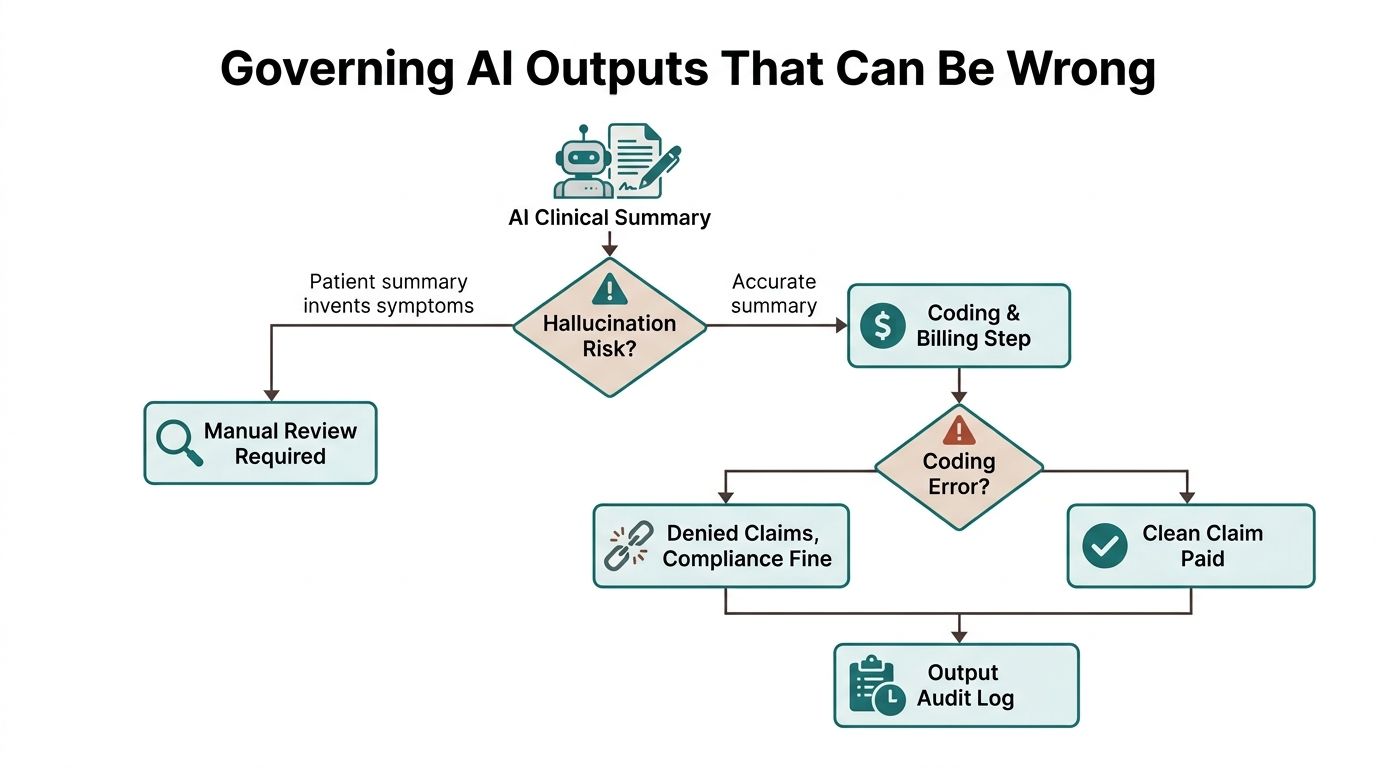
Governing AI Outputs That Can Be Wrong
Many articles stop at encryption, access controls, and a signed agreement. That's necessary, but it's not enough. A system can be technically well protected and still produce a summary, recommendation, or coding suggestion that is wrong.
That output problem is the blind spot.
Recent commentary on healthcare AI compliance has stressed that AI use cases touching ePHI must be included in risk analysis and risk management, with safeguards for audit logs, authentication, and encryption. But there's still a major gap around model behavior, human review, and documentation of AI-assisted decisions, as discussed in this analysis of changing HIPAA and AI guidance.
Where hallucinations become compliance issues
If an AI scribe invents a symptom, the problem isn't only clinical. It can affect coding, billing, documentation integrity, patient trust, and audit defensibility.
If a chatbot summarizes a patient message incorrectly, the issue isn't fixed just because the transcript was encrypted. If a coding assistant suggests the wrong code and nobody reviews the basis for that suggestion, the workflow has a governance failure.
What strong output governance looks like
A defensible setup usually includes several layers working together:
- Retrieval-grounded prompting: The model should work from verified source material such as the encounter transcript, approved knowledge base content, or selected chart sections.
- Structured outputs: Require the model to fill specific fields rather than generate free-form narrative where facts can drift.
- Human review thresholds: High-impact outputs should trigger required review before use.
- Decision logging: Save the prompt, response, reviewer, and final disposition so the clinic can reconstruct what happened later.
A secure AI tool can still create unsafe documentation if nobody governs the output.
A simple policy clinics can actually use
Many small and mid-sized healthcare organizations don't need a complicated AI board at the start. They need a written rule that answers three questions: which outputs must be reviewed by a human before use, who is allowed to approve them, and what gets logged when AI contributed to the final result.
For high-impact tasks, some teams use dual review by two clinicians or a clinician plus a coding lead. Others set rules such as "AI may draft, but never finalize." The exact policy can vary. The important part is that the rule exists, staff know it, and your logs match your policy.
Vendor Selection and BAA Realities
A business associate agreement matters, but it doesn't settle the whole question. Too many teams see a vendor mention a BAA and assume the product is ready for patient data in every configuration.
That's risky. There is no HIPAA certification for AI tools, and "HIPAA-compliant AI" is not a product label. Compliance depends on the covered entity's configuration and controls, and recent independent guidance notes that federal proposals from late 2024 through 2025 suggest scrutiny is expanding to AI training data, algorithm data, and prediction models, as outlined in this discussion of HIPAA-compliant AI tools and deployment realities.
The BAA is the starting line
A vendor becomes a business associate when it provides services to or acts on behalf of a covered entity or another business associate and PHI is involved. For AI tools, that means the HIPAA obligations still sit with the covered entity or business associate rather than being delegated away, as explained in this HIPAA and artificial intelligence legal overview.
That means your BAA review should ask practical questions like which services are covered (is the BAA limited to one API, one environment, or the entire stack), what happens to training data (does the agreement exclude your PHI from model training and downstream reuse), who are the subprocessors (which additional vendors may store, log, or transmit your data), and how does the relationship end (will the vendor return or destroy your data at termination).
Comparing the main vendor paths
| Dimension | Enterprise API | Healthcare Assistant | Self-Hosted Model |
|---|---|---|---|
| PHI exposure | Depends on API scope, logging, and contract terms | Often narrower workflow, but still requires review | Greater internal control, but more operational burden |
| BAA complexity | Usually service-specific and environment-specific | Often more packaged for healthcare use cases | May shift more responsibility to your team and infrastructure vendors |
| Output oversight tools | Varies by platform | May include review workflows | Must often be built or configured internally |
| Model transparency | Limited in many cases | Varies by vendor | More control over model choice and deployment details |
| Incident response | Shared responsibility | Shared responsibility | Heavier responsibility on your organization |
| Best fit | Custom builds with technical teams | Faster deployment for targeted workflows | Organizations needing maximum control |
A clinic director doesn't need to become an AI architect to use this table. They need to use it as a scorecard. If a vendor can't clearly explain PHI handling, review tooling, logging access, and breach response, they aren't ready for shortlist status.
For healthcare organizations also refreshing digital infrastructure, this same discipline applies to the surrounding stack. HIPAA website hosting is part of the picture because your website, forms, patient portal, and AI-enabled tools may all share vendors, environments, or data paths.
Deployment Architectures That Keep PHI Safe
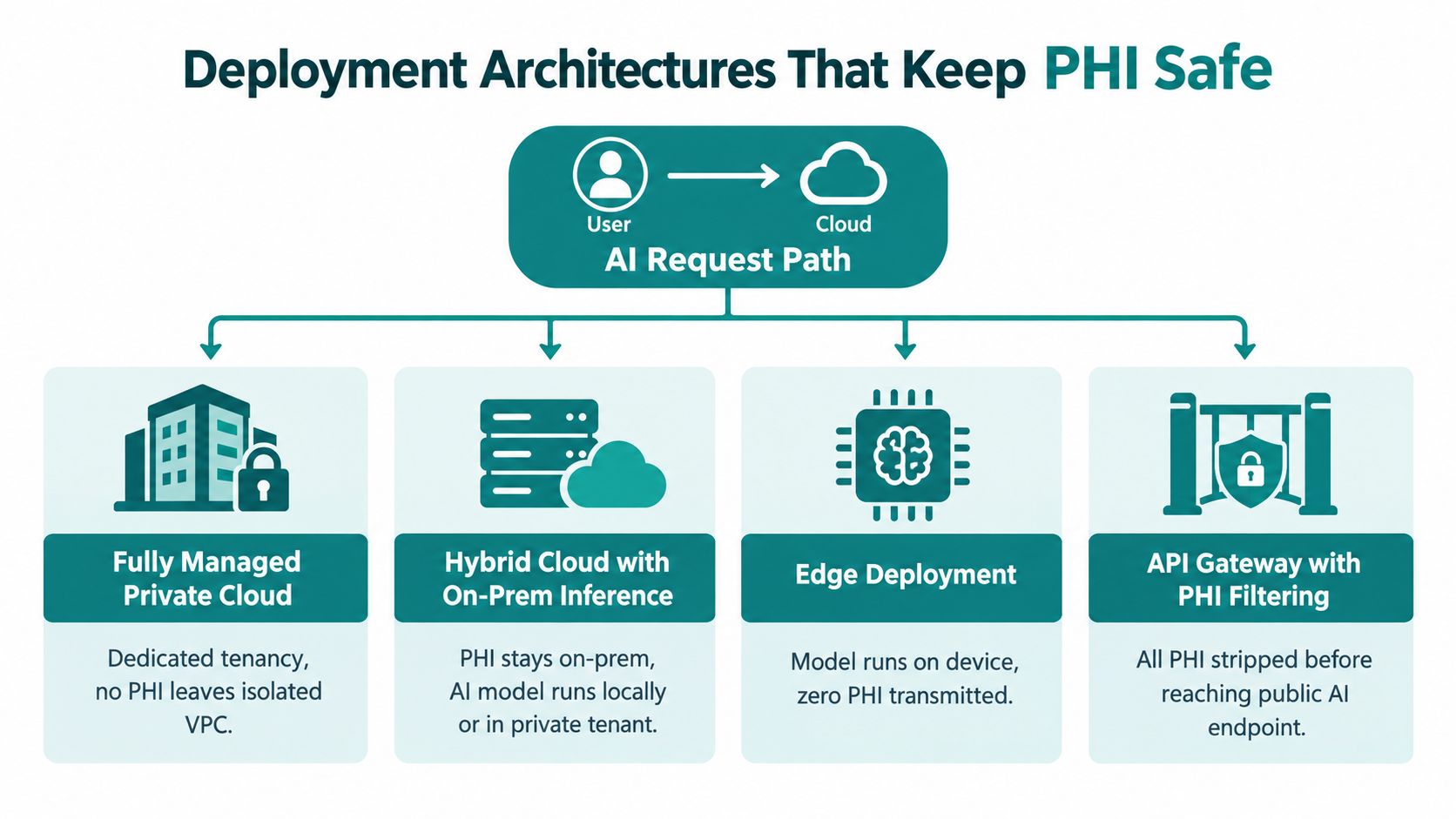
Where PHI lives depends less on the marketing demo and more on the architecture behind the request. Two tools can look almost identical to end users and have very different risk profiles under the hood.
A clinic should ask one simple question for every AI use case: where does the patient data go from the moment a user clicks submit?
Four common patterns
Fully managed private cloud works well when a vendor provides dedicated tenancy and controlled isolation. The key review points are tenant separation, logging boundaries, and whether any support personnel can access PHI during maintenance.
VPC-isolated deployment inside your cloud account gives the healthcare organization tighter control. The vendor may manage the application, but the trust boundary stays closer to your own environment.
On-premises or local regulated deployment makes sense when the organization wants PHI to remain in infrastructure it directly controls. This often appeals to teams with stricter internal policies or workflows involving highly sensitive documentation.
Edge or on-device inference is especially useful for ambient clinical tools or front-desk workflows where a zero-egress design is safer. If the model runs on the device and PHI never leaves it, the exposure surface is smaller.
What good architecture review looks like
Don't evaluate architecture only at the hosting label level. Review controls at three layers: the network layer (how is data segmented, encrypted, and restricted between systems), the application layer (who can submit prompts, retrieve outputs, export data, or change settings), and the model layer (where are weights managed, how are updates applied, and how are tenants isolated if infrastructure is shared).
Deployment choice shapes risk. The same model can be defensible in one environment and unacceptable in another.
For some uses, a vendor API with egress can be acceptable if the BAA is in place, tokens are tightly scoped, and retention is clearly logged. For other workflows, especially clinical documentation or triage, many organizations prefer a zero-egress design because it reduces the number of places PHI can travel.
A Practical Pre-Launch Checklist for Healthcare AI
The easiest way to keep an AI project from drifting into confusion is to turn it into a checklist with owners, effort, and artifacts. That gives a clinic director something concrete to track instead of depending on vague vendor promises.
If you want an additional operational reference, this checklist for deploying AI agents is a useful outside resource because it reinforces the idea that compliance has to be operationalized, not assumed.
Before deployment
- Inventory the data. Owner: Privacy or compliance lead. Effort: Moderate. Artifact: Data flow map showing where PHI enters, moves, and is stored.
- Classify the use case. Owner: Operations leader with clinical input. Effort: Low to moderate. Artifact: Written use case description with risk level and intended users.
- Review the vendor contract and BAA. Owner: Compliance lead and counsel. Effort: Moderate. Artifact: Approved contract notes covering scope, retention, subprocessors, and termination terms.
- Test model behavior on your own scenarios. Owner: Clinical reviewer or informatics lead. Effort: Moderate. Artifact: Evaluation log with examples of acceptable and unacceptable outputs.
During deployment
- Validate the environment. Owner: IT or implementation partner. Effort: Moderate. Artifact: Configuration checklist covering access, encryption, logging, and integrations.
- Provision least-privilege access. Owner: IT administrator. Effort: Low. Artifact: User access matrix by role.
- Confirm audit logging works end to end. Owner: Security or compliance lead. Effort: Low to moderate. Artifact: Sample audit records for prompts, outputs, and administrative actions.
- Document break-glass and escalation rules. Owner: Operations and compliance. Effort: Low. Artifact: Incident and exception handling procedure.
After launch
- Review prompts and outputs on a recurring schedule. Owner: Clinical informatics lead or designated reviewer. Effort: Ongoing. Artifact: Review log with corrective actions.
- Audit user access periodically. Owner: IT and compliance. Effort: Ongoing. Artifact: Access review report with removals and adjustments.
- Reassess the vendor and model changes. Owner: Compliance lead. Effort: Ongoing. Artifact: Updated risk assessment and BAA review notes.
- Run an incident response exercise. Owner: Leadership, IT, and compliance. Effort: Moderate. Artifact: Tabletop summary with action items and owners.
Treating HIPAA-Compliant AI as Ongoing Governance
The most useful mindset shift is this: HIPAA-compliant AI is an operating discipline, not a one-time purchase decision.
Models change. Vendors update terms. Staff adopt shortcuts. Clinical workflows evolve. A process that looked controlled on day one can become messy months later if nobody owns the review cycle.
Most organizations need a named owner or shared ownership between privacy, operations, and clinical leadership. They also need a regular review rhythm that asks practical questions: are outputs staying accurate enough for the intended use, have access patterns changed in a way that creates risk, did the vendor change retention, logging, or subprocessors, and does the documented policy still match actual staff behavior.
Teams that want another perspective on operational planning can review strategies to achieve HIPAA compliance with AI. It's useful as a supplementary read because it reinforces the same point: compliance depends on governance choices over time.
Quick FAQ for common misconceptions
Can a vendor certify that its AI is HIPAA compliant? No. There isn't a HIPAA certification for AI tools. Compliance depends on deployment, contracts, controls, and supervision.
If the tool signs a BAA, are we covered? Not by itself. The BAA matters, but your data flows, access settings, retention, and output review process still determine whether the deployment is defensible.
If data is encrypted, is the AI workflow safe? Encryption is necessary, but it doesn't solve hallucinations, unsafe outputs, weak role permissions, or poor documentation.
One practical note for healthcare organizations investing in websites, SEO, digital intake, or patient engagement tools around Cincinnati: AI often gets added to systems you already use for growth and operations. That's why a digital agency involved in healthcare work should understand PHI boundaries and workflow governance, not just design and traffic goals. HDM is one Cincinnati-area option for organizations that need help aligning healthcare websites, forms, automation, and AI-related implementation decisions inside a broader digital strategy.
HIPAA-compliant AI is the sum of legal alignment, technical controls, vendor accountability, output oversight, and architecture decisions. Then you repeat that cycle, because the system doesn't stay compliant on autopilot.
If your healthcare organization is updating its website, intake forms, patient communications, or AI-enabled workflows, HDM can help you plan the digital side with HIPAA-conscious structure and practical implementation support. That includes healthcare websites, secure form strategy, automation planning, and AI-related workflow guidance that fits how real teams operate.