
If you run a healthcare practice, a HIPAA-compliant website isn't just a best practice—it's a legal necessity. In simple terms, it means any part of your site that collects, stores, or sends patient information is locked down tight, meeting the strict privacy and security rules of the Health Insurance Portability and Accountability Act.
Why Your Website Is a HIPAA Compliance Minefield

If you're running a healthcare practice in the Cincinnati area, your website has likely become a major, and very quiet, compliance risk. You might see your site as a simple digital brochure, but the tools you use to make it work—contact forms, appointment schedulers, even the marketing analytics you use to track visitors—are almost certainly collecting sensitive patient information.
Think of your website as a digital waiting room. Every time someone visits, they leave behind digital footprints. Their IP address is a footprint. A submitted form asking about a specific medical service is another, much larger one. Federal regulators now argue that when this data is collected in the context of a healthcare website, it becomes Protected Health Information (PHI).
The Crackdown Is Real and It's Hitting Home
In December 2022, the U.S. Department of Health and Human Services (HHS) fired a warning shot with a bulletin specifically targeting online tracking technologies. They followed up in July 2023, when the HHS and FTC sent letters to around 130 healthcare organizations for potential HIPAA violations stemming from website trackers. Potential fines climb up to $1.5 million per violation, per year.
The marketing tools everyone uses—like Google Analytics and the Meta Pixel—were never built for HIPAA compliance. For a local practice in Cincinnati, the damage from a violation goes far beyond a fine. A data breach can instantly destroy patient trust and community reputation.
Moving Beyond a Simple "Secure" Website
A standard SSL certificate is table stakes. True compliance is a layered strategy:
-
How data is collected: Using encrypted forms that don't dump PHI into an insecure email inbox.
-
Where data is stored: Choosing a hosting provider that is actually HIPAA-compliant.
-
Who can access the data: Putting strict user controls and audit trails in place.
-
Who you partner with: Making sure every vendor signs a Business Associate Agreement (BAA).
As a Cincinnati-based agency, HDM helps practices navigate these complex rules.
The Three Pillars of HIPAA Compliance
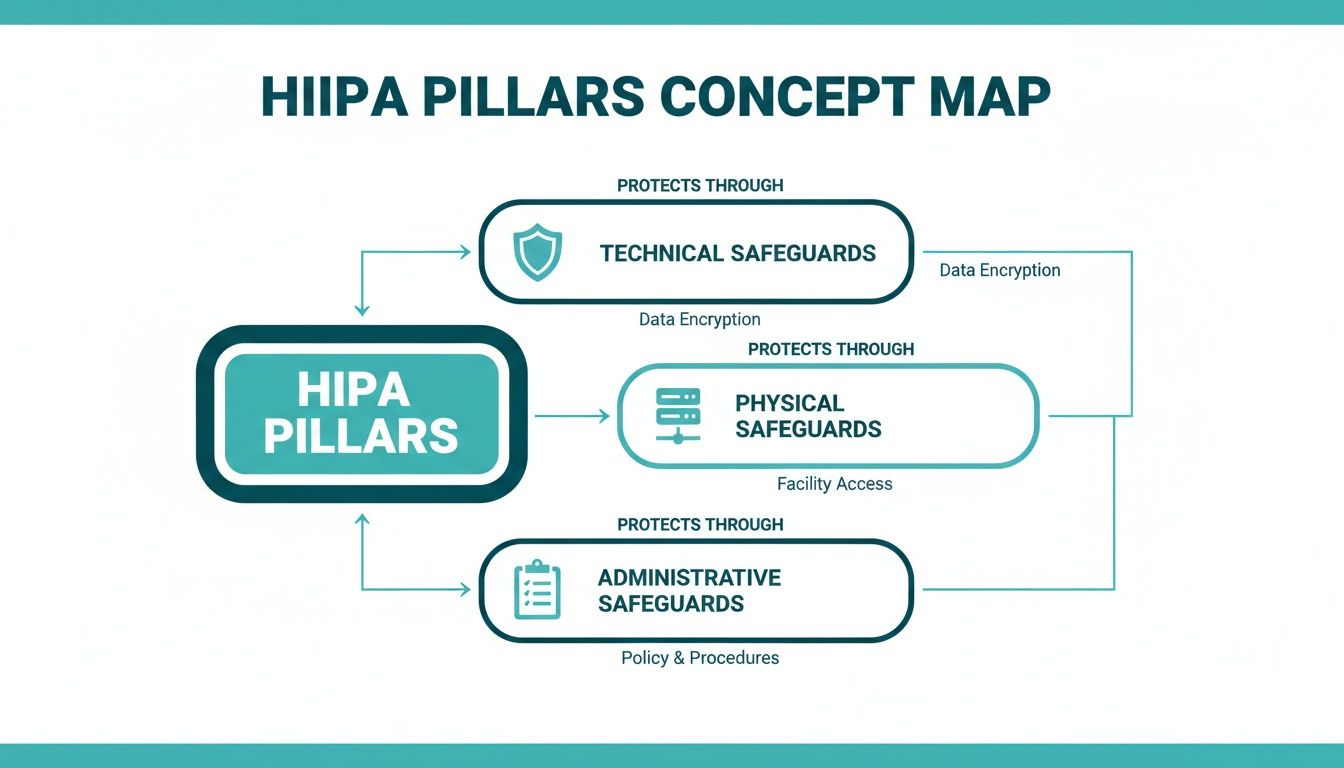
To build a genuinely HIPAA-compliant website, you have to think beyond just code. The framework rests on three core pillars: Technical Safeguards, Physical Safeguards, and Administrative Safeguards.
Technical Safeguards
Key technical requirements include:
-
Access Control: Only authorized people should see or interact with PHI. Unique user logins, strong password enforcement, and strict permission levels.
-
Encryption and Decryption: All PHI must be encrypted both in transit (SSL/TLS) and at rest.
-
Audit Controls: Systems must log and track activity related to ePHI.
-
Integrity Controls: Prove that ePHI hasn't been improperly altered or destroyed.
Physical Safeguards
This pillar covers:
-
Facility Access Controls: Limiting who can physically access servers and data centers.
-
Workstation Use: Clear policies for any computer that accesses ePHI.
-
Device and Media Controls: Formal procedures for handling electronic media including secure data destruction.
Administrative Safeguards
Key administrative responsibilities include:
-
Security Management Process: Conduct a formal risk analysis.
-
Assigned Security Responsibility: Name a HIPAA Security Officer.
-
Information Access Management: Policies dictating who gets access to which PHI.
-
The Business Associate Agreement (BAA): A legal contract with any vendor who handles PHI. HDM provides a BAA as standard.
HIPAA Safeguards at a Glance
| Safeguard Type | What It Means | Example Action |
|---|---|---|
| Technical | Technology to secure your website and data | End-to-end encryption on all web forms |
| Physical | Security of physical servers and hardware | HIPAA-compliant hosting with documented access controls |
| Administrative | Policies and contracts governing data interaction | Signed BAA with your web development agency |
Marketing Your Practice Without Violating HIPAA
The tools most businesses rely on for growth—like Google Analytics and Facebook ad pixels—are now a massive liability for healthcare providers.
The Conflict Between Marketing and HIPAA
Tools like Google Analytics and the Meta Pixel were never designed for healthcare. Their job is to collect and track user behavior. From a HIPAA perspective, this is an unauthorized disclosure of PHI.
Compliant Alternatives for Digital Marketing
-
Use Privacy-Focused Analytics: Platforms built for HIPAA compliance that will sign a BAA.
-
Implement Server-Side Tagging: Send data to your secure server first, filter and anonymize before forwarding.
-
Deploy PHI-Filtering Tools: Systems that scan for PHI in real-time and redact before transmission.
Essential Features of a HIPAA Compliant Website

HIPAA Compliant Hosting with a BAA
You must use a HIPAA-compliant hosting provider that will sign a BAA. Without that signed BAA, you are in violation from day one.
Key Insight: You wouldn't store paper patient files in an unsecured storage unit. Choosing a non-compliant web host is the digital equivalent.
Secure, Encrypted Web Forms
Your standard "Contact Us" form is probably the single biggest point of failure. A properly built site uses:
-
End-to-End Encryption: Data encrypted the instant a user hits "submit."
-
Secure Storage: Submissions stored in a secure database—never an email inbox.
Secure Patient Portals
A secure patient portal creates a password-protected space where patients can log in to view only their information, establishing a private communication channel.
Robust Data Backup and Recovery
The HIPAA Security Rule explicitly requires a disaster recovery plan with:
-
Automated, Regular Backups: Entire site backed up automatically to a secure, off-site location.
-
A Tested Recovery Process: Regular testing to ensure systems can be restored quickly.
Common Website Mistakes That Risk HIPAA Fines
Using Non-Compliant Live Chat or Schedulers
Most popular third-party chat and scheduling options are not HIPAA compliant out of the box. You must use tools only from vendors who will sign a BAA.
Forgetting to Sign BAAs with All Vendors
Key Insight: A signed BAA is your single most important administrative safeguard. Without it, you are automatically out of compliance.
Your BAA list includes: web design agency, SEO firm, email marketing platform, and cloud backup service.
Embedding Risky Third-Party Tools
Nearly 30% of U.S. provider websites still risk compliance by using conversion pixels. Run a thorough audit of every third-party script on your website.
Your Actionable HIPAA Compliance Checklist

Core Vendor and Technology Audit
-
Confirm a signed BAA with your web hosting company.
-
Verify a BAA with your web design agency.
-
Audit all third-party tracking tools.
-
Ensure SSL certificate is active site-wide.
Key Insight: Your digital compliance is only as strong as your weakest link.
Website Functionality and Data Handling Review
-
Review all contact and inquiry forms—where does the data go?
-
Check appointment scheduler and live chat for HIPAA compliance.
-
Evaluate patient portal login for strong passwords and MFA.
-
Establish clear internal policies for handling patient questions.
Frequently Asked Questions About HIPAA Web Design
Does Just Having an SSL Certificate Make My Website HIPAA Compliant?
No. SSL protects data in transit but HIPAA also requires securing data at rest, controlling access, maintaining audit logs, and having BAAs with all partners.
Can My Small Practice Really Get in Trouble for Website Violations?
Yes. HIPAA rules apply equally to major hospital systems and solo practitioners. Federal agencies are actively cracking down on website-related violations.
What Is a Business Associate Agreement and Why Do I Need One?
A BAA is a mandatory legal contract between your practice and any vendor who touches PHI. This includes your web design agency, hosting company, email marketing service, and digital marketing firm.
Ready to build a website that's both a powerful marketing tool and a fortress for patient data? At HDM, we specialize in HIPAA-compliant web design for Cincinnati healthcare practices. Contact us today to start the conversation.