

If you're a Cincinnati business owner comparing SEO quotes right now, you've probably seen the full spread. One person says they can "do SEO" for a tiny monthly fee, another wants a retainer that feels closer to a payroll line item, and a third promises quick rankings without explaining what they'll fix. The problem isn't just price, it's that most quotes blur together service lists, vague promises, and dashboards that never connect to revenue.
Affordable SEO for small business only works when it's treated like a phased investment. The goal is to spend enough to fix the bottlenecks that block leads, then prove the work is moving the business before you keep scaling it. In practice, that means focusing on the few tactics that help real buyers find you, trust you, and contact you.
What Affordable SEO Means for Small Businesses
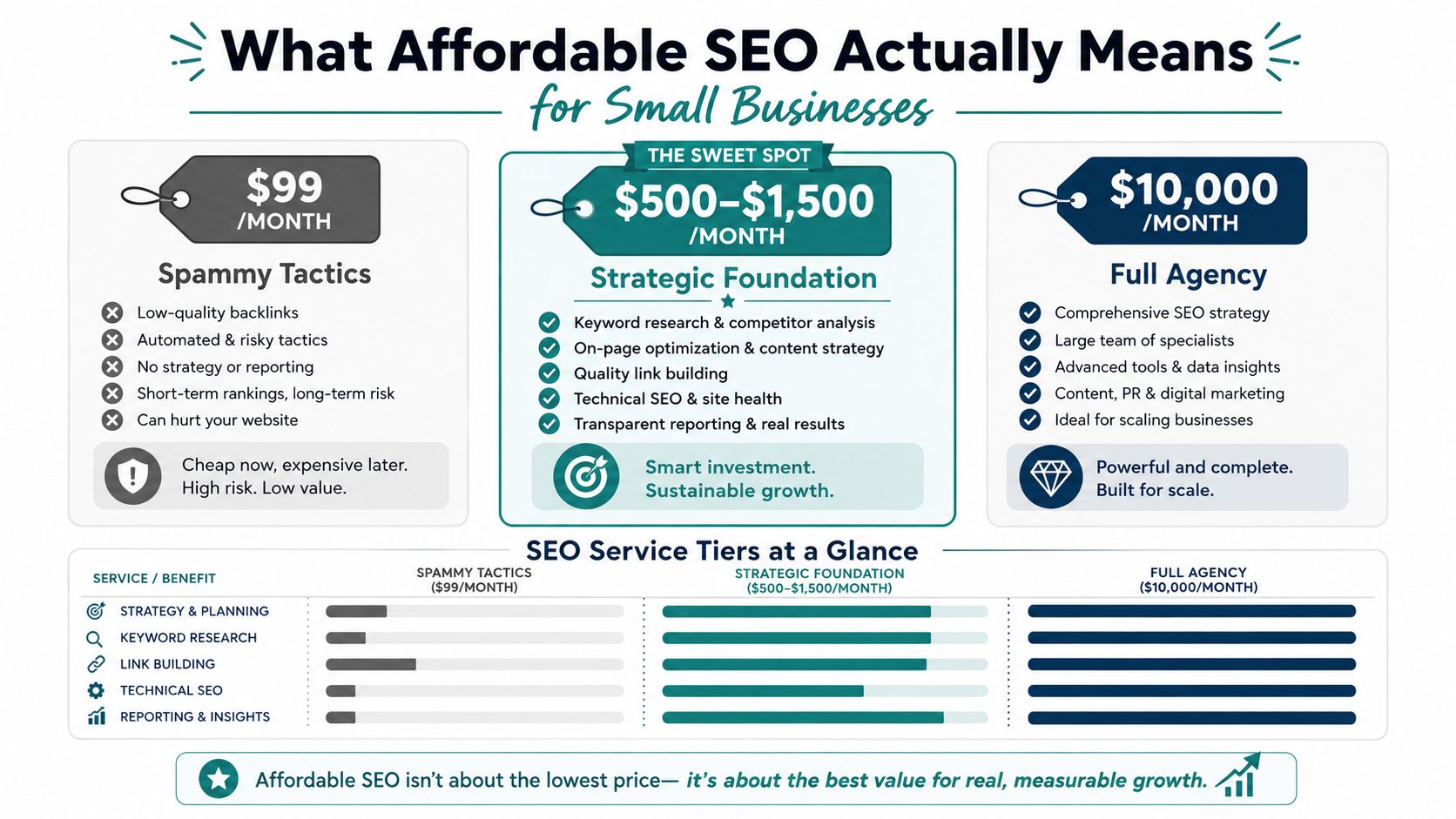
A lot of owners hear "affordable" and think it means "cheap." That usually leads to the wrong kind of SEO, the kind that looks busy on paper but does little for leads, calls, or quote requests. The market gives a clearer picture. Backlinko's SEO Services Report says U.S. organizations spent $119.4 billion on SEO and digital marketing consulting in 2025. That matters because affordable SEO for small business is not a stripped-down enterprise program, it is the highest-return slice of work inside a constrained budget.
What the middle of the market looks like
Small-business spending has long sat well below enterprise budgets, and that gap is the point. The problem is not that a lower budget is wrong, it is that very low retainers usually buy scattered activity instead of consistent progress. If the proposal is unusually cheap, ask what is missing, because something always is.
More recent pricing surveys place most businesses between $500 and $5,000 per month, with local SEO averaging $1,557 per month and agency retainers averaging $3,209 per month. Those figures do not mean every small business should spend there, but they do show where sustainable work tends to live.
The honest takeaway is simple. Budgets below the level needed for steady execution usually produce isolated tasks, not durable visibility.
Practical rule: if the quote does not mention technical cleanup, page optimization, local relevance, or reporting, you are probably buying activity, not progress.
A better way to judge SEO is by phases. First comes repair. Then comes clarity. Only after that does scaling content or links make sense. If you want a local example of that sequence, this SEO foundation checklist for small business websites shows the kind of cleanup work that should come before any bigger push.
Fixing the Foundation Before Spending on Growth
The fastest ROI usually comes from fixing what's already broken. Too many small businesses publish new blog posts while the homepage loads slowly, old pages confuse Google, or service pages don't clearly tell visitors what to do next. That's backwards, and it burns budget.
Google's own Search Central SEO Starter Guide recommends starting with Search Console so you can monitor how Google crawls and indexes the site. That tool is where the cleanest early wins often show up, because it tells you which pages are being seen, which ones aren't, and where search traffic is getting stuck.
The first pass should be a crawl-and-fix cycle
Start with the pages that matter most to revenue. For a local service business, that's usually the homepage, top service pages, contact page, and any location pages that already get attention. Fixing those first is smarter than polishing a blog archive no one visits. Google Search Console should be your first stop, not your last report.
Here's the order I'd use on a tight budget:
- Check crawl and index issues. If Google can't properly crawl the site, everything else is delayed.
- Clean up page speed and mobile experience. Small-business guides repeatedly point to mobile homepage load time under 3 seconds as a useful benchmark, along with image compression, broken links, redirect cleanup, and NAP consistency.
- Fix 404s and redirect chains. Dead ends waste link equity and frustrate visitors.
- Tune existing pages before publishing more content. Title tags, headings, internal links, and image alt text are critical.
- Submit and verify the sitemap. Then watch what Search Console says got indexed.
If you want a deeper framework for the site-wide basics, HDM has a practical guide on SEO foundations every website needs. It's a useful reference point if you're comparing what an agency says it will fix versus what gets touched.
The mistake I see most often is content first, cleanup later. On a limited budget, that order usually means you pay to create pages that inherit technical problems and never fully earn their keep. Fix the engine before you add more fuel.
Local SEO and Content Tactics That Drive Cincinnati Customers
For Cincinnati-area service businesses, local visibility is where the intent lives. People searching for a plumber, attorney, dentist, roofer, or consultant near them usually aren't browsing for fun, they're trying to solve a problem. That makes local SEO and a small amount of targeted content far more valuable than a flood of generic blog posts.
Local search behavior is especially conversion-oriented. One roundup reports that 78% of mobile local searches lead to an offline purchase within 24 hours, 46% of all Google searches have local intent, and businesses in Google's Local Pack get a 40% higher click-through rate than competitors. Those numbers make one thing clear, Google Business Profile optimization, reviews, and local relevance matter a lot for neighborhood and service-area businesses in Greater Cincinnati.
What to do first on the local side
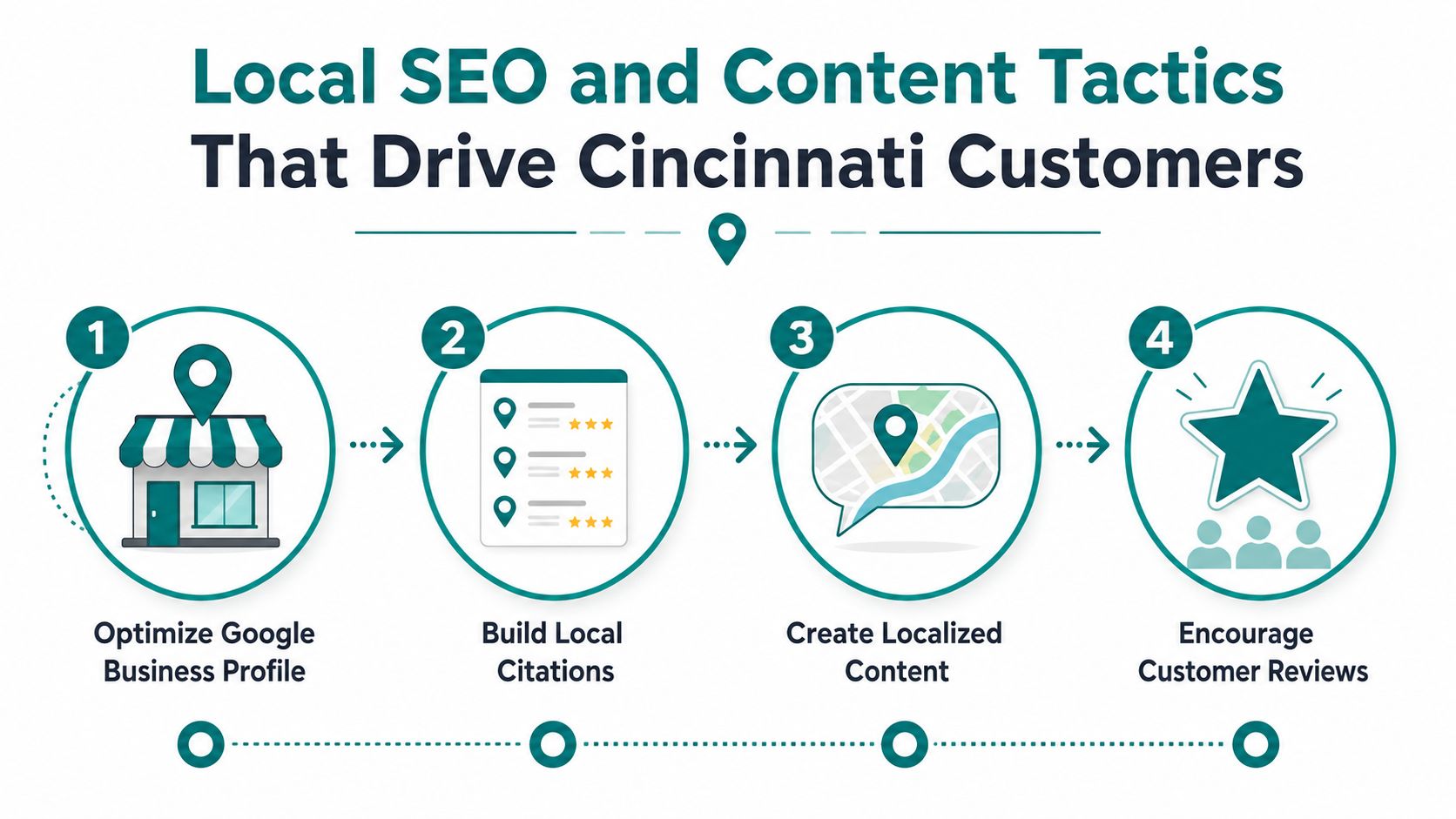
Begin with your Google Business Profile. Use the right categories, fill in services carefully, add photos that reflect the business, and keep hours and contact details current. Then build local citations, which means making sure your name, address, and phone number match across the major directories.
Content should be narrow and useful. Don't chase broad head terms that bigger brands already own. Map long-tail keywords to existing pages instead, then build around buyer intent. A service page for "roof repair in Hyde Park" or "estate planning help in Northern Kentucky" can do more work than a general article that never gets found.
A simple content cadence is enough for many small businesses. One practical plan recommends publishing only 1 to 2 posts in month 2 after critical errors are fixed, and that's the right spirit here. Consistent, targeted content beats a noisy content mill every time.
The pages that should pull their weight
If the site already has service pages, make them stronger before adding more. Each page should answer the same questions a prospect would ask on the phone, what you do, where you work, who it's for, and what happens next. Add review snippets where appropriate, a clear call to action, and internal links to related services or locations.
Don't write for Google first. Write for the buyer, then make the page easy for Google to understand. For a local example of how this shows up in practice, HDM's Cincinnati business guide to getting found on Google is worth scanning if you're trying to connect local visibility with actual customer demand.
The point isn't to publish more just because you can. The point is to make the right pages easier to find, easier to trust, and easier to contact.
Measuring Revenue Impact Instead of Vanity Metrics
Traffic is nice. Revenue is better. A small business can't afford to celebrate impressions while the phone stays quiet, especially when every monthly dollar needs to justify itself. The most useful SEO reports are the ones that connect search visibility to buyer actions. That means tracking the queries that show movement, the pages that attract high-intent visits, and the conversion points that matter, phone calls, forms, bookings, and assisted revenue. A good agency should be able to explain what changed and why it matters in plain language, not hide behind a chart full of green arrows.
What to watch in the first 90 to 180 days
The early signal usually isn't "we're ranking #1." It's movement on the terms that matter and proof that real prospects are engaging. Search Console queries rising from positions 11 to 20 can be a meaningful sign because those pages are already close enough to gain traction with targeted improvements.
A simple KPI framework helps keep the conversation honest.
| Timeframe | Leading Indicators | Revenue Signals |
|---|---|---|
| 0 to 30 days | Crawl errors fixed, pages indexed, improved titles and headings | Form submissions, calls from branded searches |
| 31 to 90 days | Query movement, stronger rankings for long-tail terms, better local visibility | More qualified calls, more booking requests, more quote forms |
| 90 to 180 days | Stable page gains, more pages earning impressions, better internal linking performance | Assisted revenue, repeat inquiries, closed deals tied to organic discovery |
How to ask for accountability
Basic conversion tracking does not need to be complicated. You need to know where calls came from, which forms were submitted, and which pages influenced the lead. If your agency only shows traffic, rankings, and impressions, you're missing the part that pays the bills.
A multi-touch view matters. A customer might find you through a service page, come back through a branded search, then fill out a form after reading a review. HDM's explanation of multi-touch attribution is a useful lens if you're trying to connect SEO to downstream revenue instead of just first-click traffic.
A straightforward question to ask any vendor is this: "Which leads came from organic search, and which pages influenced them?" If the answer is vague, the reporting is probably built for comfort, not decision-making.
DIY vs Freelancer vs Agency: Choosing the Right Path
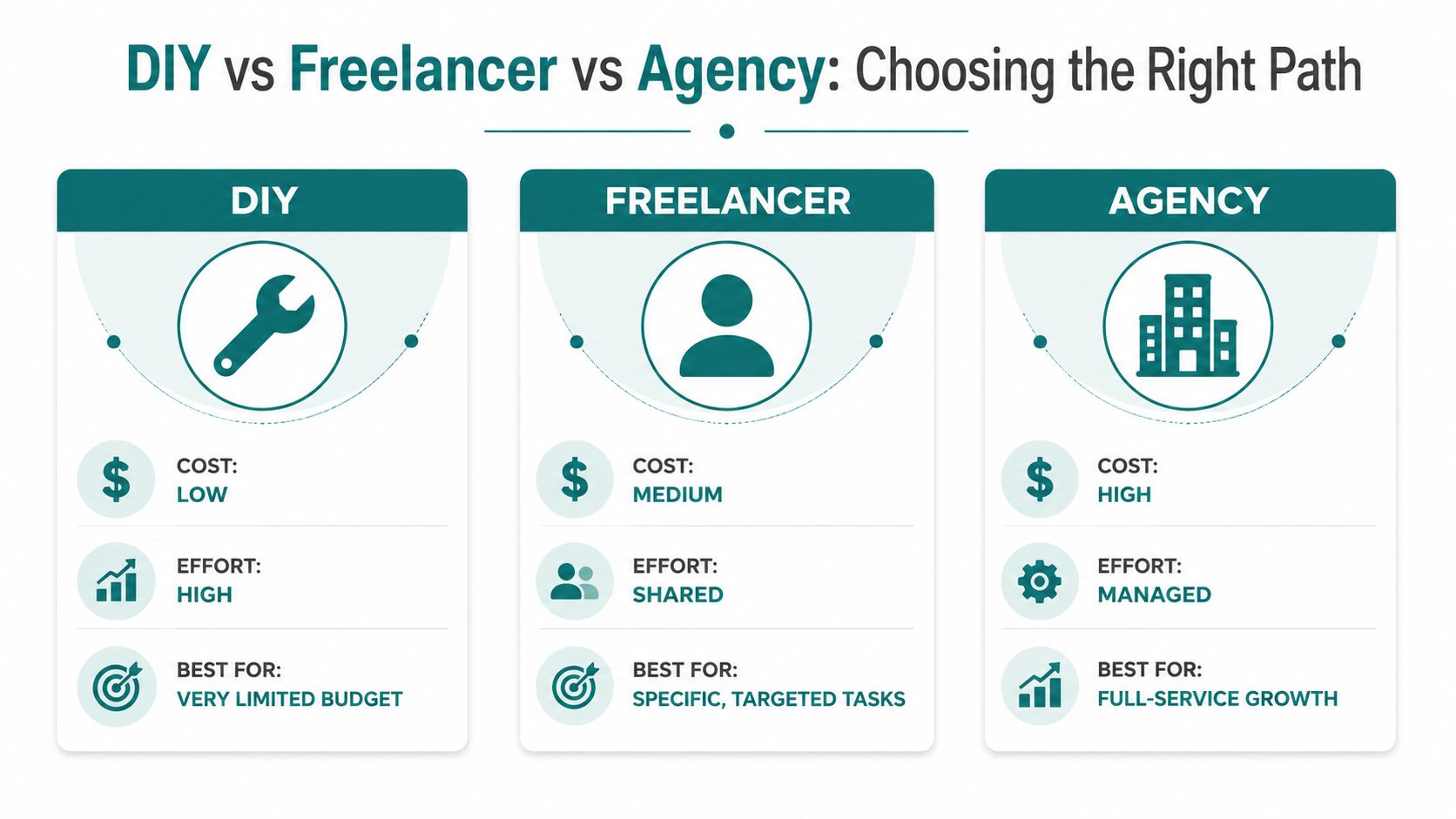
Not every business needs a full agency relationship, and not every owner has the time to do this alone. The right path depends on budget, internal bandwidth, and how much risk you're willing to carry while learning. DIY can work if you have time, patience, and a site that doesn't need major surgery. A freelancer can be useful when you need specific help, like content updates, citation cleanup, or a technical fix. An agency makes more sense when the work needs coordination across SEO, content, reporting, conversion tracking, and site changes.
What each path is good at
DIY keeps cash costs low, but the time cost is real. You'll need to keep up with Search Console, page edits, keyword mapping, local listings, and content updates. That's manageable for a very small operation, but it can become a distraction fast.
Freelancers are best when the scope is narrow. The risk is inconsistency, especially if someone is good at one piece of SEO but weak at the rest. Cheap freelancer work can look fine on the surface while missing the technical cleanup that would've made the effort worthwhile.
Agency work costs more because more is supposed to happen, strategy, execution, reporting, and coordination. In a Cincinnati market, a legitimate engagement should clearly show what's included, what gets updated monthly, and how success gets measured. HDM is one Cincinnati-area option that handles SEO alongside web design, development, and analytics, which can help when search work depends on site changes and conversion tracking.
Questions to ask before you sign
- What's included in the quote? Make sure local SEO, technical cleanup, content, and conversion tracking are spelled out.
- How do you report results? Ask for reporting that ties to calls, forms, bookings, or assisted revenue.
- Who does the work? Some vendors sell strategy and outsource everything else.
- What happens in the first 30 days? A good plan should have visible next steps, not just vague promises.
- How do you decide what to prioritize? The answer should start with the highest-value pages, not random content ideas.
If the quote only tells you the monthly fee, you don't actually know what you're buying. For most small businesses, the right choice is the one that keeps momentum without creating chaos. The cheapest option isn't always the affordable one if it wastes months.
Your 12-Month Phased SEO Budget Plan
A smart SEO budget doesn't try to do everything at once. It front-loads the foundation, proves that the work is helping, then scales the parts that earn the clearest return. That's the cleanest way to make affordable SEO for small business stay affordable.
Industry benchmarks back up the time horizon. One 2026 guide says realistic results usually take 6 to 12 months, and another points to a common spend range of roughly $1,500 to $3,000 per month for effective small-business SEO. This is a sustained effort, not a quick purchase.
A simple budget rhythm
Months 1 to 3 should go to cleanup, measurement, and local setup. That means Search Console, technical fixes, page-level optimization, Google Business Profile work, and review systems. This is the stage where you stop the leaks.
Months 4 to 6 should shift into content and authority. Publish targeted service pages, write a few useful posts that map to buyer intent, and earn local mentions or links where they make sense. For many businesses, the first visible lead lift starts to show up during this phase.
Months 7 to 12 should scale what's working and refine what isn't. You can expand into neighboring service areas, refresh pages that are close to breaking through, and tighten conversion paths. This is also where newer search behavior matters, because AI search and zero-click results are pushing more value toward structured pages, clear entity signals, and the pages most likely to be cited or converted.
For Cincinnati owners, the next move is usually not a massive overhaul. It's a disciplined first quarter, a measured second quarter, and enough patience to let the work compound.
If you want help deciding whether your site needs cleanup, local SEO, content, or a full growth plan, HDM can walk through the trade-offs with you and build a roadmap around your budget and timeline. Visit HDM and ask for a practical SEO conversation built around leads, not jargon.