
If your firm is still asking how to get more attorney leads, you're probably asking the wrong question. 81% of firms admit losing business to slow follow-up, 26% track no leads at all, and only 18% use multi-touch attribution, according to a legal marketing benchmark summary discussed by Click Vision. That changes the conversation. The problem usually isn't demand. It's what happens after someone calls, fills out a form, starts a chat, or clicks a paid ad.
For law firms in Cincinnati and similar regional markets, attorney lead generation now lives or dies on three operational issues: intake speed, attribution, and follow-up automation. If you can't tell which source produced a signed matter, if your team responds slowly, or if your website sends every practice area to one generic contact page, you're leaking revenue before an attorney ever gets involved.
That's the lens worth using this quarter. A lead only matters if it turns into a retained client. Everything else is noise.
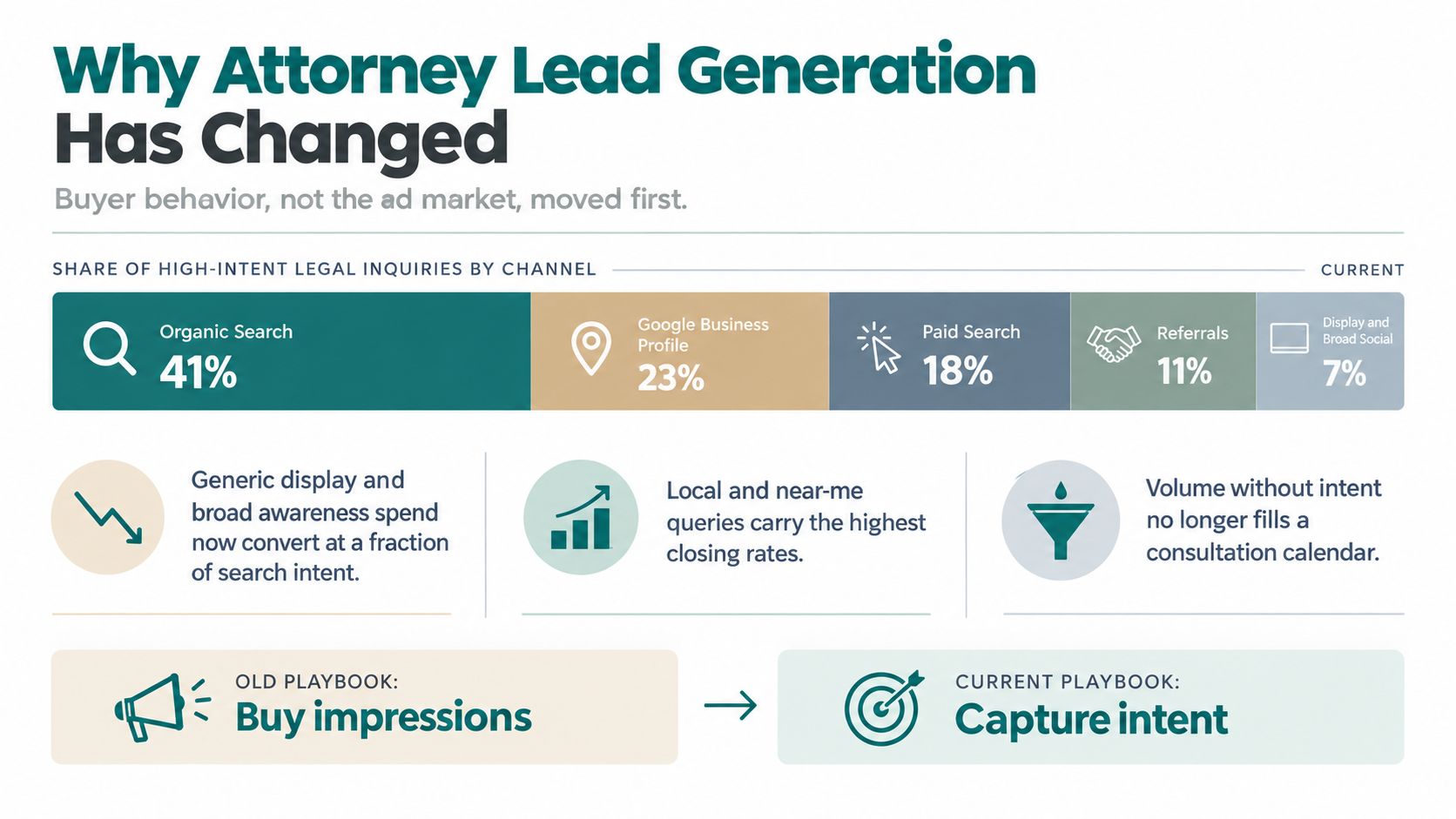
Why Attorney Lead Generation Has Changed
The old legal marketing model was simple. Build a reputation, collect referrals, maybe run some broad advertising, and wait for the phone to ring. That model isn't gone, but it isn't the center of the system anymore.
In 2005, the FindLaw and Thomson Reuters U.S. Consumer Legal Needs Survey found that 65% of consumers started with referrals and only 7% began on the internet. By 2014, legal-industry reporting cited by ABA Journal showed internet search at 38% while referrals fell to 29%, calling it a “complete flip.” More recent legal-consumer research shows 92.4% of legal consumers research their issue online before contacting an attorney, and 93.3% want to research attorneys further after finding them in search results. That's the shift that matters most in modern attorney acquisition, and it's outlined in this legal search behavior analysis.
Search changed the front half
People don't discover attorneys the way they used to. They search symptoms, not just lawyer names. They look for urgency, location, and proof. They compare firms before they ever speak to one.
That means your Google Business Profile, local SEO, practice area pages, reviews, paid search ads, and intake flow all work together. You can't treat them as separate projects.
Practical rule: Stop counting clicks and form fills as success. Count signed matters by source.
The bottleneck moved to the back half
Most firms don't have a pure lead-volume problem. They have a lead-handling problem. Good leads arrive, then sit in voicemail, get routed to the wrong person, receive no follow-up text, or disappear into a spreadsheet no one trusts.
A modern attorney lead generation system has four parts:
- Audience targeting: Who you want, who you don't, and which matters are worth pursuing.
- Channel mix: Where high-intent prospects find you.
- Conversion engine: The landing page, form, call flow, and follow-up process that turn interest into consultations.
- Measurement: The dashboard that ties spend to retained matters.
If you're deciding where to spend the next dollar, tighten the back half first. More traffic into a weak intake system just creates more waste.
Defining the Right Client and Practice Areas
Most firms skip the hard part and go straight to channels. That's backward. Before you buy ads, hire an SEO partner, or redesign your site, decide which matters deserve your attention.
Start with economics, not guesswork
Every practice area doesn't justify the same marketing investment. Rank each one by three practical criteria:
- Average case value
- Realistic close rate
- Operational fit for your attorneys and staff
If a matter type creates heavy intake work, weak close rates, and thin margins, it shouldn't get priority just because it brings volume. Busy isn't the same as profitable.
Here's a simple planning sheet to force clarity.
| Practice Area Prioritization Matrix | Avg. Case Value | Close Rate % | Monthly Lead Goal | Priority Tier |
|---|---|---|---|---|
| Personal Injury | High | A | ||
| Family Law | Medium | B | ||
| Estate Planning | Medium | B | ||
| Criminal Defense | Varies | C | ||
| Employment Law | Varies | C |
Use this as a working document, not a polished report. Fill in the blanks from your own matter history, then cut the low-value distractions.
Build one-page client profiles
For each priority area, create a short profile your intake team and marketing partner can use.
Include:
- Who they are: Age range, household situation, business owner or consumer, local service radius.
- Why they act now: Injury, arrest, divorce filing, probate deadline, employer action, contract dispute.
- What makes them hesitate: Fees, fear, confusion, timing, whether they think they even need counsel.
- What disqualifies them: Wrong jurisdiction, conflict, matter too small, issue outside your scope.
This isn't branding fluff. It's the operating brief for your marketing.
Firms that define disqualification rules early usually respond faster because intake doesn't waste time debating obvious bad fits.
Match profiles to search behavior
A person searching “do I need a lawyer after a car accident” is in a different stage than someone searching “car accident attorney near me.” If you don't map those differences, your campaigns get sloppy.
Use three simple buckets:
- Informational searches: Early research. Good for content and education.
- Local comparison searches: Looking for firms in a geography. Good for local SEO and Google Business Profile.
- Transactional searches: High-intent searches tied to contacting a lawyer now. Good for dedicated landing pages and paid search.
That document should drive everything that follows. Keyword lists, ad copy, page layout, review requests, and intake scripts all get better when they're built around a defined client, not a vague market.
Choosing Channels That Actually Produce Signed Matters
Search dominates legal demand. That does not mean every search-driven tactic deserves budget.
The firms that win signed matters usually do three things better than their competitors. They answer fast. They track the source of the lead. They follow up without relying on a busy receptionist to remember the next call. Channel selection should support those three jobs. If it does not, the channel will look busy in reports and weak in signed cases.
Four channels worth real investment
| Attorney Lead Generation Channel Comparison | Avg. Cost Per Lead | Time to First Lead | Scalability | Best For |
|---|---|---|---|---|
| Local SEO and Google Business Profile | About $183 for SEO leads based on one benchmark summary | Slower build | Strong over time | Firms building owned visibility and map-pack calls |
| Legal SEO and content authority | About $183 for SEO leads based on one benchmark summary | Slower build | Strong over time | Practice areas with longer research cycles |
| Paid search | About $442 for Google Ads leads based on one benchmark summary | Fast | Flexible but expensive | High-intent demand capture |
| Referral partnerships | Varies | Moderate | Limited by relationship network | High-trust matters and higher close rates |
The SEO and Google Ads cost benchmarks above come from Thrive Search's attorney lead generation summary.
Here is the priority order I recommend for small and mid-sized firms this quarter.
Start with paid search if you need demand now and you have someone who can answer calls in minutes, not hours. Paid search is the fastest way to test practice-area demand, message fit, and intake responsiveness. It also exposes operational problems quickly. If consults are not being booked, the issue is often intake speed or follow-up, not the ad account.
Build local SEO and Google Business Profile at the same time, but treat it as an asset, not a quick fix. Map visibility, reviews, practice-area relevance, and location signals reduce your dependence on ads over time. Firms that want a tighter search strategy should review practical guidance on SEO for law firms, because rankings matter only if they produce calls you can trace to retained clients.
Use legal SEO and content selectively. It works best for matters where prospects research before they contact anyone, such as estate planning, probate, business disputes, and some family law work. Publish content that moves a prospect toward contact. Do not build a library of articles that attract traffic from people who will never hire you.
Keep referral partnerships active, but formalize them. Casual networking is not a channel strategy. Set a list of referral partners, define the matter types you want, give them a direct intake path, and report back on outcomes. Referral sources keep sending cases when your process makes them look good.
Budget allocation that reflects reality
Spreading budget across five channels usually produces five weak datasets and no clear winner.
Use one primary acquisition path and one supporting path. For many firms, that means paid search for immediate demand and local SEO for cost control over the next two to four quarters. If referral relationships already produce strong matters, treat them as a third lane, but still measure them the same way as paid channels.
A simple rule works well:
- Need cases now: Put the larger share into paid search.
- Need lower acquisition cost over time: Keep investing in local SEO and review generation.
- Need better case quality: Strengthen referral partners and tighten disqualification rules in intake.
The common mistake is blaming the channel when the failure happens after the form fill or missed call. If your team wants a practical look at that handoff, this guide on mastering lead generation for attorneys is useful because it focuses on appointment setting, where many firms lose qualified prospects they already paid to acquire.
What earns more budget
Do not give a channel more money because it generated more leads.
Give it more money when you can prove four things:
- The source is tracked correctly
- Response time stays fast
- Follow-up runs until the prospect books or declines
- Signed matters justify the cost
That standard changes channel decisions. A referral source with fewer leads may deserve more attention than a paid campaign with a lower close rate. A high-volume SEO page may deserve less attention if it attracts the wrong matters. Signed cases decide the winner. Everything else is activity.
Building the Conversion Engine Behind the Campaigns
Campaigns don't fail only because of bad targeting. They fail because too many firms send high-intent traffic into a weak conversion path.
The build list is straightforward. The execution usually isn't.
Every priority practice area needs its own path
Start with a dedicated page for each practice area. Not a general “services” page. Not a generic contact page. A real page tied to one user intent.
That page should include:
- A headline that matches the search or ad intent
- A short explanation of how the firm helps with that matter type
- Bar admissions, attorney bios, awards, or other trust signals
- A single primary call to action
- Click-to-call and live chat options near the top of the page
- A mobile-first design that doesn't bury contact options
If you're evaluating site structure, page speed, and layout as part of this process, a resource like law firm website design is worth reviewing because conversion problems often start with page architecture.
Keep forms short, then qualify in stages
Your intake form shouldn't feel like a deposition. Ask for the minimum needed to start the conversation, then collect deeper case details in the next step.
| Conversion Engine Build List vs. Business Impact | Must-Have Elements | Impact on Signed Matters |
|---|---|---|
| Practice area landing page | Search-matched headline, trust elements, one CTA, click-to-call | Improves message match and consultation starts |
| Intake form | Mobile-first, short first step, clear consent language | Reduces abandonment while preserving qualification |
| CRM routing | Lead source capture, assigned owner, status stages | Prevents lead loss and improves accountability |
| Auto-response workflow | Immediate email or text acknowledgment | Keeps prospects engaged before a human responds |
| Follow-up tasking | Same-day call task and next-day reminder | Increases contact rate and reduces missed opportunities |
Speed matters more than most attorneys think
Public benchmarks cited for legal lead conversion place shared leads at about 5% to 12% and exclusive leads at 15% to 30% or higher. The same benchmark content says strong personal injury intake systems often average 10% to 15%, with top-performing firms reaching 25%+ when they combine sub-5-minute response times with optimized intake, according to LexGro's legal lead conversion benchmarks.
That's the lesson. Intake speed isn't a customer service detail. It's a revenue driver.
Your CRM workflow should do four things automatically:
- Capture lead source from form, call tracking, chat, or campaign tag.
- Assign ownership immediately so no inquiry sits unclaimed.
- Send an instant acknowledgment so the prospect knows the firm received it.
- Create the next follow-up task without relying on memory.
A lead that waits for a callback usually keeps shopping.
If you want one Cincinnati-area option for putting this together, Helbling Digital Media builds law firm websites, SEO systems, and conversion-focused workflows that connect traffic sources to consultations and signed matters. That's the right scope to look for in any agency or consultant, whether you use HDM or someone else.
Ethics and Compliance Guardrails for Legal Advertising
Legal marketing doesn't get to use the same shortcuts as other industries. Good campaign design starts with compliance, not creative.
What needs review before launch
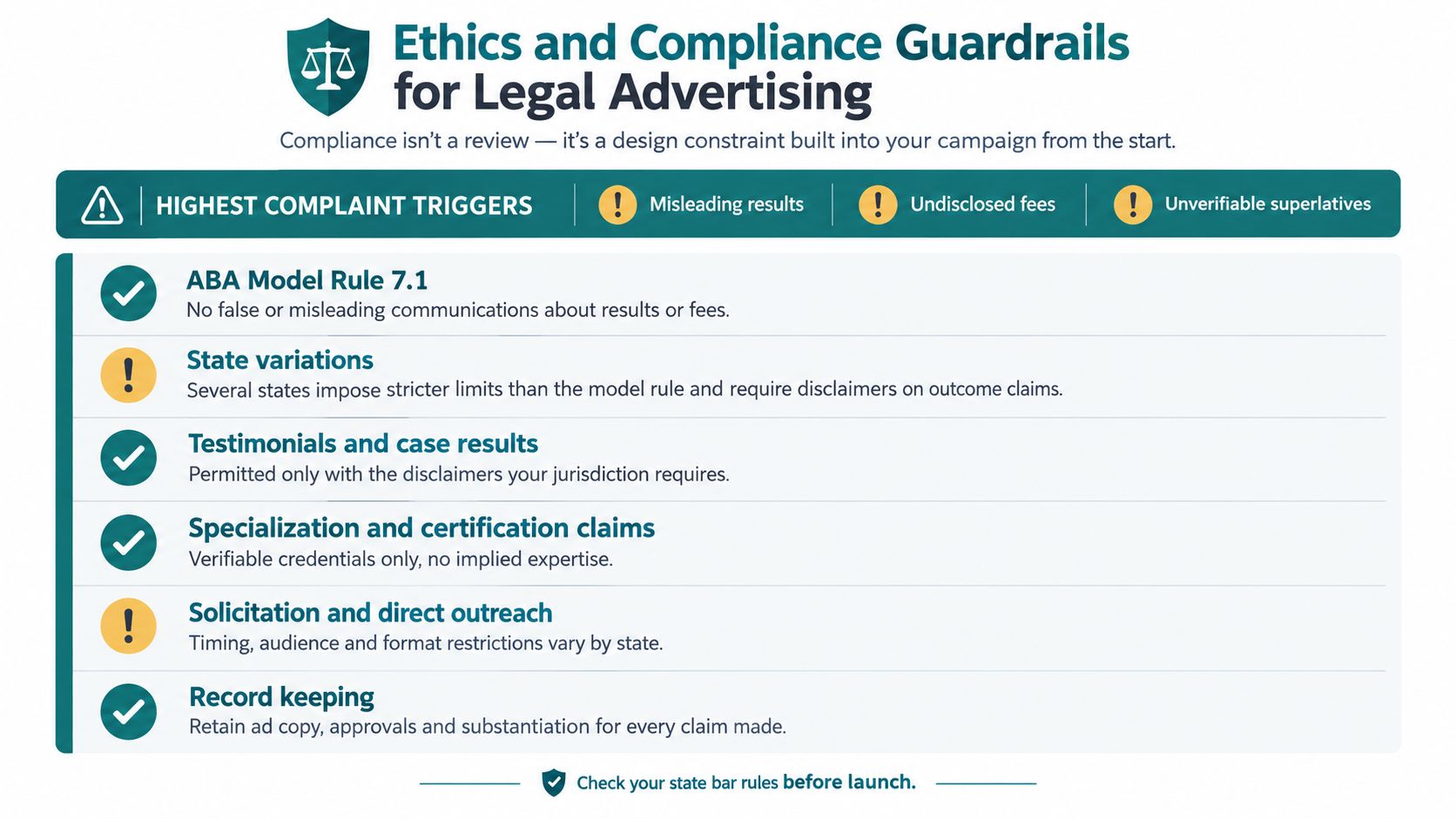
ABA Model Rule 7.1 and state-level variations should shape your ad copy, landing pages, intake scripts, and review strategy. The practical issues that trigger trouble are usually predictable:
- Misleading results language: Don't imply guaranteed outcomes.
- Unverifiable superlatives: Terms like “best” or “top” need substantiation if your state allows them at all.
- Case result claims without context: Some jurisdictions require disclaimers.
- Specialization language: Only use certification or specialist claims when they're verifiable and permitted.
- Testimonials and endorsements: State rules vary. Some require disclosure language.
- Fee language: Be precise about contingency structures, consultation terms, and expenses.
For firms that want a practical overview of campaign review and documentation, digital marketing compliance is a useful reference point.
Intake compliance matters too
The risk doesn't end when someone fills out a form. Your intake process needs consent capture for calls, texts, and recorded communications where applicable. If your team uses SMS reminders, recorded lines, or outsourced staff, document exactly how consent is obtained and stored.
This is also where staffing choices matter. Some firms use a law firm virtual assistant to extend responsiveness outside normal office hours. If you go that route, train them on your jurisdiction's solicitation and intake rules before they touch a lead.
A quick explainer can help your team understand the issue before approval and launch:
<iframe width="100%" style="aspect-ratio: 16 / 9;" src="https://www.youtube.com/embed/JffTARMRm5Q" frameborder="0" allow="autoplay; encrypted-media" allowfullscreen></iframe>The guardrails that keep campaigns clean
Build a repeatable review process. Don't rely on memory.
Keep a dated archive of every ad, landing page, disclaimer, approval, and revision. If a bar question ever comes up, documentation matters.
Use a simple operating checklist:
- Attorney approval: Require sign-off before launch.
- Copy archive: Save every active and retired version.
- Quarterly audit: Review pages, ads, forms, and testimonials.
- Referral documentation: Avoid sloppy arrangements that create fee-splitting risk.
- Intake training: Make sure staff know what they can and can't say.
Compliance slows down careless firms. It doesn't have to slow down organized ones.
Measuring What Matters and Optimizing Monthly
81% of firms report losing business because follow-up is too slow. That number matters here for one reason: monthly optimization should start with intake performance and signed matters, not traffic charts.
The only four KPIs that belong on page one
Put these four numbers in front of every managing partner each month:
- Cost per signed matter by channel
- Speed-to-lead in minutes
- Consultation-to-retain conversion rate
- Average case value
Those metrics expose the actual constraint. A campaign can produce cheap leads and still fail if intake responds late, source capture breaks, or follow-up stops after one call.
As noted earlier, attribution gaps are common. The fix is operational, not theoretical. Use CRM stages your intake team will actually maintain, require source capture on every inquiry, and review signed-matter performance by channel every month.
Build attribution your intake team can keep accurate
Keep the funnel simple:
- Lead
- Consulted
- Retained
- Signed matter
Then enforce source capture at the first touch and preserve it through the full intake process. Every form fill, tracked call, chat, and booked consult needs a source, campaign, and practice area attached inside the CRM. If intake staff have to guess later, the report is useless.
Benchmark data can help with context, but don't run the firm by cost-per-lead averages alone. Analysts at JLB Works' law firm marketing benchmarks summary cite a 5.55% average Google search ad conversion rate for Attorneys and Legal Services. Fine. That tells you almost nothing if your office takes two hours to return calls and never logs no-shows, disqualifications, or retainers by source.
Use monthly reporting to answer three direct questions:
| Monthly Review Questions | What to Check | What to Do |
|---|---|---|
| Which channels produced signed matters at an acceptable cost? | Signed matters, total spend, case value | Shift budget toward profitable channels |
| Where is conversion breaking? | Response time, consult rate, retain rate by source | Fix intake scripts, routing, and follow-up sequence |
| Which campaigns create qualified consultations, not just volume? | Practice area, disqualification reasons, no-show rate | Cut low-fit traffic and tighten targeting |
Run a monthly review that changes budget and process
Hold one 30-minute review every month. Pull the last 30 days by channel, practice area, and intake rep. Look for delays, drop-off points, and source patterns tied to retained clients.
Do not stop at marketing metrics. Compare response time against consultation rates. Compare consultation rates against retained matters. Then check whether your highest-volume sources also produce your highest-value cases. They often don't.
If your team is evaluating reporting platforms, use the same standard you use for campaigns. Decision value first. Some of the frameworks discussed in these LinkedIn analytics tools reviews are useful because they focus on which reports help a team act, not which dashboard looks polished.
If a channel cannot show a believable path to signed matters after a fair test, rework it fast or cut it.
A 90-Day Rollout Plan and Final Checklist
Most firms don't need another strategy deck. They need a sequence they can execute this quarter.
Days 1 through 30
Fix the foundation first. That means choosing priority practice areas, defining ideal clients, reviewing disqualification rules, and repairing measurement gaps.
| 90-Day Attorney Lead Generation Rollout by Phase | Focus | Key Deliverables | Exit KPI |
|---|---|---|---|
| Days 1-30 | Foundation | Practice area priorities, client profiles, call tracking, CRM stages, compliance review, intake script updates | Clean source tracking and response process in place |
| Days 31-60 | Launch | Practice area pages, one paid campaign, dedicated landing page, referral outreach, automated routing | Leads routed correctly and responded to quickly |
| Days 61-90 | Optimization | Weekly attribution checks, form testing, keyword pruning, budget reallocation, signed-matter reporting | Budget concentrated in channels producing retained clients |
This first phase is where most of the opportunity sits. If your tracking, scripts, and routing are messy, don't pile more spend on top of them.
Days 31 through 60
Launch one focused campaign, not five. Build a dedicated page for the top matter type, connect it to one paid search campaign or one strong local SEO push, and give intake a clear script for that audience.
At the same time, formalize referral outreach. Reach out to accountants, therapists, physicians, business attorneys, estate planners, or other adjacent professionals depending on your practice mix. Keep it structured. Track every referral source the same way you track digital leads.
Days 61 through 90
The third phase is where discipline separates firms that learn from firms that drift. Review source quality weekly. Adjust budget based on retained matters, not lead counts. Test one variable at a time on forms and landing pages.
Use this closing checklist:
- Tighten intake before increasing spend
- Track every source into the CRM
- Give each priority practice area its own page and call flow
- Respond fast and follow up automatically
- Review compliance before launch, not after
- Move budget only toward channels that produce signed matters
That checklist is blunt because it needs to be. Attorney lead generation isn't a mystery. It's an operations problem with a marketing front end.
If your firm needs help connecting web design, SEO, paid search, and intake into one system, Helbling Digital Media works with law firms on exactly that kind of revenue-focused setup. If you're in Cincinnati and tired of vague marketing reports, start with a review of your current lead sources, intake speed, and signed-matter attribution.