

A lot of Cincinnati law firms are sitting on the same problem. They paid for a polished website, approved the attorney bios, added practice area pages, and launched with real expectations. Then the phone barely moved.
That usually isn't a design problem. It's a visibility problem.
If your firm doesn't show up when someone searches for help, your site may as well not exist. That's the hard truth behind SEO for law firms. Prospective clients don't care how much the website cost. They care whether they can find you, trust you, and contact you fast.
For small and mid-sized firms in Cincinnati, that creates a very practical question. What drives new matters online, and what just sounds good in a pitch deck? The answer starts with the basics, then moves into two areas many firms miss entirely: staying inside ethical guardrails and adapting your content for AI-driven search.
Why Your Website Is Invisible to Potential Clients
The common scenario looks like this. A firm launches a new site, gets compliments on the look, maybe runs a few ads, and waits for leads. Months later, the site has traffic reports, but not enough consultations.
The reason is simple. Nearly 96% of individuals seeking legal advice initiate their research using a search engine, and organic search drives approximately 52.6% of total website traffic for law firms according to legal marketing statistics. If your firm isn't visible in search, you're missing the main path people use to find counsel.
A good-looking site can still fail
A modern law firm website needs to do three jobs at once:
- Show up in search: If Google can't understand the site, prospects won't see it.
- Match local intent: Someone in Cincinnati doesn't search the same way as someone across the country.
- Convert interest into contact: Rankings alone don't bring in cases. Clear calls, trust signals, and usable pages do.
Many firms invest heavily in the third piece and barely touch the first two. That's backwards.
Practical rule: Design supports trust. Search visibility creates the opportunity for trust in the first place.
What prospects are actually doing
A potential client in Anderson Township or downtown Cincinnati usually doesn't begin with your brand name. They search for the problem. That might be a practice area, a legal process, or a location-based phrase tied to urgency.
That means SEO for law firms isn't about gaming Google. It's about making your firm discoverable at the moment someone needs representation. Tools can help with the research side. If you're comparing platforms, an overview of SEO software for lawyers gives a useful look at how firms organize keyword, local, and listing work.
What works and what doesn't
A few patterns are consistent.
| Approach | What happens |
|---|---|
| Broad service language | Pages sound professional, but don't align well with how prospects search |
| City and practice-specific pages | Search engines get clearer relevance signals |
| Thin blog posts written for volume | Rarely build trust or rankings in a competitive legal market |
| Detailed pages that answer real client questions | Better fit for both search visibility and conversion |
The firms that gain traction usually stop treating SEO as a side task. They treat it as part of client acquisition. That's the right frame, especially in a market like Cincinnati where local intent and trust matter as much as legal credentials.
The Technical Foundation for Search Visibility
Before content, before backlinks, before any serious ad spend, your site needs a clean technical base. If the website is slow, hard to crawl, poorly structured on mobile, or sending mixed signals to search engines, everything built on top of it becomes less effective.
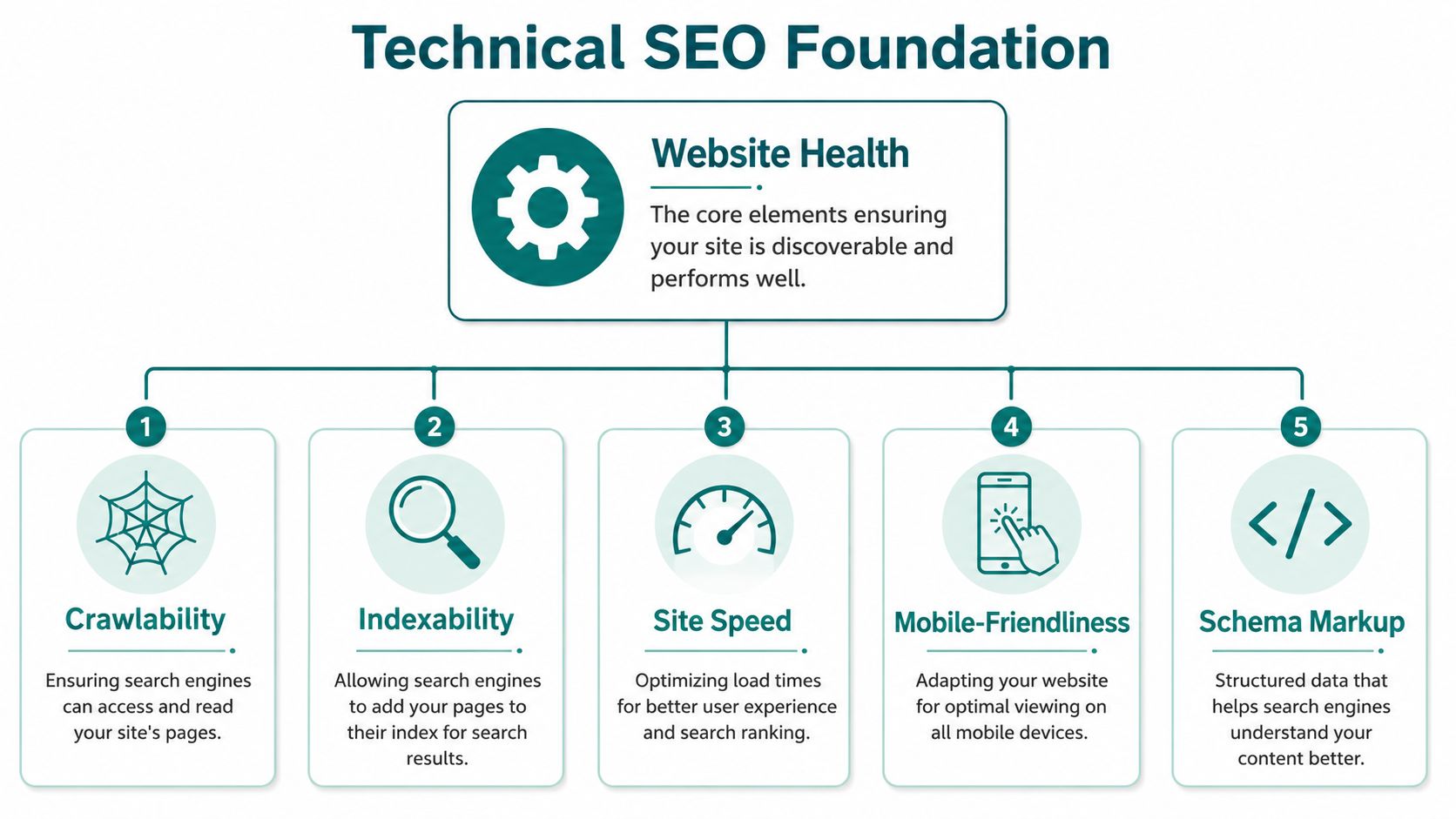
A technical SEO audit is just a systematic check of whether your site is usable for both people and search engines. For law firms, that usually includes Google Search Console, XML sitemaps, robots.txt, canonical tags, page speed, mobile-first performance, and schema markup such as LegalService.
What the audit needs to catch
Think of technical SEO as an inspection, not a marketing tactic. You're checking whether the structure underneath the site supports visibility.
- Crawlability: Search engines need to access the pages you want indexed.
- Indexability: Important pages must be eligible to appear in search results.
- Speed: Slow pages lose users early, especially on mobile.
- Mobile usability: Most legal searches happen on phones during stressful moments.
- Schema markup: Structured data helps search engines understand your services and locations.
A lot of firms skip this because it's not glamorous. That's a mistake.
Firms that implement thorough technical health checks, like optimizing for Core Web Vitals, see a 40% reduction in bounce rates and a 25% increase in consultation bookings within six months according to technical SEO research for lawyers.
What this means in business terms
If a personal injury page takes too long to load, the prospect leaves before reading it. If duplicate titles confuse search engines, the wrong page may rank. If your mobile layout forces users to pinch and zoom, they often give up and call someone else.
Those are not abstract SEO issues. They're intake problems.
Slow websites don't just rank worse. They waste demand you've already earned.
The pieces I'd fix first
For a Cincinnati law firm, the first pass is usually straightforward:
- Set up measurement correctly. Google Search Console and analytics should be installed and verified. Without them, you can't diagnose indexing, query visibility, or user behavior.
- Clean up page architecture. Each practice area should have a clear place in the site structure. URLs should be readable and tied to services.
- Improve speed on key pages. Compress large images, delay non-critical assets, and remove bloated plugins or scripts that don't support intake.
- Add legal schema. LegalService and LocalBusiness markup help clarify who you are, what you do, and where you serve.
- Check canonical tags and duplicate metadata. These are common problems on law firm sites built from reused templates.
If you want a benchmark for what a more structured engagement looks like, HDM's SEO services for growth marketing show the kind of work that usually sits under a proper legal SEO program.
What doesn't work
Technical SEO goes sideways when firms do one of two things. They either ignore it completely, or they obsess over obscure fixes while their service pages remain thin and weak.
The right approach is balanced. Get the foundation stable, then build authority on top of it.
Winning the Local Search Battle in Cincinnati
A prospective client in Hyde Park doesn't type "law firm website." They search for something close to their problem and their location. That might be a family law attorney in Cincinnati, a DUI lawyer near West Chester, or an estate planning attorney close to Blue Ash.
That local layer changes everything. Google isn't only deciding who is relevant. It's deciding who is nearby, credible, and active.
The map result often gets the first look
When someone searches with local intent, your Google Business Profile can do as much work as your homepage. If that profile is incomplete, inconsistent, or unmanaged, your visibility drops before the user even reaches your website.
Firms that fail to claim and optimize their Google Business Profile miss out on the #1 driver for Google Maps visibility. Those with 50+ verified reviews see a 70% higher click-through rate than competitors with fewer.
What a Cincinnati prospect sees
The search journey often looks like this:
- First glance: Map pack, review count, business category, office location
- Second filter: Practice fit, office photos, recent reviews, answers to common questions
- Decision point: Call from the profile, visit the website, or keep scrolling
That means local SEO isn't a side channel. For many firms, it's the front door.
A practical reference on enhancing local search visibility can help if you're evaluating how complete your profile setup really is.
The local signals that matter most
A firm trying to rank in Cincinnati should focus on signals that match real-world geography and service lines.
| Local element | What to check |
|---|---|
| Google Business Profile | Correct categories, services, office hours, photos, and an active Q&A |
| Location language on site | Practice pages should reflect Cincinnati-area search behavior without stuffing city names |
| Reviews | Recent, verified, client-generated reviews that describe actual service experiences |
| Consistency | Firm name, address, and phone details should match across directories and the website |
What firms usually get wrong
The biggest local SEO mistake is going too broad. A page titled "Family Law Services" tells Google far less than a page that clearly serves Cincinnati-area family law needs.
The second mistake is treating reviews as passive. Good firms wait for reviews to happen. Stronger firms build a compliant, repeatable process for asking at the right time, through the right channel, with the right wording.
If your firm serves Greater Cincinnati with multiple local audiences, it also helps to think in service-area patterns instead of generic regional language. This is where a local market view matters, and a city-specific lens like Cincinnati digital marketing support is often more useful than a national template.
Creating Content That Establishes Your Authority

Content is where many law firms either separate themselves or disappear into sameness. Most legal websites have the basic ingredients: a home page, attorney bios, and a short page for each practice area. The problem is that those pages often read like brochure copy.
That isn't enough anymore. Search engines need clarity, and potential clients need answers.
The old model was ranking pages. The new model is answering questions.
A traditional legal SEO plan focused on pages like "divorce lawyer Cincinnati" or "personal injury attorney Ohio." Those still matter. But search behavior has shifted toward detailed, conversational questions, especially inside AI tools and AI-generated search results.
Recent data shows that 65% of users now start legal searches with AI tools, yet only 12% of law firm websites are optimized for AI Overviews.
That gap matters because AI systems prefer content that is structured, direct, and easy to extract.
What strong legal content looks like now
A useful law firm page should do more than mention a practice area. It should guide the reader.
- Lead with the core issue: State the legal problem in plain English.
- Explain the process: Tell visitors what usually happens next.
- Address common objections: Cost, timing, court process, documentation, and urgency often decide whether someone calls.
- Add question-based sections: FAQs help both users and AI-driven search tools understand the page.
- Show who is responsible for the content: Attorney review and clear firm attribution build trust.
If a page can't answer a stressed client's first five questions, it probably won't perform well in search either.
A better content structure for Cincinnati firms
For example, a family law page shouldn't stop at "Our attorneys handle divorce and custody matters." It should answer practical questions tied to local intent, such as what filing looks like, how parenting issues are handled, what documents matter, and when to contact counsel.
A smart structure often includes:
- A core practice area page. This targets the main service and local market.
- Supporting FAQ content. Short pages or sections that answer specific client questions in natural language.
- Process-driven articles. Content that explains what happens after an arrest, injury, filing, or dispute.
- Credibility pages. Attorney bios, bar admissions, office details, and firm values matter more in legal SEO than many firms realize.
For firms comparing legal-sector marketing support, HDM's legal industry page is a practical example of how agencies frame legal growth work around visibility, trust, and conversion instead of just rankings.
What doesn't work anymore
Thin blog posts written only to hit keywords don't hold up well. Neither do city pages with minor wording changes and no real local value. AI-driven search has made that even more obvious.
The firms gaining visibility now publish content that sounds like a lawyer explaining the issue clearly to a prospective client. That's the standard to aim for.
Ethical Marketing and Building Digital Trust
Law firm SEO gets riskier when marketing advice ignores professional rules. Generic local SEO guidance often says the same things. Get more reviews, create more city pages, claim more listings, and write stronger calls to action.
That advice can create problems for attorneys.
Seventy-eight percent of law firms report that ethical compliance is their top marketing concern, yet few SEO guides provide actionable frameworks for balancing conversion optimization with bar association regulations.
Reviews need a policy, not improvisation
Most firms understand that reviews influence trust. Fewer have a documented process for requesting them ethically.
A safer framework looks like this:
- Ask consistently, not selectively: Don't create the appearance of manipulating public perception by only chasing praise in an aggressive or misleading way.
- Keep the request neutral: Invite feedback without coaching language, pressure, or suggested claims.
- Avoid incentives: Anything that looks like compensation for a positive review creates obvious risk.
- Protect confidentiality: A client's review may reveal facts. Your response should not reveal more.
Caution: The right review strategy protects the client relationship first and the ranking benefit second.
Jurisdiction pages can cross the line
A lot of location SEO tends to get sloppy. A firm wants to rank in more surrounding areas, so it publishes city pages for every nearby market. The content implies presence or authority in places where the firm may not have an office, or where the page doesn't clearly explain licensed jurisdictions.
That's not just weak SEO. It can become misleading advertising.
A better approach is to make jurisdiction and service area language explicit:
| Risky approach | Better approach |
|---|---|
| Implying you "serve everywhere" | Clearly state office locations and licensed jurisdictions |
| Using vague city pages | Publish location content tied to real service relevance and clear disclosures |
| Overpromising outcomes in copy | Use factual, process-oriented language |
| Responding to reviews with case detail | Keep responses brief, professional, and non-substantive |
Trust signals that help both ethics and SEO
The overlap between compliance and search performance is stronger than many firms think. Search engines reward clarity and credibility. So do prospective clients.
That means your site should make these points easy to verify:
- Who wrote or reviewed the content
- Where the firm is licensed and located
- How the firm can be contacted
- What the firm handles
- Which statements are informational versus legal advice
Lawyers don't need louder marketing. They need cleaner marketing. That's what builds digital trust without creating avoidable exposure.
Your 6-Month SEO Action Plan and Scorecard
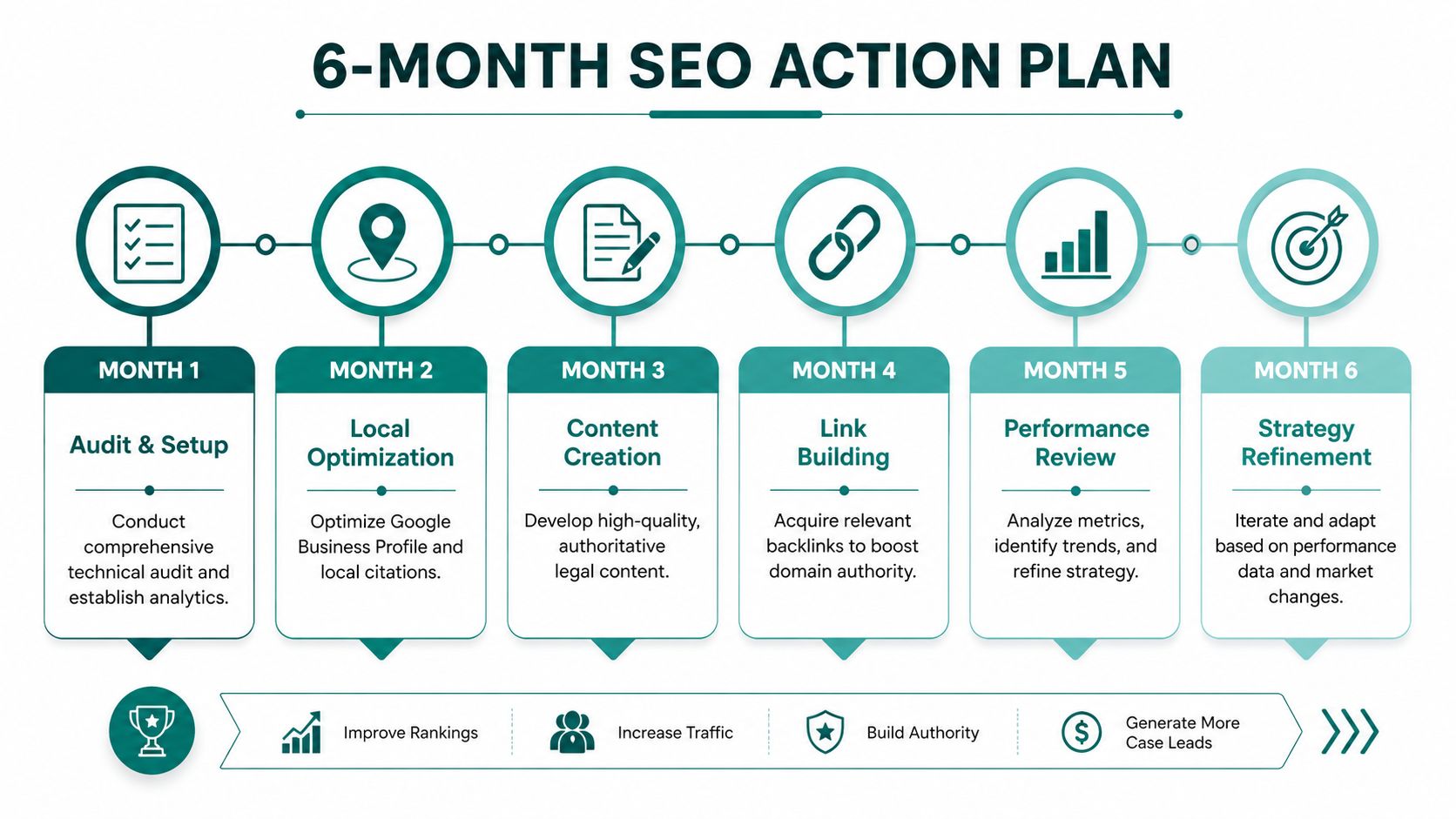
SEO for law firms works best when it's run like an operating plan, not a collection of random tasks. For Cincinnati firms, patience matters. A foundational 4 to 6 month timeline is required for Cincinnati-based firms to see significant ranking improvements.
That timeline isn't a delay. It's the normal period required for technical fixes, content improvements, local signals, and authority work to build on each other.
A practical six-month roadmap
| Month | Primary focus | What should happen |
|---|---|---|
| Month 1 | Audit and setup | Fix technical issues, verify tracking, review page structure |
| Month 2 | Local optimization | Improve Google Business Profile, clean up listings, align local page copy |
| Month 3 | Content creation | Build or rewrite key practice pages and FAQ content |
| Month 4 | Authority building | Pursue reputable legal publication mentions, local citations, and review process improvements |
| Month 5 | Performance review | Compare landing pages, identify weak conversion paths, refine internal linking |
| Month 6 | Strategy refinement | Double down on pages and topics generating consultations and local visibility |
The scorecard that matters
Too many reports focus on vanity metrics. Rankings and traffic matter, but they aren't enough on their own. The law firms that manage SEO well track business signals.
The top SEO metrics law firms should track include organic conversion rate, local search visibility, and duplicate titles and descriptions.
Use a scorecard that includes:
- Organic conversion rate: Are search visitors calling or submitting forms?
- Local search visibility: Are you appearing in map results for your target services?
- Top landing pages: Which service pages attract qualified traffic?
- Duplicate metadata issues: Are technical errors weakening relevance?
- Call and form tracking: Can you tie intake back to specific pages and channels?
If you're building reporting from scratch, a guide for effective SEO tracking is a practical reference for setting up a cleaner measurement process.
A good SEO plan should let a law firm partner answer three simple questions every month. Are we easier to find, are the right people reaching us, and are more of them becoming consultations?
If your Cincinnati firm is weighing whether to rebuild the site, fix local visibility, or create a more disciplined SEO program, HDM is one local option to evaluate. The useful standard isn't a polished proposal. It's whether the team can explain the trade-offs clearly, build around your practice areas and intake process, and show how technical, local, content, and compliance work fit together.