


86% of Americans had used online platforms to get medical advice in the previous year, according to a 2024 Tebra survey of 1,002 people (Tebra). That figure reframes what a healthcare website is for. For many who eventually walk into a clinic, the first conversation about their health didn't happen at a front desk. It happened on a screen, often days or weeks earlier, while they were deciding whether the problem was serious enough to act on.
Seo in healthcare in 2026 looks different from the version many agencies still sell. The old playbook was volume: publish fifty articles about conditions, load the service pages with keywords, buy a link package. That approach now competes with AI answers that summarize the question before anyone clicks, and it collides with a compliance rule many marketers ignore, which is that tracking a symptom search can create a privacy obligation.
What still works is narrower and cheaper than most owners expect: one page per patient question, a Google Business Profile that matches reality, medical content with a named clinician behind it, and measurement built on totals rather than individuals. Get those four right and a small practice can outrank a hospital system on the searches that fill a schedule.
Why Patients Search Before They Call
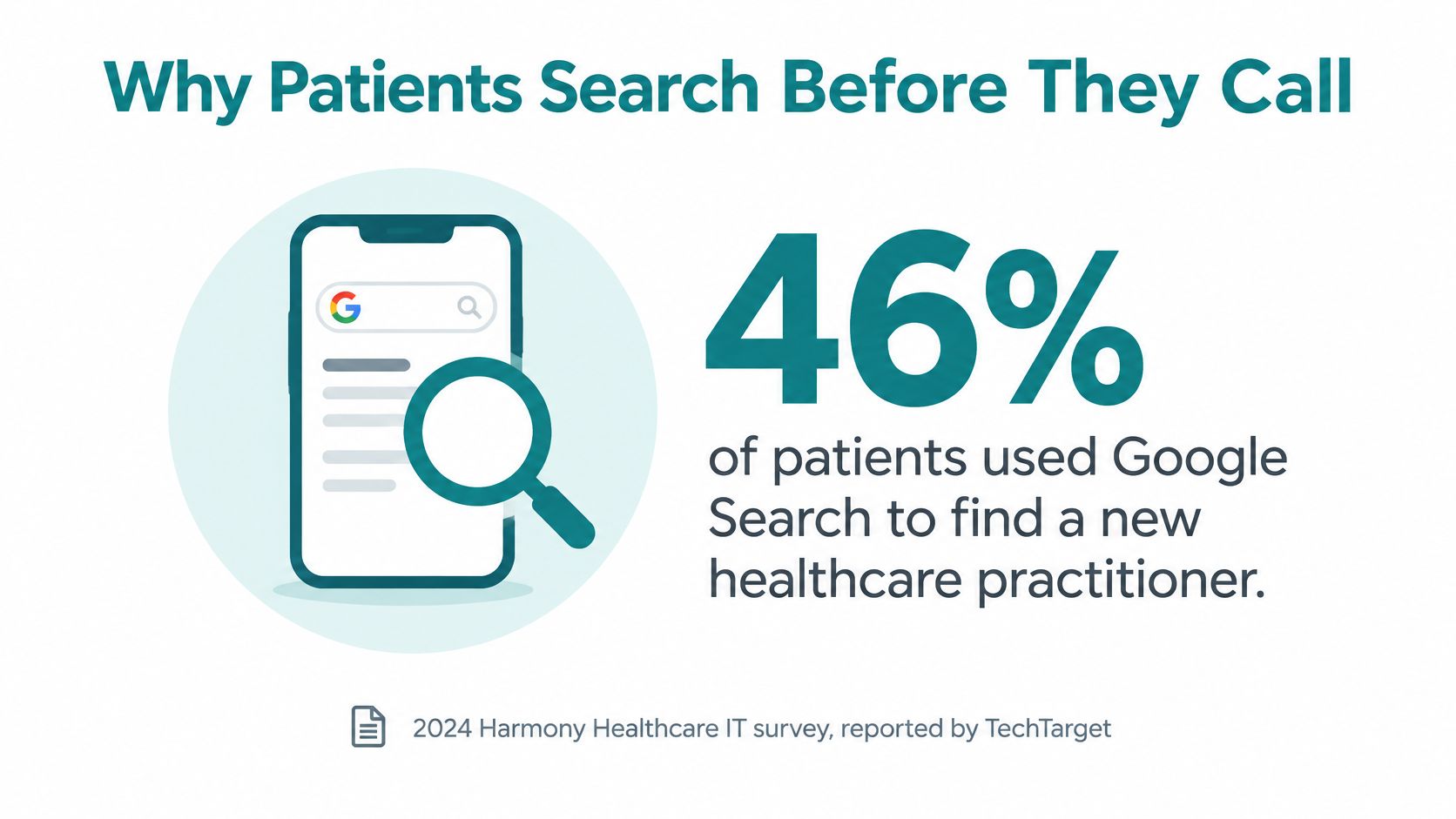
Forty-six percent of patients used Google Search to find a new healthcare practitioner, according to a 2024 Harmony Healthcare IT survey reported in TechTarget's Patient Engagement coverage. Almost half of new-patient acquisition starts in a search box, not a referral pad.
A patient in Mason notices an ache in a molar on a Sunday night. She doesn't call anyone. She types. She reads three pages, compares two practices, checks which one opens at 7 a.m. on a map listing, and calls on Monday. By the time your receptionist answers, most of her decision is already made, and your website either helped her decide or never entered the race.
Search does three jobs before a phone rings. It helps a person name what's wrong. It shows who nearby can help. It makes one practice easier to trust than the next.
A handsome site that never appears for those searches is a locked door on a side street. Plenty of Cincinnati practices have one: good photography, a warm welcome video, and no page that answers "why does my knee hurt when I climb stairs."
The behavior isn't new, only the tools around it. In Pew Research Center's 2013 health tracking study, 72% of internet users had looked online for health information during the previous year, and 77% of online health seekers said their most recent session began at a general search engine (Pew Research Center). The starting point held. The competition around it got fiercer.
What follows is the order I'd work in with a Cincinnati clinic. First, the patient questions that deserve their own page. Then how local map results work in a market crowded with hospital brands and one-doctor practices. After that come the trust signals health pages need, a page set you can copy, and a way to count leads without turning a symptom search into a privacy problem. You don't need to learn code. You need a standard before you pay for design or an SEO retainer.
Match Each Search to the Right Page
Start with the map, not a keyword list. A patient moves through stages, and each stage is a different search with a different job. This is the working list I'd hand to a writer or an agency, one row per page.
| Search stage | What they type | Page to publish | Must include |
|---|---|---|---|
| Naming a symptom | sore knee, chest pain, anxiety symptoms | Symptom or condition page | Plain explanation, when to seek care, link to the right service |
| Learning the condition | what is rotator cuff tear | Condition hub | Who it affects, how it is evaluated, related services |
| Comparing treatment | knee replacement recovery, therapy options | Treatment or procedure page | What you offer, who qualifies, risks, preparation, follow-up |
| Choosing a provider | orthopedic doctor near me | Clinician biography | Credentials, conditions treated, photo, locations, how to book |
| Checking the place | clinic hours Cincinnati, parking, insurance | Location and service-access page | Address, hours, map, insurance, phone |
| Ready to act | book appointment, new patient forms | Contact or appointment page | Click-to-call, request form, what happens next |
The evidence for splitting pages this way comes from actual search histories, not surveys. A 2019 observational study in BMJ Open analyzed Google activity from 103 emergency-department patients and captured 591,421 unique queries, of which 6% were health-related (BMJ Open). In the seven days before the visit, health searches rose to 15% of participants' search activity. During that window, 56% searched for symptoms, 53% searched for information about a hospital, and 23% searched for treatment or management.
Why each row exists
Two facts sit inside that pattern. Search happens right before real care, not months ahead of it. And more than half of those patients were evaluating a place to go, not just a diagnosis to understand.
- Symptom pages teach in plain language and say when to get seen, then hand off to the service that treats the problem.
- Service and treatment pages explain what this practice does, who qualifies, and what the first month looks like.
- Clinician pages carry credentials, the conditions that person treats, and the office where they see patients.
- Location pages answer where, when, parking, and which insurance plans are accepted.
- Contact pages make the call or the request form the most obvious thing on the screen.
Practical rule: if a page can't answer one question completely, it isn't finished. Split it rather than pad it.
Where clinics go wrong
Don't force the homepage to rank for every service in Greater Cincinnati. A homepage trying to be a cardiology page, a physical therapy page, and a billing FAQ at once gives Google nothing specific to match and gives patients nothing specific to read.
Urgent symptoms need different handling again. If a symptom can be serious, say so in the first screen and send people to emergency care or your urgent line. A soft sales line where a warning belongs costs trust, and in a real emergency it costs more than that.
After you read the table, write down the five questions your front desk hears most often. Then check whether a dedicated page answers each one. Most practices find two or three gaps in under an hour.
Get Found in Cincinnati Local Results
Most care decisions are local even when the question isn't. Someone in Springboro searches a symptom, reads a national page, then searches again for a practice within a short drive. The short list of three businesses that appears above the regular results, with a pin, star rating, hours, and a call button, is usually the first impression a practice gets.
The map pack works like a digital door sign, and the checklist in the graphic is what patients read on it.
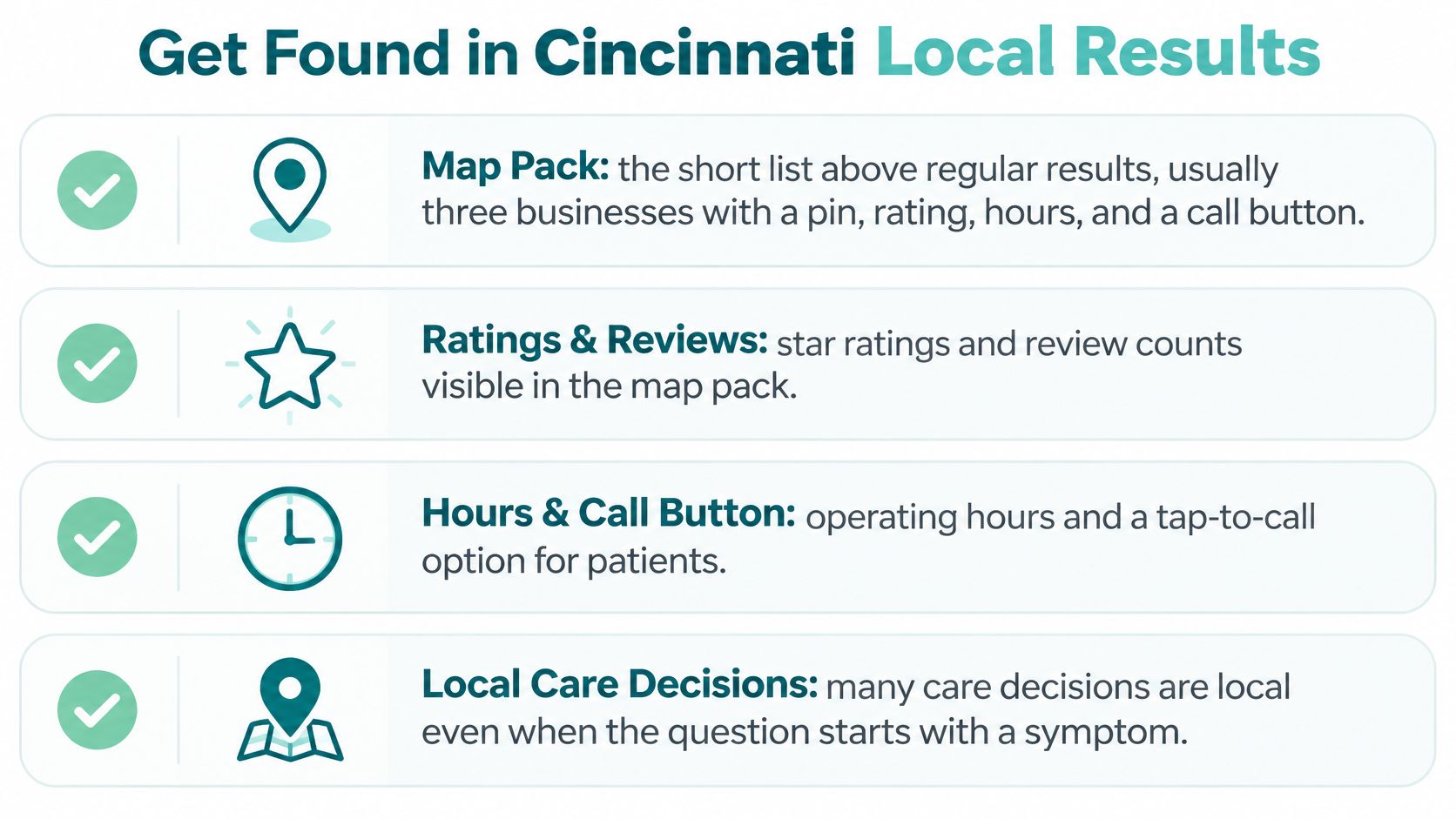
Your Google Business Profile is that door sign. The name, address, and phone number must match your website and every directory exactly, down to the suite number. Pick the most accurate primary category, list only the services you provide, and keep hours current through holidays, because a stale holiday entry sends people to a locked door.
Before you edit anything, watch this short walkthrough of how local results get assembled.
<iframe src="https://www.youtube.com/embed/jaW_RlWBjDU" width="100%" height="400" frameborder="0" allowfullscreen></iframe>Photos of the office, the team, and the entrance do quiet work. A nervous patient recognizes the building from the car and walks in calmer. The same local mechanics apply outside medicine; a doula practice competing for a handful of nearby families faces an identical profile-and-location-page problem, which is why how doulas get found online reads usefully for anyone building a small local service page set.
One page per office
A location page should repeat the address, embed a map, name nearby landmarks, and list the services offered at that specific office. One downtown page will not cover a second office in West Chester, and a copy with the city name swapped out fools nobody. If you're still working out how the profile and the site reinforce each other, the Cincinnati guide to getting found on Google covers the mechanics.
Reviews without breaking the rules
Reviews influence both rankings and trust, and they're where healthcare practices get careless. Never confirm in a public reply that someone is a patient, and never offer a reward that platform or healthcare rules prohibit. Thank the reviewer for the feedback and move the conversation offline.
| Profile element | What to verify | Fix if it fails |
|---|---|---|
| Name, address, phone | Matches the website and every directory exactly, including suite numbers | Correct the site, the profile, and every directory to the same string |
| Categories | Primary category is accurate and services listed are ones you actually provide | Remove services you do not offer |
| Hours | Current, including holiday hours | Update before each holiday |
| Photos | Real office, team, and entrance | Replace stock images |
| Reviews | Public replies never confirm someone is a patient | Thank the reviewer without confirming care |
| Citations | Old or wrong addresses on other listings | Correct or remove the outdated listing |
Local visibility is not the same as a blog. You can publish excellent articles and still be invisible on the map if the profile is incomplete. Check yours this week: categories, hours, photos, and whether the phone number matches the site.
Earn Trust on Health Pages
AI summaries now answer many long, question-shaped health searches before a patient clicks a clinic site. Those pages can change what someone does about pain, a medicine, or an emergency, so they are held to a high quality standard: visible experience, expertise, authoritativeness, and trust, not a generic article that could belong to any practice (Google Search Central).
E-E-A-T works like a signed chart. A named clinician stands behind the page, the page shows when it was last reviewed, and any treatment claim cites a current source.
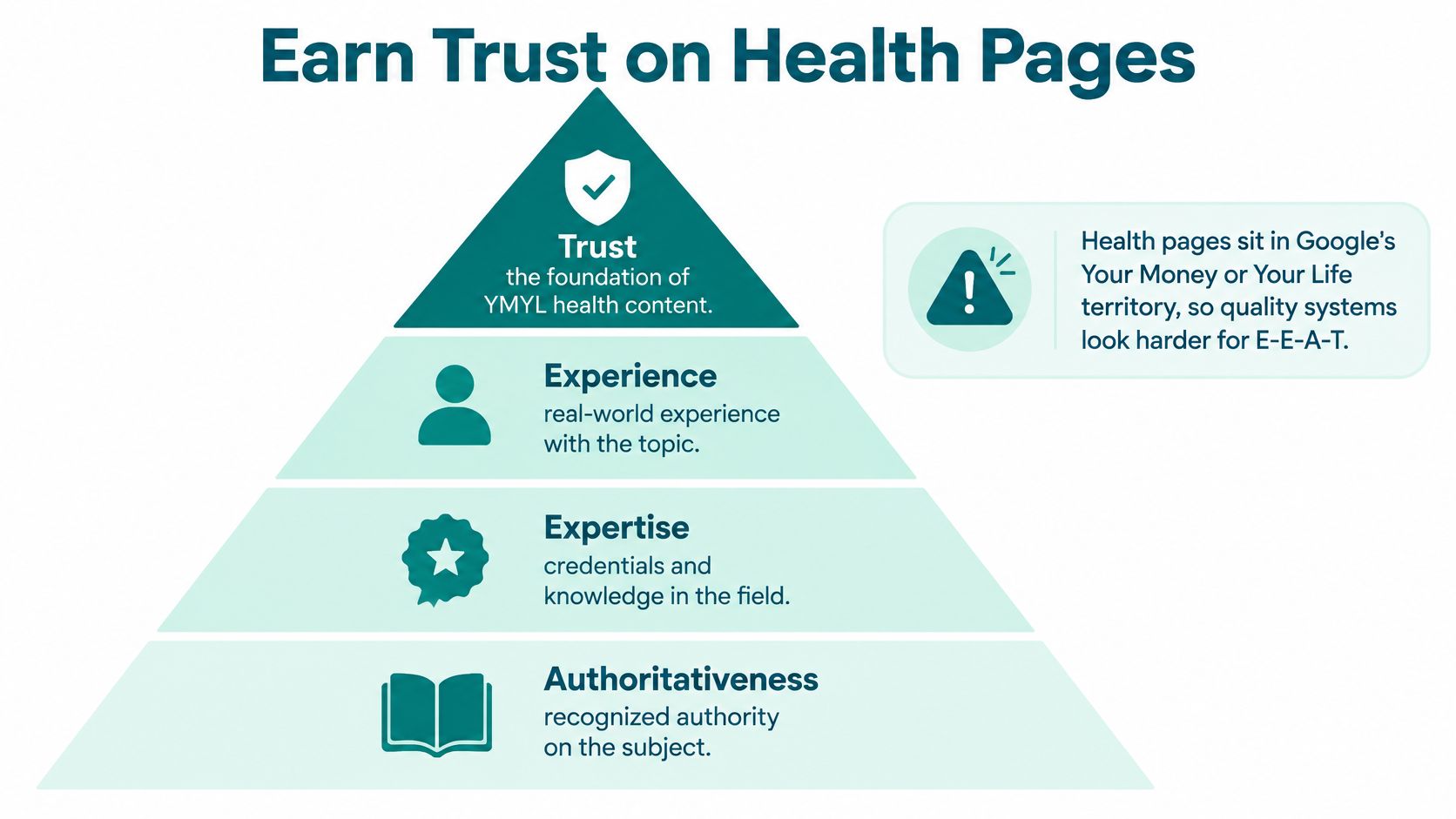
For a Cincinnati practice the build is plain. Put a named author or reviewer on every medical page, link that name to a short profile with credentials, show a review date, and keep a change log for anything that reads like treatment guidance. A page that could describe any city, with no reviewer and no dates, is weaker than a shorter page signed by the physician who sees those patients.
A test that works: read the page aloud and ask whether your most cautious physician would sign it. If not, it isn't ready to publish.
I would hold the page until that answer is yes. Separate education from personal medical advice, and route urgent symptoms to emergency care rather than a contact form. Pages that collect health details need the same care as the medical text, so settle the HIPAA website compliance basics before you add a symptom quiz or a chat widget.
Why fewer pages now beat more
Patients type full questions: "swollen ankle after a fall," "can I drive after this procedure," "what does therapy usually cost." Dozens of thin condition articles return less with every new one you publish. Fewer pages, built around a real care decision, a service you offer, a reason not to proceed, a cost range, and a clear next step, are more likely to be quoted accurately and more likely to earn the click that still follows the summary.
More pages look busy on a content calendar. They also give an answer engine more outdated copy to repeat. Fewer pages take longer to write and review, and they stay easier to correct when guidance changes.
What earns a citation in an AI answer
The summary can only repeat what your own pages state clearly. Use the same clinician name, the same service, and the same limit on that service wherever those facts appear. When a summary gets a credential, a location, or a treatment wrong, correct the page the tool is reading. Review what common AI tools say about the practice each quarter.
You can still see demand when the visit never shows up in analytics. Branded searches, calls, appointment starts, and map actions show what the page produced without storing the condition someone typed.
A Sample Clinic Page Set
Say an independent orthopedic practice runs one office in Montgomery and sees patients in Florence one day a week. A patient types "knee pain when climbing stairs." The useful path starts on a knee-pain symptom page that explains common causes in plain language, says when swelling or a locking joint needs same-week care, and links to the knee service hub.
That hub covers evaluation, imaging referrals, therapy, and surgery, but only the parts the practice provides. A knee arthroscopy page stands alone with preparation, risks, and recovery, and it links to the two surgeons who perform it. Each surgeon biography lists board certification, the joints that person treats, and the office where they see patients.
The same cluster logic works outside orthopedics. A dermatology or aesthetics practice that lets patients browse hair and skin treatments needs each treatment to own a page with candidacy, downtime, and cost expectations, because those are the questions that decide a booking.
Google's rater guidelines describe health sites authored by doctors and produced by medical institutions as examples of strong expertise, authoritativeness, and trust, and they hold medical topics to particularly high page-quality standards because poor information can harm users (Google Search Central blog). That's the argument for a connected cluster over a pile of unrelated posts.
Keep the offices separate
The Montgomery location page carries that address, hours, parking off the main road, and accepted insurance. The Florence page doesn't copy it with the city name swapped. Each page gets one canonical address so Google isn't choosing between duplicates, one clear search intent, and one button that moves the reader forward.
The internal link path that works: symptom to service, service to procedure, procedure to surgeon, surgeon to location, and every page to a call or a request.
Don't merge the symptom lesson, the surgeon's resume, and the appointment form into a single long URL. That page satisfies none of the three searches that brought people there.
The one-sheet sketch
Before you commission anything, sketch this on a single sheet and hand it over.
- Knee pain (symptom page), reviewed by the lead physician, button: book an evaluation.
- Knee care (service hub), reviewed by the clinical director, button: request an appointment.
- Knee arthroscopy (procedure page), reviewed by the performing surgeon, button: ask about candidacy.
- Surgeon biography, reviewed by the surgeon, button: see this doctor's schedule.
- Montgomery office, reviewed by the office manager, button: call the office.
- Florence office, reviewed by the office manager, button: get directions.
Schedule a clinical review at least yearly, sooner when guidance changes. An accurate recovery timeline from three years ago can become wrong while the technical SEO stays perfect.
Measure Results Without Exposing Patients
Rankings are a weak scoreboard if the tools behind them leak patient intent. HHS states that HIPAA applies when information collected by tracking technologies, or disclosed to tracking vendors, includes protected health information, that tracking vendors must sign a business associate agreement, and that an applicable permission must exist before PHI is disclosed (HHS).
A page does not need a patient portal to create that risk. A symptom quiz, an appointment form that asks the reason for the visit, a chat box, a call-tracking number, or a remarketing pixel can send health details to a vendor. If that vendor isn't under a business associate agreement and no other permission applies, you have a compliance problem rather than a marketing setting.
| Tool | Where the risk shows up | Safer approach |
|---|---|---|
| Website analytics | Symptom or condition URLs tied to a person | Aggregated page reports, no user-level health detail |
| Appointment forms | Reason-for-visit or diagnosis fields sent to a vendor | Minimize fields, keep submissions in a covered system |
| Advertising pixels | Remarketing audiences built from condition pages | Do not build audiences from health-intent pages |
| Call tracking | Recording that ties a caller to a condition page | Count calls in total, limit what is stored |
| Chat widgets | Symptom details typed into a third-party chat | Use a vetted tool with the right agreement, or skip chat on clinical pages |
| Review replies | A response that confirms the person is a patient | Thank them without confirming care |
Aggregate instead of individual
The safer design counts things without naming people. Count calls, appointment requests, and direction requests. Keep public education pages in one analytics environment and logged-in patient areas in another, so the two never share a tracking ID. Strip query strings that carry symptoms, and never email a vendor the text of a form that names a diagnosis.
Before launch, inventory every data flow. Forms, chat, call tracking, analytics, and pixels, one line each, plus where the data lands and who signed for it.
If you want the reporting side explained without the compliance layer, this primer on what marketing analytics actually measures is a reasonable starting point.
What you can still show a board
Removing measurement entirely isn't the only safe option. Redesigning it around totals preserves accountability without the exposure: branded searches, map actions, calls, and completed appointment requests. Organic sessions alone miss the person who read an AI answer, called, and never visited.
Competitive comparison belongs in the same aggregate frame. Tools that compare traffic across competitor sites only ever give estimates, and that's fine, because the useful signal is direction, not a precise patient count.
Decide What to Fix Before You Hire
A family practice in Greater Cincinnati can add condition pages all year and still miss the patient who is ready to book. Match each page to a real care decision, make the answer trustworthy for a person and for an AI summary, and measure demand without showing what that person researched.
Before you sign a redesign or an SEO retainer, ask any Cincinnati partner five things. Get the answers in writing.
- Who reviews medical pages, and where is that review stored?
- Are the Google Business Profile and citations part of the work, or only blog posts?
- Which forms, pixels, and call tools will be on the site, and how will they avoid sending health details to the wrong vendor?
- How will success be reported if people call after seeing an answer and never click?
- Who is the senior person doing the work?
I would add a sixth question about cost, and about how long before local visibility and calls should change. A retainer that cannot name that timeline is usually more articles, not a correct phone number, hours, and address.
Helbling Digital Media, based in Springboro and serving Greater Cincinnati, works with healthcare clients on HIPAA-compliant digital solutions and puts a senior person on every engagement. Local Service Ads and Local SEO covers Google LSA setup and management, Google Business Profile optimization, citation cleanup, and review automation.
If you are not ready to hire, use one afternoon. Write the five questions your front desk hears most, check whether each has its own page, and open your Google profile to confirm the phone number matches the site. Hand that list to Helbling Digital Media or to any agency you compare.
Visit Helbling Digital Media and share those five front-desk questions.