


Initial measurable SEO traction typically takes 3–6 months, with more durable growth closer to 6–12 months for competitive non-branded searches, especially when your site starts with limited authority. Use the milestones below to separate Google finding your pages from customers finding, choosing, and calling your business.
A Realistic SEO Timeline You Can Plan Around
SEO milestones and when to expect them
| Milestone | Typical window | What you should see |
|---|---|---|
| Discovery and indexing | A few days to a few weeks | Priority pages crawled and stored by Google |
| Early visibility | About 1–3 months | Impressions and long-tail rankings |
| Qualified traffic | 3–6 months | Non-branded visits from real service searches |
| Durable growth | 6–12 months | Stronger rankings plus calls, forms, or revenue |
| Hard competition | Beyond 12 months | Continued work on crowded non-branded terms |
These are planning windows, not promised delivery dates. The traction and growth ranges reflect the SEO process described by Ahrefs, not a deadline that every Cincinnati business will meet.
The graphic gives you a simple way to discuss those milestones with your team.
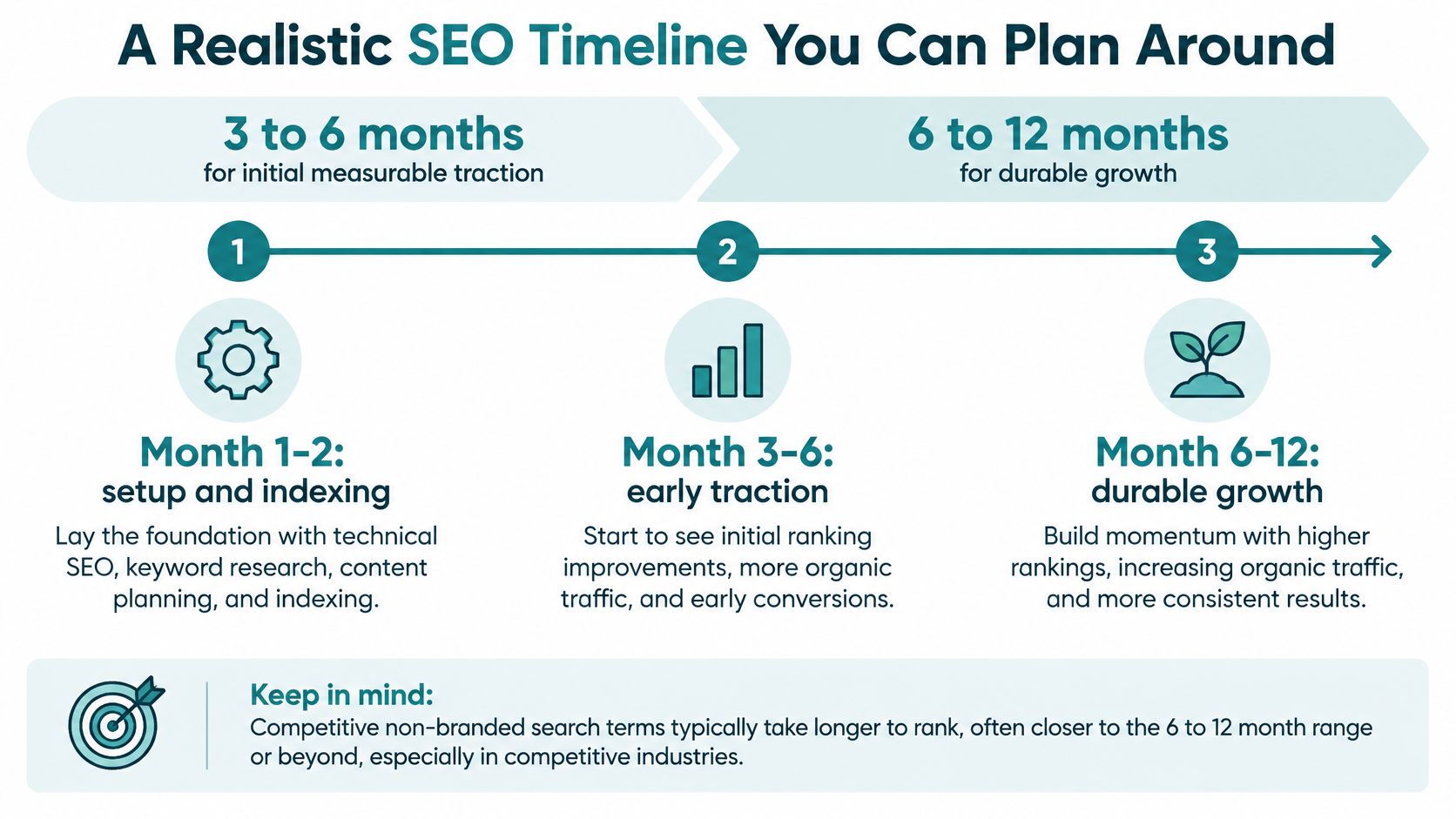
Read the milestones in order
Start with discovery and indexing. Google must find the page, fetch its content, and decide whether to store it for search. A published service page isn't automatically an indexed service page, and a crawl doesn't guarantee that Google will index it.
Next comes early visibility. An impression means your page appeared in a search result, even if nobody clicked. Long-tail rankings are appearances for specific phrases, such as furnace repair in a particular Cincinnati suburb, rather than a broad term like heating.
Qualified traffic means people arrive through searches that match something you sell. A contractor attracting homeowners inside its service area has a more useful signal than a blog attracting readers who live too far away to become customers.
Durable growth requires more than a temporary ranking jump. You want relevant pages to keep attracting potential buyers and those visitors to take useful actions. Crowded searches can remain difficult even after the rest of the site improves.
Why a launch isn't a verdict
An Ahrefs ranking study tracked one million randomly selected URLs first discovered in September 2023 and found that only 1.74% reached Google's top 10 for at least one keyword within the following year; in a separate sample of two million newly created pages with non-empty English content, 6.11% reached the top 10 within 12 months.
Those findings don't give your company a personal probability of success. They show why publishing, indexing, and prominent rankings shouldn't be treated as the same achievement.
An existing business with useful pages and credible outside references starts differently from a new domain. For a product-led startup building those references, IndieTool's guide to earn your product's first backlinks is a useful starting resource. Focus on relevant relationships and resources people would recommend, not collecting links indiscriminately.
Match your current situation to the appropriate row. Set review points at three and six months, consistent with the staged planning approach, rather than paying indefinitely toward an undefined finish date.
What Working Means When Clicks Shrink
Your rankings can improve while the phone stays quiet. A searcher may read an AI-generated answer, choose another business from the map results, or find enough information without opening your website.
This distinction matters when you compare visibility with business results.
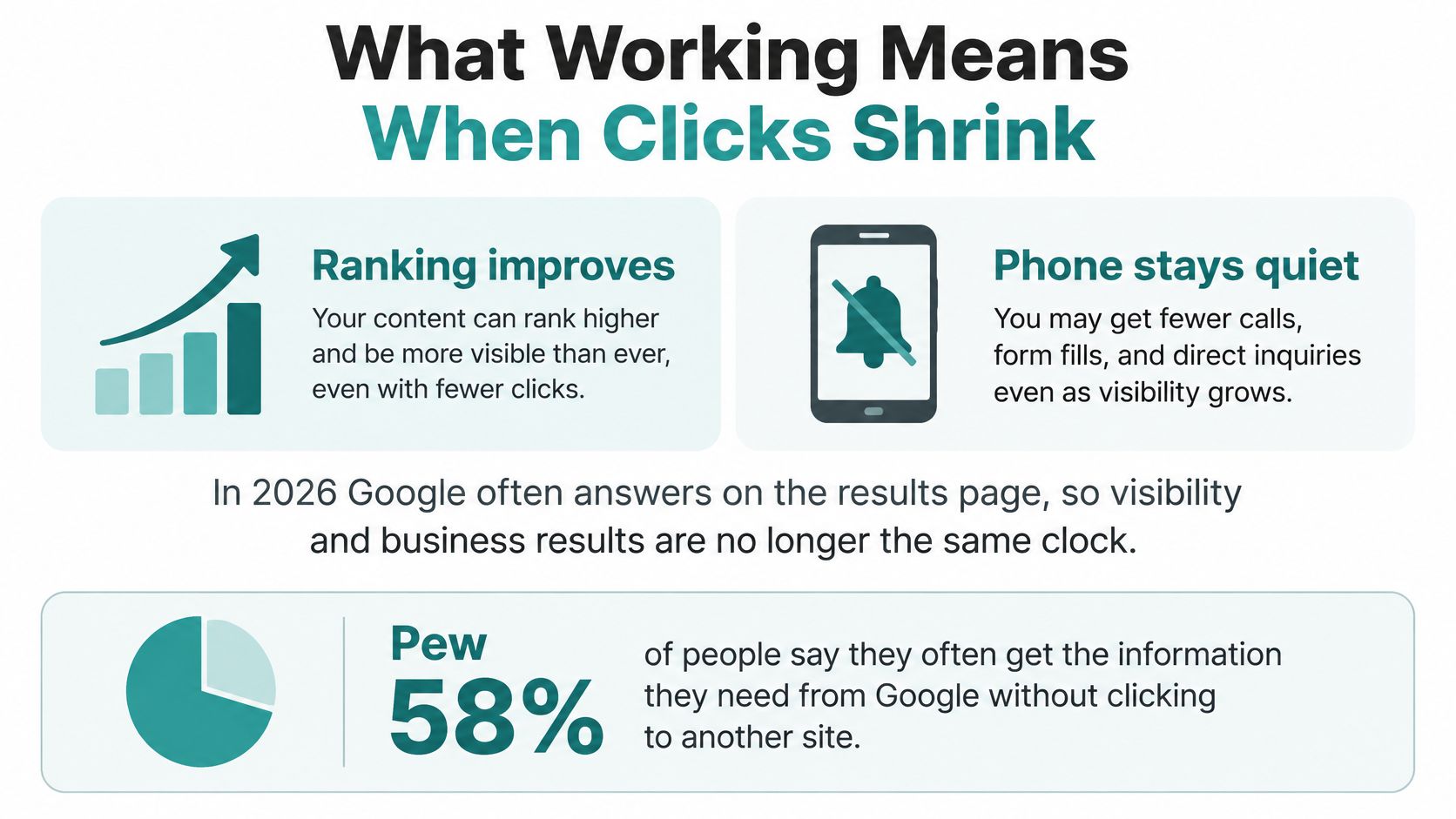
A Pew Research Center analysis of 900 U.S. adults, covered by Mashable, found that users clicked a traditional result on 8% of visits with an AI Overview, compared with 15% without one; only 1% clicked a link inside the summary. The same analysis found that 26% of AI-Overview visits ended the browsing session, versus 16% for conventional results.
Google disputes the methodology, says it isn't representative, and maintains that it continues to send billions of clicks to websites. Treat the analysis as a warning signal, not a settled law about what will happen to your business.
Separate information from buying intent
A homeowner researching why a basement smells musty isn't necessarily ready to hire a waterproofing company. Someone searching for basement waterproofing estimates in Cincinnati is closer to a commercial decision.
Don't combine those searches into a single traffic target:
- Informational searches can introduce your business, answer objections, and support trust. An AI citation may help recognition even without a visit, but don't count it as a lead.
- Commercial searches should be judged by relevant visits, calls, estimate requests, appointments, and eventual sales.
- Branded searches show people looking specifically for your company. Track them separately so existing awareness doesn't hide weak discovery among new customers.
The accompanying video offers another way to think about search performance.
<iframe src="https://www.youtube.com/embed/wjIAJDhW4U0" width="100%" height="400" frameborder="0" allowfullscreen></iframe>For a local owner, working means movement toward qualified business outcomes. That might include a prospect discovering your company through an answer, returning by name later, and booking an appointment. Analytics won't always capture that entire path, so give customers a simple way to tell you how they found you.
Ask every SEO report this question: Which business outcome moved, not just which keyword ranking moved?
What Speeds Up or Slows SEO Down
The same work can produce very different results on different websites. Before buying a larger content package or committing to a redesign, compare the conditions you're starting with.
Factors that change how fast SEO moves
| Factor | Faster when | Slower when |
|---|---|---|
| Site age and authority | The domain already has history and trust | The site is brand new |
| Competition | The target is a specific local service | Rivals are national or crowded |
| Technical health | Pages are fast, crawlable, and indexable | Pages are blocked, slow, or broken |
| Content quality | Pages answer the buyer's real question | Copy is thin, generic, or duplicated |
| Links and mentions | Relevant local citations and links exist | The brand has almost no outside references |
History helps, but it doesn't excuse a weak website
A summary of Ahrefs' 2025 findings published by SEO Genome reports that 72.9% of pages ranking in Google's top 10 were more than three years old. That's an observation about ranking pages, not proof that waiting makes a page better.
A new Springboro contractor shouldn't be judged against a competitor with an established customer base and years of useful content. Still, a technically broken established site can lag a clean newer site on a narrowly targeted local search.
Competition also changes what makes a sensible target. A neighborhood-specific repair service is a different contest from a broad national product category. Start where your service, location, and customer need align, rather than choosing a phrase because it attracts lots of searches.
Remove barriers before adding volume
Crawlable means Google's software can reach and read a page. Indexable means Google is allowed to store it for search, although permission doesn't guarantee inclusion.
Check those basics before polishing copy. A page accidentally excluded from indexing won't become eligible just because you rewrite its introduction.
Core Web Vitals are Google's measures of loading performance, responsiveness, and visual stability. On a phone, a slow page or shifting appointment button can frustrate a prospective customer even when the writing is strong. Use HDM's technical SEO audit guide to organize the checks rather than treating every warning as equally urgent.
Content needs similar discipline. A dental service page should explain the treatment, who it may suit, what the visit involves, and how to arrange an appointment. A vague paragraph about exceptional care doesn't answer those questions.
Outside references matter too, but keep their roles straight. Accurate local citations help people identify the business, reviews support customer confidence, and relevant editorial links provide context and discovery opportunities. They're not interchangeable ranking tokens.
Before spending more on blog posts:
- Identify your weakest pair of factors. Decide whether the constraint is technical access, buyer-focused content, competition, or credibility.
- Fund the bottleneck first. I would repair crawl errors and strengthen a core service page before commissioning a batch of generic articles.
The Numbers That Show SEO Is Moving
SEO signals from early clues to business results
| Signal | Type | When it usually moves | Where to look |
|---|---|---|---|
| Crawl status | Leading | Days to a few weeks | Search Console |
| Indexed pages | Leading | A few weeks | Search Console |
| Impressions and queries | Leading | About 1–3 months | Performance report |
| Clicks and click-through rate | Middle | About 3–6 months | Performance report |
| Calls, forms, and revenue | Lagging | About 3–12 months | Analytics and the booking system |
Use these as working review windows, not automatic pass-or-fail deadlines. Existing pages can respond differently from new ones, and commercial results also depend on the offer and the website's ability to convert visitors.
The funnel helps explain why an early technical improvement may not yet appear in your sales report.
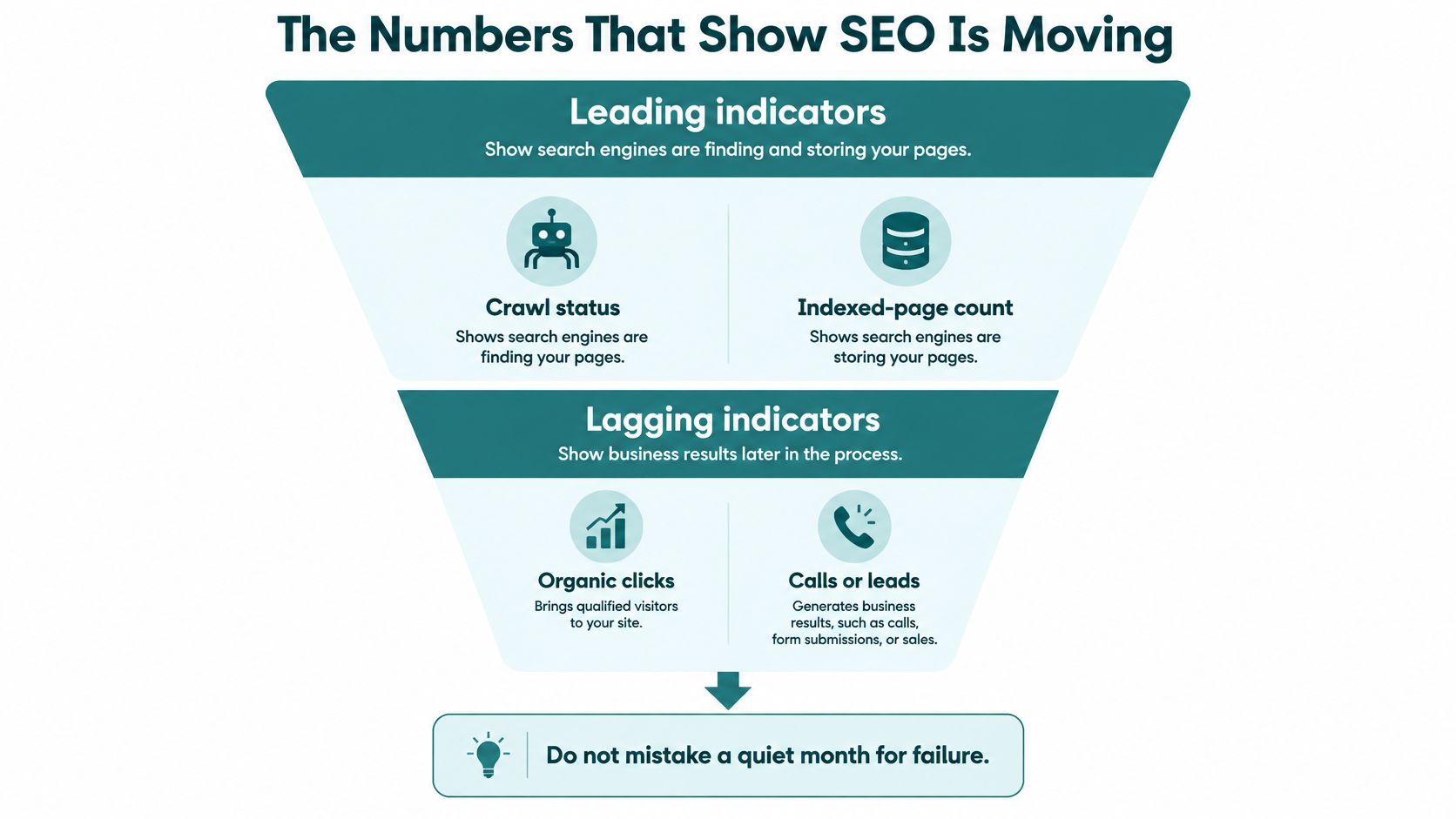
Read progress from the page outward
Google's guidance on improving search performance says some changes can affect Search within hours or days, while others may take several months, and recommends waiting a few weeks before evaluating whether an implementation improved rankings.
Google has to revisit the changed page and process what it finds. Your team should therefore document the implementation date and check the affected URLs, rather than only compare total website traffic before and after a change.
Look for relevant movement. More impressions for a service you no longer offer aren't progress, and wider query coverage isn't useful if those queries attract the wrong audience.
Connect the reports to actual customers
The Search Console Performance report provides up to 16 months of historical data, supporting year-over-year comparisons of equivalent periods. Review branded and non-branded queries separately, alongside impressions, clicks, and click-through rate, the share of impressions that produce clicks.
Make that a monthly operating habit. Seasonal demand can otherwise make a routine increase look like a campaign breakthrough.
Search Console can't tell you whether a visitor booked a profitable job. Connect website analytics with completed forms, call records, appointments, and sales records where appropriate. HDM's data-driven marketing strategy guide provides context for connecting those systems to business decisions.
Keep a simple change log:
- Website changes should include rewritten pages, technical fixes, and publication dates.
- Search changes should include announced algorithm updates and noticeable changes in result formats.
- Business changes should include service-area adjustments, promotions, and booking availability.
Google's core update guidance explains that broad changes to its systems can alter search performance. Annotating those events helps avoid blaming a page edit for an unrelated shift.
Practical rule: Validate the technical implementation before judging its commercial payoff. A confirmed repair and a booked customer are different milestones.
What to Do in 90 Days and Across a Year
Give someone ownership of the work, access to the necessary accounts, and a prioritized list of pages. An audit that nobody implements won't improve the website.
Use this checklist to keep the initial work focused.
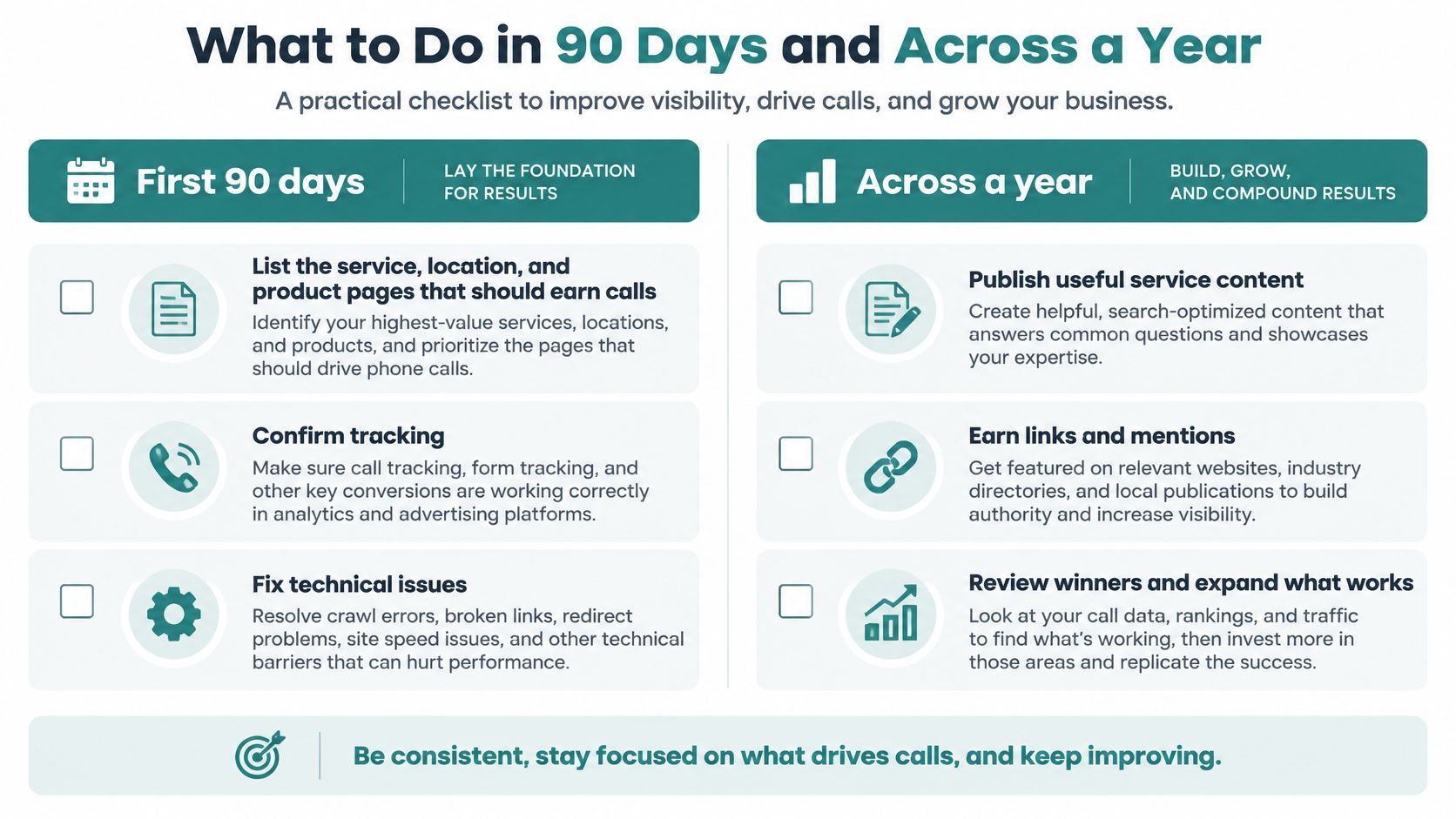
The first 90 days
-
List the pages that should earn business. Include your important service, location, and product pages. Assign each a clear purpose, such as requesting an estimate or booking a consultation, and confirm that action is measured.
-
Check access and indexing. Google Search Console is Google's free reporting tool for how your site appears in search. Use URL Inspection on priority pages, check whether Google can access them, and investigate exclusions rather than repeatedly submitting the same page.
-
Repair practical usability problems. Test those pages on a phone. Fix broken forms, unreadable text, slow-loading images, security warnings, and buttons that are difficult to use.
-
Rewrite the pages customers need most. Explain what you do, where you do it, what customers should expect, and what happens after they contact you. Use actual buyer questions instead of padding the page with repeated location names.
-
Clean up local business information. A Google Business Profile is the free listing that supports your presence in Google Maps and local results. Keep business details accurate, correct inconsistent directory listings, and make appropriate review requests part of your routine.
-
Add supporting pages selectively. Answer questions that help customers choose or prepare for your service. Link those answers to the relevant commercial page instead of publishing disconnected posts.
Google says crawling can take a few days to a few weeks, so don't score the work during its publication week. Request a recrawl for an individual URL through URL Inspection, or submit an XML sitemap, a file listing important pages, for a larger group. Neither method guarantees immediate indexing or rankings.
Keep the year-long work selective
- Improve pages already earning relevant impressions. Clarify incomplete answers and make the next action easier.
- Earn appropriate mentions. Seek relevant suppliers, professional associations, community organizations, and local publications.
- Compare discovery with demand. Review branded and non-branded queries monthly, with call and form tracking kept operational.
- Expand proven topics. Build supporting content around services that attract suitable customers, not merely high traffic.
If you're launching a startup and need a directory-submission starting point, StartupSubmit explains how to submit your startup to directories. Choose listings that fit the business and audience rather than pursuing volume.
Your 90-day success test is concrete: priority pages indexed, impressions appearing or rising on real service queries, and at least one conversion path measured. That's a usable foundation for deciding what deserves continued investment.
How Local Business Situations Change the Clock
A new home-service company, an established professional firm, and a retailer don't start with the same advantages. Use the closest scenario to set expectations, rather than borrowing a success story from an unrelated industry.
The illustration highlights how starting conditions change the work.
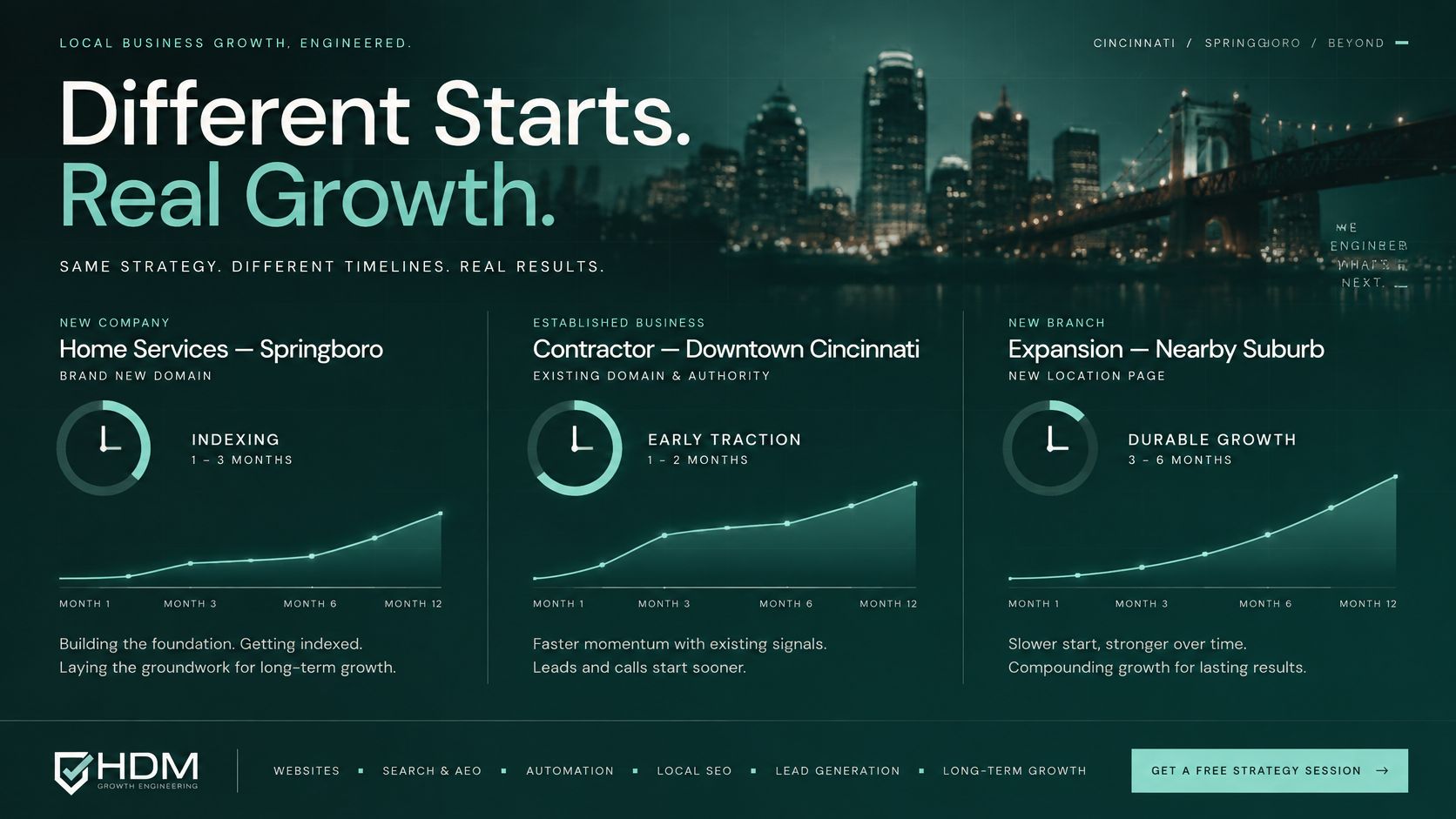
A new home-service company in Springboro
Say you're launching a repair business with a fresh domain and little online history. Early traffic may be thin even when the site is technically sound, because prospective customers have little existing awareness of the company.
Plan conservatively for calls and map visibility rather than assuming the website launch will fill the calendar. Your useful initial target is the exact service and town you can serve well, not a broad phrase that puts you against national directories.
Next action: Publish and get your core money pages indexed. These are the pages that explain the services customers can buy, with a visible way to contact you. HDM's Cincinnati business guide to getting found on Google offers additional local context.
An established law or dental practice
Consider a firm with an outdated website, existing referrals, and useful pages buried behind poor navigation. Its main limitation may be technical debt rather than a complete absence of credibility.
In that situation, clearer existing pages can begin earning better visibility while broader design work continues. A redesign shouldn't erase useful URLs or replace specific service information with polished but vague copy.
Next action: Repair technical debt on existing URLs. Preserve what customers and search engines already use, then remove the barriers that prevent those pages from working properly.
A retailer or clinic facing crowded search results
A clinic may appear beneath an AI answer and a map pack. A retailer may compete for attention with shopping units, product images, and other result features.
Pew's browsing analysis, reported by Fortune, provides an external warning that result format can affect clicking behavior, though Google disputes the findings. For this business, improved rankings alone aren't enough to diagnose whether the strategy is commercially useful.
Next action: Track query-level clicks beside leads. Pair the search terms bringing visitors with appointment, call, or sales outcomes, and include assisted conversions where you can reliably identify them.
Choose the case that resembles your starting position. Averages from businesses with different histories, services, and search results aren't a useful operating target.
Decide Whether to Stay the Course
Continue when relevant progress is visible. Adjust when the evidence points to a blocked or misdirected strategy. Bring in help when the work is not connected to business results.
Continue if priority pages are indexed, service-related impressions are improving, and suitable inquiries are beginning to arrive. A campaign can create value before every target keyword reaches the top of the results.
Know when patience becomes avoidance
At a scheduled review, look for movement across separate measures: indexing, rankings, clicks, and qualified leads. If priority pages remain unindexed, investigate access or indexing problems. If traffic is irrelevant, revisit targeting. If relevant visitors arrive but do not inquire, check the offer, page usability, and lead tracking.
- Keep the work that attracts appropriate customers and gives them a clear next step.
- Fix technical barriers, weak commercial pages, or reporting that treats rankings as the result.
- Get help if Search Console, website analytics, and your phone or booking system are not connected.
Helbling Digital Media is a full-service digital agency based in Springboro, Ohio, serving clients across the Greater Cincinnati area and beyond. Its time to productivity is 2–4 weeks. That describes getting productive on an engagement, not a promise of Google rankings. HDM responds same or next day for active projects.
For a strategy conversation, bring three months of impressions, clicks, and leads as a practical review packet, along with your priority services and service area. The aim is a clear keep, fix, or start decision based on your website and business results.
Helbling Digital Media offers web design, SEO, and digital marketing that connect website improvements with measurable business outcomes. Visit Helbling Digital Media to request a free 30-minute strategy call and discuss which SEO milestones matter next for your business.