
Picture a Cincinnati business owner whose website went live a few years ago. Social posts go out whenever there's a free hour, and every so often an ad gets boosted with no real idea what it brings back. Sound familiar? A digital marketing plan fixes that. It's a written set of decisions about who you want to reach, what you want them to do, which channels will get you there, how much you'll spend, and how you'll know it's working. In short, it turns scattered activity into a clear path toward revenue.
What a Digital Marketing Plan Does for Your Business
Think of your plan as the map and your tactics as the turns along the way. A social post, an ad, or a website tweak each feels productive on its own. Without a map, though, you can spend all day turning and still never arrive anywhere.
Why Small Businesses Need a Plan More Than Big Ones
Big companies can shrug off a failed experiment or two. A small business with a tight budget and limited hours can't. Every wrong channel costs real money and time you won't get back.
A full plan usually rests on six building blocks:
| Building Block | Key Question |
|---|---|
| Audience | Who are our best customers? |
| Goals | What numbers will we track, and by when? |
| Channels | Where will we reach them? |
| Budget | How much money and time will we commit? |
| Measurement | How will we know it worked? |
| Optimization | What will we test and improve next? |
Each block answers one question, and each one leans on the block before it.
Here's the path a plan follows, from knowing your customer to measuring what happens:
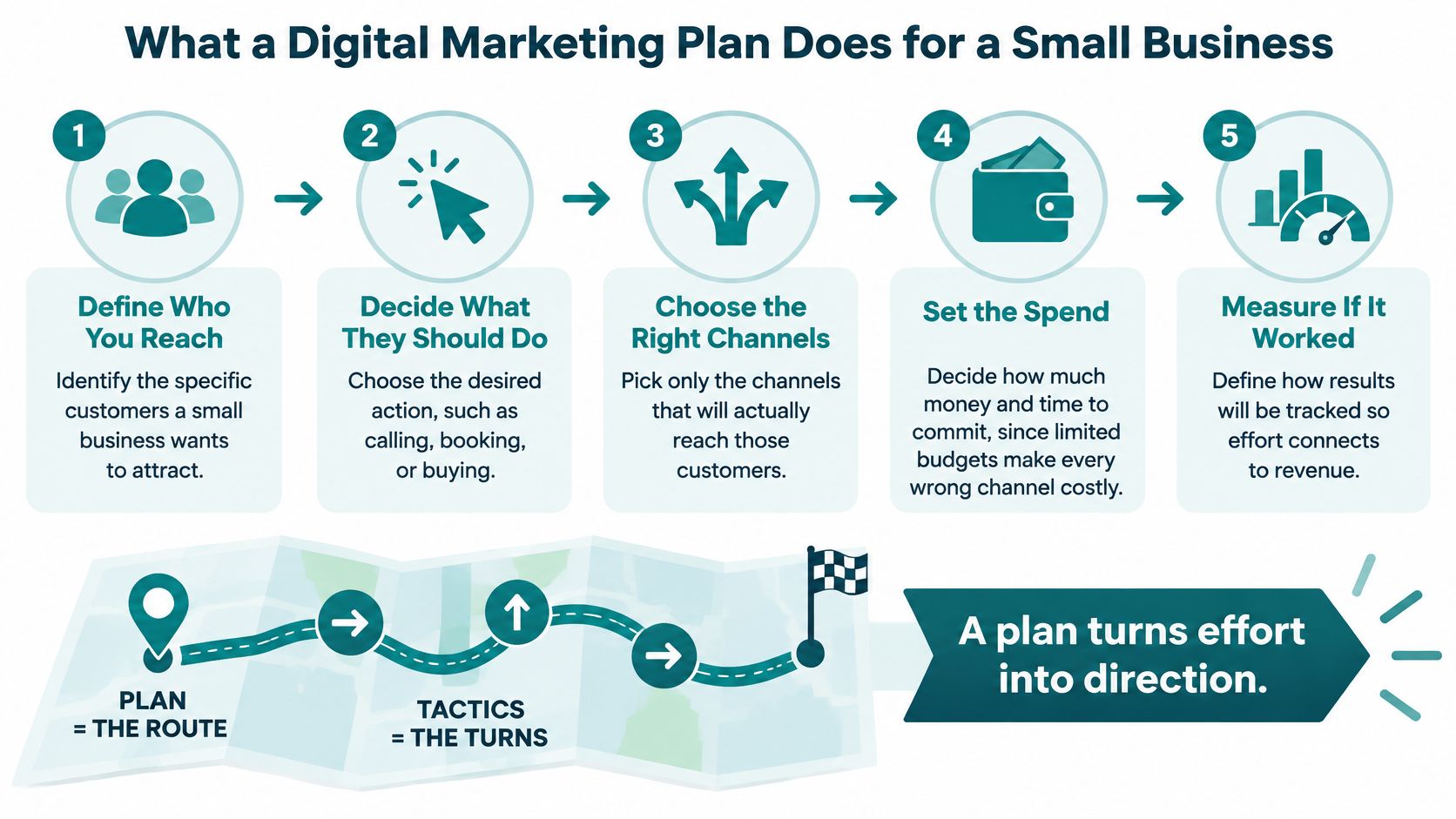
The core idea is simple. A plan starts with customers and ends with measurement, so every step ties your effort back to revenue.
Key Insight: A plan turns effort into direction.
If you want a broader foundation first, this growth planning advice from Shiny covers strategic planning for small business growth in more depth.
Setting Expectations for This Guide
The rest of this guide takes each building block in turn, so you can work through your own plan one piece at a time.
Helbling Digital Media (HDM) is a Cincinnati-based agency with its office in Springboro, serving businesses across Greater Cincinnati. Its approach to planning starts with the same question this guide asks: what does your business need to grow, and what will you actually do about it?
Know Your Audience and Set Measurable Goals

Your audience is the first building block, and it is also the one most owners skim. "Everyone in Cincinnati" feels safe, yet it leaves you with no real target.
Describe The Person Who Actually Buys
Bring one buyer to mind. What pushed them to start looking?
- The trigger: A burst pipe, a lease renewal, or a competitor's bad review
- The questions: What do they need to know before calling?
- The objections: What slows the decision, like price or timing?
- The area: How far will they drive for your service?
Run Low-Cost Research This Week
Skip the expensive research project for now. The useful clues are usually already inside your business.
Start with 4 quick checks:
- Read the last 20 sales emails or call notes and mark the questions that keep repeating.
- Ask front-line staff which worries surface every week.
- Look at which pages people visit right before they contact you.
- Borrow the exact phrases customers use in reviews.
Turn Insights Into Numeric Goals
Research earns its keep only when it becomes a target with a date. Put these side by side:
| Vanity Goal | Business Goal |
|---|---|
| More website traffic | 12 estimate requests a month at $45 each by December 31 |
| Grow social followers | 6 booked consultations a month by June 30 |
The first version creates motion without proving value. The second points straight at revenue.
Key Insight: If a goal has no number and no date, it is still a wish.
Map The Four-Stage Funnel
A funnel works like 4 gates. Each gate shows where people fall out.
Every customer passes through the same path:
- Seen: They notice you in search, maps, or social feeds.
- Clicked: They open your website or listing.
- Contacted: They call, submit a form, or book.
- Closed: They pay you.
That gives later measurement something solid to grab. If 500 people see your listing and only 10 call, the weak point sits in the middle rather than at the top. For a sharper audience picture, use our guide to market research and analysis.
Write Goals You Can Track
Give every goal one clean line with 4 parts: metric, target, deadline, and affordable cost.
Example: Qualified inquiries, 12 per month, by December 31, under $45 per lead.
Put it in writing and the later measurement stops being guesswork.
Choose Channels That Match How Customers Buy
Picking channels is a lot like picking tools. A hammer is handy, but it won't tighten a bolt. The right channel is the one that matches how your customers actually buy, and that's rarely the one everyone else is talking about.
Start With Mobile and Local Intent
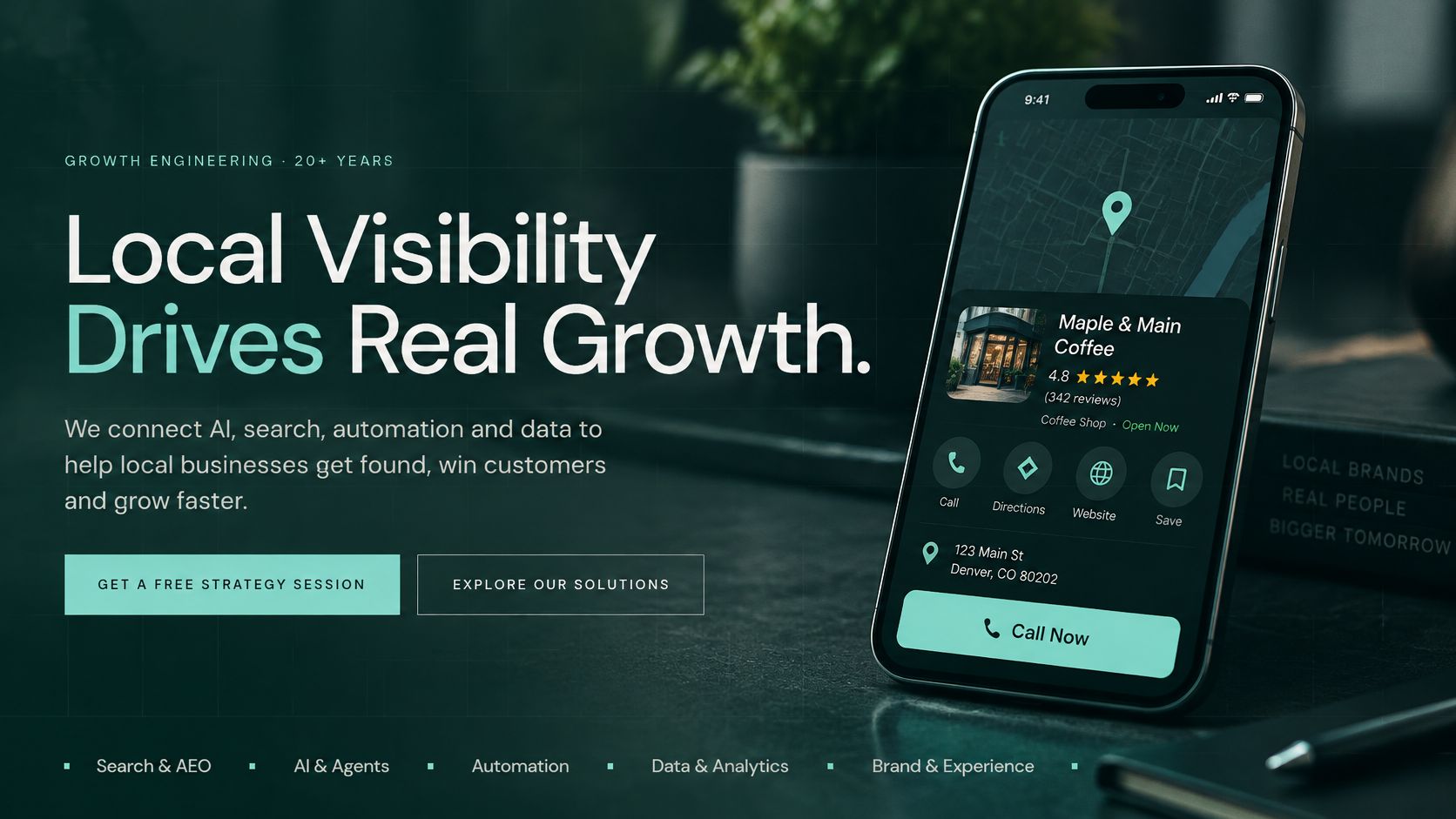
For a lot of Cincinnati service businesses, the decision happens on a phone. Someone searches for help nearby, compares a few options over coffee, and wants to call or stop by within the day.
That behavior should shape your setup. Here's where to start:
- Fast mobile pages that load quickly, even on a weak cell connection
- Accurate hours and address on your site and on every listing
- Click-to-call buttons placed where people can see them without scrolling
- Service-area pages for the towns you actually serve
- A short contact form that asks only for a name, phone number, and problem
Treat Local Listings as Revenue Work
Google Business Profile (the free listing that shows your hours, photos, and reviews in Google Maps and search), consistent business listings, and review generation can feel like branding polish. In reality, they decide whether a nearby customer finds your phone number or your competitor's.
Key Insight: Every outdated hour or wrong address is a call that goes to someone else.
HDM's Local Service Ads (LSA) and Local SEO bundle covers LSA setup and management, Google Business Profile optimization, local citation cleanup (fixing mismatched business details across online directories), and review automation. LSA are paid placements for service businesses that appear at the top of Google for local requests. Think of this bundle as making sure the basics are working before you chase anything fancy.
Compare Channels by Buyer Situation
Use this table to match each channel to where a buyer actually is, instead of signing up for every platform you've heard about.
| Channel | Best Buyer Situation | Typical Effort | Speed of Results |
|---|---|---|---|
| Google Business Profile | Nearby and ready to call today | Low to moderate | Days to weeks |
| Local Service Ads | Urgent, high-intent service needs | Moderate | Days |
| Local SEO and service pages | Researching before choosing a provider | Moderate to high | Months |
| Review generation | Comparing options and checking trust | Low, ongoing | Weeks |
| Short-form video | Browsing and discovering local brands | Moderate | Weeks to months |
| Returning or quiet leads | Low to moderate | Weeks | |
| Paid social | Broad awareness in a specific area | Low to moderate | Days |
If short-form video is on your shortlist, you can create videos with AI and test a handful of local clips first. That's a cheap way to see what resonates before you commit a bigger budget.
Pick Two or Three Channels
Seven channels on a plan looks impressive, but most small teams can run only two or three of them well. A channel run halfway is worse than no channel at all, because it eats time and produces little.
Start with the situations your customers are in most often. Once the first one is working, add a second. Then, and only then, consider a third.
Say No to Channels Customers Don't Use
This is the hardest part, and the one most owners skip. If your customers never use Facebook to find a provider like you, don't pay for a presence there just so your checklist looks complete.
Ask your customers how they found you. Their answers will tell you more than any industry report, and they'll keep you from spending money on channels that only make you feel busy.
Key Insight: The best channel is the one your customers already use.
Use SEO, AEO, and GEO to Become the Obvious Answer
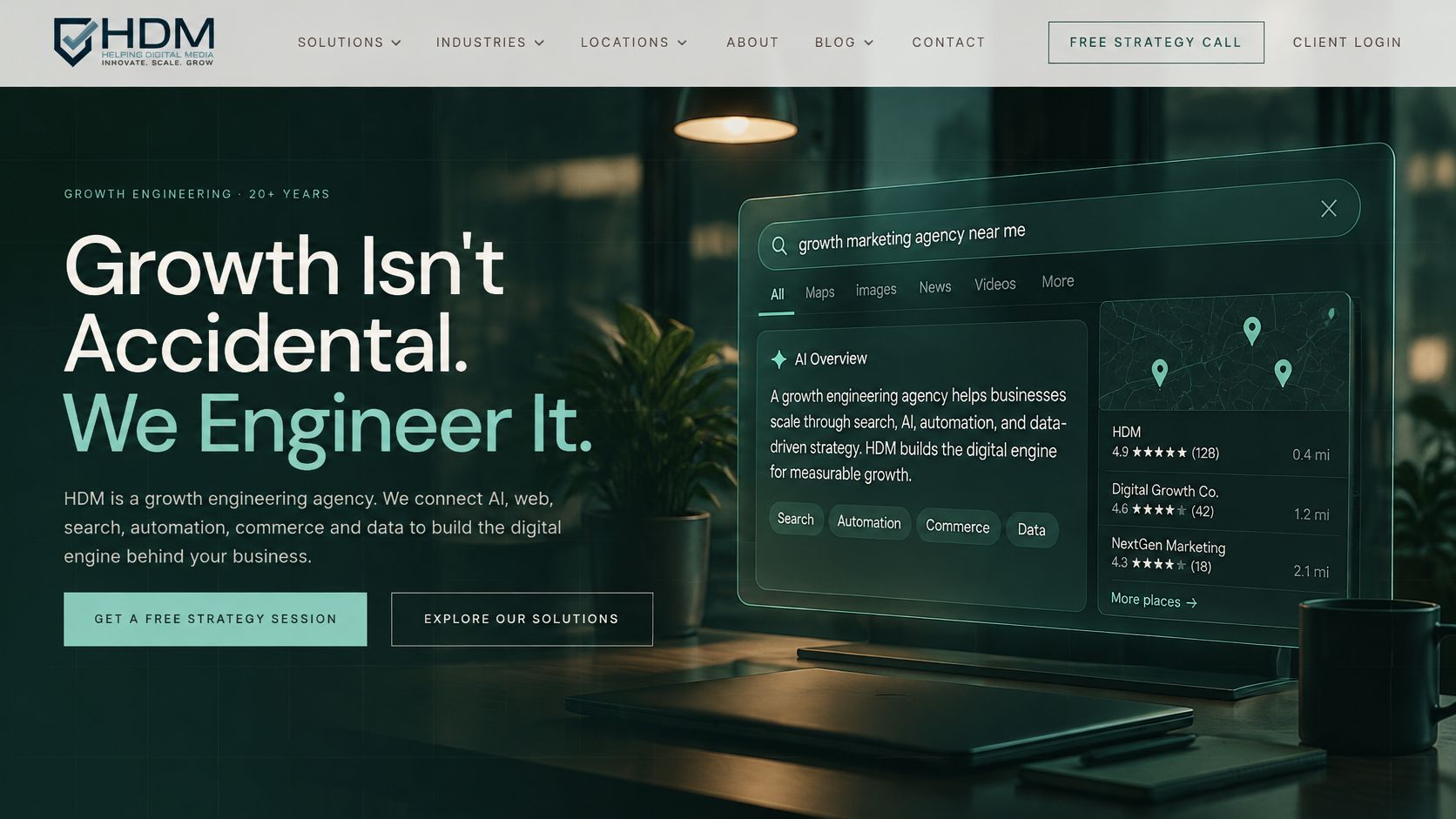
Search engine optimization, or SEO (the work of making your website and listings easier for search engines to find and understand), is about making your business the obvious answer when someone goes looking for what you sell. I like to think of it as a well-stocked shop window. A good one pulls people in off the sidewalk before they ever reach the door.
What Search Results Look Like Now
Search results don't look the way they used to. Instead of a neat list of blue links, you'll often find map listings, featured answers, and AI-generated summaries sitting right at the top.
That changes what winning looks like. Many searches now end without a click, which means your business can influence a decision before anyone lands on your website.
Traffic numbers can mislead you, too. A page with fewer visits that brings in phone calls is worth far more than a busy page where the phone never rings.
Build a Content Structure That Earns Visibility
Every solid small business digital marketing plan includes content that answers real questions. You can hire someone to write it or do it yourself, and most plans start with five page types:
- Question-answering articles tackle the questions buyers actually type, like "How much does a water heater repair cost?"
- Commercial service pages explain each service, who it's for, and how to get started.
- Comparison pages help buyers weigh their options side by side, including honest pros and cons.
- Case studies walk through a real problem, the fix, and the result.
- Location-specific pages speak to the neighborhoods and towns you actually serve.
Understanding AEO and GEO Without the Jargon
You'll probably run into two more acronyms: answer engine optimization (AEO) and generative engine optimization (GEO). They sound intimidating, but they point at one practical goal: writing content that AI assistants and answer engines can easily quote.
Picture someone asking an AI assistant which plumber in Cincinnati handles emergencies after hours. If your page gives a clear, direct answer, the assistant has something to repeat. If it doesn't, your competitor gets the mention.
Key Insight: Search visibility earns the first look, and clear answers earn the call.
HDM packages this work under its Search & Growth offering, which covers SEO, AEO and GEO, paid media (ads you pay to show), content, and analytics. It's designed for businesses with roughly $1M to $50M in annual revenue that want specialist skills across these areas without hiring 3 to 5 full-time staff to handle them.
Connect Visibility to Revenue
Visibility only matters when it turns into action. So track calls, qualified form submissions, and the pipeline value those leads create (the total expected revenue from leads that are still in progress).
A search result nobody clicks can still shape a decision. A busy website that produces no inquiries, though, shapes nothing at all.
- Calls that come from your listing and your site
- Qualified forms from people who want the work you actually do
- Pipeline value from leads that become proposals
Start small. Pick one clear answer page and one service page to work on this quarter.
Read also: Cincinnati business guide to getting found on Google walks through the basics step by step.
Turn Interest Into Loyalty With Email

Most small business plans spend their energy on getting people through the door. Far less thought goes to the people who looked around, weighed their options, and left without buying. Think of attention like a seed. If you never come back to water it, that interest dries up without anyone noticing.
Why Email Is an Audience You Own
Social followers live on platform algorithms (the automatic rules each app uses to decide who sees what), and those rules change without warning. One update can quietly cut your reach in half. Your email list works differently. You control it, and nobody can shrink your reach overnight.
Email is often praised for its strong return per dollar spent. That said, it isn't a guaranteed win. Results depend on the quality of your list, the offer you put in front of people, and how carefully you track what happens next.
Mapping Your Email Lifecycle
Email works best as a system, not a one-off newsletter blast. Start by sorting your contacts into groups you probably already recognize from your day-to-day work:
- Guide downloaders: people who wanted information but haven't bought yet
- One-time buyers: customers who are ready for a second visit
- Dormant customers: people who haven't come back in a year
- Quiet leads: people who asked for a proposal and then went silent
Key Insight: Each group needs its own message, because each one stopped at a different point in the journey.
Automations That Do the Work
Automation sends the right message at the right moment, so you aren't scrambling to hit send every week. If you're new to it, start with these four:
- Welcome sequence: Introduce your business and set expectations over a few short emails.
- Appointment reminders: Cut no-shows with a message the day before and a quick confirmation.
- Abandoned-cart messages: Remind online shoppers about what they left in their carts.
- Gentle re-engagement note: Ask dormant contacts if they still want updates, and remove the ones who don't.
Metrics Worth Watching Beyond Opens
The open rate (the share of recipients who open an email) looks good on a dashboard, but it can mislead you. Some mail apps preload images, which inflates the number. Look a little further:
- Click-through rate, which shows who wanted to learn more
- Conversion rate, the share of people who took the next step, such as booking or buying
- Unsubscribes, a useful sign that your content is missing the mark
- Revenue per recipient, the clearest signal of whether email is paying off
Keeping the Message and Page in Sync
An email promise has to land on a page that delivers it. If your email offers a free guide, the page should lead with that guide and show one clear next step.
When the two don't match, visitors feel misled, and they leave. It's a bit like ordering a burger and getting a salad with a polite apology.
HDM helps businesses line up email and content strategy with custom websites, online stores built on Shopify or WooCommerce (popular platforms for selling products online), and AI-enabled workflow automation. The goal is to keep the experience from the inbox to the checkout feeling like one continuous conversation.
Small businesses can also extend loyalty beyond email by making rewards easy to reach through digital wallets. If you want a closer look at that approach, read how cafés issue mobile loyalty cards.
Set a Budget Based on What a Customer Is Worth
Most owners hesitate to ask what a digital marketing plan for small business should cost. A better question is what a new customer is actually worth to you.
Start With What a Customer Is Worth
Start with your own numbers. Figure out how much profit a typical customer brings in over the life of the relationship. Then decide how many new customers you want each month.
Working backward usually makes the math clearer:
- Set the value of one customer, such as $600 in profit
- Choose a target, such as 10 new customers a month
- Estimate how many leads it takes to win one customer
- Divide what you can afford to spend by the number of leads
Treat this as a sketch, not a benchmark. Say you can spend up to $300 to win one customer. Ten customers means a $3,000 budget. If one in four leads ends up buying, you'll need 40 leads, which works out to about $75 per lead.
Split the Budget Into Three Buckets
Most families already manage money this way. The mortgage is a monthly bill, a new water heater is a one-time purchase, and the occasional repair falls somewhere in between. Each one gets its own line. Marketing works the same way.
- Building assets: your website, service pages, and content
- Buying attention: paid ads and promoted posts
- Keeping things running: maintenance, tools, and reporting
Key Insight: Money spent on assets keeps working long after the invoice is paid.
Weighing Three Ways to Get the Work Done
You have three realistic options:
| Option | Upside | Trade-off |
|---|---|---|
| Do it yourself | Lowest cash cost | Your time is limited and often pulled elsewhere |
| Hire one generalist | Dedicated focus | One person rarely covers every skill |
| Engage an agency | Several specialists | Higher monthly fees |
Be honest about your own time. Every hour spent writing posts or fixing a broken page is an hour you aren't spending with customers. For many owners, that's the most expensive line in the budget.
HDM includes tool costs, such as Adobe creative software and SEO software, in its services. It also brings in specialized partners for advanced SEO, paid media, niche development, and creative production. The goal is to work alongside your in-house marketing managers, not replace them.
For a deeper look at pricing, read our guide on digital marketing agency costs.
Checklist for Evaluating Any Cincinnati Provider
Before you sign anything, ask these four questions:
- Who owns the accounts and data? Your ad accounts and website should be in your name.
- What reporting will you receive? Ask which metrics you'll see and how often.
- What happens in month one? A clear onboarding plan is a good sign of a serious partner.
- Is ongoing maintenance covered? Look for security updates, performance work, backups, and support, such as HDM's Website Wellness plan.
Measure, Review, and Optimize Your Plan
A digital marketing plan only earns its keep if you actually check it. Think of it as a living document you revisit and adjust, not a file that gets tucked into a drawer and forgotten.
Build a Five-Minute Dashboard
Your dashboard has one job: telling you whether any of this is working. Keep it simple, with just five numbers:
- Qualified inquiries
- Cost per inquiry
- Conversion rate from visit to contact
- Booked appointments
- Revenue attributed to each channel (the sales you can trace back to a specific source)
Look at it once a week and the whole review takes five minutes. That's the point. If checking results feels like a chore, you'll eventually stop doing it.
Track Results Like Keeping Receipts
Tracking is a lot like keeping receipts. Without them, you know the money left your account, but you have no idea what it bought you.
Three simple tools handle most of the work:
- Call tracking numbers that show which listing or ad rang the phone
- Form submission events that log every completed contact request
- Consistent source labels that name where each customer came from
Key Insight: Impressions tell you who saw you. Calls tell you who cared.
Ignore Impressions That Don't Convert
An impression is each time your ad or listing appears on someone's screen. A channel that racks up thousands of impressions but never picks up the phone is basically background noise. It looks busy on a report, but it isn't paying the bills. When you spot that pattern, be honest about it and move the budget somewhere that's producing.
Run a Quarterly Review Routine
Every three months, sit down with your dashboard and work through three questions:
- What produced customers?
- What produced only activity?
- What single change will we test next?
The third question matters most. It keeps the review from turning into a report nobody acts on.
Test Small Changes in Sequence
Optimization doesn't mean tearing everything up every few weeks. It's more like a series of small, deliberate tests on headlines, offers, page speed, and form length, run one at a time so you know which change did the work.
Take a form that asks for eight fields. Cutting it to four and comparing results over six weeks will tell you far more than guessing ever could.
Give Each Channel Time to Work
Paid ads can show results in days. Organic search, meaning the unpaid results that appear when someone searches, can take several months to pay off.
Judge each channel against its own timeline, not against the others. If you pull the plug too early, you lose momentum right before the work starts to compound.
Set Your Next Step
Write your plan on one page, assign one owner, and put a review date on the calendar before you close this tab. A plan that fits on one page and has a name attached to it is far more likely to get done.
Helbling Digital Media offers a free 30-minute strategy call, and businesses within its 50-mile service radius can request a proposal. If outside help would speed things up, request a proposal from Helbling Digital Media to start the conversation today.