

If you're a Cincinnati business owner, you've probably had this moment. You know your customers well enough to sense when something is off, but not well enough to say exactly why. Leads slow down. Website traffic looks busy but doesn't turn into calls. A competitor with a weaker service somehow shows up ahead of you in search.
That's where market research and analysis stops being a corporate buzzword and starts being a practical business tool.
For a local company, this work isn't about producing a fancy report. It's about making better decisions before you spend money on a redesign, an SEO campaign, paid ads, or a new service line. It helps you answer the questions that actually matter. Are you targeting the right customer? Is there enough demand? Are you competing in a crowded lane without realizing it? Is your website saying what buyers need to hear?
Beyond Gut-Feel Your Modern Guide to Business Growth
A lot of owner-led companies were built on instinct. That instinct still matters. It tells you when a customer is hesitant, when pricing feels off, or when a service is gaining traction. But instinct alone breaks down once buying behavior moves online.
A customer now forms an opinion before they ever call you. They compare reviews, read service pages, scan your photos, and decide whether your business feels credible. If your website is unclear, slow, or aimed at the wrong audience, your best prospects leave before you know they were there.
That's why systematic research matters. It reduces the guesswork behind major decisions. The global market research industry reached more than $82 billion in revenue in 2022, more than double its 2008 level, and North America accounted for over half of global revenue, according to market research industry data summarized here. That matters because it shows this isn't a niche activity anymore. Businesses use research because uncertainty is expensive.
Where gut-feel still helps, and where it fails
Your experience gives you context. It does not always give you proof.
A business owner might say:
-
"Our referrals are strong." That may be true, but referrals can hide weak search visibility.
-
"People like our site." Maybe. But if visitors can't find pricing cues, trust signals, or service details, liking the design won't fix conversion issues.
-
"We know our market." Usually in part. Not always in the way Google, Maps, review platforms, and local search behavior define it.
Practical rule: Use gut-feel to form a hypothesis. Use research to decide whether to bet money on it.
What research protects you from
Good market research and analysis helps you avoid three common mistakes:
-
Building for yourself instead of your buyer Owners often want a site that "looks modern." Buyers want a site that answers questions fast.
-
Targeting broad demand instead of qualified demand More traffic isn't the goal. Better-fit traffic is.
-
Copying competitors without understanding their strategy A competitor may rank well because of authority, reviews, or location coverage. Copying page layouts won't solve that.
If you're trying to move from educated guessing to repeatable growth, a data-driven marketing strategy is the right shift. It gives your decisions a base layer of evidence, not just opinion.
The Two Flavors of Market Research What vs Why
Most business owners don't need more data. They need the right kind.
The easiest way to think about market research is sports. Quantitative research is the scoreboard. It tells you what happened. Qualitative research is the game film. It helps you understand why it happened.
If your website gets traffic but not calls, the scoreboard says there's a performance gap. The game film tells you whether visitors are confused, skeptical, price-sensitive, or in the wrong stage of the buying process.
Quantitative vs qualitative research at a glance
| Aspect | Quantitative ("What") | Qualitative ("Why") |
| --- | --- | --- |
| Primary question | What is happening? | Why is it happening? |
| Typical inputs | Form submissions, traffic patterns, rankings, lead source data, survey counts | Interviews, open-ended survey responses, sales call notes, user observations |
| Best use | Spotting trends, comparing channels, measuring demand patterns | Understanding objections, motivations, and trust issues |
| Strength | Clear patterns and easier comparison | Richer context and better message insight |
| Weakness | Can miss human motivations | Can be subjective if you only hear a few voices |
| Good business question | Which service pages attract the most qualified visits? | Why do buyers hesitate after landing on that page? |
When the scoreboard is enough
Sometimes the answer is obvious. If one service page gets stronger engagement and another gets ignored, you already know where to focus first. Quantitative inputs are useful when you need to prioritize.
That's especially true for:
-
SEO planning where you compare topics, search intent, and page performance
-
Paid media decisions where you need to see which campaigns attract the right prospects
-
Pricing or offer testing when you want to compare how different versions perform
When you need the game film
Numbers can tell you a page underperforms. They can't always tell you whether the problem is weak messaging, poor trust, missing details, or the wrong audience.
That's where qualitative work earns its keep:
-
Customer interviews reveal what buyers were worried about before they contacted you
-
Sales team feedback exposes repeated objections
-
User testing shows where visitors get lost, especially on mobile
-
Review analysis highlights what customers value enough to mention in their own words
If you only use quantitative data, you risk optimizing the wrong thing. If you only use qualitative feedback, you risk overreacting to a few loud opinions.
The strongest research combines both. Start with the scoreboard to find the problem. Then review the game film to understand it.
For local service companies, that combination is also useful in competitor price monitoring. Pricing isn't just about what competitors charge. It's about how they frame value, reduce buyer anxiety, and position their offer.
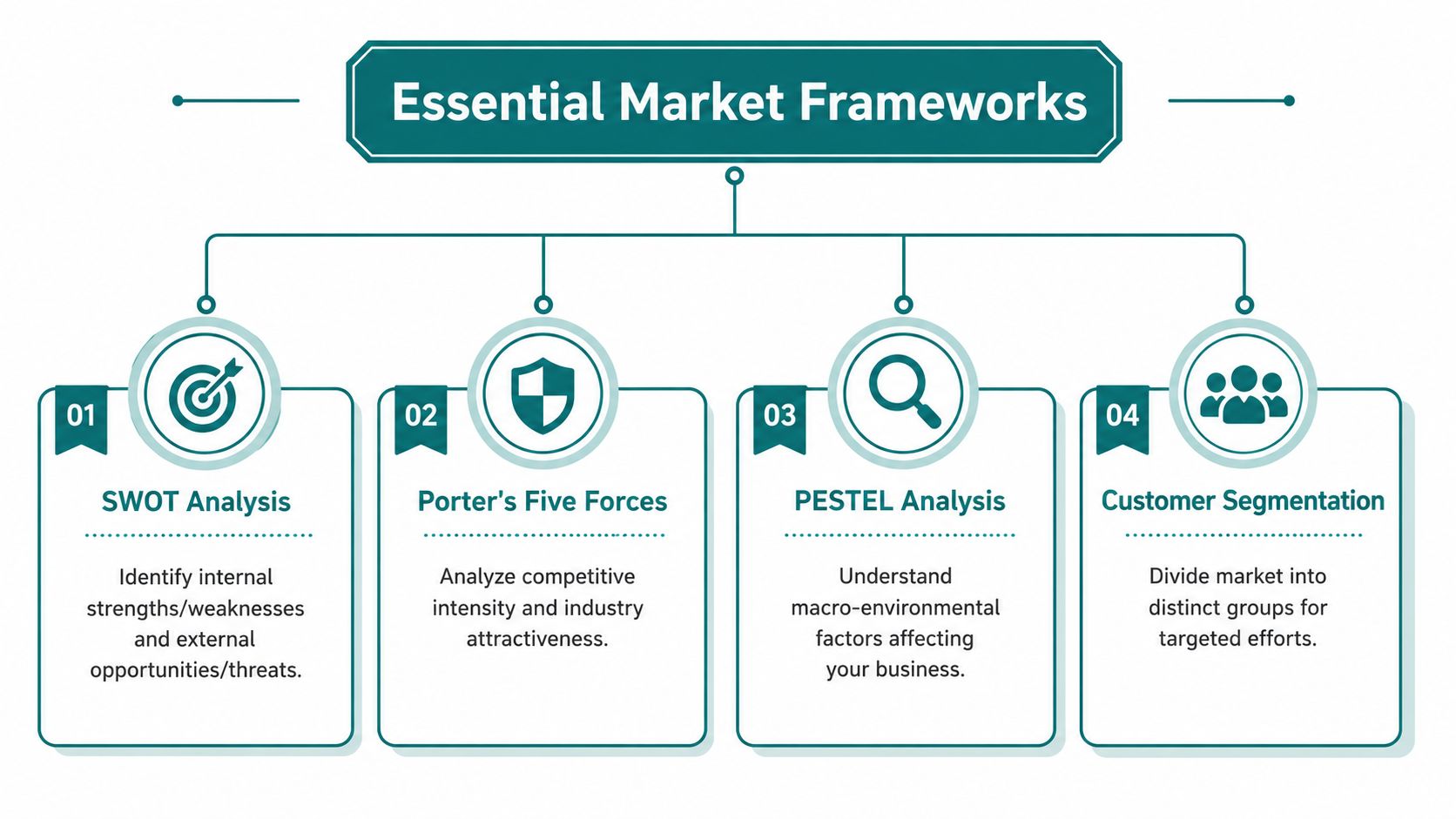
Essential Frameworks to Understand Your Market
You don't need an analyst on staff to organize your thinking. You need a short list of frameworks that force better questions.
The U.S. Small Business Administration identifies demand, market size, pricing, saturation, and location as core variables in market analysis, which you can review in its market research and competitive analysis guidance. For a Cincinnati business, those five variables are practical. They shape what to sell, where to focus, and how hard customer acquisition will be.
SWOT for honest positioning
SWOT stands for strengths, weaknesses, opportunities, and threats. It sounds basic because it is. That's why it works.
Use it when your business feels stuck and you need a clearer picture of where growth is getting blocked.
Ask questions like:
-
Strengths. What do customers consistently praise?
-
Weaknesses. Where do prospects hesitate or drop off?
-
Opportunities. What service gap exists in your area or industry?
-
Threats. Which competitors, platforms, or shifts in buyer behavior are pressuring you?
A useful SWOT is specific. "Great service" is too vague. "Fast turnaround for emergency legal filings" or "same-week scheduling for local patients" is better.
Competitor analysis for gap finding
Competitor analysis isn't spying. It's pattern recognition.
Look at:
-
Messaging. What promises are they making?
-
Offer structure. Are they pushing packages, consultations, or niche services?
-
Local visibility. Do they dominate Maps, reviews, or service-area content?
-
Proof. Are they using testimonials, case examples, certifications, or FAQs better than you are?
The goal isn't to copy them. It's to find where they're weak. Many Cincinnati businesses discover that competitors rank well but communicate poorly. That creates an opening for a better site, clearer local pages, and stronger calls to action.
Customer segmentation for better-fit leads
Not every customer deserves equal attention.
Segmentation helps you separate your best buyers from everyone else. A law firm may want high-value case types, not all case types. A contractor may want projects in a tighter geographic radius. An e-commerce brand may want repeat purchasers, not one-time bargain shoppers.
Try segmenting by:
-
Location
-
Urgency
-
Budget sensitivity
-
Service need
-
Industry or household type
Better segmentation usually leads to clearer messaging, better lead quality, and fewer wasted clicks.
Market sizing without overcomplicating it
You may hear terms like TAM, SAM, and SOM. They're useful if you keep them practical.
Think of them this way:
-
Total market is everyone who could theoretically buy.
-
Serviceable market is the portion you can realistically serve.
-
Obtainable market is the portion you can win in the near term.
A local HVAC company doesn't need to think about everyone in the state. It needs to think about the service area it can cover well, the neighborhoods where demand is strong, and the customer type that fits its margins.
Frameworks don't make decisions for you. They keep you from asking lazy questions.
A Practical Four-Step Research Approach
Most research fails because it starts too wide. "We want to understand our market" sounds smart, but it's not usable. A better starting point is one sharp question tied to one decision.
A strong workflow also treats secondary research carefully. Salesforce guidance recommends combining methods like literature review, data mining, case studies, content analysis, and triangulation across multiple sources to reduce bias, as outlined in its guide to conducting market research. In plain terms, don't trust one report, one tool, or one loud opinion.
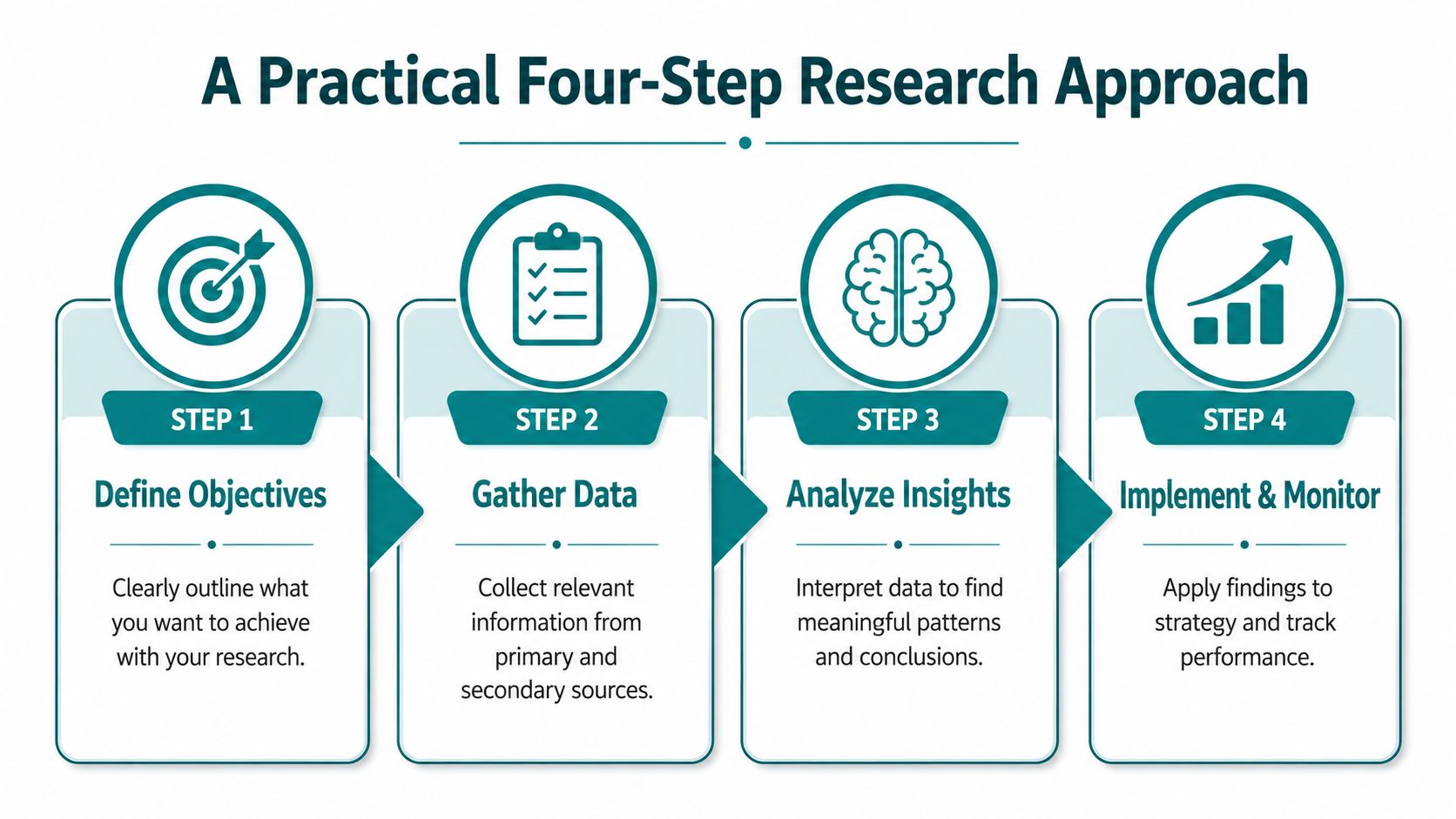
Step 1 Define the real question
Bad research questions are broad. Good ones are tied to action.
Examples:
-
Should we redesign the whole site, or just key service pages?
-
Are we losing leads because of weak SEO, weak trust, or weak conversion flow?
-
Is there enough demand for this service in our target area?
-
Are we attracting the wrong traffic entirely?
Write the question in one sentence. If your team can't agree on the question, don't gather more data yet.
Step 2 Gather what already exists
Start with information you already have or can access without expensive fieldwork.
That often includes:
-
Your own analytics for page behavior and lead paths
-
Search results to see who appears for high-value queries
-
Review platforms for common customer praise and complaints
-
Google Business Profile signals such as category fit and local presentation
-
Sales notes from intake calls and quote requests
Many businesses waste money by jumping into surveys before checking whether their CRM, analytics, or search presence already reveals the problem.
Step 3 Collect fresh insight where the gaps remain
Once secondary research shows the pattern, use primary research to fill in what's missing.
Good options include:
-
Short customer interviews to hear buying criteria in plain language
-
Surveys when you need structured feedback across a broader group
-
Focus groups if you're testing positioning or service concepts
-
One-on-one intake reviews with your front desk or sales staff
If you're a local owner, you don't need a massive study. You need enough direct feedback to confirm or challenge what the existing data suggests.
Field note: The best interview questions are simple. "What were you trying to solve?" works better than "What motivated your purchasing journey?"
Step 4 Analyze, decide, and act
Too many teams stall at this point. They collect information and keep discussing it.
Tie each finding to an action:
-
Weak service-page trust becomes stronger testimonials, FAQs, and proof elements.
-
Wrong traffic becomes tighter keyword targeting and cleaner service descriptions.
-
Geographic mismatch becomes better local landing pages and revised ad targeting.
-
Repeated pricing confusion becomes clearer offer framing, not necessarily lower pricing.
If the work feels too scattered or time-consuming, that's when outside help makes sense. An agency can often speed up synthesis because it sees patterns across web design, SEO, conversion, and content at the same time.
Research in Action for Cincinnati Industries
Research gets more useful when you stop talking about "the market" and start talking about actual buyer behavior in specific industries.
A healthcare practice, a law firm, and an e-commerce brand can all have the same complaint. "Our website isn't producing enough business." The cause is rarely the same.
Healthcare practices
A healthcare site has to do more than look credible. It has to reduce anxiety.
A patient may be asking:
-
Do they treat my condition?
-
Will I feel comfortable here?
-
Is this practice professional and trustworthy?
-
Can I figure out the next step without calling twice?
Research often shows that healthcare buyers don't need more marketing language. They need clearer answers, easier navigation, provider information, and a digital experience that feels safe and organized. For organizations with compliance concerns, those insights also shape how a HIPAA-conscious web experience should be structured.
Law firms
Legal buyers usually arrive with stress, urgency, and limited patience.
The most useful research questions are often:
-
What exact terms are prospects searching?
-
What case-related questions do they ask before contacting a firm?
-
Which concerns keep them from filling out a form?
-
What makes one firm feel more credible than another?
A law firm may assume its differentiator is courtroom experience. Research may reveal that prospects first want to know whether the firm handles their case type, serves their county, and returns calls quickly. That changes both SEO strategy and page structure.
Many legal websites talk like lawyers. Prospects search like worried people.
E-commerce brands
E-commerce research is less about broad awareness and more about friction.
Look closely at:
-
Product page hesitation
-
Shipping and return concerns
-
Mobile checkout confusion
-
Category organization
-
Review language
When people add products but don't finish, the issue may be trust, usability, or offer clarity. The fix might be better product content, stronger policy visibility, or simpler checkout flow. It's rarely solved by driving more traffic to the same broken path.
The value of market research and analysis is that it adjusts to the business model. The method changes. The principle doesn't. Find the core buyer question, then remove the obstacle.
Turning Insights into an AI-Driven Strategy
Research only matters if it changes execution. Otherwise, it's just organized hesitation.
Modern AI tools are useful here because they help teams process large volumes of inputs faster. They can group review themes, surface recurring objections from sales notes, cluster keyword patterns, and identify behavior signals across pages. That doesn't replace judgment. It speeds up pattern recognition.

What AI helps you do with research
Once you've gathered quantitative and qualitative inputs, AI can help turn them into action across your digital presence.
Examples include:
-
Website messaging alignment by matching page copy to real customer language
-
SEO opportunity mapping by grouping related topics and search intent patterns
-
Persona refinement by identifying repeated traits in high-quality leads
-
Content prioritization by spotting the questions buyers ask most often
-
Operational insight by pulling themes from calls, chats, reviews, and forms
Many small businesses can find an effective advantage. You may not have a full internal marketing team, but you can still use technology to spot patterns that would otherwise stay buried.
The underserved market trap
One of the biggest mistakes in market research and analysis is confusing low competition with a real opportunity. A market can look open because nobody wants it, it's too hard to reach, or margins are weak.
MapBusinessOnline makes that point well in its discussion of finding underserved markets with sales territory mapping. The smarter approach combines structured data such as census or NAICS information with field research and local pain-point interviews. In local business terms, don't assume a quiet suburb or niche service category is promising just because competitors aren't visible there.
A cleaner process looks like this:
-
Check the paper opportunity with demographic and business-category data
-
Validate real pain points through calls, interviews, or sales feedback
-
Compare reach costs across geography, channels, and staffing realities
-
Confirm offer-market fit before building pages, campaigns, or a new service line
If you want to operationalize that kind of pattern-finding, AI-driven data insights can help turn scattered business data into something usable.
A short walkthrough can help make that concrete.
AI is most useful after the human questions are clear. If your inputs are messy and your business question is vague, AI will just help you move faster in the wrong direction.
Your Next Move for Smarter Business Growth
The strongest local businesses don't abandon instinct. They sharpen it with evidence.
That's the practical value of market research and analysis. It helps you spend with more confidence, prioritize the right fixes, and avoid building strategy around assumptions that feel true but don't hold up. For a Cincinnati-area business, that can mean choosing the right service mix, improving local SEO focus, redesigning the pages that influence calls, or identifying a customer segment worth pursuing harder.
Start smaller than you think.
Pick one question that affects revenue. Look at the data you already have. Talk to a few real customers. Compare what you believe with what buyers do. Then make one decision based on that signal.
Done consistently, research becomes more than a project. It becomes an advantage.
If you want a local team to help you turn research into a stronger website, smarter SEO, and a clearer growth plan, HDM works with Cincinnati-area businesses to turn digital uncertainty into measurable action.