A Cincinnati business owner sees it all the time. You search your own service online, and a competitor shows up with a cleaner offer, a lower starting price, or a promotion that makes you wonder if your pricing is out of step. Maybe you're a retailer watching another store discount a key item. Maybe you're a contractor seeing "starting at" language that makes your quote look expensive before a prospect ever calls.
That moment creates pressure fast. Most owners react one of two ways. They either ignore it and hope customers won't notice, or they slash pricing without enough context. Neither move is strategic.
Competitor price monitoring gives you a better option. Instead of guessing, you track how competitors present pricing, when they change it, what promotions they run, whether products are in stock, and what the buyer sees at checkout. For Cincinnati SMBs, that can shape smarter marketing, cleaner offers, and better margins.
This isn't just a big-box retail tactic anymore. The category itself has grown into a major analytics market. One industry guide estimates competitor price monitoring was worth $1.2 billion in 2024 and projects $2.5 billion by 2033, a projected 9.2% CAGR, reflecting the shift from occasional manual checks to automated pricing intelligence that can run from daily to hourly depending on the market (Tendem competitor price monitoring guide).
Are Your Prices Leaving Money on the Table
A common local scenario looks like this. A business owner in Greater Cincinnati notices a rival pushing a lower advertised price through Google Ads, Facebook, or a refreshed landing page. Calls slow down a bit. Quote acceptance feels less predictable. The first assumption is usually, "We need to lower our price."
Sometimes that's true. Often it isn't.

The primary issue is usually a lack of visibility. You may know what one competitor is showing today, but not whether that price is temporary, limited to one item, bundled with extra fees, or tied to low inventory. Without context, business owners end up reacting to the loudest signal rather than the most useful one.
What business owners usually miss
Many Cincinnati companies still treat pricing research like a periodic task. Someone checks a few sites, screenshots a few pages, and moves on. That's better than nothing, but it doesn't tell you much about patterns.
A stronger approach watches for changes over time:
-
Price shifts: Not just current price, but how often it moves
-
Promotion behavior: Coupons, bundles, limited-time offers, seasonal specials
-
Availability signals: In stock, low stock, or out of stock notices
-
Buyer friction: Shipping fees, add-ons, or gated pricing that changes the effective offer
Practical rule: If you only compare headline price, you're probably comparing the wrong thing.
That matters whether you sell products online or run a service business. A law firm, med spa, HVAC company, manufacturer, or boutique retailer can all benefit from understanding how competitors package value. In service industries, "price monitoring" may mean tracking pricing pages, financing offers, consultation fees, promotional language, and quote form positioning rather than a literal product feed.
Control beats guesswork
The businesses that use pricing data well don't obsess over every competitor move. They use it to answer practical questions:
-
Are we priced for the market we want?
-
Are we discounting too often?
-
Are competitors winning with lower price, or with better presentation?
-
Where can we charge more confidently because our offer is stronger?
That shift matters. Competitor price monitoring isn't about panic. It's about control.
Set Your Goals and Identify Your Real Competitors
Before you monitor anything, decide what "better pricing decisions" means for your business. If you skip this step, you'll collect a pile of data and still be unsure what to do with it.
A Cincinnati boutique retailer may want to stay competitive on a handful of visible items while protecting margin on higher-value products. A local HVAC company may care less about being the cheapest and more about knowing when competitors start pushing financing, tune-up specials, or same-week install offers. A B2B manufacturer may need to defend premium pricing with stronger lead times and service promises.
Pick a pricing position on purpose
Most SMBs fit into one of these practical positions:
-
Value leader: You want to be known for accessible pricing and straightforward offers.
-
Premium choice: You charge more and need the market evidence to justify it.
-
Middle-market anchor: You don't need to be cheapest. You need to stay credible and consistent.
-
Selective aggressor: You only push hard on a few high-visibility items or services.
None of those is automatically right. The mistake is drifting between them.
Ask a few blunt questions:
-
Which products or services influence buying decisions first?
-
Where do prospects compare you side by side with another company?
-
Which offers bring in leads, and which ones make money?
-
What price changes would create operational headaches if demand suddenly spikes?
Those answers shape what you monitor and how often you review it.
Your real competitors may not be the ones across town
Most owners start with the obvious names. That's useful, but incomplete. Customers often compare local businesses with regional players, online-only brands, marketplaces, and category-adjacent alternatives.
A practical competitor set should include:
-
Direct local competitors: The firms your sales team hears about regularly
-
Search competitors: The companies showing up in local search and paid ads
-
Online disruptors: Businesses outside Cincinnati that still reach your audience
-
Alternative options: Lower-cost substitutes that reset price expectations
The best competitor list comes from customer behavior, not owner assumptions.
If you're trying to understand who that really is in your area, local search visibility is a good place to start. Reviewing your presence across Cincinnati local search markets can reveal which businesses buyers see before they ever contact you.
Keep the list tight at first
Tracking every competitor feels thorough, but it usually creates noise. Start with a focused group that directly affects sales conversations.
Use a simple filter:
| Competitor type | Why track them |
| --- | --- |
| Direct rival | Buyers compare you directly |
| Search-visible rival | They shape first impressions online |
| Price disruptor | They pressure expectations downward |
| Premium rival | They help you defend higher-value positioning |
Revisit that list regularly. Competitor sets change when markets change, new entrants show up, or an online seller starts ranking in your territory. A stale competitor list creates stale pricing decisions.
Choose Your Price Tracking Method
Once you know what you're tracking, the next question is how you'll do it. At this stage, many SMBs either overcomplicate things or stay stuck in spreadsheets too long.
At a high level, you have three workable options. You can check prices manually, use monitoring software, or work with a partner who helps manage the process and turns data into action.
A retail pricing-intelligence guide notes that modern competitor monitoring has moved toward real-time or near-real-time data and depends on accurate product matching, often at the SKU level, plus a decision framework that converts changes into action (ProfitMind guide for enterprise retailers). Even if you're not running an enterprise catalog, the lesson still applies. Fresh data matters, but only if you can match the right product or offer and know what you'll do next.
What each method looks like in practice
Manual tracking is exactly what it sounds like. Someone visits competitor pages, screenshots prices, and records updates in a sheet. That works for a very small set of pages, especially if you only need periodic market checks.
Software tools automate the watching. Some tools monitor visible page changes. Others extract pricing elements more directly. You'll hear terms like web scraping and API. For a non-technical owner, the simplest explanation is this: scraping is like having software read what's shown on a web page, while an API is a structured handoff of data when a platform allows it.
Agency support sits one level higher. Instead of just collecting prices, you get help deciding what to monitor, how often to watch it, how to validate the data, and how to connect findings to SEO, paid media, landing pages, and offer strategy.
Price Monitoring Methods Compared
| Method | Cost | Effort Required | Best For |
| --- | --- | --- | --- |
| Manual spot-checks | Low direct spend | High owner or staff time | Very small businesses with a narrow competitor list |
| Automated tools | Moderate | Moderate setup and review | Teams that need repeatable monitoring across multiple pages |
| Agency-led monitoring | Higher investment | Lower internal effort | SMBs that want both tracking and strategic guidance |
The trade-offs that matter most
Manual checks break down first on consistency. People forget, pages change, and temporary promotions get missed. You also end up checking on your schedule, not the market's schedule.
Tools improve speed and coverage, but they still need human oversight. If a competitor redesigns a page, changes product names, or uses scripts that hide content until load, alerts can become messy. If you go this route, it helps to evaluate practical automation ideas first. This overview of AI tools for Ohio small businesses is useful for owners who want to understand where automation helps and where it still needs supervision.
Software doesn't remove judgment. It removes repetitive checking so your team can focus on decisions.
Agency support makes sense when pricing affects multiple channels at once. If a competitor changes an offer, that may affect your ad messaging, service-page copy, lead magnet, or call-tracking workflow. The value isn't just data collection. It's connecting pricing intelligence to growth strategy.
Build Your Price Alerting Workflow
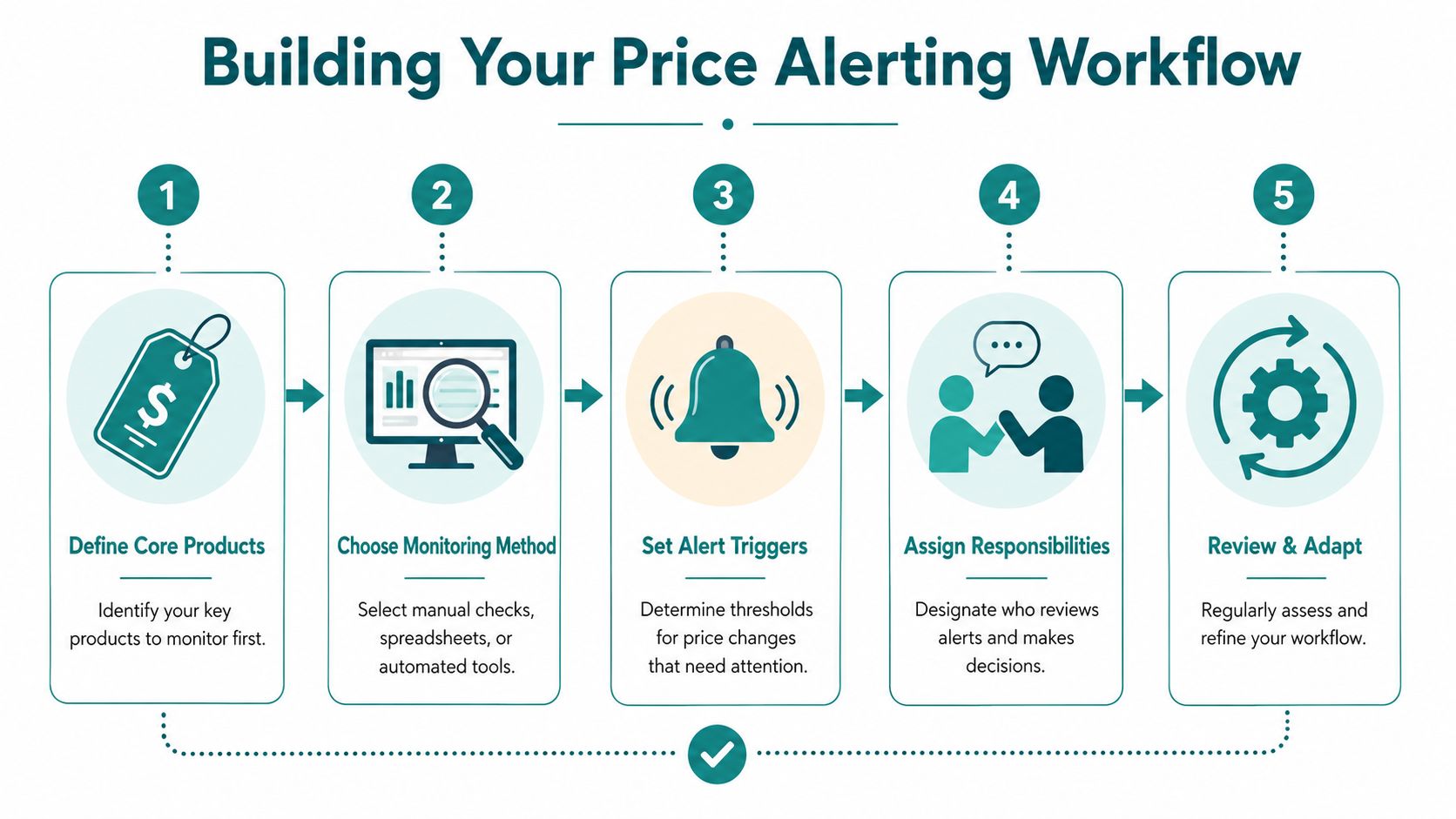
Most businesses fail here by trying to monitor too much too soon. They set alerts on every competitor page, every product, every message variation, and then stop paying attention because the volume gets ridiculous.
A practical setup starts small and gets better before it gets bigger. One price monitoring workflow recommends beginning with 5-10 competitor pages for about one week, then reviewing alert quality and adjusting rules and monitoring frequency before expanding (Visualping guide to competitor price data).
Start with the pages that influence revenue
Don't begin with everything you sell. Begin with what drives comparison.
Good starting points often include:
-
Top inquiry generators: Services or products prospects ask about first
-
High-visibility pages: Pricing pages, category pages, flagship product pages
-
Margin-sensitive offers: Items where a small shift changes profitability fast
-
Competitive pressure points: Pages where rivals frequently promote discounts or bundles
If you're a service business, this may be a competitor's pricing page, financing page, specials page, or a location page with strong "starting at" language. If you're in e-commerce, it may be your hero SKUs or product families with heavy overlap.
Set alerts that deserve attention
Not every change should trigger a response. The point of alerts is to reduce noise, not create more of it.
Use thresholds and categories like these:
-
Meaningful price moves
Alert when a visible price changes enough to matter for buying behavior. Tiny fluctuations often aren't worth immediate action.
-
Promotion changes
Watch for coupons, limited-time banners, bundles, financing language, and free shipping offers.
-
Availability shifts
If a competitor goes out of stock, that can create a short-term opening for your ads and landing pages.
-
Offer presentation changes
A new guarantee, stronger review language, or revised tier packaging can be just as important as the number itself.
If your team can't explain what an alert should trigger, the alert shouldn't exist.
Assign ownership before alerts go live
This part sounds boring, but it saves the whole process.
Decide:
-
Who reviews alerts daily or weekly
-
Who validates whether the change is real
-
Who can approve pricing changes
-
Who adjusts messaging instead of price when needed
Without ownership, alerting becomes passive reporting. Someone sees a change, nobody acts, and the business goes back to gut instinct.
Tune the workflow like an operating system
The first round won't be perfect. Some pages will require JavaScript rendering. Some will generate false positives because of layout shifts. Some competitors will change pages so often that daily checks make more sense than hourly ones.
A simple review rhythm works well:
| Review point | What to check |
| --- | --- |
| End of first week | Too many alerts, too few alerts, or wrong pages |
| After first action | Did the alert lead to a useful decision |
| Monthly | Add pages, remove noise, update thresholds |
The best workflows feel boring in a good way. They surface changes worth acting on and ignore the rest.
Turn Data into Smart Pricing Strategy
Collecting competitor pricing data is the easy part. Using it without damaging your margins is where real discipline shows up.
A common pitfall is focusing too narrowly on competitor prices while ignoring your own costs and margins. Advanced monitoring works better when it also tracks promotions, stock availability, and shipping costs, because the visible price alone often hides the complete market picture (Centric Software overview of competitor price monitoring).
Don't match every drop
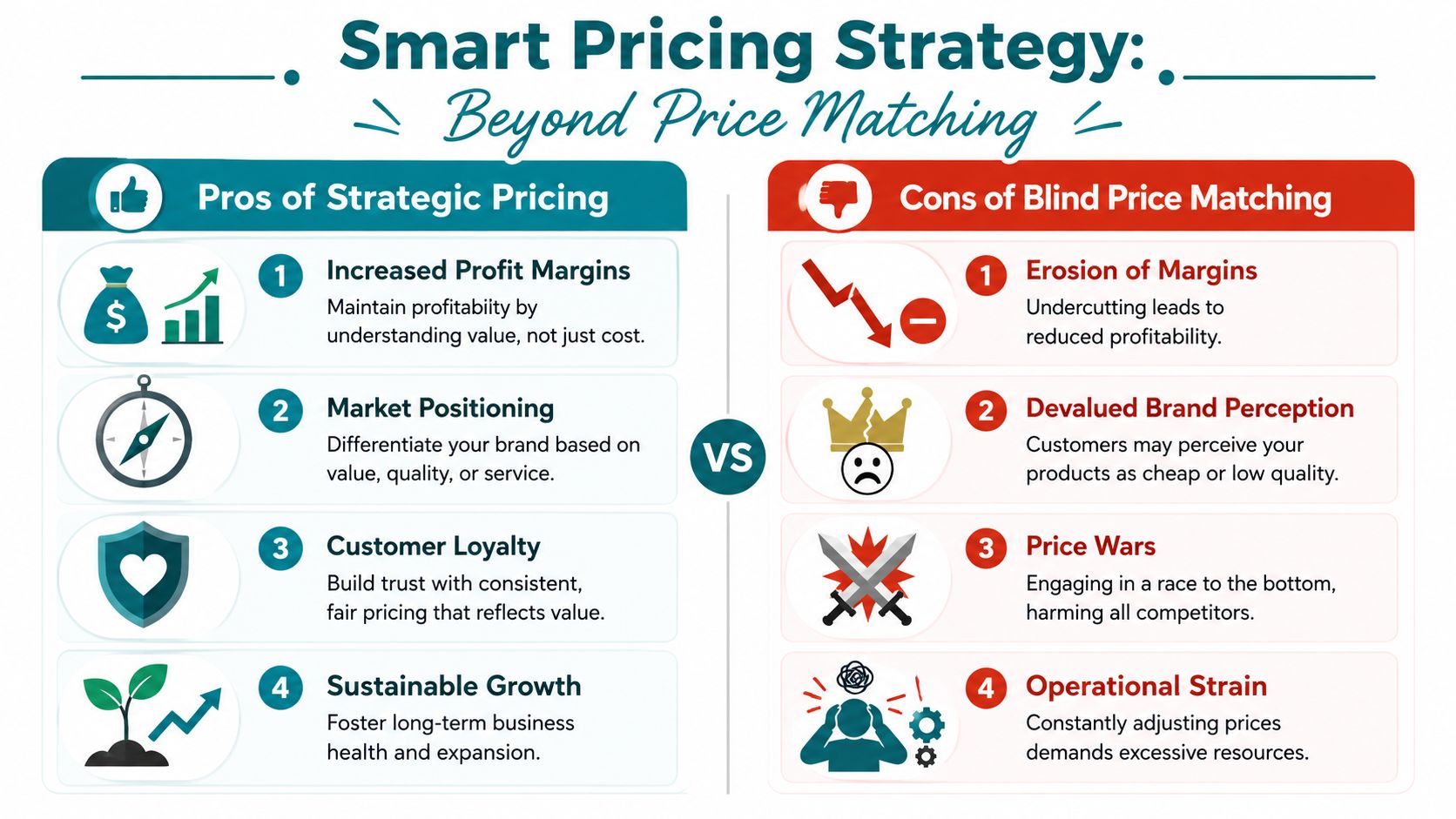
Blind price matching feels safe because it looks responsive. In reality, it can train your business to follow weaker signals and cut into profit on products or services where customers would have paid more.
A better move is to build pricing playbooks. These are predefined responses for common competitor actions.
Examples:
-
A rival cuts price on a popular item. You keep price steady but highlight warranty, service quality, or delivery speed.
-
A competitor launches a bundle. You review whether your offer needs repackaging rather than discounting.
-
Another company goes out of stock. You increase visibility on paid search and local landing pages while demand is open.
-
A low-price player enters the market. You sharpen qualification and sales messaging so your team sells value more clearly.
That's where pricing becomes strategy, not reflex.
For teams thinking more broadly about how analytics should shape decisions, this guide to a data-driven marketing strategy connects the dots well between information, action, and ROI.
Build around context, not headlines
Use your monitoring data to ask better questions:
-
Is the competitor really cheaper after shipping or add-ons?
-
Is this a short promo or a long-term repositioning?
-
Are they discounting because inventory is stuck?
-
Would a messaging change outperform a price change?
This short video gives a useful overview before you build your own rules:
<iframe width="100%" style="aspect-ratio: 16 / 9;" src="https://www.youtube.com/embed/YrwQ6zFvCSc" frameborder="0" allow="autoplay; encrypted-media" allowfullscreen></iframe>A simple pricing playbook structure
You don't need a giant pricing department to do this well. A lightweight playbook can fit on one page.
| Trigger | Response option |
| --- | --- |
| Competitor drops visible price | Review margin, compare total offer, decide whether to hold, match, or reposition |
| Competitor adds promotion | Test your own promotional language before lowering base price |
| Competitor out of stock | Increase visibility and urgency on your side |
| Competitor raises price | Evaluate whether your market can support a margin improvement |
The win isn't "lowest price." The win is making the right move with full context.
Putting Your Pricing Plan into Action
Strong competitor price monitoring isn't a one-time task. It's a repeatable business habit. You identify the right competitors, choose a practical tracking method, build a clean alerting workflow, and then act with discipline instead of reacting emotionally.
For Cincinnati SMBs, that often means starting smaller than expected. Monitor the offers that shape buying decisions. Watch the pages that affect sales conversations. Decide in advance how your team should respond. Then improve the process as you learn what matters.
Keep the legal and practical lines clear
If you're using software or a vendor to monitor public pages, stay reasonable. Respect site terms, avoid aggressive behavior that could burden another site, and don't assume every page will be easy to read automatically.
That last point matters more than many guides admit. Some competitors actively make tracking harder by showing prices as images, changing what different users see, or blocking suspicious traffic. A neutral commerce source notes that resilient monitoring has to account for these adversarial data sources, not assume every price is easy to capture (Lumav on competitor price monitoring challenges).
What works for local businesses
The most useful pattern is simple:
-
Start focused
-
Track context, not just price
-
Create response rules
-
Review results regularly
-
Adjust based on profit, not panic
That approach helps a retailer protect margin, a service business defend value, or a B2B company sharpen positioning without getting dragged into constant price chasing.
If your competitors hide pricing, rotate promotions constantly, or make comparison difficult across channels, the process gets more technical fast. That's usually the point where outside help pays for itself, not because data collection is impossible, but because clean data and better decisions are harder than they look.
If you're ready to stop guessing and start using competitor price monitoring as part of a smarter growth strategy, HDM can help. HDM works with Cincinnati-area businesses to turn messy market signals into practical action across websites, SEO, paid campaigns, and conversion strategy, so pricing data supports revenue instead of becoming just another report.