
Digital marketing compliance stops being abstract once you look at the workload. In one benchmark, 56% of respondents said they spend at least six hours per week on manual compliance monitoring, and 25% spend more than 20 hours weekly (PerformLine benchmark report). That's not a legal side note, it's a real marketing drain, right alongside campaign planning, SEO fixes, and ad changes.
For a Cincinnati business owner, that matters because the same team that builds landing pages, sends emails, and runs Meta ads is usually the team that has to keep those campaigns compliant. A cookie banner that's misconfigured, an email footer that's missing an unsubscribe path, or a retargeting setup that doesn't match consent can create work you didn't budget for and risk you didn't see coming. Compliance is a workflow problem, and once you treat it that way, it gets much easier to manage.
Why Compliance Is Now a Marketing Problem
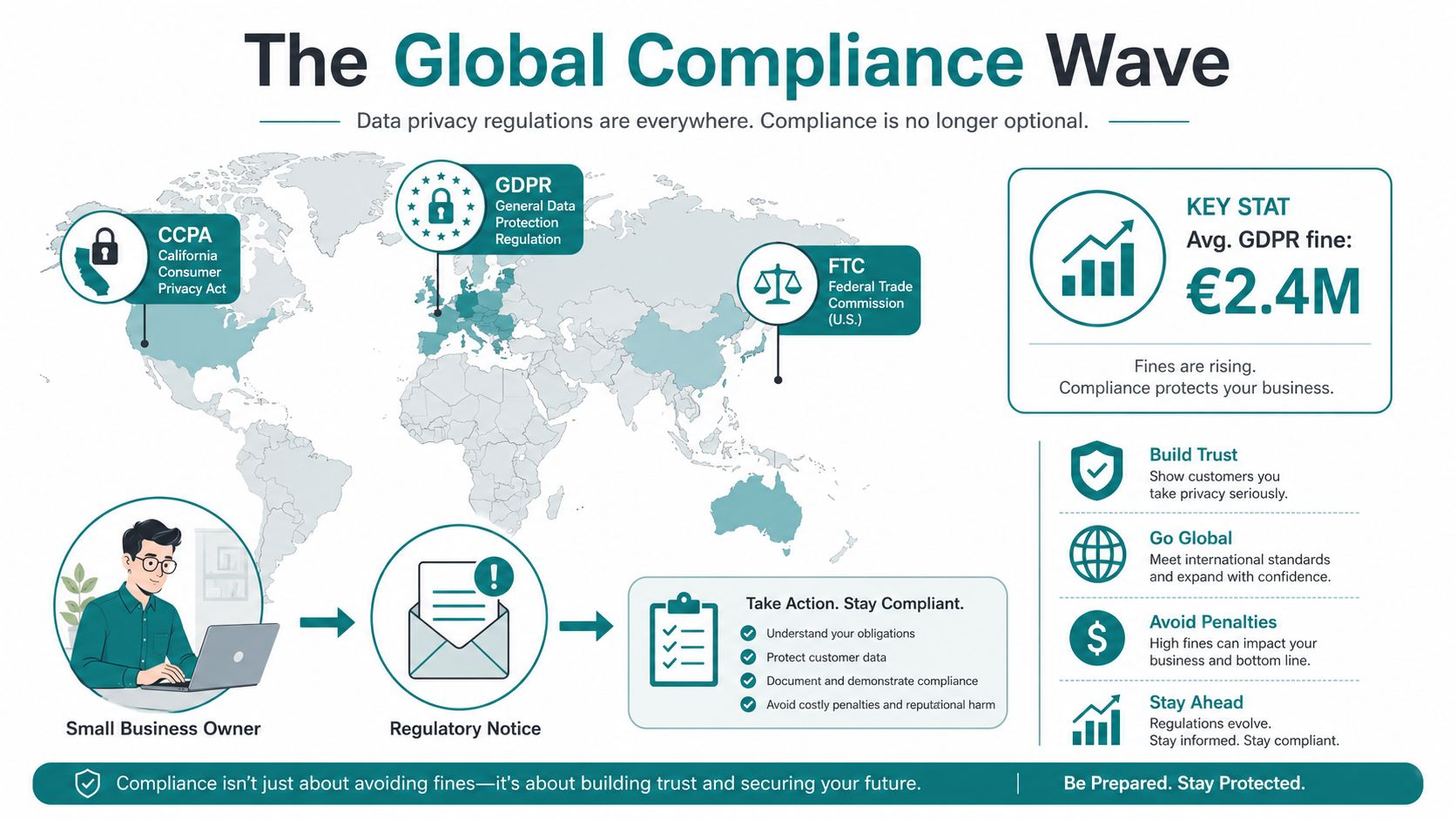
The scale of the shift is hard to ignore. By 2024, 144 countries had enacted privacy laws, covering more than 82% of the world's population (Luthor digital marketing compliance overview). In the United States alone, five new state privacy laws arrived in 2023, in California, Virginia, Colorado, Connecticut, and Utah, which means the old idea that compliance only matters for large global brands just doesn't hold up anymore.
For a local business, the practical impact shows up in ordinary campaign tools. A dentist in Cincinnati running Google Ads can still run into trouble if a lead form feeds data into a CRM without proper consent language. A boutique shop can get caught if a pixel fires before the visitor has made a choice. A service firm can create issues if its email list grew through a checkbox that wasn't really opt-in.
Where the time goes
The hidden cost is staff time. Teams are checking assets, reviewing disclaimers, and fixing old forms instead of launching the next campaign. That's why compliance belongs in marketing ops, not just in a legal folder nobody opens.
Practical rule: if a campaign touches a form, an email list, an ad audience, or a customer record, it needs a compliance check before it ships.
The upside is real. Better records mean fewer audit surprises, cleaner lists, and stronger trust signals on the website and in email. For a Cincinnati SMB, that often translates into steadier inbox placement and fewer last-minute edits before launch.
What Digital Marketing Compliance Actually Means
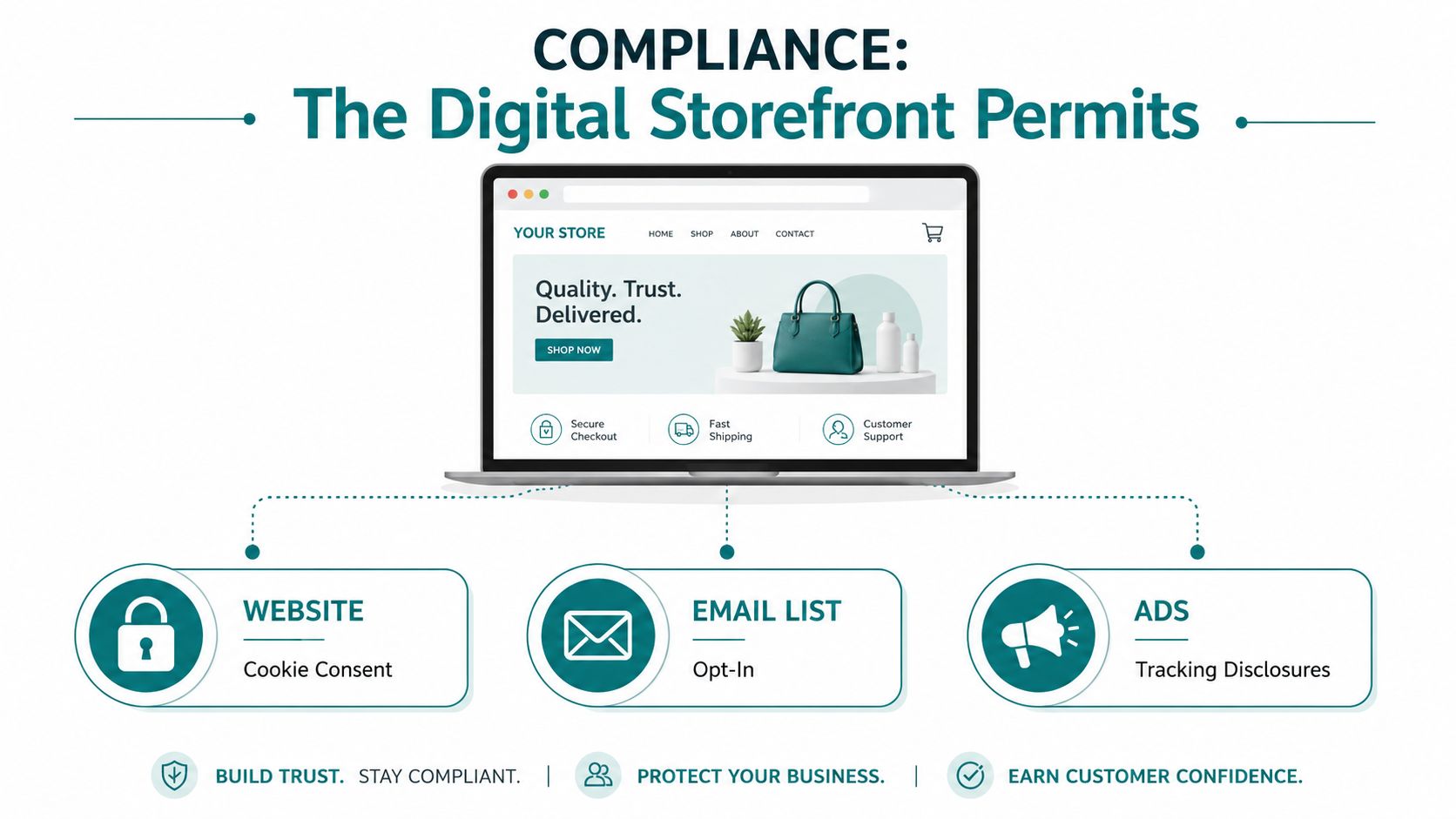
The easiest way to think about digital marketing compliance is storefront permits and inspections, but for your website, email list, and ad accounts. You don't need to memorize statutes to use the idea well. You need to know which part of your marketing stack collects data, which part sends messages, and which part makes claims.
Three pillars that matter day to day
Privacy and data collection covers what you collect and why. That means contact forms, analytics, cookies, booking widgets, and any place a visitor gives you personal information. Electronic messaging covers email and SMS, where consent, identification, and unsubscribe handling matter. Advertising standards cover truth in claims, endorsements, and platform disclosures, especially on Meta Ads, Google Ads, influencer posts, and testimonial-heavy landing pages.
Most owners already use the right tools, they just don't connect them to the rule set. Google Analytics, Mailchimp, Meta Ads, Calendly, and a website form all create separate compliance obligations. If your team copies old footer text into a new campaign or imports a list from another vendor, the risk usually comes from process drift, not bad intent.
If you want a simple deep dive on consent management, the GDPR and TCPA compliance guide is a useful companion because it helps connect consent language to real campaign operations.
Documentation is the key habit. Write down what each data source does, who approved it, and what the user saw when they opted in. That's what turns a vague policy into something your team can defend.
The Key Regulations You Need to Know
You don't need a law degree to run safer campaigns, but you do need to translate the names into plain marketing actions. Start with the rules that touch the channels you use most often, then map each one to your forms, emails, ads, and tracking setup.
The rules in plain English
GDPR governs personal data rights for EU residents and expects affirmative opt-in for personal data processing. For marketers, that means consent can't be assumed, and it has to be provable. CCPA and the newer state privacy laws in California, Virginia, Colorado, Connecticut, and Utah shape how consumers can opt out of certain data uses, especially around sharing or sale for advertising. CAN-SPAM governs commercial email, so your headers, subject lines, business identity, physical address, and unsubscribe handling all have to be clean.
The FTC focuses on endorsements and testimonials, which matters any time you use influencer content, affiliate links, or customer quotes in ads. If a recommendation is material to the buyer's decision, the disclosure needs to be clear and conspicuous. For a business handling patient information, HIPAA becomes relevant when forms, scheduling, or remarketing touch health data.
A good rule of thumb, if someone outside your company can see the page or email and still miss the disclosure, the disclosure probably needs work.
Here's a compact translation you can keep in a planning doc:
| Regulation | Who It Covers | Key Marketing Obligation |
|---|---|---|
| GDPR | EU residents' personal data | Collect affirmative opt-in and keep proof of consent |
| CCPA and state privacy laws | Consumers in covered U.S. states | Give meaningful privacy choices, especially for advertising data use |
| CAN-SPAM | Commercial email sent in the U.S. | Use honest headers, identify the business, and provide a working opt-out |
| FTC endorsement guidance | Influencers, affiliates, testimonials | Make paid or material relationships clear and conspicuous |
| HIPAA | Businesses handling patient health information | Avoid exposing health data through forms, messages, or remarketing |
For a broader training lens, a compliance training guide can help teams build repeatable habits instead of relying on one person to remember every rule. If you want a related local reference, HDM also keeps a GDPR compliance checklist for campaign planning.
The Five Highest-Risk Areas in Your Campaigns
Most SMB mistakes aren't dramatic. They happen in the ordinary places where marketing teams move fast and assume the default settings are fine. If you want to find your risk quickly, look at the spots where data, targeting, and publishing meet.
1. Website cookies and tracking pixels
A site can look polished and still fire tracking scripts before a visitor makes a choice. That's the classic cookie and pixel problem. If your analytics or ad tags load by default, you may be collecting data before consent is clear enough for the market you're serving.
2. Email capture and list imports
A pre-checked newsletter box or an old imported list can create trouble fast. A lead magnet form might seem harmless, but if the visitor never really opted in, your email platform is now carrying risk into every future send. That's why list hygiene is a compliance task, not just a deliverability task.
3. Paid retargeting and custom audiences
Retargeting is useful, but it can also be the easiest way to overstep. If someone filled out a form for a quote and later sees ads based on that activity, your team needs to know what they agreed to and what your ad platform is allowed to use. U.S. state privacy rules and consent records start to intersect with media buying here.
4. Influencer and user-generated content
If a creator posts about your business and there's any material relationship, the disclosure has to be obvious. A buried hashtag or a vague caption doesn't help much. The risk here isn't only the post itself, it's also the ad version of that post if your team reuses it in paid media.
5. Patient data in healthcare-adjacent campaigns
If you're a chiropractor, med spa, dentist, or any other healthcare-adjacent business, a contact form or chatbot can create a HIPAA problem if it collects sensitive details. HDM has a useful HIPAA-compliant web design resource for businesses that want to think through forms, scheduling, and patient experiences before launch.
A Practical Compliance Workflow You Can Run This Week
The fastest way to lower risk is to stop treating compliance like a one-time policy review. Build a repeatable workflow your team can use before every launch, even if the launch is small. That keeps the work in the marketing calendar instead of buried in a crisis.
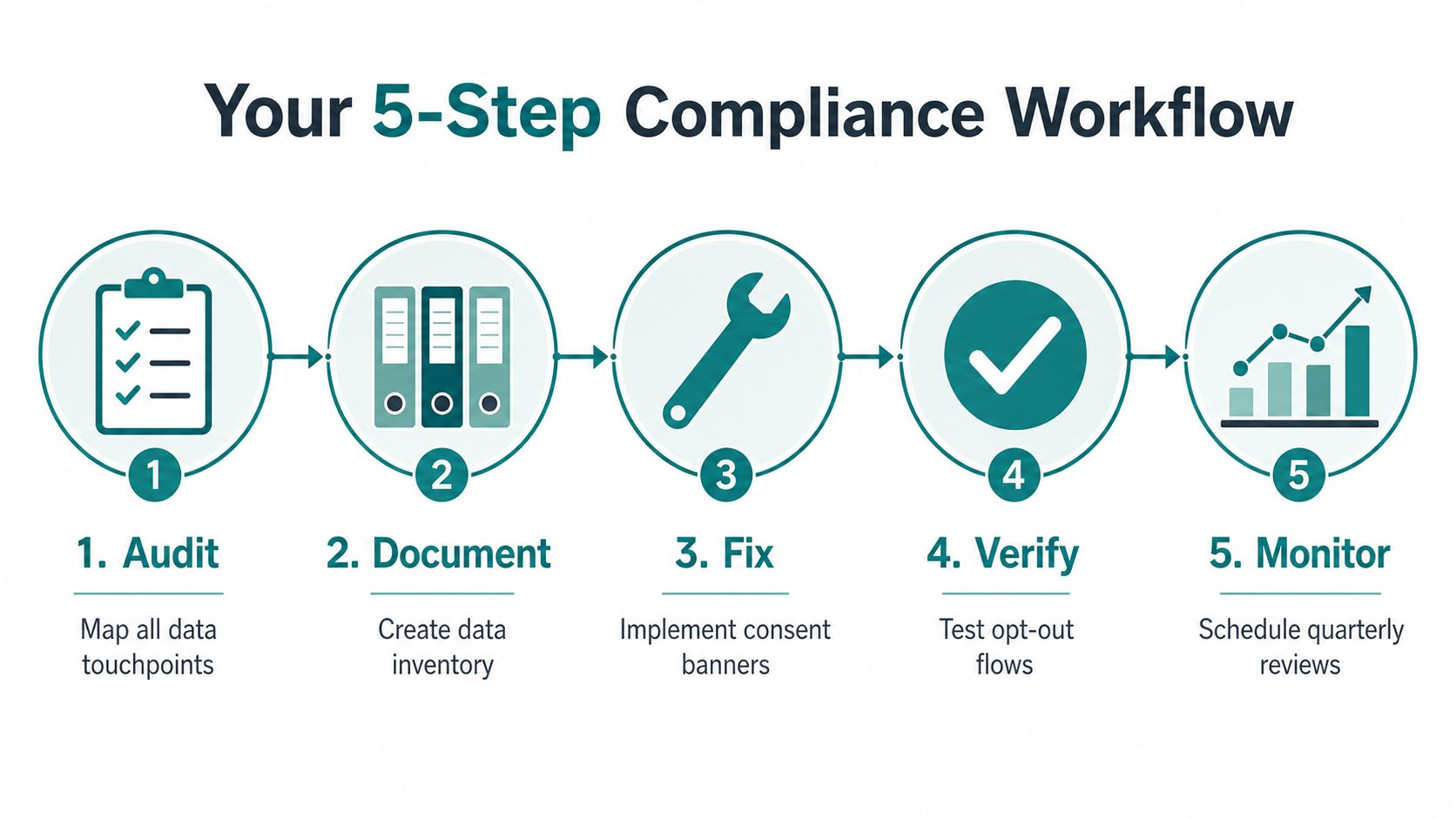
Audit, document, fix, verify, monitor
Audit means inventory every form, pixel, email list, landing page, and disclosure. Document means record what each tool collects, why it collects it, and what consent or lawful basis supports it. Fix means update banners, form language, footers, suppression rules, and ad account settings so the system matches the policy.
Verify means testing the user path, not just reading the page in a browser. Submit the form, click unsubscribe, withdraw consent, and check whether the right systems stop using the data. Monitor means putting a review cadence on the calendar so new campaigns are checked before launch instead of after a complaint lands.
Use consent like an auditable data asset. Keep separate states for email, SMS, and retargeting, because one opt-in doesn't automatically cover all three. That separation makes it easier to prove what a person agreed to and to suppress downstream activation when they change their mind.
If the team can't show who consented, when they consented, and what they consented to, the record isn't strong enough for an audit.
The last item is incident response. GDPR-style rules require certain breaches to be reported within 72 hours (Digital Marketing First UK guidance), so someone on your team needs to know who gets called, what gets reviewed, and where the facts live. A written contact list beats improvising during a bad week.
Accessibility, Trust, and the Hidden Conversion Payoff
A lot of owners hear "compliance" and think "expense." That's too narrow. Accessible forms, readable consent language, and clear opt-outs are also part of how real people decide whether to trust you with their information.
Where accessibility and privacy meet
If a form can't be used with a keyboard, or the error message is too vague to fix, a visitor may not be able to give meaningful consent. The same is true for tiny contrast, missing labels, or confusing checkbox language. Those are accessibility problems on the surface, but they also affect privacy compliance because the user can't understand the choice being offered.
Plain-language policies help too. People are more willing to submit a form when they can see what happens next, and they're less likely to bounce when the page feels honest. That's why compliance and conversion often move in the same direction.
Small changes can do a lot. Captioned video ads support access and make your message easier to consume without sound. Alt text on creative assets helps with accessibility. Clear consent copy on your lead forms reduces confusion and gives your sales team cleaner leads.
If your site still hides trust signals behind awkward pages, a basic technical trust upgrade such as an SSL certificate can be part of the same work. HDM covers that kind of foundation work in its SSL certificate installation guidance, which is useful when you want the site to feel secure before people ever fill out a form.
Tools, Support, and How to Scale Without Burning Out
A small team doesn't need a giant compliance stack. It needs the right categories of tools and a decision about who owns the process. Start with the basics, then choose the operating model that fits your risk level.
What you need and how teams usually handle it
At minimum, you want a consent management platform for the website, an email platform that handles suppression and opt-outs cleanly, an analytics setup that respects consent state, and a simple approvals workflow for paid creative and influencer posts. Those pieces don't have to be fancy. They just have to work together.
You've usually got three options. In-house works if someone on your team can maintain the process. Fractional support works if you need strategic help without adding a full-time role. Agency support works when compliance has to be built into website, SEO, and ad execution from day one.
| Operating Model | Good Fit | Main Tradeoff |
|---|---|---|
| In-house | Small teams with one strong owner | Easy to stall when that person is busy |
| Fractional lead | SMBs with some internal capacity | Still needs internal follow-through |
| Agency partner | Teams that want compliance built into builds and campaigns | Requires trusting outside process ownership |
For Cincinnati-area businesses, HDM is one option worth knowing about. It's a Springboro and Cincinnati-based full-service agency that can build websites, campaigns, and patient-facing experiences with consent, accessibility, and disclosure handling baked into the brief instead of bolted on later. If you want a contrast point while evaluating tools, the Vanta review is a useful example of how teams think about structured compliance support in a different context.
The main question is simple. Do you need help staying organized, or do you need someone to own the workflow with you? Pick the model that matches your bandwidth before the next campaign stack grows.
Putting It All Together, Your Next 30 Days
The practical takeaway is simple. Digital marketing compliance is a workflow with measurable time costs, every campaign launch deserves a quick pre-flight check, and the right partner can turn that work into a durable advantage instead of a weekly headache. For Cincinnati SMB owners, the fastest win is usually not a rewrite of every policy. It's cleaning up the few places where data collection, consent, and messaging meet.
If you want a marketing-first way to frame the next step, think in terms of the campaign stack you already use. HDM builds websites, ads, and patient experiences with compliance-aware defaults so teams aren't retrofitting policy after launch. That matters whether you're trying to protect trust, reduce manual review, or make sure the next form, email, or retargeting set-up is easier to defend.
A printable checklist helps, but a live review helps more. Book a quick pass on your site and ad stack, then fix the highest-risk items before the next campaign goes out.
HDM helps Cincinnati-area businesses build websites, ad campaigns, and patient experiences that are easier to trust and easier to maintain. If you want a practical review of your current site, forms, and ad setup, visit HDM and start the conversation today.