
A lot of Cincinnati business owners hit the same wall.
They invest in a new website, tighten up their SEO, maybe launch paid ads, and traffic starts moving in the right direction. Then the backend breaks the momentum. Products show as available when they are not. Orders ship late. A customer clicks from Google, buys with confidence, then waits too long and leaves a bad review.
That is not just an operations problem. It is a growth problem.
If your business sells physical products, manages inventory, depends on suppliers, or promises fast turnaround, your supply chain shapes the return on every marketing dollar you spend. A polished website can attract demand. It cannot fix stockouts, messy fulfillment, or poor handoffs between sales, inventory, and shipping.
Around Cincinnati, that matters more than some owners realize. Whether you are running an e-commerce brand in Oakley, a distributor near Blue Ash, or a manufacturer serving the region from West Chester, the unseen parts of the business directly affect revenue, customer satisfaction, and repeat purchases. Supply chain optimization is how you close that gap.
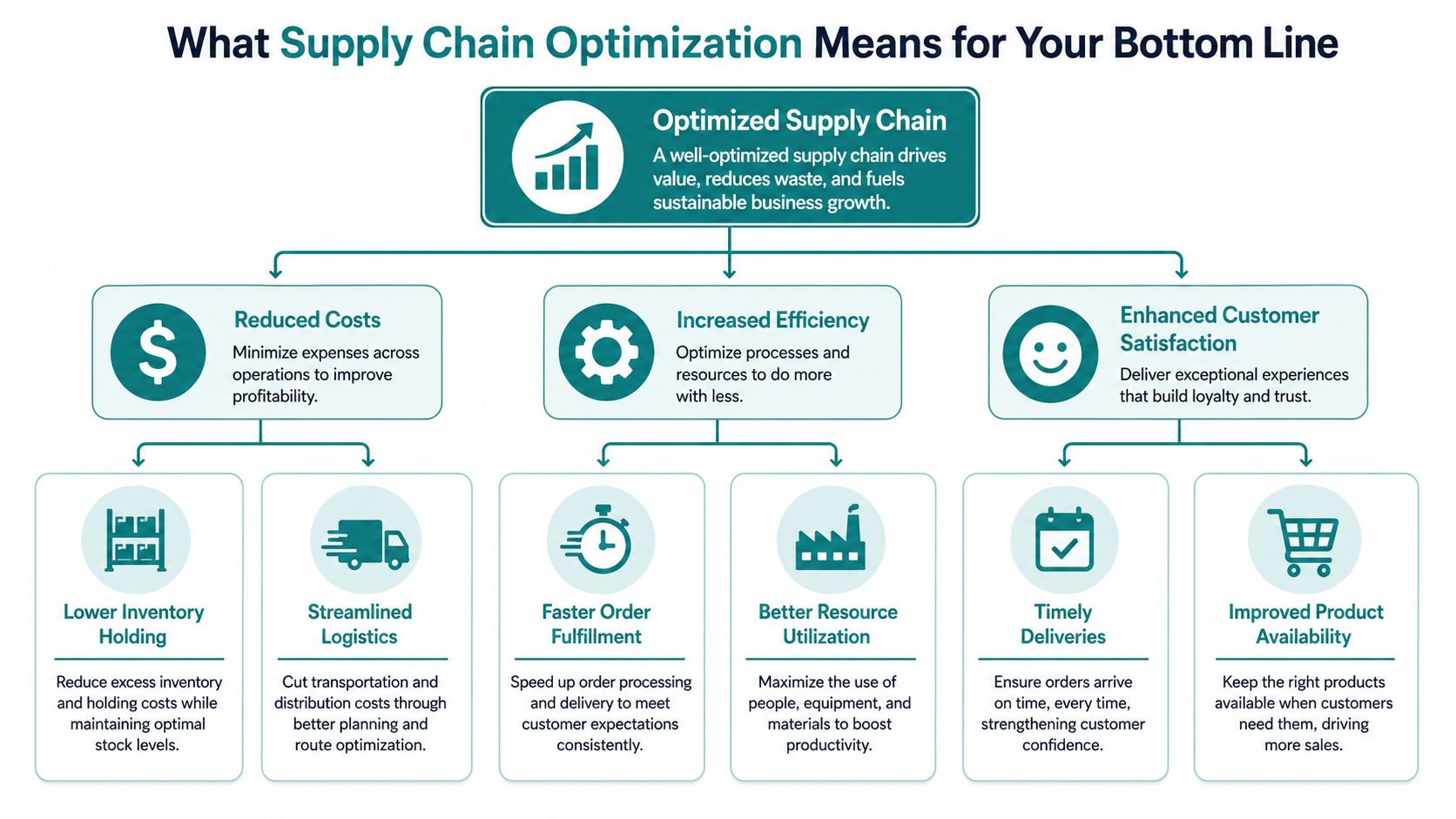
What Supply Chain Optimization Means for Your Bottom Line
Think about a local coffee shop ordering beans, cups, pastries, and milk. If it overorders, cash sits on shelves and product goes stale. If it underorders, regulars hear "we are out" and go somewhere else. If deliveries arrive late, the morning rush turns into complaints.
That same pattern shows up in larger businesses every day. Supply chain optimization is the practical work of making sure the right products, materials, and information move at the right time, in the right quantity, with as little waste as possible. For an SMB, that usually means better forecasting, smarter inventory decisions, cleaner fulfillment workflows, and fewer surprises between purchase and delivery.
It is not just a logistics issue
Most owners hear "supply chain" and think trucks, pallets, and warehouses. That is too narrow.
If your team cannot predict demand, your website can drive traffic to products you cannot fulfill. If inventory is inaccurate, your ad spend can push customers into a dead end. If shipping is inconsistent, your reviews, referrals, and repeat business all take a hit. The operational side and the marketing side are not separate anymore.
A useful benchmark comes from Michigan Techs applied statistics overview of supply chain disciplines. It notes that businesses with optimal supply chains can achieve 15% lower supply chain costs, hold less than 50% of the inventory of peers, and improve cash efficiency through faster cash-to-cash cycles.
For a small or mid-sized company, those gains matter because they free up cash and reduce the friction that slows growth.
Practical rule: If your business cannot reliably fulfill what your marketing promises, your marketing budget is subsidizing operational mistakes.
Where owners feel it first
You usually do not notice supply chain problems in a spreadsheet first. You notice them in day-to-day business pain:
-
Cash gets trapped in inventory because buyers order too much "just in case."
-
Sales disappear during stockouts because popular items run out at the worst moment.
-
Customer trust erodes when estimated delivery dates slip.
-
Staff waste time chasing down order status, purchase orders, and shipment details.
-
Online growth stalls because the business cannot support the demand it worked hard to create.
Here is the plain-English version. A smoother backend makes every front-end investment work harder. Better stock accuracy supports better product pages. Better fulfillment supports better reviews. Better delivery performance supports higher customer confidence.
Why this matters in Cincinnati
Local businesses here often compete on service, reliability, and responsiveness. That is true whether you are selling regionally or nationwide. If a customer in Mason, Covington, or downtown Cincinnati can buy the same category of product from three vendors online, they will remember the one that shipped on time, communicated clearly, and did not create hassle.
Supply chain optimization helps you protect margin while improving the customer experience. That is why it belongs in the same conversation as SEO, web design, paid media, and conversion rate work. It is not glamorous, but it often determines whether your growth compounds or stalls.
Core Strategies to Improve Business Efficiency
Most SMBs do not need a massive transformation project. They need a short list of improvements that fix the biggest friction points first.
The three levers that usually matter most are inventory policy, demand forecasting, and logistics execution. If you tighten those up, you reduce avoidable waste and make your operation easier to scale.

Start with inventory discipline
Many owners either buy by instinct or let the loudest internal voice set reorder decisions. That works until seasonality, promotions, or supplier delays expose the guesswork.
Use a tighter process instead:
-
Separate your core sellers from slow movers. Your top products need more frequent review and stricter stock rules. Slow movers need restraint, not optimism.
-
Set simple reorder logic. Do not rely on memory. Decide what stock level triggers a reorder and who approves exceptions.
-
Audit inventory accuracy regularly. If the system says you have twelve units and the shelf has five, every downstream decision gets worse.
A common mistake is treating all SKUs the same. They are not. One fast-moving item that goes out of stock can hurt revenue more than several slow-moving items sitting too long.
Forecast demand with the data you already have
Forecasting sounds more complicated than it needs to be. For most Cincinnati SMBs, the starting point is basic sales history plus context.
Look at:
-
Recent sales patterns
-
Seasonality
-
Promotion calendars
-
Known customer cycles
-
Supplier lead time variability
If your holiday season always compresses ordering timelines, plan for that before your marketing campaign goes live. If certain products spike when weather changes or local events happen, factor that in. Even a simple spreadsheet review is better than buying based on gut feel alone.
The first useful forecast is not perfect. It is simply better than guessing.
Tighten the logistics side
Logistics is where many "small" inefficiencies accumulate. Receiving delays, poor pick-pack flow, unclear shipping rules, and weak carrier selection all show up later as customer frustration.
Focus on a few basics:
-
Map your order flow. From website order to final delivery, identify where work stalls.
-
Create standard handling rules. Staff should not improvise packaging, carrier choice, or shipping priority every day.
-
Review fulfillment promises. If your site says fast shipping, your warehouse process has to support it.
A short table makes the trade-offs clear:
<table> <thead> <tr> <th>Area</th> <th>What works</th> <th>What does not</th> </tr> </thead> <tbody><tr> <td>Inventory</td> <td>Reorder rules tied to actual sales movement</td> <td>Bulk buying without a review plan</td> </tr> <tr> <td>Forecasting</td> <td>Using recent sales and seasonal patterns</td> <td>Relying only on intuition</td> </tr> <tr> <td>Shipping</td> <td>Standard carrier and fulfillment workflows</td> <td>Ad hoc decisions on every order</td> </tr> </tbody></table>Use technology after the process is clear
Software can help, but software is not the strategy. Industry reporting cited by Fictivs supply chain statistics article projects the global market for supply chain management software from $25.7 billion in 2022 to $72.1 billion by 2032, a 10.9% CAGR. That tells you businesses are investing heavily in visibility and resilience, but it does not mean every SMB should rush into a big platform purchase.
For many smaller firms, a better move is to fix the workflow first, then automate the pieces that repeatedly waste staff time. That is where tools like workflow automation consulting can make sense if your team is stuck doing the same order, approval, or status-update tasks manually.
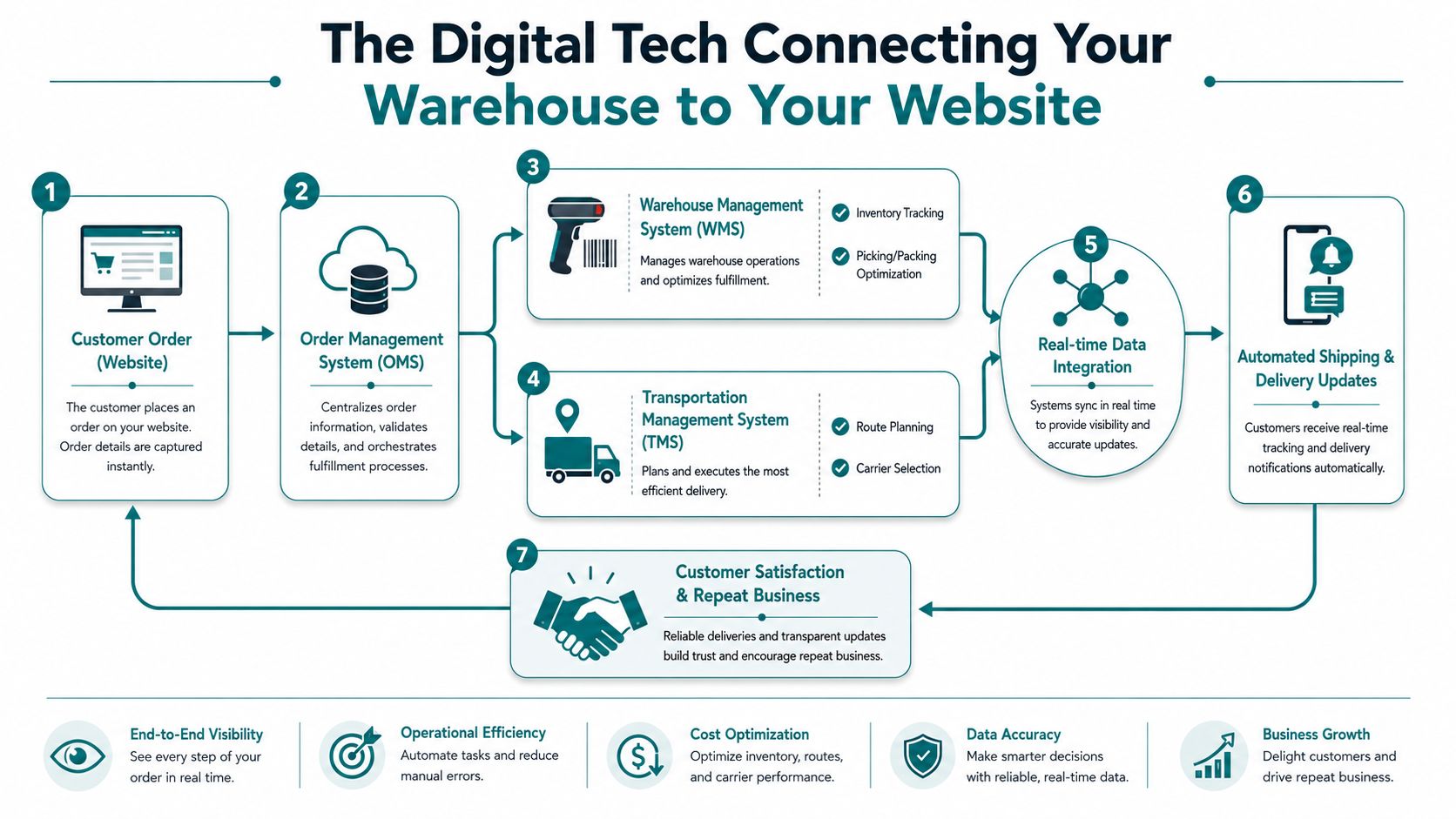
The Digital Tech Connecting Your Warehouse to Your Website
Your website is not just a brochure or lead generator anymore. If you sell products online, it acts like the front counter of your business, the order intake desk, and part of your customer service operation all at once.
That means the site has to connect cleanly with what is happening behind the scenes. If it does not, customers see one reality and your warehouse lives in another.
The systems that need to talk to each other
A practical digital stack often includes your e-commerce platform, inventory records, order management, shipping tools, and customer data. In larger organizations those may live in separate systems. In smaller businesses, some of them sit inside Shopify, WooCommerce, QuickBooks, a warehouse spreadsheet, or shipping software like ShipStation.
The problem is not that you use multiple tools. The problem is when those tools do not stay aligned.
According to Rfgens overview of supply chain optimization, a mature optimization stack unifies ERP, TMS, WMS, and CRM data into a single visibility layer, which enables faster detection of bottlenecks and tighter inventory control. That same guidance notes that predictive analytics then use this data to forecast demand and disruption risk.
For a non-technical owner, that means your business makes better decisions when the website, warehouse, shipping, and customer systems are looking at the same information.
What good integration changes
When integration is working, several things get easier:
-
Inventory shown online is more reliable
-
Orders reach fulfillment faster
-
Customer service can answer status questions quickly
-
Marketing teams can promote products with more confidence
-
Managers can spot delays before customers start complaining
Bad data creates fake demand and fake confidence. A campaign may look successful on the traffic side while the business loses trust on the delivery side.
For businesses building out this kind of connected setup, system integrations for web apps and operations are often the missing piece. HDM works in that space as one option, alongside the other developers and platform partners SMBs may already use, especially when a business needs its site, e-commerce tools, and internal workflows to share data more reliably.
Your website should reflect operational truth, not marketing hope.
A short explainer is useful here:
Where AI and analytics fit
Owners hear "AI" and often assume it means a giant software budget. In practice, the more valuable question is simpler. Can your business use available data to make fewer bad decisions?
If your systems are connected, analytics can help you flag unusual order patterns, spot products that are trending toward stockout, and identify fulfillment slowdowns before they turn into customer complaints. That is the operational side of digital growth. It is not flashy, but it is what lets an online store scale without constantly disappointing buyers.
A well-built website supports that process by serving as a clean entry point for orders, customer communication, and product information. When the digital side and the physical side line up, your marketing creates revenue instead of cleanup work.
An Actionable Roadmap for Cincinnati SMBs
Most owners do not need to optimize everything at once. They need a sequence that matches budget, staff capacity, and real-world urgency.
The most useful approach is crawl, walk, run. That keeps you from overspending on software before your process is ready, which is one of the most common mistakes SMBs make.
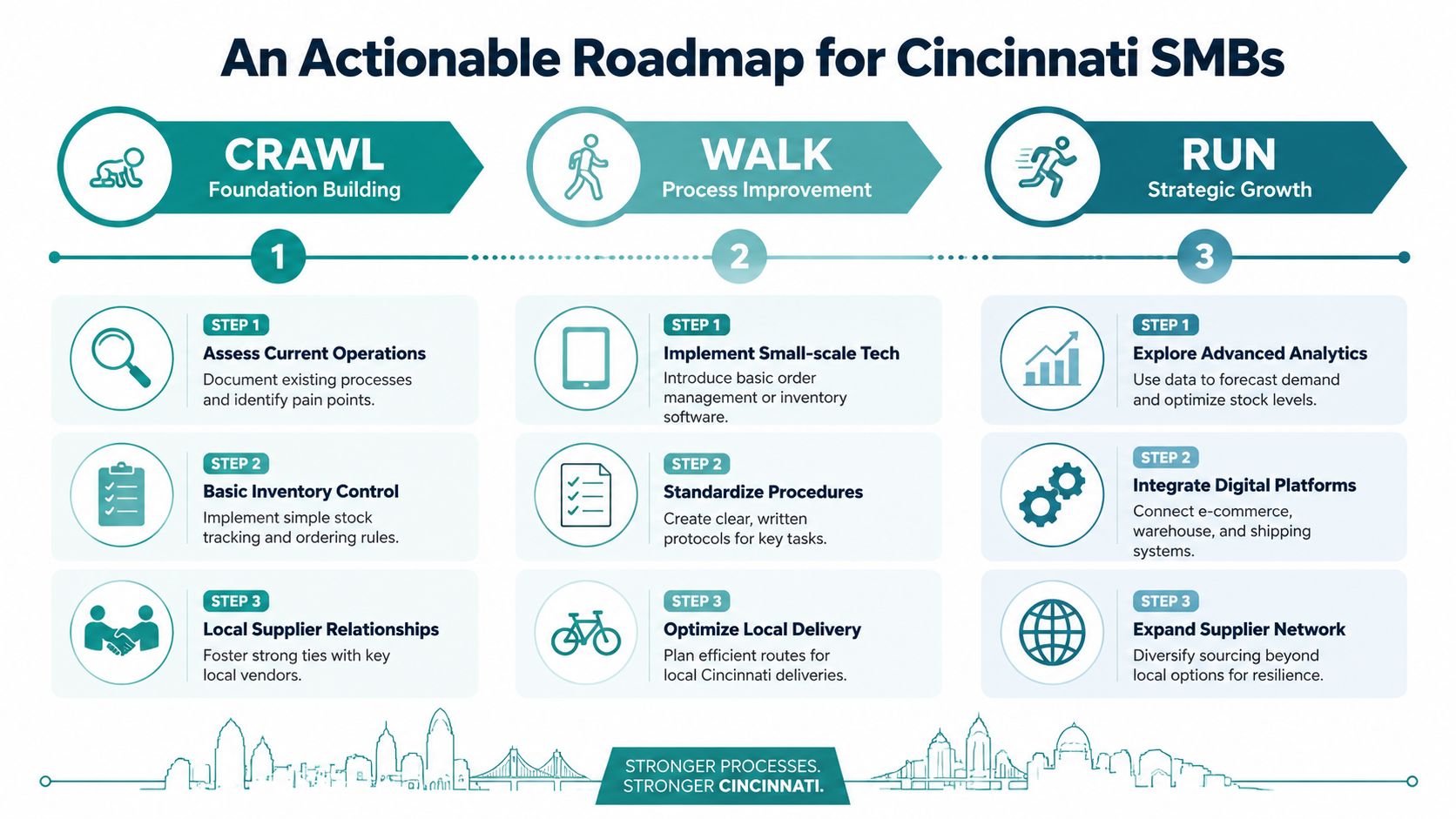
Crawl with data cleanup and process mapping
Start with visibility, not tools.
List the steps from incoming demand to final delivery. Include website orders, phone orders, purchasing, receiving, inventory updates, fulfillment, shipping, and customer communication. Then mark where delays, errors, or repeated manual work happen.
Focus especially on:
-
Inventory records that do not match physical counts
-
Demand data spread across systems
-
Manual handoffs between teams
-
Frequent exceptions that depend on one employees memory
This first stage sounds basic because it is. It also saves money. The University of Tennessees Haslam guidance on supply chain optimization emphasizes that for SMBs, prioritization is the challenge, and a phased approach that starts by validating demand and inventory data before expanding to network design or automation produces better ROI by focusing on high-friction cost centers first. You can read that perspective in Haslams discussion of what supply chain optimization involves for business practice.
Walk with standard rules and simple tools
Once your data is cleaner, put structure around the work. At this stage, many businesses can make meaningful progress without a large implementation.
A good middle stage includes:
<table> <thead> <tr> <th>Stage</th> <th>Priority</th> <th>Example action</th> </tr> </thead> <tbody><tr> <td>Walk</td> <td>Standardize</td> <td>Write clear reorder and fulfillment rules</td> </tr> <tr> <td>Walk</td> <td>Simplify</td> <td>Use one source of truth for inventory updates</td> </tr> <tr> <td>Walk</td> <td>Improve local execution</td> <td>Tighten delivery windows and shipping communication</td> </tr> </tbody></table>If you run local or regional delivery around Greater Cincinnati, route planning and order cut-off times deserve attention. A business that promises same-day or fast regional turnaround needs rules the team can execute.
Field note: The best SMB improvements usually look boring on paper. Cleaner SKU data, written reorder rules, and consistent shipping cutoffs beat expensive chaos every time.
Run with integration and smarter forecasting
Only after the basics are stable should you move into more advanced work.
That might include connected software, better reporting dashboards, predictive demand planning, or custom workflows between your site and operational systems. At this point, the investment tends to work better because the process underneath it is no longer broken.
For Cincinnati-area owners, the roadmap is less about becoming a giant enterprise and more about building an operation that can support growth without constant strain. If your website starts generating more orders next quarter, can your current backend handle them cleanly? If the answer is no, the roadmap starts now, not later.
Optimization in Action Across Ohio
The easiest way to understand supply chain optimization is to see how it changes decisions on the ground.
An apparel brand in Over-the-Rhine
A small apparel company in Over-the-Rhine had done a solid job on the front end. Product photography was strong. Social campaigns were bringing in attention. Email promotions were driving bursts of traffic during seasonal drops.
The problem sat behind the storefront. Inventory updates lagged behind actual sales, and the owner was planning holiday purchasing based mostly on instinct. Popular sizes sold out too early, while weaker styles lingered in storage. Customer service spent too much time answering "Where is my order?" and "Why did I buy something that was unavailable?"
The fix was not a massive rebuild. The company tightened product-level forecasting, reviewed previous sales by style and size, and created firmer reorder rules for its core sellers. It also aligned promotional timing with realistic inventory availability instead of pushing everything at once.
The result was a healthier cycle. Marketing campaigns promoted products that were ready to ship. Customers had fewer fulfillment surprises. Reviews improved because the business was finally matching digital demand with operational readiness.
A manufacturing firm near Dayton
A small manufacturer outside Dayton faced a different issue. The website and sales team were doing their job. Quote requests were steady, but production schedules kept slipping because component ordering was inconsistent and supplier communication lived in scattered emails and spreadsheets.
Management initially looked at the problem as a purchasing issue alone. It was not. Procurement, inbound logistics, production timing, and customer expectations were all tied together. A delayed material order did not just affect the shop floor. It affected promised timelines, sales follow-up, and client confidence.
The company started by mapping which components created the most schedule risk. From there, it clarified supplier communication, set clearer reorder triggers for critical materials, and improved visibility between incoming orders and production planning. It also took a broader look at how manufacturing businesses can connect digital demand with operations through resources like HDMs manufacturing supply chain perspective.
What changed was less drama. Fewer surprise shortages. Better alignment between quote timelines and actual capacity. A stronger handoff between what the company promised online and what operations could deliver.
The shared lesson
These examples are different on the surface, but the lesson is the same. Growth does not break businesses by itself. Misalignment does.
If your marketing is outperforming your operations, success starts to feel expensive. Supply chain optimization brings those two sides back into sync so demand turns into fulfilled revenue, not avoidable frustration.
Common Pitfalls That Derail Small Businesses
Small businesses rarely fail at supply chain optimization because they lack ambition. They fail because they solve the wrong problem first.
Do not buy software to fix a broken process
If your inventory counts are inconsistent, your reorder rules are unclear, and your team handles exceptions differently every day, new software will not save you. It will digitize confusion.
Fix the workflow first. Then choose tools that support the process you have already defined.
Do not trust dirty data
Bad SKU names, duplicate products, missing lead times, and outdated stock counts create bad decisions fast. Owners often underestimate this because the problem looks minor until a campaign goes live or a key order gets delayed.
Clean data is not admin work for its own sake. It is the foundation for accurate ordering, fulfillment, and online merchandising.
Do not optimize one area while hurting another
A lower shipping cost is not a win if it creates delays that upset customers. A leaner inventory position is not smart if it produces constant stockouts on your best sellers.
Use a balanced view. Revenue, margin, fulfillment speed, and customer satisfaction all matter together.
Do not ignore operational impact when planning marketing
Many SMBs are blindsided when they launch a promotion, improve rankings, or redesign the site without asking whether the backend can support the added demand.
Before any major campaign, check:
-
Stock readiness for promoted products
-
Fulfillment capacity for expected order flow
-
Supplier timing for replenishment
-
Customer communication for delays or backorders
Do not make one employee the entire system
If one person "just knows" how purchasing works, where inventory issues hide, or which vendor to call when something goes wrong, you are carrying more risk than you think. Document key processes. Cross-train the team. Reduce dependence on memory.
Small businesses become fragile when critical operations live in one persons inbox or head.
Do not wait until growth exposes the problem
By the time customer complaints pile up, the issue has already touched revenue and reputation. It is cheaper to tighten your process while the pressure is manageable than to rebuild trust after repeated fulfillment issues.
If you are improving your website, SEO, or digital campaigns, it is worth checking whether your operations can support that growth. HDM works with Cincinnati-area businesses on the digital side of that equation, especially when websites, integrations, and customer experience need to align with how the business operates.