


A prospective customer in Cincinnati may be comparing your business with three competitors before you've had your first cup of coffee. They've searched for pricing, read reviews, checked alternatives, and looked for signs that your company understands their problem. If your website says little beyond "Contact us," the conversation may already be over.
That's the practical power of They Ask You Answer. Instead of hiding behind polished sales language, you publish the answers buyers need before they call. You become the helpful business owner who explains the options, costs, risks, and next steps clearly.
For a local contractor, law firm, healthcare organization, manufacturer, or online retailer, this approach connects content with revenue. It gives search engines useful information, gives sales teams better resources, and gives buyers a reason to trust you. HDM, a Cincinnati-area digital agency, uses this kind of revenue-focused thinking across SEO, user experience, analytics, chatbots, and content strategy.
Introduction: Why Answering Wins Before the Sales Call
It's close to midnight in Cincinnati. A homeowner has found a water stain near the ceiling and doesn't want to call a contractor yet. A business owner in Blue Ash is comparing website agencies after a long day. A patient is reviewing healthcare options before deciding whether to request an appointment. A retailer is checking whether a product is worth the price.
These people aren't ready for a sales pitch. They're ready for information.
They want to know what a service costs, what could go wrong, how one option compares with another, and whether a provider is a sensible fit. If your website answers those questions plainly, you've started building trust before anyone fills out a form. If your website avoids them, a competitor who explains the decision may earn the inquiry instead.
The website becomes part of the sales team
A useful website doesn't announce that your company exists. It helps a buyer think through a decision. A pricing article can address budget concerns. A comparison page can clarify alternatives. An FAQ can remove uncertainty. A short video can explain a complicated process in a way that feels more approachable than a dense service page.
This doesn't mean publishing every private detail or promising an exact price for a custom project. It means explaining how decisions work. A Cincinnati remodeling company might discuss the factors that affect project cost. A law firm might explain which type of matter it handles and when someone should consider another path. A healthcare organization can clarify what a patient should expect before contacting the office.
Key Insight: Buyers don't need more persuasion before they understand their options. They need useful answers.
The framework centers on becoming the most trusted answer source in your market. That trust matters because buyers often do their own research long before a conversation with sales. They may never announce that they visited your website, but the information they found can shape whether they contact you, what they ask, and how much confidence they bring to the call.
This guide shows how to turn real buyer questions into content, search visibility, better website experiences, useful chatbot conversations, and measurable business outcomes. The goal isn't to publish for the sake of publishing. The goal is to help the right people make informed decisions, then make it easy for qualified buyers to take the next step.
What They Ask You Answer Really Means
Think about two neighbors. One explains which plumber to call, what the repair may involve, and what warning signs to watch for. The other immediately hands you a business card and insists that his company is the only sensible choice. Many people trust the first neighbor because helpful information feels more credible than pressure.
They Ask You Answer applies that same idea to business marketing. The methodology asks a company to identify what customers are thinking and create honest written and video content that addresses those questions on its own website. The business teaches first, earns confidence, and invites the buyer to continue the conversation when the fit is right.
The guiding question is simple:
What is my customer thinking?
That question changes how a team chooses topics. Instead of asking, "What product should we promote this month?" you ask, "What is making a prospect hesitate?" Instead of writing a generic post about industry trends, you answer the question a salesperson hears every week.
Answering requires more than an FAQ page
A traditional FAQ page can help, but They Ask You Answer is broader. It treats buyer questions as the foundation for the website's content and sales process. A useful answer might become a detailed article, a service page, a comparison guide, a short video, a calculator, a chatbot response, or a resource your sales team shares after a call.
The best questions usually involve money, risk, alternatives, proof, and fit. Buyers want to understand the decision, not just read a list of features.
A practical starting point is to review emails, sales notes, chat transcripts, proposal objections, and support conversations. If your team has answered a question more than once, that question may deserve a permanent home on the website. The guidance on how to turn meetings into content can help teams capture those questions without creating a separate research project.
The approach also depends on honesty. A page that only praises your service won't answer the buyer's real concern. Strong content explains limitations, acknowledges alternatives, and tells readers when another option may be better. That candor can reduce inquiries from poor-fit prospects while making serious buyers more comfortable moving forward.
Watch: They Ask You Answer explained (YouTube)
The point isn't to sound less professional. It's to make your expertise easier to understand. A business that explains complicated choices in plain language often feels more trustworthy than one that fills every page with marketing claims.
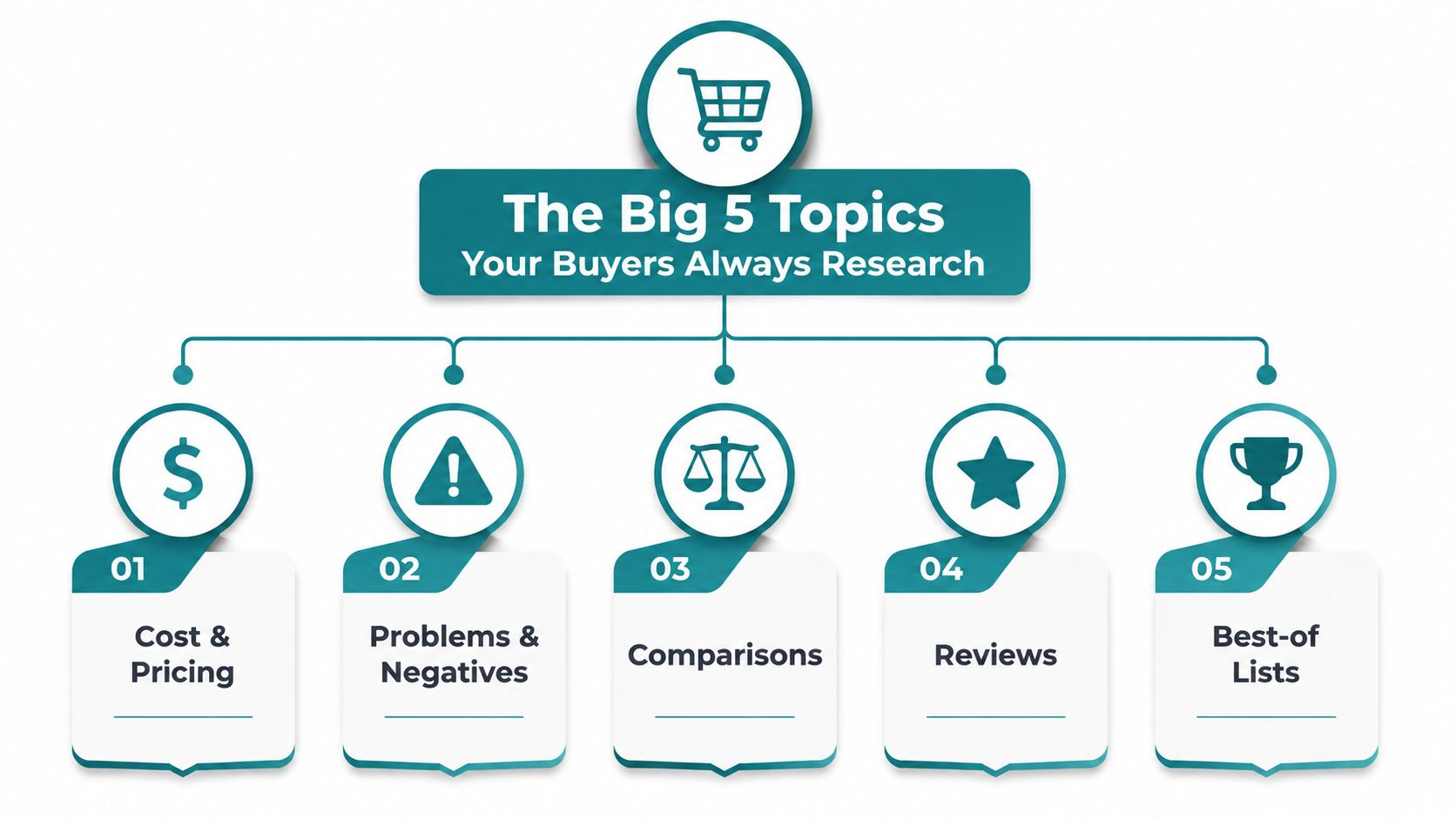
The Big 5 Topics Your Buyers Always Research
The Big 5 gives business owners a practical editorial checklist. These topics are cost and pricing, problems and negatives, comparisons, reviews, and best-of lists. They matter because buyers use them to evaluate risk, value, alternatives, and trust before they decide whom to contact.
Cost and pricing
Pricing questions rarely disappear because a company refuses to discuss them. They usually move somewhere else, often to a competitor's website or a sales conversation the buyer never starts.
A Cincinnati web design agency might publish "How much does a business website cost?" and explain the factors that affect the investment, such as scope, integrations, content, accessibility, ecommerce requirements, and ongoing support. A contractor could explain why two projects with similar descriptions may have different prices. The answer doesn't need to promise a fixed quote. It should help a reader understand what drives the final number.
Problems and negatives
Every purchase carries tradeoffs. A problem-focused article might explain the limitations of a software platform, the risks of delaying a repair, or the situations in which a service isn't appropriate.
This content can feel uncomfortable, especially for owner-led businesses. Yet candid guidance helps people make better decisions and gives your team a way to address objections before a call. It also keeps a poor-fit buyer from entering the sales process with unrealistic expectations.
Comparisons
Comparison content helps a buyer understand choices such as Shopify versus WooCommerce, an in-house hire versus an agency, or two approaches to handling a legal or operational problem.
A fair comparison should explain the strengths and weaknesses of each option and identify who each option suits. A page that pretends every alternative is inferior will sound like an advertisement. A page that acknowledges where another option may work better can make your own recommendation more credible.
Reviews and best-of lists
Reviews answer the trust question. Buyers want to know what a product or service does well, where it falls short, and who should consider something else. A thoughtful review sets expectations rather than repeating praise.
Best-of content helps readers narrow a broad search. A Cincinnati manufacturer might publish a guide to choosing a production partner. A professional services firm might explain what to look for when evaluating providers. The article must establish clear selection criteria, not place the publishing company at the top.
Use your sales team as a primary source. The people speaking with prospects hear the questions, objections, and misunderstandings that marketing teams may miss. For broader content planning, a content strategy for B2B can help connect those questions to the buying journey. Teams comparing AI-supported content workflows may also find the Nuwtonic AI SEO Platform useful as part of their research process.
Why This Approach Builds Trust and Generates Better Leads
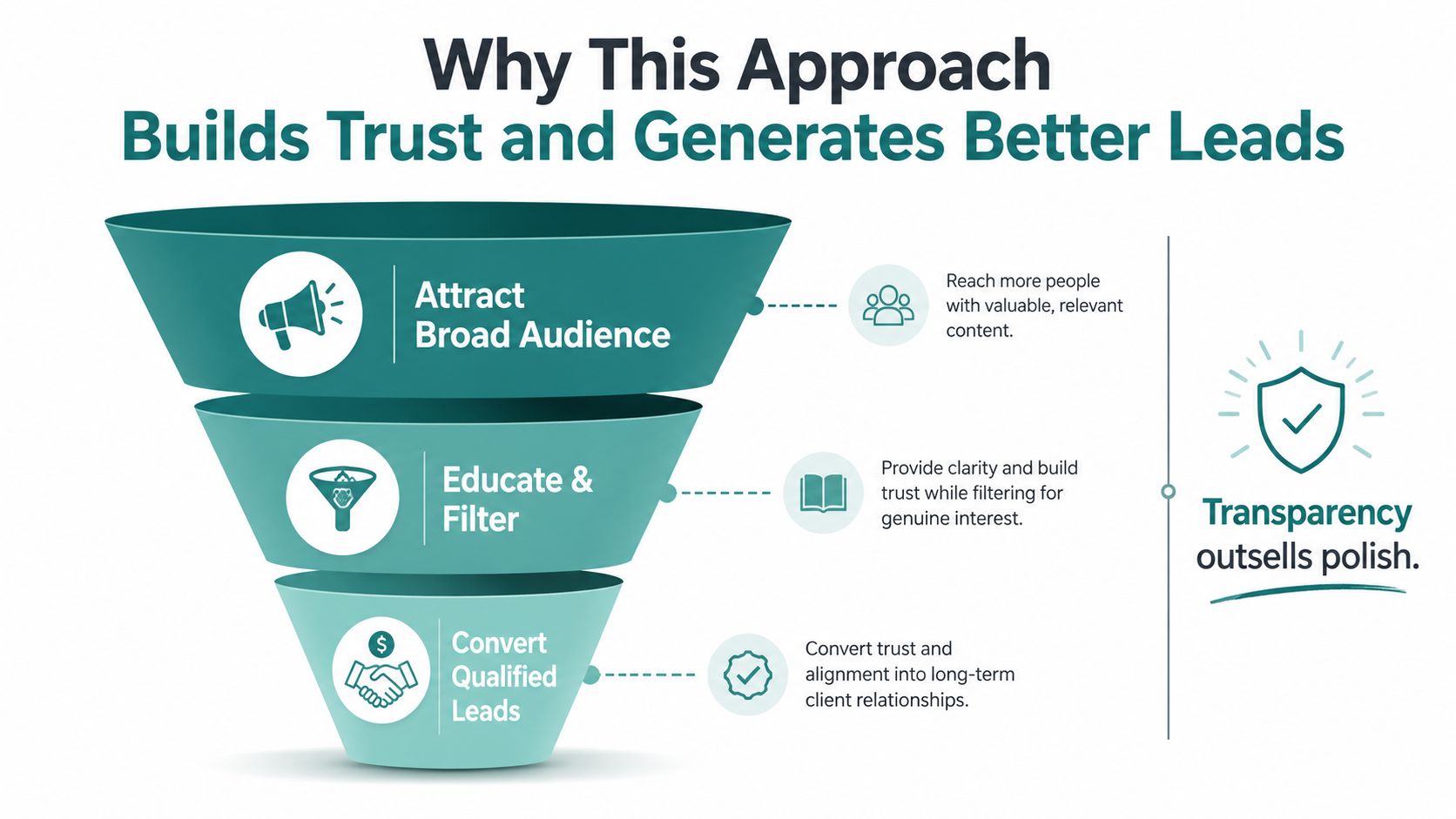
Transparency isn't a decorative feature on a website. It changes who contacts you and what they already understand when they do.
A buyer who reads a clear pricing explanation may realize that your service fits the budget, or that it doesn't. Both outcomes can save time. A comparison guide may help a prospect choose between approaches before speaking with sales. A candid article about limitations may prevent a difficult project from entering the pipeline.
That filtering is valuable for a small business. Owners and sales teams don't have unlimited time for conversations with people who aren't ready, qualified, or suited to the service. Helpful content gives buyers enough context to make a more informed first move.
Trust changes the sales conversation
Traditional marketing often asks for contact information before offering much substance. They Ask You Answer reverses that order. You provide meaningful information first, then offer a relevant next step.
That next step might be a consultation, an estimate request, an appointment, a product demonstration, or a conversation with a specialist. The call to action should match the reader's level of confidence. Someone learning basic terminology may need another guide. Someone comparing vendors may be ready to talk about scope.
Key Insight: A useful answer doesn't replace sales. It gives sales a better starting point.
The framework also supports consistency. When a salesperson explains an issue on Monday and a different team member explains it another way on Tuesday, buyers receive mixed signals. A well-written page creates a shared reference point while leaving room for a personal conversation.
Answer-first content reaches beyond traditional search
People increasingly use AI assistants and answer engines to summarize options and recommend next steps. Those systems need clear, organized, trustworthy information to work with. A page that answers one question directly, explains its reasoning, identifies the right audience, and includes useful supporting details is easier for both humans and machines to interpret.
That doesn't mean writing awkward content for a robot. It means placing the answer near the top, using descriptive headings, defining terms plainly, supporting claims, and keeping the page focused. Structured information helps an AI system understand what the page answers and whether the content deserves to be summarized or cited.
The opportunity is especially relevant for local businesses. A buyer may ask an assistant to identify a Cincinnati-area provider, compare service options, or explain what to expect. Businesses that publish useful answers give those systems more substance to draw from than businesses whose websites contain only promotional slogans.
How HDM Turns Buyer Questions Into Revenue
A content framework only matters when someone can turn it into a working business system. For a small or mid-sized company, that system usually includes five connected jobs: identifying questions, creating answers, making them easy to find, capturing conversations, and measuring outcomes.
HDM can connect those jobs through content strategy, SEO, UX, chatbots, analytics, and website development. The agency is based in Springboro, Ohio, and serves businesses across Greater Cincinnati and beyond. Its role in this context is practical, translating customer questions into digital experiences that support the buying process.
Content strategy gives each question a job
The Big 5 isn't a list of random blog categories. Each topic should support a business decision.
A cost article can prepare a buyer for a consultation. A problem article can qualify the lead. A comparison page can support a sales follow-up. A review can reduce uncertainty. A best-of guide can attract someone earlier in the research process.
A growth marketing content strategy can organize those assets around audiences, search intent, services, and conversion paths. The important question is what the reader should understand and do after consuming the page.
SEO and UX make the answer usable
SEO helps the right people discover an answer. UX helps them find and understand it once they arrive. A page can contain excellent advice and still fail if the heading doesn't match the question, the answer is buried, the form is confusing, or the mobile experience is slow.
Google describes Core Web Vitals as real-user metrics for loading performance, interactivity, and visual stability. The common good targets are LCP under 2.5 seconds, INP under 200 milliseconds, and CLS under 0.1, as documented in Google's Core Web Vitals guidance. For revenue-critical pages, those technical signals connect directly to a basic business concern: can a visitor quickly understand the answer and take the next step?
Chatbots and analytics complete the loop
A chatbot can help after hours by answering routine questions, guiding visitors to relevant resources, and collecting context for a follow-up. It shouldn't pretend to replace a specialist. Its job is to make the next helpful step easier.
Analytics then show which answers attract visitors, which pages assist conversions, and where people leave. HDM also works with healthcare organizations, where a website handling electronic protected health information must account for the HIPAA Security Rule. HHS says the rule requires administrative, physical, and technical safeguards for covered entities and business associates when electronic health information is involved, including controls such as access management, audit logging, encryption, and secure transmission workflows. That makes compliance part of the technical architecture, not merely a policy statement. More detail is available in the HHS Security Rule requirements.
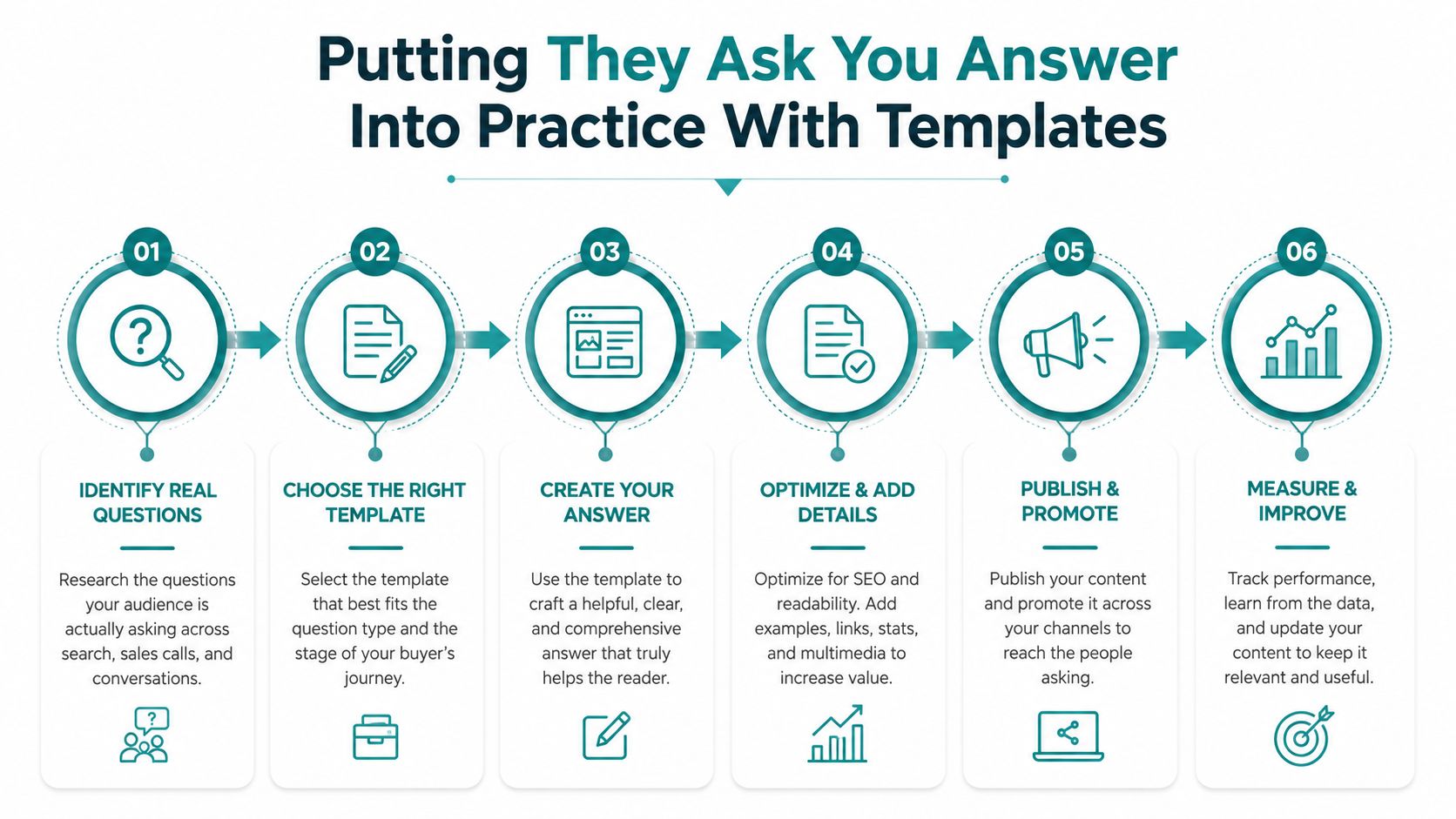
Putting They Ask You Answer Into Practice With Templates
You don't need a large marketing department to begin. You need a repeatable way to collect questions, choose priorities, assign ownership, and publish useful answers.
Start with the conversations already happening. Ask salespeople to save questions from calls. Review emails, contact forms, chat transcripts, proposals, and support tickets. Ask customer-facing employees which concerns appear just before a buyer agrees to move forward.
A lean workflow for busy teams
-
Collect the language buyers use: Write down questions exactly as customers ask them. "Why is this so expensive?" may become a stronger title than "Understanding Our Investment."
-
Sort each question into the Big 5: Mark it as pricing, problems, comparisons, reviews, or best-of. Some questions may overlap, but one primary category keeps the content focused.
-
Choose the business priority: Start with questions that affect active opportunities, create repeated objections, or reveal a clear service fit issue.
-
Assign an internal expert: Sales should provide context. An operations or subject-matter expert should check accuracy. Marketing or an agency can shape the answer for clarity and search.
-
Publish one useful asset: Use an article, service page, video, checklist, calculator, or FAQ entry based on the question. Don't force every answer into a blog post.
-
Add a helpful next step: Invite the reader to request an estimate, compare options, book a conversation, or read a related answer. The call to action should feel like assistance, not pressure.
A simple answer template
Use the buyer's question as the title. Open with a direct answer in plain language. Explain the factors that affect the answer, identify limitations or exceptions, give a local or industry example, and finish with the appropriate next step.
For example, a Cincinnati law firm might publish "What should I bring to an initial consultation?" A healthcare organization could answer "What happens after I request an appointment?" A service company might write "What problems can this solution solve, and when is it not the right fit?"
If you're refining pages for AI-assisted discovery, this practical guide on how to optimize pages for AI search offers additional content considerations. For organizations building a structured internal resource, HDM's guide to knowledge base creation provides a useful direction.
The sales team's involvement isn't optional if you want authentic content. Sales hears the buyer's exact language and knows which answers change the conversation. Marketing brings structure and consistency. The strongest programs use both.
Measuring What Matters and Improving Over Time
Traffic alone doesn't tell you whether They Ask You Answer is helping the business. A page may attract many visitors and produce few meaningful inquiries. Another page may bring a smaller audience but influence valuable conversations.
Track what happens after a buyer reaches an answer. Look at engagement with the page, movement to relevant service pages, form submissions, calls, chat interactions, and assisted conversions. Ask sales whether prospects are arriving with better questions and a clearer understanding of the service.
Separate useful signals from vanity metrics
A healthy measurement process connects content to business activity.
- Page engagement: Are visitors reading, watching, scrolling, or leaving immediately?
- Conversion behavior: Do answer pages lead visitors toward consultations, estimates, appointments, or purchases?
- Lead quality: Do inquiries match your service area, budget, needs, and decision stage?
- Sales feedback: Do representatives use the content, and does it address common objections?
- Content freshness: Does the page still reflect current pricing factors, services, competitors, regulations, and customer expectations?
Review pricing and comparison pages whenever the underlying offer changes. Add video explanations when a process is difficult to understand in writing. Strengthen pages that answer broad questions with links to more specific service information.
Adapt answers to the industry
A healthcare organization must handle privacy and compliance considerations alongside patient education. An ecommerce retailer may need clear product comparisons, delivery information, returns guidance, and buying advice. A law firm should explain process and fit without implying that general information is personal legal advice. A manufacturer may need detailed explanations for technical buyers and shorter summaries for executives.
AI adoption also makes answer quality more important, but adoption isn't uniform. McKinsey-referenced 2026 reporting says 88% of organizations use AI in at least one business function and 72% use generative AI, compared with 33% in 2024, according to State of Enterprise AI Adoption 2026 reporting. Separate U.S. Census reporting described in that source found large firms with at least 20 employees were the biggest AI users, while retail trade lagged the national average at around 14% current use and about 17% expected use in the next six months. Those figures point to uneven adoption, not a reason to force AI into every page. Start with clear answers, sound measurement, and workflows your team can maintain.
Online buying is also a structural part of consumer markets. A 2026 projection places global ecommerce at about $7.9 trillion, with 10.4% year-over-year growth and online retail representing 24.5% of worldwide retail transactions. The same projection estimates 2.77 billion digital buyers globally in 2026 and $11.4 trillion in ecommerce sales by 2030, as reported in ecommerce statistics for 2026. Whether you sell locally or worldwide, buyers expect answers before they expect a conversation.
HDM helps Cincinnati-area businesses turn buyer questions into revenue-focused websites, SEO content, user experiences, chatbots, analytics, and ongoing optimization. Visit HDM to discuss which unanswered customer questions are costing your business opportunities and how to turn them into useful digital assets.