You're probably doing at least some content already.
A blog post goes up when someone has time. Your office manager shares a few updates on LinkedIn. Maybe your firm posts a short video, or your marketing person keeps saying the website needs "fresh content." Everyone stays busy, but when you ask the only question that matters, did any of this bring in qualified leads, the answer gets fuzzy fast.
That's where a lot of Cincinnati service businesses get stuck. Law firms, healthcare groups, consultants, accounting firms, specialty B2B providers. They're producing content, but they don't have a real content strategy for B2B. They have activity. Those aren't the same thing.
Going Beyond Just Posting Content
The first hard truth is simple. Posting content isn't a strategy. It's a task.
A lot of owners assume consistency alone will solve the problem. If we just publish more. If we stay active on social. If we keep the blog updated. But volume without direction usually creates a content treadmill. You put time and money in, and all you get back is more pressure to publish next week.
That problem is bigger than most businesses realize. Only 47% of B2B marketers have a documented content marketing strategy, leaving more than half of organizations operating without a formalized plan. This lack of documentation impedes scalability and makes it difficult to measure ROI according to Salesgenie's roundup of content marketing statistics.
For a local business owner, that shows up in practical ways:
- The website says too little. Buyers visit, skim a few pages, and leave with unanswered questions.
- Sales repeats the same explanations. Your team keeps answering basic questions one at a time instead of letting content do some of that work upfront.
- Marketing can't prove impact. You see page views and maybe some clicks, but you can't tie the effort to real consultations, calls, or deal flow.
Practical rule: If your content can't be traced to a business goal, it's probably acting like overhead.
That's especially true in B2B service industries. A homeowner might buy a shirt or a lamp on impulse. Nobody hires a business attorney, healthcare technology provider, or fractional CFO that way. They read. They compare. They ask other people internally. They circle back later. Good content supports that process. Random content just fills space.
What random content usually looks like
You've seen it before. Generic "top tips" posts. Short social updates with no clear audience. Website articles written around broad keywords that don't match what your best prospects ask before they sign.
That kind of content often sounds polished, but it doesn't move a sale forward.
A useful B2B approach is different. It starts with the buyer's questions, the sales process, and the risks that make people hesitate. Then it builds content around those points on purpose. That's how a website starts acting like a business development tool instead of a brochure.
Why documentation matters
A documented strategy doesn't need to be fancy. It can live in a shared Google Doc, a Notion workspace, or inside your CRM planning notes. What matters is that your team can answer the same basic questions every time:
- Who are we trying to reach
- What problems are they trying to solve
- What content do they need before they contact us
- How will we know if the content helped generate revenue
Once those answers are written down, content becomes easier to delegate, easier to improve, and much easier to judge accurately.
What B2B Content Strategy Actually Means
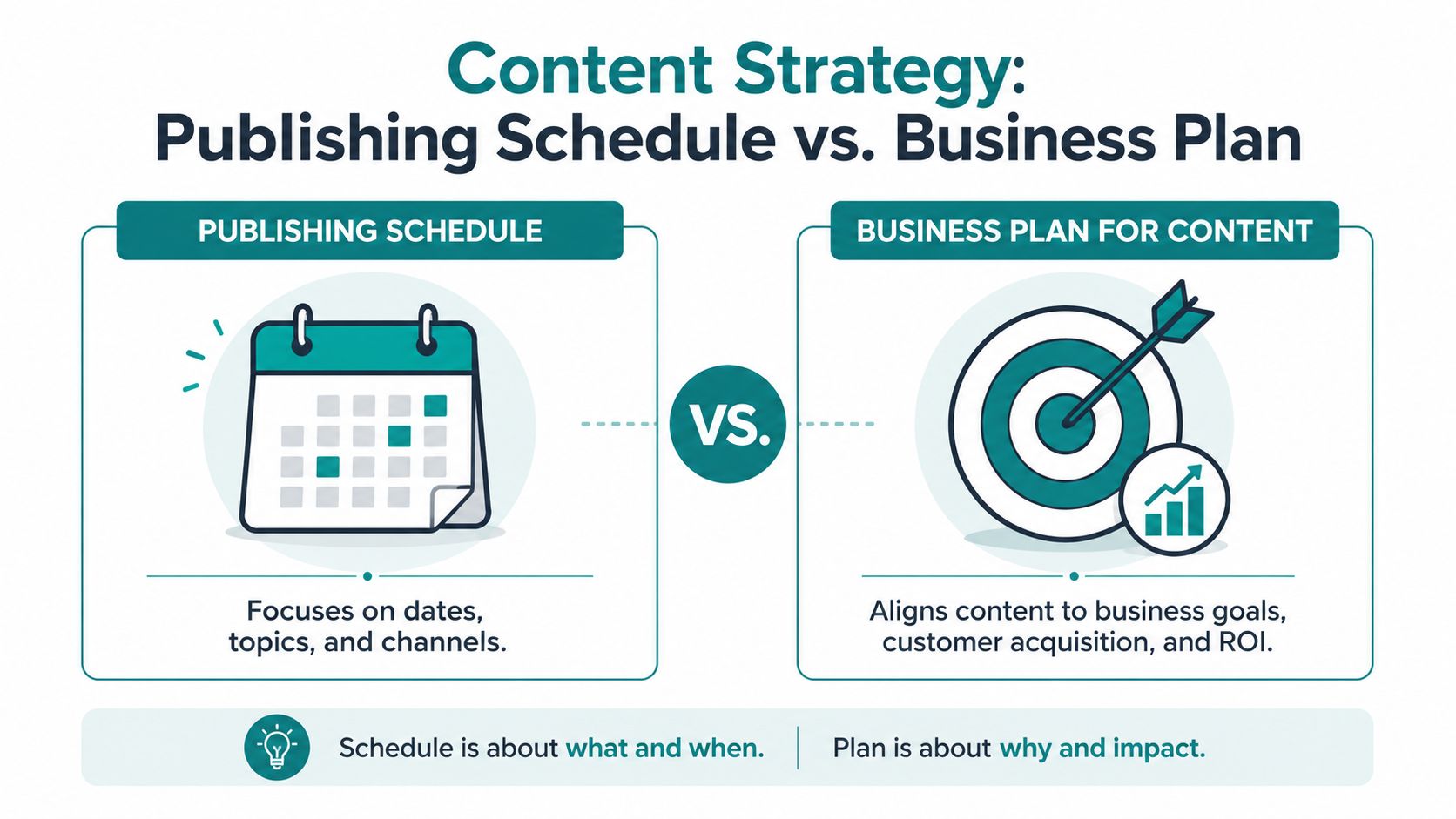
A real content strategy for B2B is a business plan for earning trust and creating demand with content. It is not just a publishing calendar.
A content strategy operates much like a building blueprint. A blueprint doesn't just say when the crew should show up. It shows what gets built, why it belongs there, and how each part connects to the whole structure. Every article, service page, email, webinar, and video should support a larger commercial goal.
Publishing calendar versus business plan
Here's the distinction most companies miss.
| Factor | Publishing Schedule | Business Plan for Content |
|---|---|---|
| Primary focus | Dates, topics, and channels | Business goals, buyer movement, and ROI |
| Main question | What are we posting this week? | What buyer problem are we solving, and what outcome should this support? |
| Success measure | Content went live | Content helped create trust, leads, or sales conversations |
| Team behavior | Reactive | Deliberate |
| Common result | More output | Better alignment |
The calendar still matters. You need one. But a calendar without strategy is like a delivery route without a destination.
Why B2B works differently from B2C
B2B buyers usually don't act alone. A service business owner in Cincinnati might love your proposal, but they still need to run it past a partner, operations lead, office administrator, compliance lead, or finance person. In some organizations, several people need confidence before anyone signs.
That's one reason B2B content needs more depth. In fact, 68% of B2B buyers require content from 4+ stakeholders before purchasing, as discussed in this B2B content strategy framework. One person wants strategic clarity. Another wants implementation details. Another wants cost control. Another wants proof that the decision won't create new problems.
Here's a clean comparison.
B2B vs. B2C Content At a Glance
| Factor | B2B (Business-to-Business) | B2C (Business-to-Consumer) |
|---|---|---|
| Buying process | Longer, more layered | Usually faster |
| Decision makers | Multiple stakeholders | Often one individual or household |
| Content goal | Reduce risk and support a considered decision | Spark interest and simplify a purchase |
| Useful formats | Service pages, guides, FAQs, webinars, comparison content, case-based explanations | Product pages, short videos, promos, reviews |
| Tone | Clear, credible, specific | Often lighter and more emotionally driven |
If you want a helpful outside perspective on how planning content across channels should support larger goals, PostSyncer's content strategy insights are worth reading. The key idea is the same one many businesses skip. Channel activity should follow strategy, not replace it.
Good B2B content answers the questions buyers ask before they're comfortable contacting you.
That mindset changes everything. You stop asking, "What should we post next month?" and start asking, "What does a serious prospect need to understand before they trust us?"
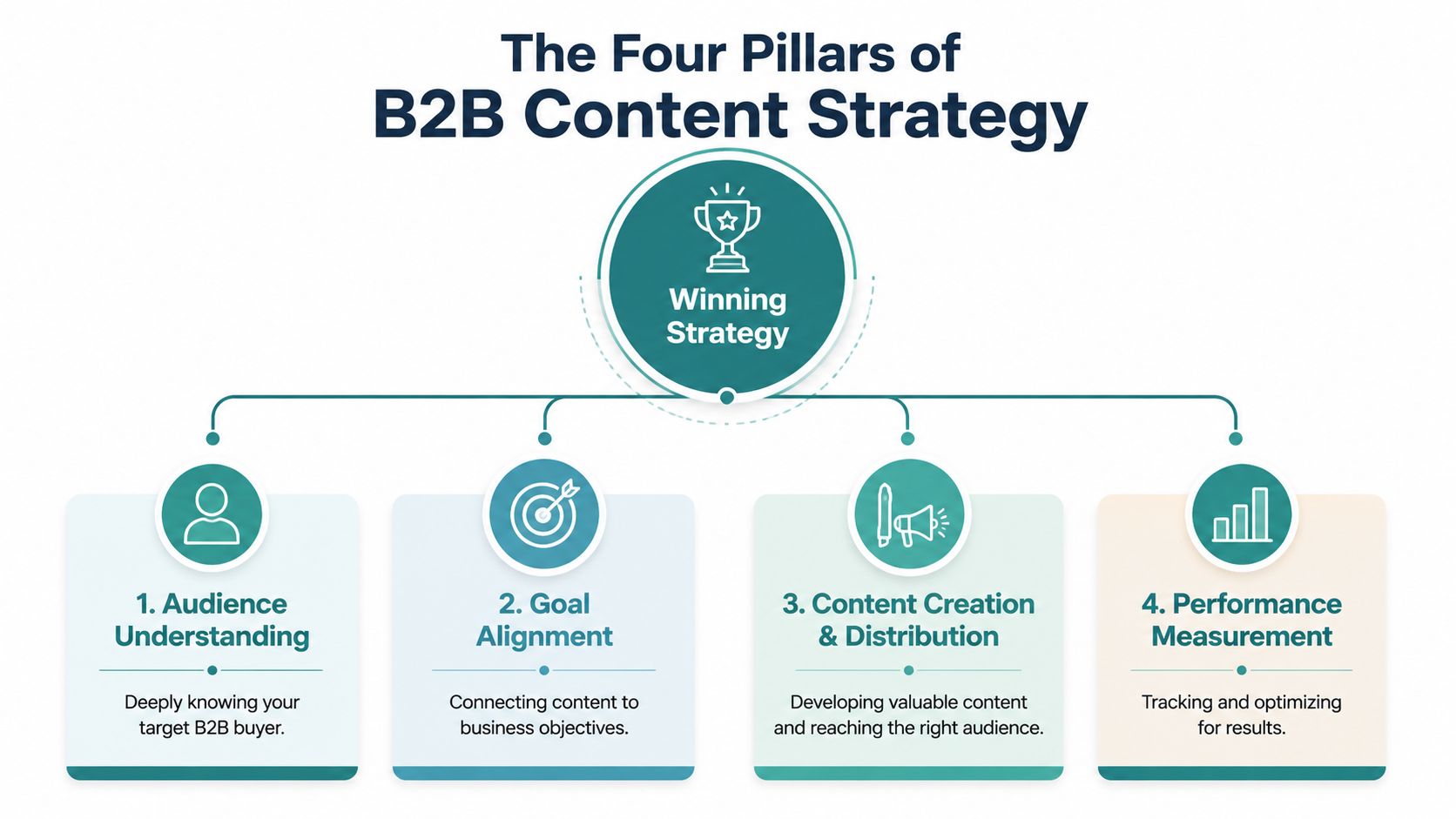
The Four Pillars of a Winning Strategy
Most strong B2B programs rest on a handful of fundamentals. Strip away the buzzwords, and the work gets much easier to manage.
Organizations with a documented B2B content marketing strategy achieve 64% success rates compared to only 19% for those without one, demonstrating a direct relationship between strategic documentation and pipeline generation according to LinkedIn's guide to improving B2B content marketing strategy.
That gap makes sense when you look at what documented teams do better.
Audience mapping
Basic personas aren't enough. "Business owners in Cincinnati" is too broad to guide content.
A better map looks at job role, pressure, objections, and buying triggers. The managing partner at a law firm doesn't read your site the same way an operations manager does. A healthcare administrator cares about workflow, patient experience, and compliance. A CFO wants risk reduction and financial clarity.
Useful audience mapping often includes:
- Role-based concerns such as compliance, staffing, speed, reporting, or growth
- Buying friction like approval bottlenecks, legal review, or budget scrutiny
- Decision-stage questions that come up before a call, during vendor review, and right before contract signature
If your content speaks to everyone, it usually persuades no one.
The intent ladder
Think of this as the staircase from curiosity to contact.
At the top, people are trying to understand a problem. In the middle, they compare approaches. Near the bottom, they want confidence that your company can deliver. Content should match that progression.
Here's a practical version:
| Buyer stage | What they're thinking | Content that helps |
|---|---|---|
| Awareness | "Something isn't working." | Educational articles, explainers, industry issue pages |
| Consideration | "What are my options?" | Comparison pages, webinars, detailed service guides |
| Decision | "Who should we trust?" | Case-based pages, process breakdowns, FAQs, consultations |
A lot of companies overload the top of the funnel and neglect the middle. They publish broad blog posts, but they never create the pages that answer "Why your process?" or "What happens if we switch providers?" That's where deals often stall.
Content pillars
Your content pillars are the core subjects your business has earned the right to talk about repeatedly.
I think of them like university departments. A university doesn't claim expertise in everything. It builds a reputation in specific disciplines. Your firm should do the same.
For a Cincinnati B2B legal practice, pillars might include:
- Business formation and structure
- Contract risk and review
- Employment compliance
- Dispute prevention
For a healthcare organization, pillars might include patient education, care workflows, digital intake, and privacy-conscious communication. For a professional services firm, they might include operational efficiency, reporting, leadership, and industry-specific advisory.
Pick a small set you can own. Then go deep.
What works: Repeating a clear point of view across related topics. What fails: Chasing every trend because it feels timely.
Distribution with intent
A good article hidden on your website won't help much. Distribution is how content gets in front of buyers who need it.
For many B2B service businesses, that means a practical mix of LinkedIn, email, sales follow-up, service pages, webinars, and selective repurposing. It does not mean spraying every piece onto every platform.
A simple distribution plan answers:
- Where does this buyer already pay attention
- Who on our team can share or use this content
- How does this piece support sales conversations after it's published
The smartest distribution often happens one-to-one. A lawyer sends a relevant article after an intro call. A consultant includes a guide in a proposal follow-up. A practice manager points patients to a privacy-safe resource page. That's still content marketing. It's just tied to business outcomes instead of vanity visibility.
How to Build Your Content Strategy Step-by-Step
Most owners don't need another theory lesson. They need a workable process.
If you're building a content strategy for B2B from scratch, keep it small at first. A lean strategy executed well will beat a giant plan that never gets finished.

Checkpoint one. Define one business goal
Start with one clear target. Not ten.
For a law firm, that goal might be more qualified consultations in a practice area. For a healthcare organization, it might be more appointment requests for a profitable service line. For a B2B services company, it might be better-fit discovery calls from a specific industry.
Write the goal in plain language. Then make every content decision answer back to it.
A good internal test is simple. If a piece of content can't reasonably support that goal, it goes to the bottom of the list.
Checkpoint two. Study your best clients
Your best content topics are usually hiding in sales calls, intake calls, proposal meetings, and client onboarding conversations.
Look for repeated questions such as:
- What's the process
- How long does this take
- What does this cost range depend on
- What are the common mistakes
- How do we stay compliant
- What happens if we delay this
If you need a more structured way to gather those patterns, HDM's market research and analysis article offers a useful lens for turning audience observations into better decision-making.
Checkpoint three. Build a short pillar list
Don't brainstorm fifty ideas yet. First choose the subject areas that matter most to revenue.
For many service firms, the best pillar test is this:
| Question | If the answer is yes |
|---|---|
| Does this topic come up before a sale? | It likely deserves content |
| Does it help qualify the buyer? | It can save sales time |
| Does it reduce fear or confusion? | It can improve conversion |
| Does it showcase your specific expertise? | It can differentiate your firm |
This is also where a lot of generic AI content falls apart. It can produce words, but it often misses the buyer friction your team hears every week.
Checkpoint four. Write fact-dense pages
The modern shift matters here. In 2026, successful B2B content strategy must optimize for AI Visibility, requiring content to contain definitive, factual statements that AI systems can confidently cite. This changes content creation from purely keyword-driven to "fact-dense" writing to establish topical authority according to Geisheker's analysis of B2B content marketing strategy.
For a business owner, that means your content should stop dancing around the point.
Instead of vague copy like "we provide customized solutions," write pages that clearly explain:
- Who the service is for
- What problem it solves
- What the process looks like
- What constraints, rules, or compliance issues matter
- What buyers should evaluate before choosing a provider
That style helps people, helps search, and increasingly helps AI systems understand what your business knows.
A concise framework like Surva.ai's content advice can help if your team struggles to keep content focused and useful.
Checkpoint five. Map content to the buying journey
Once your pillars are set, assign each idea to a stage.
- Early stage content educates. It explains risks, categories, and common misconceptions.
- Middle stage content compares options, methods, or service models.
- Late stage content lowers friction. Think pricing factors, timelines, onboarding steps, and trust-building FAQs.
That's also a good moment to add richer media where it makes sense.
This short video is useful if you want to see the strategic side in a more visual format.
Checkpoint six. Decide how content gets used after publishing
Publication day isn't the finish line.
A practical system includes where the content lives, who shares it, and how sales or intake staff can use it. One strong article can become a follow-up email asset, a LinkedIn post, a short FAQ video, and a support page your team references weekly.
That's when content starts acting like infrastructure instead of decoration.
Content Strategy in Action for Cincinnati Businesses
This gets easier when you stop thinking in abstract marketing terms and look at how a few Cincinnati-area businesses would practically use it.
A law firm that wants better consultations
Say a business law firm keeps getting inquiries from people who aren't a fit, while stronger prospects still arrive confused about structure, timelines, and legal risk.
A weak content approach would publish broad posts like "Why legal help matters for your business." That sounds nice, but it doesn't help someone who's deciding between an LLC and an S-Corp in Ohio, or trying to understand what should be in an operating agreement.
A better strategy would build around a pillar like Ohio business formation and risk management. That could include:
- Awareness content on common startup legal mistakes
- Consideration content comparing entity options and contract basics
- Decision content explaining the firm's intake process, scope, and what clients should prepare before a consultation
The result is cleaner lead qualification. Prospects show up with better questions, and the firm spends less time on basic education during paid expert time.
A good legal content strategy doesn't try to replace legal advice. It helps the right clients understand when they need it.
A healthcare practice that has to balance education with compliance
Healthcare content has an extra layer. You're not just trying to earn trust. You also have to protect privacy, avoid reckless oversimplification, and stay aligned with HIPAA-conscious workflows.
That changes the strategy.
A Cincinnati medical group, therapy practice, or specialty clinic might create patient education content around treatment expectations, intake preparation, insurance questions, or follow-up care. But the content must be written and published with guardrails. No casual collection of sensitive information through unsecured forms. No sloppy page structure that exposes avoidable privacy risks. No advice content that creates confusion about what's general education versus individual medical guidance.
A practical healthcare strategy often works best when it includes:
| Content need | Smart approach |
|---|---|
| Patient education | Clear resource pages with plain language |
| Intake readiness | FAQ pages and process explainers |
| Trust building | Provider bios, care philosophy, and service expectations |
| Compliance awareness | Forms, workflows, and contact paths designed with privacy in mind |
For healthcare, trust isn't built by sounding promotional. It's built by being clear, respectful, and careful.
A professional services firm with a longer sales cycle
Now take an accounting, consulting, engineering, or managed services company. These businesses often deal with committee-driven decisions. One person likes the idea. Another asks for proof. Another wants to know how implementation will affect daily operations.
That's where middle-of-funnel content matters most.
A strong strategy might include comparison pages, process breakdowns, onboarding guides, and detailed FAQ content that sales can send after a first conversation. If the company also sells products or manages complex catalogs online, there are useful crossover lessons in HDM's guide to content strategy for ecommerce, especially around structuring pages that answer buying questions clearly.
A local manufacturer or supplier selling to other businesses
This kind of company often has deep expertise and a thin content library. The website may list capabilities, but it doesn't help engineers, purchasing managers, or operations leaders evaluate fit.
The right content here usually isn't trendy. It's practical.
Think technical specification pages, use-case articles, lead-time explanations, industry application content, and pages that explain how to choose between product types or fulfillment approaches. That kind of material won't always go viral. It will do something better. It will help serious buyers move closer to a conversation.
For Cincinnati B2B companies, that's the larger point. You don't need Silicon Valley style content. You need content that matches how your buyers make decisions in practice.
Measuring Success and Proving ROI to Your Team
A lot of content reporting is built to make marketers feel busy, not to help owners make decisions.
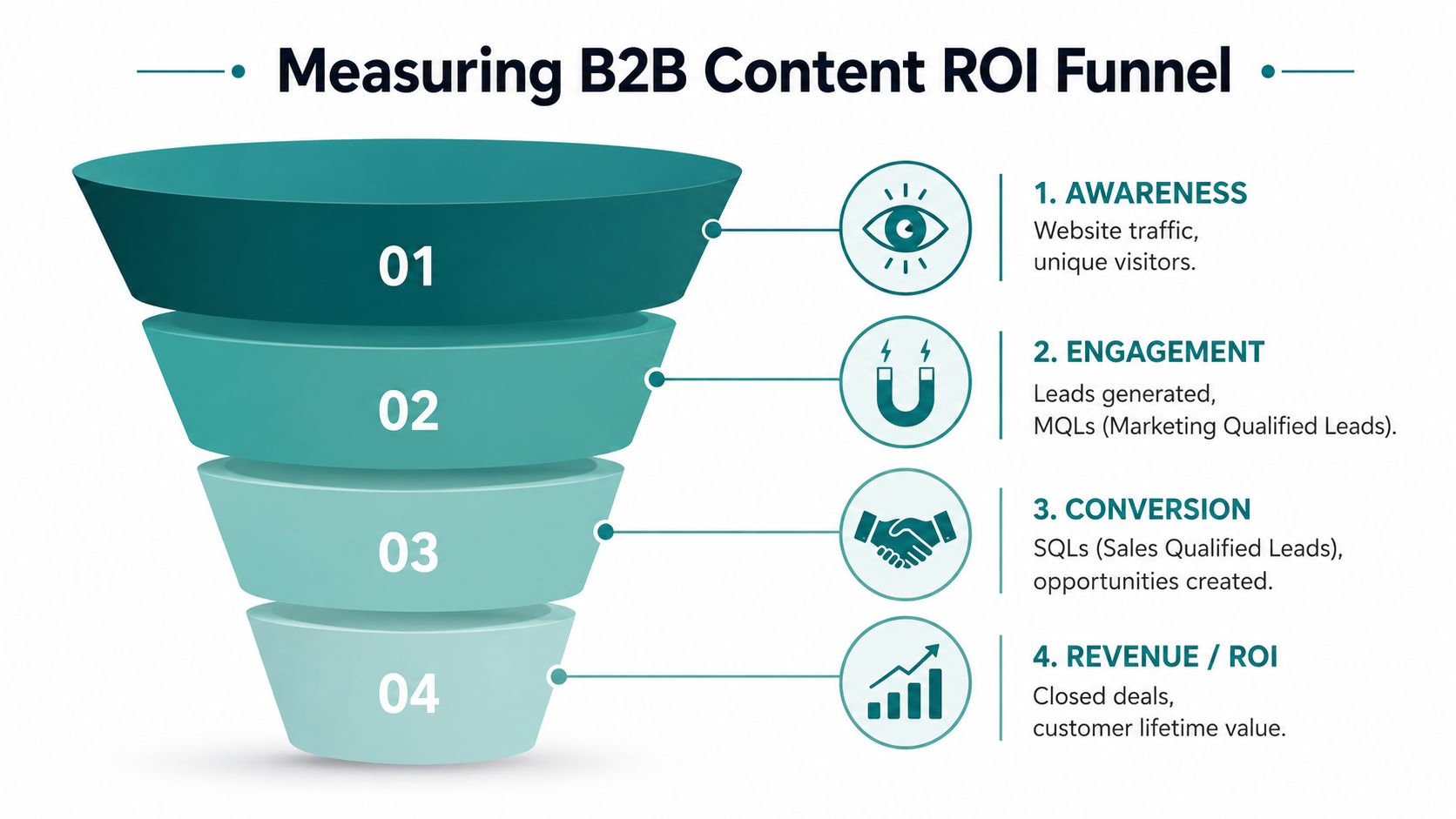
Likes, shares, impressions, and raw traffic can tell you something. They just rarely tell you enough. If you own the business, you need to know whether content is helping create qualified opportunities, shorten trust-building, and support revenue.
That measurement gap is common. While 72% of B2B marketers use AI for content creation, only 28% can definitively tie content consumption to closed deals, creating a significant gap in practical frameworks for revenue-centric measurement that appeals to CFOs and CEOs according to Tendo Communications' discussion of improving B2B content marketing strategy.
What to pay attention to instead
For most small and mid-sized B2B businesses, I'd rather see a short list of meaningful indicators than a giant dashboard full of noise.
Focus on metrics like these:
- Qualified leads generated from organic search, email, referral, and direct website inquiry paths
- Sales conversations influenced by content such as prospects who viewed service pages, guides, or FAQs before booking
- Conversion points by content type so you know whether decision-stage pages are doing their job
- Customer acquisition cost by channel when your tracking is mature enough to support it
If you use tools like Google Analytics, HubSpot, Salesforce, or another CRM, connect website behavior to lead records wherever possible. You want a line of sight between the content people consume and the actions they take next.
The CFO test
A simple standard helps here. Ask whether your reporting would make sense to a non-marketing executive.
A useful report sounds like this:
| Weak reporting | Better reporting |
|---|---|
| "Our blog traffic went up." | "Decision-stage service content influenced more consultation requests." |
| "LinkedIn got engagement." | "Prospects from LinkedIn spent time on service and contact pages before inquiry." |
| "The video performed well." | "The video helped sales explain the process and reduced repeat pre-sale questions." |
That second column is much more useful because it ties content to business movement.
Bottom line: If a metric wouldn't help you decide where to invest next quarter, it probably belongs lower on the report.
Don't ignore AI visibility
Measurement is changing too. It's no longer just about rankings and form fills. More buyers now ask AI tools for provider comparisons, summaries, and recommendations before they ever land on a website.
That's why brand monitoring needs to evolve. If you want to understand whether your expertise is showing up in these new discovery paths, how to monitor AI brand mentions from Riff Analytics is a useful practical read.
For business owners, the takeaway is simple. Better measurement means tracking not just who visited, but what role content played in moving a serious buyer toward trust.
Your Next Steps and Finding the Right Partner
Most businesses don't need more content first. They need more clarity first.
If your current marketing feels scattered, the fix usually isn't another batch of blog posts. It's a documented plan that connects audience questions, buying stages, and business goals. Once that foundation is in place, content gets easier to prioritize and much easier to judge.
The channel mix is also getting more demanding. In 2024, 96% of B2B marketers used LinkedIn for content distribution, and 69% plan to increase investment in video, signaling a strategic shift toward dynamic, high-engagement formats that require specialized execution based on Reboot Online's content marketing statistics summary.
That doesn't mean every Cincinnati business needs to become a media company overnight. It means you should be realistic about what modern execution takes. Clear messaging. Strong website architecture. Useful writing. Video where it helps. Distribution that fits your audience. Tracking that reaches beyond vanity metrics.
A quick self-check
Use this short list to see where you stand:
- Documented plan. Can your team point to one current content strategy document?
- Clear audience. Do you know which buyer roles you're trying to influence?
- Buyer-stage coverage. Do you have content for awareness, consideration, and decision?
- Sales alignment. Does your team use content in follow-up, proposals, or intake?
- Meaningful reporting. Can you explain what content contributes to leads and revenue?
If you answer "not really" to most of those, you don't have a content problem. You have a strategy problem.
Choosing outside help matters too. Not every agency is built for B2B service firms with longer sales cycles, compliance concerns, or more technical buyer journeys. If you're weighing options, this guide on how to choose a digital marketing agency is a practical place to start.
The right partner should help you simplify the process, not bury you in jargon. They should be able to connect web design, SEO, analytics, and content into one revenue-focused system.
If your business needs a clearer path from website traffic to qualified leads, HDM can help you build a practical B2B content strategy that fits how Cincinnati-area service companies sell. From HIPAA-conscious healthcare experiences to lead-focused websites for legal and professional services firms, HDM brings strategy, execution, and measurement together so your content does real work.