

You've probably felt this already.
Your business has a good reputation in Cincinnati. Customers like working with you. Your team knows its craft. But your website feels dated, your leads are inconsistent, your Google visibility is uneven, and a competitor with a weaker real-world reputation somehow looks stronger online.
That is usually the moment when owners start looking for help. They search for web design, SEO, paid ads, or "full-service marketing" and quickly run into a wall of polished agency websites that all sound the same. Everyone says they drive growth. Everyone says they are strategic. Everyone says they care about results.
The hard part is figuring out who can help and who will just hand you a nicer-looking version of the same problems.
After working in this space for more than two decades, I can tell you the biggest mistake business owners make is treating the agency search like a vendor bid. They compare line items, look at who seems the most polished, and hope the right answer reveals itself. It usually doesn't. The better approach is to look for a growth partner. Someone who can connect your website, your traffic, your lead flow, your sales process, and your internal systems into one practical plan.
That matters even more for Cincinnati businesses that are trying to grow carefully. Most small and mid-sized companies are not sitting on unlimited budgets. You need marketing that supports revenue, not marketing theater.
If you're still narrowing your options, this local roundup of the best digital marketing agencies in Cincinnati for 2026 can help you build a starting list. But a list is only the first step. The next step is knowing how to evaluate what's behind the pitch.
Your Digital Crossroads A Guide for Cincinnati Businesses
A lot of agency searches start the same way. A business owner notices a few warning signs at once.
The website looks fine on the surface, but it does not generate many inquiries. SEO reports show activity, but sales do not feel the impact. Paid ads are running, yet nobody can clearly explain which campaigns are producing qualified leads and which ones are draining budget. Meanwhile, competitors keep showing up in search results and winning attention.
That is a frustrating place to be, especially when you know the quality of your business is stronger than what your digital presence communicates.
What this decision really affects
Choosing a digital marketing agency is not only about hiring someone to redesign pages, write content, or manage campaigns. You are choosing who will influence how prospects first see your company, how easily they can contact you, and how efficiently your marketing dollars turn into opportunities.
A weak agency relationship usually creates three problems:
-
Confusion: You get reports full of terms and charts, but no direct answer about business impact.
-
Delay: Projects drag because strategy, design, development, and communication are disconnected.
-
Waste: Money gets spent on activity that looks busy without fixing the underlying bottleneck.
A strong relationship feels different. The agency asks better questions. They care about what happens after a click. They want to know how your office handles incoming leads, what makes a prospect qualified, where deals stall, and what your margins can support.
A good agency should make your business clearer, not more complicated.
The Cincinnati reality
For Cincinnati-area businesses, the challenge is often practical, not theoretical. You may need a better website, but you may also need help connecting that site to a CRM, improving local search visibility, cleaning up analytics, or aligning ad spend with your sales capacity.
That is why generic checklists rarely go far enough. You do not need another vendor promising "more traffic." You need a partner who can understand your business model, your market, and your growth constraints.
The companies that make good agency decisions usually do one thing differently. They stop asking, "Who offers SEO or web design?" and start asking, "Who can help us grow in a way that makes operational and financial sense?"
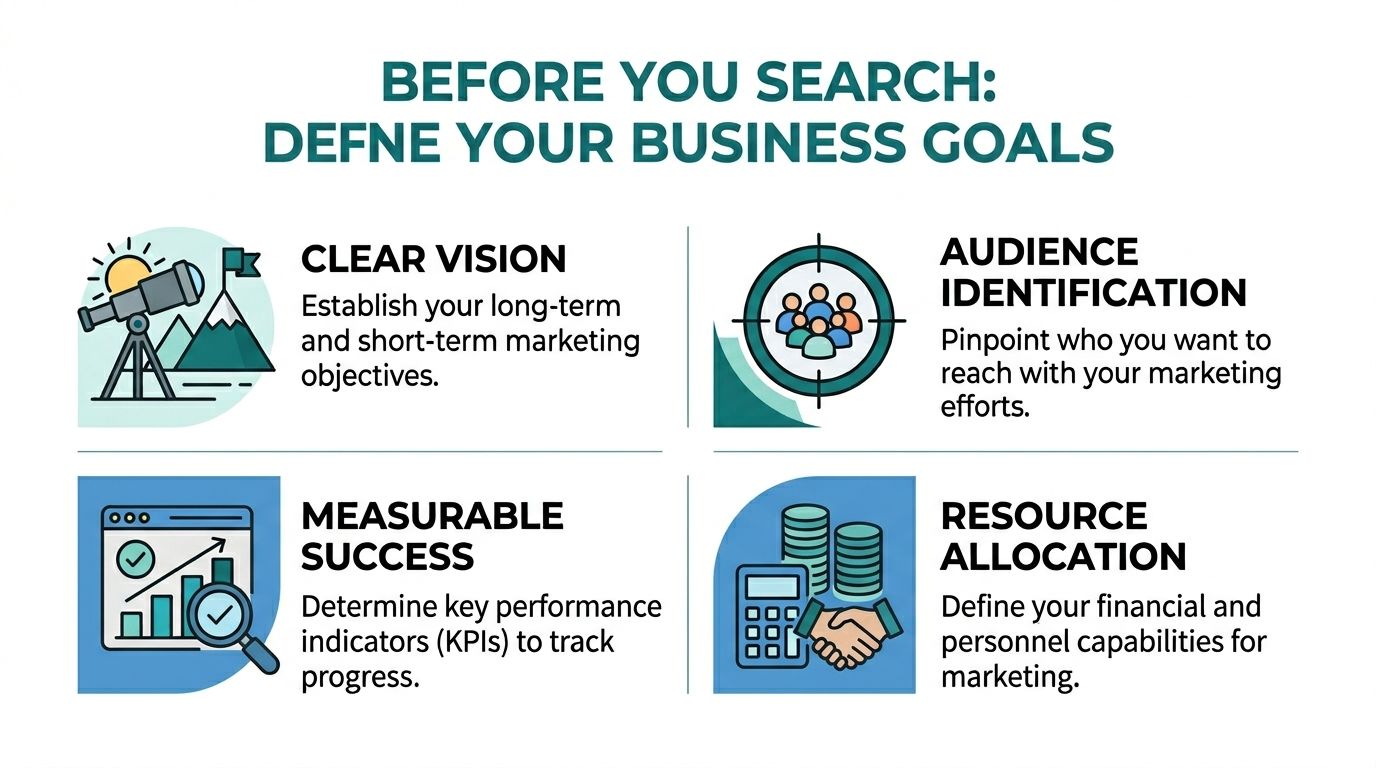
Before You Search Define Your Business Goals
Most business owners start their agency search too early.
They open Google, compare websites, and book discovery calls before they have defined what success should look like. That creates a predictable problem. Agencies end up leading the conversation based on their services instead of your business priorities.
If you want to know how to choose a digital marketing agency wisely, start by getting specific about what you are trying to change.
Start with the business problem
"More business" is not a marketing goal. It is a wish.
A useful goal sounds more like this:
-
Lead generation: You need more qualified calls, form fills, or booked appointments.
-
Sales efficiency: Your traffic is decent, but too few visitors turn into real opportunities.
-
Local visibility: People search for what you do in Cincinnati, but your competitors show up first.
-
E-commerce growth: Your store gets visitors, but product pages or checkout are underperforming.
-
Reputation alignment: Your offline reputation is stronger than your digital presence.
Each of those points to a different strategy. A business with poor conversion issues needs something different from a business with no visibility. A business with strong traffic but weak follow-up may need process fixes as much as marketing help.
Turn goals into measurable outcomes
You do not need to become a data analyst. You do need a working understanding of what an agency should measure.
Three of the most important metrics are Click-Through Rate (CTR), Conversion Rate, and Cost Per Acquisition (CPA). They matter because they show whether your campaigns are attracting the right people, persuading them to act, and doing so profitably. Agencies that show specific outcomes in case studies, such as a redesign that produced a 40% increase in conversions and a 15% decrease in bounce rate, signal a more data-driven approach. A 2023 analysis also found that SMBs working with metric-transparent agencies saw 25-30% higher ROI on average than those that did not (Walker Media Agency's guide to choosing a digital marketing agency in 2025).
In plain language:
-
CTR tells you whether people are interested enough to click.
-
Conversion Rate tells you whether the page or offer is convincing.
-
CPA tells you what it costs to acquire a lead or customer.
An agency that cannot explain these in relation to your business will struggle to manage your budget responsibly.
Build a simple goal framework
Before you talk to agencies, write down answers to these questions:
What result matters most right now?
More calls, more qualified leads, more online sales, better visibility, or a stronger website foundation?
What does a qualified lead look like?
Not every inquiry is valuable. Define the kind of customer you want.
What is the bottleneck?
Low traffic, poor website messaging, weak conversion paths, slow follow-up, or unclear analytics?
What internal resources do you have?
Someone has to approve content, provide brand assets, answer technical questions, and respond to leads.
What is your budget comfort level?
Not a perfect number. A realistic range.
Know what a good agency will do with your goals
A good agency will not just nod along when you say, "We want more leads."
They will push further. They will ask what kind of leads, from which services, in which markets, and with what close rate. They will want to understand whether the problem is awareness, trust, conversion, or follow-through.
If an agency talks about tactics before they understand your revenue goals, they are probably selling a package, not solving a problem.
Keep your goals tied to operations
This part gets skipped all the time. Marketing goals have to fit your business capacity.
If you are a law firm, medical practice, contractor, or service company, more inquiries are only helpful if your team can respond quickly and consistently. If you run e-commerce, growth is only healthy if your fulfillment, inventory, and customer support can keep up.
The best agency relationships start with that reality in plain view. They do not separate "marketing" from the rest of the business. They connect the two.
How to Vet an Agency's Real-World Expertise
An agency's website can look impressive and still tell you very little.
Nice branding is easy to buy. Strong copy is easy to outsource. What matters is whether the agency can show depth, consistency, and practical experience in situations similar to yours.

Look past the portfolio surface
A portfolio full of attractive homepage screenshots does not prove much. You want to know what the work accomplished and what challenges were involved.
When you review case studies, ask yourself:
Did they state the business problem clearly?
Good agencies explain the situation before they talk about the solution.
Did they show measurable outcomes?
Results matter more than deliverables.
Did they work through complexity?
A straightforward brochure site is different from a site that requires integrations, compliance, or ongoing campaign support.
Did they explain their role accurately?
Be cautious if everything sounds like a miracle and nothing sounds difficult.
Experience matters, but the right kind matters more
Longevity is not everything, but it does matter. Agencies with 10+ years in operation tend to adapt better to platform and algorithm changes, and they hold a 35% edge in client retention over newer firms. Agencies with average staff retention above 5 years also avoid knowledge gaps that can lead to a 15-20% annual performance drop when teams turn over too often (JumpFly's breakdown of key factors to consider when choosing a digital marketing agency).
That matters for a simple reason. Marketing platforms keep changing. Google changes. Meta changes. Tracking changes. Search behavior changes. A team that has weathered those shifts usually has better judgment than one that has only operated in one version of the market conditions.
Ask about industry familiarity
Many owners either overcorrect or undercorrect in this area.
You do not always need an agency that works only in your niche. But you do want an agency that understands the stakes and workflows of your type of business.
For example:
-
Healthcare organizations often need HIPAA-aware processes and careful handling of forms, data, and patient communication.
-
Law firms need clear intake paths, trust signals, and local visibility built around high-value service lines.
-
E-commerce brands need tight coordination across product pages, inventory systems, analytics, and paid campaigns.
-
Professional services firms need strong messaging, authority-building content, and lead qualification.
An agency should be able to talk about your business model without sounding like they just learned it that morning.
Meet the actual team, not just the salesperson
A polished sales process can hide a thin delivery team.
Ask who will do the work. Then ask how long those people have been with the agency, what they own, and how the handoff from sales to production works.
Here are the signs I trust more:
-
Visible specialists: You can meet the strategist, designer, developer, or account lead who will touch your work.
-
Clear ownership: You know who is responsible for SEO, ads, web updates, reporting, and technical implementation.
-
Stable communication: You are not likely to get reassigned every few months.
Team stability is not a soft issue. It affects campaign continuity, reporting accuracy, and how quickly the agency can respond when something changes.
Watch for practical thinking
Real expertise sounds grounded.
A seasoned agency will talk about trade-offs. They will tell you when SEO takes time. They will explain why a redesign alone will not fix a broken offer. They will say when tracking needs cleanup before campaign scaling makes sense. They will raise operational questions that less experienced firms miss.
That is usually the difference between a partner and a presentation.
The Critical Questions to Ask Potential Partners
The first agency conversation should not feel like a pitch meeting where you listen and absorb claims.
It should feel like a working session where both sides are testing fit. The best questions do not just uncover what an agency sells. They reveal how that agency thinks, how it communicates, and how it handles problems when the work gets messy.

Ask about the first 90 days
A serious agency should be able to describe how it would approach the early phase of the relationship.
You are listening for structure, not perfection.
Some good questions:
-
What would the first 90 days look like for a business like ours?
-
What would you audit first?
-
What would you need from our team in the first month?
-
What quick wins do you look for, and what usually takes longer?
You do not want vague answers like "we'll optimize everything" or "we tailor it to each client" with no specifics behind it.
A solid answer should include discovery, analytics review, website assessment, competitor review, channel prioritization, and early decision points.
Ask how they connect reporting to business outcomes
A lot of agencies are good at reporting activity. Fewer are good at reporting impact.
Ask these directly:
-
What metrics will you report on each month?
-
How do those metrics tie back to leads, sales, or revenue?
-
Can we see a sample report before signing?
-
How do you explain underperformance when a campaign misses the mark?
If the answer centers on impressions, reach, clicks, or generic engagement without connecting those to business goals, keep digging.
A useful report should tell you three things clearly. What happened. Why it happened. What the agency will do next.
Ask who will communicate with you
Communication problems ruin otherwise decent work.
Some owners want weekly touchpoints. Others prefer one strong monthly review plus quick email access when needed. The key is clarity.
Ask:
-
Who will be our day-to-day contact?
-
How often do you meet with clients?
-
How quickly do you usually respond to questions?
-
If we need a website change, ad update, or content revision, what is the process?
You are not looking for grand promises. You are looking for an operating rhythm that fits your business.
The best communication plans are boring in a good way. Clear contact. Clear cadence. Clear next steps.
Ask the technical questions most owners never ask
Many agency evaluations fall apart at this stage.
Most guidance on how to choose a digital marketing agency focuses on channels and creative work, but often ignores whether the agency can handle the technical complexity behind the marketing. That includes legacy website migrations, CMS integrations, API connections, and data flow between systems, which is especially important for healthcare, e-commerce, and legal organizations (Blueprint Digital's article on choosing a digital marketing agency).
If your business already runs on real systems, ask questions like these:
-
How do you handle website migrations without losing important content or search visibility?
-
Have you worked with platforms like WordPress, Shopify, WooCommerce, or headless CMS setups?
-
How do you connect marketing efforts with our CRM, practice management software, or e-commerce systems?
-
Who handles tracking setup and data accuracy?
-
How do you approach user permissions, security, and access during a transition?
These questions matter because great-looking campaigns can still fail if the technical plumbing is weak.
Here is a useful overview that touches on some of the issues owners often face during the evaluation process:
Ask how they handle disagreement
This sounds small. It is not.
The relationship will eventually hit a decision point where you and the agency see something differently. Maybe you want faster results. Maybe they recommend pausing a tactic you expected them to push harder. Maybe lead quality is off and nobody agrees on where the issue starts.
Ask:
-
How do you handle situations where a client wants one direction and your team recommends another?
-
How do you escalate concerns?
-
Who makes strategic recommendations, and who signs off?
An experienced partner will answer without getting defensive. They know that healthy tension is part of real collaboration.
Decoding Agency Pricing and Spotting Red Flags
Pricing confuses a lot of business owners because agencies often describe it in ways that make apples-to-apples comparison nearly impossible.
One firm quotes a monthly retainer. Another offers a fixed project. A third uses hourly billing. A fourth mixes strategy, creative, ads management, and development into one blended number. None of those models is automatically right or wrong. Each fits a different situation.
Common pricing models
Here is the cleanest way to think about the main options.
Pricing Model
How It Works
Best For
Project-based
One defined fee for a specific scope, such as a website redesign, SEO audit, or landing page build
Businesses with a clear deliverable and limited ambiguity
Monthly retainer
Ongoing monthly fee for continued strategy, SEO, paid media management, content, reporting, or support
Companies that need continuous optimization and sustained growth work
Hourly
Agency bills for time used across strategy, development, consulting, or specialized tasks
Short-term needs, troubleshooting, and flexible support
If you want a better sense of how paid media budgeting fits into the bigger picture, this guide on online advertising cost is a helpful companion.
What business owners often get wrong about price
The cheapest option can become the most expensive if it creates rework, weak execution, or poor tracking.
The most expensive option can also be a mistake if the agency is oversized for your needs, forces a rigid process, or adds layers of account management that slow decisions down.
The better question is not "What does it cost?" It is "What am I buying?"
Look for clarity around:
-
Scope: What is included, what is not, and what triggers extra fees.
-
Ownership: Who owns the website, ad accounts, analytics, creative files, and data.
-
Cadence: How often strategy, reporting, and optimization happen.
-
Dependencies: What the agency needs from your team to keep work moving.
Red flags that should slow you down
Some warning signs are obvious. Others are subtle.
-
Guaranteed rankings or lead promises: No serious agency can guarantee exact Google ranking outcomes.
-
No access to accounts: If they want to keep your Google Ads, GA4, Search Console, or Meta assets under their sole control, be careful.
-
Thin reporting: If you only get activity summaries and no interpretation, you will struggle to judge performance.
-
Heavy pressure to sign fast: Good agencies do not need urgency games to close a fit-based relationship.
-
One-size-fits-all packages: Your business should not get the exact same plan as a completely different company with different margins and goals.
A healthy pricing conversation feels transparent. You understand the work, the expectations, and the limits before you sign.
The blind spot in partnership and white-label work
This matters for companies with internal marketing teams and for agencies hiring agency partners.
Existing guidance often leaves out how to evaluate white-label and partnership capabilities, even though over 40% of agency work involves some form of partnership. That means communication protocols, confidentiality, and scalability deserve real scrutiny (Mesh Agency's discussion of founder's bias and agency selection).
If you need an agency to act as an extension of your team, ask about:
-
Process documentation: How they keep delivery consistent.
-
Confidentiality: NDAs, client privacy, and white-label boundaries.
-
Capacity planning: Whether they can scale with your workload.
-
Service accountability: Who owns deadlines, revisions, and approvals.
A good partner model should feel organized, not improvised.
Making Your Final Decision and Ensuring a Strong Start
By the time you narrow the list, several agencies may look capable on paper.
That is normal. Final decisions usually come down to fit, judgment, and trust. Not just service menus.
Weigh the full picture
If one agency is cheaper, one has the prettiest presentation, and one asks the best questions, I would usually pay the closest attention to the one asking the best questions.
A strong partner should make you feel two things at once. Confident that they know what they are doing. Clear on how the work will happen.
Use a simple final filter:
-
Strategy fit: Do they understand your business goals and constraints?
-
Execution fit: Can they handle the channels, website needs, and technical realities involved?
-
Communication fit: Will your team work well with their team month after month?
-
Commercial fit: Does the scope make sense for your budget and stage of growth?
Read the agreement carefully
Before signing, review the proposal, contract, or Statement of Work with a practical eye.
Check for:
-
Defined deliverables: Specific work, not vague promises.
-
Timeline expectations: What happens first, and what depends on your input.
-
Reporting expectations: What you will receive and how often.
-
Asset ownership: Your site, content, accounts, and data should remain accessible to you.
-
Exit terms: What happens if the relationship ends.
If something sounds fuzzy before the work starts, it usually gets fuzzier later.
Set up the partnership for success
A strong start is not only the agency's job.
Your team should be ready to provide access, brand materials, historical performance data, and a clear internal decision-maker. Delays on the client side can derail momentum just as quickly as delays on the agency side.
Give the agency context that matters. Which services are most profitable. Which locations matter most. Which leads are junk. Which sales objections come up repeatedly. That information helps them build a smarter strategy faster.
The best agency relationships start with shared candor. Tell them what has not worked before, where your team is stretched thin, and what success needs to look like to justify the investment.
Frequently Asked Questions
How long should I expect before I see results
It depends on the work. Paid campaigns can produce feedback quickly, while SEO, content, and larger website improvements usually take longer to mature. A good agency should tell you which indicators show early progress and which business outcomes require more time.
Should I hire one full-service agency or several specialists
That depends on your internal capacity. One partner can create cleaner coordination across design, development, SEO, paid media, and reporting. Separate specialists can work well too, but only if someone on your side is actively managing the handoffs and priorities.
Does a local Cincinnati agency matter
Sometimes yes, sometimes no. Local familiarity can help with market context, in-person collaboration, and regional understanding. But proximity alone should not outweigh strategic fit, technical ability, and communication quality.
What if I only need a new website right now
That is fine, as long as the website is treated like a business tool and not a design exercise. A redesign should consider messaging, user flow, search visibility, analytics, and conversion paths, not just appearance.
Is it a bad sign if an agency says SEO takes time
No. It is a good sign. Honest agencies talk about trade-offs and timing. Be wary of anyone who treats complex growth work like a quick fix.
What should I prepare before the first agency call
Bring your current website, your main goals, any recent marketing reports, access questions, and a short list of what has felt frustrating. If you know your best service lines or customer types, bring that too. Clear input improves agency recommendations.
If you want a Cincinnati-area team that treats web design, SEO, paid media, development, and complex integrations like parts of the same growth system, HDM is worth a look. HDM brings 20+ years of experience, builds custom websites and web apps, supports HIPAA-compliant and e-commerce projects, and works as both a direct partner for businesses and a white-label partner for agencies that need dependable execution.