
If you own a business in Cincinnati, you have probably asked some version of the same question: what online advertising should cost me, and how do I know if I am spending the right amount?
That question gets harder fast. One agency talks about clicks. Another talks about impressions. Google Ads shows one set of numbers. Meta shows another. Then you add landing pages, creative work, and management fees, and the budget gets blurry.
The useful way to look at online advertising cost is not as a flat price. It is a budgeting system. You are buying attention, traffic, and leads in a competitive market. Some of that spend is visible in the ad platform. Some of it is hidden in execution. And some of it gets wasted when the strategy is off.
For Cincinnati area businesses, the best budget is rarely the cheapest one. It is the one built around your sales cycle, your local competition, and the margin you need to protect.
How Much Should You Budget for Online Ads in Cincinnati
A practical budget starts with business reality, not platform hype.
If you are a local service company in Mason, a law firm downtown, a healthcare practice in Northern Kentucky, or a B2B company selling across the Midwest, your ad budget should answer one question first: what kind of customer are you trying to buy access to? Emergency plumbing calls, elective healthcare inquiries, online product sales, and B2B demo requests all behave differently.
That matters because online advertising is now a core growth channel, not an experiment. According to industry data, global digital advertising spending is projected to exceed $600 billion by 2027, continuing a trend of consistent double-digit annual growth. PPC advertising often delivers an average of $2 for every $1 spent, and paid search visitors are 50% more likely to convert than organic visitors.
Start with a spend range, then pressure-test it
For many small and mid-sized businesses, the first budget is not How much can we afford? It is How much do we need to spend to get enough data to make a decision?
A small budget can work if your geography is tight, your offer is clear, and your website converts. A larger budget may still fail if it spreads across too many audiences, channels, or services at once.
Use this sequence:
-
Pick the main goal. Calls, form leads, booked consultations, online orders.
-
Choose one primary channel. Most local businesses start with search or paid social, not both.
-
Set a test window. Give the campaign enough time to collect meaningful behavior.
-
Track the full path. Clicks alone do not pay payroll.
What Cincinnati owners usually get wrong
The biggest budgeting mistake is treating online ads like a line item instead of a system.
A smart ad budget has to cover:
-
Media spend paid to Google, Meta, or LinkedIn
-
Management time to build and optimize campaigns
-
Creative and landing pages so traffic has somewhere useful to go
-
Conversion tracking so you know what is working
Key Insight: If you cannot explain how a click turns into a lead and how a lead turns into revenue, the budget is still incomplete.
The Three Pricing Models That Drive Your Ad Spend
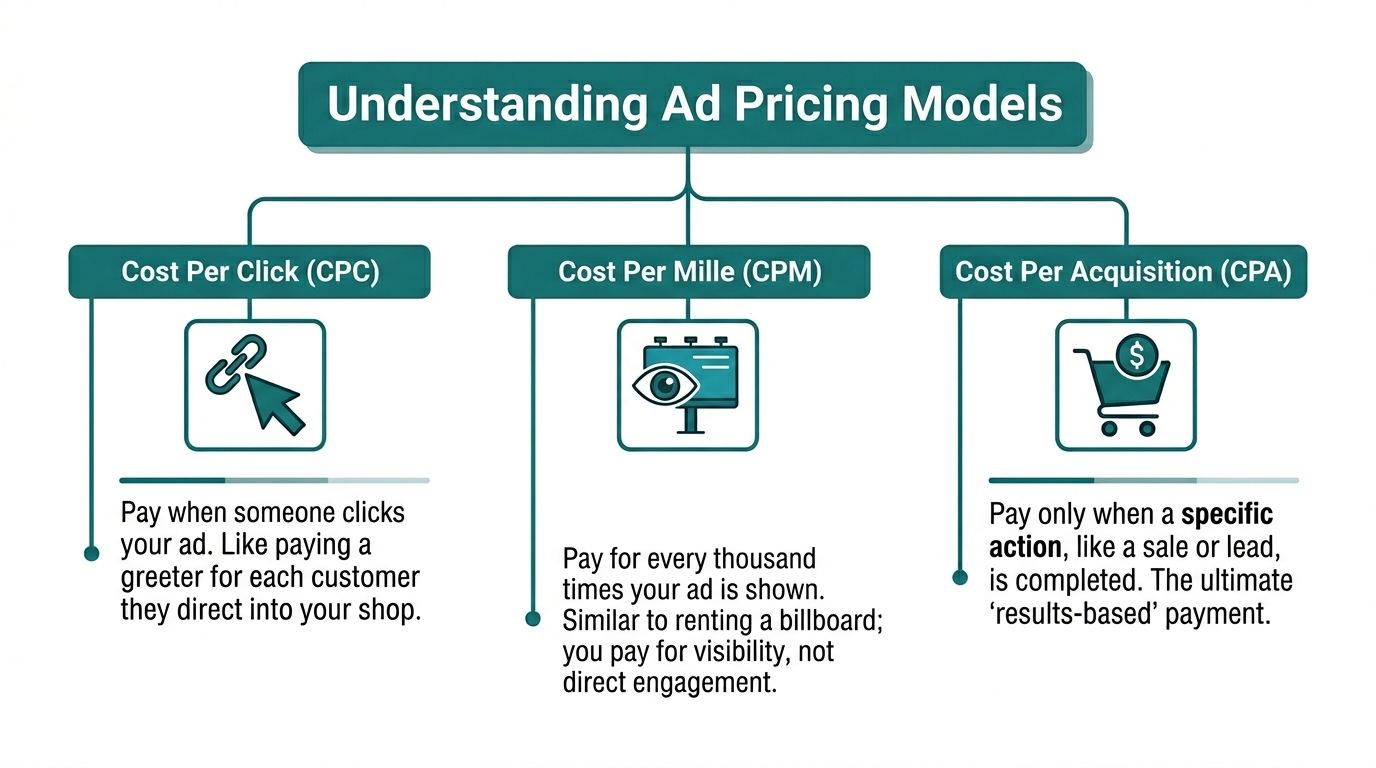
Most ad costs fall into three buckets. Once you understand them, the jargon gets much easier.
CPC means you pay for the visit
Cost per click, or CPC, means you pay when someone clicks your ad. For a local owner, this is the easiest model to understand. It is close to paying someone only when they send a real visitor through your front door. If nobody clicks, you do not pay for the traffic.
Google Search is the classic CPC environment. Someone types a need into Google, your ad appears, and you pay if they click. That is why search traffic usually costs more than broad awareness traffic. The person has intent.
According to benchmark data, in Google Ads, average CPC on the Search Network is $2.32, while the Display Network averages $0.58. A 10% improvement in ad relevance and landing page experience can lower CPC by 20% to 30%.
That last point matters more than most business owners realize. You do not buy clicks in a vacuum. Google runs an auction. Your bid matters, but so does ad quality. If your ad matches the search and your landing page delivers what the ad promised, Google often rewards that with lower costs.
CPM means you pay for visibility
Cost per mille, or CPM, means you pay for every thousand impressions. In plain English, you are paying to be seen.
This model is common in display, video, and social awareness campaigns. It is closer to renting digital billboard space than paying for direct visits. The goal is usually reach, repetition, and recall.
CPM can make sense when:
-
You need awareness first before people will search for you
-
Your product is visual and benefits from repeated exposure
-
You are retargeting past site visitors with reminders
The trap is obvious. A cheap CPM can still be expensive if the audience is wrong or the creative is forgettable.
CPA means you pay for the business outcome
Cost per acquisition, or CPA, focuses on the result. That result might be a lead, a booked appointment, or a sale.
This is the number most owners care about because it connects ad spend to revenue. The platform may bill on clicks or impressions, but the business should still judge performance on acquisition cost.
A campaign with a higher CPC can still be the better buy if it produces better leads. A lower CPC campaign that sends weak traffic often looks efficient in the dashboard and expensive in the bank account.
Why these models matter together
Most businesses should not obsess over only one metric.
Use them this way:
-
CPC tells you what traffic costs
-
CPM tells you what visibility costs
-
CPA tells you what growth costs
Key Insight: The cheapest click is not the goal. The goal is the lowest reasonable cost to get a qualified customer.
Typical Advertising Costs by Digital Channel and Industry
Online ad costs vary by platform, but platform averages only tell part of the story. The cost depends on who you are trying to reach and how competitive that audience is.
A Cincinnati bakery, a regional manufacturer, and a personal injury firm do not buy attention at the same price. They may all use digital advertising, but they are participating in very different auctions.
According to industry analysis, digital advertising is 70% to 85% more cost-effective than traditional media. Online CPM averages $3 to $10, compared with $22 or more for offline channels like magazines and radio.
Benchmark Online Ad Costs for Cincinnati Businesses 2026
| Channel | Average CPC | Average CPM | Best For |
|---|---|---|---|
| Google Search | $2.32 | N/A | High-intent local searches, service calls, lead generation |
| Google Display | $0.58 | $3-$10 | Retargeting, awareness, visual reminders |
| LinkedIn Ads | $5.26 | $3-$10 | B2B targeting by job title, company, industry |
| Traditional offline media | N/A | $22 or more | Broad awareness when direct tracking is less important |
Google Search for demand that already exists
Search ads are usually the first place local businesses should look when customers already know what they need. A person searching for a roofer, a med spa, a family lawyer, or commercial cleaning is showing intent. That is why Google Search often produces better lead quality than channels aimed at passive browsing.
Search gets expensive when the service is high value, several advertisers fight over the same local terms, or the keyword suggests urgent or high-margin work.
Display for remarketing and staying visible
Display traffic is cheaper, but it also behaves differently. Display usually works best when the audience already knows you. Someone visited your website, viewed a service page, or started a form but did not finish. A display ad can bring that person back at a lower click cost than search.
For a Cincinnati SMB, display tends to fail when used as a cold lead machine with generic creative. It tends to work when used as support for another channel.
LinkedIn for narrow B2B audiences
LinkedIn is expensive compared with broad social channels, but it can still be justified if you need a very specific buyer. If you want to reach plant managers, healthcare administrators, HR directors, or CFOs, LinkedIn gives you filters that other platforms do not. The trade-off is cost.
That means LinkedIn usually works better for higher-value B2B offers, longer sales cycles, account-based campaigns, and thought leadership tied to a clear offer.
The local competition layer
National averages help with rough planning. They do not tell you what happens when three well-funded competitors target the same Cincinnati metro searches you want.
Key Insight: Do not ask only, What does a click cost? Ask, What does a qualified opportunity cost in my market?
How to Set a Realistic Advertising Budget
A realistic budget is built backward from business goals, not forward from platform averages. Start with one method. The three below are the most practical for Cincinnati SMBs.

Use the revenue method if your business is stable
If your company already has steady sales, budgeting as a share of revenue is the cleanest starting point. This method works well for established businesses because it keeps spending grounded in cash flow.
Use the goal-based method if growth is the priority
If you care most about adding leads or sales, work backward from the goal. This method forces business math into the conversation and exposes weak spots fast.
Use the competitor-aware method in crowded markets
Some industries in Greater Cincinnati are crowded. Legal, healthcare, home services, and B2B niches with a small buyer pool all feel this. In those markets, your budget has to reflect the fact that you are entering an active auction, not an empty room.
Budget for the full funnel, not only the click
Clicks are only the first cost. The budget should also account for landing page work, call tracking or form tracking, creative refreshes, search term cleanup, and audience refinement.
Key Insight: If you are testing ads for the first time, keep the channel mix narrow. One well-built campaign beats three underfunded ones.
Example Ad Budgets for Cincinnati Businesses
These examples are hypothetical. They are meant to show budgeting logic, not promise a specific outcome.
A West Chester plumbing company
This business needs high-intent calls, especially for urgent repairs. The smartest place to start is Google Search. People search when the problem is immediate. The budget would include search ads for core service terms, a tight service-area focus, call-focused landing pages, negative keywords to block irrelevant searches, and call tracking. The owner should judge success by booked jobs, not by cheap traffic.
A Hyde Park boutique selling online
This business has a different challenge. Customers may not be searching for a specific store name yet. Visual appeal matters more. A sensible starting mix could be Meta ads for product discovery, retargeting for past visitors, strong creative tied to a clear offer, and landing pages that match the ad message.
A Blue Ash B2B software firm
This company sells to a narrower audience and likely has a longer sales cycle. LinkedIn can make sense here because the targeting is specific. A practical plan might center on one buyer persona, one offer, one conversion path, and one follow-up sequence after the lead comes in.
Beyond the Click Price: What Are You Really Paying For
Your online advertising cost includes media spend, management, creative production, landing page work, reporting, and the operational discipline required to keep campaigns clean.

Hidden fees change the math
Hidden agency fees and undisclosed markups can reduce an SMB effective media budget by 20% to 40%.
Ask these questions before signing anything
-
Do I own the ad account?
-
How much goes to media spend versus management?
-
Are there markups on ad spend?
-
What is included in creative work?
-
Are landing pages extra?
-
What reporting will I see?
Cost categories owners overlook
Even when fees are transparent, owners still underestimate support costs such as new ad creative when performance drops, landing page revisions, tracking setup, CRM or lead-routing cleanup, and time spent qualifying weak leads.
Key Insight: A simple, visible budget where platform spend and service fees are clearly separated is what works.
How to Reduce Your Costs and Improve ROI
Lowering online advertising cost is usually not about finding a secret cheap platform. It is about removing waste. Research shows that poorly targeted or low-engagement ads can waste 30% to 50% of an ad budget.
Tighten targeting before raising spend
Many campaigns underperform because they target too broadly. For local businesses, useful tightening often includes service-area targeting, audience exclusions, retargeting past website visitors, and filtering irrelevant search terms.
Fix the message match
The ad, keyword, and landing page should feel like one continuous conversation. A person who clicks an ad about emergency repair should land on a page built for emergency repair.
Refresh creative before performance fades
Fresh headlines, stronger images, clearer offers, and sharper calls to action can improve efficiency without raising spend.
Watch cost per result, not vanity metrics
Keep your scorecard narrow: qualified leads, booked calls, sales, and revenue tied to campaign source.
Key Insight: Review search terms, audience quality, and landing page behavior together. Looking at any one of them alone hides waste.
What usually works best
For most SMBs, the strongest gains come from:
-
Cleaner targeting
-
Better ad relevance
-
Stronger landing pages
-
Negative keyword management
-
Clear conversion tracking
Frequently Asked Questions About Online Ad Costs
How long does it take to see results
Search campaigns can produce activity quickly if demand already exists. Paid social and display often need more testing because message, audience, and creative all affect performance.
Is a higher CPC always bad
No. A more expensive click can still be a better buy if it comes from a high-intent search or a tightly qualified B2B audience.
Can I run ads myself
Yes, especially if your offer is simple, your geography is tight, and you are willing to learn the platforms.
Should I use Google or social ads first
If customers already search for what you sell, start with search. If your product needs discovery or remarketing, social may fit better.
Conclusion
If you want a clearer view of what your online advertising cost should look like before you commit budget, HDM can help map the full picture, from media spend and landing pages to tracking and ROI. The useful outcome is not just a cheaper click. It is a budget that fits your business and produces measurable growth.