
If you run a business in Cincinnati, you've probably had the same reaction a lot of owners have right now. Everyone is talking about AI. Your inbox is full of pitches, your team is testing random tools, and you're trying to figure out whether this is a real growth lever or just one more distraction.
That skepticism is healthy.
Most small and mid-sized businesses don't need "AI strategy" in the abstract. They need more qualified leads, faster follow-up, lower admin load, and a website or marketing system that pulls its weight. That's where AI starts to matter. Not as a science project, but as a practical layer inside sales, service, operations, and marketing.
For local companies evaluating web design, SEO, or digital marketing support, the essential question isn't whether AI is coming. It's whether you'll use it with a clear plan or let competitors use it first.
Is AI Another Buzzword or a Real Business Tool
A lot of Cincinnati business owners are hearing the same promise from every direction. AI will save time. AI will grow revenue. AI will change everything. The problem is that most of those claims are too vague to help you make a decision.
Here's the clearer view. Roughly 75% of small and mid-sized businesses are experimenting with AI solutions in 2025, and many report higher margins and improved scalability, according to Fresh Consulting's summary of SMB AI adoption. That matters because it shows AI isn't limited to enterprise IT teams. It's already moving into the day-to-day operations of smaller companies.
That still doesn't mean every tool is worth buying.
Some businesses are wasting money on standalone AI apps that don't connect to their website, CRM, inbox, ad platform, or content workflow. Others are getting value because they're using AI to solve one specific business problem at a time. That difference is why strategy matters more than hype.
AI becomes useful when it shortens the path between a prospect's question and your team's answer.
For a Cincinnati company, that might mean improving lead response from your website, speeding up content production for SEO, or cleaning up repetitive internal work that eats staff time. It might also mean deciding where AI does not belong, especially in customer interactions that require trust, nuance, or compliance.
If you're trying to sort signal from noise, this look at AI and digital marketing trends for 2025 is a good example of how the conversation is shifting from novelty to execution.
What AI Consulting Actually Means for Your Business
AI consulting for businesses sounds more technical than it really is. In practice, it usually means bringing in a specialist to look at how your company sells, markets, communicates, and operates, then finding specific places where modern AI tools can improve speed, consistency, or decision-making.
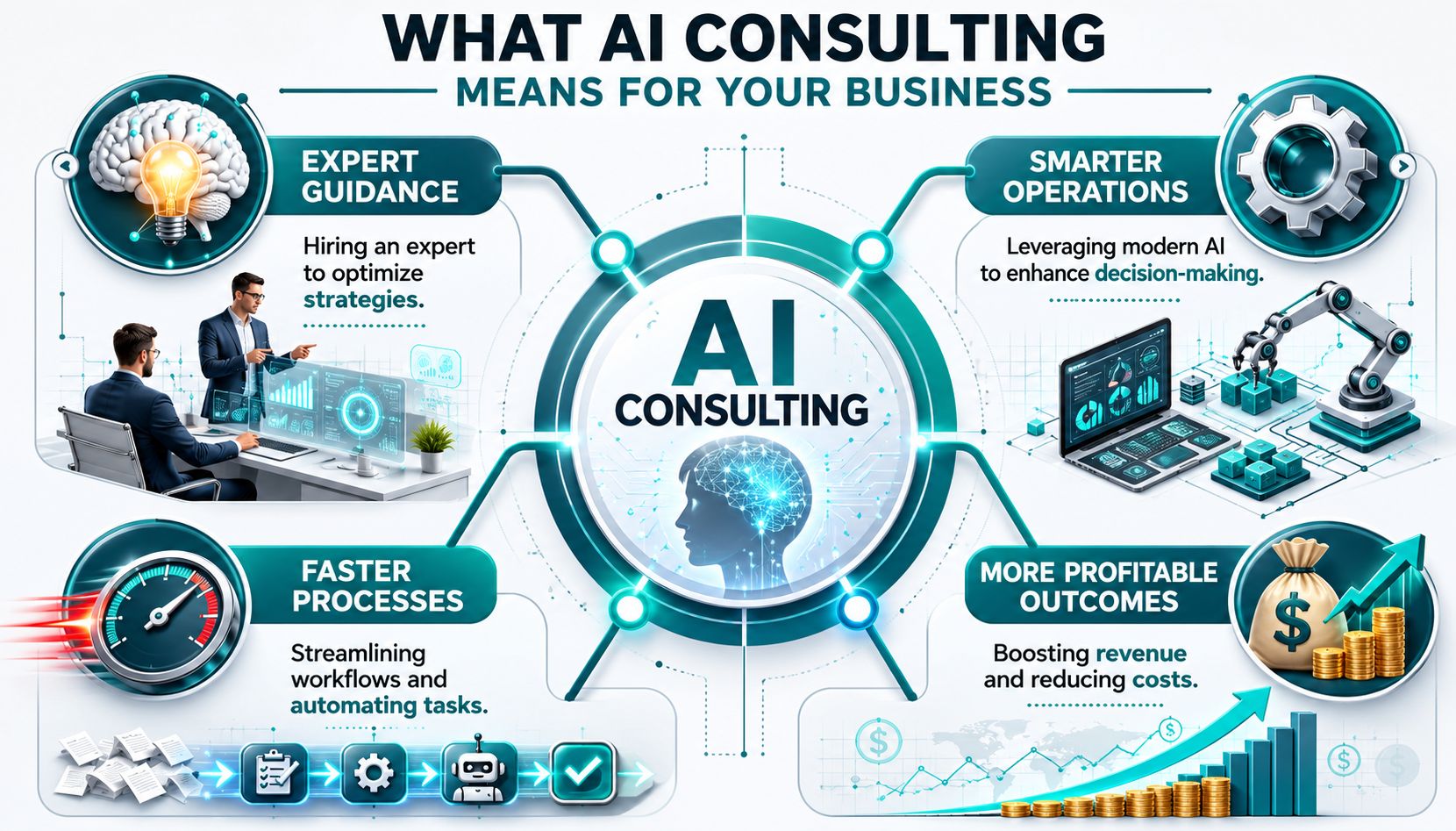
Consider AI consulting as hiring a process consultant for your digital side of the business. Not someone who shows up talking only about models and prompts, but someone who looks at your contact forms, CRM, scheduling, reporting, content pipeline, customer support, and sales follow-up and asks a simple question: where are you losing time or money?
What a good consultant actually does
A solid engagement usually includes a few practical steps:
-
Review the current workflow: How leads come in, how they're routed, how quickly someone responds, and where things stall.
-
Spot repetitive tasks: Things like drafting follow-up emails, sorting inquiries, updating records, summarizing calls, or preparing content outlines.
-
Match tools to real use cases: ChatGPT, Claude, Microsoft Copilot, HubSpot AI features, Shopify tools, scheduling assistants, and chatbot platforms all have different strengths.
-
Connect AI to the stack you already use: Your site, forms, CRM, email marketing platform, analytics, and ad channels need to work together.
What it should not be
It should not be a vendor selling you a flashy demo with no plan for implementation. It should not be "let's add a chatbot" just because chatbots are popular. And it definitely shouldn't be a one-off experiment that nobody owns after launch.
Practical rule: If a consultant starts with the tool instead of the business problem, the project is already drifting.
For business owners comparing options, this AI consulting FAQ gives a useful baseline for what these engagements usually involve and what questions to ask before you sign anything.
The Four Main Ways AI Can Grow Your Company
Most SMB AI projects fall into four buckets. The names can sound technical, but the business impact is straightforward. You either free up time, improve responsiveness, uncover better insights, or build something that gives your company an edge.
A useful benchmark from the SMB market: a 2025 IDC report found that 57% of SMBs expect AI to be embedded in at least three core business processes by 2027, and businesses with regular AI refresh cycles achieve roughly 1.8x higher ROI, as summarized in this small business AI consulting analysis. The lesson isn't "use AI everywhere." It's that the companies getting results treat AI as an operating layer, not a single pilot.
Common AI services and their business impact
| AI Service | What It Does | Primary Business Benefit |
| --- | --- | --- |
| Workflow automation | Handles repeatable tasks across forms, email, CRM, and reporting | Saves staff time and reduces manual errors |
| Chatbots and assistants | Answers questions, routes leads, and supports customers | Improves response speed and lead handling |
| Data-driven insights | Finds patterns in campaign, sales, or customer data | Supports better decisions and smarter spending |
| Custom AI applications | Builds a tailored tool for a specific internal need | Creates a process advantage competitors may not have |
Workflow automation
Before AI, a sales coordinator might pull website inquiries from email, copy them into a CRM, assign them to a rep, and send a manual follow-up. After automation, the system can categorize the inquiry, create the contact record, trigger a draft response, and route the lead based on service type or urgency.
That's not glamorous. It is profitable.
For teams looking into process design, workflow automation examples for marketing and operations are often the easiest place to start because the gains show up quickly.
Chatbots and assistants
A lot of owners hear "chatbot" and think of clunky website popups that frustrate users. Bad chatbot implementations still do that. Good ones answer common questions, qualify leads, collect useful intake details, and know when to hand off to a person.
A home services company, for example, can use an assistant to capture job type, location, urgency, and preferred appointment window before the office even opens.
Data-driven insights
Most businesses already have data. They just don't have time to interpret it.
AI can help summarize campaign performance, identify which lead sources convert best, flag drop-off points in your funnel, or pull patterns from customer inquiries. That doesn't replace human judgment. It gives your team a faster first pass so decisions don't stall.
Custom AI applications
This is the category that makes sense after the basics are working.
A manufacturer might want an internal assistant that helps staff retrieve spec sheets and answer distributor questions. A legal office might need a secure intake helper that organizes submitted information before staff review it. A retailer might want recommendation logic built into a product discovery flow.
Custom work costs more than off-the-shelf tools, but it can create a stronger operational fit.
Measuring Real ROI from Your AI Investment
Business owners don't need another dashboard full of promises. They need a reason to invest. That reason usually comes down to one of three outcomes: lower labor spent on repetitive work, more revenue from better marketing and sales execution, or less leakage in the customer journey.
Start with the financial side. A guide for small businesses reports a median annual savings of $7,500 after AI implementation, with 25% of businesses saving more than $20,000. The same guide says 80% of businesses using AI for marketing and sales reported revenue increases, and 40% saw gains of 6% or more, according to Darwin's small business AI guide.
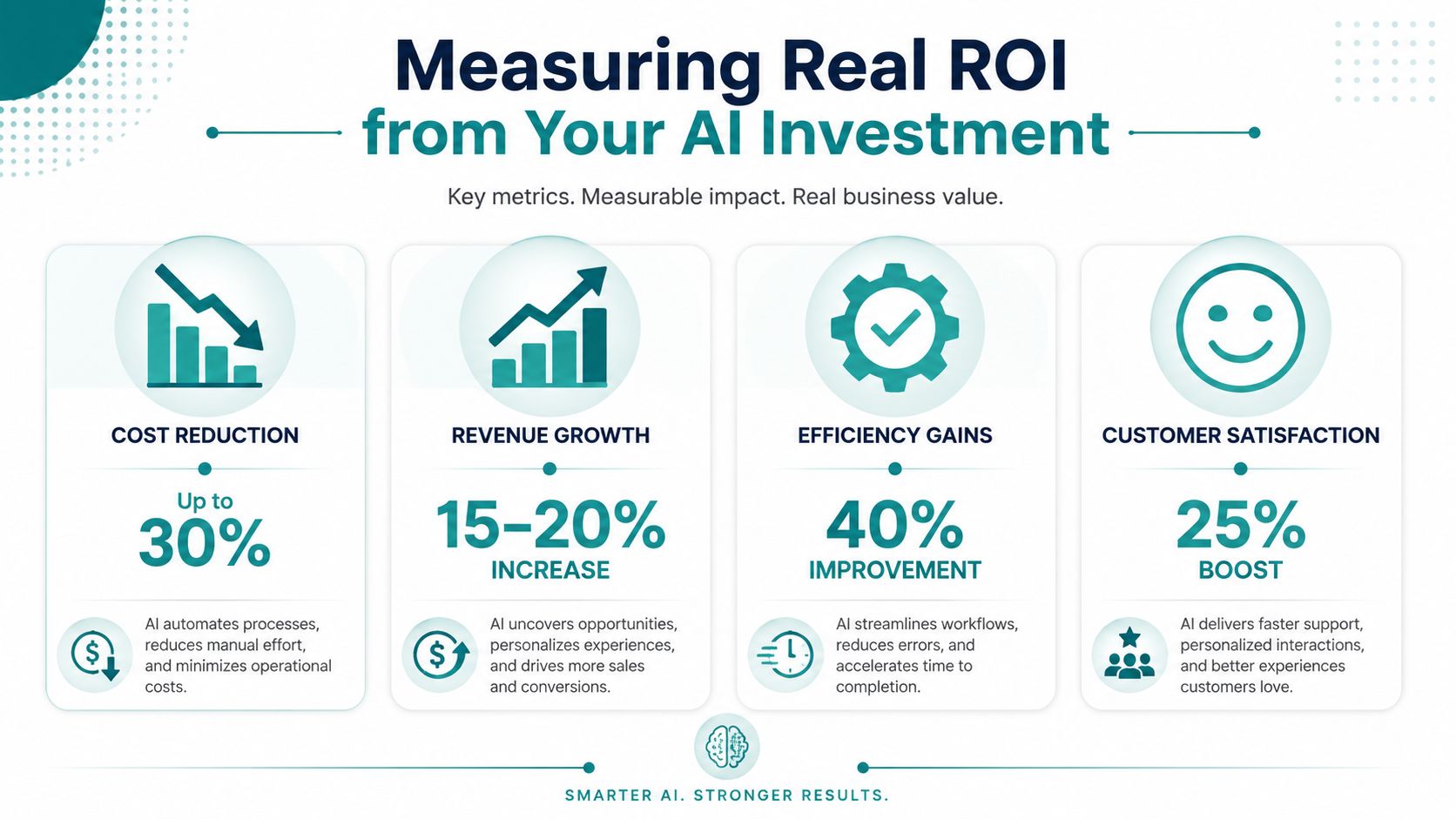
Those numbers matter because they move the conversation away from novelty. If AI helps your office manager spend less time on repetitive admin, your sales team follow up faster, or your marketing team publish stronger content more consistently, the return shows up in labor, speed, and conversion.
Where ROI usually appears first
The earliest wins often come from operational friction, not moonshot innovation.
-
Lead handling: Faster response, better qualification, and fewer missed inquiries
-
Content support: Quicker drafts for service pages, ads, emails, and FAQs
-
Admin reduction: Less manual sorting, tagging, summarizing, and copying between systems
-
Sales enablement: Better notes, cleaner follow-up, and faster access to relevant information
The video below gives a helpful overview of how companies are thinking about AI investment and outcomes.
<iframe width="100%" style="aspect-ratio: 16 / 9;" src="https://www.youtube.com/embed/5uKFszLtnjI" frameborder="0" allow="autoplay; encrypted-media" allowfullscreen></iframe>What does not count as ROI
Buying a tool and hoping your team figures it out is not ROI. Neither is generating more content if that content doesn't improve rankings, leads, or sales conversations.
Revenue impact usually comes from better execution around existing demand, not from the mere presence of AI software.
For Cincinnati businesses evaluating web design, SEO, or digital marketing support, the strongest AI investments are usually tied to a specific business bottleneck. If your site gets traffic but too few leads, AI might support better follow-up, stronger landing page content, or improved inquiry qualification. If your team is buried in admin, automation may create the bigger payoff first.
How to Choose the Right Cincinnati AI Partner
Choosing an AI partner is less about finding the most technical firm and more about finding the one that can connect AI to real business outcomes. Plenty of vendors can talk about automation, agents, and models. Fewer can explain how those things will help your company close more business or run more efficiently.
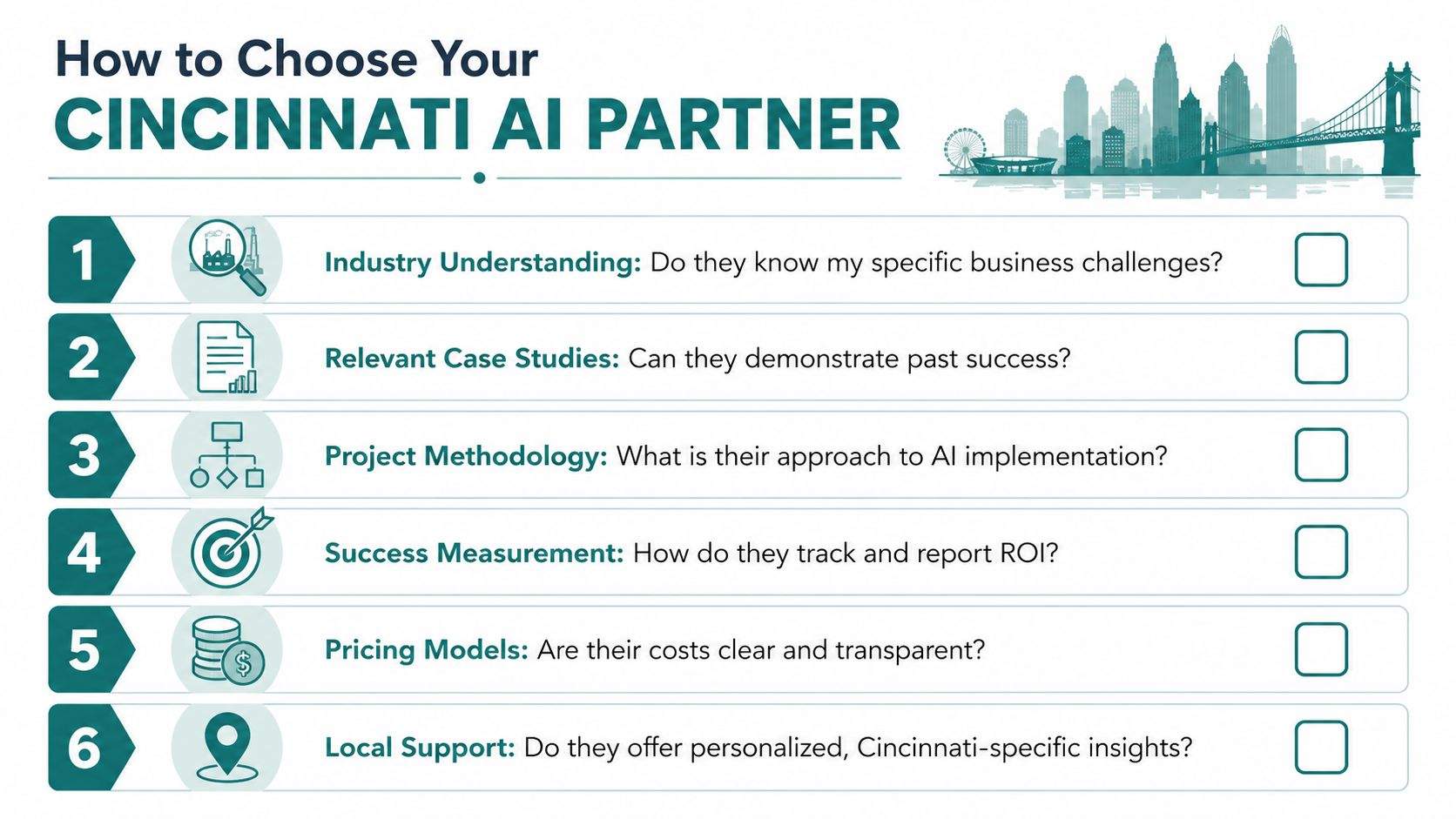
One idea matters more than the rest: effective AI consulting should begin with business-value triage, where you define the KPI, identify the small set of value drivers behind it, and only then discuss tools, based on this business-value triage framework. If a consultant skips that step, you'll probably end up with activity instead of results.
Questions worth asking in the first meeting
Use these as a filter:
-
What KPI are we trying to move? If they can't get specific, the project will stay fuzzy.
-
What process are you changing first? Good partners narrow scope before they expand it.
-
How will this connect to my current systems? Your CRM, CMS, forms, analytics, and email tools all matter.
-
Who owns the workflow after launch? If nobody does, the system decays.
-
How will success be measured? You want reporting tied to business performance, not just usage.
What a strong answer sounds like
A strong partner might say your main KPI is qualified lead volume, and the value drivers are response time, intake quality, and follow-up consistency. From there, they might recommend a smarter website intake flow, AI-assisted email drafts, CRM automation, and reporting that compares lead source quality over time.
That's a business conversation.
A weak partner will usually start with a shopping list of tools.
Why local context helps
Cincinnati businesses often need something practical. They may have a lean team, a mix of legacy systems, and a sales cycle built on trust. A local or regional partner often understands that your website isn't just branding. It's tied directly to calls, form fills, appointments, and revenue.
HDM is one Cincinnati-area option that combines AI consulting with website development, SEO, paid media, analytics, and workflow support, which can matter when your AI project has to connect with the rest of your digital stack instead of sitting off to the side.
A Simple Roadmap for Your First AI Project
The first AI project should be boring in the best possible way. It should solve a clear problem, fit into your current workflow, and be small enough to manage without derailing the rest of the business.
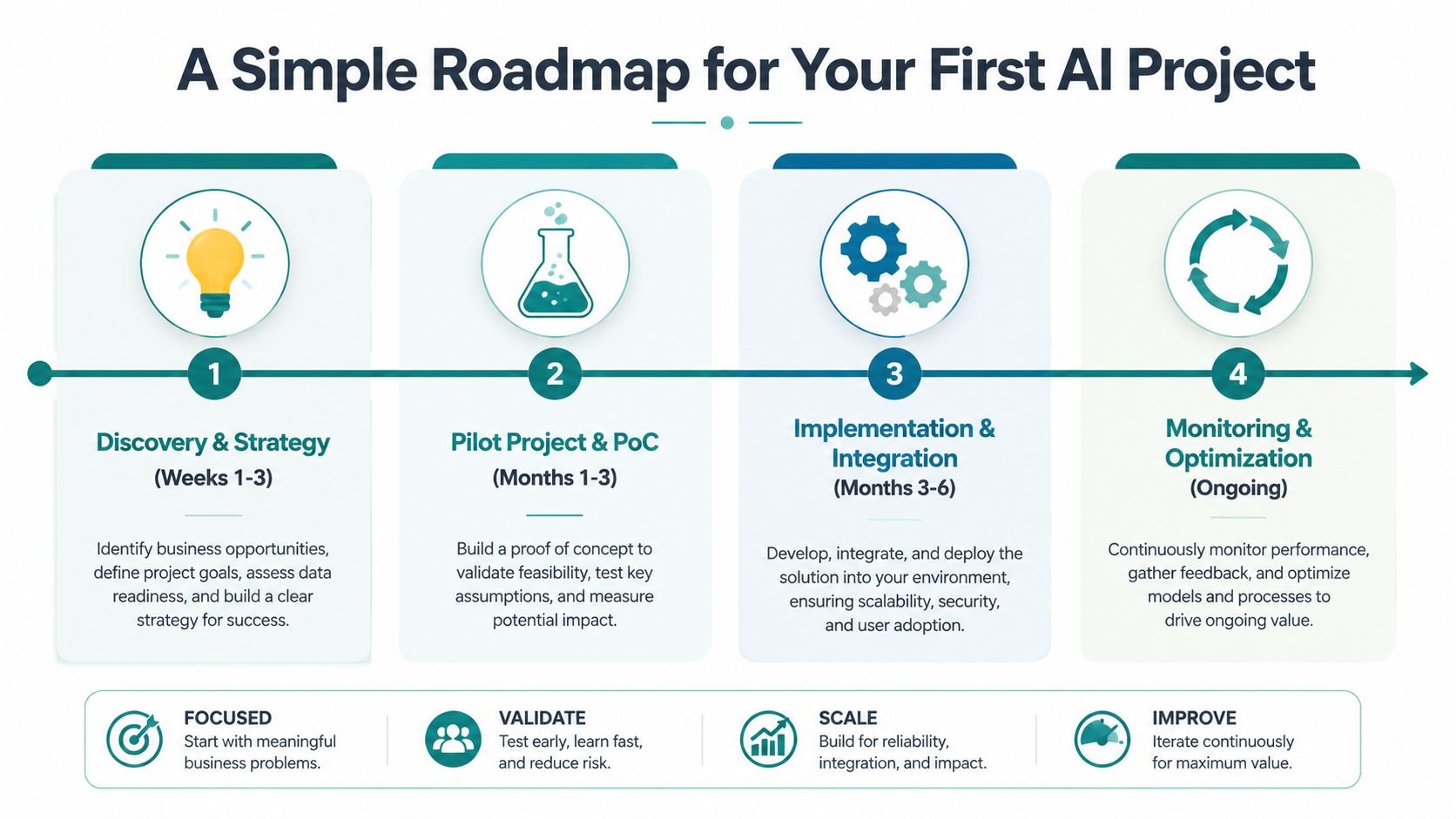
A practical roadmap usually follows the same sequence. Strategy first. Pilot second. Implementation after the pilot proves useful. Ongoing optimization after launch.
Phase one discovery and strategy
Start with one business issue that is costly, repetitive, or both.
Good first candidates include slow lead response, repetitive intake tasks, inconsistent follow-up, content production bottlenecks, or messy reporting. The key is choosing something your team already feels every week.
At this stage, define the target outcome in plain terms. More booked consults. Less admin time. Faster quote turnaround. Better lead qualification.
Phase two pilot project
A pilot should be narrow.
For example, instead of "use AI in marketing," test AI-assisted intake and follow-up for one service line. Instead of "automate customer support," start with common website questions and appointment requests. A contained pilot shows whether your data, workflow, and team habits support the idea.
Phase three implementation and integration
Once the pilot works, connect it properly.
That may include your website, CRM, email platform, scheduling tool, analytics, or ad campaigns. At this stage, many projects get harder than owners expect. The challenge usually isn't choosing a model. For production AI, the main technical bottlenecks are often data readiness, model drift, and post-launch governance, and the right lifecycle includes strategy, build/integrate, and operate/scale phases with ongoing monitoring, according to CGI's overview of AI consulting for results.
The most expensive AI mistake is launching something nobody maintains.
How pricing usually works
You'll typically see three pricing models:
-
Project-based fees: Best for a defined pilot or specific implementation
-
Monthly retainers: Useful when AI work touches SEO, content, analytics, optimization, and ongoing tuning
-
Hourly consulting: Fits audits, planning sessions, or targeted troubleshooting
Project-based work gives you scope clarity. Retainers make sense when AI is becoming part of normal operations. Hourly work can help if you're still validating the opportunity before committing to a larger engagement.
AI in Action for Cincinnati Industries
The easiest way to judge AI consulting for businesses is to stop thinking about "AI" and start thinking about everyday friction inside a specific company.
Healthcare practices
A medical practice gets the same questions every day. Do you accept this insurance? What times are available? How do I reschedule? Staff spend hours answering routine inquiries while more important patient communication waits.
A well-structured assistant can handle common scheduling questions, guide patients to the right form, send reminders, and reduce front-desk overload. In healthcare, the important part isn't novelty. It's making sure the experience is clear, compliant, and easy for patients who may already be stressed.
Law firms
A law office has a different problem. Intake is inconsistent. Potential clients submit incomplete forms, leave vague voicemails, or email long narratives that take time to sort.
AI can help summarize intake details, organize submitted documents, and prepare structured notes for attorney review. It can also support website chat that screens for practice area, urgency, and basic fit before a human follows up. That doesn't replace legal judgment. It gives the firm cleaner information sooner.
In service businesses, better intake often creates more value than better content because it improves what happens after interest already exists.
E-commerce and retail
An online store in the Cincinnati area may have solid traffic but weak conversion. Shoppers browse, compare, then disappear. The catalog may be growing faster than the team can manage descriptions, merchandising, and support.
AI can help with product recommendations, search assistance, merchandising support, and inventory-related forecasting. It can also speed up product page creation when a team has dozens or hundreds of SKUs to maintain across a busy catalog.
Manufacturing and B2B services
Many local manufacturers and B2B firms sit on valuable internal knowledge that's hard for staff to access quickly. Sales reps need spec details. Customer service needs part information. New employees need answers without interrupting senior staff all day.
An internal knowledge assistant can help teams pull approved answers faster from documentation, past records, and structured resources. For businesses with complex offerings, that can improve responsiveness without forcing every question through the same few people.
Frequently Asked Questions About AI Consulting
Is AI consulting only for large companies
No. Smaller companies often benefit faster because one good workflow improvement can remove a lot of friction from a lean team.
Do I need a custom AI tool to get value
Usually not at first. Many businesses can start by improving existing processes with off-the-shelf tools and better integration before investing in custom development.
What's the best first project
Pick a problem that is repetitive, measurable, and connected to revenue or time savings. Lead intake, follow-up, content support, and admin automation are common starting points.
Will AI replace my staff
In most SMB settings, the better use is support, not replacement. AI handles repeatable work so your team can focus on judgment, service, sales, and relationship-building.
How long does it take to see results
That depends on the project scope and how clean your workflow is. Simpler process improvements can show value quickly. More integrated initiatives take longer because they involve systems, approvals, and ongoing tuning.
Is AI risky for customer-facing work
It can be if it's deployed carelessly. Customer-facing AI needs clear guardrails, human escalation paths, and regular review. The right setup improves speed without making the experience feel robotic or untrustworthy.
If you're evaluating AI, web design, SEO, or digital marketing and want a practical conversation about where AI fits, HDM works with Cincinnati-area businesses on growth-focused digital systems that connect strategy, websites, automation, and measurable performance.