A Guide to Customer Retention Programs for Cincinnati SMBs
June 10, 2026
You probably already know your regulars.
They're the patients who come back to the same practice, the families who reorder from your online store, the clients who call your firm again when a new issue comes up, and the customers who ask for your business by name. In a lot of Cincinnati companies, that loyalty exists, but it isn't managed. It just sort of happens when service is good and people remember you.
That's fine until growth gets expensive.
A business owner spends on ads, SEO, a website refresh, social media, maybe even a sales push. New leads come in. Some buy once. Then the business moves on to the next batch, leaving money on the table because there's no real system for bringing existing customers back. Good service is still there, but there's no follow-up rhythm, no customer list segmented by value, no reminder flow, no offer strategy, and no way to tell who is drifting away.
That's where customer retention programs become practical, not corporate.
A retention program is a structured way to keep good customers engaged, buying again, renewing, referring, or returning before they forget about you. For a local business, that could involve a timely email after a purchase, a reminder before a service interval, a loyalty perk for repeat buyers, or a check-in when someone has gone quiet.
In the Cincinnati market, where reputation and repeat business still matter a lot, this can be one of the most profitable parts of your marketing. If your website and marketing bring in first-time buyers, retention is what helps those buyers turn into reliable revenue. That's also why many businesses that work with a Cincinnati digital partner eventually realize the true value isn't just lead generation. It's building a system that keeps customers from becoming one-and-done transactions.
Introduction Turning Repeat Buyers into Loyal Customers
A lot of owners can spot loyalty without seeing it in a report.
The owner of a neighborhood service business notices the same names on the calendar. A retailer recognizes familiar order notifications. A law office sees former clients return for a different matter. Those are strong signs, but they're not yet a customer retention program. They're just evidence that you have something worth building on.
The difference matters. Hope is not a system.
What loyalty looks like without a program
Without a program, repeat business often depends on memory, staff effort, and timing. Someone on your team remembers to follow up. A customer happens to see your next email. A former buyer thinks of you at the right moment. That can work for a while, especially in a close-knit market, but it gets unreliable as the business grows.
A real retention program adds structure to what your best employees already do naturally.
-
It identifies repeat customers before they disappear into a general contact list.
-
It creates useful follow-ups tied to actual customer moments, like a first order, a completed job, or a lapse in activity.
-
It gives people a reason to return that feels relevant, not random.
-
It helps you measure behavior so you can tell whether customers are becoming more loyal or buying when they would have regardless.
Good service earns a second chance. A retention program earns the third, fourth, and fifth purchase.
Why this matters for local businesses
For many Cincinnati-area SMBs, customer relationships are already a competitive advantage. The problem is that most of that advantage lives in the owner's head, the front desk's memory, or the salesperson's inbox. That makes it hard to scale.
If you've ever said, "We get a lot of repeat business, but we don't really track it," you're in the exact spot where retention work starts paying off. The goal isn't to make your business feel automated or impersonal. The goal is to support customer relationships with a system that makes repeat business more likely.
Why Retention Is Your Business's Hidden Growth Engine
Customer retention programs deserve attention because they affect margin, not just goodwill.
The business case is straightforward. A 5% increase in customer retention can raise profits by 25% to 95%, and retaining an existing customer is generally 5x cheaper than acquiring a new one, with some sources placing acquisition costs at 5 to 25 times higher than retention, according to Annex Cloud's retention summary.
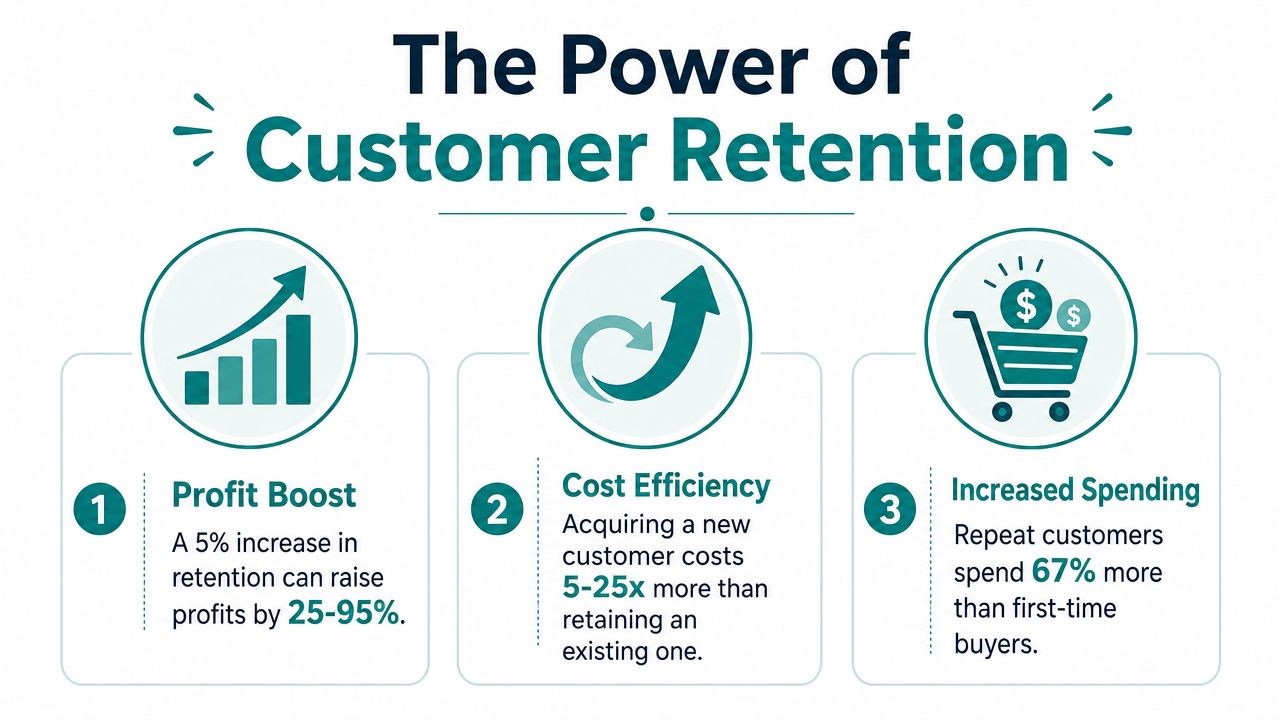
That's why retention isn't a "nice to have" sitting somewhere under customer service. It's a growth lever. If you can keep more of the customers you already paid to acquire, every dollar spent on marketing works harder.
What these numbers mean in plain English
If acquisition is getting more competitive, you can respond in two ways. You can keep spending more to replace churn, or you can reduce the need to replace as many customers in the first place.
Most owners feel this without naming it. They see healthy sales, but profit still feels tight because too much energy goes into restarting the pipeline. A strong retention program reduces that pressure. It helps you generate more value from customers who already know your name, trust your service, and need less persuasion to buy again.
The few metrics that actually matter
You don't need a giant dashboard to manage retention. You need a short list of numbers that tell you whether customers are sticking around and becoming more valuable over time.
<table> <thead> <tr> <th>Metric</th> <th>What it tells you</th> <th>Why it matters</th> </tr> </thead> <tbody><tr> <td><strong>Customer lifetime value</strong></td> <td>How much a customer is worth over the full relationship</td> <td>Helps you see which customer segments deserve more attention</td> </tr> <tr> <td><strong>Churn rate</strong></td> <td>How many customers stop buying, cancel, or disappear</td> <td>Shows where revenue is leaking</td> </tr> <tr> <td><strong>Repeat purchase rate</strong></td> <td>How often customers come back for another purchase</td> <td>Reveals whether your first sale is turning into a relationship</td> </tr> </tbody></table>A lot of businesses jump straight to lead volume because it's easy to see. Retention metrics are harder to notice unless you track them on purpose, but they often tell you more about the health of the business.
Where owners usually get stuck
The common objection is time. "We're busy getting new business. We can't build a whole retention machine."
Fair point. But customer retention programs don't need to start big. They start with a few disciplined habits.
-
Follow up after the first transaction
-
Separate repeat customers from one-time buyers
-
Watch for inactivity
-
Create offers that protect margin instead of training customers to wait for discounts
Practical rule: If you don't have a plan for what happens after the first sale, you're paying acquisition costs without building the full value of that customer.
A Repeatable Framework for Designing Your Program
Most customer retention programs get overcomplicated too early. They don't need to.
Start with a simple structure you can explain to your team in a few minutes. The framework I use most often with small and mid-sized businesses has four parts: segmentation, offers, lifecycle mapping, and measurement. If you can sketch those on paper, you can build something workable.
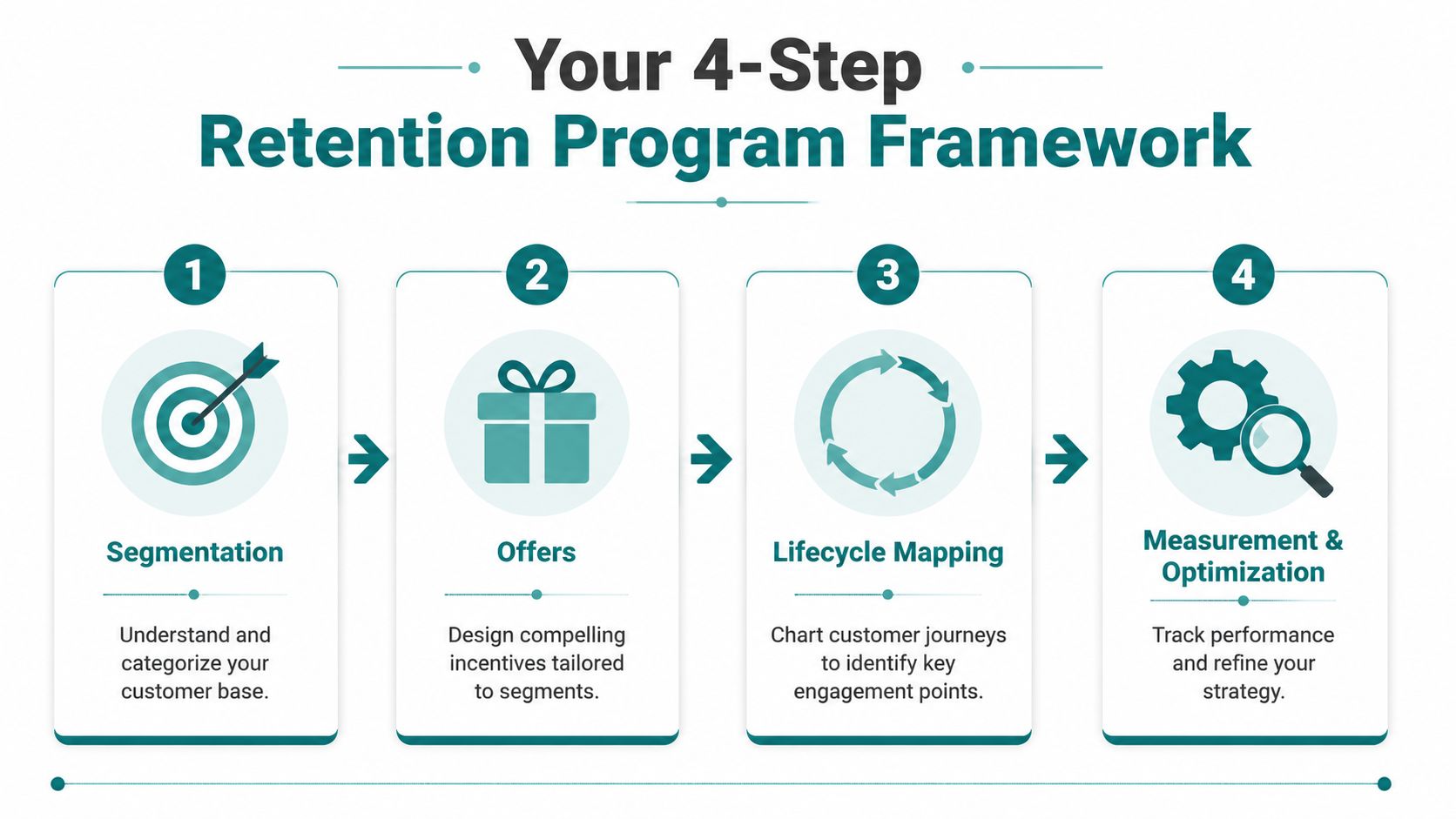
Start with segmentation
Not every customer should get the same message, perk, or level of attention.
At a minimum, divide your list into a few useful groups. Think in terms of behavior, not demographics. Your best customers are the ones who buy repeatedly, spend consistently, refer others, or renew on time. Another group may be new buyers who need a good second experience. Another may be drifting customers who haven't engaged in a while.
That one step changes everything. Instead of sending the same generic promotion to everyone, you can match the message to the relationship.
For example:
-
Best customers might get early access, priority scheduling, or a thank-you note from the owner.
-
New customers may need onboarding, usage tips, or reassurance that they made the right choice.
-
At-risk customers often need a timely check-in, not a giant discount.
Build offers that fit your margin
A weak retention strategy throws discounts at every problem. That trains customers to wait for deals and cuts into profit.
A stronger approach is to think beyond price. Good offers often include convenience, recognition, access, and relevance.
Some examples that work better than blanket discounting:
-
Service businesses can offer preferred scheduling or bundled maintenance reminders.
-
Professional firms can share useful follow-up resources after a matter closes.
-
E-commerce brands can create replenishment reminders, account-based reorder tools, or loyalty perks tied to purchase behavior.
The key is simple. Give customers a reason to stay connected that still makes business sense.
Map the customer lifecycle
This is the part many owners skip, even though it's where the program starts to feel practical.
Write down the moments that matter after the first purchase or inquiry. A new customer should not get the same communication as someone who's been buying from you for years. A customer who just completed a service should not hear from you the same way as someone who has gone quiet.
Useful lifecycle moments often include:
-
First purchase or first appointment
-
Post-purchase follow-up
-
Time-to-reorder or time-to-return window
-
Inactivity period
-
Win-back attempt
-
Loyal customer recognition moment
Here's a good explainer on how data connects these touchpoints to results:
Measure and improve
Many programs transition from "we tried some emails" to "we know what's working."
You need a way to see who received a message, who returned, and whether behavior changed. That's where clean reporting matters. If your data is scattered across an inbox, a point-of-sale tool, and a spreadsheet, it's hard to improve anything.
A business that wants clearer retention reporting usually needs better marketing analytics support, even before it needs fancy automation.
A retention program doesn't fail because the idea was bad. It usually fails because nobody tied the message, timing, and customer response together in one view.
The Right Technology to Power Your Program
Technology should support the retention strategy, not replace it.
A lot of SMB owners get pitched software before they've defined the problem. They hear about automation, loyalty platforms, customer journeys, and AI tools, but what they really need is a basic system that keeps customer information organized and makes timely follow-up possible.

Think of the stack as brain, voice, and scoreboard
Your CRM is the brain. It stores customer history, purchases, form fills, service notes, and status. If that data is incomplete or scattered, retention gets sloppy fast.
Your email and message automation tools are the voice. They send reminders, thank-yous, reorder prompts, onboarding messages, and reactivation campaigns. Done right, these messages feel timely and helpful. Done badly, they feel like spam.
Your analytics setup is the scoreboard. It tells you what happened after the message went out. Did customers come back? Did certain segments respond better? Did one offer perform better than another?
What to ask before buying anything
Most owners don't need more tools. They need better questions.
Use this short checklist when evaluating retention tech:
-
Data question. Can this system see purchase history, service history, or customer status?
-
Trigger question. Can it act on real customer behavior, or does it only send generic blasts?
-
Reporting question. Can you tell which messages led to return visits, repeat orders, or renewals?
-
Workflow question. Will your staff use it, or will it become another abandoned login?
A system that your team ignores is not a retention platform. It's overhead.
Sensitive industries need a higher standard
If you're in healthcare or another regulated field, convenience can't come at the cost of compliance. Patient reminders, intake workflows, and follow-up messaging need to be handled with care. That changes what platforms you can use and how data moves between systems.
This is also where implementation matters more than features. A Cincinnati-area business may need a website, CRM integration, analytics, and message workflows to work together cleanly. That kind of buildout is one place a firm like HDM's email and automation team can fit, especially when the retention goal crosses website performance, email execution, and reporting.
Retention Programs in Action Across Cincinnati
Retention looks different depending on how customers buy, how often they need you, and how easy it is for them to switch.
Industry benchmarks help frame expectations. ServiceNow's retention benchmark summary reports approximate retention rates of 90% for SaaS, 84% for media, 83% for insurance, 78% for fintech, 75% for banking, 63% for retail and e-commerce, and 55% for hospitality. Those numbers matter because they show why one business model can't copy another.
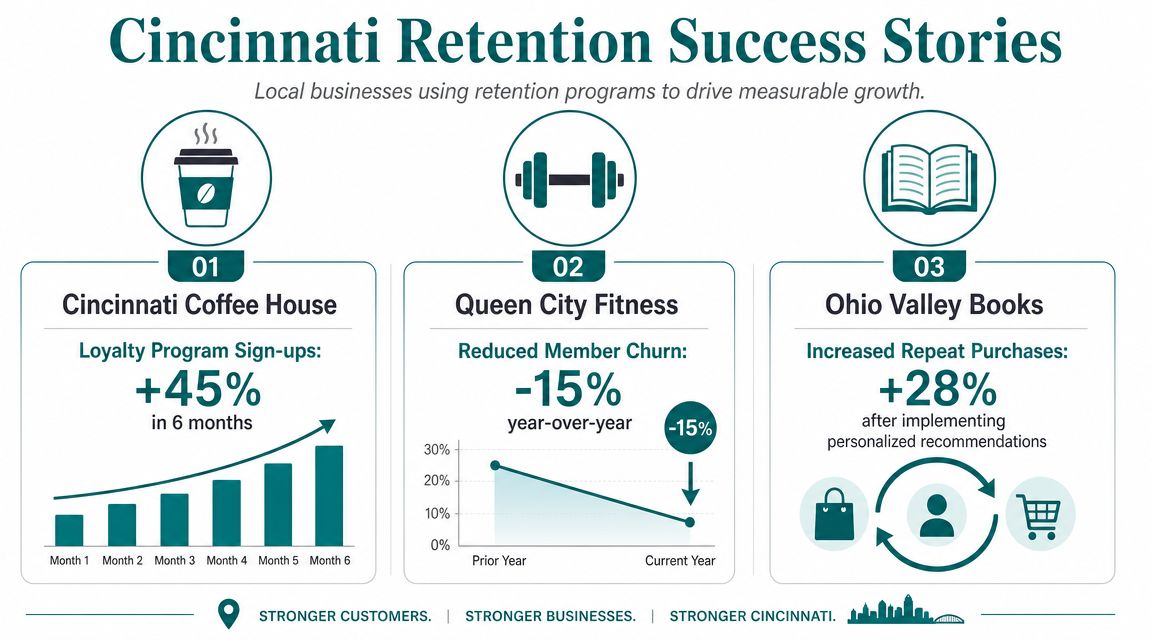
The infographic above includes example numbers, but treat those as illustrative design elements rather than evidence. For planning, use your own customer data and industry context.
A healthcare practice
A local practice doesn't need a flashy loyalty program. It needs a dependable patient experience after the first visit.
That usually means appointment reminders, post-visit instructions, easy ways to ask follow-up questions, and educational content that keeps the practice top of mind. In healthcare, retention often comes from reducing friction and building trust over time. If the website is hard to use, forms are clunky, or follow-up is inconsistent, patients drift.
A law firm
Legal retention is different. Clients may not need you every month, but they do remember whether the communication felt clear and professional.
A practical program here might include a clean intake process, status updates while a matter is active, a thoughtful closing follow-up, and occasional outreach that provides useful legal education without sounding like a hard sell. Referral requests can have a place, but only after the relationship has been handled well. For many firms, retention is as much about staying remembered as staying top of inbox.
Clients rarely come back because of one clever email. They come back because the full experience made them confident referring you and hiring you again.
A Cincinnati e-commerce brand
Retail and e-commerce typically face lower retention benchmarks than subscription-style businesses, so discipline matters more. A local online store might focus on welcome flows, replenishment timing, product education, account logins that make reordering easier, and segmented campaigns for repeat buyers.
Small improvements in customer experience can matter. Better product pages, cleaner checkout, order updates, and smart post-purchase emails all support retention. If someone buys once and then disappears, the issue may not be your product. It may be that you never gave them a reason to return.
Common Pitfalls and How to Avoid Them
Not all customer retention programs help. Some just hand out perks to people who were going to stay anyway.
That's the trap. A business launches a loyalty offer, sends a few campaigns, sees some activity, and assumes the program worked. But activity alone isn't proof. Some of those customers may have purchased again with no program at all.
The margin-killer problem
The most common mistake is overusing discounts.
If every retention effort starts with "take 15% off," you're teaching customers to delay purchases until a deal arrives. That can increase response in the short term while weakening profit and brand positioning over time. Better programs use discounts selectively and rely more on timing, convenience, relevance, and service.
Other frequent mistakes show up fast:
-
Treating everyone the same. Best customers, new customers, and at-risk customers need different messages.
-
Communicating too often. Relevance beats frequency.
-
Launching too much at once. If your team can't maintain it, simplify it.
-
Ignoring post-purchase experience. The retention job starts after the sale, not before it.
The incrementality question
A major blind spot in many retention programs is failing to measure whether they're incremental. Contentstack's retention guide notes that many guides don't explain how to use holdout testing to prove a program is creating new loyalty rather than subsidizing customers who would have stayed anyway.
That sounds technical, but the core idea is simple. Don't send the campaign to everyone.
Hold back a small comparison group. If the people who got the retention message behave meaningfully better than the similar group who didn't, you have stronger evidence that the program changed behavior. If not, you may be rewarding existing loyalty without creating new value.
Keep the first version boring
The best early retention programs are often a little plain.
Start with one segment, one trigger, one follow-up sequence, and one clear outcome to watch. For example, target recent first-time buyers with a useful follow-up and compare their return behavior against a similar holdout group. That teaches you more than launching five campaigns at once and guessing which one mattered.
One hard truth: a retention campaign that looks busy is not the same as a retention campaign that changes customer behavior.
Your First Step to Building Customer Loyalty
If you want to build customer retention programs that drive revenue, start smaller than you think.
Don't begin with software. Don't begin with a loyalty app. Don't begin with a complicated automation map. Start by exporting your customer list and identifying your best existing customers by actual behavior. Who buys repeatedly? Who has returned recently? Who hasn't purchased in a while but used to be active? That one exercise will tell you more than a dozen marketing brainstorms.
Then choose one action.
Maybe it's a post-purchase email for first-time buyers. Maybe it's a check-in for inactive customers. Maybe it's a simple thank-you offer for your strongest repeat buyers that protects margin instead of giving money away. The point is to create one repeatable motion tied to customer behavior.
That's how retention becomes real. Not as a slogan, but as an operating habit.
For Cincinnati-area SMBs, this matters because growth usually doesn't come from one channel alone. Your website, email, CRM, analytics, service experience, and follow-up process all affect whether people return. When those pieces connect, customer retention programs stop feeling like a marketing add-on and start acting like a revenue system.
If your business has outgrown spreadsheets, one-off email blasts, and memory-based follow-up, it may be time to formalize the process.
If you want help turning a rough retention idea into a working system, HDM can support the website, analytics, automation, and customer experience pieces that make repeat business easier to manage.