
A lot of business owners are in the same spot right now. The service is strong. The team knows its craft. Clients stay once they sign. But the pipeline feels uneven, and marketing looks like a mix of random tactics rather than a system.
That problem gets sharper in managed IT. MSPs sell something essential, but not always easy to explain. Buyers often don't search for "great technology partner." They search when a system fails, a compliance issue appears, or an internal team gets stretched thin. If your website, search visibility, and follow-up process aren't built for that moment, you lose deals before a conversation starts.
That's why digital marketing for MSPs is such a useful example for any Cincinnati business owner evaluating web design, SEO, or growth strategy. If you can build a practical marketing engine for a complex, trust-heavy service like managed IT, you can apply the same strategic thinking to many other service businesses.
Why Most MSP Marketing Falls Flat
Most MSP marketing fails for a simple reason. The company markets services, not buying decisions.
An MSP might talk about cloud support, endpoint management, cybersecurity, and response times. Those services matter. But the buyer is usually thinking about risk, downtime, accountability, and whether this provider feels credible enough to trust with the business.
That gap creates a familiar pattern. The company launches a new website, posts on LinkedIn, maybe runs a few ads, and waits for leads that never really become consistent. The issue usually isn't effort. It's that the pieces don't support each other.

The opportunity is real, but so is the pressure. The MSP market is projected to reach $303.16 billion globally in 2025, while 38% of MSPs face pressure from being underpriced and 55% report increasing costs as a major obstacle. Growth attracts competitors. Competitors squeeze margins. Weak marketing gets exposed fast.
Where the disconnect usually starts
A lot of firms lean on tactics that feel productive but don't build momentum:
-
Generic messaging: "We provide managed IT services for small businesses" sounds safe, but it doesn't give a buyer a reason to choose you.
-
Brochure websites: The site explains who you are, but it doesn't guide a visitor toward action.
-
Channel hopping: One month it's SEO. The next month it's paid ads. Then social posting. Nothing runs long enough to compound.
-
No lead handling process: Inquiries arrive, but follow-up depends on who's available that day.
Buyers don't reward the MSP that lists the most services. They choose the one that feels most relevant and most trustworthy.
What actually works
The firms that win usually do three things well.
First, they pick a market position instead of trying to serve everyone the same way.
Second, they build a website that sells clarity, not just capability.
Third, they connect traffic generation to a real conversion process. That means search, content, paid media, automation, and sales follow-up all point in the same direction.
For a non-technical business owner, that's the main takeaway. Good digital marketing isn't a pile of channels. It's a sequence. Position first. Then visibility. Then conversion. Then measurement.
Build Your Foundation with Positioning and a High-Performance Website
Before spending money on traffic, fix the reason traffic won't convert.
For MSPs, that starts with positioning. If the market can't quickly tell who you serve, what problem you solve, and why your offer fits, the rest of your marketing gets expensive.
Niche beats generic every time
A common mistake is trying to look broad so no opportunity gets excluded. In practice, that weakens the message.
"Managed IT for businesses in Cincinnati" is understandable, but it's thin. "Managed IT and compliance support for healthcare practices" is sharper. "Co-managed IT for manufacturers with lean internal teams" is sharper in a different way.
The point isn't to make the business smaller. The point is to make the offer easier to trust.
What good positioning sounds like
A strong position usually answers four questions fast:
| Question | Weak answer | Strong answer |
|---|---|---|
| Who is this for? | Small businesses | Healthcare practices, law firms, manufacturers |
| What problem do you solve? | IT support | Compliance risk, recurring downtime, stretched internal IT |
| Why you? | Great service | Fast response, vertical expertise, local support, strategic planning |
| Why now? | Contact us | Audit gap, security concern, growth strain, upcoming transition |
When a site answers those questions clearly, visitors don't have to decode your value.
Your website is your sales floor
For many MSPs, the website still acts like a digital brochure. It lists services, includes a contact form, and hopes a prospect will connect the dots.
That isn't enough. Your website needs to behave like a guided sales experience.
A high-performance site should do the following:
-
Lead with business outcomes: Talk about continuity, security, compliance, and support confidence before diving into technical features.
-
Segment users quickly: Give visitors paths based on who they are, such as healthcare, legal, manufacturing, or co-managed IT.
-
Reduce friction: Make contact forms short, calls-to-action clear, and mobile usability solid.
-
Support trust: Show team credibility, client proof, certifications, and straightforward process language.
-
Create next steps: Offer a call, an assessment, a consultation, or a practical resource.
Practical rule: If a first-time visitor can't tell within a few seconds whether your company is relevant to them, the page is underperforming.
Trust design matters more in MSP marketing
Managed services is a trust sale. Buyers are often handing over systems, security responsibilities, employee workflows, and vendor coordination. That means design isn't decoration. It signals reliability.
Foundation before promotion
Before launching SEO, paid search, or email outreach, an MSP should have a clear target market, a differentiated value proposition, service pages built around buyer pain points, industry-specific proof or language, and calls-to-action that match buying intent.
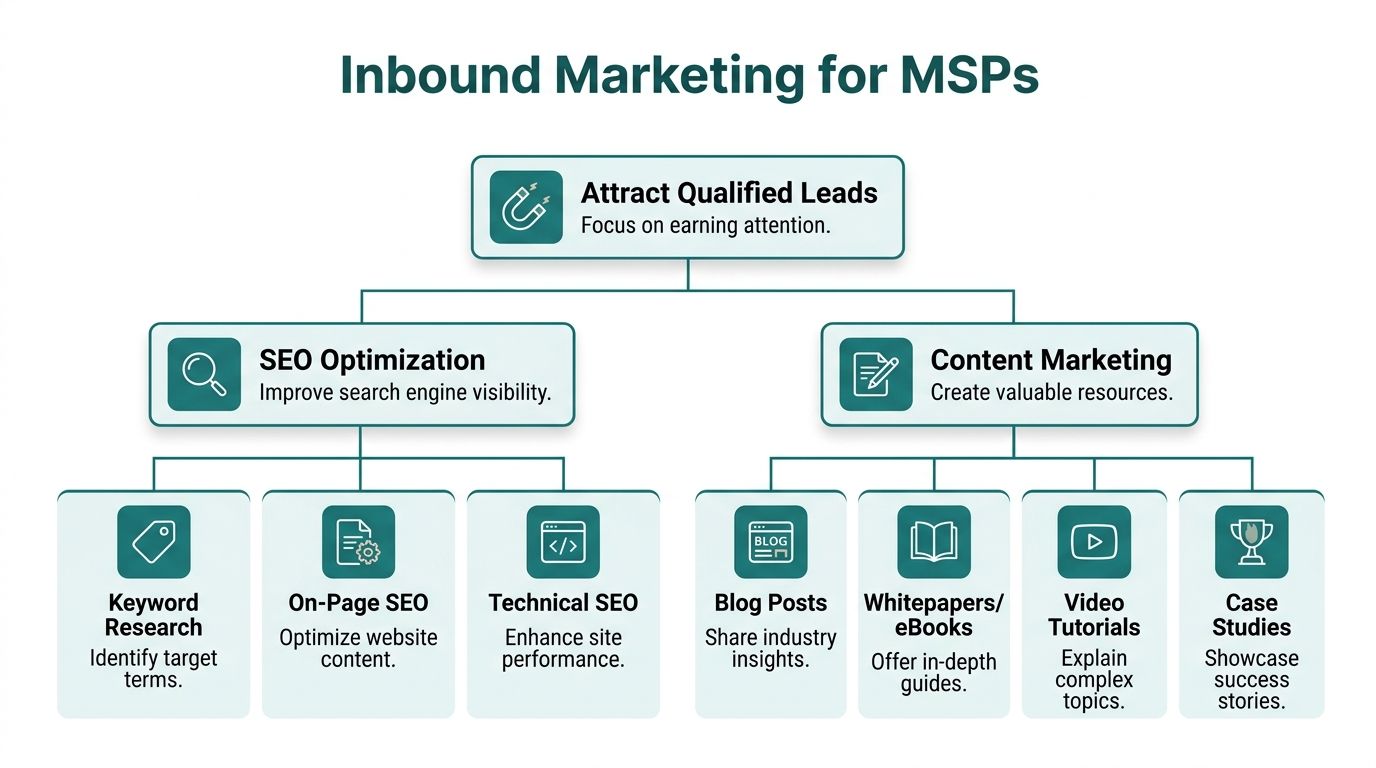
Attract Qualified Leads with SEO and Expert Content
A Cincinnati business owner realizes their IT support is failing when staff lose half a day to recurring tickets, cyber insurance questions start piling up, and no one can explain what will break next. The search that follows is rarely broad. It is specific, urgent, and tied to a business problem.
That is why SEO for MSPs starts with intent, not traffic volume.
Start with service page SEO
Many MSPs spend too much time publishing blogs before their core pages are ready. Service pages usually carry the highest commercial intent.
Expert content earns trust before the sales call
Good content answers the questions buyers ask before they are ready to talk. Strong content closes the gap between ranking and converting.
Local SEO usually beats broad visibility
Local and regional visibility often produces better opportunities because the buyer wants someone who understands their market.
The best MSP content translates technical risk into cost, downtime, compliance exposure, and operational drag.
| Asset type | Purpose | Best use |
|---|---|---|
| Service pages | Capture high-intent demand | Core offers and industry niches |
| Blog posts | Earn discovery and support trust | Common questions and emerging risks |
| Downloadable resources | Convert visitors into leads | Checklists, guides, audits |
| Case studies | Reduce buying hesitation | Sales follow-up and bottom-funnel pages |
Accelerate Growth with Paid Ads and Strategic Partnerships
SEO compounds over time. Paid media moves faster. That's the trade-off.
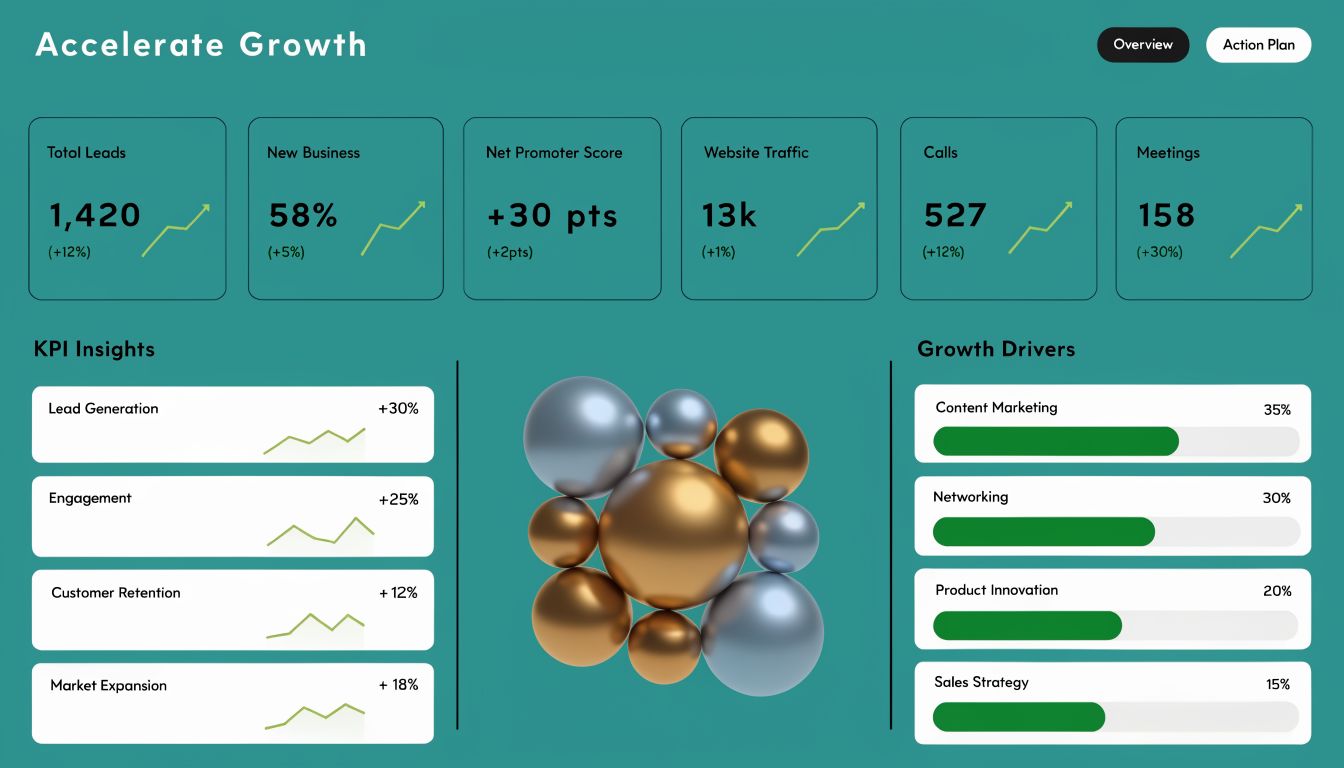
Social media has become the top MSP client acquisition channel at 25.8%, ahead of cold calling at 10.6% and referrals at 9.1%.
Google Ads versus LinkedIn
Google Ads captures existing intent. LinkedIn creates visibility with a narrower audience.
Paid media only works when the landing page is specific
If the ad mentions healthcare IT support, the landing page should continue that conversation.
Strategic partnerships can outperform cold outreach
Good partner fits include accounting firms, commercial real estate brokers, business attorneys, and industry consultants.
| Situation | Better fit |
|---|---|
| Need leads faster | Google Ads |
| Need awareness in a narrow vertical | |
| Strong local network | Partnerships |
| Weak brand but strong niche offer | Paid campaign to niche landing page |
| Limited budget and no conversion system | Fix site and offer first |
Decision test: If you can clearly define the audience, pain point, and next step, paid media can work. If not, partnerships or foundational work usually produce better returns first.
Convert Interest into Revenue with Automation and Social Proof
A lead comes in through a search ad. They don't book immediately. They look at the website again later. A few days after that, they open an email. Then they forward your case study to a colleague. After that, they request a conversation.
That middle stretch decides a lot of deals. It's where many MSPs go quiet.
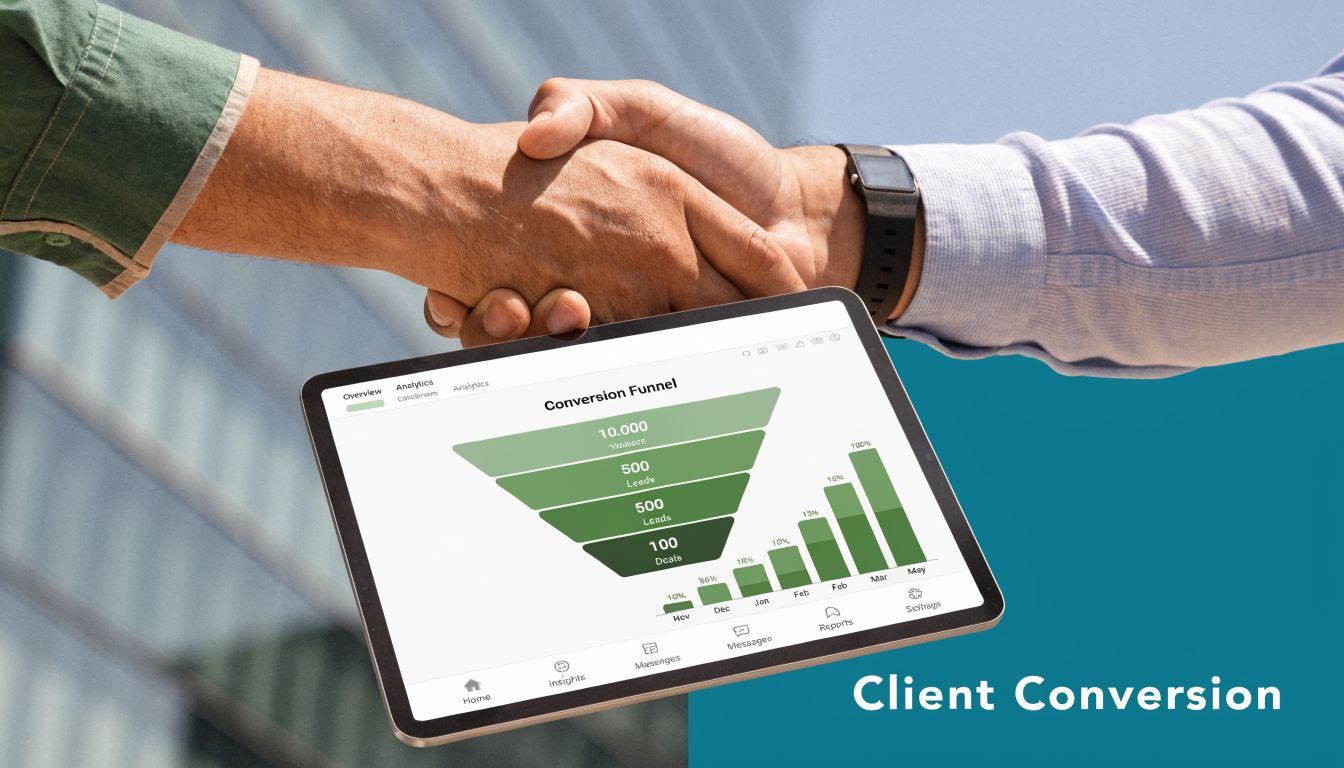
A simple nurture sequence beats random follow-up
For MSPs, a nurture sequence after a form submission might look like:
-
Immediate response — Confirm the request and set expectations for timing.
-
Educational follow-up — Share one useful resource tied to the original inquiry.
-
Proof of capability — Send a short case study or client story that matches the prospect's industry.
-
Low-pressure next step — Offer a consultation, assessment, or short planning call.
Where AI can help
AI-powered tools like chatbots can boost lead conversion by 20-30%. Used well, AI can help with triaging inquiries, routing leads by service interest, answering basic pre-sales questions, and personalizing follow-up timing and content.
Social proof should tell a story
A better case study has a simple narrative: Before (what problem existed), Change (what did the MSP implement), and After (what became easier, safer, or more predictable).
Prospects trust proof that feels similar to their own situation. Relevance matters more than polish.
A practical trust stack
When a lead revisits your site or receives follow-up, give them evidence in layers:
-
Testimonials that mention the business problem solved
-
Case studies organized by industry or service
-
Process clarity so they know what happens after signing
-
Team visibility so the company feels real
-
Relevant resources that show expertise without hard selling
Measure Success and Implement Your MSP Marketing Plan
Marketing gets expensive when nobody agrees on what success looks like.
Practical benchmarks for MSP campaigns include aiming for a website bounce rate under 40%, a landing page conversion rate over 3%, and customer acquisition cost under $500 per qualified lead.
The metrics that matter
Track metrics that answer these questions: Is the website holding attention? Are landing pages creating inquiries? Are leads affordable and qualified? Which channels deserve more budget?
A workable 30-60-90 day rollout
First 30 days: Clarify niche and messaging, tighten core service pages, install clean analytics and conversion tracking, define main calls-to-action, identify one primary offer.
By 60 days: Launch or improve local SEO assets, publish supporting content for the core offer, build one dedicated landing page, set up automated lead follow-up, establish a reporting dashboard.
By 90 days: Test paid search or LinkedIn with focused targeting, build one partner outreach initiative, review lead quality by source, refine underperforming pages, turn strong client outcomes into case studies.
If measurement only happens after a campaign disappoints, the reporting arrived too late. Tracking has to start before launch.
Frequently Asked Questions about MSP Marketing
How much should a small MSP spend on marketing?
There isn't one universal number because budget should follow goals, competition, and how strong the foundation already is. A small MSP with a weak website shouldn't rush into aggressive ad spend. It usually makes more sense to fix positioning, service pages, tracking, and follow-up first.
How long does SEO take compared with paid ads?
Paid ads can create visibility quickly if the offer and landing page are strong. SEO usually takes longer because you're building authority, relevance, and trust with search engines over time. The important part is not choosing one as a belief system.
Can a very small team do this without a full marketing department?
Yes, but only if priorities stay tight. Start with a clear niche, a website that converts, one main SEO priority, one lead magnet or resource, and one simple email nurture sequence.
What if referrals are still your biggest lead source?
Keep them. Just don't depend on them alone. Referrals are strongest when they land on a website that confirms the recommendation, explains the offer clearly, and makes next steps easy.
What's the biggest mistake owners make?
They treat marketing like a list of disconnected tactics. The firms that grow usually commit to one coherent system. Positioning, website, SEO, paid media, automation, and measurement all support the same business goal.
If your business needs a clearer path from website traffic to qualified leads, HDM helps Cincinnati-area companies build the kind of strategy outlined here. HDM combines high-performance web design, SEO, paid media, analytics, and AI-driven execution so your marketing works like a system, not a collection of guesses.