

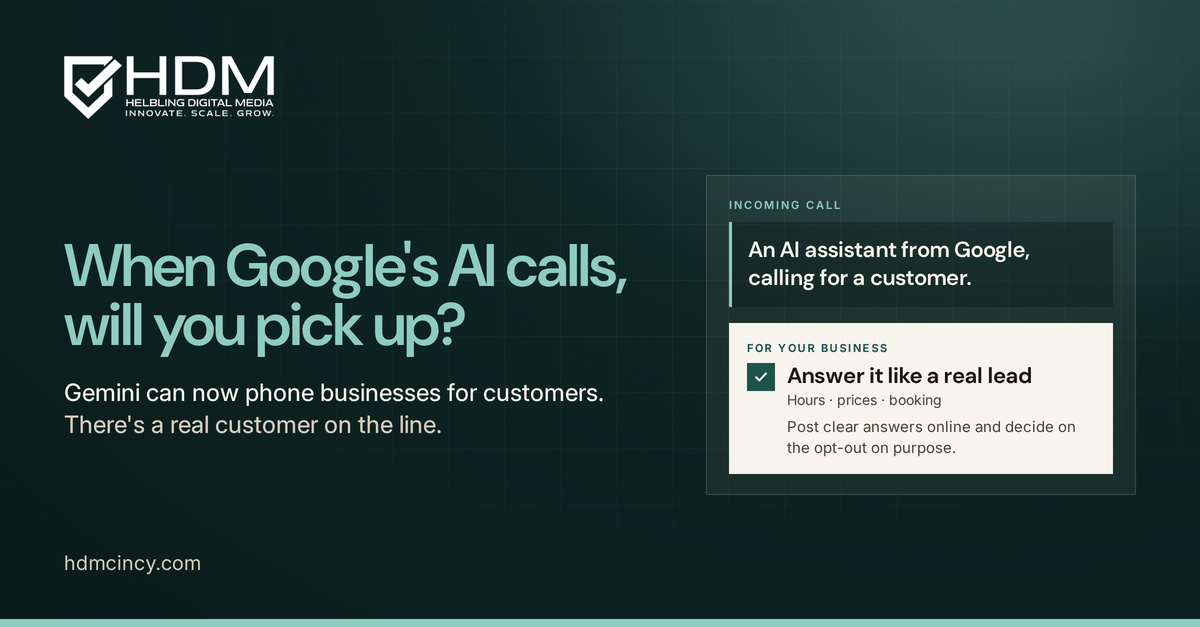
Picture this: your phone rings, and the voice on the other end says it's an AI assistant from Google, calling on a recorded line for one of your customers. It wants a price, an opening or to know what's in stock. A lot of people will hang up. Starting this week, that could mean hanging up on a real customer.
What happened
On Tuesday, Google announced it is rolling out Tasks in Gemini free of charge to hundreds of millions of people in the U.S., Japan, Korea, Canada, Australia and India. Tasks is the part of the Gemini app that does things for you instead of just answering questions. It was previously called Spark and only available to paying subscribers.
The part that matters most for local businesses is a set of advanced features starting in the U.S. According to Google's release notes, Gemini can now place calls on a person's behalf, "even dialing multiple shops at once," to compare quotes, check inventory or negotiate bills. The person reviews and approves the call plan first, then gets a summary and full transcript.
Google's own example says a lot. Josh Woodward, the Google vice president over the Gemini app, asked it to get his minivan serviced. Gemini found the two nearest dealerships on Google Maps and called both at once, then booked with the shop that took appointments rather than walk-ins only. One business got the job. The other didn't.
Gemini can also buy things. It now checks out with Google Pay using a spending cap the person sets, and Google says it is designed to ask for confirmation or pre-approval before clicking "Buy."
What the call sounds like on your end
Google's help page spells it out. Gemini calls from the customer's own phone number, and "starts every call by disclosing that it's an AI assistant from Google calling on a recorded line on your behalf, stating your name." In other words, you'll hear the customer's name and see their number.
The same page says Gemini can call businesses to get hours, product availability and service quotes, book or manage appointments, and navigate phone menus and wait on hold. It can't make payments over the phone, share sensitive personal information or make telemarketing calls, and there are daily limits on how many calls each person can make.
A fair caveat: Google says it's rolling this out gradually, and the help page still lists requirements like a recent Pixel phone and a Google AI subscription. Calling also isn't available yet in Indiana, Louisiana, Minnesota, Montana and Nebraska. You may not get one of these calls tomorrow, but the direction is clear.
Why this matters for your business
For years, being found online meant showing up when someone searched. Now an assistant may do the searching, call the top few businesses and report back. If your hours are wrong, your prices are a mystery or nobody picks up, the assistant moves on to the next shop.
What to do now
- Tell whoever answers your phone. If they hear "AI assistant from Google," it isn't spam. There's a real customer behind it. Answer the way you would for a person, and don't share anything you wouldn't want on a recorded line.
- Make your basic answers easy to find. Put your hours, services, price ranges or "starting at" prices, and how booking works on your website, and make sure your Google Business Profile says the same thing. Clear answers online can save everyone a call.
- Say whether you take appointments. That one detail decided Google's own example.
- Share inventory if you sell products. For the calls it makes through Search and Maps, Google says that if you've shared in-store product details through Merchant Center, it will use that instead of calling you about inventory.
- Decide on purpose whether to opt out. Google has a Gemini calling opt-out page for your phone number. Your Business Profile has its own settings for automated calls Google makes for customers through Search and Maps. If you want to stop both, check both.
- Check your online booking and checkout. Google notes that on some sites, Gemini gets most of the way through and then hands the screen back to the person. We covered how to keep your site from turning AI shoppers away in AI Agents Can Now Pay for Things.
Our take
For most local businesses, I wouldn't rush to opt out. Each of these calls starts with a person who wants to hire someone or buy something. If you opt out, that request most likely goes to whoever does pick up. The businesses that do well here will be the ones that are easy to reach, easy to understand and quick to say yes.
If you're lost, we can help
If you're not sure what your website and Google Business Profile tell customers, or what an AI assistant would find when it goes looking, that's normal. This is new for everyone. HDM has been building and caring for websites out of Springboro, Ohio for 20 years, and today we help businesses get found in AI search, too. We'll check your hours, services and booking details across your site and Google profile, and tell you plainly what we find. Learn about our growth marketing services, send us a request or call us at (513) 668-7344.