


AI marketing uses artificial intelligence to make marketing decisions and customer interactions faster, more personal, and easier to measure, with a person still accountable for the outcome. A 2026 survey of 184 marketing and advertising professionals found that 98.4% reported using generative or agentic AI, while only 6.5% evaluated those investments against defined metrics.
Most owners hear the phrase and picture a chatbot that writes posts overnight. That picture is incomplete. The useful version is a decision layer. Data goes in, a prediction or a draft comes out, and someone on your team still owns the result.
If a Cincinnati HVAC company, law office, or shop can't name the extra bookings, the lower cost per lead, or the calls that stopped wasting staff time, the tool hasn't earned its place. Hours saved are a side benefit. They aren't proof.
This guide covers a plain definition, four capabilities, local examples, the risks that affect small businesses, and a first pilot you can judge in six to eight weeks.
What AI Marketing Means in Plain English
AI marketing is the use of artificial intelligence to improve marketing decisions and customer interactions.
Think of a careful sales assistant who reviews every customer record overnight and suggests who to call first. That assistant doesn't replace the sales team. It sorts the pile so a person spends the morning on the right names.
The work runs as a three-part loop. Customer data goes in. Predictions or content come out. A person approves the decision before it reaches a customer.

A short history, then a local picture
Early systems from the 1950s to the 1980s followed fixed rules for pricing and customer groups. As a Springer reference overview traces, the field didn't gain real momentum until after 2015, when cloud computing and large behavioral datasets made real-time prediction practical. Public large language models from late 2022 then put content drafts and chat assistants within reach of ordinary teams.
A chatbot is only one piece. The same family of tools can rank leads, tailor an offer, or draft a message. The most useful systems estimate not only who is likely to buy, but which customers a specific message would change.
Say an HVAC company in the Cincinnati suburbs has three years of tune-up records. The tool ranks past customers who are due for a seasonal visit, and a coordinator calls the top of that list on Monday. The software didn't book the job. It changed who got called.
If a tool uses customer data to change a marketing decision, it belongs in this category. A grammar checker that never touches a customer record doesn't.
The Four Core Capabilities at a Glance
Use this table as the reference for the rest of the guide. Each row is something a small team can run without a data department.
| Capability | What It Does | Everyday Example | Sign It Is Working |
|---|---|---|---|
| Personalization | Tailors emails, offers and page content to past behavior | Returning client sees the service they booked last spring | Higher email click rates among returning customers |
| Automation | Runs repeat tasks when a trigger happens | Welcome sequence starts after a website form is filled | Faster first response to new leads |
| Predictive analytics | Estimates who is likely to buy or leave | Leads are ranked so staff call the top ten first | More of the calls made turn into booked appointments |
| Chatbots | Answers common questions and books appointments | Visitor asks about hours and books a slot at 9 pm | Fewer missed inquiries outside office hours |
What each row looks like on a Tuesday
Personalization changes the message to match what a customer already did. A returning client sees the service they booked last spring, not a generic sale. An early sign it's working is higher email click rates among people who have bought before.
Automation runs a repeat task when something happens. A welcome sequence starts after a website form is filled, or a follow-up goes out when a quote sits unanswered for three days. Watch for a faster first response to new leads.
Predictive analytics estimates which leads are most likely to buy and which customers may leave, so staff call the right people first. If more of those calls turn into booked appointments, the ranking is doing its job. A score that nobody acts on is just a number.
Chatbots answer common questions, collect qualifying details, and book appointments outside office hours. A visitor asks about hours and books a slot at 9 pm. Fewer missed inquiries after you close is the sign to watch.
The strongest setups combine two capabilities. A predictive score can trigger a personalized automated email, so the people most likely to book hear from you first, in language that matches their last visit. Later sections cover how to run each one safely and how to measure it. If you want the measurement habits underneath these scores, a data-driven marketing strategy is the place to start before you buy another tool.
Real-World AI Marketing Examples for Small Businesses
These five scenes are the bottlenecks owners in Greater Cincinnati describe most often. Each one names the jam, what the software does, and the result worth watching.
A family law firm downtown loses callers who reach a full voicemail after 6 pm. An intake chatbot collects case details overnight and flags urgent matters for the next morning. Watch whether fewer qualified callers disappear before a person calls back. Legal claims still need a lawyer's review before anyone treats the chat as advice.
A roofing company gets a flood of "how soon can you come" messages after a storm. The tool ranks inbound requests by likely job size and urgency, so estimators spend the morning on the best prospects. The result to watch is more estimates that turn into signed jobs, not more emails sent.
A boutique retailer blasts the same sale to every subscriber. Personalization uses purchase history, so a customer who bought running shoes receives socks and care products instead of a generic discount. Watch repeat purchases from that segment, not the size of the send.
A dental practice misses recalls because reminder calls pile up on the front desk. Automated appointment reminders and recall messages go out on a schedule. Patient consent and access controls are written down before launch. Healthcare teams need that paperwork. The result is fewer no-shows, not a bigger contact list.
A neighborhood restaurant needs a weekly social post and nobody has an hour to write five versions. Generative AI drafts several options, and a staff member approves every version before it goes live. Watch reservations or coupon redemptions tied to that post, not how fast the draft appeared.
Owners who sell online can see the same pattern in a marketing automation setup for ecommerce, where a trigger replaces a manual follow-up. For a wider set of small-team examples, a marketing guide for time-strapped business owners from PostSyncer is a useful companion when you're choosing which bottleneck to fix first.
Which of these jams is closest to the one costing you leads this month?
Benefits, Risks and How to Keep Them in Balance
Faster drafting frees staff time. Personalization can lift satisfaction and revenue. Those gains are possible, not promised.
McKinsey's analysis of AI in marketing and sales estimates that AI-driven personalization can raise customer satisfaction by 15–20%, increase revenue by 5–8%, and reduce cost to serve by as much as 30%. The same analysis estimates generative AI could improve marketing-function productivity by 5–15% of total marketing spending. Those figures describe potential outcomes. They depend on data quality, connections to your website, customer records, and ad accounts, plus testing. They aren't a quote for your next quarter.
Where small teams get hurt
Customer records can leak when someone pastes them into a tool the business never approved. Generated text can state a wrong price or a service area you don't cover. Google's guidance on AI content treats scaled content abuse as creating many pages mainly to manipulate rankings, and Google can act whether or not automation was involved. Automated targeting can also favor the wrong people, and brand tone drifts when nobody reviews the output.
There's a transparency risk too. NIST's description of the AI Risk Management Framework treats transparency as making appropriate information available to people interacting with a system, including people who may not realize they're dealing with automation. The framework is voluntary. In practice, tell customers when they're talking to automation, explain what you collect and why, and keep a clear path to a human. Never paste confidential customer data into a tool your team hasn't approved.
| Benefit or Risk | What It Looks Like | Control to Put in Place |
|---|---|---|
| Faster content production | Drafts for emails and social posts appear in minutes | Human review and approval before anything is published |
| Personalization lift | Offers and messages match each customer's history | Test against a holdout group before scaling |
| Lower cost to serve | Routine questions are answered by automation | Human escalation path for complaints and complex requests |
| Data privacy exposure | Customer records pasted into an unapproved tool | Written data-use rule and approved tools only |
| Inaccurate output | Wrong prices, service areas or claims in generated copy | Fact-check list for prices, legal and health claims |
| Scaled low-quality pages | Many thin location pages created to rank | Publish fewer pages, each with unique local detail |
Practical rule: Adopt an AI workflow only when you can name the control for each risk it introduces.
A style guide with a named approver covers tone. A monthly cap on new pages covers ranking risk. A bias check on audience lists covers targeting that excludes a neighborhood you meant to serve.
Choosing Tools and Partners Without Overpaying
Bring a checklist to every vendor call. Access to software is no longer the hard part.
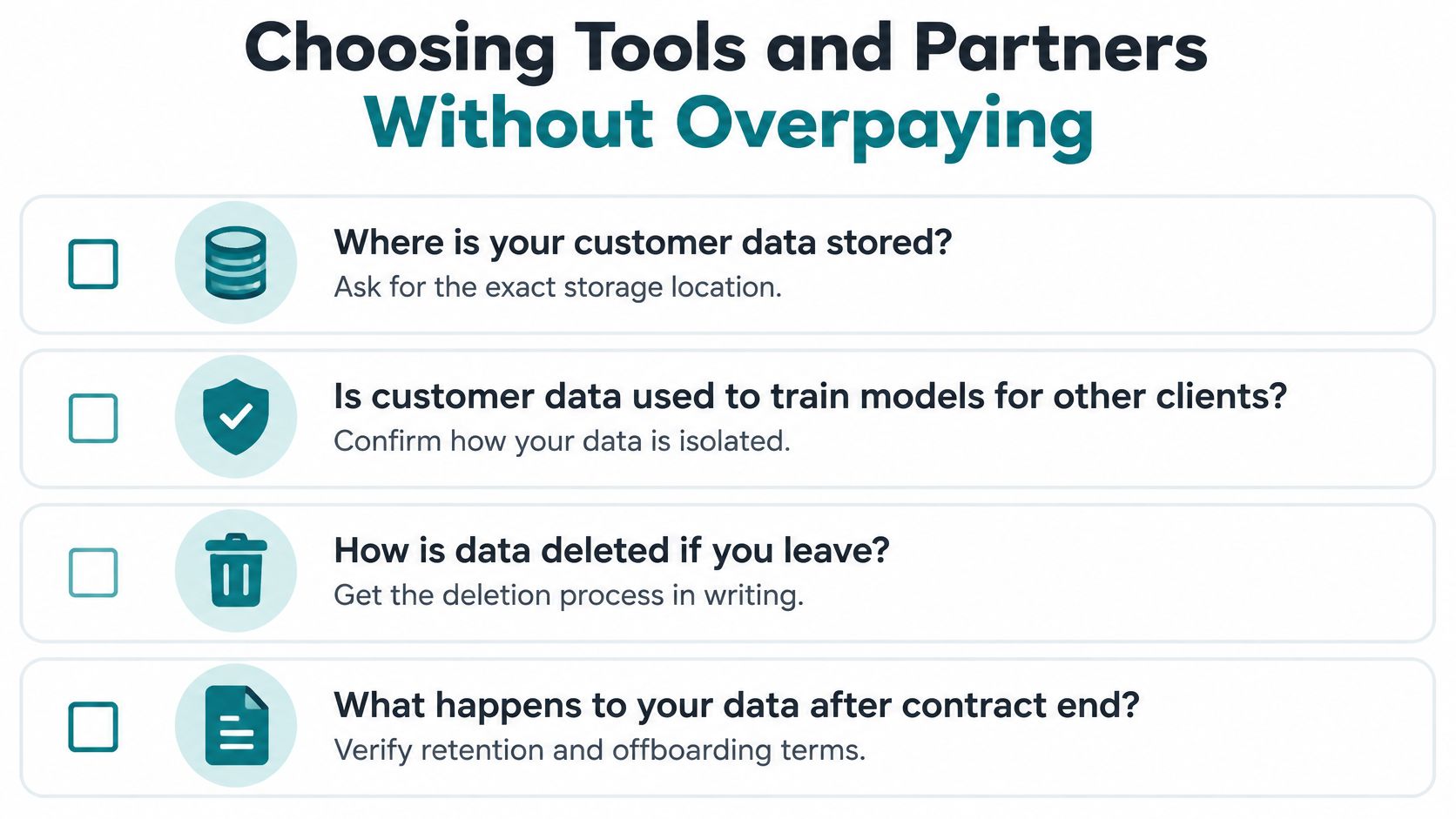
A 2026 Southeast Asian marketing study found that 57% of organizations had reached advanced AI adoption, while scaled integration, talent, and risk governance remained the larger gaps. In a separate 2026 survey covered in that report, only 13% of marketers described their first-party data as extensive and well structured, 50% considered AI's brand-safety and misinformation risk significant, and 83.7% believed AI should be regulated. Ask what data is permitted, which claims need review, and how a customer can challenge an automated decision.
| Question to ask | Good answer | Red flag |
|---|---|---|
| Where is my customer data stored? | Named location with a written data-processing agreement | Vague answer or refusal to put it in writing |
| Is my data used to train models for other clients? | No, or a written opt-out | Unclear answer or no answer |
| How is my data deleted if I leave? | Defined deletion timeline and data export | No exit terms |
| Can someone see why a lead scored high? | Plain-language reasons for each score | Black-box scores only |
| Will you guarantee results? | Explains what will be measured and how | Guaranteed results or no measurement plan |
| Who maintains the system after launch? | Named owner and support hours | No owner after go-live |
Confirm the tool connects to your website platform, CRM, and email system without manual copying. Compare per-user, per-message, and usage pricing, and ask for a twelve-month total that includes setup and add-ons. Ask for references in your industry. A short tour of best AI marketing tools from Riff Analytics helps you see categories before a demo, and this roundup of AI tools for Ohio small businesses keeps the comparison local. Many teams keep an in-house owner and hire help only for setup. Helbling Digital Media is a Cincinnati-based agency, and the same checklist applies whichever provider you consider.
This short walkthrough shows how those vendor questions sound on a real call.
<iframe src="https://www.youtube.com/embed/a3u-z6P19-s" width="100%" height="400" frameborder="0" allowfullscreen></iframe>How to Launch Your First AI Marketing Project
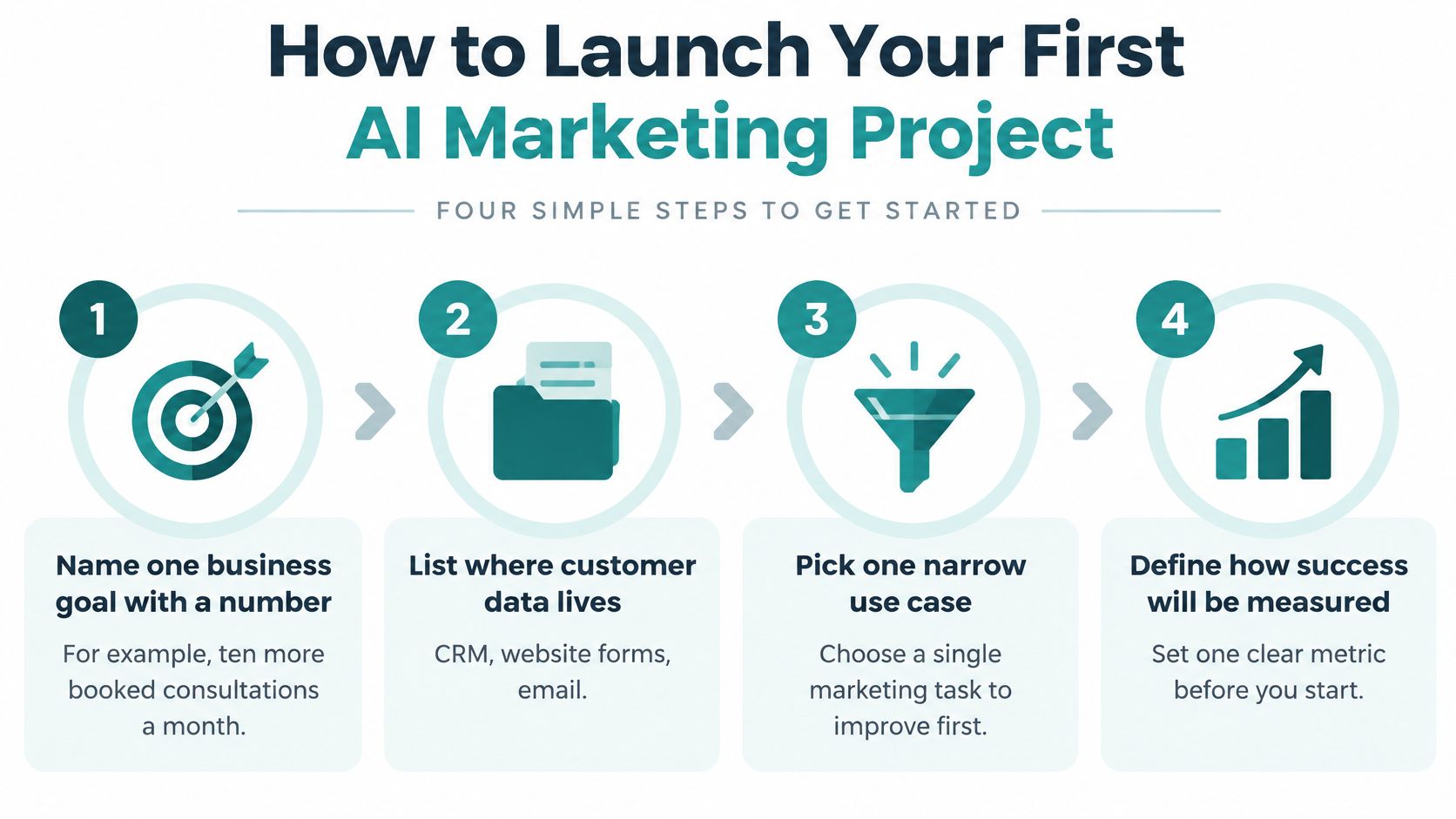
Adoption has run ahead of proof. In that 2026 Basis survey of 184 marketing and advertising professionals, 98.4% reported using generative or agentic AI, yet only 6.5% evaluated AI investments against defined metrics and benchmarks, and 65.1% either didn't measure AI return or didn't know whether their organization did. A separate 2026 survey in the same report found that only 41% of marketers could prove AI ROI, down from 49% the prior year. Start with a measurement design, not a tool menu.
-
Name one business goal with a number. Ten more booked consultations a month is a target you can judge. "Use AI more" isn't. The common slip is picking a tool before the number exists.
-
List where customer data lives. Check the CRM, website forms, email platform, and booking calendar. Confirm the records are clean and that customers agreed to this use. Look for duplicates, outdated phones, and blank fields before any model reads them. Skipping consent is the slip that creates problems later.
-
Choose one use case that touches that goal. Lead scoring or a reminder sequence is enough. Adding a chatbot and a new ad account in the same week means you won't know which change moved the number.
-
Record a baseline for four to six weeks. You need to see what normal looks like, including a holiday week or a slow season. Measuring only after launch hides the swing that was already coming.
-
Run a controlled test. Send the AI-supported treatment to most customers and withhold it from a holdout group. The slip is skipping the holdout because it feels like leaving money on the table.
-
Compare the groups on incremental results. That's the difference the workflow caused, not every conversion the tool touched. Tools claim credit for sales that would have happened anyway. Counting emails sent is activity, not impact.
-
Keep, adjust, or stop, and write down who approved the change. A workflow with impressive automation stats can still lose money. Stopping it is a valid outcome.
Any generated message needs a human review before it reaches a customer. Brand-safety mistakes in a price, a medical claim, or a legal promise cost more than a slow draft.
A solid pilot, after six to eight weeks, has a written baseline, a holdout, one owner, and a clear keep-or-stop decision tied to bookings, qualified leads, or cost per acquisition. Content volume and hours saved can sit in the notes. They don't decide the call.
Pick One Measurable AI Pilot This Quarter
Pick one bottleneck, one channel, one metric, and one six-to-eight-week window. Write the goal as a number. Define the holdout group before launch. Judge the result on incremental gains, not on total activity.
Your next action fits on one page, and you can finish it today. Write the business goal, the metric, the holdout rule, the test dates, and the person who will approve changes.
If you want an outside view before you commit, Helbling Digital Media can talk through that bottleneck and whether an AI workflow fits. We offer a free 30-minute strategy call, and a free AI visibility check that looks at whether your business is the answer when customers ask an AI assistant who to hire. Treat either conversation as a starting point, not a guarantee. The pilot above works without outside help.
Helbling Digital Media helps Greater Cincinnati businesses turn AI marketing into measured workflows, from lead follow-up and scheduling assistants to search and website work a person can still approve. If you want a second set of eyes on the one-page pilot you just wrote, visit Helbling Digital Media and book a free 30-minute strategy call or request the free AI visibility check.


