You're running a Cincinnati service business, and the workday keeps disappearing into tasks that don't directly serve customers. Someone exports a report, another employee follows up with leads, a manager checks appointment requests, and everyone spends too much time copying information between systems. You've tried a chatbot or generative AI tool, but it still feels like a collection of disconnected experiments rather than a dependable business process.
That gap explains why 76% of small business owners use AI in some capacity, while only 14% have fully integrated it into core operations, according to a 2026 survey summarized in an AI consulting guide. AI consulting helps close that gap by connecting practical tools to real business goals, including faster follow-ups, better reporting, safer data handling, and more consistent customer experiences.
For a Cincinnati-area owner evaluating SEO, web design, or digital marketing services, the important question isn't whether AI sounds impressive. It's whether a consultant can identify a useful first project, fit it into your existing systems, train your team, and measure the result. A Cincinnati-based agency such as HDM's AI services team can be one option to evaluate as you move from scattered tools toward a workable plan.

Understanding AI Consulting
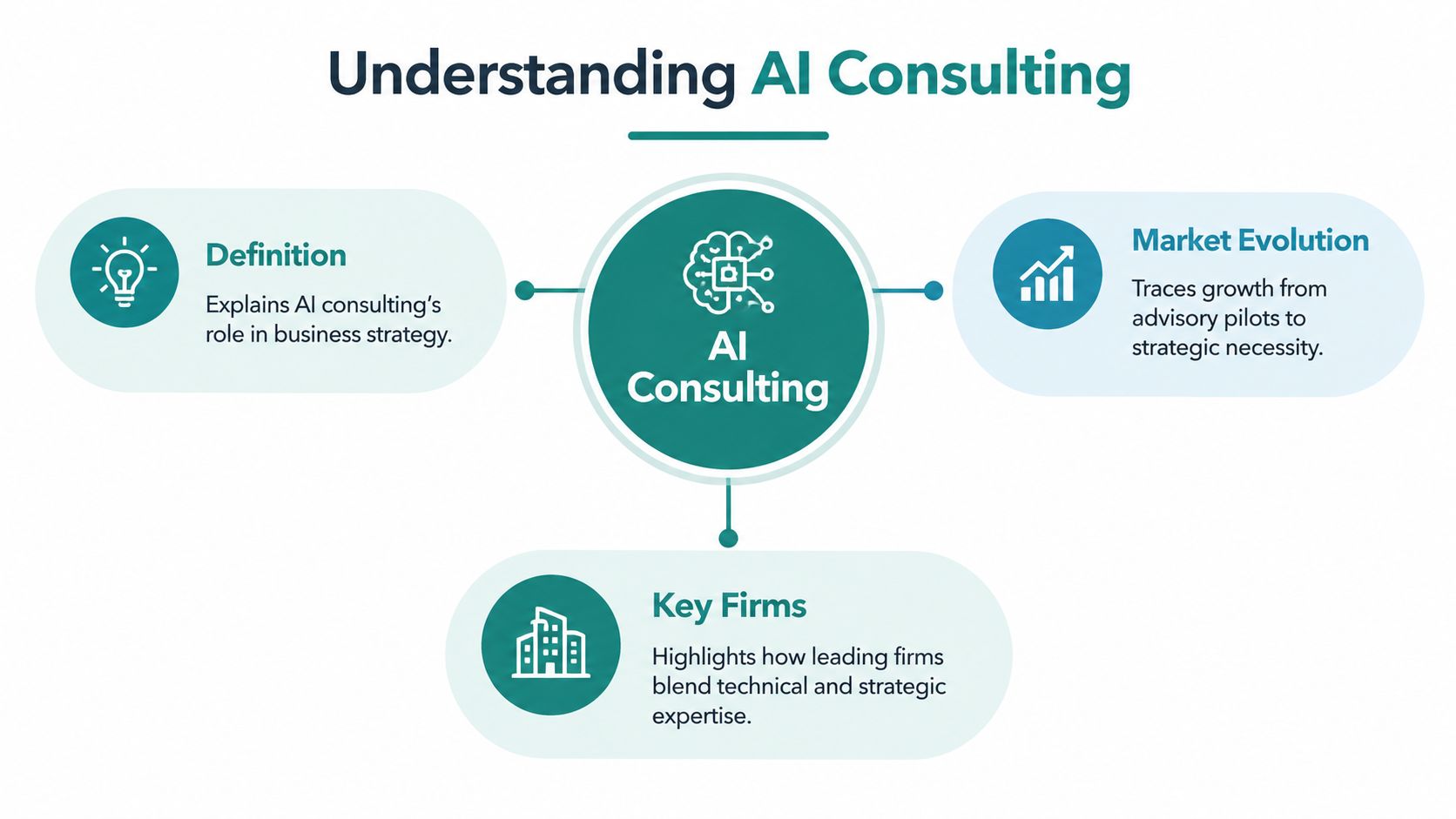
AI consulting is a specialized advisory and delivery service that connects artificial intelligence with business strategy. A consultant helps identify valuable use cases, evaluates organizational readiness, and creates an implementation roadmap. That work typically includes reviewing data quality, infrastructure, governance, and change-management constraints before recommending a model or tool, as described in The Hackett Group's AI consulting glossary.
For a small business, this may mean examining how leads enter your CRM, how staff answer common questions, or how managers prepare weekly reports. The consultant then decides whether automation, a chatbot, a reporting workflow, or a different digital improvement makes practical sense. The model itself is only one part of the solution.
The market's growth shows how the role has changed. The global AI consulting market was valued at $11.3 billion in 2023 and is projected to reach $73.01 billion by 2032, reflecting a 23.1% CAGR, according to industry market data. Those figures describe a shift from niche advisory work toward a normal part of digital transformation.
For an owner, the takeaway is simple: don't hire a consultant merely to "add AI." Hire one to improve a defined process, protect sensitive information, and create a roadmap your team can operate.
Core Services of AI Consulting
AI consulting usually becomes easier to understand when you view it through three practical services. Each solves a different type of business problem.
Workflow automation
Workflow automation is like installing a self-service station for repetitive internal work. Instead of asking an employee to move information manually from a web form into a spreadsheet, a consultant can connect the systems so the process runs with defined rules and human review.
Examples include:
- Lead handling: A website inquiry can be categorized, assigned, and acknowledged automatically.
- Email triage: Messages can be sorted by topic so urgent requests reach the right person.
- Reporting: Data from website analytics, advertising platforms, and sales tools can be organized into a recurring report.
- Administrative tasks: Invoices, appointment reminders, and status updates can follow a consistent workflow.
HDM describes this type of work through its workflow automation solutions. The right design depends on your existing website, CRM, forms, accounting platform, and staff responsibilities.

Chatbots and virtual assistants
A chatbot acts like a receptionist who handles routine questions at any hour. It can explain services, direct visitors to the correct page, collect basic information, or help a customer begin a request. A virtual assistant may support employees instead, helping them find approved information or prepare a draft response.
The important safeguard is a clear handoff. A bot should know when a question requires a person, especially when the customer is discussing a complaint, a medical concern, a legal matter, or a payment issue.
Data insights
Data insights turn scattered records into decisions. A consultant might organize sales figures, website behavior, search performance, and customer feedback so you can see which services attract attention and where prospects stop moving forward.
AI tools also create operating costs, especially when teams use multiple models or process large amounts of information. Businesses comparing options can review guidance on optimizing large language model costs before committing to a complex setup.
Business Benefits and Measuring ROI
The business case for AI consulting should begin with an operational problem, not a fascination with technology. If staff spend too much time preparing reports, answering repetitive questions, or checking the same records, the first project should target that bottleneck.
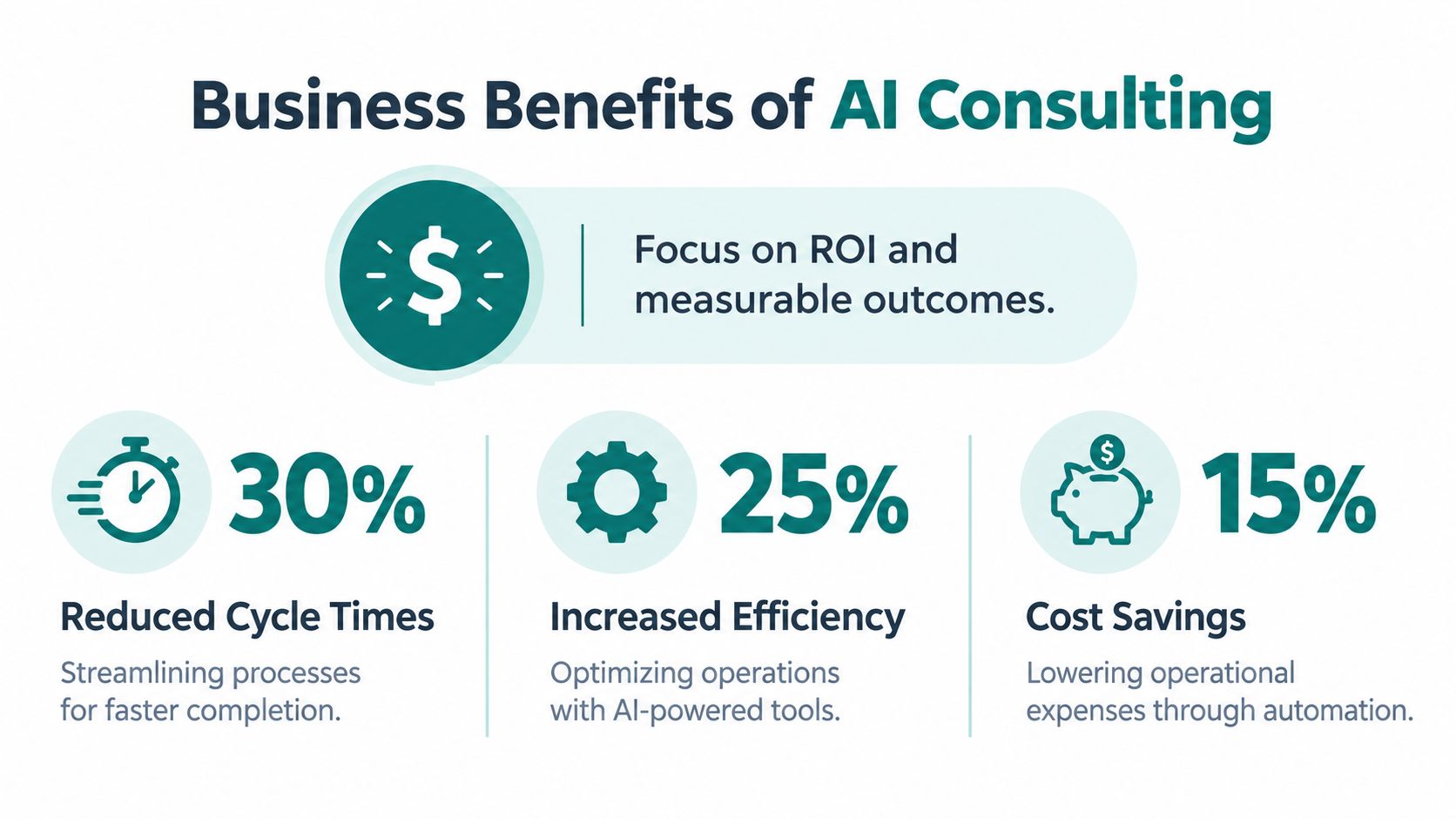
Industry guidance describes AI consulting engagements as outcome-focused, with ROI tracked through cost savings, revenue growth, faster decisions, or reduced risk, as explained by Synvestable's AI consulting guidance.
Start with a baseline. Record how long a task takes, how often errors occur, how quickly leads receive responses, or how many customer questions employees answer manually. After implementation, compare the same measure under similar conditions.
Useful measures include:
- Time saved: Compare staff hours spent on a task before and after automation.
- Response speed: Track how quickly a new inquiry receives an appropriate reply.
- Error reduction: Count corrections required in reports, records, or handoffs.
- Revenue contribution: Connect qualified leads or completed sales to the improved workflow.
- Risk control: Document approvals, review steps, and exceptions that the old process didn't capture.
A basic ROI calculation is: ROI = (financial benefit minus project cost) divided by project cost.
Don't force every benefit into a dollar figure immediately. Faster decisions, fewer missed inquiries, and clearer accountability can justify a project even when the financial effect develops over time. If your marketing team needs to connect customer behavior with sales opportunities, resources on how to turn customer data into revenue can help shape the measurement plan.
Industry-Specific AI Consulting Use Cases
AI consulting looks different in a healthcare practice than it does in a law firm or online store. The same general technology may appear in each setting, but the data, approval process, and acceptable level of automation change substantially.
Healthcare
A healthcare organization might want a patient-intake assistant that answers general questions, collects non-sensitive preliminary details, and routes requests to staff. A consultant should design the experience around HIPAA-aware handling, access controls, auditability, and human review. The assistant shouldn't diagnose conditions or make clinical decisions because it can generate fluent language.
For a healthcare website, the project may also involve improving appointment requests, directing patients to approved resources, and ensuring staff can review an interaction before action is taken.
Legal services
A law firm may have large volumes of documents, intake forms, and recurring correspondence. AI can help organize materials, identify passages for attorney review, or prepare a first draft from approved information. The attorney remains responsible for legal judgment, confidentiality, and the final work product.
A vendor should explain how client data is stored, who can access it, and whether the system uses submitted information for other purposes.
E-commerce
An online retailer can use AI to classify product questions, summarize customer feedback, or support personalized recommendations. The consultant first needs clean product data, consistent categories, and a clear definition of what "relevant" means for the customer.
Paid media teams may also benefit from practical guidance on optimizing Google Ads with AI for SMBs, particularly when campaign automation needs to remain tied to business goals rather than unchecked spending.
Agencies and professional services
Marketing agencies can use AI to assemble campaign reports, surface unusual performance changes, or create client-ready summaries that account managers review before delivery. Demand for industry-specific and compliant solutions is growing: professional services firms' AI adoption rose from 31.4% in late 2024 to 43.4% by late 2025, according to UK government reporting.
Engagement Roadmap for AI Consulting Projects
A sound engagement should feel like a managed business project, not an open-ended technology experiment. You should know what happens first, what your team must provide, and how the consultant will decide whether to continue.
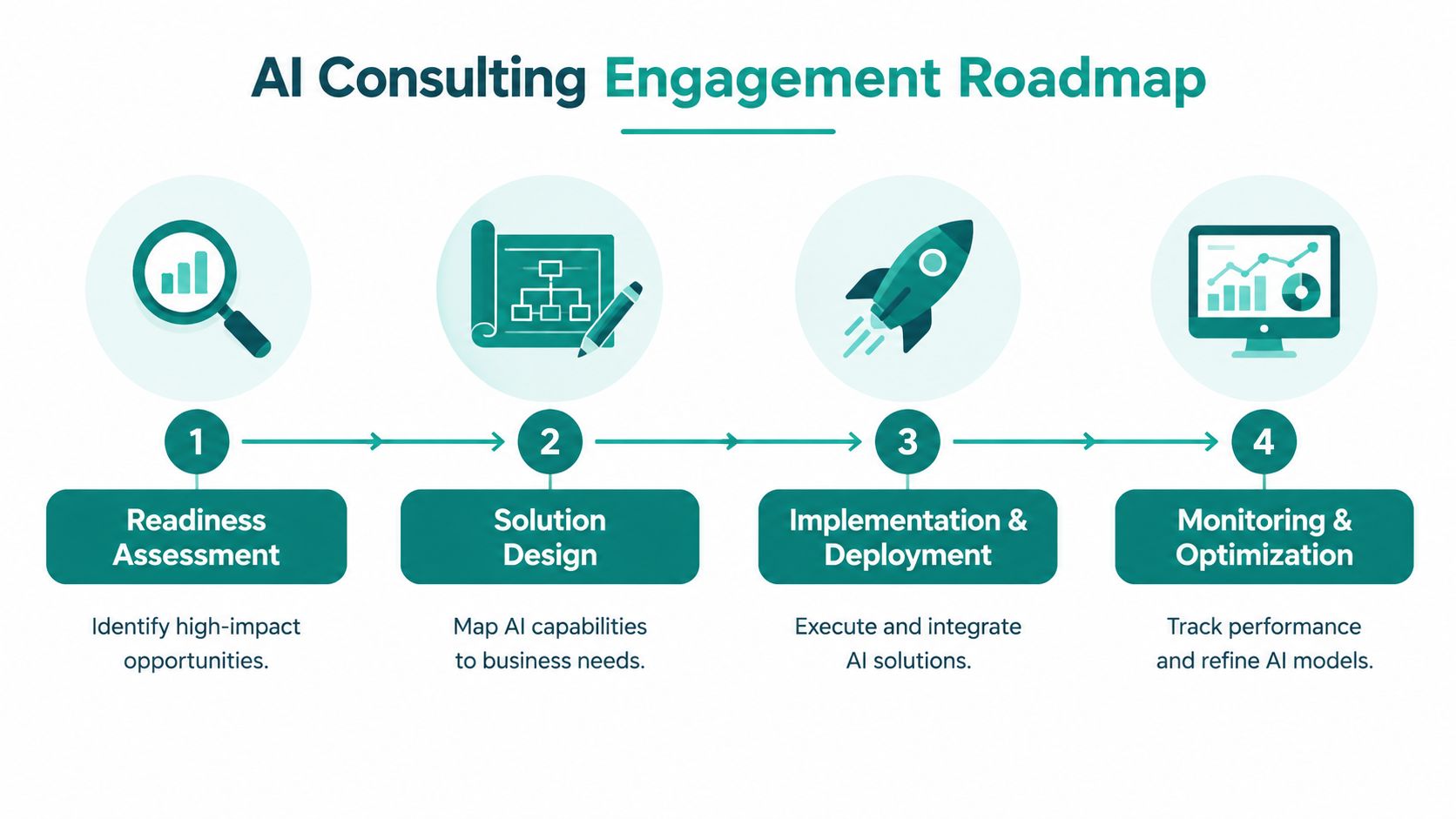
Readiness assessment
The consultant reviews your goals, systems, data, workflows, and constraints. You should receive a prioritized list of opportunities, a risk summary, and a recommendation for a manageable first project.
Include the people who perform the work every day. A manager may describe the desired outcome, while an employee can identify the exception that would break the proposed automation.
Solution design
The next phase maps the chosen AI capability to a specific process. The deliverable may include a workflow diagram, tool recommendations, data requirements, access rules, human approval points, and success measures.
Practical rule: If nobody can explain where the AI starts, where a person reviews it, and what happens when it fails, the design isn't ready.
Implementation and deployment
The consultant configures or develops the solution, connects it to your systems, tests ordinary and unusual scenarios, and launches it with limited exposure. A pilot gives your staff a chance to find problems before the workflow becomes central to daily operations.
Keep ownership clear. Someone at your company should approve content, verify business rules, and decide when the tool is ready for broader use.
Monitoring and optimization
Deployment isn't the finish line. Review accuracy, usage, handoff rates, customer feedback, and operating cost. Update prompts, rules, source content, or integrations as the business changes.
Cincinnati and Dayton businesses can also use this AI implementation roadmap as a planning reference when discussing milestones with a local or remote provider.
Pricing Models and How to Vet Vendors
AI consulting prices vary because the work can range from a short readiness review to a custom system integrated with several business platforms. One industry guide says readiness assessments can start around $2,000, while initial small-business engagements typically range from $10,000 to $50,000. Full custom implementations may reach $150,000, depending on scope, according to small-business AI consulting pricing guidance.
| Pricing Model | Price Range | Best For | What You Get |
|---|---|---|---|
| Readiness assessment | Starting around $2,000 | Owners uncertain where to begin | Workflow review, opportunity ranking, risk considerations, and an initial roadmap |
| Scoped project | $10,000 to $50,000 for initial projects | A defined automation, assistant, or insight workflow | Design, configuration or development, testing, launch, and handoff |
| Full custom implementation | Up to $150,000 | Organizations needing broader integration | Custom development, multiple systems, governance support, training, and ongoing refinement |
Ask each vendor questions that reveal how they work:
- Business fit: Which process would you improve first, and why?
- Data governance: What information must never enter a public AI model?
- Human review: Which outputs require employee approval?
- Security: How are credentials, access permissions, and stored data managed?
- Experience: Can the team explain similar workflow, healthcare, legal, or e-commerce requirements without exposing confidential client information?
- Ownership: Who owns the prompts, documentation, integrations, and finished work?
- Support: What happens when a tool changes, an integration fails, or output quality declines?
- Measurement: Which baseline will you record, and when will you evaluate results?
A written policy should define approved tools, prohibited data, review requirements, exceptions, and compliance evidence. Practical governance guidance recommends barring sensitive information such as PII, PHI, financial records, student data, and proprietary material from public AI models, as outlined in this business AI governance framework.
Conclusion with Actionable Next Steps
AI consulting means applying the right AI capability to a defined business problem, in a sequence your people can manage. For a Cincinnati SMB, that may start with lead follow-up or reporting rather than a company-wide transformation. For a regulated organization, governance and human review may matter more than the speed of deployment.
Use this starting checklist:
- General SMB: Audit one repetitive workflow, document the current handoffs, choose a low-risk pilot, and define the baseline measure. Bring the findings to a consultant for a readiness discussion.
- Law firm: List document-heavy processes, separate administrative review from legal judgment, identify confidentiality requirements, and select one narrow workflow for controlled testing.
- E-commerce retailer: Organize product and customer data, identify common questions or recommendation gaps, establish approval rules, and connect the pilot to customer experience or sales measures.
- Marketing agency: Map how campaign data moves into client reports, identify repetitive analysis, define account-manager review points, and scope a reporting dashboard that preserves human interpretation.
Give your team time to test the process and report exceptions. A useful consultant won't just demonstrate a tool. They'll help you decide what to automate, what to leave with people, how to protect information, and how to determine whether the investment created business value.
HDM offers AI consulting for workflow automation, chatbots and assistants, and data insights, alongside web development, SEO, analytics, and digital marketing support. Visit HDM to discuss a practical AI roadmap for your Cincinnati-area business.