


Say it's 7:40 p.m., and your Cincinnati roofing company gets a website form from a homeowner who wants the roof checked before the next storm. You're finishing a job, your office is closed, and that message lands beside a vendor pitch and an incomplete estimate request. You don't need more names in an inbox. You need the right inquiry to reach the right person while there's still a chance to help.
What AI Lead Qualification Does After the Form
AI lead qualification is the automated work between a submitted form and a returned call: the tool reads the inquiry, checks whether it fits your services, asks for the details the form missed, and recommends who should respond. Where reliable job history exists, it can compare the request with past inquiries that turned into booked work. Its job ends at a recommended handoff, because the sales conversation still belongs to a person.
A qualification tool works like a front-desk helper who never clocks out. It sorts the pile, flags the urgent request, and gets a person's attention. It never inspects the roof, commits to an appointment nobody can honor, or closes the sale on its own.
Speed first, score second
Speed deserves attention before you buy a scoring tool. The first hour after a form arrives is when contact odds run highest, and they fall the longer the message sits.
"Qualified" means a meaningful conversation with someone who can say yes or no. An automated acknowledgment alone does not produce one. It buys time for a person to make that attempt while the homeowner is still comparing contractors.
For the roofing inquiry, a useful setup would:
- Acknowledge the request: Confirm receipt without promising availability.
- Fill the important gaps: Ask a few short questions about location, timing, or contact preference.
- Assign the next action: Alert the estimator responsible for that service area.
Make the handoff visible
Buying more ads adds names to the pile. Qualification works on the names already there, deciding which need a fast conversation and which can wait until morning.
For an owner evaluating web design or SEO, lead-generation website design should account for what happens after submission just as much as the form's appearance. A useful implementation resource covers how to connect qualification scores to your CRM, your customer relationship management system, so the recommendation reaches a working sales queue instead of dying in a shared inbox.
The deliverable is a controlled handoff: clean signals, clear routing, a named responder, and a record of what happened next. When any one of those pieces is missing, even a fast score leaves the lead on the floor.
How a Score Decides Who Gets the Call
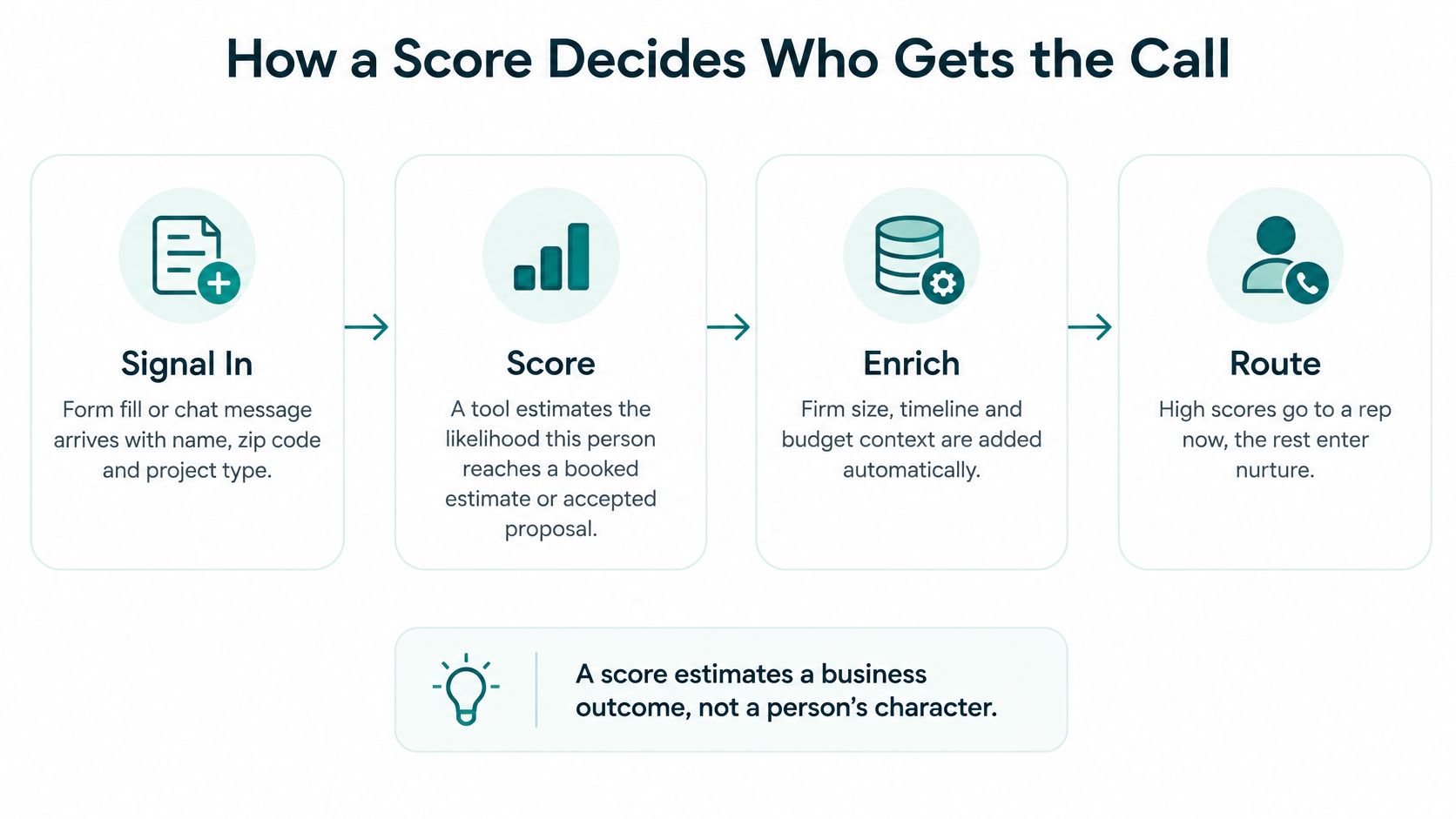
A lead score estimates whether an inquiry will reach a defined business result, such as a booked estimate or an accepted proposal. It isn't a judgment of someone's character, seriousness, or ability to become a valuable customer later.
Modern tools build on established methods. A 2024 review of 44 academic studies summarized by Boostideal identified decision trees and logistic regression among the most commonly used lead-scoring methods. Logistic regression estimates the chance of a target action; a decision tree follows a chain of conditions, such as whether the service and location fit.
The practical sequence looks like this:
Give the tool useful inputs
Start with information your team can recognize and maintain: service requested, location, source, project size or budget if offered, recent replies, and whether comparable past inquiries became paying work. For business-to-business sales, company size and service needs can add context.
Don't confuse a ranking with a precise probability. A high score may mean call this inquiry before the others. Ask what the score predicts and what the salesperson should do differently because of it.
Lead signals, priority, and who should respond
| Signal | What it usually means | Priority | Next action |
|---|---|---|---|
| Service and location both fit | They want work you do, in or near Cincinnati | High | Alert the owner or closest estimator within the hour |
| Budget or project size fits typical jobs | The request matches work you want more of | High or medium | Put it on today's sales queue with a short talk track |
| Clear urgency | Storm damage, a deadline, or language like this week | High even if details are thin | Send an immediate alert, not a nurture email |
| Repeat engagement | Pricing page, second visit, or an email reply | Raises a medium lead | Call the same day |
| Strong source | Referral, past customer, or a local search visit | Use with fit, never alone | Tag the source in the CRM for later review |
| Poor fit | Outside the service area, student research, or a vendor pitch | Low | Send a polite reply and spend no sales time |
| Missing contact details | No phone, or only a vague request for info | Hold | Ask for phone, timeline, and preferred contact method |
Turn priority into a specific action
An urgent, in-area roofing request should page the on-call estimator during the same hour. The alert needs the message, service location, contact details, and reason for priority. Sending only a score forces the estimator to reconstruct the inquiry.
A clear vendor pitch or confirmed out-of-area request gets a polite response without an estimator making a trip. But uncertainty isn't the same as poor fit. A thin inquiry belongs on hold for clarification, not in a discarded folder.
The owner sets the cutoff based on today's capacity. If the team can't call everyone promptly, the score recommends the order. Someone still needs responsibility for the remaining queue, so medium-priority inquiries don't become permanently unattended.
Two Local Inquiries From Message to Follow-Up
Consider a West Chester homeowner submitting a roofing form from a phone. The ZIP code fits the company's service area, the message mentions storm damage, and the homeowner attaches photos and asks for an inspection this week.
The automated helper identifies itself, confirms receipt, and asks for the best callback number and whether anyone will be home. It doesn't repeat questions the homeowner already answered or claim that photos establish the condition of the roof.
The urgent request reaches an estimator
The estimator receives the original message and a short summary identifying service fit, location, and urgency. The next human action is clear: attempt the callback and determine whether an inspection can be arranged.
Later, the owner checks minutes to the first human call attempt and whether that attempt became a meaningful conversation. The eventual invoice belongs in the business record, but it shouldn't conceal a slow or failed handoff.
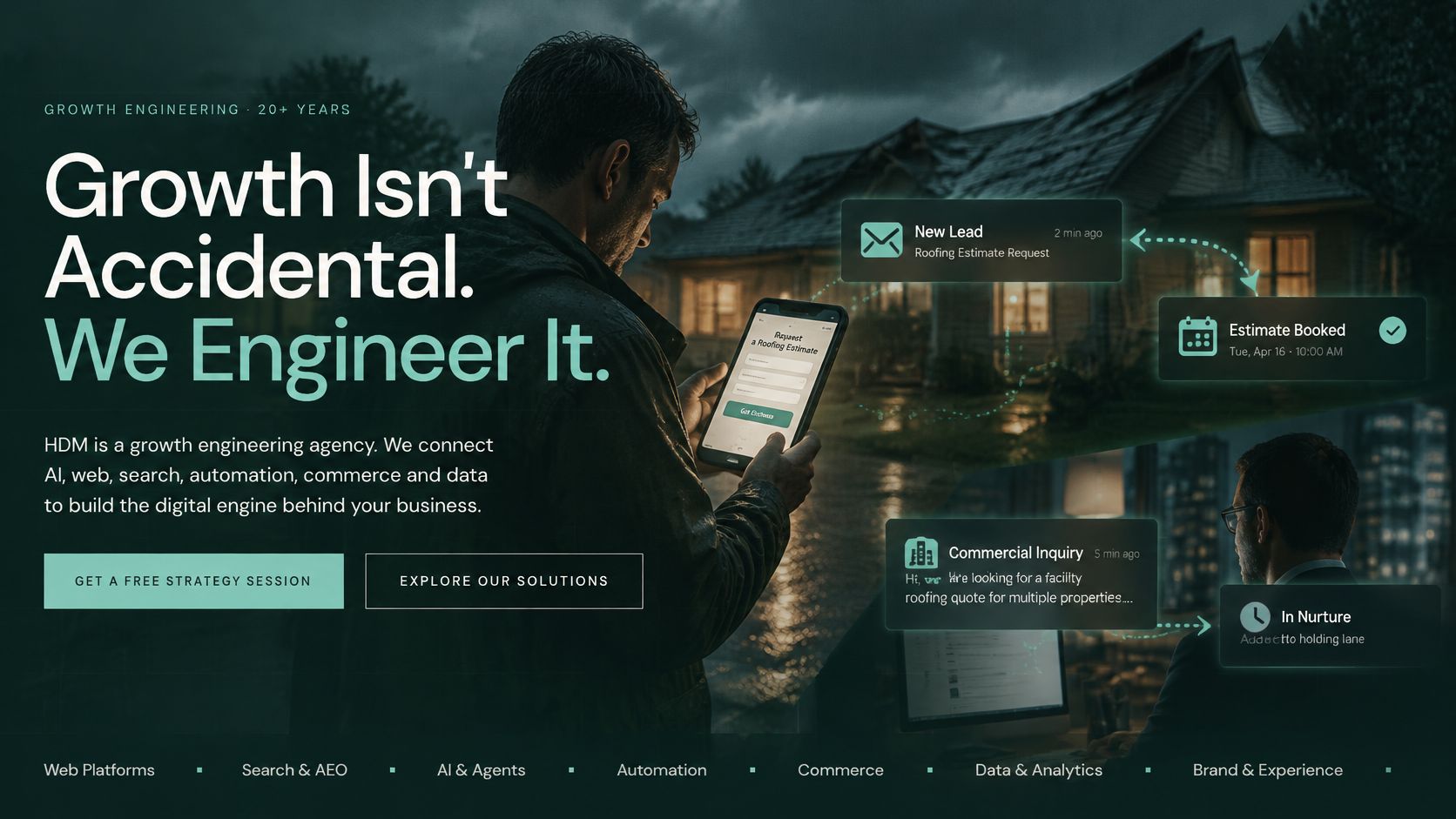
Connected workflows should make that chain visible without making the visitor work harder:
The unclear inquiry gets a question
Now consider a downtown professional-services inquiry asking about contract review. The sender leaves no budget, names several unrelated services, and uses a generic email address.
The system marks the inquiry medium priority or hold. A same-day note asks which matter is urgent and how the sender would prefer to speak with someone. It doesn't treat a missing budget as proof that the inquiry is worthless, and the score isn't a legal judgment about the matter.
The person responsible for intake reviews the reply. If the request falls outside the firm's services, that person can explain the boundary. If it fits, they can arrange the appropriate conversation without asking the visitor to disclose contract details in an open chat.
A referral takes a different path
A past customer's sibling might send only a short message and visit the website once. The referral tag keeps that inquiry visible even though its browsing history doesn't resemble a typical online buyer.
A Cincinnati firm such as Helbling Digital Media can help map the website form, alert, and response-time record into a coherent operating process. Well-defined marketing automation workflows make it easier to distinguish follow-up activity from the final sale.
After each inquiry, record service fit, urgency, source, and the human who owned the next step. Those details explain the decision more usefully than a score alone.
Checks That Show the Score Is Honest
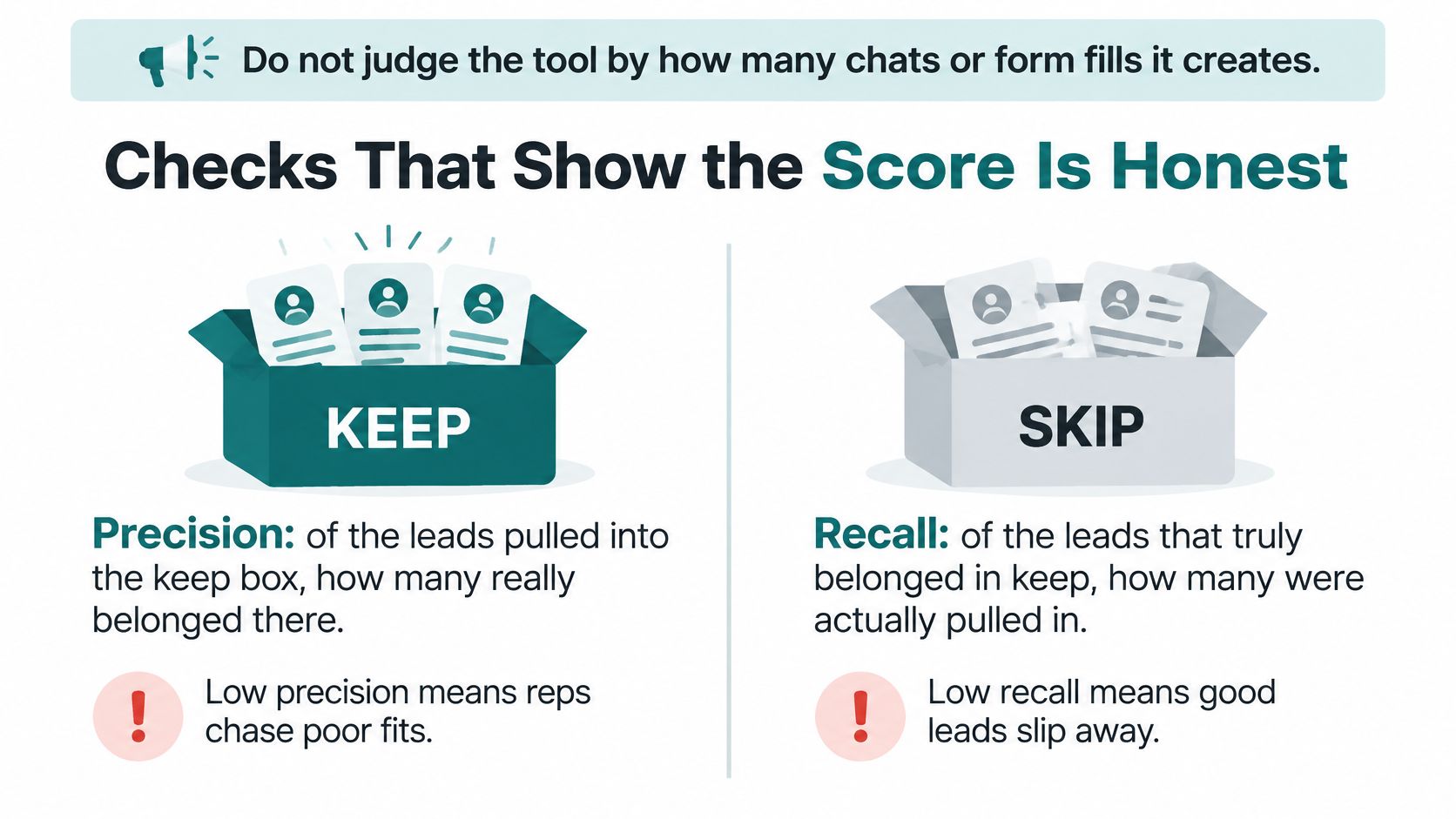
A score is only useful if the boxes it sorts into are honest. Lead qualification works like two labeled boxes, keep and skip. Precision asks how many inquiries placed in keep really belonged there. Recall asks how many of all the worthwhile inquiries the system managed to find.
Don't judge the tool by the number of chats it starts or forms it processes. A busy chatbot can still send poor fits to your estimator while a strong buyer sits unread in the skip box. Speed means little when the wrong leads are the ones moving fast.
The distinction is easier to see as a sorting exercise:
Use evidence without treating it as a promise
Compilations of AI lead generation research, such as the statistics gathered by Stealth Agents, describe research systems reporting strong precision and recall when distinguishing leads from non-leads. Results like these show the approach can work under controlled conditions.
They are not a performance promise for your Cincinnati business. Your service area, inquiry mix, record quality, and definition of a worthwhile lead all shape the outcome. A term you will see in vendor materials, F1, combines precision and recall into a single figure that balances both kinds of error.
A false positive is a poor fit marked worth pursuing, which consumes sales time. A false negative is a good prospect scored too low, which can leave valuable work untouched. The false negative is the quieter problem: nobody calls, nobody complains, and the job goes to whoever answered first.
Qualification checks an owner can review monthly
| Check | Plain meaning | Healthy sign | Warning sign |
|---|---|---|---|
| Precision | Of leads marked worth a call, how many were real fits | Most hot leads become useful conversations | The daily queue is mostly junk |
| Recall | Of real buyers, how many the system surfaced | Few won jobs began in the low pile | Good customers appear only after they call back |
| False positives | Sales time spent on poor fits | Occasional mismatches | Repeated wasted appointments |
| False negatives | Good buyers scored too low | A weekly sample of cold leads looks correctly cold | Referrals and unusual jobs are ignored |
| Time to contact | Minutes from inquiry to a human attempt | High-priority leads are attempted inside an hour | New forms sit until the next day |
| Tied outcome | Whether the score matches booked work | Higher scores book more often | Confident scores do not match revenue |
Check the queue your team can actually work
Review these checks monthly against booked conversations, not clicks. If your team can only work the highest-priority slice, examine how many of those inquiries became useful conversations and whether later wins appeared among records originally marked cold.
The cold pile deserves a scheduled look, not a hunch. Have a person sample a handful of skipped inquiries each month and call or email two or three of them. When those leads turn out to be real buyers, the scoring rules or the data feeding them need attention, and that adjustment is the handoff working as designed.
For a visual explanation to discuss with the person managing your setup:
<iframe width="100%" style="aspect-ratio: 16 / 9;" src="https://www.youtube.com/embed/IVTEPl0K_Wc" frameborder="0" allow="autoplay; encrypted-media" allowfullscreen></iframe>Choose an outcome appropriate to the business: a booked consultation for a law firm or clinic, an accepted estimate for a trade, or a retained client for professional services.
Practical rule: A score with no tied outcome is only a label.
When a Low Score Still Needs a Person
The most expensive qualification error may be the buyer nobody calls. A referral, a property manager representing an owner, or an out-of-town buyer with a Cincinnati project might not resemble your usual website inquiry.
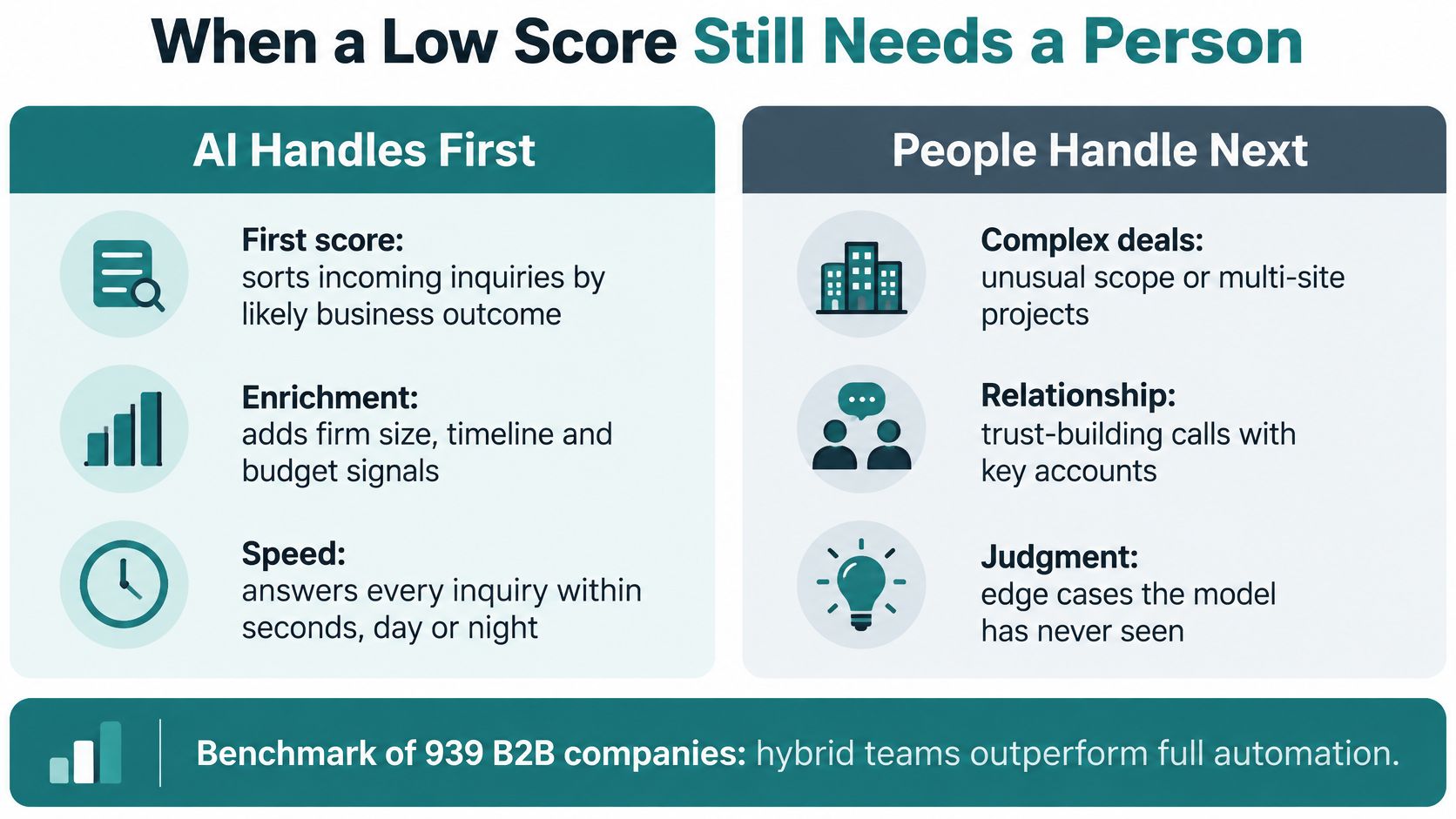
A benchmark covering 939 B2B companies described by Optifai reported that hybrid organizations commonly assign initial scoring and enrichment to AI while people handle complex relationships, with fully automated qualification remaining a minority approach; the same benchmark estimated that 20–30% of qualified leads may be misclassified as unqualified.
That estimate isn't a forecast for your local business. It is a reason to inspect the rejected pile, not just admire the speed of the accepted queue.
AI may sort the pile, but it should not be allowed to hide a lead the business would have wanted.
Define when automation stops
A clinic visitor who won't type private details into chat hasn't necessarily lost interest. A manufacturer asking about an unfamiliar application hasn't necessarily contacted the wrong supplier. Missing or unusual information should trigger judgment when the potential consequences justify it.
Use these handoff triggers:
- High job value: A substantial project deserves review even when the inquiry is sparse.
- Sensitive context: Healthcare or legal matters need an appropriate intake process.
- Conflicting answers: The stated location, service, and timeline don't agree.
- Unfamiliar work: A new industry or unusual scope falls outside familiar patterns.
- Unclear permission: A person needs to resolve whether and how contact is appropriate.
- Complex decisions: Several stakeholders are involved, or the system expresses low confidence.
The division of work should be deliberate:
Keep a path back to a person
Create separate lanes. High-confidence inquiries with ordinary service fit can route automatically. Borderline inquiries wait for representative review. Sensitive or confusing records go to a designated person rather than an automated rejection.
Document who reviews each lane and how they can override the recommendation. A system that flags uncertainty but assigns nobody to resolve it still leaves the visitor waiting.
Give cold inquiries a requalification path through a regular review of dismissed records and a human callback when the visitor requests one. The point isn't to automate every decision. It's to use automation where it helps while protecting relationships that need context.
Bad Records and Private Details That Skew Scores
A capable AI assistant working from bad records is like a sharp receptionist using a smudged appointment book. The assistant can follow the process correctly and still contact the wrong person or miss the reason someone reached out. Scoring only pays off when the record underneath it is clean.
More than 60% of respondents in a recent B2B commerce survey discussed by Salesforce identified poor data integration and data quality as primary barriers to realizing AI value. If that many businesses struggle to trust their own records, an owner feeding inquiries into a new assistant should assume the same problem lives in theirs and check before routing anything.
Clean the working record first
Duplicate contacts can make one person look like several prospects. An old phone number produces an immediate alert that leads nowhere. A missing source prevents you from knowing whether a referral, search visit, or paid ad produced the job.
Before automated routing, establish this minimum record standard:
- One usable identity: Merge duplicate person or company records.
- A contact method: Require a phone number or email address.
- Service and location: Give the system enough information to assess basic fit.
- Source: Preserve where the inquiry came from, including referrals.
- Freshness: Store a last-updated date and flag stale details.
Reliable CRM system integration preserves these fields between the website, sales records, and reporting. A dropped connector can turn missing information into a low-priority judgment, and that is how a real buyer gets scored like spam. When a field disappears, the person reviewing borderline inquiries is what catches the good lead the model just buried.
Keep the first exchange narrow
The NIST Generative AI Profile identifies privacy concerns involving personal information, transparency, participation or consent, and purpose specification. Translated into plain operating rules: disclose the automated assistant, explain why it asks a question, collect only what routing requires, offer human contact, and establish transcript retention.
For clinics, law firms, and similar organizations, keep early questions focused on service type, location, urgency, and contact preference until security, contracts, and compliance requirements have been validated. A qualification chat shouldn't become an invitation to submit medical records or confidential legal documents.
The Federal Trade Commission's guidance on privacy and confidentiality commitments warns against undisclosed uses of customer data, including model training. A privacy-policy sentence doesn't automatically fix an undisclosed change in use.
Have a qualified legal or compliance advisor review protected-information handling before sending it to a vendor. Your business remains responsible for the promises it makes.
Choose a Route and Run a Four-Week Trial
Choose the smallest implementation that solves your actual follow-up problem. If every inquiry already lives in your CRM, start there. If after-hours visitors need help reaching someone, an assistant may be more useful than another dashboard.
Three ways to run AI lead qualification
| Route | What it involves | Best for | What it demands from you |
|---|---|---|---|
| Native CRM scoring | Rules and predictive scoring options inside HubSpot, Salesforce, or GoHighLevel, subject to the available plan and configuration | A team that already logs every inquiry in one system | Setup hours and clean, complete fields |
| Website assistant | An on-page helper that says it is automated, asks three qualifying questions, and books a call | After-hours form traffic and a one-person front desk | A monthly tool fee, question copy, and testing |
| Managed build | An agency connects website forms, CRM records, alerts, and a response-time report | An owner with no in-house marketing operations | A one-time build plus ongoing support |
Qualification also needs a boundary. A contractor evaluating Exayard AI-powered takeoff and estimating is considering a different part of the workflow: preparing the estimate after the inquiry reaches the right person. Don't mistake estimating assistance for intake, prioritization, or callback ownership.
Run a limited trial
Use a four-week trial as a practical operating test, not a promise of statistically conclusive results.
- Week one: Define a qualified conversation and name the person responsible for the first callback. Save the preceding four weeks of response-time and conversation records as your comparison.
- Week two: Select a route from the table and test it with urgent, incomplete, poor-fit, and referral scenarios.
- Week three: Enable alerts for the clearest high-fit inquiries. Keep the broader queue under human review.
- Week four: On day 28, compare first-call minutes and booked conversations with the preceding period. Check unusual-but-good inquiries separately.
At Helbling Digital Media, a Greater Cincinnati agency based in Springboro, our Lead Generation & Scoring includes form abandonment recovery, lead quality scoring, CRM sync with HubSpot, Salesforce and GHL, and routing with alerts. Our AI Chat & Online Scheduling uses a custom-trained agent that answers questions, qualifies prospects, and books calls 24/7.
Keep the setup if promising inquiries reached a person faster and unusual buyers still received attention. Change the rules if the queue filled with poor fits or worthwhile inquiries disappeared. Faster follow-up is a win only when the good, unusual leads still reach a person.
Helbling Digital Media offers a free strategy call to identify the first qualification rule worth implementing and the human handoff it should trigger. Visit Helbling Digital Media to discuss connecting your website inquiries, CRM records, and alerts without committing to a whole new platform before you know what needs fixing.