A visitor lands on your Cincinnati-area business website, asks a straightforward question, and receives a polished answer from your new chatbot. The launch feels successful. Then policies change, a service page gets rewritten, staff stop reviewing conversations, and the bot slowly becomes less useful. Nobody notices until customers begin abandoning the chat or calling your team with questions the bot should have handled.
That's the challenge in AI chatbot development. The initial build matters, but the business value comes from keeping the chatbot accurate, useful, secure, and connected to your operations after launch. For small and mid-sized businesses, the right question isn't "How quickly can we put a bot on the website?" It's "How will we manage this system through its first model change, knowledge update, and customer handoff?"

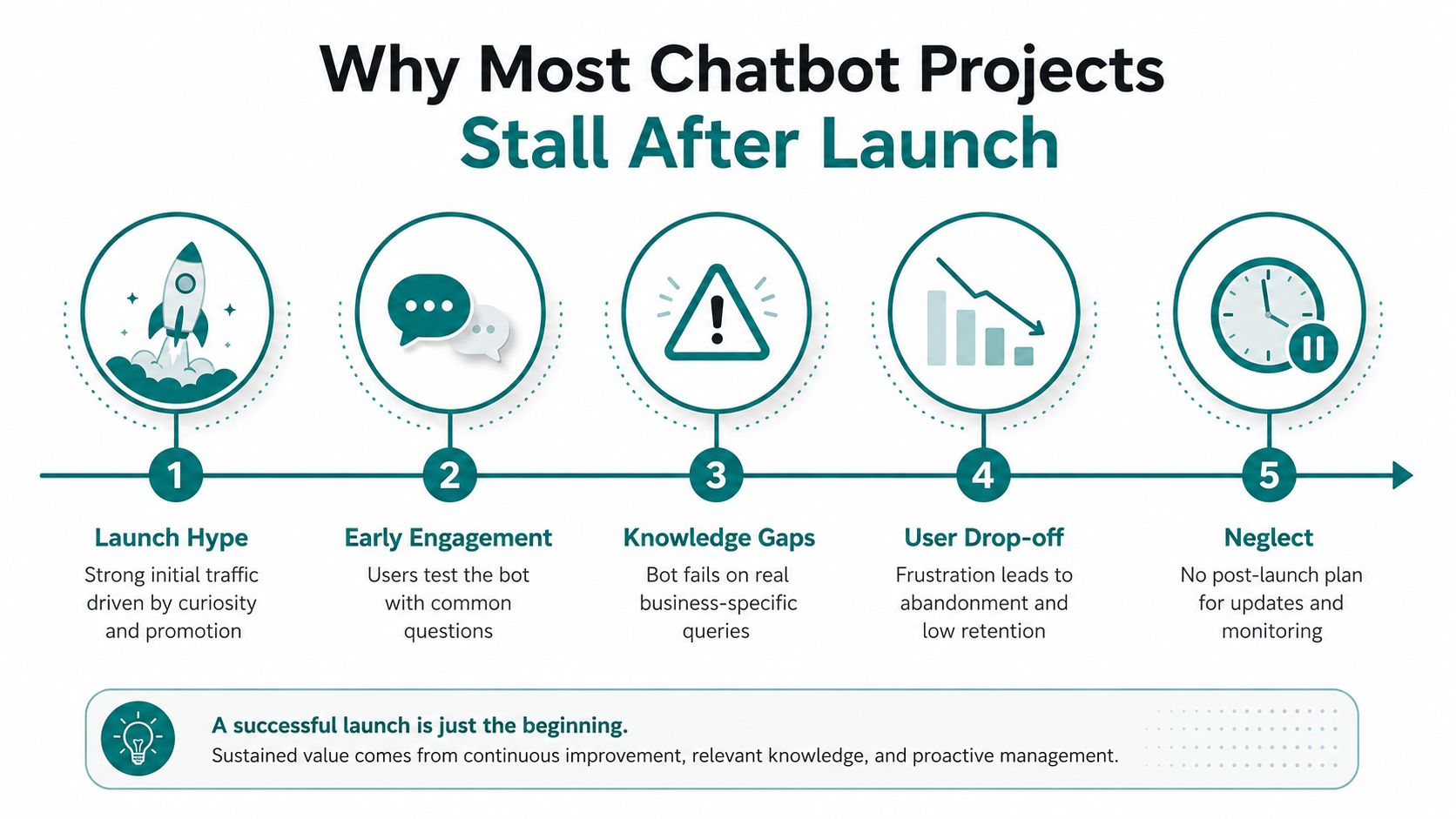
Why Most Chatbot Projects Stall After Launch
The most common failure pattern is predictable. A chatbot launches with curiosity and promotion, handles obvious questions, and earns positive internal reactions. Then the business stops treating it like an operating system and starts treating it like a finished website feature.
A regional law firm might spend six figures on a custom intake bot, see fifty conversations in its first week, and assume the hard part is over. Months later, practice policies change, intake requirements shift, and nobody reviews the transcripts. The bot still responds confidently, but its answers no longer reflect how the firm works. The problem isn't that the technology stopped functioning. The business stopped maintaining the knowledge and decisions behind it.
The market itself shows why this deserves lifecycle planning. One current estimate places the global conversational AI market at USD 17.97 billion in 2026, with a projection of USD 82.46 billion by 2034 at a 21.00% CAGR. Another report estimates USD 14.79 billion in 2025, followed by the same projected USD 17.97 billion in 2026 and USD 82.46 billion by 2034, reflecting the rapid expansion of chatbot infrastructure, natural-language understanding, and automated support systems (Fortune Business Insights on the conversational AI market).
The build is only one stage
The technical implementation is roughly a third of the practical work. The remaining effort includes:
- Knowledge maintenance: Updating policies, services, prices, schedules, and frequently asked questions.
- Prompt tuning: Adjusting instructions when the bot gives incomplete, overly broad, or poorly worded answers.
- Escalation design: Deciding when the bot should transfer a conversation to a person.
- Evaluation: Testing real customer questions instead of trusting a vendor demonstration.
- Model migration: Preparing for the next provider or model without rebuilding the entire application.
Modern chatbot history supports this shift. Early systems such as ELIZA and ALICE relied on basic scripted approaches, while current systems use large language models that generate context-aware responses. A historical review traces the field from foundational chatbot milestones in the 1960s and 1970s, and from basic statistical models dating to 1906, toward today's generative systems (historical review of chatbot development).
Practical rule: Measure success by retained usefulness, not launch-week excitement.
A durable plan covers strategy, architecture, business knowledge, consent, integrations, monitoring, and the first twelve months of operation. You should know who owns transcript review, how often content changes are published, what triggers a human handoff, and how the team will test a replacement model before the current one is retired.
Defining the Right Job for Your Chatbot
A chatbot with a vague mission becomes an expensive general-purpose search box. Start with the two or three jobs it must perform well, then refuse everything outside that scope.
For a Cincinnati service business, the initial jobs might include answering tier-one support questions, qualifying new leads, and scheduling consultations. A healthcare organization may limit the bot to appointment preparation and routing. A law firm may use it to collect preliminary information, while keeping legal advice, conflict checks, and sensitive case decisions with staff.
Define the audience by intent rather than demographics. An anonymous visitor needs a clear service explanation. An authenticated customer may need account-specific help. An internal employee may need access to procedures that shouldn't appear in a public chat. Those audiences require different permissions, knowledge sources, and escalation rules.
Use a written job charter
Before choosing a platform, circulate a one-page charter containing:
- Primary jobs: The tasks the bot owns from start to finish.
- Audience paths: Anonymous visitor, verified customer, or internal user.
- Human-only topics: Advice, regulated decisions, disputes, payment exceptions, or sensitive personal matters.
- Success measures: Deflection rate, escalation rate, qualified leads per week, and CSAT after handoff.
- Refusal behavior: The exact way the bot redirects an out-of-scope question.
- Owner: The person responsible for reviewing conversations and approving updates.
A useful scope exercise is to list real questions from sales emails, support tickets, and website searches. Place each question into one of three groups, answer automatically, collect information and escalate, or refer elsewhere. The third group protects the business from a bot that guesses because a user asked confidently.
| Job Category | In Scope Example | Out of Scope Example | Primary Metric |
|---|---|---|---|
| Customer support | Explain delivery, service areas, or account procedures | Approve an exception without staff review | Deflection rate |
| Lead qualification | Ask about service need, timing, and contact preference | Promise a contract term or final quote | Qualified leads per week |
| Scheduling | Offer available appointment times | Change a protected calendar event without confirmation | Completed bookings |
| Data requests | Explain how to submit a request | Reveal private customer information to an unverified user | Escalation accuracy |
If your team needs outside implementation help, review what to expect when you hire an AI chatbot developer. The useful question isn't whether a developer can connect a model to a chat window. It's whether they'll help your staff define ownership, evaluation, security, and post-launch maintenance before development begins.
Choosing the Right Architecture for Your Business
Most small and mid-sized businesses should start with a hosted large language model API and retrieval-augmented generation, commonly called RAG. RAG lets the application retrieve relevant passages from your approved business documents and provide them to the model at answer time. You can update the knowledge base without retraining the model, and you can replace the model behind a stable application interface.
A fine-tuned open-source model makes sense in narrower situations. Choose it when your organization needs a highly consistent tone, specialized terminology, or controlled behavior that prompting and retrieval don't provide. It also brings more responsibility for hosting, security, testing, updates, and model operations. Don't choose fine-tuning because it sounds more customized.
An off-the-shelf vendor platform with custom flows can be the practical choice when speed and simplicity matter more than deep control. These platforms often provide visual conversation builders, analytics, integrations, and handoff tools. The trade-off is dependence on the vendor's model choices, data handling, pricing, and roadmap.
| Architecture | Data Control | Time-to-Launch | Typical SMB Cost | Best Fit |
|---|---|---|---|---|
| Hosted LLM API with RAG | Strong control over business knowledge and retrieval layer | Moderate | Variable based on scope and usage | Most SMB support, sales, and service bots |
| Fine-tuned open-source model | High control if self-hosted | Longer | Higher engineering burden | Specialized language, consistent style, sensitive workloads |
| Vendor platform with custom flows | Depends on vendor terms and configuration | Fastest | Subscription plus implementation | Straightforward support and lead-routing use cases |
Make the choice with three questions
First, how sensitive is the data? Protected health information requires a healthcare-appropriate provider relationship and controls. For HIPAA workloads, use a BAA-covered endpoint and prevent protected information from reaching an unsuitable model provider in plaintext. SOC 2 requirements also demand a close review of access, logging, vendor controls, and change management.
Second, how deep are the integrations? A bot that only answers public questions has a lighter architecture than one that creates CRM records, schedules appointments, checks account details, and opens helpdesk tickets.
Third, who will operate it? A business without in-house engineering may benefit from a managed platform, while a company with strong technical capacity may prefer an API-based design that keeps the model replaceable.
Grounding Your Bot in Real Business Knowledge
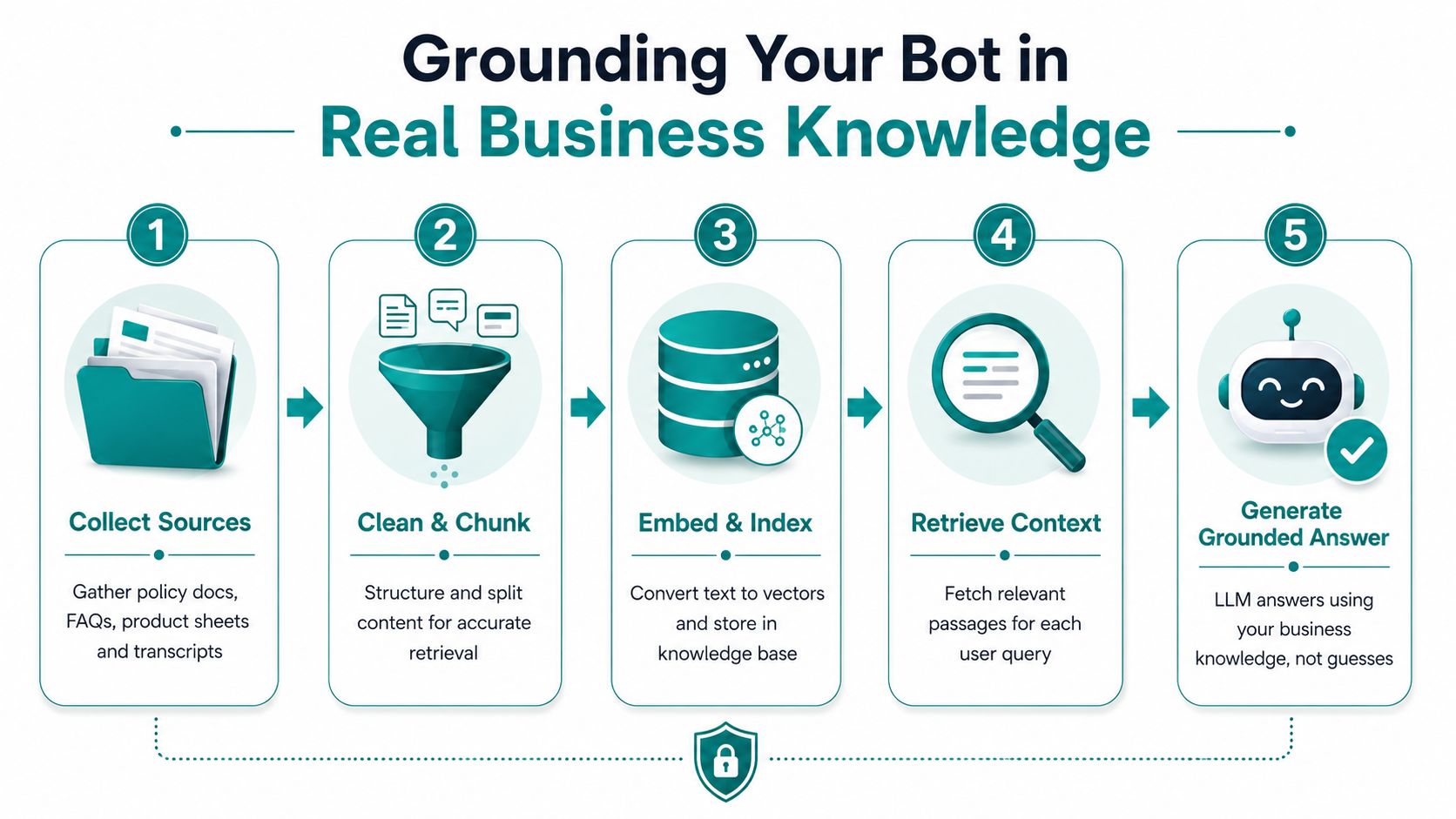
An LLM alone doesn't know your business. It can produce a fluent answer, but fluency isn't evidence. Your chatbot needs an approved knowledge layer containing policy documents, FAQs, product sheets, service descriptions, transcripts, and internal procedures that the application can retrieve for each question.
Start by cleaning the source material. Remove outdated pages, duplicate explanations, contradictory policies, and content written for internal audiences that shouldn't reach customers. Split documents by meaningful sections, such as cancellation policy or appointment preparation, rather than cutting text into arbitrary blocks. Convert those sections into embeddings, store them in a maintained vector database, and retrieve the most relevant passages for each query.
Test answers before customers do
Create a domain-grounded evaluation set before deployment. Start with 50 to 100 real customer questions with known correct answers, then expand it weekly with logged failures. The goal is to measure end-to-end accuracy and usefulness with business-specific questions, not to accept a vendor's demo as proof of quality. Research around end-to-end chatbot benchmarks and hallucination-focused evaluations, including HaluEval and HaluEval 2.0, shows why factuality needs testing across domains (EMNLP benchmark research).
Write system instructions that define:
- Role and scope: What the chatbot handles and what it refuses.
- Tone: How it should communicate with your customers.
- Escalation triggers: When it must transfer to a person.
- Evidence rules: When it must cite retrieved information or decline to answer.
- Privacy rules: What personal information it must not request or repeat.
Treat prompt text like production code. Version it, review changes, test every revision against the evaluation set, and keep the previous version available for rollback.
Hallucination control deserves special attention. One benchmark reports hallucinations in 31.4% of authentic LLM-human query-response pairs, increasing to 60.0% for difficult math and number tasks. Another medical benchmark found the best model's binary hallucination detection F1 as low as 0.625, showing that even strong models can struggle to identify unreliable content (hallucination benchmark research).
Use input filters for personal information and prompt injection, output filters for unsafe content, and confidence thresholds that route weak answers to a human queue. For practical guidance on organizing the source material behind this process, use HDM's resource on knowledge base creation.
Channels, Consent, and Core Integrations
Put the chatbot where customers already ask for help. For most local businesses, that means starting with a website widget, validating the text experience, and only then considering SMS, WhatsApp, or voice. A channel isn't valuable because it's available. It's valuable when the conversation helps a customer complete a meaningful task.
Consent belongs at the beginning of every conversation that may involve personal data. Tell users they're interacting with an AI system, link to the privacy notice, explain what information will be stored and for how long, and record a timestamped opt-in. Give users a way to continue without data collection when the task allows it. Practical compliance guidance recommends a consent gate, clear choices, and a visible privacy explanation before collecting personal information (chatbot GDPR compliance guidance).
Identity checks come before account data. Ask the user to verify an email address or phone number, then use an appropriate sign-in flow such as OAuth when the bot needs authenticated access. Don't let a conversational interface become an informal shortcut around your existing security controls.
Map integrations to specific intents
Each integration should support a defined job, not an open-ended promise that the bot can "connect to everything."
| Business Function | Required Integration | Data Boundary Note |
|---|---|---|
| Lead generation | CRM | Write only approved contact and qualification fields |
| Scheduling | Calendar | Require confirmation before booking or changing an appointment |
| Support | Helpdesk | Attach transcript, intent, and customer context to the ticket |
| Transactions | Payment processor | Keep card data outside the LLM conversation |
| Healthcare workflow | EHR or core system | Keep protected health information within approved boundaries |
For healthcare and finance, map data flows before building. Protected health information and card data shouldn't pass to the model provider in plaintext. Every channel also needs a human handoff path, with the transcript and relevant context attached to the live agent's ticket.
HDM describes related implementation options through its chatbot and AI assistant solutions. Whether you use an agency, internal staff, or a vendor platform, keep write actions narrow and require explicit confirmation before the system changes a record.
Deployment, Monitoring, and Planning for Model Changes
Deployment is the beginning of operations. Release the chatbot behind a feature flag, expose it to a limited audience, watch failures, and increase traffic only after the evidence supports expansion. Keep the previous version available so your team can roll back without rebuilding the service under pressure.
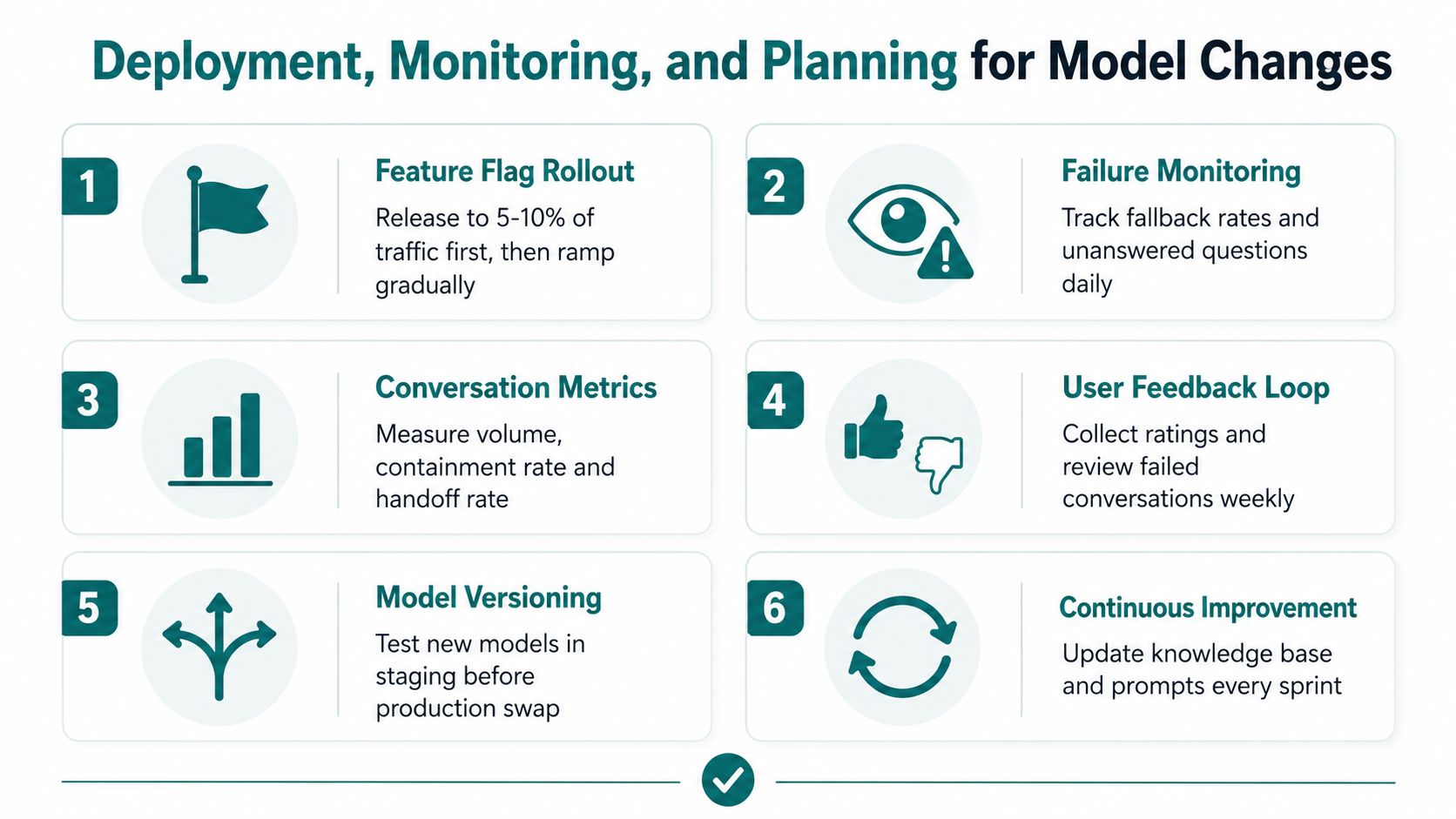
Track operational measures that explain customer experience:
- Conversation volume: How many people use the bot and which topics they bring.
- Containment rate: How often the bot resolves a request without escalation.
- Fallback rate: How often it says it can't help or fails to find relevant context.
- Escalation rate: How often customers need a person.
- Turns to resolution: Whether users reach an answer efficiently.
- Latency: Whether the bot responds quickly enough to retain attention.
- Cost per conversation: What each interaction costs to operate.
- User satisfaction: Ratings collected after an answer or handoff.
A dashboard isn't a monitoring strategy unless someone acts on the numbers. Set alert thresholds, assign an owner, and review a sample of conversations on a regular schedule. A business evaluating broader automated business performance monitoring should apply the same discipline here, connect signals to decisions rather than collecting metrics for display.
Build a model replacement routine
Run scheduled evaluations against your golden question set and a sampled portion of live conversations. Perform a weekly hallucination audit that checks whether answers are grounded, citations are accurate, and instructions are followed. When a user asks for a person, the topic is sensitive, or confidence is low, transfer the conversation with full context.
Abstract the model behind an interface so a provider swap becomes a configuration and testing exercise. Maintain a model registry that records which version serves each environment, freeze prompts during evaluation windows, and keep the previous model warm for rollback. Treat model replacement as ordinary maintenance, not an emergency.
Don't fine-tune until retrieval is mature and you have at least a few thousand labeled examples. Even then, treat the tuned model as a snapshot that needs refreshing. For regulated workloads, require BAA-covered hosting, applicable regional data residency, and documented change control before switching models.
Costs, ROI, and a Phased Launch Checklist
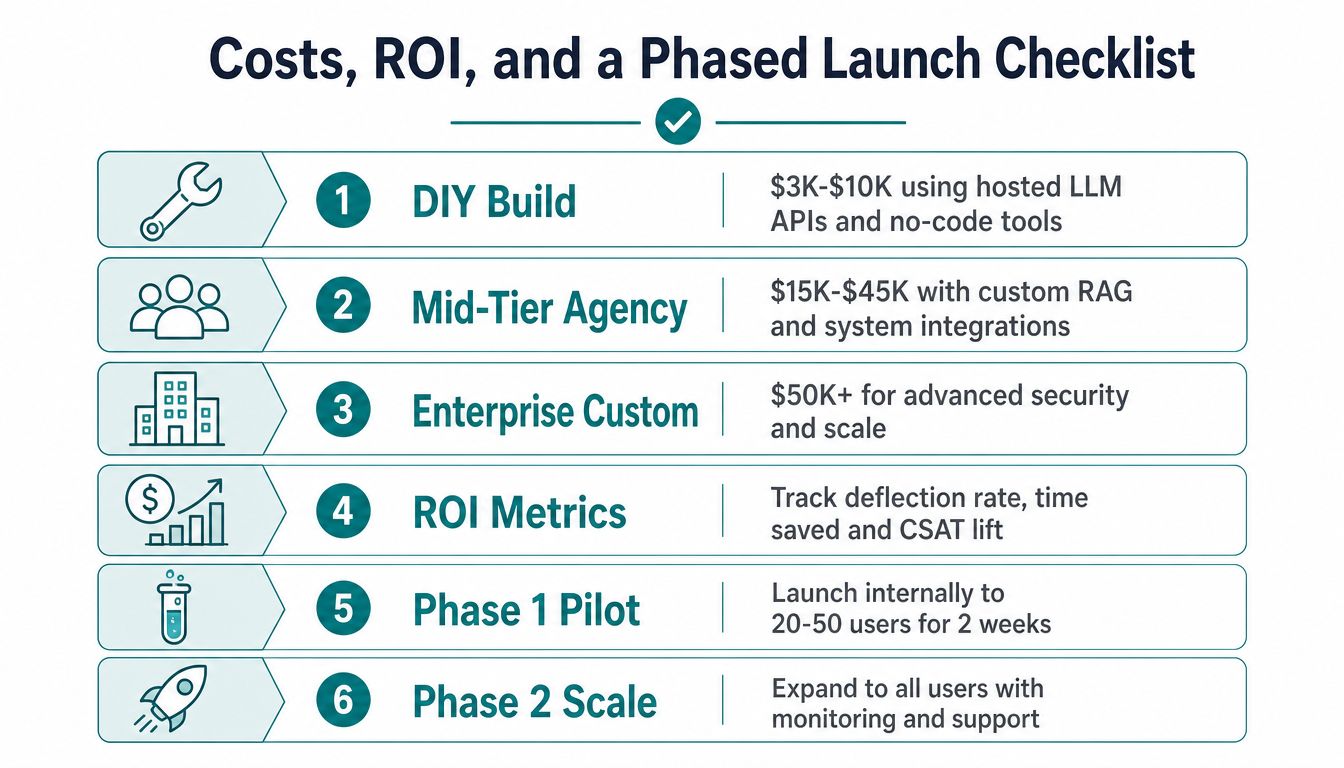
The right budget depends on integrations, data sensitivity, channel count, and how much ongoing management your team can handle. A do-it-yourself project using hosted APIs and no-code tools may fit within $3K to $10K, while a mid-tier agency engagement with custom RAG and integrations may range from $15K to $45K. Enterprise work with advanced security and scale can exceed $75K, with some projects reaching $200K or more when regulated workflows and extensive controls are involved.
Operating expenses typically include model usage, vector database hosting, monitoring tools, and human handoff software. Don't evaluate only the build invoice. Ask who will update the knowledge base, review transcripts, maintain integrations, test new models, and respond when the bot routes too many customers to staff.
Published business summaries report documented chatbot returns commonly ranging from 148% to 200%, while one widely cited benchmark says successful implementations can return about $8 for every $1 invested. Those summaries also report that many companies see positive ROI within 3 to 6 months, although complexity and adoption can extend the timeline (AI chatbot business ROI summary).
Measure ROI through three business outcomes, reduced support effort, qualified lead growth, and completed service actions. A chatbot that produces many conversations but few qualified leads or resolved requests isn't performing well.
Use the first 90 days to prove the operating model
Before launch: Audit the knowledge base, remove conflicting information, build the evaluation set, complete the security review, define human escalation, and assign an internal owner.
During the soft launch: Use internal staff first, then expose the bot to a controlled group of customers. Review monitored tickets, document failure patterns, and fix scope or retrieval problems before broad promotion.
At full launch: Review KPIs weekly, publish knowledge updates through an approval process, sample conversations for hallucinations, and schedule the forced model-swap drill for month six. The drill should prove that your team can evaluate a replacement, switch safely, and roll back if customer experience declines.
For Cincinnati businesses weighing service automation alongside website and SEO improvements, HDM's guide to an AI chatbot for customer service provides another practical starting point. The essential decision is simple: fund the lifecycle, not just the launch.
HDM helps businesses plan, build, and maintain AI chatbots, custom websites, integrations, and digital growth systems, including HIPAA-conscious experiences for healthcare organizations. Visit HDM to discuss your chatbot's first use case, knowledge requirements, integration plan, and model-change strategy before you commit this quarter.