
A lot of Cincinnati manufacturers are in the same spot right now. They've built a solid business through referrals, repeat customers, trade relationships, and years of doing hard technical work well. Then they look at their website and realize it isn't helping much. It may look dated, bury key capabilities, or fail to answer the questions a buyer has before they ever call.
That gap matters more than it used to. Buyers still value relationships, but they also research vendors online long before they talk to sales. A plant manager, engineer, purchaser, or owner may all visit your site at different points in the process, and if what they find is thin, generic, or difficult to use, you lose ground before your team even gets a shot.
That's where a manufacturing marketing company can be useful, if it understands how industrial buying works. The right partner doesn't just post on social media or chase empty traffic. It helps your company get found, explain what you do clearly, prove credibility, and turn website visits into qualified conversations.
Growing Your Manufacturing Business in a Digital World
A familiar scenario goes like this. A manufacturer in the Cincinnati area has great equipment, experienced people, strong quality processes, and a reputation earned over decades. Yet online, the company looks almost invisible. The site lists a few services, the copy sounds like everyone else, and inbound leads are inconsistent enough that nobody trusts the numbers.
Meanwhile, competitors are investing. A widely cited benchmark found that manufacturing marketing budgets rose from 6% in 2021 to 9.2% in 2022, a 3.2 percentage-point increase in one year, which points to heavier investment in digital and measurable growth tactics across the sector, according to Act-On's manufacturing marketing metrics overview.
That doesn't mean every manufacturer needs flashy campaigns. It means more firms are treating marketing like an operational function tied to pipeline and revenue, not just a brochure expense.
Strong operations don't automatically create strong visibility
Most manufacturing owners didn't build their business by becoming SEO experts. They built it by delivering parts on spec, solving production problems, and keeping customers happy. That expertise matters. But it doesn't automatically translate into a website that ranks for the right searches or content that helps a buyer compare vendors with confidence.
A digital presence can feel like a black box when you don't live in that world every day. You hear terms like rankings, paid media, automation, and attribution, but what you really want is simple. More qualified RFQs. Better-fit opportunities. Fewer wasted conversations.
Buyers don't care how much marketing activity you generate. They care whether your company looks credible when they're ready to evaluate vendors.
What a partner should change
A real manufacturing marketing partner closes the gap between what your company can do and what the market can understand online. That often starts with basic but important work:
-
Clarifying capabilities so buyers can see exactly what you make, for whom, and under what standards
-
Organizing proof through certifications, case studies, process detail, and technical explainers
-
Improving conversion paths so visitors know how to request a quote, start a project discussion, or talk to the right person
For Cincinnati-area firms, the opportunity is often less about reinventing the business and more about making existing strengths visible. Good digital marketing does that. Bad digital marketing adds noise.
What a Manufacturing Marketing Partner Actually Does
Think of a manufacturing marketing program like a production line. If one station fails, the whole system underperforms. You can't expect SEO alone to carry a weak website. You can't expect paid ads to fix unclear positioning. You can't expect automation to rescue poor lead quality.
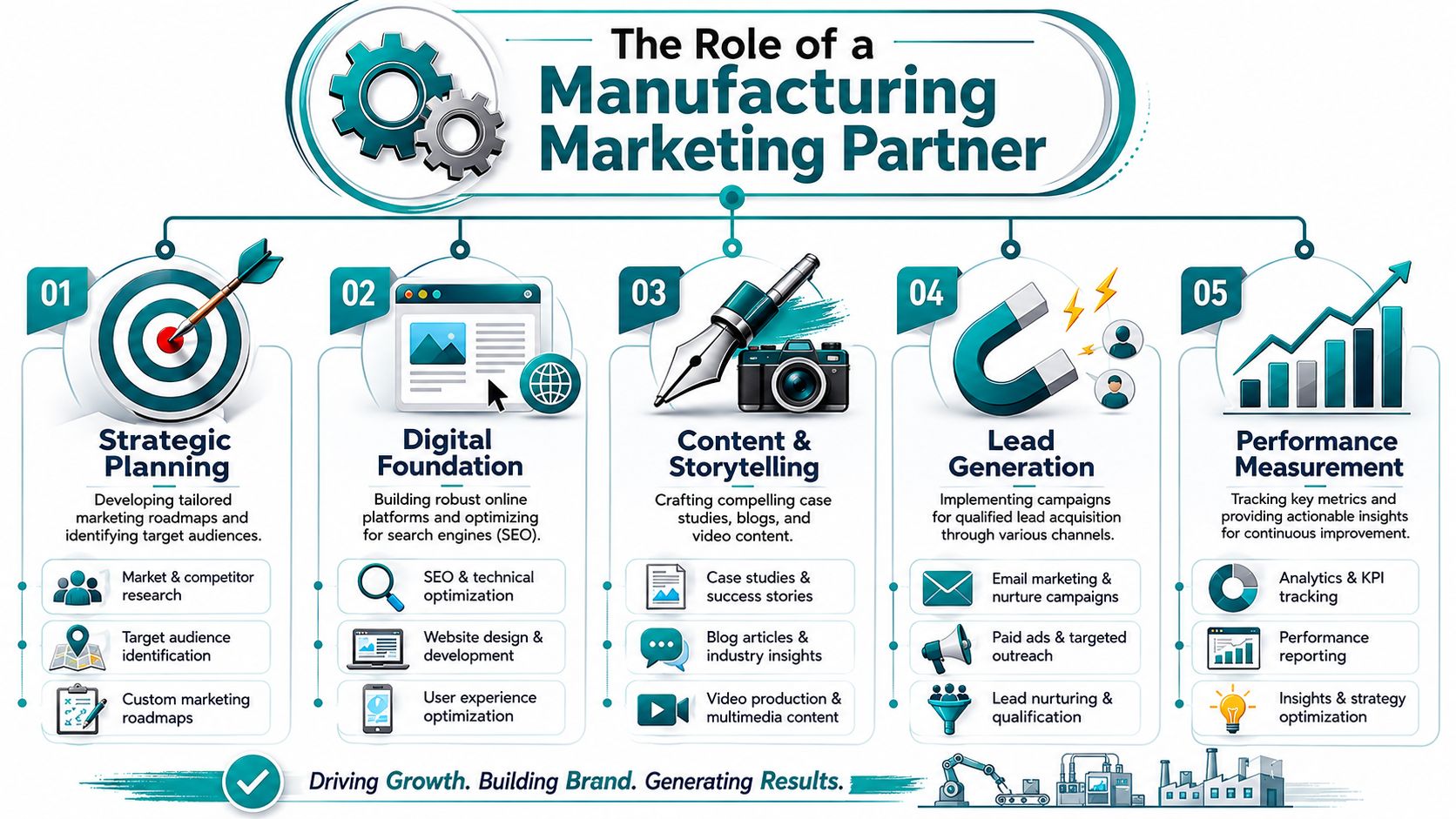
Search visibility that matches how industrial buyers search
For manufacturers, SEO isn't about chasing broad vanity terms. It's about showing up when someone searches for a specific process, material, tolerance, certification, or application. Recent guidance in the sector points to AI-driven SEO and structured content that answers exact buyer questions, especially in niche, high-consideration markets where the right search moment matters more than broad traffic, as explained in FSM's manufacturing industry guidance.
That has practical implications. Your site should answer questions like:
-
What do you make
-
What industries do you serve
-
What standards or certifications do you meet
-
What problems are you best equipped to solve
If those answers are buried, search engines struggle, and buyers do too.
A website built for capability and conversion
A manufacturing website has to do more than look modern. It needs to present technical depth without overwhelming a non-technical visitor. That usually means capability pages, industry pages, process pages, quote forms, downloadable assets, and a content structure that helps both engineers and executives find what they need.
Here's a simple comparison:
| Website approach | What happens |
| --- | --- |
| Generic brochure site | Buyers leave with unanswered questions |
| Capability-focused site | Buyers understand fit faster |
| Conversion-focused site | Sales gets better context with each inquiry |
A partner with industrial experience should also understand when custom development matters. Some manufacturers need more than a standard site build. They may need distributor tools, gated technical resources, searchable product data, or CRM-connected quote workflows. Firms looking at options can review how agencies position manufacturing digital services and compare that against their own operational needs.
Content, campaigns, and follow-up
Content marketing in manufacturing should support real buying decisions. That includes:
-
Case studies that show the problem, process, and outcome without sounding inflated
-
Technical explainers that help buyers evaluate materials, tolerances, or production methods
-
Sales enablement content that gives your team useful proof during long deal cycles
Paid media can help when you need visibility for specific service lines, recruiting, product launches, or target accounts. Marketing automation becomes valuable once the basics are in place. It helps route leads, follow up consistently, and give sales context on what a prospect viewed before making contact.
Many programs often break down. The pieces exist, but they aren't connected. A good partner makes them work as one system.
Marketing to the Entire Buying Committee Not Just One Person
A common mistake in industrial marketing is writing as if one buyer makes the whole decision. That's rarely how manufacturing deals work. One contact may request a quote, but several people usually shape the final outcome.
Best-practice guidance in the industry stresses the need to market across a multi-stakeholder buying committee, including input from technical staff and accessible content for non-engineers, according to Konstruct Digital's discussion of manufacturing marketing in practice.
Different roles need different proof
An engineer may want drawings, tolerances, materials, process control details, or quality documentation. A purchasing manager may care about responsiveness, vendor stability, and ease of procurement. An owner or executive may want to know whether your solution reduces risk, supports production goals, or justifies the spend.
If your website says only “high quality solutions with excellent service,” none of those people gets what they need.
A stronger content strategy maps evidence to the role reviewing it. For example:
-
Engineers often respond to process detail, specifications, capabilities, and technical FAQs
-
Procurement teams need clarity on lead times, communication, documentation, and supplier fit
-
Executives want a clean business case, confidence in the supplier, and reduced implementation risk
Translate expertise without watering it down
Manufacturers often know their products so well that their messaging becomes too internal. Acronyms pile up. Terms are left unexplained. The site assumes the visitor already understands the production process.
That creates friction for non-engineers inside the account.
Practical rule: Interview your technical team, then rewrite what they say in plain business language without stripping out the important detail.
That doesn't mean dumbing things down. It means layering the information. Start with a clear explanation of what you do and why it matters. Then let interested buyers go deeper through specs, process pages, or downloadable resources.
Better education can improve sales quality
This is the part many agencies miss. The goal isn't just more leads. It's better-informed buying groups.
When marketing gives a sales rep the right proof, the conversation changes. The rep spends less time correcting misunderstandings and more time discussing fit, scope, timing, and value. That tends to improve the quality of the opportunity, even if total lead volume doesn't spike right away.
For many Cincinnati manufacturers, that's the key payoff. Fewer weak inquiries. More credible conversations.
How to Measure Real Business Impact from Marketing
If an agency reports page views, impressions, and social engagement, that isn't useless. It's just incomplete. A manufacturer needs to know whether marketing is helping produce qualified opportunities and closed business.
Industry guidance for manufacturers puts the emphasis on conversion and revenue metrics, including cost per qualified lead, marketing-sourced revenue, and lead-to-customer conversion rate, as outlined in Monday.com's manufacturing marketing strategy guidance.
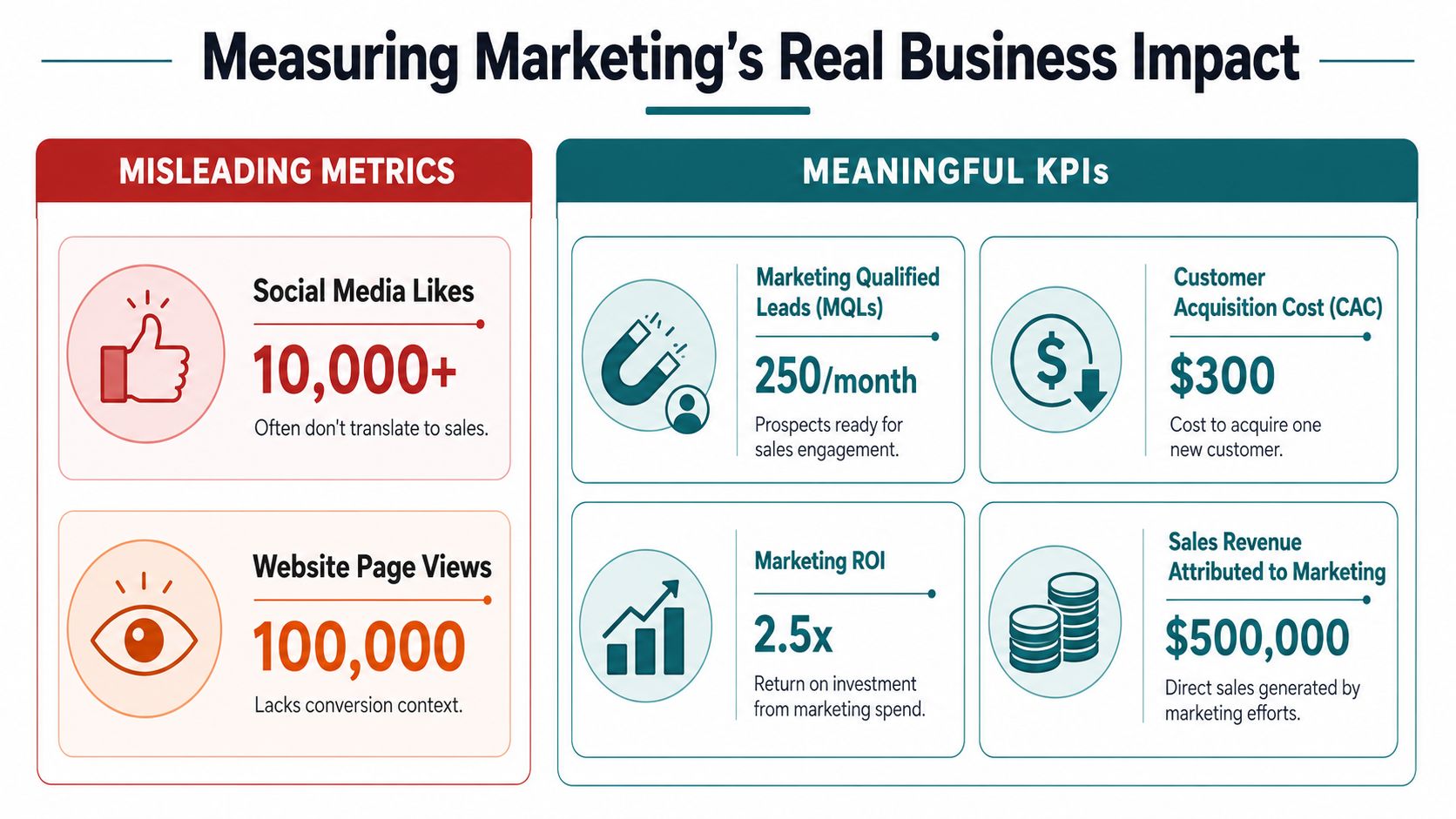
Metrics that matter more than traffic alone
A practical reporting conversation should include questions like these:
-
Which leads were qualified
-
Which channels produced those leads
-
How many moved into real sales conversations
-
Which opportunities eventually turned into revenue
That's a different standard than “your website traffic went up.”
Here's the distinction:
| Vanity metric | Better business metric |
| --- | --- |
| More website visits | More qualified quote requests |
| More form fills | Better lead-to-customer conversion |
| More ad clicks | Lower cost per qualified lead |
| More followers | More marketing-sourced revenue |
Ask how attribution works
The hard part in manufacturing isn't only generating a lead. It's tracking what happened after the first touch, especially when sales cycles are long and several people are involved.
A credible partner should be able to explain how your website, CRM, forms, call tracking, and email activity connect. If those systems don't talk to each other, reporting becomes guesswork. Sales may say marketing sends weak leads. Marketing may say sales didn't follow up. Nobody has clean evidence.
If a marketing company can't show how inquiry data reaches sales and loops back into reporting, you won't get clear accountability.
What useful reporting looks like
Good reporting is specific and operational. It should help you make decisions, not just review charts.
Look for reports that answer questions such as:
-
Which service pages create the best inquiries
-
Where do prospects drop off before contacting sales
-
Which campaigns attract the wrong-fit leads
-
What content tends to support movement toward a real opportunity
When you have that view, marketing stops feeling mysterious. It becomes something you can evaluate like any other business function.
Choosing the Right Partner in the Cincinnati Area
Hiring a manufacturing marketing company isn't like ordering a commodity service. You're choosing a team that needs to understand your sales process, your buyers, your capabilities, and the way your business wins work.
That's why the wrong agency often sounds polished in the pitch and underdelivers later. They know marketing language but not industrial reality. They talk about “brand storytelling” in broad terms yet can't explain how to present machining tolerances, fabrication capabilities, or a multi-step RFQ process in a way buyers can use.
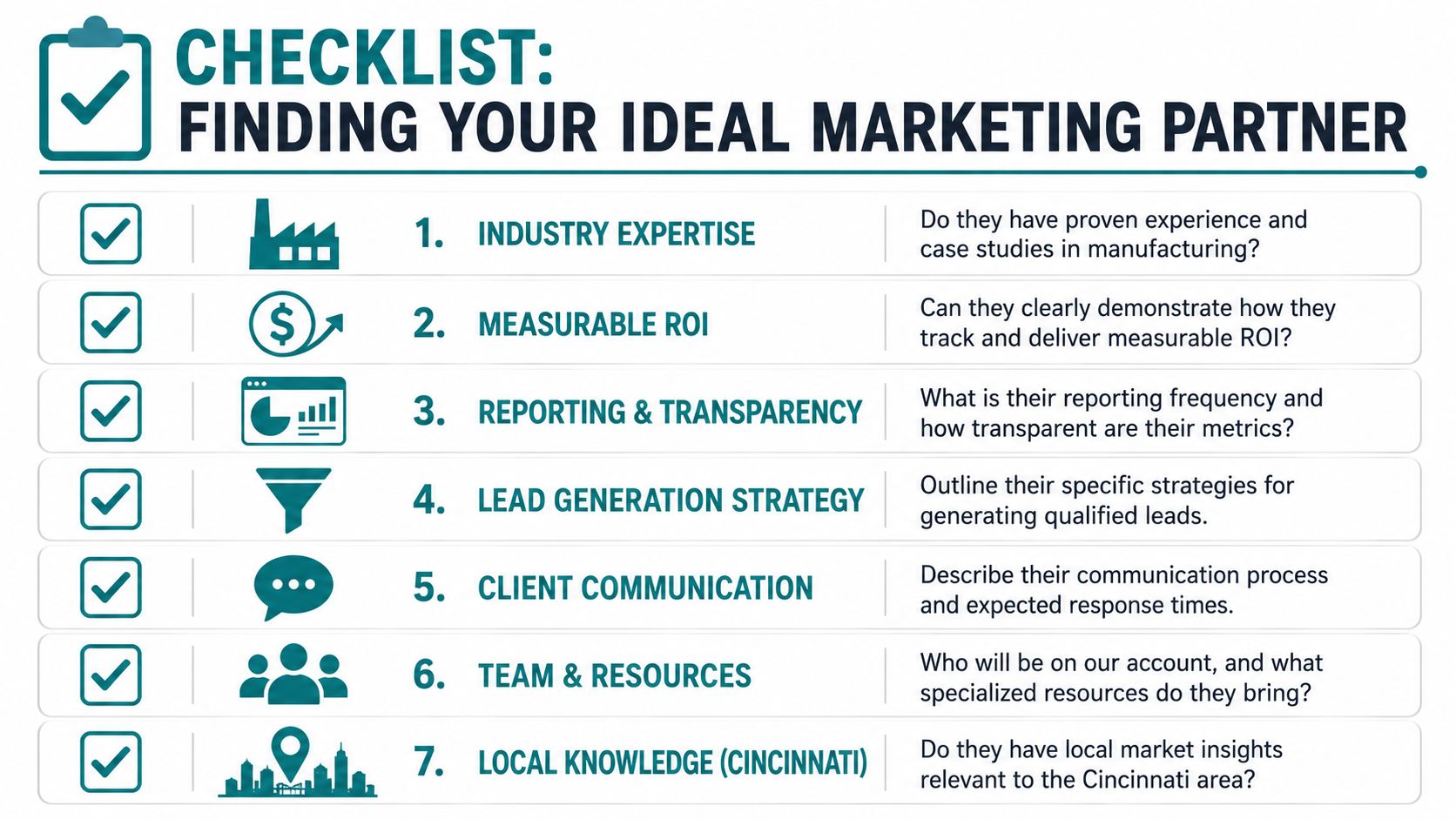
Questions worth asking in every agency conversation
You'll learn a lot from the first meeting if you ask direct questions.
-
How do you learn our sales process If they don't ask how deals are sourced, qualified, quoted, and closed, they're not building around revenue.
-
How do you handle technical subject matter Good partners interview engineers, estimators, operators, and sales staff. They don't rely only on generic copywriting.
-
What does success look like in the first phase You want a clear plan. Not vague promises. Maybe that means fixing tracking, rebuilding key pages, or improving conversion paths before pushing traffic harder.
-
Who does the work Some firms sell strategy and outsource most execution. That's not always bad, but you should know who's writing, building, optimizing, and reporting.
Local context helps
A Cincinnati-area partner can bring practical advantages. They may understand the regional mix of industrial businesses, labor realities, and the way local companies balance legacy sales relationships with digital growth. Proximity can also make discovery sessions, site visits, and stakeholder meetings easier.
For companies exploring local-fit options, it helps to compare agencies that explicitly work with Cincinnati manufacturing businesses. One example is HDM, a Springboro-based agency that offers digital services for manufacturers alongside broader web development and growth marketing work. That matters less as a sales point than as a screening signal. You want an agency that can discuss RFQs, technical content, sales enablement, and reporting without needing a crash course in how manufacturers sell.
Watch for package-first selling
Some agencies push a standard monthly package before they understand your business. That's usually a warning sign.
A partner worth hiring asks tough questions before recommending tactics.
You need someone who can say, “Your issue isn't traffic. It's that your site doesn't clearly show who you serve, what you make, or why a buyer should trust you.” Sometimes that's the most valuable advice in the room.
Understanding Marketing Budgets and Pricing Models
Most owners don't mind investing in growth. They mind vague spending. That's why marketing proposals can feel frustrating. You may see a monthly retainer, a project quote, setup fees, ad management fees, and a list of deliverables that still doesn't answer the basic question: what are we buying?
One useful benchmark is that manufacturing marketing is often pegged at about 6.7% of revenue spent on marketing, which helps frame marketing as a real operating investment in a sector with long sales cycles and trust-heavy buying decisions, according to HMM's manufacturing statistics overview.
The three pricing models you'll usually see
Most agency proposals fall into one of these structures.
| Model | Best fit | Watch-out |
| --- | --- | --- |
| Monthly retainer | Ongoing SEO, content, ads, reporting, and optimization | Scope can get fuzzy if deliverables aren't defined |
| Project-based fee | Website rebuilds, tracking setups, messaging work, automation builds | Momentum can stall after launch if no ongoing support follows |
| Hybrid model | Initial build plus monthly growth work | Requires clear division between setup and ongoing execution |
A retainer makes sense when you need continual improvement. SEO, paid media, reporting, content development, and conversion work don't usually succeed as one-and-done tasks.
A project model fits when you have a clear immediate need, such as replacing an outdated website or fixing broken analytics. Hybrid models work well when a company needs both a foundation and ongoing support.
What should be included
Don't compare proposals by price alone. Compare them by what gets done and how progress is measured.
Look for clarity around:
-
Strategy work such as positioning, audience definition, and content planning
-
Execution including design, development, SEO, copy, paid media, or automation
-
Reporting so you can see whether activity is tied to business outcomes
-
Collaboration time with your internal sales or technical team
If you want a plain-English breakdown of common agency cost structures, this guide to digital marketing charges is the kind of resource worth reviewing before you sign anything.
Think like you would with equipment
Manufacturers are used to evaluating capital decisions. You don't buy machinery because it looks impressive. You buy it because it improves throughput, quality, margins, or capacity.
Marketing should be treated the same way. The right spend isn't the cheapest line item. It's the one that supports measurable growth and makes your sales process more effective.
Your First Steps Toward Measurable Digital Growth
A lot of owners stay stuck because they assume they need a complete digital overhaul before they can act. Usually, they don't. They need a clearer starting point and a willingness to test what's getting in the way.

Start with what buyers see today
Open your website as if you were a new prospect. In the first few seconds, can a visitor tell what you make, who you serve, and why your company is credible? Can they find the right next step without hunting for it?
If the answer is no, that's not a branding problem. It's a sales problem happening on your website.
Write down the pages that feel thin, confusing, outdated, or too inward-facing. Those are often the best places to start.
Pick one business goal, not ten
Don't begin with a giant wish list. Pick one clear objective for the next phase of growth. That might be generating better RFQs for a specific capability, improving visibility in a target industry, or giving sales stronger content for complex deals.
That focus helps you evaluate a partner's recommendations. If every suggestion sounds disconnected from your business goal, the strategy probably isn't mature enough.
This video offers another perspective on building momentum from a practical starting point.
Have one serious conversation
The next step is simple. Talk with a partner that understands manufacturing and ask hard questions. Bring your sales concerns. Bring your website frustrations. Bring examples of the kinds of jobs you want more of.
You're not looking for magic. You're looking for clarity, process, and evidence that someone can help your company turn online attention into better business opportunities.
If you run a manufacturing company around Cincinnati, that work is worth doing now. Buyers are already researching. The only real question is whether your digital presence helps your team win.
If you're ready to look at your website, lead flow, or search visibility with a practical manufacturing lens, HDM is one Cincinnati-area option to talk with. A useful first conversation should focus on your sales process, your target buyers, and the gaps between what your company does well and what your digital presence currently communicates.