
You're probably here because you asked for a few quotes and got back numbers that don't even seem to describe the same job.
One agency says they can handle your SEO for a few hundred dollars. Another sends a proposal with strategy, content, tracking, and reporting at several thousand a month. A third wants to rebuild your site first, then talk about ads later. If you own a business in Cincinnati, that's frustrating because you're not shopping for "marketing stuff." You're trying to buy growth, more leads, better customers, and a website that stops leaking opportunities.
Digital marketing charges vary for the same reason home renovation quotes vary. One contractor prices paint and patchwork. Another prices electrical, permits, waterproofing, and work that won't need redone in six months. Marketing works the same way. The quote depends on scope, skill, and whether the work is meant to look busy or drive revenue.
That's the part most proposals skip. They give you line items, but not the business logic behind them.
A fair quote should tell you what's being done, why it matters, how success will be measured, and what kind of investment matches your stage of growth. Once you know how pricing really works, digital marketing charges stop looking random.
Why Are Digital Marketing Quotes So Different
A Cincinnati business owner gets three proposals for "the same" job. One is cheap, one is moderate, and one is high enough to make you wonder if someone added an extra zero. That happens every week because agencies often use the same words to describe very different levels of work.
"SEO" might mean setting a few title tags and updating a Google Business Profile. It might also mean technical fixes, location pages, content planning, link-building, call tracking, and conversion improvements on your service pages. Both proposals say SEO. They are not the same product.
The same problem shows up with web design. One quote covers a simple brochure site. Another includes messaging, UX planning, copy support, custom development, CRM forms, analytics, and speed optimization. If you only compare the total, the expensive proposal looks overpriced. If you compare the actual work, it may be the only one that solves the business problem.
What usually changes the quote
- Depth of strategy: Some providers execute tasks. Others diagnose why leads are weak, why pages don't convert, and how channels should support each other.
- Quality of implementation: A polished, fast, well-tracked website costs more than a template with stock text and no real measurement.
- Who is doing the work: A solo freelancer, a niche specialist, and a full team don't carry the same overhead or deliver the same range of capability.
- How accountable the agency is: Clear reporting, planning, and iteration take time. Cheap work often removes those first.
Most bad pricing decisions happen when a business owner compares packages instead of comparing outcomes.
When quotes are far apart, don't ask only, "Why is this so expensive?" Ask, "What problem is each proposal solving?"
Understanding the Three Main Pricing Models
A Cincinnati business owner might get three proposals for the same goal, more leads, and still be looking at three completely different ways to pay for the work. That can make a fair comparison harder than it should be.
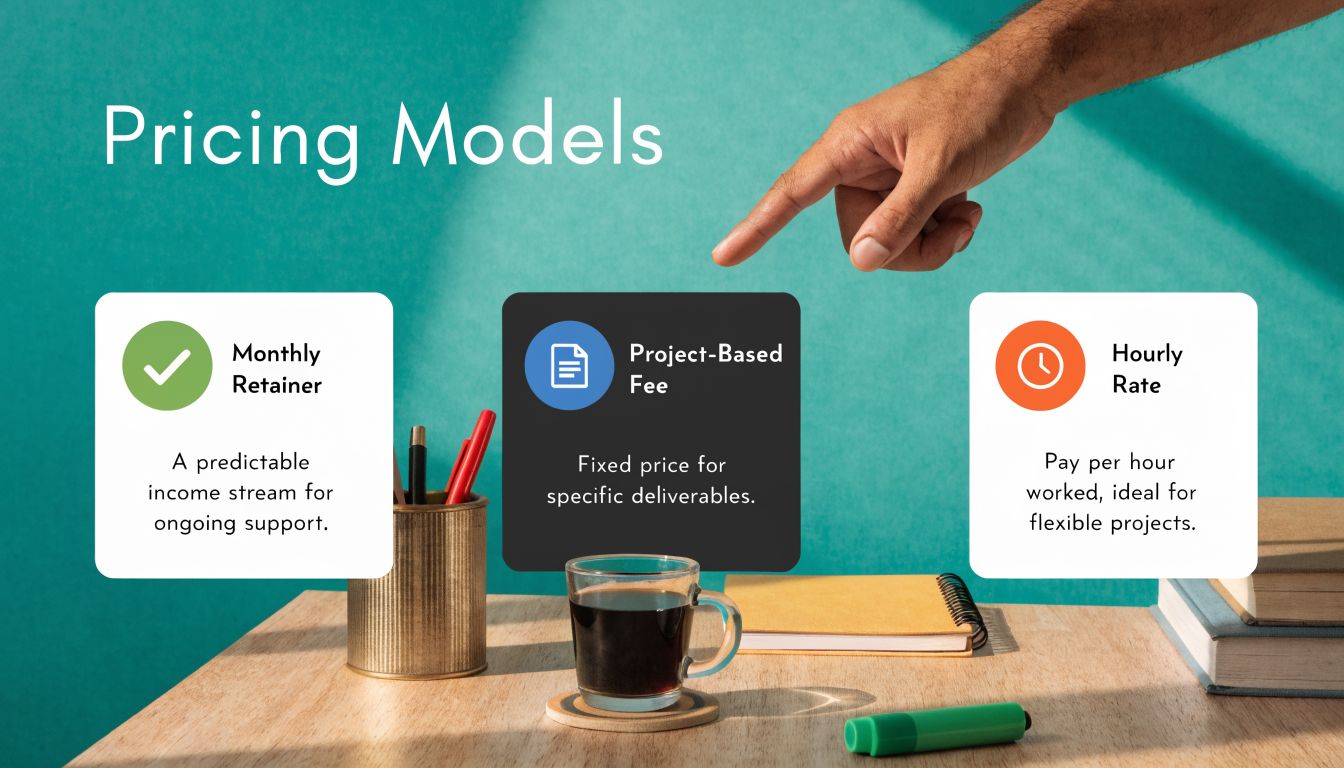
Most agency pricing falls into three models. The right one depends less on the channel and more on the kind of problem you need solved.
Monthly retainer
A monthly retainer works like having a marketing team on call each month. You are paying for steady execution, regular review, and course correction as the numbers come in.
This model usually fits SEO, content, paid ad management, email campaigns, conversion improvements, and reporting. It makes the most sense when results depend on consistent work over time, not a one-time fix.
The trade-off is straightforward. A retainer gives you continuity and accountability, but only if the scope is clear. If the proposal says things like "ongoing optimization" without showing what gets done, how success is measured, and who is responsible, you can end up funding motion instead of growth. Businesses investing in paid campaigns often pair a retainer with ad spend, which is a separate line item from management. If you want a clearer picture of that side of the budget, this breakdown of online advertising costs for local businesses helps.
Project-based pricing
A project fee works like hiring a contractor for a defined build. The work has a start date, a finish line, and clear deliverables.
That makes project pricing a good fit for website builds, analytics setups, audits, landing page packages, or a one-time ad account cleanup. According to a pricing breakdown from Brand House, project-based digital marketing work often ranges from $3,000 to $30,000+, and defined deliverables such as an SEO audit often land in the $3,000 to $10,000 range.
For a local business, this can be a smart first step. You get a lower-commitment way to evaluate how an agency communicates, whether their recommendations are practical, and whether the work leads to a better next decision. The catch is that a project can identify issues without fixing the larger system. A strong audit has value. It does not replace ongoing execution.
Hourly pricing
Hourly billing is usually best for narrow, specialized work. That might include consulting, tracking repairs, technical troubleshooting, proposal reviews, or small development tasks.
It gives you flexibility and can save money when the need is limited.
It becomes expensive when you use it to manage an ongoing growth problem. If lead quality is weak, conversion tracking is off, and ad performance needs weekly attention, paying by the hour can create a stop-and-start process with no one responsible for the full result.
Which model makes sense
A simple way to match the pricing model to the job:
| Situation | Best fit |
|---|---|
| You need ongoing lead generation and regular optimization | Monthly retainer |
| You need a website, audit, or defined deliverable | Project-based |
| You need expert help on a specific issue | Hourly |
Practical rule: Match the pricing model to the business problem. Ongoing growth usually needs ongoing ownership.
Digital Marketing Charges A Service-by-Service Breakdown
A Cincinnati business owner might get one proposal for $1,200 a month and another for $6,000 for what sounds like the same work. Usually, they are not buying the same thing.
One plan covers basic execution. The other may include strategy, tracking, creative, landing page improvements, and regular optimization tied to leads and sales. That gap matters because line-item pricing only tells part of the story. The key question is what each service is expected to produce.
Based on benchmarks from ForeFront Web's digital marketing pricing research, 67% of businesses invested between $50 and $6,000 per month in digital marketing, and 68% spent $500 to $7,500 per month on SEO. For many small businesses, $500 to $1,000 per month on one core channel is a realistic starting point if the goal is to test traction before expanding.
That range is broad for a reason. Digital marketing pricing works a lot like hiring a contractor. Two quotes may both say "kitchen remodel," but one includes cabinets, plumbing, permits, and finish work, while the other covers demolition and little else.
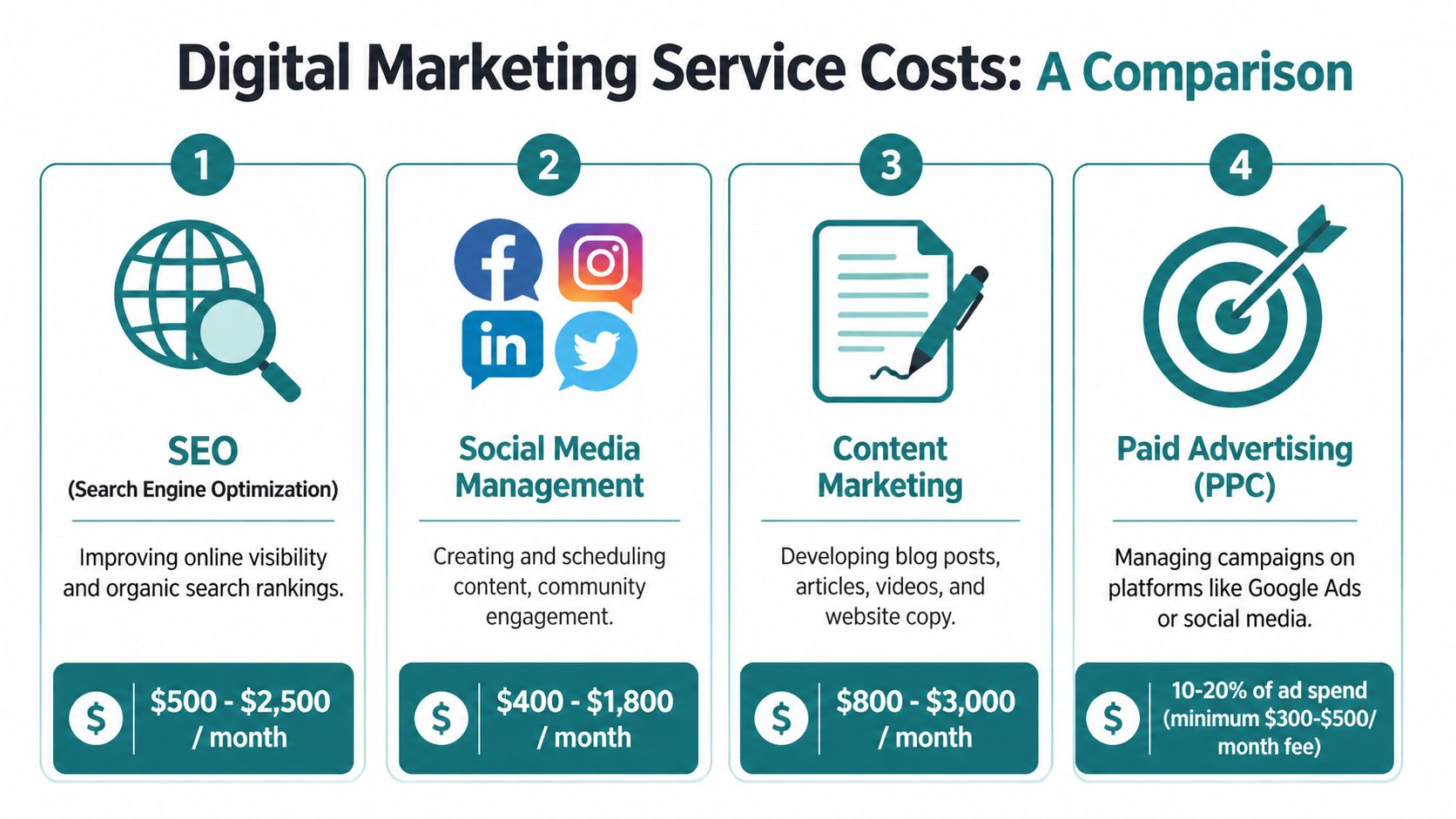
A useful way to read the numbers
The best way to read pricing is by business stage.
- Starter fits one clear need and a narrow scope.
- Growth adds coordination across channels and more active optimization.
- Advanced supports heavier competition, stronger reporting, and more testing.
Lower cost is not automatically better. A cheaper package often means less strategy, weaker tracking, slower execution, or fewer revisions. Those cuts do not always show up in the proposal, but they show up later in missed leads and unclear ROI.
Typical Monthly Digital Marketing Charges for SMBs 2026
| Service | Starter (Getting Started) | Growth (Scaling Up) | Advanced (Market Leader) |
|---|---|---|---|
| SEO | $500 to $1,000 | $2,000 to $5,000 | $5,000 to $10,000 |
| PPC management and ad program | $500 to $1,500 plus ad spend | $2,000 to $5,000 plus ad spend | $5,000 to $10,000+ plus ad spend |
| Social media marketing | $1,500 to $5,000 total monthly investment | $5,000 to $15,000 total monthly investment | $20,000 to $120,000+ total monthly investment |
| Email marketing | $51 to $1,000 is common for many businesses | Higher investment when strategy, automation, and campaign management expand | Advanced programs vary based on complexity |
| Website and conversion projects | Project-based | Project-based | Project-based |
| Audits and defined one-time work | $3,000 to $10,000 | $5,000 to $15,000 | $30,000+ depending on scope |
SEO charges
SEO pricing changes based on the job you need done.
At the starter level, agencies usually focus on local listings, core service pages, on-page fixes, and technical cleanup. For a smaller Cincinnati service business, that can be enough to improve visibility for the searches that drive calls.
Growth-level SEO usually adds content planning, internal linking, conversion updates, and more consistent optimization. This is often where SEO starts acting like a lead generation system instead of a maintenance task.
Advanced SEO combines technical work, content production, authority building, and conversion analysis. That costs more because it requires more specialized labor and tighter coordination. It also reduces the risk of spending a year "doing SEO" without building meaningful traffic or revenue.
Paid ads and PPC charges
PPC looks simple on paper and expensive in practice when the setup is weak.
A starter campaign can work well if the offer is clear, the service area is defined, and the landing page gives people a good reason to call or submit a form. If those pieces are missing, the ad budget becomes a testing fee for problems elsewhere in the funnel.
Growth-level PPC usually includes better conversion tracking, ad testing, audience refinement, and landing page work. The management fee is only one part of the cost picture. The platform spend matters too, and this breakdown of online advertising cost for local businesses gives useful context on how those numbers fit together.
Social media charges
Social media pricing varies because the work varies.
Some businesses need organic posting, light design, and community management. Others need paid campaigns, short-form video, creative testing, and reporting tied to booked jobs or online sales. Those are different scopes, so they should not cost the same.
For a local business, social media becomes more valuable when it supports a clear objective. That could be staying visible with past customers, building trust with new prospects, or supporting paid campaigns with stronger creative. Paying for frequent posts without a business purpose usually looks affordable right up until the owner asks what it produced.
Email marketing charges
Email often starts cheap and gets more valuable as the strategy improves.
Basic email support may include a newsletter or a few monthly campaigns. A stronger program includes segmentation, automated follow-up, abandoned cart or lead nurture sequences, testing, and list cleanup. That extra work is what turns email from a reminder channel into a repeat-sales channel.
For many small businesses, email delivers strong ROI once the list quality is good and the offer is clear. The mistake is assuming low software cost means low labor cost. Writing, setup, testing, and ongoing refinement still take time.
Website and project charges
Websites are usually priced as projects because the work has a defined build phase, but the actual cost depends on what the site is expected to do.
A basic brochure site is one price. A site built to support SEO, paid traffic, lead tracking, CRM integration, stronger copy, and conversion testing is another. Both may be called "a new website," but one is a digital brochure and the other is a sales tool.
A low-cost website often saves money only until you need leads, tracking, speed, copy, integrations, and fixes the original build didn't include.
That is why service-by-service pricing should always be read through an ROI lens. The cheaper option can be the more expensive decision if it creates weak tracking, poor conversion rates, or months of rework later.
Key Factors That Influence Your Final Cost
A Cincinnati home services company and a multi-location legal practice can both ask for "SEO and a new website" and get proposals that are miles apart. The difference usually is not arbitrary pricing. It comes from how much work it takes to produce leads, track them properly, and avoid expensive mistakes.
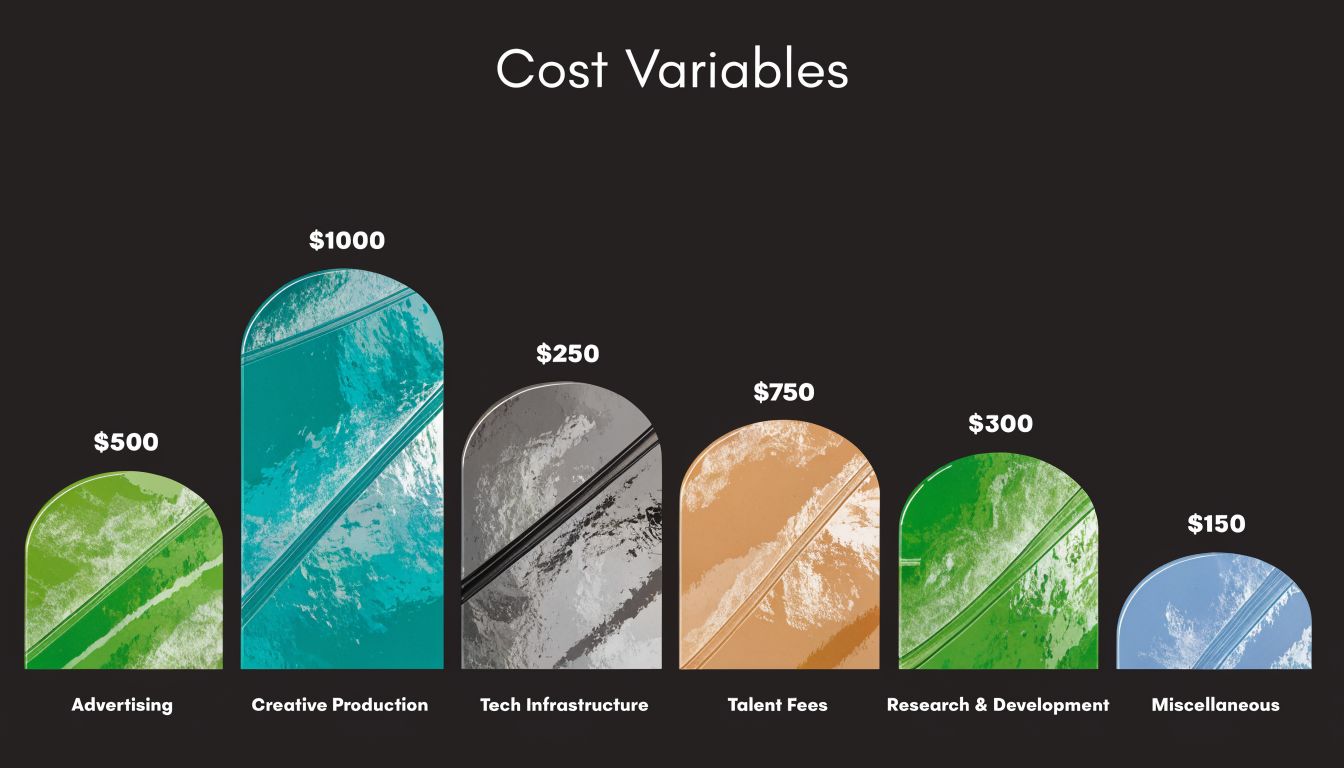
Scope drives both cost and payoff
A five-page site for a solo consultant is a smaller job than a site for a contractor with six services, two counties to cover, financing options, and a CRM that needs to capture every lead source.
Marketing works the same way. One channel is simpler to manage than SEO, paid ads, landing pages, content, call tracking, and reporting tied together. Each added piece can raise cost, but it can also improve results if those pieces support the same sales goal. The right question is not "How much does each item cost?" It is "Which pieces help this business produce profitable leads?"
Experience changes the risk profile
Higher fees often reflect fewer shortcuts.
Experienced teams usually spend more time on discovery, tracking setup, offer alignment, and conversion issues before traffic starts flowing. That work is easy to overlook in a proposal because it is less visible than ad spend or design mockups. It still affects ROI. A cheaper quote can look attractive until the phones stay quiet, leads are impossible to trace, or the site has to be rebuilt six months later.
Competition affects how hard each lead is to win
Some Cincinnati businesses can get traction with a clean site, solid local SEO, and consistent follow-up. Others compete in crowded categories where every click costs more, every ranking takes longer, and every landing page needs tighter copy and more testing.
That pressure changes pricing because the agency is not buying tasks. It is buying time, judgment, and iteration. If ten competitors are all bidding on the same search terms, your costs rise long before you see the first signed customer.
Compliance adds real labor and real liability
Healthcare, legal, and similar industries come with stricter requirements around forms, messaging, record-keeping, and data handling. Generic execution creates risk fast.
A breakdown of regulated-industry marketing costs from RankMeTop shows that digital marketing for healthcare and legal businesses can carry a 30 to 50% compliance cost premium for development and management because of requirements such as data encryption, audit logging, and specialized strategy.
That premium usually covers work like:
- Security-focused development: forms, intake flows, and data handling need tighter controls
- Documentation and accountability: teams need records of changes, approvals, and processes
- Stronger content review: messaging often needs legal or compliance input before it goes live
- More coordination: internal stakeholders, compliance reviewers, and technical teams all slow production
A short explainer on cost shifts in the current market helps frame this well:
<iframe width="100%" style="aspect-ratio: 16 / 9;" src="https://www.youtube.com/embed/QD9TKLM7QoQ" frameborder="0" allow="autoplay; encrypted-media" allowfullscreen></iframe>For businesses sorting through automation, staffing changes, and new production tools, this explanation of how AI is changing the cost of digital marketing adds useful context.
If an agency never asks about compliance, lead handling, or approval requirements early, the missing work usually shows up later as delays, rebuilds, or legal exposure.
How to Evaluate Agency Proposals and Spot Red Flags
A Cincinnati business owner gets three proposals for the same problem. One is $2,500 a month. One is $5,000. One is $8,500. On paper, all three promise SEO, ads, reporting, and content. In practice, they are rarely selling the same thing.
The question is not, "Which one costs less?" It is, "Which one gives me the best chance of profitable growth without creating expensive cleanup later?"
Cheap marketing often fails in expensive ways. The agency brings in traffic but never fixes weak forms, slow pages, poor follow-up, or mixed messaging between channels. Sales blames marketing. Marketing blames the website. The owner is left paying for activity instead of results.
An analysis of fragmented marketing costs by Digital Time Savers suggests the hidden cost of disconnected digital marketing can reach 2 to 3 times the direct agency fees through lost conversions and damaged customer trust. A $5,000 monthly retainer can look affordable until siloed work starts wasting leads you already paid to generate.
What a solid proposal should include
A good proposal shows how the agency thinks, not just what it plans to ship.
Look for these elements:
- A real discovery process: They should ask about your margins, lead quality, seasonality, sales capacity, close rate, and which services make you money.
- Clear priorities: Strong proposals sequence the work. They identify what needs to happen first, what can wait, and why.
- Defined success metrics: The scorecard should connect to business outcomes such as qualified leads, booked jobs, signed cases, revenue by channel, or cost per acquisition.
- Reporting a business owner can read: You should be able to tell, in a few minutes, what changed, what it means, and what the agency is doing next.
- Ownership of conversion points: Good agencies care about the full path from click to call to close, not just impressions or traffic.
A proposal also needs to match your stage of growth. A company trying to stabilize lead flow needs a different plan than one opening a second location or entering a more competitive service area.
Red flags that deserve a hard pause
Price can hide risk.
If a proposal looks polished but avoids hard questions about sales process, tracking, website conversion, or lead handling, assume the gaps will become your problem later.
| Red flag | Why it matters |
|---|---|
| Guaranteed rankings | Search platforms change constantly, and no agency controls them |
| Boilerplate strategy | You get a reused plan that may ignore your margin, market, and sales cycle |
| No tracking discussion | You may spend for months without knowing which channels produce revenue |
| Separate channel silos | SEO, ads, email, and web updates can work against each other |
| Long contract with vague scope | The agency keeps flexibility while you absorb the downside |
One more practical test helps. Ask each agency what they would stop doing if results lag after 90 days, and what they would change first. Experienced teams answer that quickly because they know where waste tends to hide. Weak teams go back to generic deliverables.
If you want a sharper checklist before signing, review this guide on how to choose a digital marketing agency.
Sample Pricing Scenarios for Cincinnati Businesses
A Cincinnati business owner gets three proposals for the same problem. One is $2,500 a month. One is $5,000. One is $8,500. On paper, all three promise SEO, ads, reporting, and content. In practice, they are rarely selling the same thing.
According to a pricing guide from Digital Agency Leaders, engagements in the $5,000 to $10,000 per month range often support a broader program that includes technical SEO, content production, and conversion analysis. For many mid-market businesses, that range makes sense when simple execution is no longer enough and the core need is coordinated growth.
The Hyde Park HVAC contractor
This business usually does not have a visibility problem all year. It has a timing problem.
Referrals and repeat customers keep things moving, but lead volume drops outside peak season and spikes can be hard to capture when competitors are bidding on the same urgent searches. In that case, the best spend often goes to local SEO, Google Ads for high-intent service terms, call tracking, and landing page improvements for the jobs that drive margin.
A full website rebuild may not be the first move. If the current site is clear, mobile-friendly, and easy to call from, rebuilding it too early can eat budget that should be producing booked jobs.
The practical priority is simple. Show up when someone nearby needs help now.
What usually matters most:
- Paid search for urgent, high-converting service terms
- Local SEO for map visibility
- Call tracking tied to service lines
- Landing pages focused on booking, not browsing
The expensive mistake here is paying for broad awareness campaigns before the basics are fixed. For this kind of company, missed calls, weak service pages, and poor tracking cost more than a modest ad budget ever will.
The Over-the-Rhine e-commerce boutique
An e-commerce brand has a different math problem. Traffic alone does not pay the bills. The site has to turn visits into orders, and first-time buyers have to come back.
That usually means the budget gets split across paid social, branded and non-branded search, product page improvements, email automation, and creative updates. Organic social can support the brand voice, but it rarely carries revenue on its own for a growing store.
This is one of the clearest examples of why cheap marketing gets expensive fast. If ads are driving clicks but product pages are weak, return drops. If email flows are missing, the brand keeps paying to reacquire buyers it already earned once. If creative sits unchanged for months, performance fades and the owner assumes the channel stopped working.
Common budget misses include:
- Overspending on traffic before fixing conversion rate
- Underspending on email and retention
- Using stale creative too long
- Treating paid social, search, and merchandising like separate projects
For a Cincinnati retailer with decent average order value and repeat purchase potential, a mid-tier investment often makes more sense than a bare-minimum retainer. The upside is not just more traffic. It is stronger return from each visitor already coming to the store.
The Tri-County healthcare practice
Healthcare quotes often look higher for good reason.
A practice may need a site experience that supports compliance, secure intake forms, careful analytics setup, accurate provider and location information, and content that builds trust before a patient ever calls. Staff workflow matters too. If marketing sends leads into a clunky intake process, the practice can spend more and still feel no growth.
That often pushes the engagement toward a project-plus-retainer structure. The project handles the website, form setup, and technical foundation. The monthly work then focuses on local search visibility, service-line content, reputation support, and conversion improvements.
The trade-off is straightforward. The upfront cost is higher, but the cost of errors is higher too. In this category, a cheap partner can create rework, staff friction, and reputational issues that are far more expensive than the original quote.
What these examples have in common
The right budget follows the business model.
A contractor may win with one strong channel and tight lead tracking. An e-commerce brand usually needs several moving parts working together. A healthcare practice may need process and site infrastructure before it needs more traffic.
Same city. Same broad category of digital marketing charges. Very different return potential, and very different consequences if the strategy is wrong.
Measuring ROI and Negotiating a Value-Driven Partnership
A Cincinnati business owner gets two proposals. One is $2,500 a month. The other is $6,000. If the cheaper option brings in weak leads, misses tracking, and needs to be rebuilt six months later, it was never the cheaper option.
ROI starts with what a new customer is worth.
A lot of owners skip that step and go straight to the monthly fee. That usually leads to a bad negotiation, because the discussion turns into line items instead of business outcomes. The better approach is to decide what the investment needs to produce. More qualified calls. Higher-value jobs. Better close rates from traffic you already have.
Start with business math you can use
The numbers do not need to be fancy. They need to be real.
Look at four basics:
- Average sale or average client value
- Lead-to-customer close rate
- Repeat purchase or lifetime value
- Gross margin on a new customer
Those numbers give you a practical ceiling for customer acquisition cost. They also help you judge risk. If a new roofing job is worth several thousand dollars in margin, paying more for strong local SEO, better landing pages, and clean call tracking can make sense fast. If you run a lower-margin retail operation, the tolerance for wasted spend is much tighter.
That is why ROI should be discussed before scope gets locked.
Judge channels by sales quality, not cheap clicks
Lower media cost can look good on a report and still hurt the business. A click that never turns into a call, form fill, booked appointment, or sale is just noise.
The same rule applies across SEO, paid search, paid social, email, and web work. A cheaper channel is only better if it produces profitable customer actions. For some Cincinnati businesses, that means paying more for high-intent search traffic. For others, it means fixing the website first because current traffic is leaking out before it converts.
I tell owners to ask a simple question. "If this channel works, what happens in the business?" If the answer is vague, the proposal is still too fuzzy.
Negotiate scope with the outcome in mind
Strong agencies rarely have much room to cut price without cutting the work that makes the program effective. The smarter move is to trim or sequence scope.
That can look like this:
- Start with the revenue bottleneck: fix tracking, landing pages, or local search visibility first
- Delay secondary channels: hold off on paid social until paid search or SEO is producing usable data
- Limit early content production: build the pages that support the highest-margin services first
- Set a review point: agree on what gets measured after 60 or 90 days before expanding the engagement
This protects your budget without forcing the agency to understaff the account. It also gives you a cleaner way to judge results, because you can tie the first phase to a specific goal instead of trying to improve everything at once.
A value-driven partnership should feel clear
Clarity matters more than polish.
You should know who owns strategy, who handles execution, what gets reported, how often decisions are reviewed, and what would justify increasing or reducing spend. You should also know what is not included. That last part saves a lot of frustration.
A healthy agency relationship works like a good contractor relationship. You want a clear scope, realistic expectations, and someone who can explain why the recommendation costs what it costs. If results stall, the next step should be diagnosis and adjustment, not a prettier report.
Good negotiation produces a tighter plan, clearer accountability, and a better shot at profit. It does not turn serious marketing work into bargain-bin labor.
Your Next Step Finding a True Growth Partner
Digital marketing charges make more sense when you stop treating them like a commodity.
The number on the proposal reflects scope, capability, accountability, and risk. A low quote may be perfectly fine for a narrow task. It can also be the first step toward weak tracking, fragmented campaigns, and a website that looks decent but doesn't help the business grow. A higher quote isn't automatically better either. It has to connect clearly to outcomes that matter.
For Cincinnati business owners, the smartest move is usually to slow the buying process down just enough to ask better questions. What is this investment supposed to do? What's included? What's missing? How will success be measured? Where could cheap work create expensive problems later?
When those answers are clear, you can choose with confidence.
If you want a second set of eyes on a proposal or need a clearer plan for web design, SEO, paid media, or a more integrated growth strategy, HDM is a Cincinnati-area option worth considering. They build websites, growth marketing systems, and custom digital solutions for businesses that want costs tied to measurable business outcomes.