

You're probably seeing this right now in your own reports.
You spend money on Google Ads. You've invested in a better website. You post on social media when you can. Maybe you've also put time into SEO, email, or content. Then a lead finally comes in and your report says one thing got all the credit.
That sounds clean. It also leaves out most of the story.
For a Cincinnati business owner, that's where marketing gets frustrating. You're not trying to win an argument about analytics terminology. You're trying to decide whether to keep funding paid search, improve your website, publish more content, or stop wasting money on channels that look busy but don't move revenue. Multi touch attribution helps answer that question by showing how your marketing works together, not just which click happened last.
Why Your Marketing Reports Might Be Lying to You
A lot of business owners assume their dashboard is telling the truth because it looks precise. A lead came from Google Ads. A sale came from organic search. A form fill came from direct traffic.
But most default reporting systems lean heavily on last-click attribution. That means the final interaction before the conversion gets the spotlight, while earlier touches fade into the background.
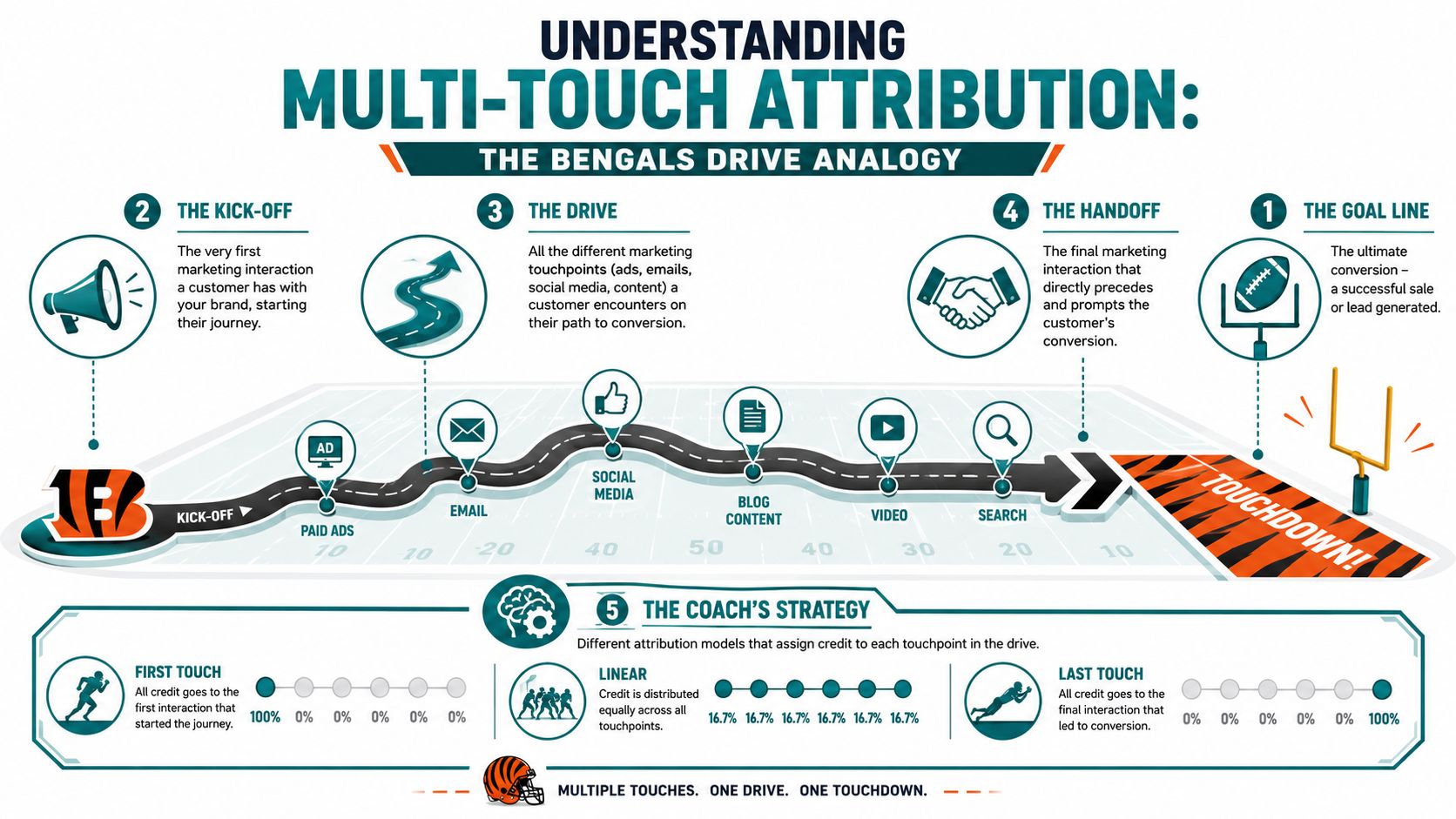
If someone first found your company through a blog post, came back later from a social ad, then searched your name on Google and filled out a form, last-click reporting usually gives all the credit to the branded Google search. That's like giving all the credit for a Bengals touchdown to the player who crossed the goal line and ignoring the pass, the block, and the earlier first down.
What gets missed in a typical report
Small and mid-sized businesses run into the same blind spots over and over:
-
SEO looks weaker than it really is because content often introduces people early, not at the moment they convert.
-
Paid search looks stronger than it really is because it often closes demand that another channel created.
-
Social media looks random because it assists more often than it finishes.
-
Direct traffic gets too much credit when tracking is incomplete.
That's why business owners start doubting their own numbers. The report isn't always wrong. It's just incomplete.
Practical rule: If one channel keeps getting all the credit, your measurement probably favors the last step in the journey, not the full journey.
A better approach is to look at the customer path as a sequence of interactions. That's what multi touch attribution does. It spreads credit across the touchpoints that influenced the result, instead of pretending one click did all the work.
For owners who want a clearer view of what's driving pipeline and sales, this kind of marketing analytics setup becomes much more useful than a simple traffic report. And if you're sorting out who should help manage paid campaigns in the first place, this breakdown of what a search engine marketing consultant does is a helpful companion read.
Why this matters to your bottom line
When reports over-credit closers and under-credit introducers, businesses make bad budget decisions. They cut the blog that started the conversation. They pause awareness campaigns that filled the funnel. They overfund the channel that happened to be last.
That's how decent marketing programs get hollowed out. The parts that build trust disappear first because they don't look flashy in a last-click dashboard.
What Is Multi-Touch Attribution Really
Multi touch attribution is a way to assign conversion credit across the full customer journey.
A touchpoint is any meaningful interaction a prospect has with your business. That could be seeing an ad, clicking a search result, reading a blog post, opening an email, or returning directly to your site after hearing about you elsewhere.
Consider a Bengals drive. The touchdown matters. So does the play that got the team out of its own end zone, the key third-down conversion, and the pass that set up the score. Looking only at the last play gives you a distorted view of what worked.
The basic idea in plain English
Multi touch attribution asks a simple business question:
Which marketing interactions helped move this customer toward becoming a lead or sale?
That matters because customers rarely buy the first time they hear about you. They bounce around. They compare options. They come back later. They need reminders. In local service businesses, they may research for days or weeks. In B2B, it can take much longer and involve several people.
According to Improvado's guide to multi-touch attribution, proper implementation has three phases. You collect granular data through tracking codes and UTMs across touchpoints, unify that data in a central place for storage and analysis, and then visualize it through dashboards so you can see how credit is distributed across the journey.
What makes it different from simple reporting
Simple reporting usually answers one narrow question: where did the converting session come from?
Multi touch attribution asks a better one: what sequence of interactions led to the conversion?
That shift changes how you evaluate marketing. A blog post may not close many deals directly, but it may introduce a lot of eventual buyers. An email might revive dormant prospects. A retargeting ad might keep your company visible until the buyer is ready.
Here's the practical point. The goal of multi touch attribution isn't complexity. It's fairness.
-
Fair credit for discovery when someone first learns about you
-
Fair credit for nurturing when content, email, or remarketing keeps the prospect engaged
-
Fair credit for conversion when a bottom-funnel click finally gets the lead across the line
If you want a broader view of how data should shape channel decisions, this piece on a data-driven marketing strategy connects the dots well. And if you want a plain-language overview of how attribution can optimize marketing ROI with attribution, that's a useful outside perspective too.
The best attribution setup doesn't just tell you what happened. It helps you decide what to keep, what to fix, and what to stop funding.
Common Attribution Models Explained for Business Owners
A Cincinnati business owner asks a fair question after hearing all this: "So which attribution model should I trust?"
The honest answer is simpler than agencies sometimes make it sound. An attribution model is just a rule for handing out credit across a buyer's path. The right model depends on the question you want answered, not on which one sounds the smartest in a slide deck.
If you run a roofing company in West Chester, a law firm downtown, or a B2B manufacturer up near Blue Ash, your real question usually comes down to this: are you trying to learn what starts leads, what helps move them along, or what finally gets them to call?
A plain-English comparison
| Model Type | How It Works | Best For |
|---|---|---|
| First-Touch | Gives credit to the first known interaction | Businesses focused on awareness and lead origination |
| Last-Touch | Gives credit to the final interaction before conversion | Businesses that care most about what closes immediately |
| Linear | Splits credit evenly across all touchpoints | Teams that want a simple team-effort view |
| Time-Decay | Gives more credit to touches closer to conversion | Businesses with shorter buying cycles or strong closing sequences |
| Data-Driven | Uses observed conversion patterns to assign more weight to certain touchpoints | Businesses with mature tracking and strong data quality |
What each model is really saying
First-Touch, who opened the door
First-touch gives all the credit to the first recorded interaction.
That helps when your main question is about lead origination. Maybe someone first found you through a Google search, a local article, or a paid social campaign. First-touch tells you which channels are introducing your business to new people.
The tradeoff is obvious. It treats every later interaction like it did not matter, even if email follow-up, remarketing, or a sales call did most of the convincing.
Last-Touch, who got the signature
Last-touch gives all the credit to the final interaction before the conversion.
This is the default in a lot of reporting tools because it is easy to explain. Someone clicked a branded search ad, filled out the form, and that channel gets the win.
The problem is that last-touch often flatters the channel closest to the finish line. It can make branded search, direct traffic, and remarketing look stronger than they really are because those channels often show up after earlier marketing already did the hard work.
A local example helps. If someone hears about your HVAC company from a Facebook ad, reads reviews a week later, then searches your brand name and calls, last-touch credits the branded search. That is not wrong. It is just incomplete.
Linear, everybody gets a share
Linear attribution splits credit evenly across every touchpoint.
Many business owners like this model because it matches how buying usually works in real life. People rarely convert because of one single interaction. They see you, check you out, come back later, then act.
Linear does not claim every touch mattered equally. It just uses an even split as a simple rule. If your priority is getting a fairer picture without making the report hard to follow, this is often a reasonable place to start.
Time-Decay, the closer touches count more
Time-decay spreads credit across the journey, but it gives more weight to interactions that happened closer to conversion.
This model fits businesses where timing matters a lot. If your buyers often need a reminder, an offer, or a final nudge before they call, later touches may deserve extra credit.
Still, this model bakes in an assumption. It assumes recency equals influence. Sometimes that is true. Sometimes the early touch did the actual persuasion and the later one just collected the lead.
Data-driven models. Useful, but not automatic
Data-Driven, the custom weighting option
Data-driven attribution uses observed conversion patterns to assign credit instead of following a fixed rule like first-touch or linear.
That sounds appealing, and it can be helpful. But for a local SMB, a little skepticism in this context is rewarding. If your CRM has messy source data, your forms are not passing tracking details, or your ad platforms are naming campaigns inconsistently, a more complex model can still give you bad answers. They just look more polished.
Earlier in the article, the Improvado source explained that algorithmic models weight touchpoints based on conversion patterns rather than a preset formula. That matters only when the inputs are trustworthy.
Put plainly, data-driven attribution is like asking a bookkeeper to sort out your finances with half the receipts missing. You might still get a report. You should not assume it reflects reality.
If your agency cannot explain why a channel got credit in plain English, you do not have insight. You have a black box.
Questions to ask your agency before choosing a model
Use these questions in your next call or quarterly review:
-
What business question are we trying to answer? Are we measuring awareness, lead quality, sales efficiency, or what ultimately closes?
-
How many touchpoints are we effectively capturing? If calls, forms, CRM updates, and ad clicks are not connected, any model will have blind spots.
-
Which channels tend to get over-credited in this model? Every model has a bias. Ask them to name it.
-
Can you show me one real customer path from first visit to lead? A concrete example is easier to trust than a dashboard full of percentages.
-
What decision would change if we switched models? If the answer is vague, the exercise may be more about reporting than improvement.
For many SMBs, the best choice is not the most complex one. It is the one your team can explain, trust, and use to make better budget decisions.
Getting Your Business Ready for Attribution
A Cincinnati business owner sits down for a monthly marketing review and asks a simple question: "Which campaigns brought in the jobs we specifically want?" The agency opens three dashboards, the CRM, and a call tracking tool. Twenty minutes later, nobody can give a straight answer.
That is the true readiness test.
Before you spend time debating attribution models, make sure your tracking setup can follow a lead from first click to closed sale. If that path breaks in the middle, the final report will still look polished. It just will not be trustworthy.

Start with a simple audit
You do not need a data team to begin. You need a checklist and a little discipline.
Look at every place a prospect can raise their hand:
-
website forms
-
phone calls
-
chat tools
-
appointment schedulers
-
quote requests
-
CRM entries from sales reps
-
offline leads that later get entered manually
Then ask one practical question for each source: Can we see where this lead came from, in plain English, without guessing?
If the answer is no, fix that first.
Clean up your UTM habits
UTMs are the labels attached to links so analytics tools can tell one campaign from another. They work like the job ticket on a work order. If the ticket is missing or filled out three different ways, the back office has to guess what happened.
That is why naming conventions matter so much for SMBs.
If one person tags traffic as "Facebook," another uses "facebook_paid," and your agency uses "Meta," your reports split one channel into three buckets. You cannot make smart budget decisions from messy labels.
A workable naming standard can be boring on purpose:
-
Use one agreed source name for each platform
-
Use one agreed medium name for paid, organic, email, and referral traffic
-
Use campaign names your team will still understand six months from now
-
Keep a shared reference sheet so nobody invents labels on the fly
Boring is good here. Boring gives you clean reports.
Make sure your CRM is part of the story
A lot of local companies in Cincinnati often get stuck. Marketing can show clicks and form fills, but sales lives somewhere else.
If the CRM does not store original lead source, latest lead source, and final revenue outcome, attribution stops at the lead stage. That may be enough for an ecommerce store with instant purchases. It is usually not enough for a roofing company, law firm, manufacturer, med spa, or home service business with a longer sales cycle.
You want to connect three moments:
-
How the person first found you
-
What they did before becoming a lead
-
Whether they became real revenue
Without that connection, your reports may reward cheap leads instead of profitable customers.
Check whether calls are treated like first-class conversions
For many local businesses, the phone is still the sale.
If your reporting tracks forms but ignores calls, attribution will over-credit channels that drive web submissions and under-credit channels that make the phone ring. Paid search often gets judged this way. So does Local Services Ads, branded search, and high-intent mobile traffic.
Ask your agency these questions:
-
Are calls from ads tracked separately from calls from organic traffic?
-
Do calls pass source data into the CRM?
-
Can we separate junk calls from qualified opportunities?
-
Are repeat callers being counted correctly?
That last point matters more than people expect.
Standardize what counts as a conversion
A page visit is not the same as a qualified lead. A whitepaper download is not the same as a booked estimate. If every action gets lumped together, attribution reports can make weak campaigns look stronger than they are.
Set clear conversion tiers your whole team agrees on. For example:
-
Primary conversions: booked consultation, quote request, sales call, completed purchase
-
Secondary conversions: form start, brochure download, email signup, video view
This keeps your reporting tied to business outcomes instead of vanity activity.
Assign one owner for tracking hygiene
Attribution breaks slowly. A form gets replaced. A landing page goes live without UTMs. A CRM field stops syncing. Six months later, everyone is arguing over bad data.
One person should own the checklist, even if they are not doing every task. That can be someone on your team or your agency, but the responsibility should be clear.
Their job is simple:
-
review tagging conventions
-
spot missing source data
-
test forms and call tracking
-
check CRM field mapping
-
flag changes before reports go sideways
If nobody owns this, nobody catches the small errors.
Plan for privacy and durability
Tracking has gotten less dependable across browsers and devices, so local businesses need cleaner first-party data practices. In plain terms, collect the information you need, store it correctly, and rely less on shortcuts that disappear when platforms change their rules.
For a business owner, that usually means asking better questions, not learning code:
-
Are we capturing lead source in systems we control?
-
If ad platform data disappears, what still remains in our CRM?
-
Are we relying too heavily on one platform to grade its own homework?
-
Will our setup still work if cookies become less useful?
Owner's shortcut: If your team cannot trace one new customer from first touch to signed deal without piecing together multiple screenshots, your business is not ready for advanced attribution yet.
That is not bad news. It is a practical starting point. Get the basics clean, and multi touch attribution becomes a tool for better decisions instead of another dashboard nobody trusts.
When to Use MTA vs Other Measurement Methods
A lot of business owners hear "attribution" and assume there's one right way to measure marketing. There isn't.
Multi touch attribution and marketing mix modeling, often shortened to MMM, solve different problems. One isn't the replacement for the other.
Think map versus GPS
MMM is like looking at a regional highway map. It helps you decide broad spending questions such as whether radio, paid search, or digital video deserves more investment over time.
MTA is like turn-by-turn GPS for one trip. It shows how a specific customer journey unfolded across individual interactions.
That distinction matters because the level of detail is different. MTA works at a granular, user-level basis, while MMM uses aggregate channel-level data, as explained in HockeyStack's B2B multi-touch attribution overview.
When MTA makes more sense
MTA is the better fit when you need to understand:
-
How leads move across channels before converting
-
Which touchpoints assist deals even when they don't close them
-
What happens in longer consideration cycles
-
How digital channels support each other
This is especially useful for service businesses, professional firms, manufacturers, and other companies where people rarely convert after one visit.
When MMM is the better tool
MMM is better when the question is broader.
If you want to know whether a category of spend is lifting demand overall, or whether a whole region or media type is worth more budget, MMM can be useful. It's less about one customer path and more about bigger allocation decisions.
For many SMBs, though, MMM is more than they need at first. They usually get more immediate value from understanding individual conversion paths before they move up to higher-level modeling.
Why B2B businesses care so much about MTA
Here, MTA becomes especially practical.
In complex B2B sales, attribution can use account-based modeling to assign revenue across multiple stakeholders involved in one buying decision, rather than crediting a single click. HockeyStack also notes that revenue reconciliation matters. If a $75,000 deal has three touchpoints, the total credit assigned across those touches must still equal exactly $75,000. Otherwise, the reporting inflates value and misleads the business.
That's not just a technical detail. It protects your ROI analysis from nonsense.
Good attribution accounting should work like real accounting. The totals need to reconcile, or the report isn't trustworthy.
For a Cincinnati manufacturer, software company, or professional service firm with a longer sales cycle, this is often the moment attribution starts to feel relevant. One person may click an ad, another may attend a demo, and another may sign the agreement. A single-touch model can't explain that well.
Making Attribution Actionable for Your Cincinnati Business
A Cincinnati business owner reviews the monthly marketing report and sees paid search listed as the winner again. So the instinct is simple. Put more money there.
That decision can be expensive if paid search is only getting credit for customers who were already warmed up by SEO, email, social, or referral traffic.
Attribution earns its keep when it changes what you do next. If it never affects budget, creative, landing pages, or follow-up, it is just a nicer-looking report.

Example one, a Cincinnati law firm
A law firm may look at last-click reporting and decide Google Ads are carrying the whole load because many form fills happen after a search.
A better attribution view often shows a more realistic story. A prospective client first finds a blog post answering a local legal question. They read for a few minutes, leave, talk it over with a spouse, come back later by searching the firm name, then submit the form.
That matters because the blog post did the job of introducing trust. Branded search finished the trip. If the firm only rewards the final click, it may underinvest in the content that starts good cases in the first place.
Example two, a Dayton-area manufacturer
A manufacturer with a long sales cycle might see LinkedIn produce very few final conversions in standard reports.
That can lead to the wrong conclusion. In many B2B paths, LinkedIn starts the conversation, paid search helps buyers compare options, and direct visits or sales outreach close the deal. The first touch is not less valuable just because it did not appear at the end.
A lot of SMBs get tripped up here. They judge every channel by the same standard, even though channels play different positions. Some get attention. Some build credibility. Some collect the lead.
What useful attribution looks like in practice
For a business owner, actionable attribution should answer plain-English questions:
-
Which channels introduce new prospects who would not have found us otherwise?
-
Which channels help people return after they already know our name?
-
Where are we losing people between the ad, the page, and the form?
-
Which campaigns look efficient only because they capture demand created somewhere else?
That is the difference between theory and something you can use on Monday morning.
If paid media is part of your mix, your attribution review should connect directly to how campaigns are planned, targeted, and judged. This overview of paid media strategy and execution shows the kind of business-first thinking that should sit behind the numbers.
Attribution should help you ask better questions, not admire cleaner charts.
A good report helps you keep patience with channels that create demand early, fix weak handoffs in the middle, and stop overcrediting the channels that appear at the finish line. For Cincinnati companies, that can mean fewer bad budget cuts and better growth decisions grounded in how customers purchase.
If your business is ready to move beyond last-click guesswork, HDM can help you build a cleaner measurement foundation, connect your website and marketing data, and turn attribution into practical growth decisions. For Cincinnati-area companies investing in web design, SEO, paid media, or analytics, that clarity can keep you from cutting the channels that are contributing to key outcomes.