


A full schedule does not mean the practice is growing the right way. Your front desk can be busy, your referral base can be steady, and your website can still miss the patients who are actively looking for care nearby. For a doctor, seo services for doctors should be measured by booked visits, calls, and map-pack visibility. Searchers who type "doctor near me" or "dermatologist in Cincinnati" are already close to choosing, and the practice that appears first often gets the call, especially when the patient is comparing a few providers before booking.
Organic search is not a vanity channel. It is intake. The economics are hard to ignore. A healthcare SEO review found that 46% of all Google searches have local intent, and organic search drives 54% to 68% of new patient website sessions for health and wellness practices, while SEO can run at $40 to $90 per lead versus $120 to $200+ per lead for paid search. For a practice owner, that changes the decision from "Do we need more traffic?" to "Which channel buys more booked visits at a lower cost?"
The trust side matters too. Patients do not book based on a website visit alone. They scan the name, the location, the reviews, the service line, and whether the practice looks like a real local option they can contact today. If your site ranks but fails to turn that interest into calls or appointment requests, the problem is not visibility. It is conversion.
That is why a doctor should judge SEO by what it moves in the business. Map-pack views tell you whether local search can find you. Calls tell you whether searchers trust you enough to reach out. Booked visits tell you whether the campaign is paying for itself. If a vendor cannot connect their work to those outcomes, the work is too vague to manage and too expensive to trust.
Why SEO Is the Practice's Quietest Growth Channel
A doctor's week is already packed. Patients need attention, staff need direction, claims need cleanup, and the front desk cannot absorb more noise. Still, a practice can look busy and miss the patients who are already searching for care nearby. That is why seo services for doctors should be measured by booked visits, calls, and map-pack visibility. If someone searches "doctor near me" or "dermatologist in Cincinnati," the practice that appears first often gets the first call, especially when the patient is comparing a few providers before booking. Organic search is not a vanity channel. It is intake.
What changed and why it matters now
The economics are clear. Analysts at Healthgrades and similar healthcare marketers consistently show that organic search brings in a large share of new patient website sessions, and SEO usually costs less per lead than paid search. For a practice owner, that changes the question from "How much traffic did we get?" to "How many qualified patients did this turn into?"
Trust matters just as much. Google now expects medical sites to look credible, specific, and clinically grounded, and weak E-E-A-T signals can drag visibility down. If your site looks thin, generic, or disconnected from real patient needs, it will struggle to win attention from searchers or from search engines.
Key Insight: If a vendor talks about rankings but cannot connect them to booked visits, calls, or consult requests, you are paying for motion instead of growth.
The three things that move the needle
Local visibility gets you found near the patient. Trust signals make the practice believable. Content that search engines can extract gives Google and AI systems something clean to surface. That is the right way to judge return on investment. Do not ask how many pages got published. Ask how many more qualified patients found the practice, called, and showed up.
If you already have a broader marketing plan, keep SEO tied to intake goals, not vanity metrics. A practical place to start is this digital marketing guide for healthcare practices. If you also need the site itself to load quickly enough to keep patients from bouncing, make sure you speed up your WordPress site before you spend more on content or ads.
Local SEO Foundations Every Doctor Needs
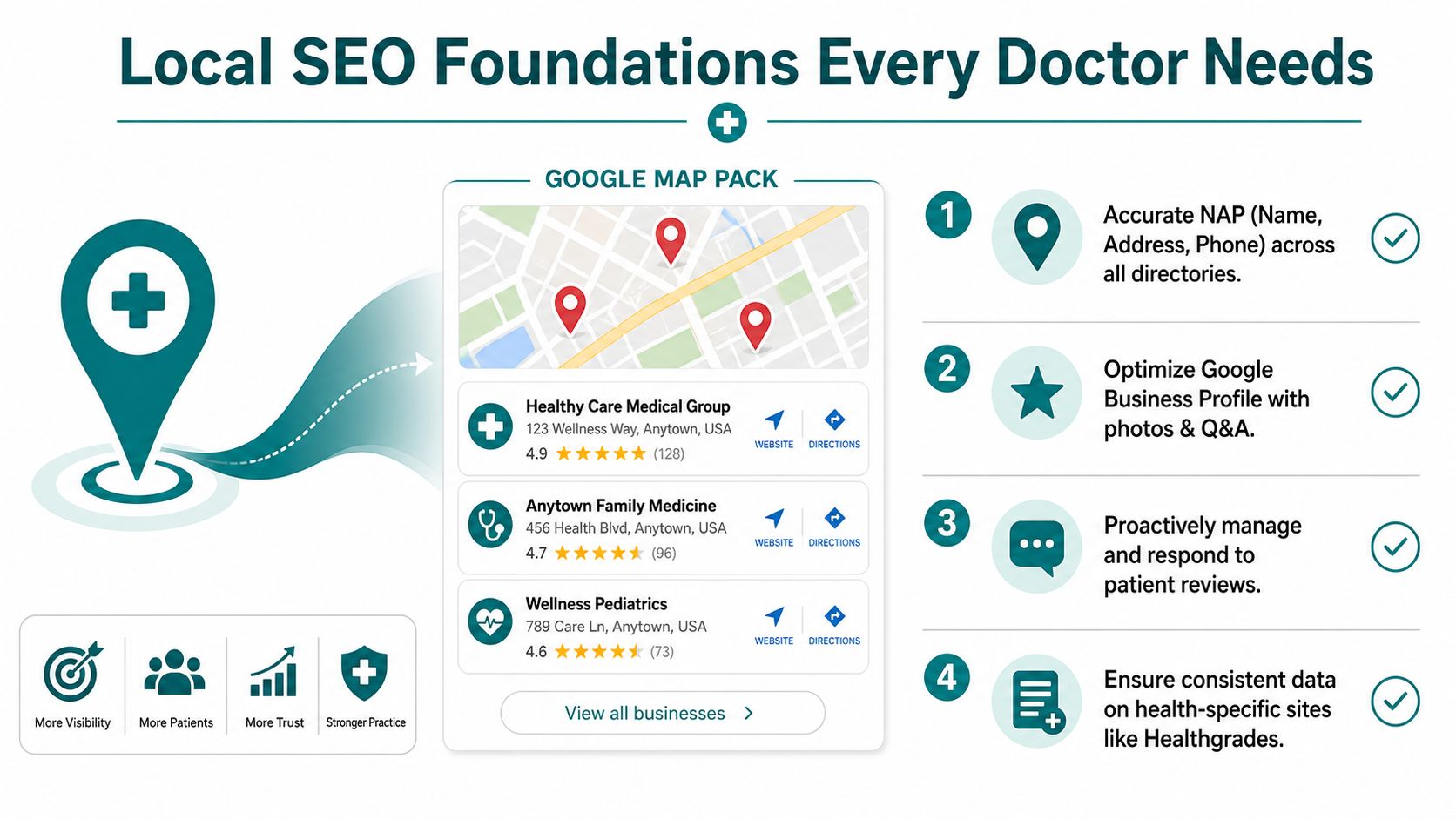
A patient in Cincinnati does not start with your homepage. They search the map pack, compare nearby practices, check reviews, scan hours, and tap the phone number that looks easiest to trust. That makes local SEO the first growth system to get right.
The business case is simple. Local search is tied to calls, booked visits, and direction taps, not just visibility. A healthcare SEO compilation reports that 78% of local mobile searches lead to offline purchases or appointments, and 76% of people who search for something nearby visit a related medical business within 24 hours. For a practice owner, that is appointment intent, not vanity traffic.
What has to be in place
A Google Business Profile needs to be complete, current, and consistent. That means hours, phone number, images, clear address data, and the same practice name wherever the business appears online. It also means NAP consistency, name, address, and phone, across directories and the practice's own site, because search engines use that consistency to judge whether the business is real and relevant.
For multi-location groups, each location needs its own page with unique content. Copying the same service text across five cities is a fast way to flatten performance. Google can see the duplication, and patients can tell when the page was written for a template instead of their location.
Structured data belongs here too. Schema markup helps search engines interpret the practice as a medical entity, understand specialties, and connect the business to its location. That matters because the map pack often filters the field before a patient ever reaches the website.
If you want a practical model for how local trust and content work together, the ethical SEO guide for law firms shows the same principle in another regulated market, specific local signals beat generic marketing language.
The tangible results of local SEO
Local SEO moves map-pack views, direction taps, call clicks, and walk-in intent. It shortens the distance between search and action, which is why it pays off so fast for medical practices.
A Cincinnati practice should treat the Google Business Profile like a live patient-access asset, not a directory listing. If hours change, services expand, or the front desk number shifts, those updates need to go everywhere right away. Keep the name identical, keep the address exact, keep the phone current, and keep the service descriptions written for the patient who is comparing three options at once. That is the standard.
On-Page and Technical SEO That Builds Trust
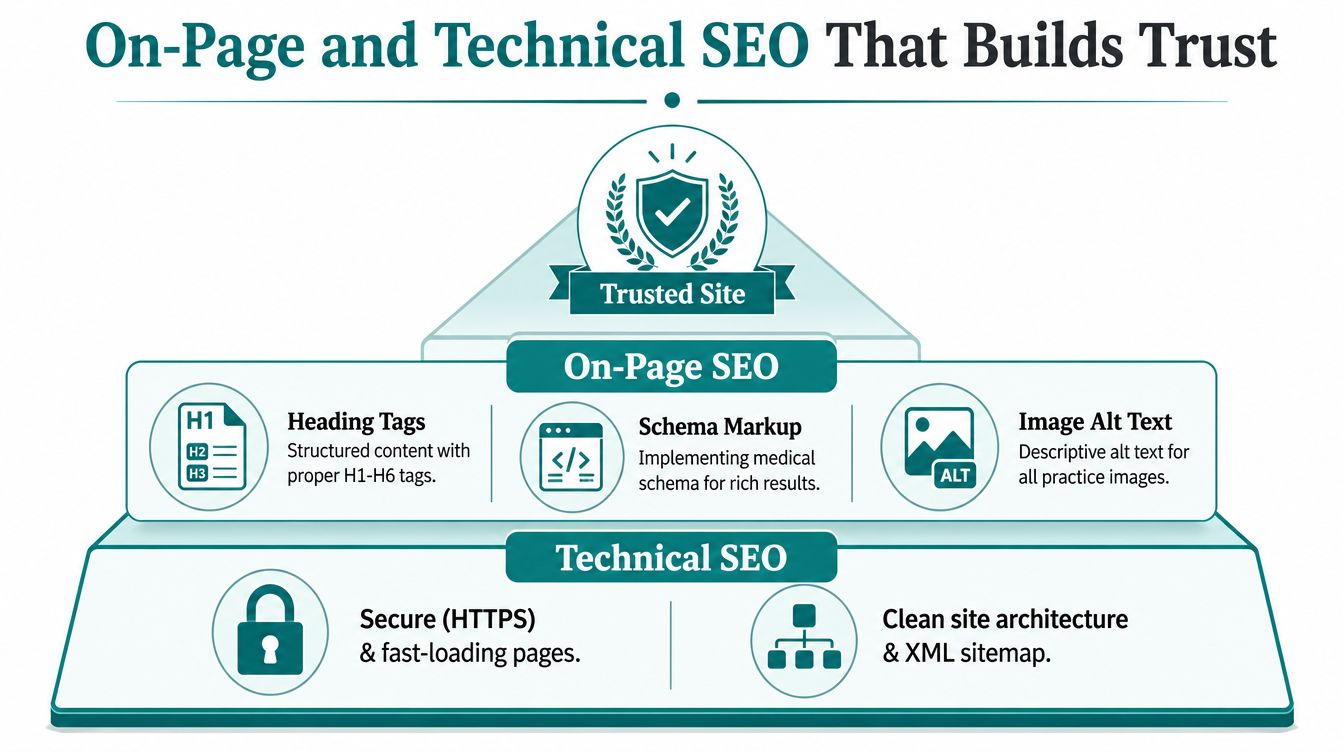
Local visibility gets attention. The website closes the gap. If the practice site looks thin, slow, or vague, patients hesitate and Google has less reason to trust it.
The site structure patients and search engines can read
Every major service needs its own page. A page for dermatology in Cincinnati is not the same as a page for acne treatment, and neither should be forced into a single catch-all template. Search engines do better when the page has one clear topic and one clear intent.
That structure also helps the patient. A person searching for a treatment wants direct answers, not a maze of generalities. If the page starts with a service overview, follows with who it's for, and then explains next steps, the site feels organized and the visitor stays longer.
Schema markup should support the page structure. Use medical schema where appropriate, and make sure the site is secure with HTTPS, loads quickly on mobile, and has a clean sitemap. For WordPress sites that feel sluggish, a practical place to start is a resource on how to speed up your WordPress site.
Why trust signals aren't optional anymore
Medical content sits in YMYL, so Google applies a higher standard to it. That means E-E-A-T is not a branding exercise, it is part of the site's ability to earn visibility. Author pages, clinician credentials, and clear site organization help search engines understand who is speaking and why a patient should trust the page.
A clean technical review should also check whether buttons are easy to tap on mobile and whether contact paths are obvious. If a patient cannot call or submit a form in one or two taps, the site is leaking leads.
The main domain is where authority collects, so the practice's root domain should stay the center of the site architecture. Major location pages and service pages should reinforce that core identity, not scatter it. A root domain explanation covers the concept in plain terms for owners who want to understand how the site should be organized.
Writing Medical Content That Ranks and Respects Patients
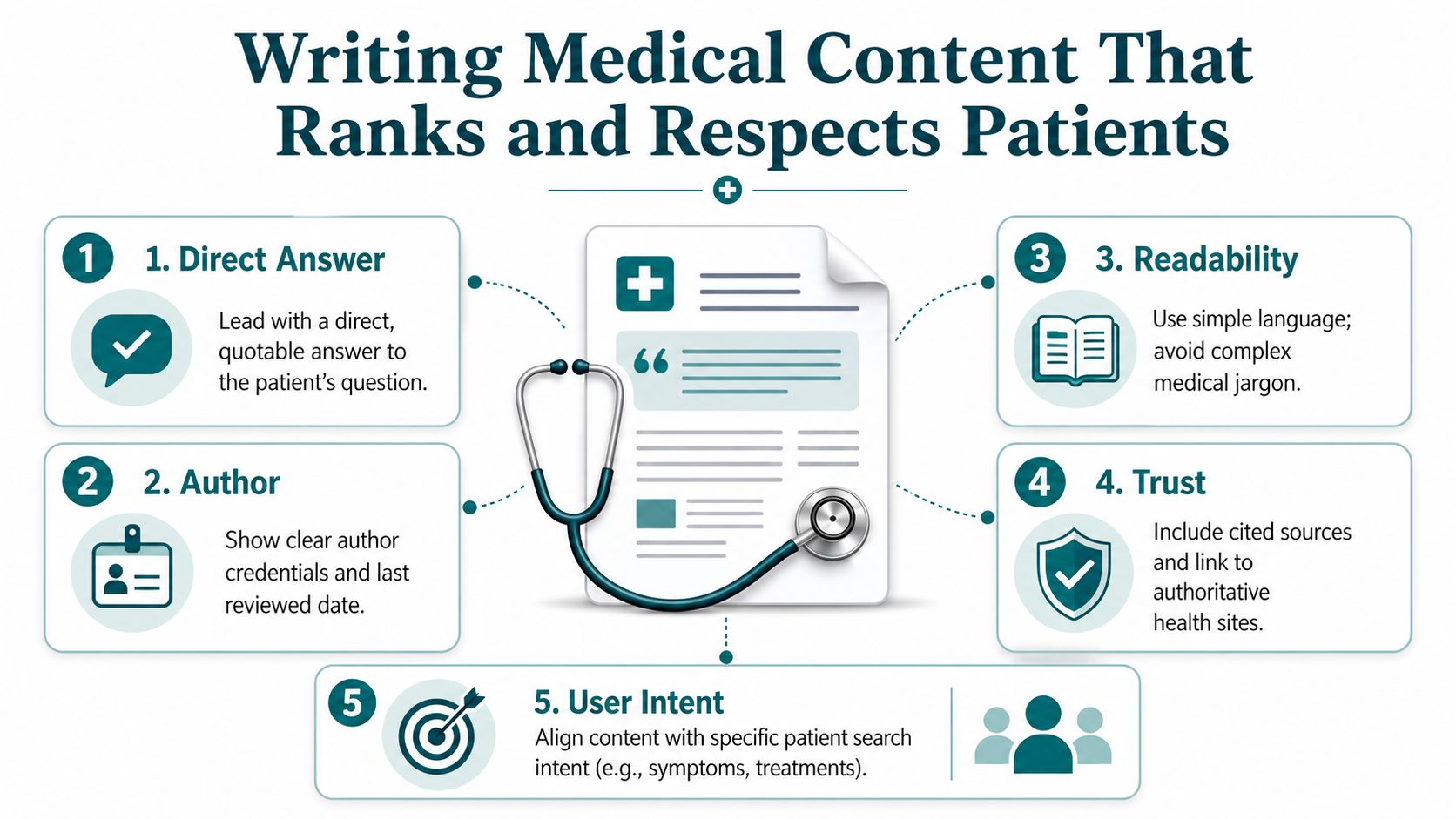
Medical content fails when it tries to sound impressive instead of useful. Patients want a straight answer. Google wants a page it can understand. AI systems want clean structure they can extract without guessing.
The strongest medical pages start with the answer, then back it up with evidence. Doctor-focused SEO guidance points to direct, quotable answers, named clinician authors, and citations from trusted medical sources like PubMed, Mayo Clinic, or the CDC when a page makes clinical claims.
What each page type should do
A condition page should explain symptoms, when to seek care, and what a patient can expect. A treatment page should describe the procedure, recovery, and the practical next steps a patient needs after reading. An FAQ page should answer short questions in plain language, because those pages are the ones most likely to be pulled into AI summaries and snippet-style results.
Content should also show the clinician behind the advice. Credentialed bylines, board certifications, and a visible editorial policy tell patients that the content was reviewed by someone who knows the field. That is not decoration. It is trust architecture, and it helps a practice turn page views into booked visits.
Key Insight: Write for the anxious patient sitting in a car outside the office, not for another marketer reading an SEO checklist.
What to avoid
Do not bury the answer in a long intro. Do not stuff in jargon. Do not publish broad treatment copy with no author, no citations, and no review note. If you want a useful comparison point outside medicine, look at how a strong ethical SEO guide for law firms handles credibility, specificity, and plain-language explanation. The principle is the same. In healthcare, the sourcing and review bar is higher, because the content has to help patients make real decisions.
The practical standard is simple. If a page cannot be read aloud in a few seconds and still make sense, it is probably not ready for patients or search.
Reviews, Reputation, and HIPAA-Aware Response Workflows
Reviews aren't a finishing touch. They're part of the ranking system and part of the conversion system. Patients read them, Google weighs them, and the front desk lives with the result.
A good review workflow starts with timing. Ask at the right moment, usually after a successful visit or procedure, and make the ask easy to complete. Then keep the process consistent so the practice doesn't depend on one staff member remembering to do it.
What to say and what not to say
A reply to a review can acknowledge the experience without confirming the person was a patient. That line matters. The practice can be polite, factual, and grateful without crossing into protected health information. When a review is negative, don't argue in public. Acknowledge the feedback, invite the person to contact the office directly, and keep the reply short. The goal is to show future patients that the practice is responsive and controlled, not defensive.
For the compliance side of the house, keep your website and marketing workflows aligned with HIPAA rules. A practical reference for that is HIPAA website compliance guidance, because review response, form handling, and site content all sit close to patient data.
What reputation work actually moves
Reviews move click-through rate, trust, and local visibility. They also help a practice stand out when patients are comparing providers with similar credentials and similar services. A simple standard works well for most Cincinnati practices:
- Ask consistently: Request reviews after visits when the patient experience is fresh.
- Respond quickly: Keep public replies short, professional, and HIPAA-aware.
- Track themes: Watch for repeated comments about wait times, bedside manner, or front desk communication.
- Fix what repeats: If the same complaint shows up again and again, it's an operations issue, not just a reputation issue.
That's the right mindset. Reviews are not just social proof, they're operational feedback that also happens to influence search.
Pricing, Timelines, and Measuring the ROI of Doctor SEO
Most practices ask the wrong first question. They ask what SEO costs before they ask what it has to deliver. Ask what it should move instead, booked visits, calls, or map-pack exposure, and how long the work needs before it pays back.
The price range is wide for a reason. A medical SEO pricing guide cites monthly bands from about $500 to $15,000+, depending on practice size, competition, number of locations, and scope. That spread is exactly why cheap SEO gets expensive fast, because the work gets cut until it cannot influence patient acquisition in any meaningful way.
Medical SEO Pricing Bands in 2026
| Practice Profile | Typical Monthly Band | Scope | Time to Meaningful Results |
|---|---|---|---|
| Single-location practice | Lower end of the broad market range | Local SEO, core service pages, reviews, reporting | 4 to 12 months |
| Growing multi-location group | Mid-market range | Location pages, content, technical cleanup, citation control | 4 to 12 months |
| Competitive specialty practice | Higher end of the broad market range | Deeper content, authority work, technical SEO, ongoing optimization | 4 to 12 months |
Pricing should map to the work that changes booked visits, call volume, and map-pack visibility. A practice that needs one location cleaned up is buying a different outcome than a multi-location group trying to hold share in a crowded metro. The budget should match the revenue opportunity, not a generic retainer template.
Competition drives cost first. So does the number of pages that need to be built or fixed, the number of locations that need consistent data, and the amount of clinician review required before anything goes live. A dermatology practice in a dense metro has a very different workload than a low-competition specialty in a smaller market.
The right ROI question is simple. Are the phones ringing with qualified calls, are more people booking, and are more local searchers seeing the practice in the map pack? Rankings matter only if they feed those outcomes. If visibility rises but leads stay weak, the campaign is missing the mark. Use the budget to buy the work that produces appointments, not the invoice that looks easiest to approve.
A Vendor Checklist That Filters Out the Bloat
Picking the wrong SEO partner can waste a year. The right one should be able to show what was done, why it was done, and what changed because of it. A Cincinnati practice should ask whether the vendor understands local search, medical trust signals, and HIPAA-aware workflows. A local agency like HDM brings 20+ years of experience and works with healthcare clients using HIPAA-aware delivery, which is the kind of operational detail that matters when a site handles real patient intent.
Questions that expose weak vendors
Ask these in the sales call, and don't let anyone skate past them:
- What will you change in the first 30 days? You want a concrete plan, not a pitch deck.
- How do you measure success? Look for booked appointments, calls, and qualified leads.
- Who writes and reviews medical content? There should be clinician oversight or a documented medical review process.
- How do you handle AI search and E-E-A-T? If the answer is vague, the strategy is dated.
- What do monthly reports include? You want transparent, custom reporting, not a generic dashboard.
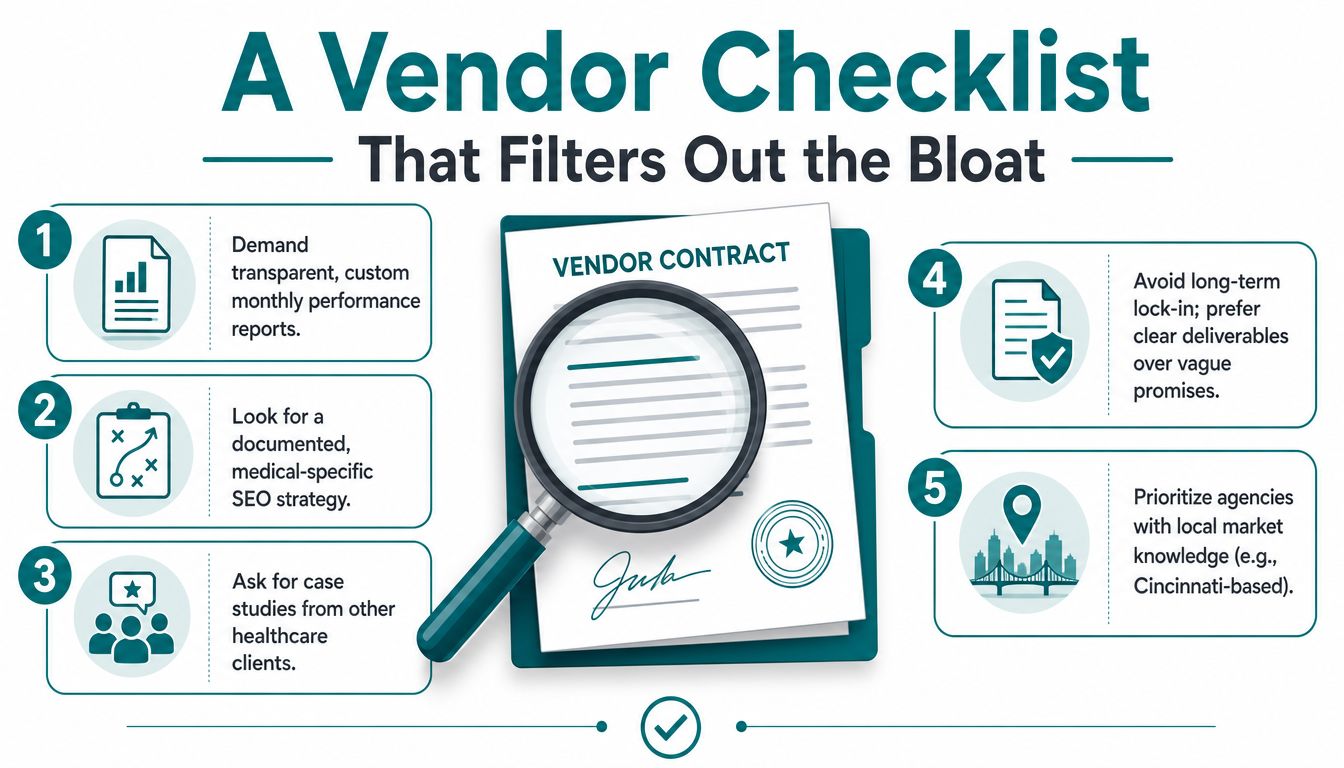
Avoid vendors who sell only keywords, promise instant results, or lock you into long contracts without clear deliverables. Also avoid anyone who won't explain local SEO, content standards, or technical fixes in plain English. A strong vendor should be able to talk about technical audits, on-page optimization, content creation, and link building without hiding behind jargon. If they can't explain the work to a non-technical practice owner, they probably can't manage it well either.
For a healthcare practice, the best relationship is simple. You know what they're doing, they know what changed, and the report ties back to real patient acquisition.
Your 30/60/90 Plan and Questions Doctors Actually Ask
Start with the basics and move fast on the parts that affect discovery. In the first 30 days, clean up the Google Business Profile, fix NAP inconsistencies, and audit the major directories the practice already appears in. In days 31 to 60, publish the core service and condition pages with named clinician bylines and clear patient-focused answers. By day 90, the practice should have a review request process, a response workflow, and a reporting cadence that shows what's happening with calls, map visibility, and appointment requests. That's enough to hold a vendor accountable without drowning in marketing noise.
The questions owners ask most
Is SEO HIPAA-compliant? The marketing itself can be, but the practice still needs to handle forms, reviews, and patient data carefully. Compliance lives in the workflow, not just on the homepage.
Do AI Overviews change the work? Yes, because clear structure, direct answers, and strong sourcing matter even more when search systems summarize content instead of just listing links.
How do I know if it's working? Track booked appointments, qualified calls, form submissions, and local visibility, not just pageviews. Those metrics tie closer to revenue.
What should I do Monday morning? Fix the profile, clean the listings, and demand a vendor report that shows patient-acquisition movement, not vanity metrics.
If you want a local partner that can handle the website, the SEO, and the ongoing maintenance without turning the job into a maze, start a conversation with HDM. Bring your current site, your service mix, and your target neighborhoods, and ask for a plan that connects search visibility to booked visits.