
You've probably reached the same point as many Cincinnati business owners: the products are ready, the brand looks solid, and Shopify appears simple until you're choosing a theme, connecting payment tools, fixing mobile layouts, planning SEO, and figuring out why checkout feels clumsy. A store can be technically live and still lose sales through slow pages, confusing navigation, weak product content, or disconnected systems.
That's where Shopify website development services become more than theme setup. The right partner helps you decide what to build, what not to build, and where custom engineering will improve revenue. For most local and regional businesses, the smartest answer is a well-structured modern theme with focused integrations. Headless Shopify can be excellent, but it shouldn't be treated as a trophy purchase.

What Shopify Website Development Services Actually Cover
A Cincinnati business owner may begin with a straightforward request: "Can you put our products into Shopify?" After the first conversation, the project usually looks different. The store may need a redesigned product page, inventory synchronization, a better mobile menu, local SEO foundations, customer reviews, subscription billing, shipping rules, analytics, and a checkout experience that doesn't create unnecessary hesitation.
That full scope is what separates a basic store setup from a strategic commerce build. Shopify's scale supports a large ecosystem of merchants and service providers. The company reported $11.55 billion in annual revenue in 2025, up from $8.88 billion in 2024, while its 2026 quarterly results continued at a high pace, with Q1 revenue of $3.17 billion and Q2 revenue of $3.58 billion, both roughly 34% year over year. Shopify also reported that merchants surpassed $100 billion in gross merchandise volume in a single quarter in Q1 2026. Those figures come from Shopify's investor financial reports, and they help explain why businesses can find mature tools, integrations, developers, and support around the platform.
The work behind a store that sells
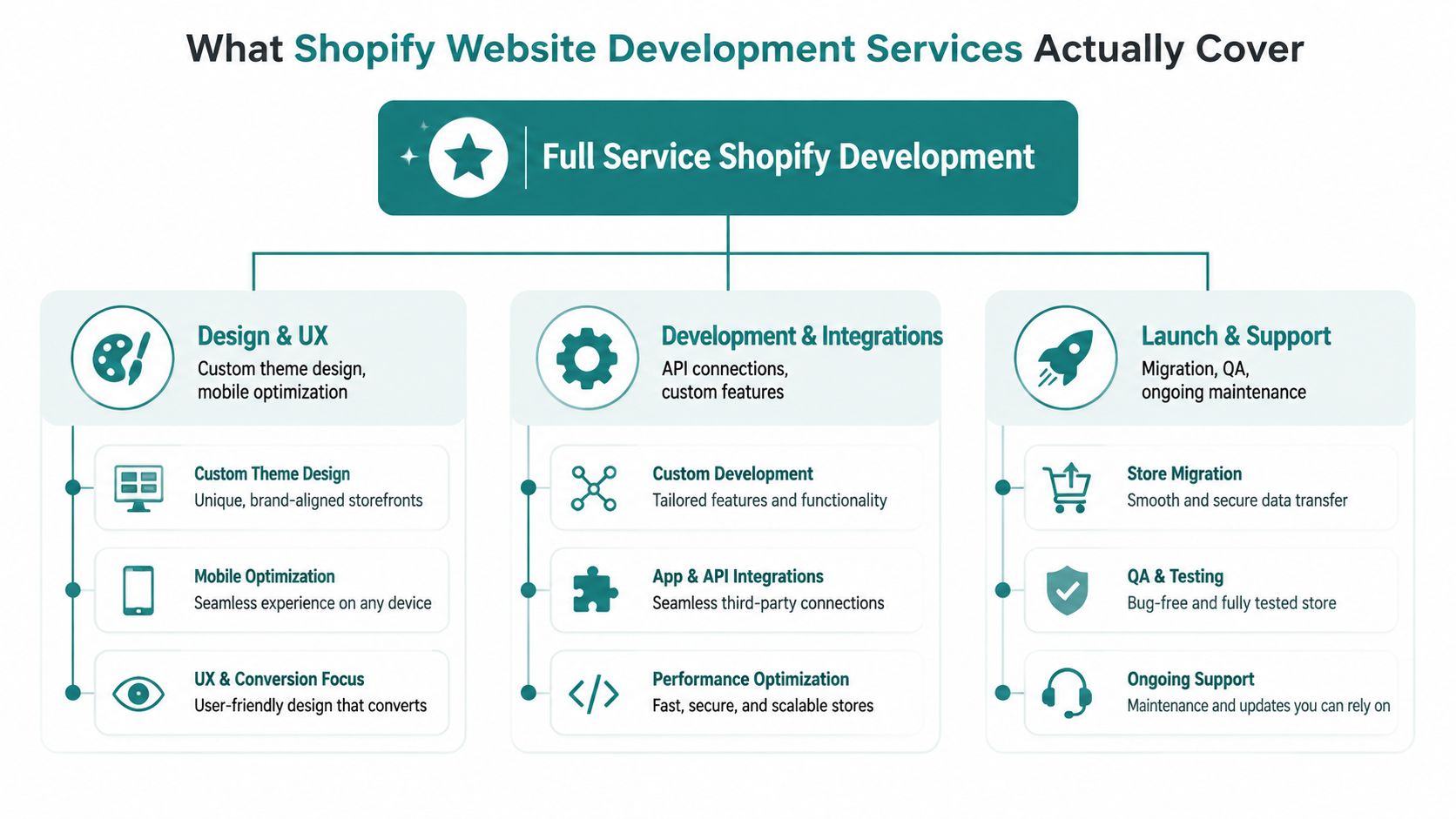
A capable Shopify team typically handles three connected areas:
- Design and user experience: Brand-aligned layouts, product discovery, mobile navigation, collection pages, photography direction, accessibility, and calls to action.
- Development and integrations: Theme customization, Liquid development, Shopify APIs, inventory tools, email platforms, customer relationship systems, reviews, subscriptions, search, and reporting.
- Launch and support: Content migration, redirects, quality assurance, analytics setup, staff training, monitoring, maintenance, and post-launch improvements.
A migration from WooCommerce, Magento, or a custom platform adds another layer. Product data, customer records, URLs, metadata, order history, and tracking must move without damaging search visibility or daily operations. If you're comparing platforms or looking for outside context on WooCommerce and Shopify site builders, focus on the actual business workflow rather than the platform label.
Basic setup versus strategic development
A basic project might configure an existing theme, add products, set up payments, and launch the store. That can be appropriate for a narrow catalog and a business that already has strong branding and clean product information.
Strategic development addresses the reasons people fail to buy. The agency studies how visitors arrive, what they need to understand, where they hesitate, and what your staff must manage after an order is placed. That may lead to a faster collection structure, clearer product comparisons, better shipping communication, or a custom integration instead of another disconnected app.
Practical rule: Pay for custom development when it removes a real sales or operational obstacle. Don't pay for custom code merely because a proposal makes the project sound sophisticated.
Core Service Types and What Each Delivers
Shopify development covers several distinct services. The right choice depends on your catalog, internal workflow, budget, and how much control your storefront needs.
| Service Type | Best For | Typical Complexity | Timeline |
|---|---|---|---|
| Theme-based build | Businesses launching or improving a standard online store | Low to moderate | Shorter |
| Custom theme development | Brands needing distinct layouts and stronger control over the shopping journey | Moderate | Moderate |
| Custom app development | Businesses with unique workflows that existing apps can't handle | Moderate to high | Moderate to extended |
| Headless commerce | Brands requiring a separate front end, unusual experiences, or advanced content systems | High | Extended |
| Platform migration | Businesses moving from WooCommerce, Magento, or a custom platform | Moderate to high | Moderate to extended |
| Third-party integrations | Stores connecting inventory, ERP, CRM, shipping, subscriptions, or marketing systems | Varies by system | Varies |
Theme-based builds
A modern Shopify theme keeps the store on Shopify's established architecture while allowing changes to layouts, product pages, navigation, and brand presentation. For many Cincinnati SMBs, this is the sensible starting point because it controls launch risk, development cost, and ongoing maintenance.
A theme build can include custom sections, improved product templates, filtering, merchandising, mobile optimization, structured content, and conversion testing. "Theme-based" does not mean generic. It means the team improves the customer experience without replacing the storefront foundation.
Custom apps and integrations
Custom app development fits businesses whose operations do not match a standard product catalog. A manufacturer may need a specialized quoting workflow. A retailer may require inventory rules that an off-the-shelf app cannot support. A service business may need bookings, deposits, or account-specific pricing.
Integrations require the same level of review. Connecting Shopify to an ERP, CRM, email platform, warehouse, or accounting system can affect orders, customer information, inventory, and fulfillment. A connector that works in a demo can fail in daily operations unless the agency defines data ownership, error handling, and timing. Ask who will monitor failures after launch and who is responsible for correcting them.
Headless and migration work
Headless commerce separates Shopify's commerce engine from the front end customers see. That gives developers more control over unusual experiences and content systems, but it also adds software to build, deploy, cache, test, and maintain. For a Cincinnati SMB, that engineering cost needs a clear business reason. A well-built modern theme will usually be the better investment unless the storefront demands capabilities that Shopify's standard architecture cannot provide.
A migration has a different goal. It is a controlled move that preserves useful data, search equity, tracking, and business continuity. Ask an agency which requirements need custom architecture and which Shopify capabilities can handle without extra code. Don't pay for custom code just to make the project sound impressive.
When Headless Shopify Is Worth the Investment
Headless Shopify is not automatically the premium choice. It separates the customer-facing front end from Shopify's back end, often using technologies such as React and Remix with Hydrogen. That architecture can support highly customized experiences, but it also demands stronger engineering, caching, deployment, and maintenance practices.
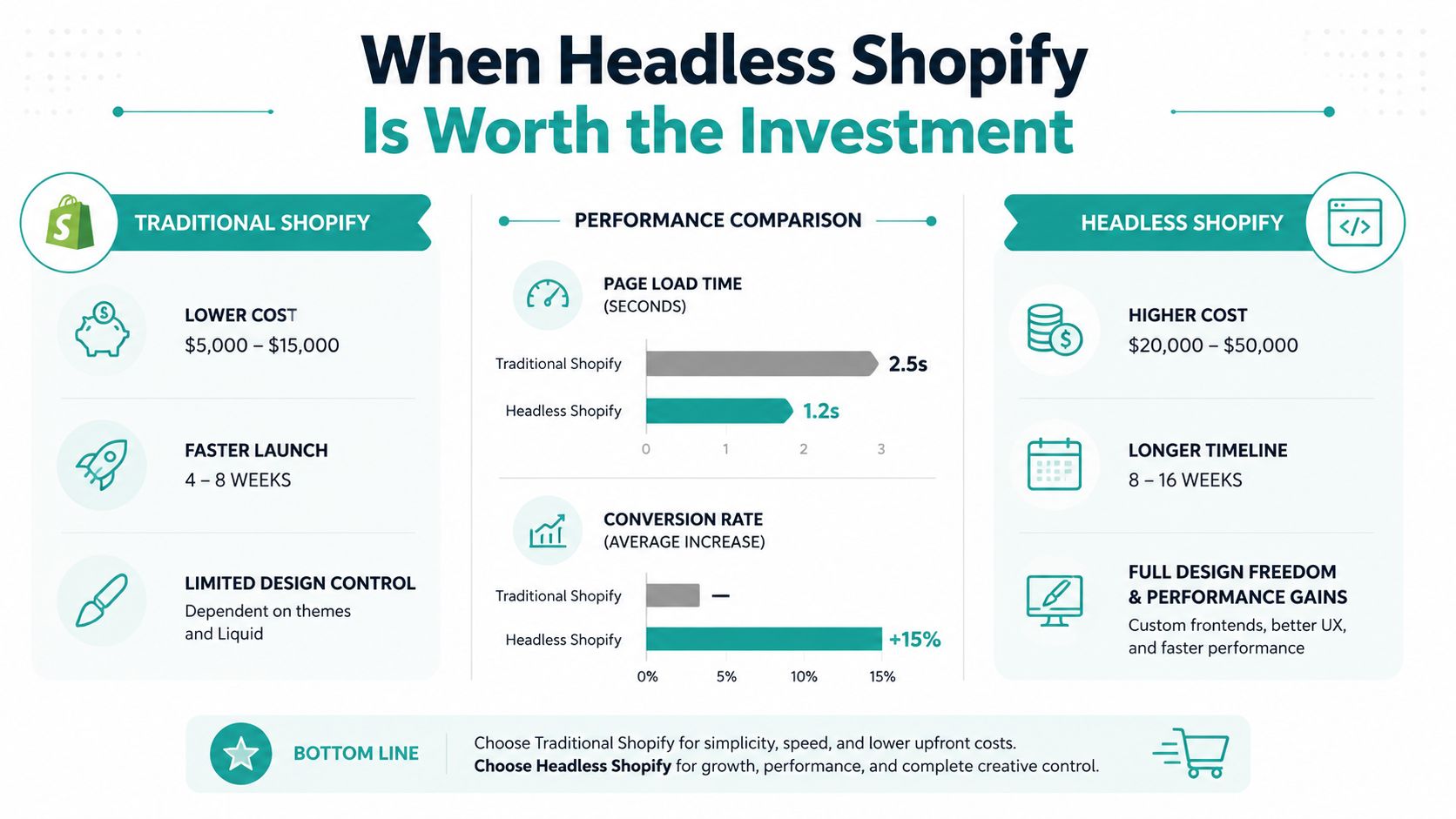
Independent benchmark reporting on headless Shopify storefronts found a median mobile LCP of 1.4 seconds for Hydrogen/Oxygen versus 2.0 seconds for traditional Shopify, a median INP of 110 milliseconds versus 185 milliseconds, and a Core Web Vitals pass rate of 78% versus 58% in the compared conditions. Those figures are reported by Weaverse's Liquid versus Hydrogen performance analysis. They show a meaningful technical advantage, not a guaranteed increase in sales.
What the performance difference means
Faster rendering can make products feel easier to browse, especially on mobile connections. Better interaction responsiveness can reduce the frustration that appears when filters, menus, cart controls, or variant selectors lag after a visitor taps them.
Shopify's official Hydrogen guidance treats performance as engineering work. Developers are advised to profile server-side CPU startup, inspect subrequest waterfalls, and analyze bundle size so they can reduce JavaScript weight and hydration cost. The Hydrogen performance guidance connects less rendering work and fewer subrequests with improvements to TTFB, LCP, and INP.
The catch is that headless performance doesn't happen by itself. A poorly cached headless storefront can be slower than a well-built theme. Your team also needs developers who can maintain the front end, manage releases, diagnose failures, and keep integrations stable.
The Cincinnati SMB decision
Headless is worth serious consideration when you have a genuine architectural requirement:
- A highly differentiated experience: Your store needs interactions or content structures that Shopify's theme system can't support cleanly.
- Complex content operations: Marketing teams need a separate content platform, publishing workflow, or multi-channel presentation.
- Multiple front ends: The same commerce engine serves several distinct customer experiences.
- A strong internal or agency engineering partner: Someone must own React, Remix, APIs, caching, testing, and deployment after launch.
For a local retailer, specialty manufacturer, or growing direct-to-consumer brand with a manageable catalog, a modern theme is usually the better investment. Recent industry commentary also notes that headless has cooled for many merchants because modern themes can deliver strong speed without the complexity burden. This headless commerce analysis is useful precisely because it challenges the assumption that every serious store needs a headless build.
For deeper technical context, review headless CMS implementation considerations before approving a proposal.
Pricing Tiers and Realistic Timelines for Cincinnati SMBs
A proposal should connect price to scope. If an agency gives you one large number without identifying the pages, integrations, migration work, testing, content responsibilities, and support included, you can't tell whether you're buying a focused build or unnecessary complexity.
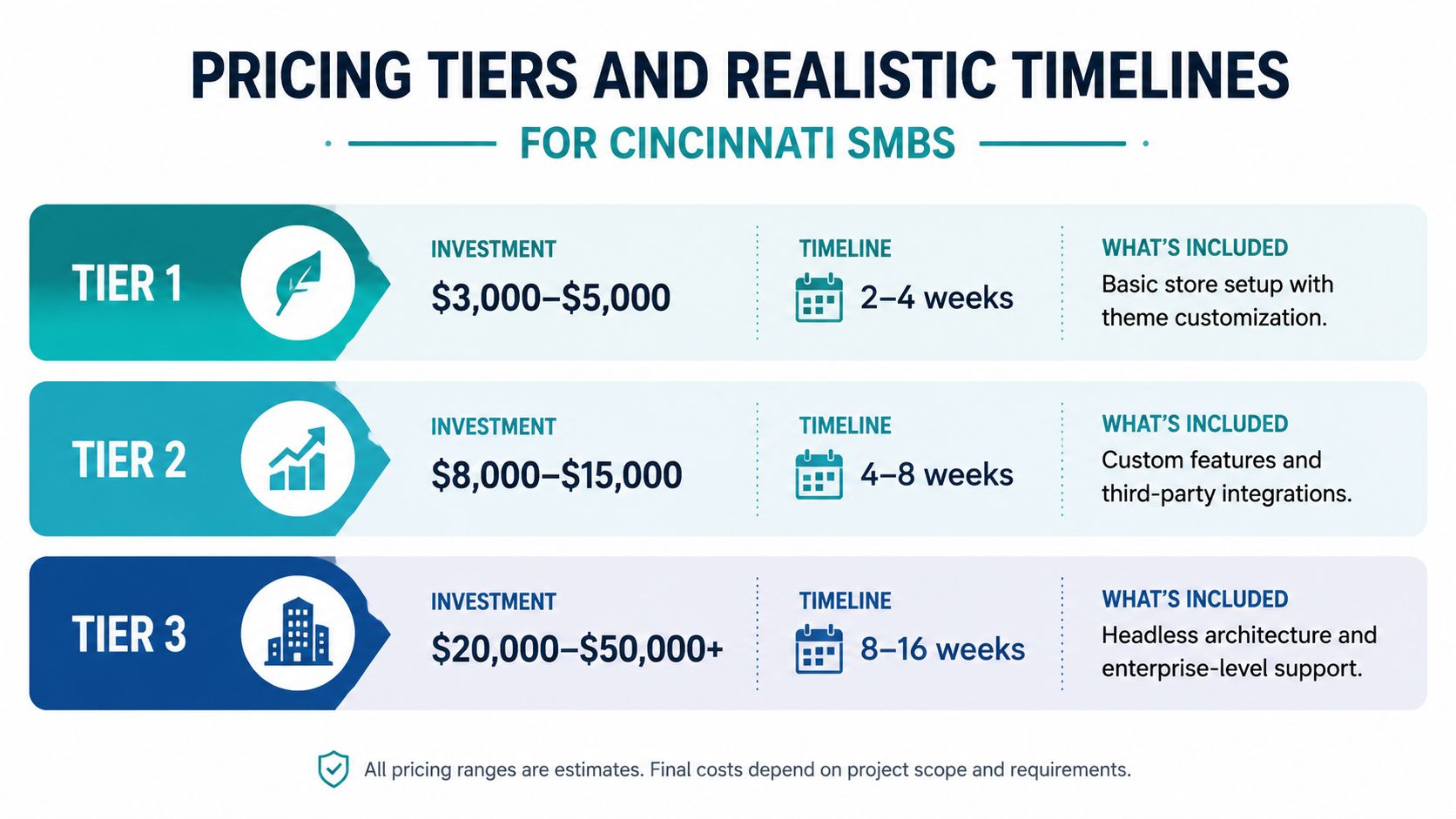
The following ranges are practical Cincinnati planning benchmarks for different project sizes. They're not universal quotes, and they shouldn't be presented as fixed market statistics. Your catalog, content readiness, integrations, internal availability, and approval speed will change the final proposal.
Three useful planning tiers
Starter theme build, $3,000 to $5,000, typically 2 to 4 weeks. This usually covers Shopify configuration, theme customization, core pages, product setup, payment settings, basic analytics, mobile checks, and launch support. It works when your brand assets and product information are already organized.
Growth build, $8,000 to $15,000, typically 4 to 8 weeks. This range is more appropriate for custom sections, stronger UX planning, third-party integrations, product filtering, migration assistance, conversion improvements, and more extensive quality assurance. You'll need clearer approvals and a named decision-maker on your side.
Advanced or headless build, $20,000 to $50,000 or more, typically 8 to 16 weeks. This covers complex front-end work, custom architecture, enterprise-level integrations, deeper performance engineering, migration risk, and ongoing technical support. The investment makes sense only when the business case requires that level of control.
For a broader Ohio benchmark, compare the scope questions in HDM's web development cost guide for Ohio in 2026.
Costs that continue after launch
The project invoice isn't the whole ownership cost. Plan for Shopify fees, paid apps, email and review platforms, payment processing, content production, maintenance, analytics, SEO, and occasional development. Headless builds can add more hosting, deployment, monitoring, and engineering responsibilities.
Ask for an itemized quote that separates design, development, migration, integrations, testing, training, and maintenance. Also ask what happens when an app changes its API, a theme needs updating, or your staff wants a new product workflow.
Budget test: If the proposed build won't leave room for product photography, content, SEO, analytics, and post-launch improvement, the budget is incomplete.
How to Evaluate and Choose the Right Shopify Agency
Start with relevance, not presentation quality. An agency can produce beautiful mockups and still misunderstand your fulfillment process, customer acquisition model, legal obligations, or local market.
A Cincinnati healthcare organization may need a HIPAA-conscious approach to patient experiences and connected systems. A law firm needs a site designed around qualified inquiries, trust, practice-area content, and client acquisition. A manufacturer may care more about quote requests, account pricing, technical product data, and sales-team workflows than online impulse purchases.
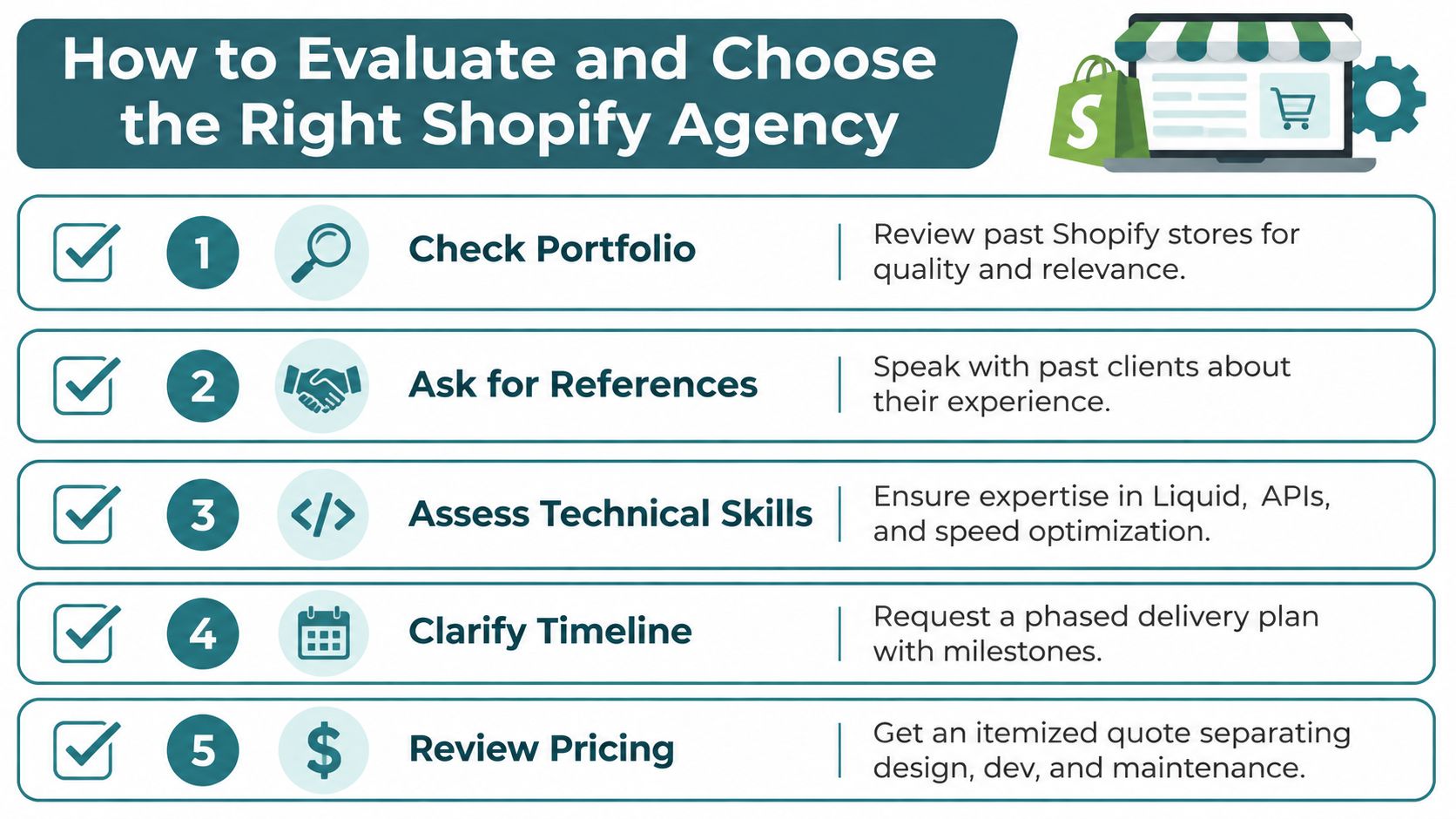
Use this evaluation checklist
- Check the portfolio: Look at live Shopify stores, not only screenshots. Test the site on your phone, inspect product discovery, add an item to the cart, and see whether the experience feels coherent.
- Ask for references: Speak with clients about communication, surprises, launch quality, training, and support after the final invoice.
- Assess technical skills: Ask whether the team works with Liquid, Shopify APIs, analytics, structured data, speed optimization, migrations, and integrations. If they recommend headless, ask who will maintain React, Remix, caching, and deployments.
- Clarify the timeline: Request phases, milestones, client responsibilities, review windows, testing, launch steps, and a plan for handling delays.
- Review pricing: Require separate line items for strategy, UX, design, development, content migration, SEO, analytics, training, and maintenance.
Ask about growth, not just launch
A store needs more than attractive pages. Ask how the agency handles redirects, canonical URLs, metadata, product schema, collection architecture, internal linking, image optimization, search tracking, and conversion measurement. You should also ask what happens after launch, because search visibility and conversion performance need ongoing attention.
For a wider framework on selecting a digital partner, this guide to choosing a digital marketing agency can help you compare strategy, communication, and accountability alongside technical capabilities.
Request a working session before signing. A good agency should be able to explain its recommendation in ordinary language, identify risks early, and tell you when a standard Shopify feature is enough. HDM is one Cincinnati-area option that combines Shopify and custom e-commerce development with SEO, analytics, conversion optimization, maintenance, and related digital services.
Your Engagement Roadmap and ROI Expectations
A productive Shopify engagement begins with business decisions, not a theme gallery. Before design starts, define the products you want to grow, the audiences you want to reach, the systems your staff uses, and the customer actions that matter most.
A practical project sequence
Discovery comes first. The agency should review your current site, catalog, analytics, customer journey, competitors, operational workflows, and technical constraints. You decide whether a theme, custom theme, app, integration, or headless build solves the actual problem.
Planning turns the findings into scope. The team should produce a sitemap, content responsibilities, integration map, measurement plan, and launch sequence. If you're migrating, include URL mapping, redirects, data cleanup, and validation before development begins.
Design and development should work together. Designers shape the shopping journey while developers confirm that layouts, product data, filtering, forms, and integrations can function reliably. Approvals should happen in stages, not all at the end.
Testing protects revenue. Review mobile and desktop layouts, product variants, discounts, shipping, tax behavior, payments, email notifications, search, analytics, accessibility, and redirects. Have staff members who weren't involved in development test common tasks, because fresh users expose confusing paths quickly.
Launch is a transition, not a finish line. Monitor orders, tracking, search visibility, errors, customer questions, and performance after release. Then prioritize improvements based on evidence rather than personal preference.
Measure the return honestly
Shopify's average store conversion rate has been summarized at 1.4%, with the top 20% at 3.2% and the top 10% at 4.7%, according to independent Shopify checkout optimization benchmark reporting. Treat those figures as directional context, not a promise for your business. Your product category, traffic quality, pricing, trust signals, repeat purchase behavior, and seasonality all matter.
Shopify's checkout has also been reported to outperform competitors by up to 36%, with an average advantage of 15%, in a 2023 study conducted with a Big Three global management consulting company, as described in Shopify's checkout research. The takeaway is practical: checkout decisions deserve measurement, not casual styling.
Track qualified traffic, conversion rate, average order value, abandoned checkouts, repeat purchases, product-level performance, customer service friction, and time saved on manual operations. A new store is paying off when it helps the right people buy more easily and helps your team spend less time repairing preventable problems.
HDM provides Shopify and custom e-commerce development, including design, integrations, performance work, SEO, analytics, conversion optimization, and ongoing website maintenance. Visit HDM to discuss your current storefront, compare a modern theme with a headless approach, and get a practical development plan for your Cincinnati-area business.