
Headless commerce separates your storefront, the part shoppers see, from your commerce backend, which manages products, pricing, carts, and checkout. The two layers communicate through APIs, so they can evolve independently, and the global market is projected to grow from USD 1.32 billion in 2020 to USD 13.08 billion by 2028, at a 30.1% CAGR (market overview and forecast).
You may have arrived at this question after another campaign stalled. Your Cincinnati store needs a faster product page, your marketing team wants a custom landing page, or your mobile experience feels like an awkward copy of the desktop site. Someone recommends "going headless," but the phrase sounds more like an engineering project than a growth decision.
The plain-English answer is that headless commerce gives your customer-facing experience its own development path while leaving core commerce operations in a separate system. That can provide speed, flexibility, and new channels, but it also adds cost, coordination, and technical responsibility. For many Cincinnati small and mid-sized businesses, headless is useful in specific situations and unnecessary in others.
The Problem That Pushed You Here
A Cincinnati retailer might start with a perfectly sensible storefront. The catalog is manageable, checkout works, and the platform's theme gets the business online without a major technical project. Then the business grows. Marketing needs a seasonal landing page, merchandising wants a different product layout, and the owner notices that mobile shoppers are dealing with slow pages and an awkward checkout.
The problems arrive together. A developer can't safely change the product template without touching checkout logic. A new campaign requires theme work instead of a marketing edit. A kiosk for a physical location becomes a custom rebuild because the original storefront was designed for a desktop browser. Each request feels small, but the tightly connected platform turns every change into a release-risk discussion.
A healthcare practice can hit a similar wall, even if it isn't selling products in the traditional sense. The practice may need separate patient, provider, and location experiences, while its appointment, content, analytics, and portal systems remain distinct. A DTC brand faces a different version of the same constraint when creative testing demands a steady flow of custom pages rather than another variation of the existing theme.
Practical rule: If every customer-experience improvement requires a backend release, your architecture is limiting your marketing cadence.
Traditional commerce platforms combine the storefront and commerce operations in one tightly coupled system. That approach is often efficient at the beginning, but the shared templates, database relationships, and release process become restrictive as the business adds channels or specialized tools. The issue isn't that the platform is bad. The issue is that one system is being asked to handle presentation, transactions, content, and every new customer touchpoint at once.
Headless commerce addresses that structural problem by separating the presentation layer from the commerce engine. It isn't automatically better, and it won't fix unclear merchandising or weak conversion strategy. It does give a business more control over how the experience is built, which is why the architecture has moved from experimentation into a substantial investment category. One market estimate projects growth from USD 1.74 billion in 2025 to USD 7.16 billion by 2032, at a 22.4% CAGR (headless commerce market forecast).
How Headless Commerce Actually Works
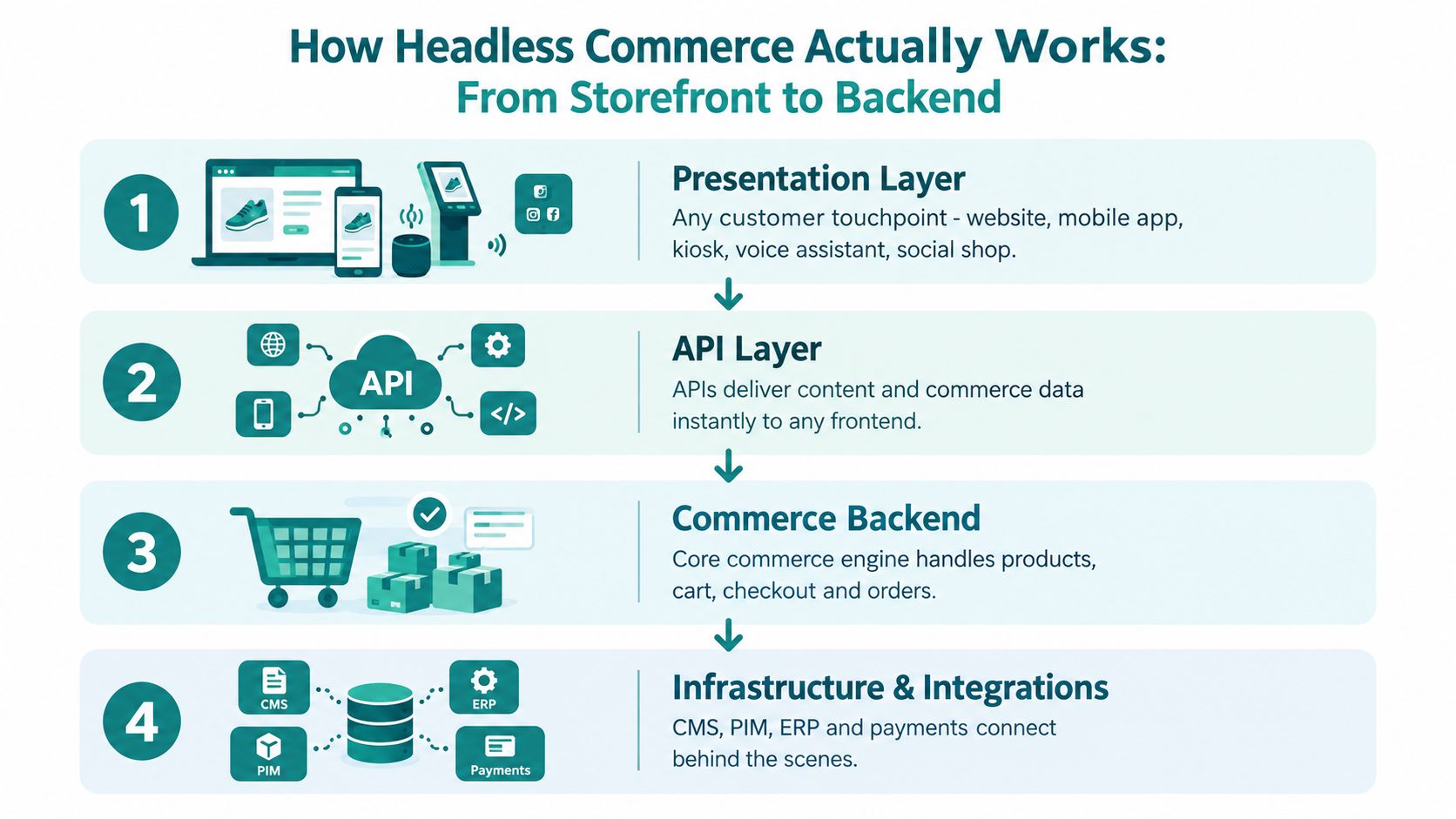
Think of headless commerce as a set of layers with clear responsibilities. The shopper interacts with the storefront, while the storefront requests information from services behind it.
The storefront layer
The presentation layer is what customers see and use. It might be a website built with Next.js, Remix, or Shopify Hydrogen, a mobile app, an in-store kiosk, a voice interface, or a social commerce experience. The storefront controls layout, navigation, design, interactions, accessibility, and the way content appears on each device.
It doesn't own the underlying product or transaction rules. Instead, it asks other services for product details, pricing, inventory, customer information, cart contents, and checkout options.
The API layer
APIs are the agreed communication contract between the storefront and the systems behind it. A shopper opens a product page, and the frontend requests product data from a commerce API. It may also request editorial content from a headless CMS such as Sanity or Contentful, search results from a search service, and customer-specific information from a personalization system.
An API gateway can sit in the middle to manage authentication, permissions, traffic rules, and request routing. For a nontechnical owner, the important point is simple: the storefront doesn't need direct access to every system. It receives the information it needs through controlled connections.
You can find a related explanation of content separation in HDM's headless CMS guide.
The commerce and infrastructure layers
The commerce backend handles products, pricing, inventory, carts, checkout, payments, and orders. Shopify, BigCommerce, commercetools, and other platforms can serve this role. The headless CMS manages landing pages, articles, promotional content, and structured marketing information. A PIM may manage product information, an ERP may handle business operations, and payment services support transactions.
The storefront assembles these responses into the final page. Because the API is the boundary, a team can change the presentation layer without rewriting core commerce logic. It can also upgrade a content service or search tool without rebuilding the entire storefront, provided the new service honors the required data contract.
The advantage is independence. The cost is that someone must design, document, monitor, and maintain those connections.
Headless vs Traditional Commerce
Traditional, or monolithic, commerce puts the storefront and backend in one platform. The same system often controls the theme, content administration, cart, checkout, and integrations. That makes launch straightforward because the business buys and configures one primary system.
Headless commerce separates the frontend from the backend. The two systems can use different technologies and release cycles, but the team must manage the APIs and the connections between services.
The right choice depends on the business constraint, not on which architecture sounds more modern.
| Dimension | Traditional / Monolithic | Headless |
|---|---|---|
| Launch path | Usually faster to configure and launch | Requires architecture, frontend work, and API planning |
| Storefront control | Theme and platform conventions guide the experience | Custom frontend can be designed around the brand and customer journey |
| Checkout changes | Often limited by platform templates and rules | Can support a custom experience while using backend transaction services |
| Marketing velocity | Campaigns may depend on theme or developer releases | Frontend and content changes can move independently when workflows are well designed |
| Channels | Web is usually the primary experience | One commerce backend can serve web, mobile, kiosks, and other touchpoints |
| Operating cost | Generally simpler to staff and manage | Requires frontend, API, integration, monitoring, and ongoing support skills |
| Best fit | Stable catalog, one main channel, straightforward experience | Custom UX, multiple channels, specialized integrations, or rapid experimentation |
For a young store with a simple catalog and a single sales channel, traditional commerce usually wins. You get a shorter path to market and fewer moving parts. A business owner evaluating platforms can use HDM's e-commerce platform guide to clarify the broader platform decision before considering architecture.
Headless becomes more compelling when the storefront itself is blocking growth. That might mean a custom buying journey, a mobile experience that must match the website, complex account-based pricing, or a marketing team that needs to launch and test experiences without waiting for a full platform release.
Most Cincinnati SMBs sit between the two extremes. A fully monolithic setup may become restrictive, while a fully composable system can create more operational work than the business can support. A focused headless frontend on a reliable commerce backend is often the more practical middle ground.
Key Benefits and What They Mean for an SMB
Headless commerce can improve a storefront, but the payoff depends on your business. Traffic patterns, the buying journey, release process, integrations, and available technical support all shape the result. For a Cincinnati SMB, the right question is whether your current storefront blocks revenue-producing changes, not whether headless is popular.
Performance is the clearest potential benefit. Reported production migrations include roughly 40% to 60% faster page performance and 60% to 75% smaller JavaScript bundles when moving from Shopify Liquid to Hydrogen. A separate migration from BigCommerce Stencil to Next.js reported about 45% to 55% faster performance and 65% to 80% smaller bundles. The same production data reports conversion lifts ranging from 6% to 18%, tied largely to lower client-side rendering costs and improved Core Web Vitals (migration performance data).
Those outcomes are benchmarks, not promises for a Cincinnati retailer. A headless build can still ship slow code, oversized images, weak search, or a confusing checkout. The architecture creates room for better performance. Your implementation determines whether shoppers feel the difference.
The SMB translation
| Benefit | Enterprise Benchmark | Realistic SMB Outcome | Catch |
|---|---|---|---|
| Faster storefront | Significant gains from optimized rendering and smaller bundles | Faster product and campaign pages when the current theme is a real bottleneck | A careless frontend can erase the advantage |
| Conversion improvement | Reported migration lifts of 6% to 18% | Better mobile usability, clearer merchandising, and fewer experience constraints | Conversion depends on offer, trust, pricing, and checkout, not architecture alone |
| Developer velocity | Independent frontend releases and specialized teams | Faster campaign work when an experienced partner or internal developer owns the stack | You still need someone who understands the APIs |
| Omnichannel reach | Shared services across many customer touchpoints | A practical path to mobile, kiosk, or location-specific experiences | Each new channel adds testing and content governance |
| Peak-event resilience | Independent scaling and controlled infrastructure | More control during major promotions or seasonal demand | Hosting, CDN, monitoring, and caching become your responsibility |
| Personalization | Detailed segmentation across channels | More relevant content and merchandising for meaningful customer groups | Data quality, consent, and operational discipline matter |
The strongest SMB case is usually a blocked storefront. Your team may need a new buying flow, better mobile merchandising, or faster campaign changes, while the current platform makes each request expensive or slow.
Headless becomes a poor trade when nobody can own the API layer, frontend releases, monitoring, and integrations. If your traffic and operational complexity do not justify that work, a faster theme or targeted platform improvement may solve the problem at lower cost.
A 2025 survey reported that 60% of retailers were adopting headless commerce or planning to do so, including 20% with live implementations, 25% in active migration, and 15% with approved plans for the next 24 months (adoption survey summary). That indicates serious adoption, not universal fit. Use the market signal to guide research, then make the decision from your own margins, team capacity, customer journey, and growth plans.
Where Headless Commerce Shines in Practice
A DTC brand launching frequent creative tests can benefit when the storefront needs to behave more like a flexible campaign system than a fixed catalog. A headless frontend can support custom landing pages, product storytelling, bundles, and channel-specific layouts while the commerce backend continues handling catalog and checkout operations. The architectural move is a presentation layer built around reusable content and commerce APIs, rather than a collection of increasingly complex theme overrides.
A multi-location healthcare practice has a different reason to consider the model. Each location may need distinct services, providers, forms, and local content, while patient portals and scheduling systems remain separate. A decoupled public frontend can help the practice keep marketing content away from protected health information, but headless does not make a website HIPAA compliant by itself. The organization still needs appropriate vendors, contracts, access controls, data handling, and review of every integration.
For healthcare teams: Treat the public storefront or website as a non-PHI surface only when the actual data flow supports that decision. Misconfigured forms, analytics, chat tools, or appointment integrations can create the compliance problem.
A Cincinnati retailer expanding from web sales into a custom mobile experience can reuse commerce services instead of creating a second set of product and checkout rules. The mobile frontend can present location-aware inventory or a different browsing flow, while the backend remains the source for commerce operations. That approach is valuable when mobile serves a distinct customer need, not because the business wants an app.
B2B merchants often have the clearest architectural justification. Complex catalogs, quote workflows, account-specific pricing, buyer permissions, and custom ordering interfaces can strain a standard theme. A headless frontend can give different customer groups distinct experiences while APIs connect those experiences to catalog, pricing, customer, and order systems.
Regardless of the scenario, SEO must remain part of the architecture rather than a post-launch task. Rendering strategy, crawlable HTML, product structured data, canonical handling, redirects, faceted navigation, and content governance all need owners. HDM's complete e-commerce SEO guide is a useful planning reference for that work.
When Headless Commerce Is Not the Right Call
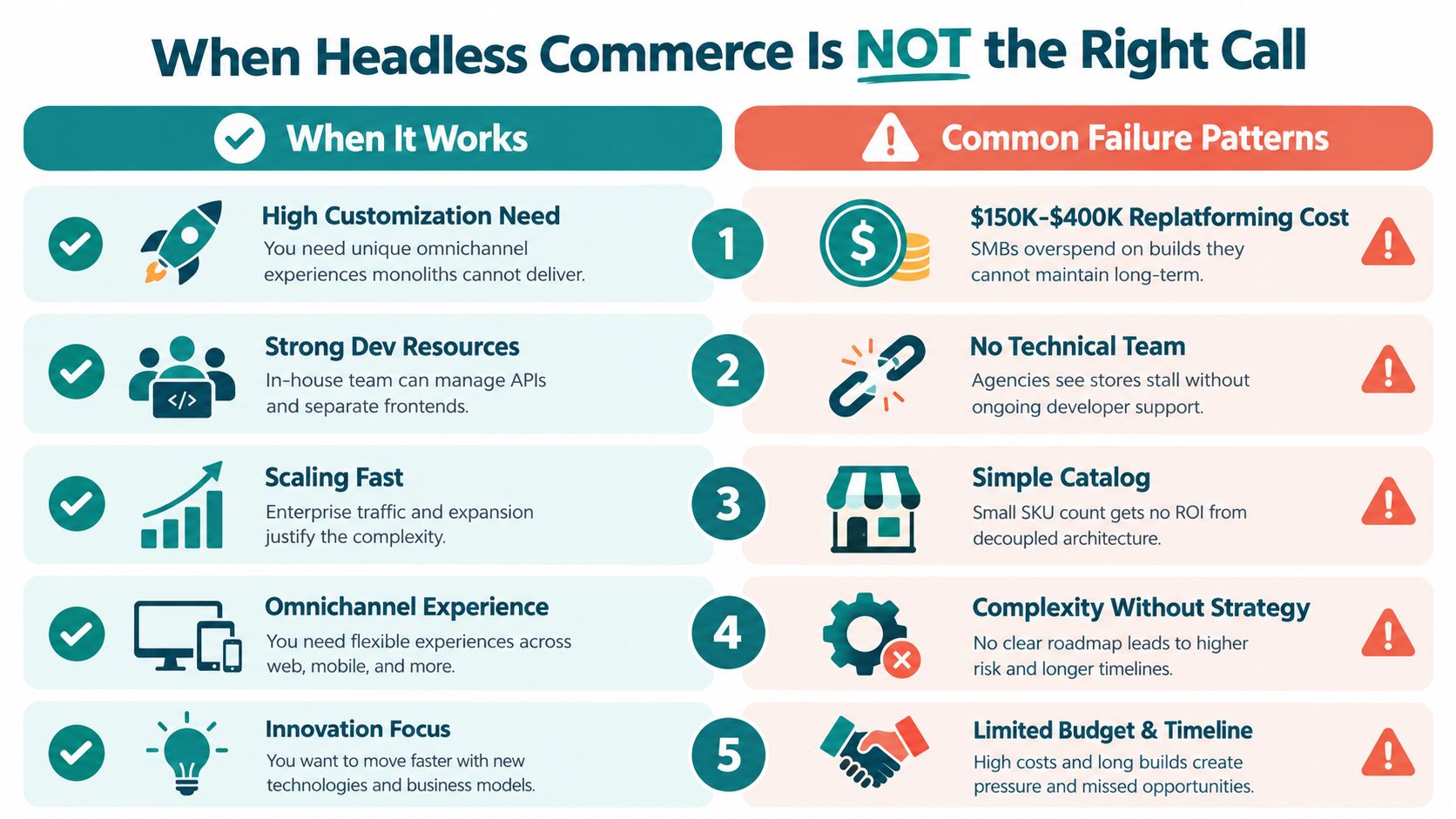
Headless is not the default choice for a growing business. If your catalog is straightforward, your content cadence is stable, your sales happen mainly through one storefront, and your current platform isn't blocking revenue work, decoupling the frontend may add complexity without creating enough value.
The most damaging pattern is a business buying an architecture before identifying the constraint. The required build becomes larger than expected because the quote covers a custom frontend, API work, search, content modeling, analytics, redirects, hosting, quality assurance, and post-launch maintenance. The existing SaaS subscription doesn't disappear, so the business pays for the commerce backend and the new operating layer around it.
Technical readiness matters just as much. A company without frontend, API, and deployment capability may depend on an agency for every update. That relationship can work, but only when the contract includes clear ownership, documentation, monitoring, and support. Without those pieces, marketing edits can conflict with merchandising rules, integrations can fail without visibility, and the business can become afraid to change its own storefront.
Use this decision lens
- Stay monolithic if the store is stable, the catalog is simple, and the current platform supports the customer journey.
- Consider a focused headless build if custom experience, faster experimentation, or omnichannel delivery is actively limiting growth.
- Consider composable commerce only when the organization can govern several specialized services and owns the integration work.
- Reject the proposal if the agency can't explain who maintains APIs, monitoring, content workflows, and release processes after launch.
Market estimates reinforce that the category is growing, but they don't prove that every SMB should adopt it. One estimate places the global market at approximately US$2.13 billion in 2026 and projects US$7.24 billion by 2033, while another 2026 estimate places it at US$2.41 billion with a path to US$6.17 billion by 2031 (market growth analysis). Treat those figures as evidence of investment, not as a recommendation for your business.
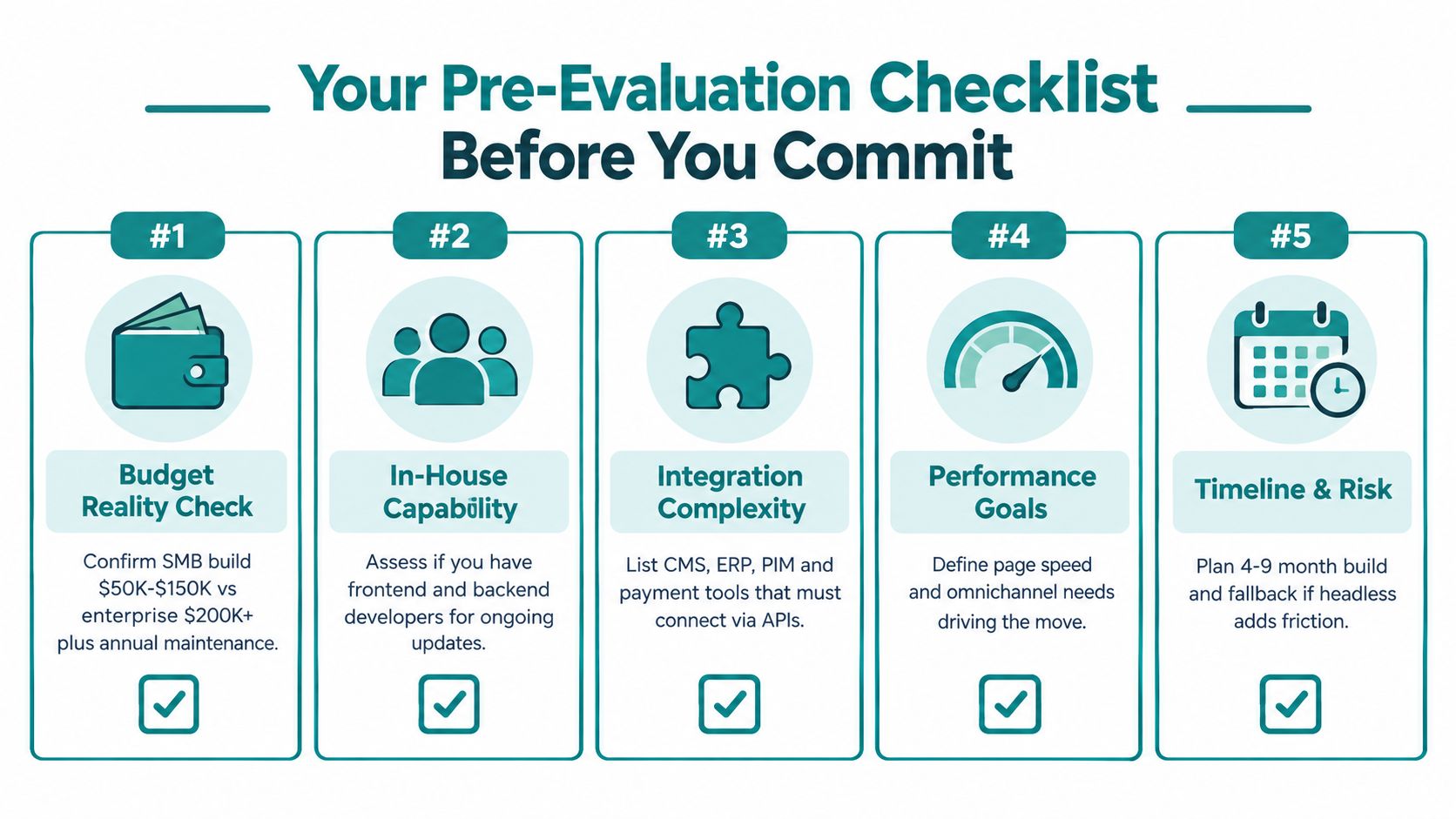
Your Pre-Evaluation Checklist Before You Commit
Start with a scorecard, not a vendor demo. You need to know whether the business can fund the build, operate the result, and measure a meaningful improvement.
Budget reality
The provided planning framework identifies $50K to $150K for SMB builds and $200K or more for enterprise work, plus annual maintenance. Use those figures as planning ranges, not promises. Ask for a total-cost model that includes frontend development, CMS work, integrations, hosting, monitoring, SEO migration, analytics, content migration, and post-launch support.
Red flag: the proposal compares only the new build fee with your current platform subscription.
In-house capability
List the people who will own frontend updates, API troubleshooting, deployments, analytics, search, and content governance. You don't need every skill internally, but someone must be accountable for the system after the agency finishes the launch.
Red flag: the agency says the platform is "easy to manage" but can't name the role responsible for failed API requests or broken releases.
Integration complexity
Inventory the systems that must connect, including the CMS, ERP, PIM, payment tools, search, customer accounts, fulfillment, scheduling, and analytics. Separate essential integrations from future ideas. This prevents the first release from becoming an unbounded platform program.
Red flag: the vendor recommends a stack before asking what data must move between systems.
Performance and channel goals
Write down the customer experience you want to improve. It might be mobile browsing, campaign landing pages, location-based inventory, B2B ordering, or a more flexible content workflow. Define how you'll judge success using business and experience measures, not the word "headless."
Red flag: the proposal promises speed without showing the rendering approach, caching plan, image strategy, or testing process.
Timeline, ownership, and vendor fit
Plan for a multi-month build, not a rushed six-week transformation. Shopify Hydrogen can suit a business that wants Shopify's commerce foundation with a custom React-based storefront. BigCommerce can fit organizations that need powerful commerce APIs while retaining a managed backend. commercetools is generally better suited to teams prepared for deeper composability and integration ownership.
Ask every agency:
- Who will build the frontend and API connections?
- What support response times apply after launch?
- Who owns documentation and monitoring?
- What will the total cost of ownership look like over three years?
- What happens if the headless approach fails to improve the stated business problem?
- Can the agency show a limited architecture spike before a full replatform?
Your Next 90 Days and How HDM Can Help
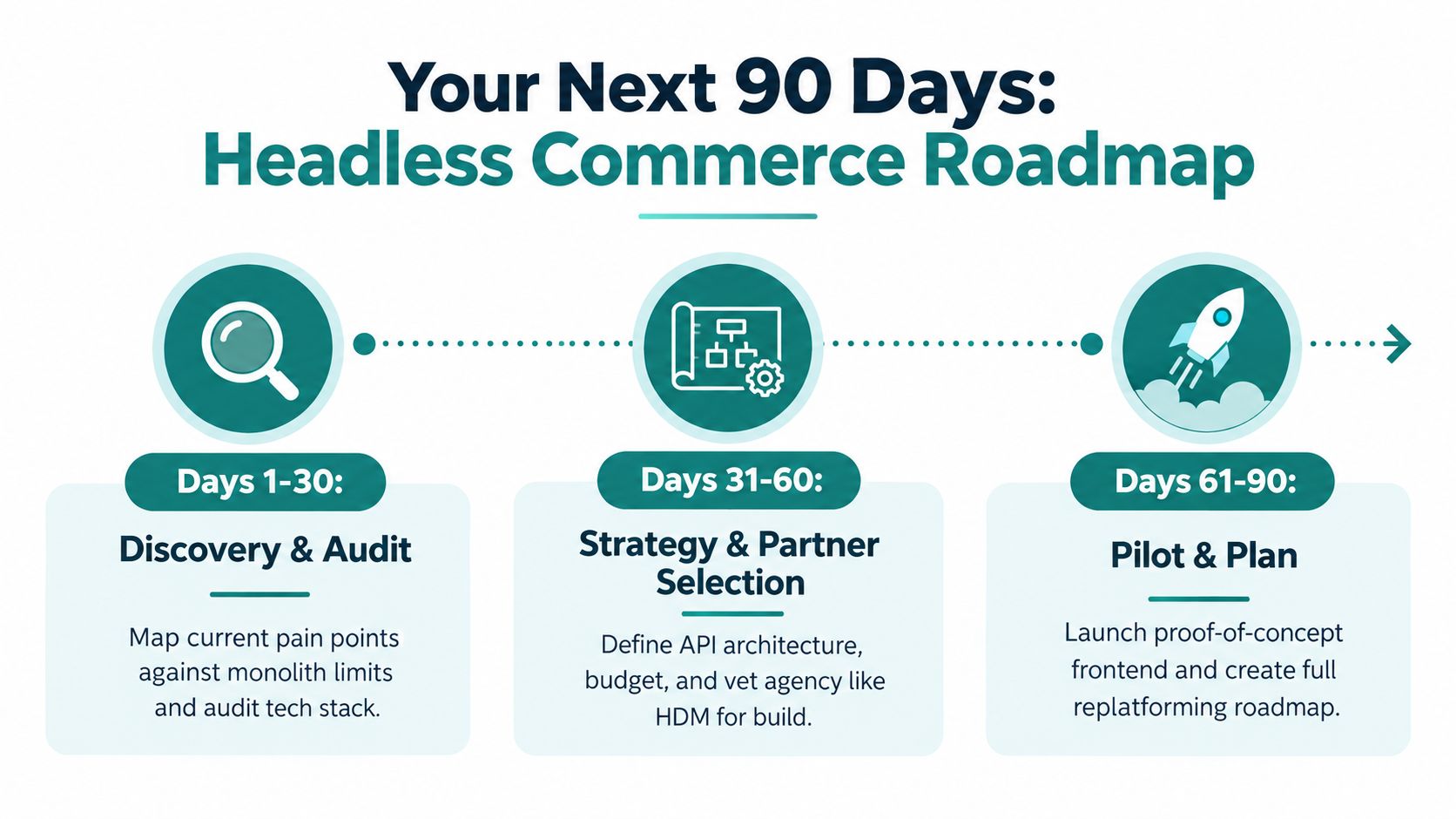
A sensible evaluation doesn't begin with rebuilding the whole store. It begins by proving that the current architecture is the problem and identifying the smallest change that can test the opportunity.
Days one through thirty
Audit the existing storefront, checkout path, CMS, analytics, search, integrations, and content workflow. Interview marketing, sales, customer service, operations, and whoever handles website updates. Record the specific requests that get delayed, the customer journeys that fail, and the platform constraints that cause those delays.
Days thirty-one through sixty
Shortlist commerce platforms and agencies based on your requirements, not brand familiarity. Ask for a paid architecture spike or proof of concept that tests a real product page, content workflow, search request, or checkout handoff. A small technical exercise will reveal more than a polished pitch deck because it exposes integration assumptions and ownership gaps.
Days sixty-one through ninety
Decide whether to improve the current platform, add a focused headless frontend, or plan a broader replatform. Approve a defined MVP with a budget, responsible owners, launch criteria, SEO migration plan, and support arrangement. Keep the first release narrow enough to measure, then expand only when the results justify additional complexity.
HDM is a Cincinnati-area digital agency that works with healthcare organizations, multi-location retailers, e-commerce businesses, and other growth-focused companies on custom development, headless CMS implementations, performance marketing, SEO, analytics, and ongoing website maintenance. HDM can help evaluate whether headless is justified, design a practical architecture, and connect the technical plan to the customer journeys and revenue goals that matter to your business.
If you're considering a headless build, don't book a sales demo first. Book a discovery call with HDM to review your current storefront, identify the true constraints, and decide whether a focused improvement or a broader architecture change makes financial sense.