
Every day, your potential customers in the Cincinnati area scroll through hundreds of social media posts. Most get ignored. A handful stop the thumb mid-scroll, spark curiosity, and drive action. The difference? The hook.
A hook is the first line, visual, or concept that captures attention within the first 1–3 seconds of a social media post. In a landscape where the average user spends less than 1.7 seconds deciding whether to engage or keep scrolling, your hook isn't just important — it's everything.
For businesses across Greater Cincinnati — from boutique shops in Blue Ash to growing agencies in West Chester and service providers throughout the Tri-State — mastering social media hooks is the difference between being seen and being skipped. At HDM, we've tested these hook frameworks across dozens of local campaigns, and the results speak for themselves.
This guide breaks down 8 proven social media hook types, explains why each one works psychologically, and gives you actionable tips to implement them for your Cincinnati-area business today.
1. The Problem-Agitate-Solve (PAS) Hook
The PAS framework is one of the oldest and most reliable copywriting formulas in existence — and it translates powerfully to social media. It works by identifying a problem your audience already feels, amplifying the emotional weight of that problem, and then positioning your brand as the solution.
How It Works in Practice
Problem: Your audience has a frustration they can't ignore.
Steps:
- Identify the Problem — Open with a pain point your audience immediately recognizes. "Tired of spending money on ads that don't convert?"
- Agitate — Amplify the consequences. "Every month you run underperforming campaigns, you're not just wasting budget — you're handing customers to your competitors."
- Solve — Present your solution. "Our data-driven marketing framework identifies exactly where your spend is leaking and redirects it to channels that actually drive revenue."
Key Insight: The PAS hook works because it mirrors the emotional journey your customer is already on. You're not creating a problem — you're validating one they already feel, then offering relief.
Actionable Tips for Cincinnati Businesses
- Research local pain points. A roofing company in West Chester might open with: "Another storm rolled through Butler County last night. Is your roof ready for the next one?"
- Use specific numbers. "87% of Cincinnati homeowners don't know their roof has storm damage until it's too late" is more compelling than a generic statement.
- Keep the agitation honest. Don't manufacture fear — amplify real consequences your customers face.
- End with a clear CTA. After the solve, tell them exactly what to do next: book a call, request a quote, visit your website.
2. The Behind-the-Scenes (BTS) Hook
In an era of polished feeds and AI-generated content, authenticity is a competitive advantage. The BTS hook pulls back the curtain on your process, your team, or your workspace — and audiences love it because it feels real.
How It Works in Practice
Problem: Your audience craves authenticity but sees mostly polished, impersonal content from brands.
Steps:
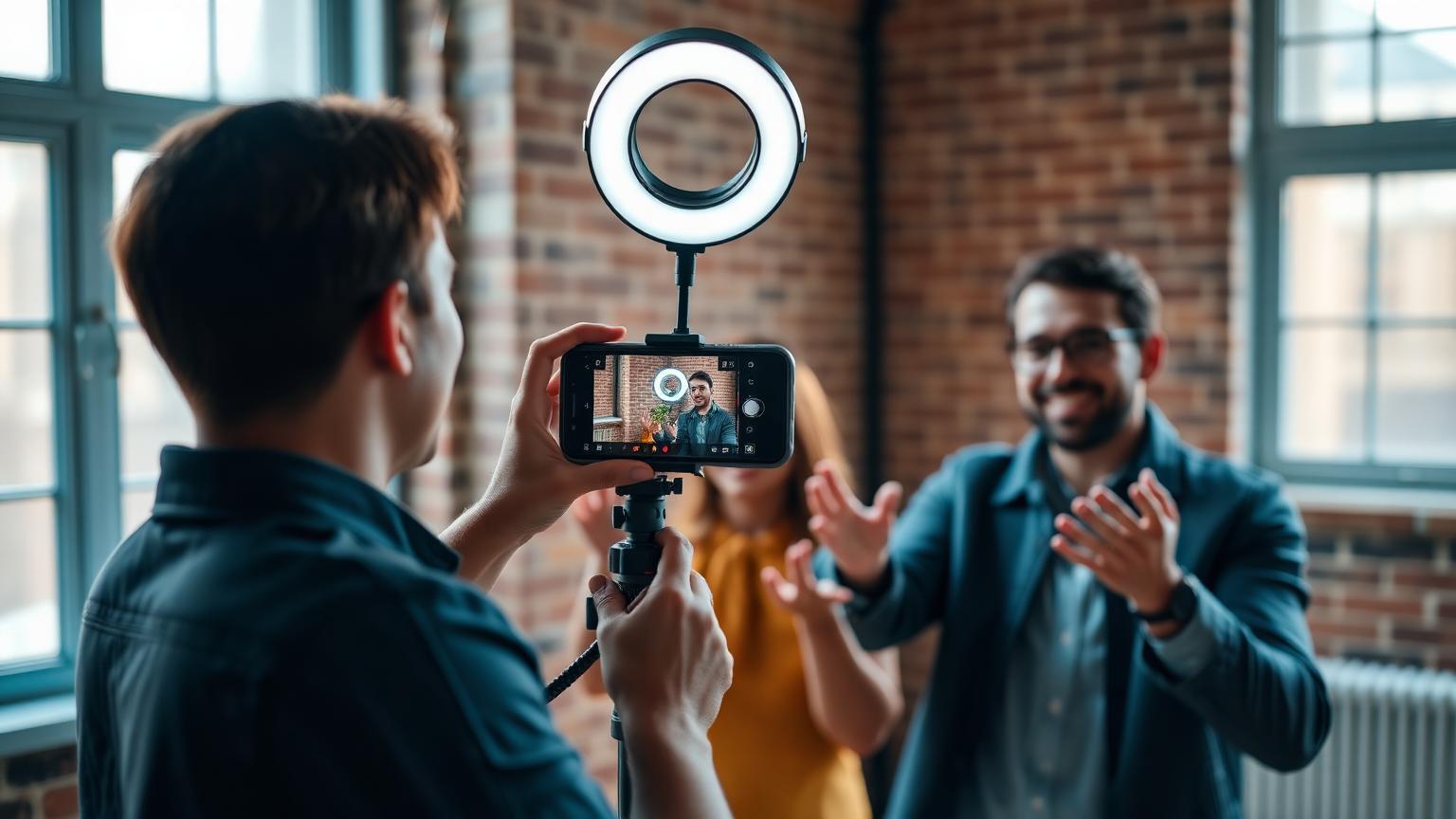
- Show the raw process. Film your team during a project kickoff meeting, share a time-lapse of a website being built, or document a product being packaged and shipped.
- Create team narratives. Introduce team members with short "day in the life" clips. People connect with people, not logos.
- Document milestones. Moving into a new office in Blue Ash? Launching a new service? Celebrating a team member's anniversary? Share it.
Key Insight: BTS content consistently outperforms polished promotional content on engagement metrics. Why? Because it triggers the familiarity principle — the more people see the real humans behind your brand, the more they trust you.
Actionable Tips for Cincinnati Businesses
- Start simple. A 15-second phone video of your morning routine at your shop is more engaging than a professionally produced ad that feels impersonal.
- Show the mess. A contractor showing the "before" of a demolition site with the caption "This is where the magic starts" is compelling content.
- Use captions and text overlays. Most social media is consumed with sound off — make sure your BTS content works silently.
- Be consistent. Make BTS a recurring content pillar — "Workshop Wednesday" or "Friday Team Spotlight" gives your audience something to anticipate.
3. The Data-Driven/Statistical Hook
Numbers stop the scroll. When you open with a surprising, specific statistic, you immediately establish authority and create an information gap the reader wants to fill.
How It Works in Practice
Problem: Your audience is skeptical of generic marketing claims.
Steps:
- Lead with a surprising stat. "68% of potential clients research law firms online before ever making a phone call." This immediately reframes how a law firm should think about their online presence.
- Provide context. Explain what the number means for your audience specifically.
- Connect to your expertise. Show how your service addresses the reality that statistic reveals.
If you want to go deeper on building a data-driven approach to your marketing, our complete guide to data-driven digital marketing strategy breaks down the entire framework.
Key Insight: The most effective statistical hooks use numbers that contradict what the audience assumes. "93% of online experiences begin with a search engine" is interesting — but "46% of all Google searches are seeking local information" is more actionable for a Cincinnati business owner.
Actionable Tips for Cincinnati Businesses
- Use local data when possible. A statistic drawn from Cincinnati-area businesses is far more compelling than a national average, as long as you can cite where it came from.
- Cite your sources. Credibility matters — link to the study or data source.
- Pair stats with visuals. A bold number on a clean graphic stops the scroll faster than a paragraph of text.
- Make it relevant. A stat about e-commerce trends doesn't resonate with a local plumber — match the data to the audience.
4. The Curiosity Gap Hook
The curiosity gap is the space between what someone knows and what they want to know. When you intentionally withhold a key piece of information, you create cognitive tension that can only be resolved by consuming the rest of your content.
How It Works in Practice
Problem: Your audience scrolls past predictable content that reveals everything in the first line.
Steps:
- Tease the outcome without revealing how. "This one small change to their product pages increased their e-commerce revenue by $180K in six months."
- Create pattern interrupts. "We told this Cincinnati restaurant owner to stop running Facebook ads. Here's what happened next."
- Use open loops. Start a story but delay the resolution — "Three months ago, a Tri-State home services company came to us with a problem. Their website looked great but generated zero leads. What we found surprised even us..."
Key Insight: The curiosity gap works because of the information gap theory — when we perceive a gap in our knowledge, we experience something similar to a physical itch. The only way to scratch it is to find the answer.
Actionable Tips for Cincinnati Businesses
- Don't clickbait. The curiosity gap only works if you deliver on the promise. Misleading hooks destroy trust permanently.
- Use numbers for specificity. "5 things we changed" is more compelling than "some things we changed."
- Apply it to carousels and Reels. Slide 1: the hook. Slides 2-9: the reveal. Slide 10: the CTA.
- Test different formats. "You won't believe..." is overused. Try "The part nobody talks about is..." or "Here's what actually moved the needle..."
5. The Contrarian/Hot Take Hook
Nothing sparks engagement like a well-crafted contrarian opinion. When you challenge a widely held belief in your industry, you force people to stop and consider a perspective they haven't encountered before.
How It Works in Practice
Problem: Your audience is bombarded with the same recycled advice and tunes it out.
Steps:
- Challenge a common belief. "Your website's biggest problem isn't design — it's strategy." This immediately creates friction with the assumption that a pretty website equals an effective one.
- Back it up with evidence. A hot take without substance is just noise. Support your position with data, experience, or case studies.
- Offer the better alternative. Don't just tear down the old way — show what replaces it.
Key Insight: Contrarian hooks work because they trigger cognitive dissonance — the discomfort of encountering an idea that conflicts with an existing belief. The reader must engage to resolve that discomfort, either by agreeing or arguing. Either way, you win the engagement.
Actionable Tips for Cincinnati Businesses
- Stay in your lane. Your contrarian take should be about your industry and backed by your expertise. A landscaping company challenging common lawn care myths is credible. A landscaping company giving hot takes about AI is not.
- Don't be contrarian for its own sake. The goal isn't to be provocative — it's to share a genuinely better perspective.
- Prepare for comments. Hot takes drive conversation. Have your team ready to engage thoughtfully in the comments.
- Pair with authority signals. "After building 200+ websites for Cincinnati businesses, here's what I've learned: most of them didn't need a redesign. They needed a strategy." The credential makes the take credible.
6. The Transformation/Before-and-After Hook
Humans are hardwired to notice change. The transformation hook leverages this by showing a dramatic before-and-after that makes the value of your work immediately visible.
How It Works in Practice
Problem: Your audience can't visualize the impact of your service until they see tangible proof.
Steps:
- Lead with the visual. Side-by-side images, slider comparisons, or video reveals create instant impact.
- Quantify the transformation. Don't just show the change — measure it. "From 12 leads/month to 147 leads/month in 90 days."
- Tell the story behind the numbers. What was the client struggling with? What did you change? Why did it work?
Key Insight: Transformation content performs exceptionally well because it serves as implicit social proof. You're not claiming you can deliver results — you're showing that you already have.
Actionable Tips for Cincinnati Businesses
- Get permission first. Always get client approval before sharing their results publicly.
- Use the split-screen format. Instagram and TikTok both reward this format with higher engagement.
- Include specific timelines. "In 6 weeks" is more credible than "quickly." Specificity builds trust.
- Make it a series. "Transformation Tuesday" gives you a recurring content pillar and trains your audience to expect results-focused content weekly.
7. The Trending Audio/Meme Hook
Trending sounds and meme formats are the native language of platforms like TikTok and Instagram Reels. When you adapt a trending format to your industry, you tap into the algorithm's preference for trend participation while making your brand feel current and culturally aware.
How It Works in Practice
Problem: Your audience perceives your brand as outdated or out of touch with current culture.
Steps:
- Monitor trending sounds weekly. Use TikTok's Discover page and Instagram's Reels tab to identify sounds gaining momentum.
- Adapt — don't force. The trend should fit your brand naturally. A Cincinnati accounting firm using a trending sound to explain tax deadlines is clever. The same firm doing a dance trend is awkward.
- Move quickly. Trends have a 5–14 day window. By the time a sound feels everywhere, it's already declining.
Key Insight: The algorithm explicitly boosts content using trending audio. By combining a trending sound with your industry expertise, you get the reach benefit of the trend and the authority benefit of your content — it's the best of both worlds.
Actionable Tips for Cincinnati Businesses
- Create a trend swipe file. Save trending Reels and TikToks in a folder organized by format type. When it's time to create, you'll have a library of templates to adapt.
- Batch your trend content. Spend 1-2 hours per week filming 3-4 trend adaptations. Post them across the week while they're still relevant.
- Add your twist. The best trend content adds a unique industry perspective. "POV: You're a web developer and the client says 'just make it pop'" resonates because it's specific.
- Don't chase every trend. Be selective. One well-executed trend per week outperforms five forced ones.
8. The Educational/How-To Hook
The educational hook promises to teach the viewer something valuable — and that promise of free value is one of the strongest scroll-stoppers in social media.
How It Works in Practice
Problem: Your audience has questions about your industry but doesn't know where to find trustworthy answers.
Steps:
- Promise a clear outcome. "How to check if your website is actually showing up on Google (takes 30 seconds)."
- Deliver actionable steps. Don't be vague — give them something they can do immediately after watching or reading.
- Position your brand as the helpful authority. When someone learns something valuable from you for free, they remember you when they need to hire someone.
For businesses trying to understand their Google presence, our guide to getting found on Google in Cincinnati is a great resource to share or adapt into social content.
Key Insight: Educational content builds what marketers call reciprocity equity. When you give value freely, your audience feels a subconscious obligation to give back — often in the form of a follow, a share, or eventually a purchase.
Actionable Tips for Cincinnati Businesses
- Answer real questions. Check your Google Business Profile Q&A, your DMs, and your sales team's most-heard questions. That's your content calendar.
- Use the "1-2-3" format. "3 things to check before hiring a contractor in Cincinnati" is a format that works across every platform.
- Save the advanced stuff for paying customers. Share enough to be genuinely helpful, but your most sophisticated strategies and insights are what clients pay for.
- Repurpose into multiple formats. One how-to topic can become a Reel, a carousel, a blog post, and an email newsletter. HDM uses this exact approach to maximize content ROI for our clients.
Hook Comparison: Finding the Right Fit
Not every hook works for every situation. Use this comparison table to match the right hook type to your goals, resources, and audience:
| Hook Type | Complexity | Resources Needed | Expected Outcome | Ideal Use Case | Key Advantage |
|---|---|---|---|---|---|
| PAS | Low | Copywriting skill | High conversion | Sales-focused posts, ads | Directly addresses pain points |
| BTS | Low | Phone camera | High engagement, trust | Brand building, recruiting | Authenticity differentiator |
| Data-Driven | Medium | Research, data access | Authority building | Thought leadership, B2B | Establishes credibility fast |
| Curiosity Gap | Medium | Strong storytelling | High click-through | Blog promotion, carousels | Drives content consumption |
| Contrarian | High | Deep expertise | Viral potential, debate | Thought leadership, differentiation | Cuts through noise |
| Transformation | Medium | Before/after assets | Social proof, conversions | Case studies, portfolios | Visual proof of results |
| Trending Audio | Low-Medium | Cultural awareness | Reach, new audiences | Brand awareness, younger demos | Algorithm boost |
| Educational | Medium | Subject expertise | Follower growth, trust | Nurturing, SEO, authority | Builds reciprocity equity |
From Hooks to Growth: Your Action Plan
Understanding hooks is one thing. Implementing them consistently across your social media presence is where real results happen. Here's how to move from theory to practice:
Your 4-Week Implementation Plan
Week 1 — Audit and Baseline Review your last 30 social media posts. Categorize each by hook type (or lack thereof). Identify which types generated the most engagement. This gives you your baseline.
Week 2 — Test Two New Hook Types Pick two hook types from this guide that you haven't used before. Create 3-4 posts using each type. Track engagement against your baseline.
Week 3 — Optimize and Double Down Analyze Week 2 results. Double down on the hook type that performed best. Refine your approach based on what you learned.
Week 4 — Build Your Content System Create a recurring content calendar that rotates through your top 3-4 performing hook types. Batch create content weekly to maintain consistency.
The Bottom Line
The businesses winning on social media in Cincinnati aren't the ones with the biggest budgets — they're the ones with the best hooks. Every scroll is a competition for attention, and the brands that understand how to capture that attention in the first 1–3 seconds are the ones that grow.
At HDM, we help Cincinnati-area businesses build social media strategies that don't just post content — they stop the scroll, spark engagement, and drive real business results. From content strategy and creation to full-service digital marketing, we're here to help you turn social media from a time sink into a growth engine.
Ready to transform your social media presence? Schedule a free strategy session and let's build a hook-driven content strategy that captures your Cincinnati audience and converts followers into customers.