
If you're a Cincinnati business owner, there's a good chance your social media feels stuck in one of two lanes. Either you're posting because you know you should be there, or you've gone quiet because none of it seemed to lead to real opportunities. Both situations are common, especially for B2B companies that sell services, manufacturing expertise, consulting, software, or specialized local business support.
The problem usually isn't effort. It's direction.
Most social media marketing for B2B fails because the business treats social like a branding side project instead of a sales support channel. That leads to random posting, weak targeting, and reports full of likes that never turn into calls, quotes, or closed business. A better approach is simpler than it might seem. Start with one goal, focus on one platform, publish useful content, and track what happens after the click.
Start with Business Goals Not Social Platforms
A lot of B2B companies start with the wrong question. They ask, "Which platform should we be on?" The better question is, "What business result are we trying to create?"
That shift matters because social media isn't the goal. Revenue, qualified leads, stronger sales conversations, and better market visibility are the goals. Social is just one way to get there.
A recent Salesforce overview of B2B social media marketing notes that 60% of B2B marketers polling in 2023 said social media drove the highest revenue, up from 50% in 2022. That doesn't mean every post prints money. It means the companies getting value from social are treating it like a business system, not a content chore.

Pick one business outcome first
For most Cincinnati SMBs, social media works best when it supports one of these outcomes:
- Lead generation: Drive consultation requests, estimate requests, demo bookings, or contact form submissions.
- Sales enablement: Give your sales team useful content they can send to prospects after meetings.
- Market credibility: Help buyers see that your company knows the industry, understands the problem, and has a clear point of view.
- Recruiting support: Attract experienced employees who want to work for a credible, growing business.
If you try to chase all four at once, your messaging gets muddy. If you pick one primary outcome, your content becomes easier to write and easier to evaluate.
Define your real audience
"Small businesses" isn't an audience. "Manufacturing companies" isn't much better.
A useful Ideal Customer Profile, or ICP, gets specific. Think in terms of company type, buyer role, and buying trigger. For example:
- Company type: Local commercial contractor, regional manufacturer, professional services firm, healthcare group, or B2B software company.
- Buyer role: Owner, operations manager, marketing director, sales leader, or IT decision-maker.
- Buying trigger: Outdated website, weak lead flow, poor search visibility, disconnected reporting, or stalled growth.
Practical rule: If you can't name the person who'd approve the budget, your social targeting is still too broad.
Use a simple goal framework
A practical social media marketing for B2B plan can fit on one page. Write down:
| Question | Example answer |
|---|---|
| What do we want social to do? | Generate sales conversations |
| Who do we want to reach? | Owners and marketing leaders at Cincinnati-area B2B firms |
| What problem are they trying to solve? | Inconsistent lead flow and weak online visibility |
| What action should they take? | Visit key service pages, book a call, or reply to a post |
| How will we know it's working? | More qualified inquiries and better sales conversations |
That's enough to keep your team honest.
What doesn't work
Random acts of posting. Company news with no buyer relevance. Generic motivational graphics. Product features with no context. Long dry updates written like internal memos.
What works is tighter. Speak to a specific buyer, name a real business problem, and offer a clear next step. That's how social starts behaving less like noise and more like pipeline support.
Choose Your Digital Handshake LinkedIn First
Most B2B businesses don't need a dozen active social channels. They need one platform that consistently puts them in front of the right people.
For most companies, that's LinkedIn.

LinkedIn acts like a modern chamber of commerce, referral lunch, and industry event rolled into one. Your buyers are there, your peers are there, and the people checking out your company after hearing your name are often there too.
According to Statista's data on social media platforms used by B2B marketers, LinkedIn is the primary channel for 86% of B2B marketers worldwide and generates 80% of all B2B social media leads. That's why it makes sense to put most of your early effort there instead of spreading yourself thin.
Why LinkedIn deserves your first serious effort
LinkedIn fits B2B buying behavior better than almost any other platform because people already show up in a professional mindset. They're evaluating vendors, watching peers, checking credentials, and looking for proof that a company understands its field.
For a Cincinnati-area business, that matters in practical ways:
- Buyers can vet you fast: They can review leadership profiles, company updates, and shared expertise before they ever call.
- Your team becomes visible: Engineers, account managers, consultants, and executives can all reinforce credibility.
- Local networking scales: You can stay active with regional prospects, referral partners, and business groups without constant in-person events.
Your LinkedIn presence is often the first handshake before the first meeting.
What to do on LinkedIn first
Don't overbuild this. Start with the basics and do them well.
- Clean up leadership profiles: Use clear headlines, current positioning, and buyer-focused summaries.
- Make the company page credible: Good branding, clear service description, updated website link, and recent posts.
- Post useful insights consistently: Not daily if you can't sustain it. Weekly is fine if it's thoughtful.
- Encourage employee participation: A few active team voices usually outperform a silent company page.
A quick walkthrough can help if your team hasn't used the platform strategically:
What about YouTube, X, or Facebook
They can all have a role. They just shouldn't be your starting point unless your business has a very specific reason.
| Platform | Best use case for B2B |
|---|---|
| YouTube | Deep educational content, demos, and repurposed video |
| X | Commentary, fast industry takes, niche conversations |
| Community visibility, recruiting, some paid lead generation use cases |
If you're still trying to get traction, LinkedIn first is the safer bet. Build your digital handshake there. Once that machine is working, then decide whether another platform supports the same business goal.
Create Content That Builds Trust and Opens Doors
Most business owners think content means constantly coming up with something new. That's usually what makes social stall out. The better method is to take one strong piece of real expertise and turn it into several useful posts.
That approach works because buyers don't need endless updates. They need repeated evidence that you understand their problems and can help solve them.
A practical B2B social strategy guide from Journeyh recommends extracting 3 to 5 core insights from a single deep asset such as a webinar or whitepaper, then repurposing them into formats like LinkedIn carousels and short videos. It also makes an important point. Success should be measured by ICP conversations, not vanity metrics.
Turn one project into a week of content
Say your company just finished a website redesign for a regional service business. That's not one post. It's a week's worth of useful social media marketing for B2B content if you break it down correctly.
Monday could be a plain-text post on the problem the client faced. Maybe their old site looked fine but didn't support lead generation.
Wednesday could be a short carousel on what changed. Better calls to action, tighter page structure, clearer messaging, stronger service pages.
Friday could be a short video from the project lead explaining one lesson other business owners should know before starting their own redesign.
None of that requires you to invent content. You're just unpacking the work you already do.
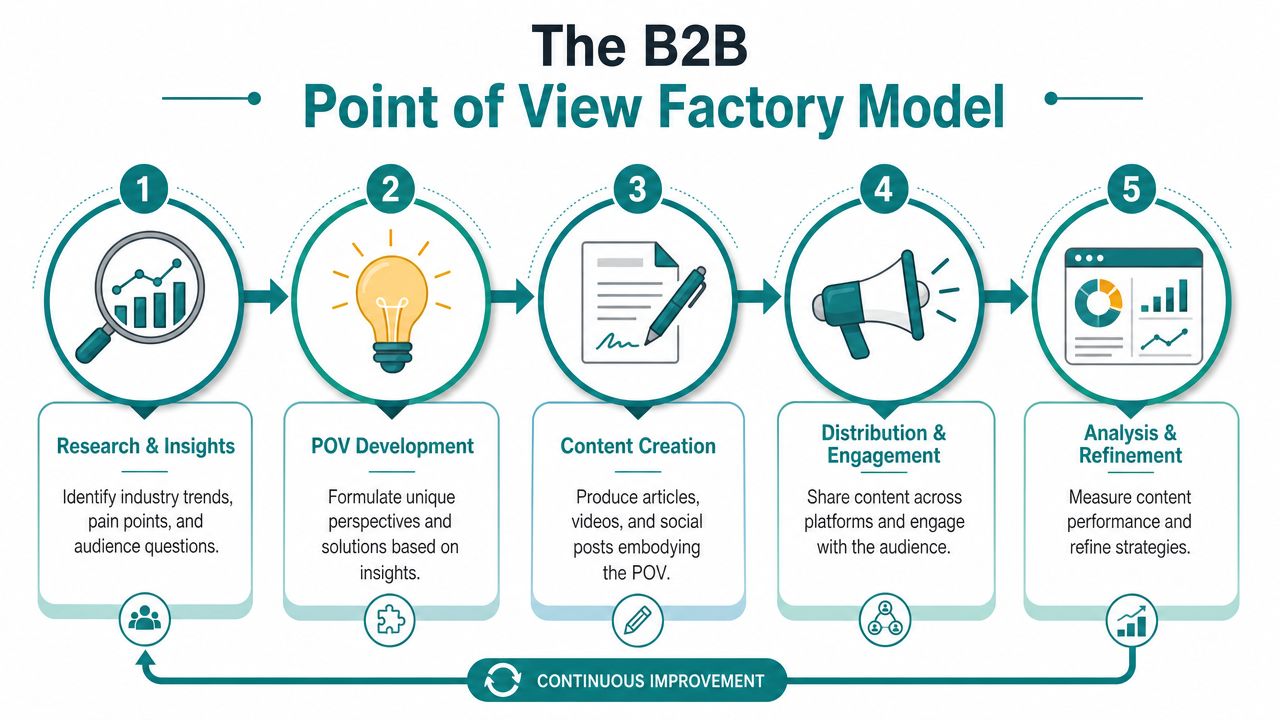
A simple point of view factory
Use this rhythm when you're short on time:
- Start with one deep asset A webinar, FAQ, proposal theme, sales call pattern, project recap, or whitepaper.
- Pull out a few useful insights Focus on what your buyers care about. What mistake are they making? What should they look for? What changed your thinking?
- Match the insight to format Some ideas work as text posts. Others fit better as a short talking-head video or a PDF-style carousel.
- Let people see your team Employee perspective often feels more credible than polished company copy.
A good B2B post doesn't try to impress everyone. It helps the right buyer understand one issue more clearly.
What to post more of
Content that opens doors usually falls into a few buckets:
- Expert advice: Simple answers to common buyer questions.
- Project lessons: What worked, what didn't, and what you'd do differently.
- Decision guidance: How to choose a vendor, evaluate a redesign, or think about paid media.
- Team insight: A specialist from your company sharing hard-earned perspective.
If you need help turning long-form material into sharper social content, this guide on how to create insightful LinkedIn posts is worth a look. It pairs well with a more structured content strategy approach when you're trying to build consistency without hiring a full in-house team.
What to post less of
Skip generic feature dumps. Skip company-first chest thumping. Skip updates that only matter to people already inside your business.
Your buyers care about whether you understand their situation. They don't need more noise. They need clarity, relevance, and proof that someone on the other side knows what they're doing.
Amplify Your Message with Paid Social and ABM
Organic posting helps. Paid social makes sure the right people see your best material.
That's the difference many B2B owners miss. They think paid social means tossing money behind a boosted post and hoping for the best. Used well, it's closer to precision distribution. You choose who should see the message, what they should see first, and what action you want next.
Think of paid social as targeted delivery
If you've written a strong post about choosing the right website partner, you don't need everyone to see it. You need the right owners, directors, or department heads to see it.
That's where LinkedIn Ads can be useful. You can build campaigns around:
- Job titles and functions
- Industry categories
- Specific company lists
- Geographic relevance, including the Cincinnati market
- Content engagement and retargeting audiences
For B2B, paid social becomes practical. You're not paying for attention in the abstract. You're paying to place a useful message in front of people who can influence or approve a purchase.
Keep the offer low friction
A cold audience usually isn't ready for a hard sell. Start with something they can consume quickly.
Short-form video is especially useful here. DSMN8's roundup of B2B social media statistics notes that short-form video dominates both organic and paid social strategies for B2B marketers, and that employee advocacy can help offset costs while supporting measurable ROI.
That doesn't mean every company needs a studio setup. A clear video from your owner, strategist, or project lead, recorded cleanly and built around one useful point, can do the job.
Paid social works best when it amplifies content that already has a reason to exist.
ABM in plain English
Account-Based Marketing, or ABM, sounds more technical than it is.
It's just focused marketing to a list of companies you want to win. Instead of casting a wide net across every possible buyer, you identify a short list of target accounts and tailor your outreach around them. Social can support that by putting relevant content in front of those accounts repeatedly.
A simple ABM setup might look like this:
| Step | Practical version |
|---|---|
| Build the list | Identify target companies you want to reach |
| Match the message | Create content tied to their likely pain points |
| Run targeted ads | Show that content to relevant roles |
| Support sales outreach | Give your team content to share in follow-up |
If your mix includes Meta for certain lead generation campaigns, this resource on how to optimize Facebook ad lead results can help frame the mechanics. For broader campaign planning and channel fit, a solid paid media strategy keeps spend from drifting into guesswork.
Measure What Matters From Engagement to Revenue
If your social reporting ends with impressions, likes, and follower count, you still don't know whether it's helping the business.
Those numbers can be useful signals, but they aren't proof of performance. A B2B company needs to know what happened after someone clicked. Did they visit a service page? Fill out a form? Book a consultation? Enter the pipeline? Close later through the sales team?
That shift in thinking changes everything.
A Sprout Social ROI article focused on B2B measurement highlights a core principle: use UTM tracking and full-funnel analytics to connect social metrics to revenue, including CRM integration that tracks opportunities and closed deals beyond the initial click.
Start with UTM tracking
A UTM parameter sounds technical, but it's simple. It's just a small tag added to a link so your analytics tool can tell where a website visitor came from.
Without UTMs, social traffic gets blurry. With them, you can tell whether a visitor came from a LinkedIn post, a paid campaign, or an employee-shared update. That helps you stop guessing.
Here are the questions UTMs help answer:
- Which post drove the visit
- Which platform brought the lead
- Which campaign led to a form fill
- Which content themes attract better-fit prospects
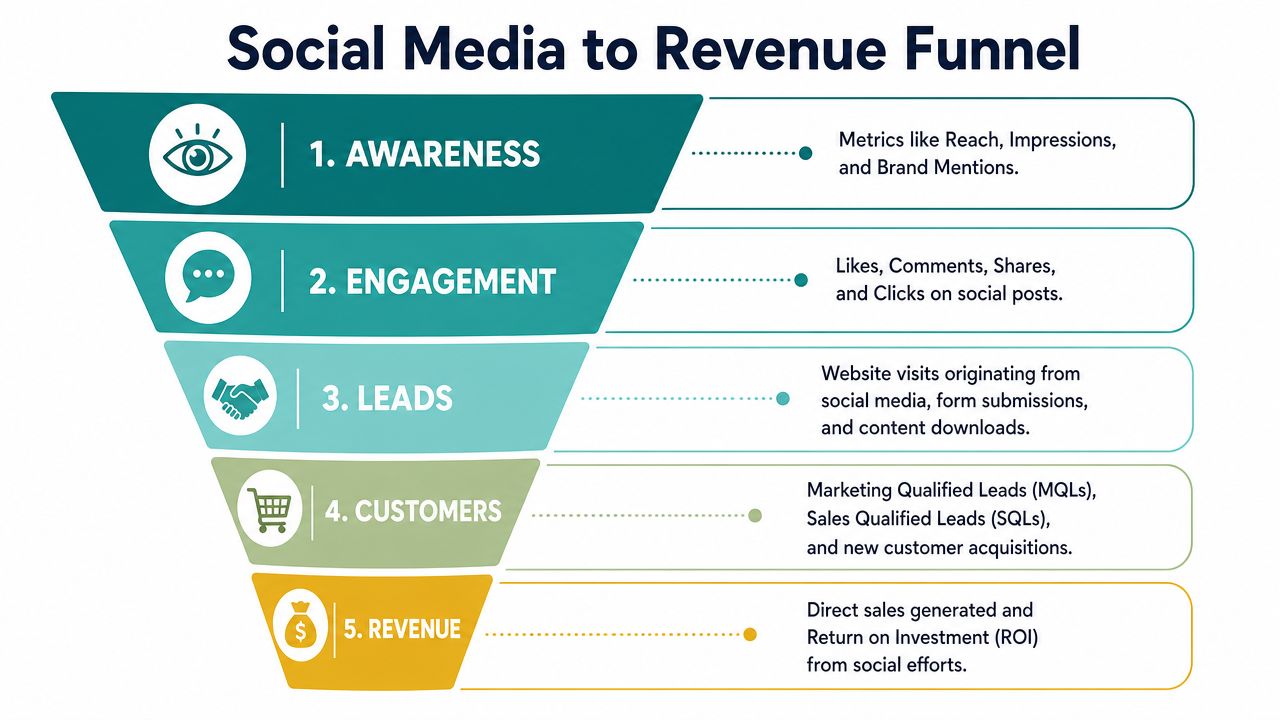
Watch the full funnel
A click isn't the finish line. It's the opening move.
A stronger reporting model follows the path from social activity into business outcomes:
- Traffic quality Are visitors from social landing on the right pages and sticking around long enough to matter?
- Lead actions Are they filling out contact forms, downloading useful material, or requesting consultations?
- Pipeline movement Do those leads turn into qualified opportunities in your CRM?
- Revenue contribution Which campaigns or content types show up in closed business, even if they weren't the last touch?
Most B2B social programs don't have a content problem. They have a measurement problem.
What to ignore and what to keep
Not every metric deserves the same attention.
| Useful metrics | Weak standalone metrics |
|---|---|
| Qualified website visits | Raw follower count |
| Contact form submissions | Likes without clicks |
| Consultation requests | Reach with no action |
| Opportunities created | Impressions alone |
| Closed deals influenced | Comments with no buyer fit |
This doesn't mean engagement is worthless. It means engagement only matters when it points toward business intent.
If you're benchmarking paid performance and want more context for ad evaluation, this roundup of essential B2B SaaS ad data can be a helpful companion read. The bigger idea is still the same. Tie channel activity back to revenue with disciplined tracking and a clear data-driven marketing strategy, or you'll end up reporting motion instead of results.
The practical test
At the end of each month, ask four questions:
- What content brought the best-fit traffic?
- Which posts or campaigns led to actual inquiries?
- What did sales say about lead quality?
- What should we stop doing next month?
That last question matters. Good measurement doesn't just validate effort. It also gives you permission to cut weak tactics and focus on the few things that move the business.
Your B2B Social Media Starter Plan
A workable B2B social strategy doesn't need to be big. It needs to be disciplined.
For most non-technical business owners, the cleanest path looks like this: choose one business goal, define the buyer, commit to LinkedIn first, publish useful expertise on a steady rhythm, and track what happens after the click. That's enough to build traction.
A realistic first 90 days
If you're starting from scratch or trying to reset, keep it simple:
- Month one: Clarify your goal, clean up key LinkedIn profiles, and identify the problems your buyers ask about most.
- Month two: Turn one strong internal asset into several posts and begin posting consistently.
- Month three: Put modest paid support behind your best-performing content and tighten tracking so you can see what happens on the site and in sales follow-up.
That sequence works because it respects reality. Most SMBs don't have time for a sprawling content operation. They need a practical system they can maintain.
The trade-offs worth accepting
You probably won't dominate every channel. That's fine.
You may post less often than larger competitors. Also fine, if your content is sharper and more useful.
You may need to say no to trendy platforms, recycled filler, and vanity reporting. That's usually where better results begin.
Consistency beats complexity in social media marketing for B2B.
The businesses that get value from social aren't the loudest. They're the clearest. They know who they're trying to reach, what they want that person to do, and how to tell if the effort is paying off.
If that's the lens you bring to social, it stops feeling like a burden. It starts becoming part of your growth engine.
If you want help building that engine, HDM can help you create a focused B2B digital strategy that connects social media, content, paid campaigns, website performance, and lead tracking into one practical system for growth.