


Your website probably isn't broken enough to force action. That's the problem.
It still loads. The contact form still sort of works. Your team can still send prospects to it. But leads feel softer than they used to. A few pages look dated on mobile. Someone mentioned a browser warning once. You've wondered whether the site is helping your Cincinnati business grow or subtly getting in the way.
That in-between stage is where a lot of small and mid-sized businesses get stuck. They don't have a web emergency. They have a web drift problem. The site slowly falls behind, and revenue slips with it.
I call that a web wellness issue. Not a design issue alone. Not an SEO issue alone. Not an IT issue alone. It's the ongoing health of the system that supports how people find you, trust you, and buy from you.
Your Digital Storefront Needs a Check-Up
A common Cincinnati business story goes like this. You paid to launch a site a few years ago. It looked sharp on day one. Then plugins aged, content got stale, mobile performance got uneven, and nobody owned the routine care. Now the website feels like a liability you're hoping won't flare up at the wrong time.
That's not a small problem. It's the digital version of letting your front entrance, phones, signage, and cash register all deteriorate at once. Customers may not complain directly. They just leave.
Web wellness is the discipline of preventing that slow decline. It treats your website like a business asset that needs regular inspection, cleanup, tuning, and protection. Smart owners already do this with accounting, HVAC, fleet vehicles, and production equipment. Your website deserves the same seriousness because it often handles first impressions, lead capture, appointment requests, and online sales.
The broader market makes this even harder to ignore. The global digital health and wellness market is projected to reach USD 494.19 billion in 2026 and USD 2,352.67 billion by 2035, with the US market alone reaching $480 billion in 2024, according to digital health and wellness market projections. Even if you're not in healthcare, the takeaway is obvious. Digital trust and digital experience now sit at the center of how people evaluate businesses.
What owners usually notice first
- Lead quality drops: People visit, but fewer take the next step.
- Small glitches pile up: Broken forms, outdated pages, image issues, and odd mobile layouts.
- Confidence falls internally: Your team hesitates to send traffic to the site because they're not sure what visitors will experience.
Practical rule: If your website causes even mild hesitation for your own team, prospects are feeling it too.
If you want a simple outside checklist to sanity-check your current situation, review these essential checks for website performance. It's the kind of basic audit framework every owner should understand before paying for another redesign.
From Tech Chore to Business Strategy
Most owners make the same mistake. They treat website upkeep like oil changes. Necessary, annoying, and disconnected from growth.
That mindset costs money.
Web wellness is closer to maintaining a performance vehicle that your sales team drives every day. If you only fix it after warning lights come on, you'll spend more, lose time, and accept lower performance than you should.

The business case is straightforward. The global wellness economy reached $6.8 trillion in 2024 and represented 6.12% of global GDP, according to Global Wellness Institute industry data. If your website is the gateway to your business, then its condition directly affects how much of that growing digital demand you can capture.
What web wellness is not
It's not "hosting is paid, so we're covered."
It's not "we update WordPress once in a while."
It's not "we'll redesign it next year."
Those are fragments. Web wellness is the operating system for how your site stays fast, secure, visible, compliant, and usable month after month.
What web wellness actually does for the bottom line
A healthy site protects revenue first. It reduces the chance that your forms stop working, your pages go down, or your visitors hit friction at the exact moment they're ready to contact you.
Then it creates growth. Faster pages improve conversion potential. Cleaner technical foundations support SEO. Better user experience makes more of your existing traffic useful. That matters if you're spending on Google Ads, content, email, or sales outreach, because every campaign performs worse when it lands on a weak site.
A neglected website doesn't fail all at once. It leaks opportunity every week.
The shift owners need to make
Stop asking, "What does maintenance cost?"
Start asking:
- What does downtime cost us in missed leads?
- What does a poor mobile experience cost us in abandoned inquiries?
- What does weak trust cost us when buyers compare us to a sharper competitor?
That's the right frame. A website isn't a brochure anymore. It's part storefront, part salesperson, part operations tool. If you run it like an afterthought, it will perform like one.
The Eight Pillars of a Healthy Website
Your website can look polished and still lose money every week.
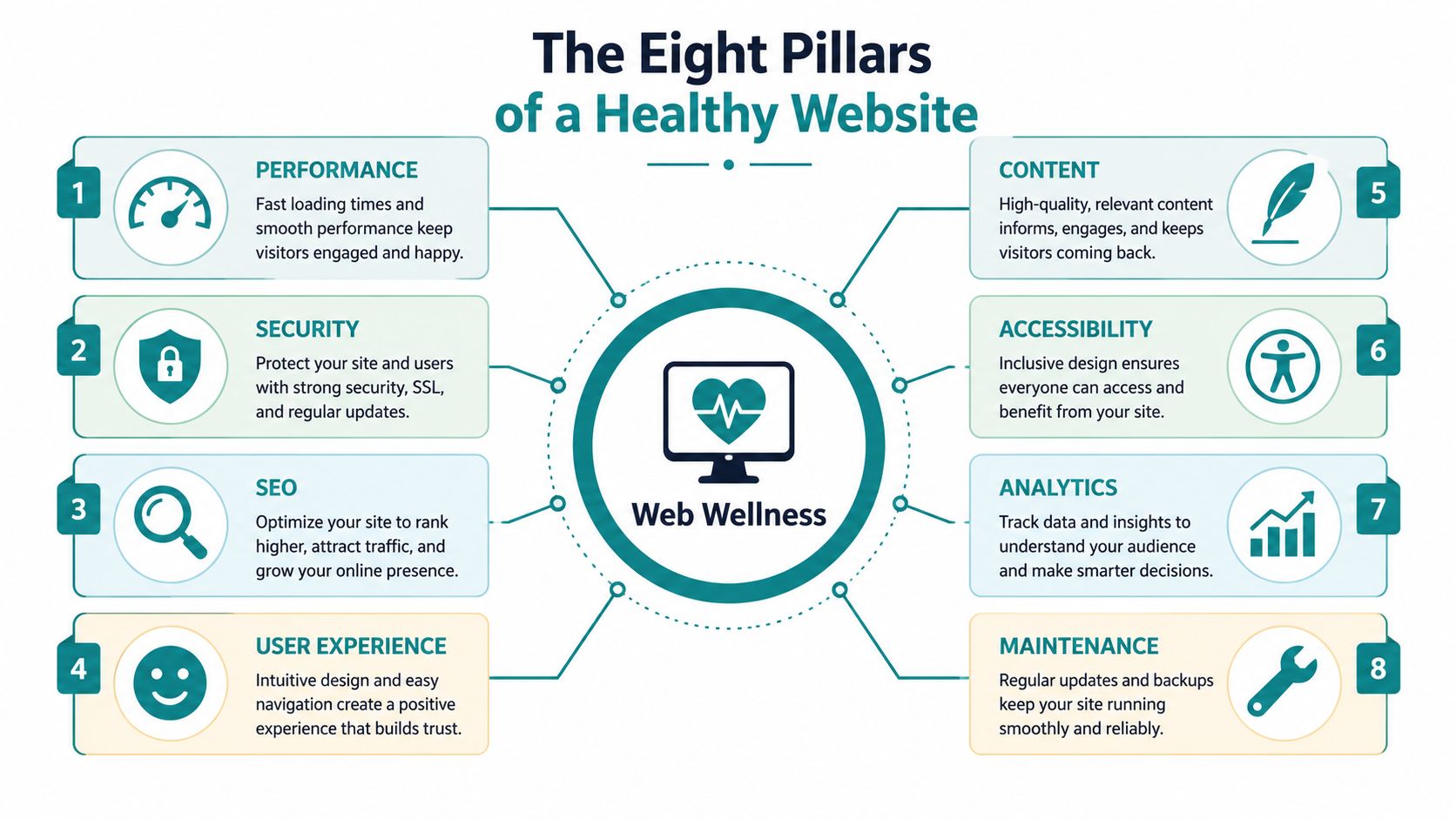
What matters is whether it stays reliable, earns trust, supports search visibility, and turns visits into calls, form fills, and appointments. For Cincinnati businesses, these eight pillars are the core of web wellness.
Maintenance and backups
Software ages fast. WordPress core, plugins, themes, forms, and third-party integrations all need scheduled updates and post-update testing.
Backups are part of that discipline. If an update breaks your quote form or wipes a service page, you need a recent restore point and a team that can use it quickly. Waiting until something fails is expensive.
Security
Small businesses get targeted because they are easier to exploit, not because attackers confused them for a Fortune 500 company.
Good security covers patching, malware scans, access controls, login protection, and routine reviews of admin accounts. If your site collects intake details, customer records, or any health-related information, weak security becomes a revenue risk and a compliance problem. Cincinnati medical practices, therapy groups, and healthcare-adjacent companies should also review vendors and workflows that touch protected data, not just the website itself. Teams that support those environments should pay attention to essential dark web monitoring for MSPs because stolen credentials often create the first opening.
Performance tuning
Slow pages waste paid traffic and organic traffic alike.
Performance work includes image compression, script cleanup, caching, mobile optimization, and plugin restraint. The goal is simple. Pages should feel fast on a phone in actual usage, not just in a desktop office test. If you want a practical standard for what that work should cover, review website wellness performance services.
Uptime and monitoring
A site outage during business hours is a sales problem. A broken form that runs for two days without anyone noticing is the same thing.
Monitoring should track uptime, form submissions, checkout steps, and major page errors. You want alerts early enough to fix the issue before your team starts asking why leads slowed down.
Technical SEO health
Search performance starts with technical basics. If search engines struggle to crawl, index, or understand your pages, your rankings suffer even if your content is solid.
This pillar includes site structure, redirects, metadata, internal links, canonicals, indexing controls, and crawl health. For a local business, that affects whether nearby buyers find you before they find a competitor across town.
Accessibility and compliance
Accessibility affects usability, legal exposure, and conversion rates at the same time.
Your site should support keyboard navigation, readable contrast, clear headings, form labels, and predictable page structure. If those basics are missing, some visitors cannot use the site properly, and that creates avoidable risk. ADA claims can be expensive, with penalties often cited around $50,000 per violation. For healthcare practices and other regulated businesses, accessibility also overlaps with HIPAA expectations around trust, privacy, and safe access to information.
Content hygiene
Outdated content tells buyers your business is inattentive.
Old staff pages, expired offers, thin service copy, broken links, and stale proof points weaken trust before a prospect ever calls. Content hygiene means reviewing key pages on a schedule, updating claims, removing dead weight, and making sure the message matches what you sell today.
User experience
User experience decides whether traffic turns into action.
People should know where to click, what to do next, and how to contact you without hunting around the page. Mobile layouts matter most here. If buttons are buried, forms are clunky, or navigation gets in the way, your website creates friction at the exact point where a buyer is ready to move.
Analytics and decision support
You need reporting tied to business outcomes.
Track lead sources, high-intent pages, form completion rates, drop-off points, call clicks, and device performance. That gives you a clear list of what to fix first and what to leave alone. Without that visibility, web wellness turns into guesswork, and guesswork is expensive.
Your Prioritized Web Wellness Roadmap
A Cincinnati business owner usually notices web problems the same way. A form stops sending. The site slows down on mobile. A staff account that should have been removed still has access. Then revenue gets hit, trust slips, and the website suddenly becomes urgent.
That is why the roadmap matters. Handle web wellness in the right order, and you protect sales first, then improve growth.
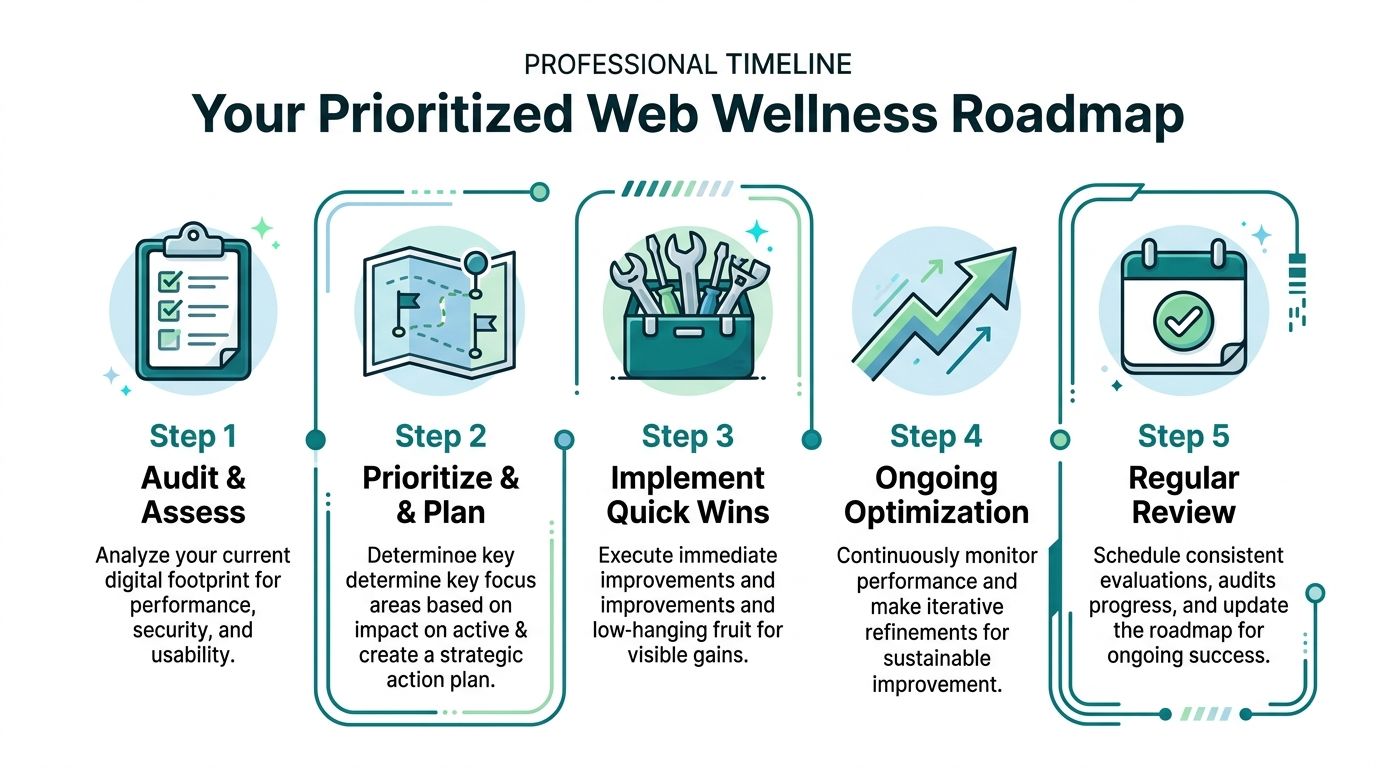
Phase one critical foundations
Start with business risk. If your site is unstable, exposed, or poorly controlled, every marketing dollar works harder than it should.
- Secure the hosting environment: Choose infrastructure with accountable support, clear ownership, and documented maintenance.
- Automate backups: Backups only matter if they restore cleanly and quickly. Test them.
- Set uptime monitoring: Get alerts the moment the site, forms, or booking tools fail.
- Review admin access: Remove former staff, tighten permissions, and protect high-risk areas with stronger login controls.
For healthcare practices, legal firms, and any company collecting sensitive customer information, this phase also covers privacy and compliance. HIPAA, intake security, and customer trust are business issues, not just IT issues. Research on privacy concerns in eHealth found that underserved users often avoid digital tools when they fear their data will be misused, which makes clear policies, secure forms, and plain-language privacy communication a direct part of conversion and retention, as discussed in research on privacy-utility tradeoffs in eHealth.
Phase two performance and growth
Once the foundation is under control, fix the issues that affect lead flow.
- Improve speed: Faster pages usually convert better, especially on mobile. Set a clear performance standard and treat slow load times as a sales problem.
- Run a baseline SEO review: Fix indexing problems, weak metadata, broken internal links, and page structure issues that keep high-intent pages from ranking.
- Scan accessibility: Check contrast, keyboard use, alt text, labels, and form behavior. That protects reach, trust, and legal exposure.
- Test lead paths: Submit every form, click every major call to action, and review booking, quote, and checkout steps on phones.
Do not manage this phase by gut feel. Use reporting that ties page performance, channel quality, and conversion paths to actual business outcomes through growth marketing analytics services.
Phase three ongoing optimization
Web wellness works best as an operating rhythm. Monthly reviews catch small problems before they become lost leads, compliance headaches, or emergency rebuilds.
| Focus area | What to review |
|---|---|
| Software health | Updates, plugin compatibility, form tests |
| Content quality | Outdated pages, stale offers, missing proof |
| Lead flow | Conversion paths, call tracking, contact submissions |
| Security posture | Alerts, admin access, suspicious activity |
Look beyond the website itself. If staff credentials tied to your domain show up in a breach somewhere else, attackers often use them to get into email, forms, or admin tools. That is why it is smart to understand essential dark web monitoring for MSPs even if your business does not have a full internal IT team.
Businesses do not need a longer task list. They need a clear order of operations that protects revenue first and improves growth second.
How to Measure What Matters
If a provider can't explain success in business terms, keep shopping.
You don't need to become a developer to manage web wellness well. You do need a short list of metrics that connect technical work to revenue outcomes. Good reporting should help you answer simple questions. Is the site available? Is it fast? Are people finding it? Are they converting?
KPIs worth tracking
Focus on a handful of indicators:
- Page speed: Look at real load experience on mobile, especially key service and landing pages.
- Form and conversion health: Test quote requests, booking paths, downloads, and calls.
- Organic visibility: Watch whether your core pages are gaining or losing search traction.
- Security status: Ask for a clear summary of vulnerabilities found, fixed, and still open.
- User behavior: Review where visitors drop off before contacting you.
For a deeper look at measurement discipline, a strong analytics setup should connect site performance to lead quality, channel effectiveness, and conversion paths through growth marketing analytics services.
Sample Web Wellness SLA Targets
A real service agreement should be specific. Vague promises like "we'll monitor your site" aren't enough.
| Metric | Target (Good) | Target (Excellent) |
|---|---|---|
| Site downtime response | Same business day | Within 1 hour |
| Critical security issue response | Same business day | Immediate triage |
| Broken form fix | Within 24 hours | Same day |
| Routine content update | Within 2 business days | Within 1 business day |
| Monthly reporting | Summary report | Summary plus action plan |
Ask one blunt question: "If my site goes down at 10 a.m. on a Tuesday, what happens next, and who owns it?"
That question tells you more than a polished proposal ever will.
Three Web Wellness Myths That Cost Businesses
A Cincinnati owner gets the call no one wants. The site is up, but leads stopped coming in, a form has been broken for days, and nobody knows who is responsible. That kind of problem rarely starts with one big failure. It starts with bad assumptions.

Myth one my host handles everything
Your host keeps the server running. That is only one slice of the job.
They usually do not maintain your CMS, fix plugin conflicts, test quote forms, review accessibility issues, improve page speed, or catch content that has gone stale. If your website drives calls, bookings, patient inquiries, or quote requests, host support is not a web wellness plan. It is basic infrastructure.
Myth two once the site is launched the hard part is over
Launch is the start of ongoing effort. Browsers change, plugins age, search standards shift, and customer expectations keep rising.
For Cincinnati businesses in healthcare, wellness, legal, and other trust-sensitive fields, the risk is bigger. Privacy language, consent tools, secure forms, and HIPAA-aware handling of user data shape whether people feel safe contacting you in the first place. If your site looks dated, loads slowly, or asks for sensitive information without clear guardrails, prospects hesitate. Revenue slips long before anyone files a complaint.
Myth three any cheap maintenance plan is good enough
Cheap maintenance plans usually cover automated updates and a backup report. That is better than nothing. It is still a weak business decision if your website plays a serious role in sales.
Real web wellness covers things owners care about:
- Business continuity: Backups, uptime monitoring, and a tested recovery process.
- Revenue protection: Form testing, mobile usability, speed improvements, and clear calls to action.
- Search support: Technical SEO upkeep, indexation checks, and crawl issue fixes.
- Trust and compliance: Security patches, accessibility fixes, privacy clarity, and stronger handling of regulated data.
A low monthly fee can still be expensive if it ignores the parts of your site that affect leads, compliance, and customer confidence. If you are weighing vendors, use this guide on how to choose a digital marketing agency for your business and ask who owns results, not just updates.
Choosing Your Path In-House or Expert Partner
There are only three real options. Do it yourself, assign it internally, or hire a specialist partner.
DIY works if your website is simple, low-risk, and not central to lead generation. Most established businesses outgrow that fast. Internal ownership can work too, but only if you have people with time and skill across security, development, content, SEO, analytics, and compliance. Most SMBs don't. They have one overloaded marketing person, one outsourced IT contact, and a site that sits in the gap between them.
That's why an expert partner usually makes more sense. You get process, specialized knowledge, and accountability without building a full in-house bench. The key is choosing carefully.
What to look for
- Local accountability: You want a team that understands the Cincinnati market and answers the phone.
- Clear reporting: You should know what was done, what was found, and what comes next.
- Business focus: They should talk about leads, visibility, user trust, and risk reduction. Not just plugin updates.
- Proven fit: If you're in healthcare, legal, e-commerce, or professional services, they should already understand the demands of your industry.
If you're comparing providers, use a practical checklist like this guide on how to choose a digital marketing agency. It helps cut through polished sales language and get to the questions that matter.
The right web wellness partner won't just keep your site alive. They'll help keep it useful, credible, compliant, and profitable.
If your website feels more fragile than dependable, it's time for a serious review. HDM helps Cincinnati-area businesses strengthen performance, security, user experience, and ongoing website wellness so the site supports growth instead of holding it back.


