
A lot of Cincinnati business owners end up in the same spot. The store is live. Products are loaded. Payment processing works. Maybe you even ran ads or posted on social media. But sales feel inconsistent, the site feels clunky, and every small update somehow turns into a project.
That usually means the problem isn't WooCommerce itself. It's the gap between having an online store and having a store that's built to sell, load fast, integrate with the rest of your business, and stay healthy after launch.
Your Online Store Is Open But Is Anyone Buying
If your store feels stuck, you're not alone. I talk with business owners around Cincinnati and Dayton who already have a WooCommerce site but still deal with the same issues: slow category pages, abandoned carts, awkward checkout steps, plugin conflicts, and no clear plan for what to improve first.

That can be frustrating because WooCommerce is not some fringe platform. WooCommerce powers 33.4% of all ecommerce websites globally, and WordPress runs 43.5% of the internet, which is why WooCommerce has become the default choice for businesses that want flexibility and ownership on WordPress, according to this WooCommerce market share breakdown.
The platform usually isn't the bottleneck
Most stalled stores don't need a different platform. They need better execution.
A healthy WooCommerce store has to do several jobs at once:
- Sell cleanly: Customers should find products fast and complete checkout without friction.
- Support operations: Orders, shipping, accounting, and inventory can't live in separate silos forever.
- Stay manageable: Your team should be able to update products, content, and promotions without fear.
- Scale with demand: Seasonal spikes, new product lines, and marketing campaigns shouldn't break the site.
When those pieces aren't planned together, the store becomes expensive to own even if the original build looked affordable.
A store can look polished and still underperform if checkout, speed, and backend processes weren't built around how your business actually operates.
What a specialized agency changes
A general web shop might build a website. A WooCommerce development agency should build a revenue system.
That difference matters for local businesses. A Cincinnati manufacturer selling replacement parts online needs something different than a DTC skincare brand in Mason or a healthcare group adding patient education products to its site. The code, integrations, compliance needs, and customer journeys are different.
The right agency doesn't start with a theme. It starts with questions about margin, operations, lead sources, customer behavior, and what needs to happen over the next few years for the site to keep up.
Why Hire an Agency Instead of a Freelancer
Hiring a freelancer can work for narrow tasks. If you need one plugin adjusted or a template issue fixed, a capable independent developer may be enough. But if you're trying to grow an online store, you're usually not hiring for a single technical task. You're hiring for outcomes.
The team in a box advantage
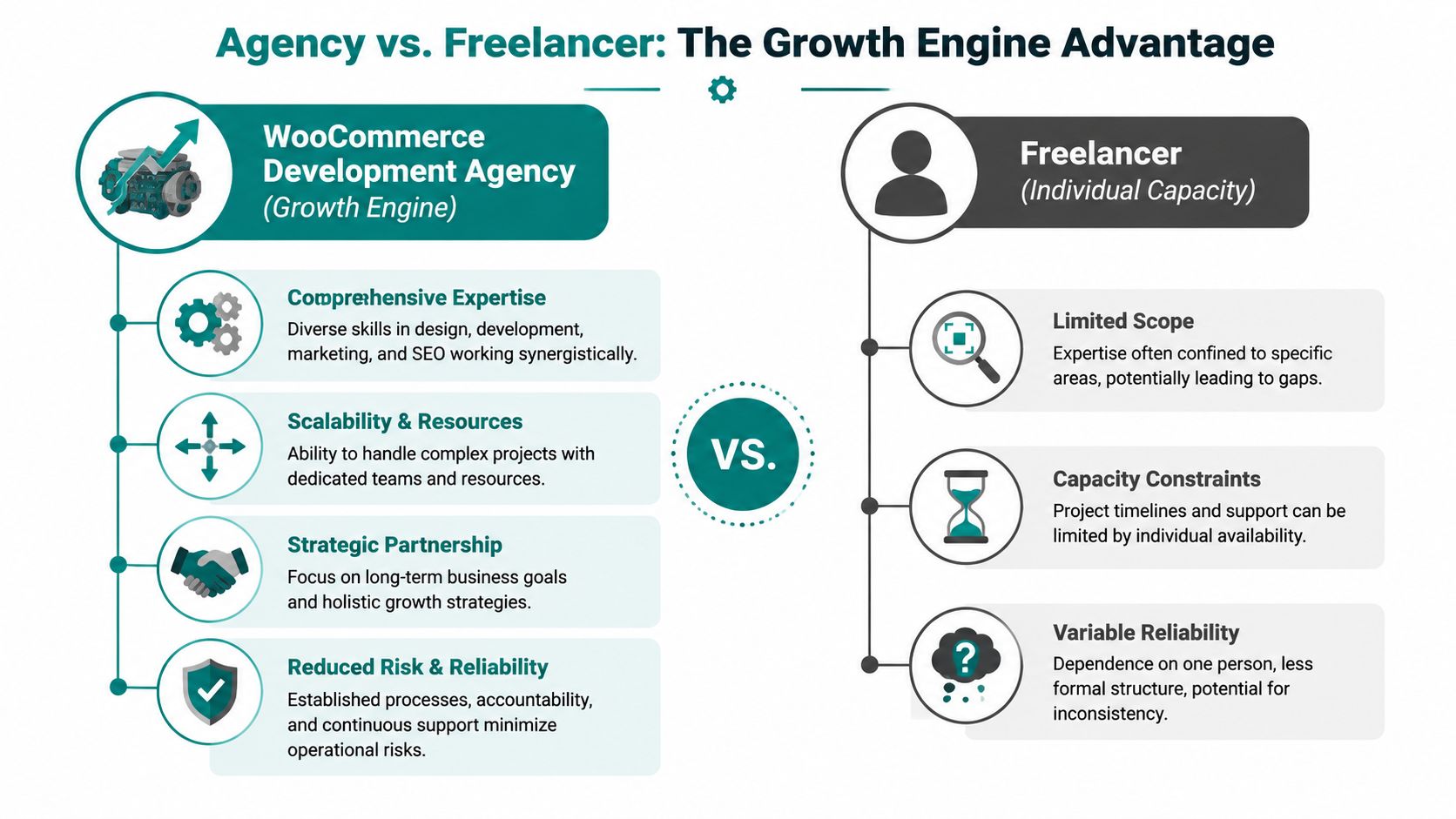
A freelancer is one person. An agency should function more like a team in a box.
That means your project can include:
- A lead architect who thinks through platform decisions, integrations, and future scalability
- A designer who improves product pages, navigation, and checkout flow
- A developer who builds and tests the actual functionality
- A project manager who keeps timelines, scope, and communication under control
That mix is why specialized agencies can do more than code. According to this analysis of high-volume WooCommerce agency work, specialized agencies can lift conversion rates by up to 35% through UX optimization and checkout improvements, and they provide a broader set of expertise that a solo freelancer often can't match.
Strategy matters more than hours
A lot of business owners compare proposals the wrong way. They compare line items, hourly rates, or page counts.
A better question is this: who is thinking beyond launch?
An experienced agency should connect the website roadmap to your business roadmap. If your goal is to add wholesale ordering, connect to your ERP, support subscriptions, or hand off order data cleanly to accounting, those decisions affect architecture on day one.
Here's a helpful visual overview before you interview anyone:
Where freelancers still fit
This isn't anti-freelancer. Good freelancers are valuable. They often fit best when:
- Scope is contained: You know exactly what needs to be fixed.
- Risk is low: If a timeline slips, business operations won't suffer.
- Internal leadership exists: Someone on your side can manage requirements and quality control.
If you don't have that internal oversight, the freelancer model can become fragile fast. One person's vacation, overload, or change in availability can stall critical work.
Practical rule: If your store affects sales, fulfillment, customer service, and marketing at the same time, you probably need a partner with process, not just technical talent.
Decoding Core Services and Technical Expertise
Most business owners don't need more technical jargon. They need plain answers to one question: what are you paying a WooCommerce development agency to do?
Core work that directly affects sales
At the base level, a strong agency should handle the things that make the store usable and trustworthy.
| Service | What it means in plain English | Why it matters |
|---|---|---|
| Custom theme development | Building the store layout around your brand and customer journey | Better usability, better credibility |
| Checkout optimization | Removing friction from cart and checkout | Fewer lost sales |
| Payment gateway setup | Connecting secure payment systems correctly | Customers can actually buy without errors |
| Product architecture | Structuring categories, filters, variants, and bundles | Shoppers find the right item faster |
| Technical SEO setup | Making the site easier for search engines to crawl and understand | Stronger visibility for product and category pages |
Some of this sounds basic. It isn't. Stores often underperform because the fundamentals were rushed.
The backend work owners don't see
The next layer is operational, determining whether a WooCommerce build either helps your team or creates more manual labor.
Good agencies often handle:
- API integrations: Connecting WooCommerce to shipping software, accounting platforms, CRM systems, warehouse tools, or ERP workflows.
- Custom plugin development: Building a feature your store needs when no off-the-shelf plugin does the job cleanly.
- Performance optimization: Using tools like Redis for object caching, WP Rocket or LiteSpeed for page caching, and Perfmatters for script control so pages stay lean.
- Store-specific development standards: Making sure custom features work with modern WooCommerce requirements like HPOS compatibility.
If you sell products with fulfillment rules, this gets even more important. For merchants dealing with restricted items, age-gated products, hazmat categories, or state-based limitations, Plugins for regulated product shipping is a useful starting point because shipping restrictions usually need to be enforced before checkout mistakes turn into support problems.
Advanced builds for more complex businesses
Not every business needs headless commerce, AI-assisted checkout, or custom block themes. But some do.
A healthcare organization may need HIPAA-conscious workflows around forms and patient interactions. A multi-location retailer may need inventory logic tied to specific fulfillment rules. A fast-growing DTC brand may need a headless frontend for more design flexibility and faster user experiences. Law firms selling digital products or gated resources may need clean CRM and intake integrations without creating messy handoffs.
For a deeper look at what a professional build can include, HDM's WooCommerce solutions overview is a solid example of the kinds of development, integration, and performance services businesses typically evaluate.
If an agency can't explain complex work in business terms, that's a warning sign. Technical skill matters. Translation matters too.
Budgeting for Growth Cincinnati Website Costs
The most common question is still the right one. What does this cost?
The honest answer is that WooCommerce pricing depends on complexity, not just design. A brochure-style site with a simple cart is one thing. A store with custom shipping logic, subscriptions, integrations, and SEO requirements is another.
A real local pricing anchor
For Cincinnati businesses, there is at least one useful benchmark. A professional WooCommerce development project in the Cincinnati market typically starts around $2,997, including custom theme work, payment gateway setup, and foundational SEO, according to this Cincinnati WooCommerce pricing page.
That number is helpful because it resets expectations. It tells you what an entry point into professional work may look like locally. It does not mean every serious store should expect to stop there.
Two common pricing models
Most agencies price WooCommerce work in one of two ways.
Fixed project pricing
This model fits when the scope is clear.
Examples include:
- launching a new store
- redesigning product and category pages
- migrating from another platform
- rebuilding checkout and payment setup
Project pricing works best when everyone agrees on deliverables, timelines, and what counts as out of scope.
Ongoing retainer support
This model fits when the store needs continuous improvement.
That usually includes:
- Monthly updates: plugin, theme, and security maintenance
- Conversion work: testing page layouts, product templates, and checkout flow
- Technical support: fixing issues before they become outages
- Marketing support: aligning SEO, landing pages, and store changes
If you're trying to compare website budgets more broadly, this Cincinnati website cost guide helps frame the bigger picture around pricing models and what drives cost up or down.
What actually drives the budget
Three things usually move the price more than anything else:
- Business rules: Complex shipping, pricing, user roles, subscriptions, and product variations add work quickly.
- Integrations: Connecting your store to the rest of your systems is where many projects get more technical.
- Decision speed: Slow approvals, unclear ownership, and changing requirements almost always increase cost.
A cheap build can become the expensive option if it has to be rebuilt in a year.
The Post-Launch Gap Most Agencies Don't Discuss
A website launch is not the finish line. For WooCommerce, it's the start of a maintenance cycle.
Too many businesses assume that once the site is live, they can leave it alone unless something breaks. That's how stores drift into slow load times, plugin conflicts, checkout errors, and avoidable security problems.
The hidden cost of neglect
This issue is bigger than most owners realize. According to this review of WooCommerce agency maintenance gaps, 73% of SMBs face critical security and performance issues within six months of launching a new site, and 68% of WooCommerce stores experience a breach or conflict within a year.
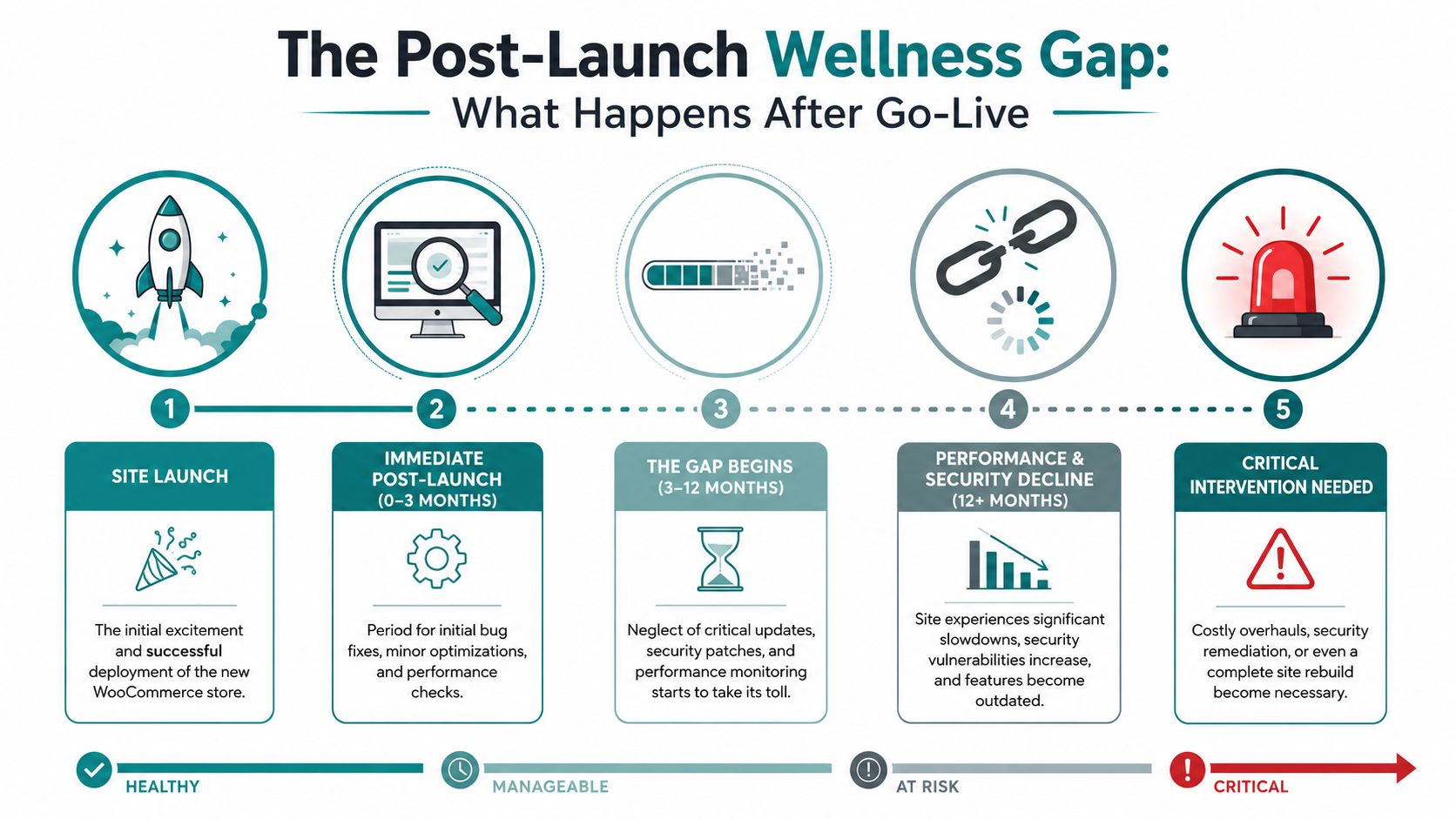
Those numbers line up with what happens in practice. Plugin ecosystems change. Payment tools update. Shipping extensions get revised. WordPress core evolves. If nobody is watching those moving parts, the store slowly becomes unstable.
Think of it like vehicle maintenance
A WooCommerce site is closer to a delivery van than a printed brochure.
You wouldn't buy a van, drive it daily for business, and skip oil changes, tires, brakes, and inspections. But many companies do the digital equivalent with ecommerce.
Post-launch support should include at least:
- Security updates: WordPress core, WooCommerce, plugins, and themes
- Compatibility checks: making sure one update doesn't break another tool
- Backups and recovery planning: because problems rarely happen at convenient times
- Performance tuning: image cleanup, cache review, script management, database health
- Revenue monitoring: checkout, forms, and transactional emails need regular testing
A site rarely fails all at once. Owners usually notice it in small ways first. Slower pages, weird cart behavior, missing emails, or a plugin update that quietly breaks something important.
If you're trying to assess whether your current site is being maintained the right way, this website wellness checklist is a practical place to start.
What a good maintenance plan looks like
Avoid vague "support" promises. Ask for specifics.
A solid post-launch plan should define:
| Area | What to ask for |
|---|---|
| Update process | How updates are tested before going live |
| Monitoring | What gets checked regularly |
| Response | Who handles urgent issues and how fast |
| Reporting | What you receive each month |
| Ownership | Who is accountable for uptime, backups, and plugin conflicts |
If an agency disappears after launch, you didn't hire a partner. You hired a builder.
Your Agency Evaluation Checklist and Red Flags
Once you start talking to agencies, many proposals can sound similar. Everyone says they build custom websites. Everyone says they care about growth. The difference shows up in the questions they ask, the examples they can prove, and the way they define responsibility.
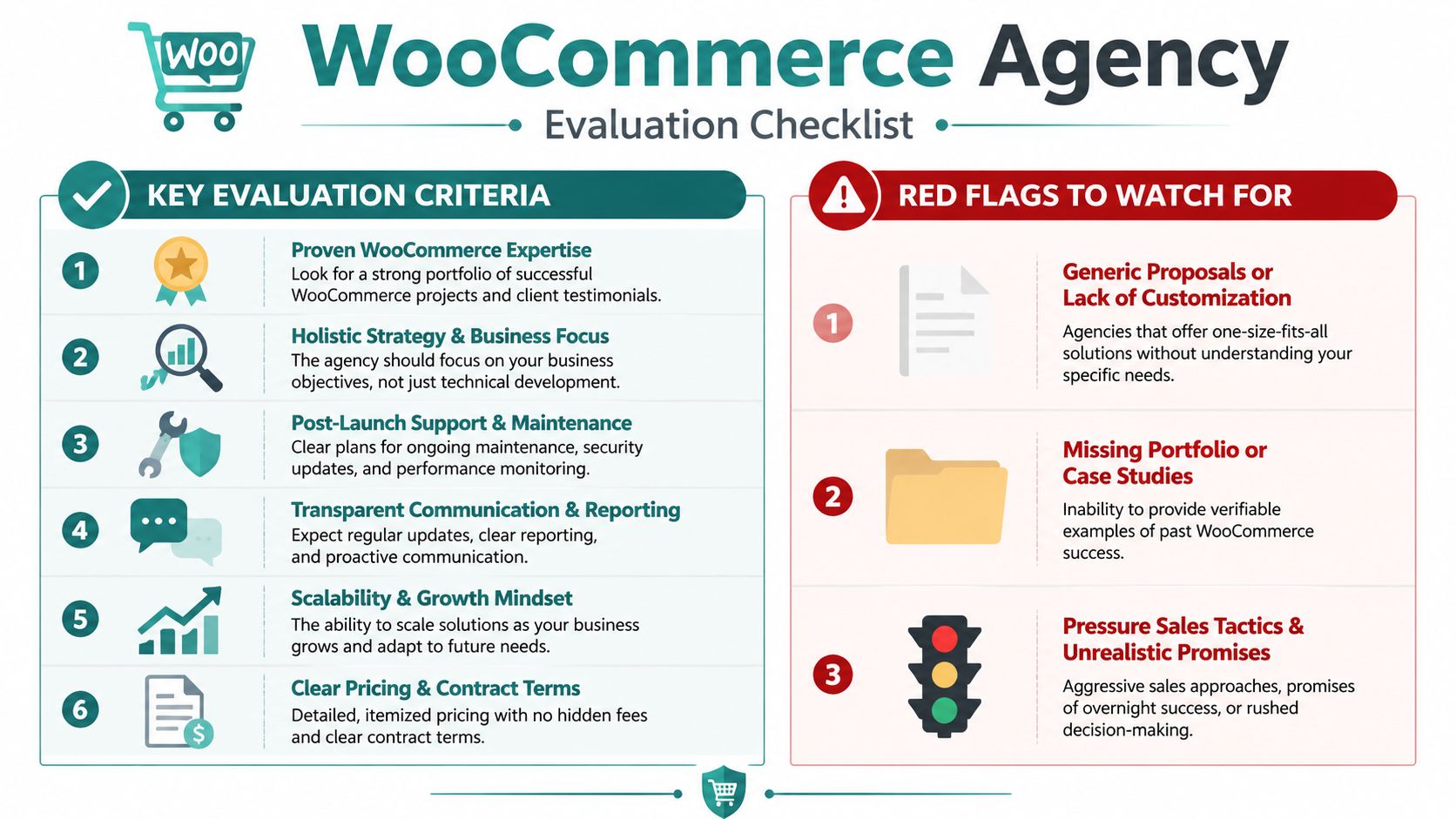
Questions worth asking in every interview
Bring this list into every agency conversation.
- Who will work on my project? You want names and roles, not just a sales rep and a generic promise.
- Can you show live WooCommerce examples, not just screenshots? Click through the sites yourself. Test product filters, cart behavior, and checkout.
- How do you handle complex requirements? Ask about subscriptions, bundles, custom pricing, ERP connections, or shipping logic if those apply to your business.
- What is your post-launch support model? If the answer is vague, expect trouble later.
- How do you approach performance? Competent teams should be comfortable talking about caching, script control, and testing actual checkout flow on desktop and mobile.
What strong answers usually sound like
A capable WooCommerce development agency tends to speak clearly about process.
Look for signs like:
- a defined discovery phase
- documented scope and change management
- staging environments for testing
- QA before launch
- a maintenance path after launch
They should also connect technical choices to business realities. If they recommend a custom plugin, they should explain why that beats stacking three plugins that may conflict later. If they suggest headless commerce, they should explain what problem it solves and what added complexity comes with it.
Reality check: Good agencies don't promise miracles. They explain trade-offs, dependencies, and where custom work is worth the investment.
Red flags that should slow you down
Some warning signs are obvious. Others are easy to miss until you're already committed.
| Red flag | Why it matters |
|---|---|
| One-size-fits-all proposal | It usually means they didn't understand your business |
| No clear team structure | Accountability gets fuzzy fast |
| Portfolio is mostly template sites | They may not handle complex store requirements well |
| No discussion of maintenance | They may treat launch as the end of the relationship |
| Pressure to sign quickly | Good partners don't need to rush informed decisions |
The simplest test is this: do they make the project feel clearer or murkier? The right team reduces confusion. The wrong one hides behind jargon.
A Tailored Hiring Checklist for Your Business
Generic advice only goes so far. A Cincinnati business owner selling supplements online doesn't need the same agency checklist as a healthcare group, a law firm, or another marketing agency looking for white-label development support.
For DTC brands
If you're selling direct to consumer, the site has to convert and scale under campaign pressure.
Focus on these questions:
- How do you improve product page conversion? Ask about image handling, variation selection, mobile UX, cart flow, and cross-sell logic.
- What happens during traffic spikes? Your agency should have a plan for caching, performance testing, and release management.
- Can you support merchandising changes quickly? Promotions, seasonal launches, and product bundles shouldn't require a development emergency every time.
A useful outside perspective is expert advice on search agencies, especially if your ecommerce growth depends on the agency relationship between development, SEO, and paid acquisition working together instead of in separate silos.
For healthcare organizations
Healthcare websites carry a different level of risk. If your WooCommerce store touches patient communication, protected information, or health-related purchasing flows, your agency needs discipline.
Look for:
- HIPAA-aware development practices
- Secure form and data handling
- Clear user permissions and access controls
- A documented process for updates and plugin review
Don't settle for "we've worked with healthcare before" if they can't describe how they reduce risk in practical terms.
For law firms
Most law firms won't use WooCommerce the same way a retailer does, but some firms sell digital resources, consultations, educational products, or gated service packages. In that case, trust and clarity matter as much as functionality.
Ask whether the agency understands:
- intake flow and lead capture
- CRM handoff after purchase or inquiry
- page structure that supports credibility
- local search visibility for practice areas
If the store creates friction or looks generic, it can hurt trust before a prospect ever contacts you.
For agencies needing white-label help
This is one of the least discussed use cases, even though it's common. Marketing agencies often win ecommerce opportunities before they have the in-house development depth to deliver WooCommerce correctly.
A strong white-label partner should offer:
- Quiet delivery: They should strengthen your client relationship, not compete with it.
- Reliable process: Clear scope, timelines, and communication matter even more when you're the one facing the client.
- Technical range: They should handle custom development, integrations, and post-launch support without needing constant supervision.
- Documentation: Your internal team still needs clean handoff notes and a clear record of what was built.
The wrong white-label partner creates hidden risk. The right one makes your agency look more capable without stretching your team thin.
The best agency choice usually isn't the cheapest or the flashiest. It's the one that understands how your business makes money, where your operational friction lives, and what your site needs to support over time.
If you're evaluating a WooCommerce development agency and want a local team that understands Cincinnati-area businesses, HDM is worth a conversation. HDM helps organizations with WooCommerce development, growth-focused design, SEO, custom integrations, and ongoing Website Wellness, with experience across ecommerce, healthcare, legal, and white-label agency partnerships.