

You check Google on your phone and your business is right there, page one, map pack, good reviews. Then a customer tells you she asked ChatGPT who to hire in Cincinnati, and your name never came up. She hired the company the AI named instead.
That gap is frustrating, and it's common. It's also fixable, once you understand what AI tools need that Google rankings don't give them.
What AI Search Engine Optimization Means
Say a Springboro roofing owner ranks well for "roof repair near me." A homeowner in Mason opens Perplexity and asks, "Who's a reliable roofer for a leak around a chimney, and what should I expect to pay?" The answer names two competitors, quotes their service areas, and never mentions him. He's visible in one place and invisible in the other.
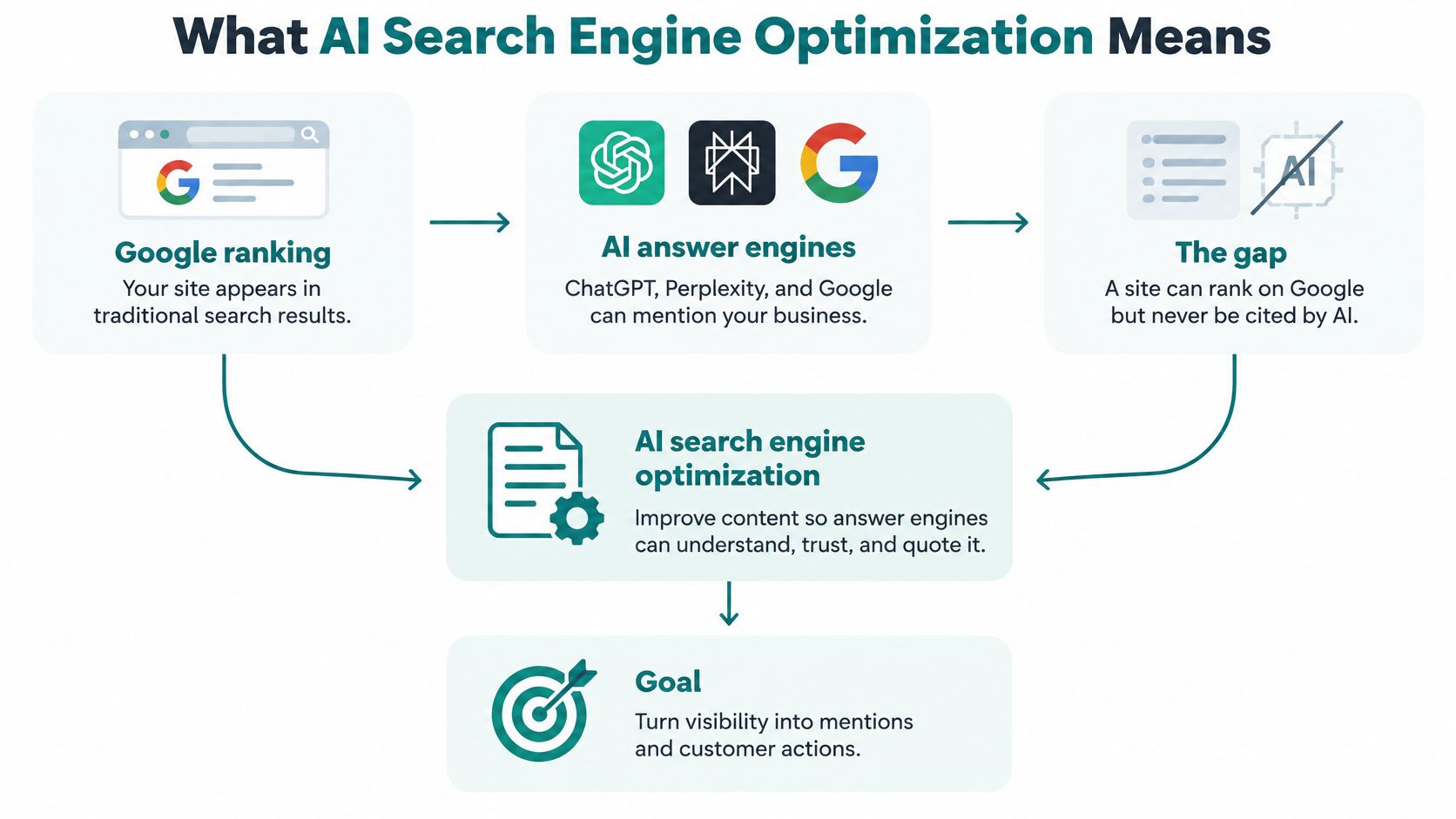
AI search engine optimization means making your business easy for AI systems to find, quote accurately, and recommend, while ordinary SEO keeps earning you blue links and map pack rankings. Those are related jobs, but they're not the same job.
Three jobs, in plain language
Search optimization earns your place in Google, Bing, and the local map pack. Answer optimization shapes short, self-contained passages that featured snippets, voice assistants, and Google AI Overviews can lift word for word. Generative optimization makes your brand citable inside ChatGPT, Perplexity, Claude, Gemini, and Copilot when they write an answer from scratch.
You don't need three websites for this. You need pages that do all three jobs at once. If you want a broader look at how sites get prepared for AI agents, the website optimization advice from Agentable is a useful companion read.
Why this matters now
More searches end without anyone visiting a website. A 2024 Zero-Click Search Study summarized on Wikipedia's AI Overviews page reported that 58.5% of U.S. Google searches and 59.7% of searches in the European Union ended without a click. Only about 360 of every 1,000 U.S. searches generated a click that left Google.
Google introduced AI Overviews in the United States in May 2024 and expanded the feature internationally beginning in August. So a customer may read a summary of your business, form an opinion, and call you days later, or call someone else, without your analytics ever showing a visit.
A mention shapes your reputation before anyone reaches your site, so counting sessions alone hides real value.
That's the trade-off to accept early. You're optimizing for being found, being quoted correctly, and being chosen. Traffic is only part of that picture.
How SEO AEO and GEO Differ
Owners often hear these three acronyms pitched as three separate services. They're stacked layers on the same website. Here's the whole comparison in one table.
SEO, AEO, and GEO at a glance
| Layer | What you are optimizing | Where you can show up | Success looks like |
|---|---|---|---|
| SEO, classic search | Rankings, crawlability, and local relevance | Google organic results, Bing, local map pack | Qualified clicks, calls, and direction requests |
| AEO, answer engines | Short, extractable answers | Featured snippets, voice assistants, Google AI Overviews | Your passage is the answer that gets read aloud or lifted |
| GEO, generative engines | Citable facts, brand clarity, and trust | ChatGPT, Perplexity, Claude, Gemini, Bing Copilot, Google AI Overviews | The brand is named, cited, and described correctly |
SEO is the foundation. If Google can't crawl your pages, or your service pages don't match what people type, or your site loads slowly on a phone, nothing else here works. The practical steps to improve search rankings cover that groundwork well if you're starting from zero.
AEO is about the shape of your writing. A voice assistant can only read one short answer. An AI Overview lifts a sentence or two. If your best answer is buried in paragraph six, under a vague heading, another company's cleaner sentence wins.
GEO is about whether an AI system trusts your facts enough to repeat them and attach your name. That takes clear claims, named experts, and consistent business details across your site and your listings.
One company, three different results
Take a Cincinnati HVAC company. It ranks second for "furnace repair Cincinnati," so the SEO row looks healthy. A homeowner asks Alexa what a furnace tune-up includes, and the spoken answer comes from a national publisher, because the HVAC site never answers that question in one tidy paragraph.
That night the furnace quits. The homeowner asks ChatGPT which local company handles emergency calls and services older systems. The answer names three competitors whose pages state their hours, service area, and specialties plainly. Our company isn't mentioned.
Same business, same website, three different outcomes. Mark the row where you're weakest before you change any copy. Most local firms are strongest in the first row and weakest in the third, and that gap is where the lost calls hide.
Find Customer Intent and Read the Live Results Page
Start with questions your customers ask, not keywords a tool suggests. Sort them into three intent groups.
- Learn: What does a furnace tune-up cost in Cincinnati, and what's included?
- Compare: Which local firm handles older systems well, and how do their warranties differ?
- Act: Who can come out today, and how fast?
Collect these from phone calls, texts, reviews, and the People Also Ask boxes Google shows under a search. Your front desk already hears the best ones every week.
Read the live page before writing anything
SERP analysis just means reading the actual results page for each question.
- Search it privately: Use a private browser window and note whether an AI Overview, map pack, featured snippet, or video appears.
- List who's named: Write down every business and source the page surfaces.
- Ask the AI tools: Put the same question to ChatGPT, Perplexity, and Gemini, and record which local firms appear.
- Check your own page: Mark each question your page doesn't answer in its first paragraph.
If you're checking results across many suburbs, an approach built for multiple service areas helps. Our guide to multi-location SEO for businesses with several locations shows how to keep those pages distinct. For checking pages at scale, it also helps to compare options for the best SERP API rather than copying results by hand.
Tools, and one firm limit
Think in five groups: search console tools for indexing and queries, analytics for visits and calls, question research tools, writing assistants for first drafts, and automation for reporting and rank checks.
Automate collection and reporting. Never automate publishing. Every AI-drafted sentence needs a person to check it against a source, because invented numbers and made-up experts damage trust fast.
Content Moves That Earn AI Mentions
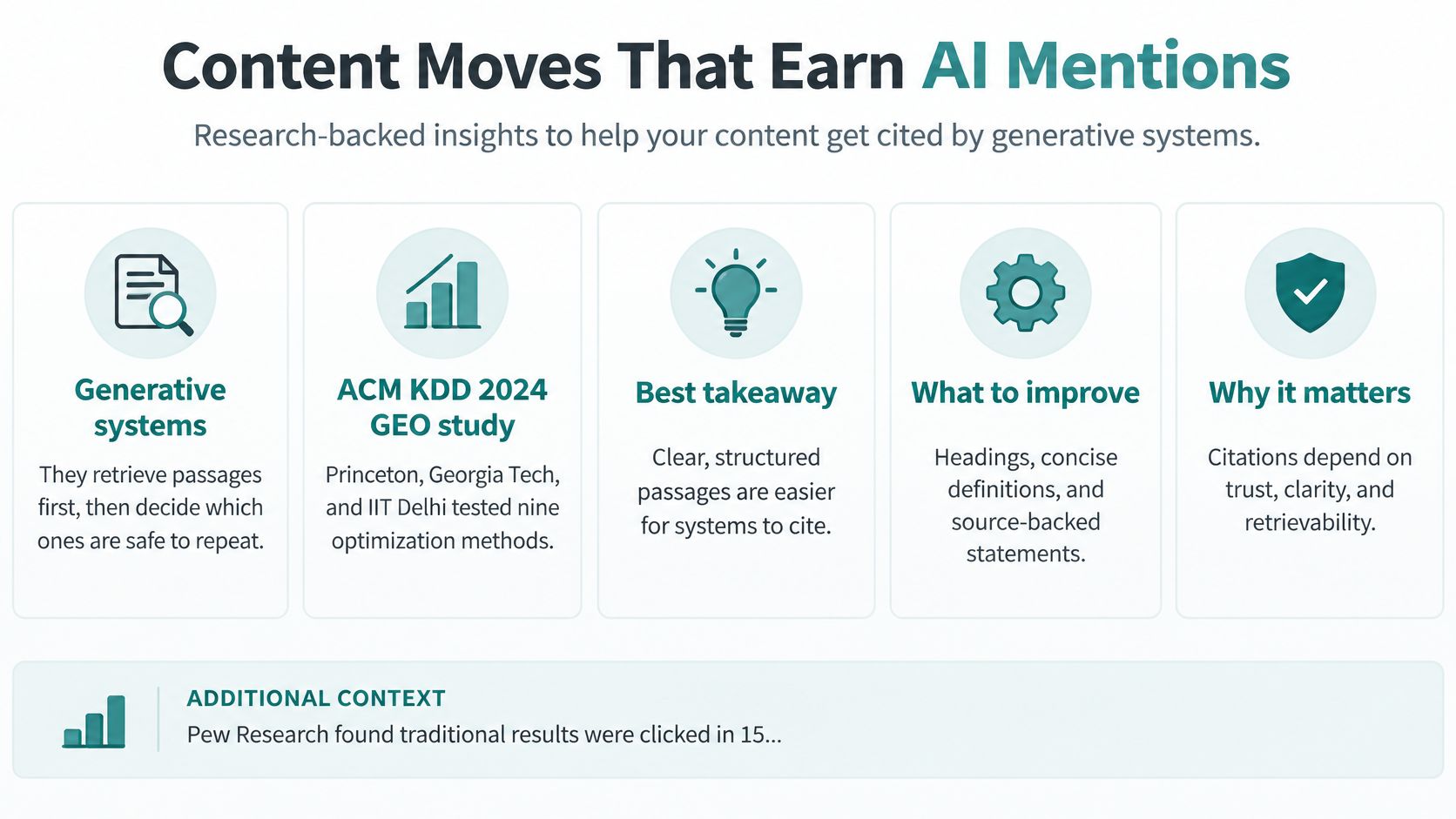
Generative systems work in two passes. First they retrieve candidate passages. Then they decide which ones are safe to repeat. Your writing has to survive both passes, and the second one is where most local pages fail.
The clearest evidence comes from the ACM KDD 2024 study on Generative Engine Optimization by researchers from Princeton University, Georgia Tech, and IIT Delhi. They evaluated nine content-optimization methods across a benchmark of 10,000 queries. Adding relevant citations produced visibility gains of up to 40%, incorporating statistics produced gains of approximately 41%, and adding quotations produced gains of about 28%.
Two other findings matter for a local owner. Improvements were especially meaningful for websites that began with lower visibility, which describes most small firms. Traditional keyword stuffing did not improve performance and could reduce visibility.
What each move looks like on a real page
A citation means naming a recognizable source next to a claim. Cite the city permit rule, the manufacturer spec, or the published guideline your recommendation rests on. "We follow best practices" cites nothing and convinces no one.
A statistic means a real number with a traceable origin. Use your own job records, a typical project range, or years serving Cincinnati. A number you can't source is worse than no number, because an AI may repeat it and a customer may hold you to it.
A quotation means a named person with a role. "Our team believes in quality" is filler. A sentence from your lead technician, with her name and certification, is something an AI can attribute and a customer can believe.
Before and after
Before: "We're Cincinnati's most trusted furnace experts with top-rated service you can count on."
After: "Most furnace repairs we run in Hamilton County fall into a range we quote in writing before work starts, and our technicians follow the manufacturer's diagnostic sequence for each model. As our service manager puts it, 'We show the failed part and the reading that condemned it, so the homeowner sees why we're replacing it.'"
The second version gives an AI system a claim, a source it can point to, and a person it can name. This short video walks through the same idea visually.
<iframe src="https://www.youtube.com/embed/gYWQYNKj7_U" width="100%" height="400" frameborder="0" allowfullscreen></iframe>Practical rule: If a sentence could appear unchanged on a competitor's site, it gives an AI no reason to pick yours.
Stuffing city names into every sentence works against you here. Write the way you'd explain the job across a kitchen table, then add the proof.
A Workflow From Indexed Page to Cited Answer
Retrieval comes before prose. If your page never enters the candidate set an engine chooses from, better sentences don't matter, because nobody's system ever reads them. This five-step workflow fixes that order.
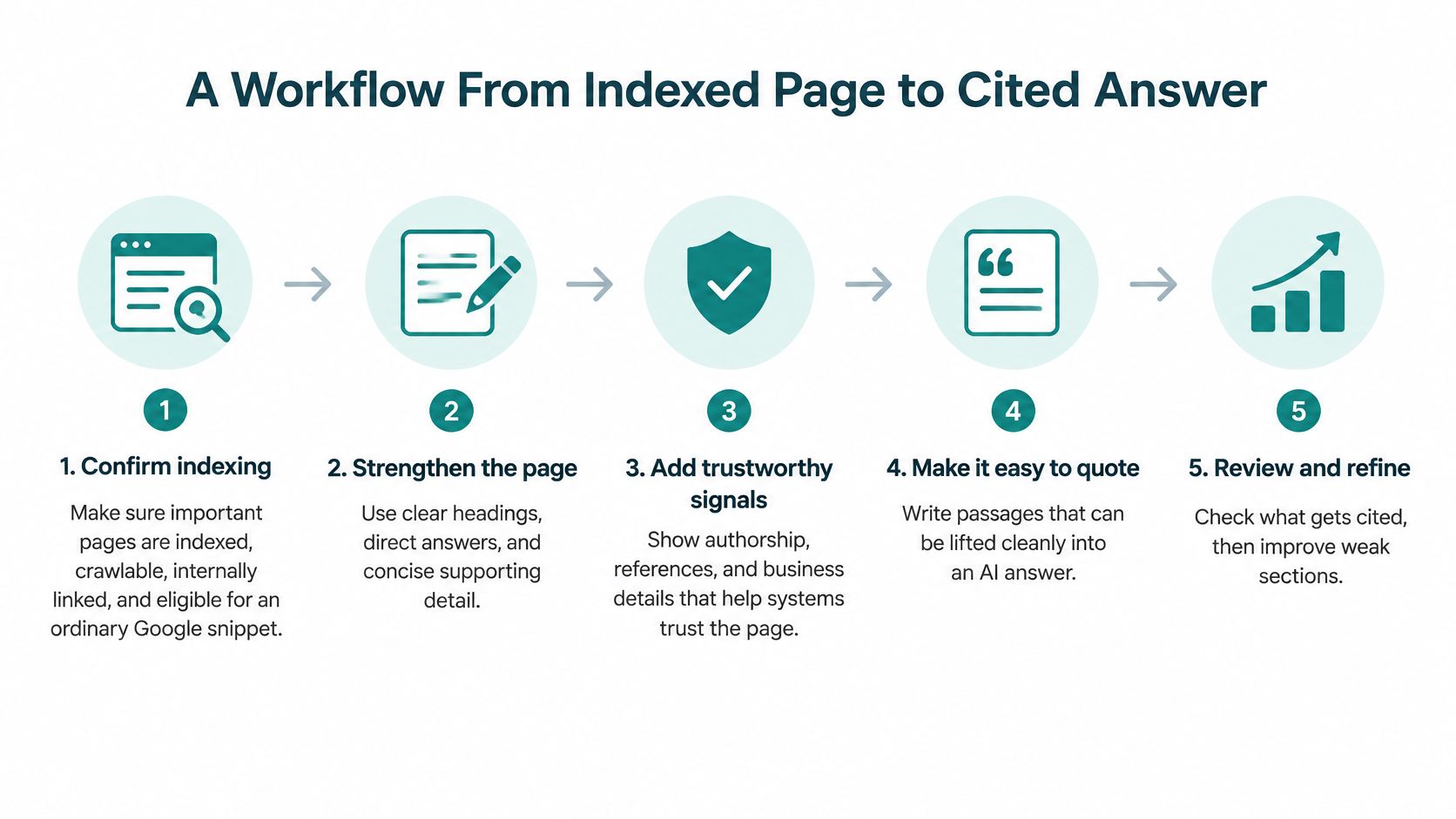
The five steps
-
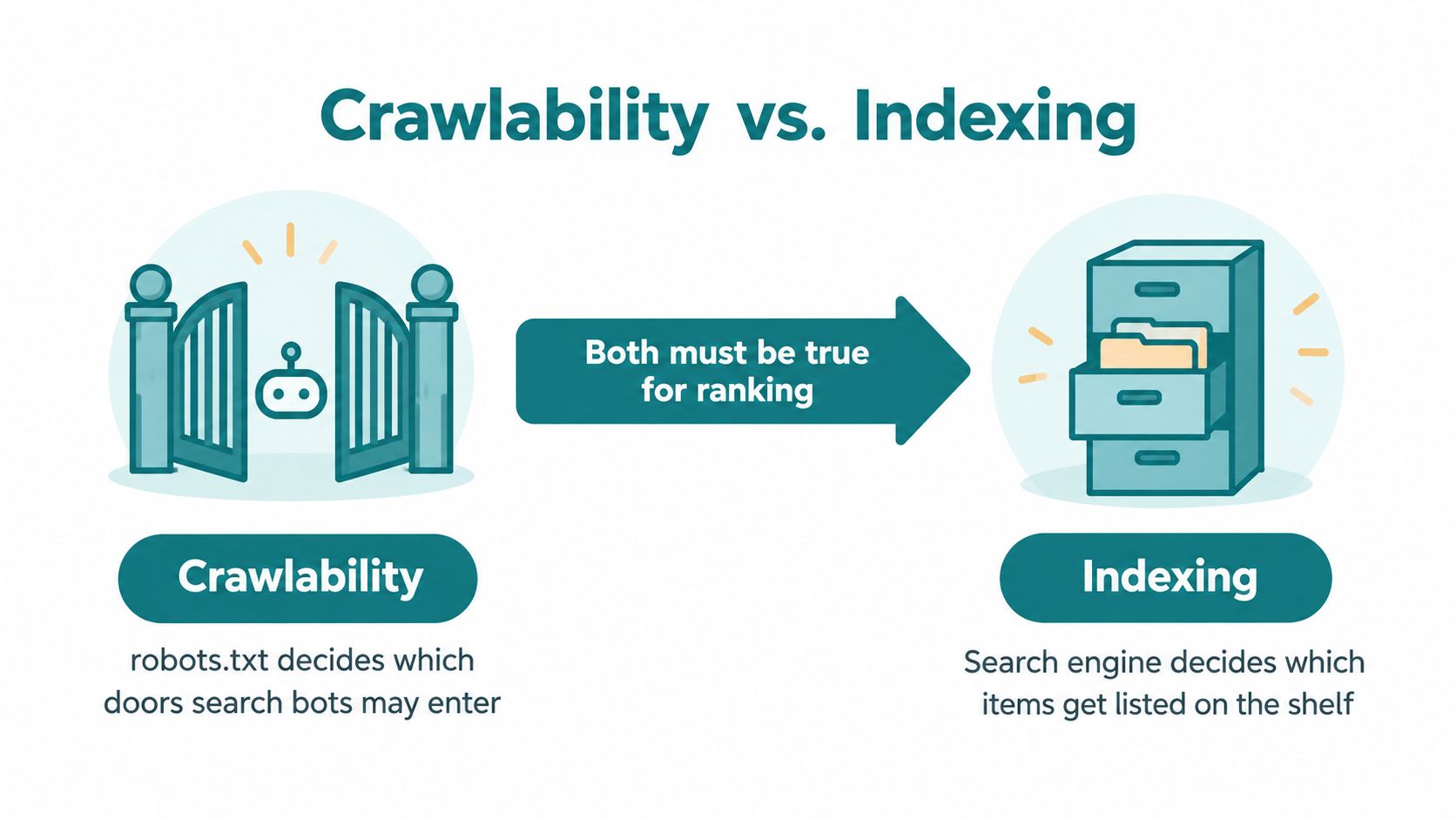
Confirm indexing first. Verify your important pages are indexed, crawlable, internally linked, and eligible to appear in ordinary Google Search with a snippet. According to Google's guidance on AI features in Search, websites don't need special AI markup, AI text files, or a separate optimization system to qualify for AI Overviews or AI Mode, and there are no additional technical requirements beyond being indexed and eligible for a snippet.
-
Answer in the first paragraph. Put the customer's question in a plain heading and answer it immediately, in text, on a stable URL. Don't hide key facts in an image, a PDF, or a script that loads late. A passage that stands alone is a passage an engine can lift.
-
Add proof to that passage. One sourced number, one named citation, one expert line. You don't need all three on every paragraph, but every important claim on the page should have at least one of them nearby.
-
Use structured data only for visible facts. Structured data is code that labels facts for machines. Apply it selectively to your organization, local business details, products, or events, and make sure every labeled fact matches what a visitor can read on the page. Skip speculative AI fields. Markup that promises something customers can't verify creates risk, not advantage.
-
Give clickers a job the summary can't finish. Add service area detail, credentials, a comparison, pricing context, photos of finished work, or a booking path. A summary can repeat your facts. It can't schedule your truck.
Where owners get sold the wrong fix
Vendors now pitch proprietary AI files and special markup packages. Google's own guidance undercuts that pitch. Before paying for anything AI-specific, get indexing, crawl access, internal links, page speed, and on-page content checked. Our walkthrough of a technical SEO audit and what it should cover lists those checks in order.
If a proposal starts with AI markup and never mentions indexing, ask why.
A checklist you can hand to your web partner
- Indexed and eligible: Every money page appears in Google with a snippet.
- Linked internally: Each service page is reachable from navigation and related pages.
- Answer first: The main question is answered in the opening paragraph.
- Proof attached: Claims carry a source, a number, or a named expert.
- Markup matches: Structured data repeats only facts visible on the page.
- Next step clear: A visitor can call, book, or compare without hunting.
Work that list top to bottom. Any step skipped early makes the later steps weaker.
Measure Assisted Demand Not Just AI Clicks
A thin stream of visits from ChatGPT or Perplexity doesn't prove AI had little effect. That conclusion feels logical when you stare at a referral report, and it's usually wrong.
Similarweb data cited in iPullRank's AI search statistics and trends roundup found that users who received an AI recommendation for a brand were 2.5 times more likely to visit that brand's website within seven days. Yet only 8.8% of those visits arrived directly from an AI platform. Search accounted for 55.9% and direct traffic for 19.9%.
Read that again as an owner. The AI answer plants the name. The customer later types your name into Google, or goes straight to your site, and your analytics credits search or direct. AI did the persuading and got none of the credit.
What to track besides AI referral traffic
| Outcome | What to watch | Why sessions alone miss it |
|---|---|---|
| Retrieved | The page is in the set an engine can choose from | Strong writing can't help a page that's never found |
| Cited | The brand or URL is named in the answer | A mention is exposure, not a visit |
| Citation prominence | How much of the answer uses your facts | A footnote is weaker than being the main source |
| AI referral sessions | Clicks tagged from ChatGPT, Perplexity, or similar tools | Only 8.8% of influenced visits arrived directly from an AI platform |
| Assisted demand | Branded search, direct visits, and lead quality within seven days | Search was 55.9% and direct 19.9% of those later visits; recommended brands were 2.5 times more likely to be visited |
How to read each row
Retrieval fails when titles, headings, and internal links hide a page. Fix discoverability before rewriting copy.
Citation is a yes or no, and it flatters you. Prominence is the better question. Being one of five sources in small print is not the same as supplying the facts the answer is built on.
Referral sessions will look small by design. Don't kill a working program because that one number is modest.
Assisted demand is where a Cincinnati service firm, clinic, law office, or shop sees money. Watch branded searches, direct visits from new users, call volume, and whether leads mention your name correctly. Our explainer on multi-touch attribution for local marketing shows how to credit earlier touches without double counting.
One limit deserves respect. Healthcare sites shouldn't try to stitch individual patient journeys together in ways that break HIPAA. Track patterns in aggregate, not people.
Stop asking how much traffic AI sent. Ask whether AI increased qualified demand that search, direct visits, or the phone later captured.
When a Citation Does Not Become a Customer
An AI citation can put your business in front of a customer without sending that person to your website. The click doesn't follow as often as many owners expect.
Reporting on Pew Research Center's study of Google AI Overviews found that users shown an AI Overview clicked an external result 8% of the time, versus 15% when no overview appeared. Only 1% clicked a cited link inside the summary. Users ended their browsing session on 26% of pages with an overview, compared with 16% without one.
Being referenced is not being selected
An AI might quote your price range, then recommend a competitor because that business appears to fit the customer's needs better. Your page helped explain the answer. The competitor may still get the call.
A visitor who does click may be comparing a short list of options. Make it easy to see why your business fits:
- Current credentials: State licenses, certifications, and insurance plainly.
- Real availability: List the neighborhoods you serve, your hours, and realistic response times.
- Pricing context: Explain what affects cost, even when you can't quote a job sight unseen.
- Proof of work: Show photos, named projects, and reviews tied to specific jobs.
- A clear next step: Offer one obvious way to call, book, or request a quote.
Check what AI says about you
Accuracy matters as much as visibility. On pages where advice can affect someone's health or legal decisions, show who wrote the content, when it was reviewed, and what qualifications they have. A wrong or out-of-context summary can harm trust and create safety or compliance concerns.
Ask the questions your customers might ask, then compare the answers with your actual services, locations, and credentials. If an AI describes your business incorrectly, update the source pages it may be drawing from.
Publishing more generic FAQ pages won't solve a lack of useful evidence. Specific, verifiable information gives customers clearer reasons to trust your business and gives AI systems better material to interpret.
See If AI Tools Recommend Your Business
A customer in Cincinnati might ask ChatGPT, Google AI Overviews, Perplexity, or Gemini who to hire. Try the same kind of question for your service and location, then record whether your business is absent, misdescribed, or recommended.
Use a few prompts that match real customer needs:
- Who should I hire for this service in Cincinnati or a nearby suburb?
- Which company handles this specific need, such as emergency furnace repair in Hyde Park?
- What is this business known for, using your company name?
- Does the answer name a competitor for the job you most want?
Save the exact answers. They can change, so keeping a record makes it easier to compare results when you repeat the test.
If your business is absent, start with whether its pages can be crawled and indexed. Then check that service pages explain the offering in clear text. If an answer misdescribes your business, review the pages and listings that may be informing it, make corrections, and test again after those changes are live. Repeat the test periodically.
Skip an AI plugin until you know what needs fixing. Helbling Digital Media offers a free AI visibility check to see whether your business is named when customers ask AI assistants who to hire. Its Search & Growth services cover SEO, AEO/GEO, paid media, content, and analytics. The PHP, Security & AI-Readiness Audit checks which software your site runs, what is publicly exposed, and whether AI search tools can read and understand it.
Share your answers with whoever manages your website and agree on a next step.
Start at Helbling Digital Media and request the free AI visibility check by name.