


A Cincinnati-area business owner can collect customer feedback from everywhere and still struggle to improve the business. Website comments sit in email, sales objections live in a CRM, support issues stay in call notes, and public reviews arrive on several platforms. By the time someone tries to identify a pattern, the original context may be gone.
The best customer feedback tools aren't necessarily the biggest platforms. A short website survey may be right for improving a lead form. A Salesforce-triggered CSAT request may fit a service team. An in-app product board can help a SaaS company prioritize its roadmap, while an enterprise voice-of-customer program may be necessary for a regulated healthcare organization.
This comparison looks at feedback channels, analysis, integrations, pricing approach, implementation effort, and privacy. It also focuses on what happens after collection, because feedback that never reaches a decision-maker is just another disconnected data source. Businesses exploring ways to boost customer loyalty with AI should start by matching the tool to a specific business question.
For Cincinnati businesses, HDM can help connect feedback findings to website improvements, SEO, analytics, content, and conversion optimization. The right platform should make those connections easier, not add another dashboard that nobody checks.
1. Qualtrics XM
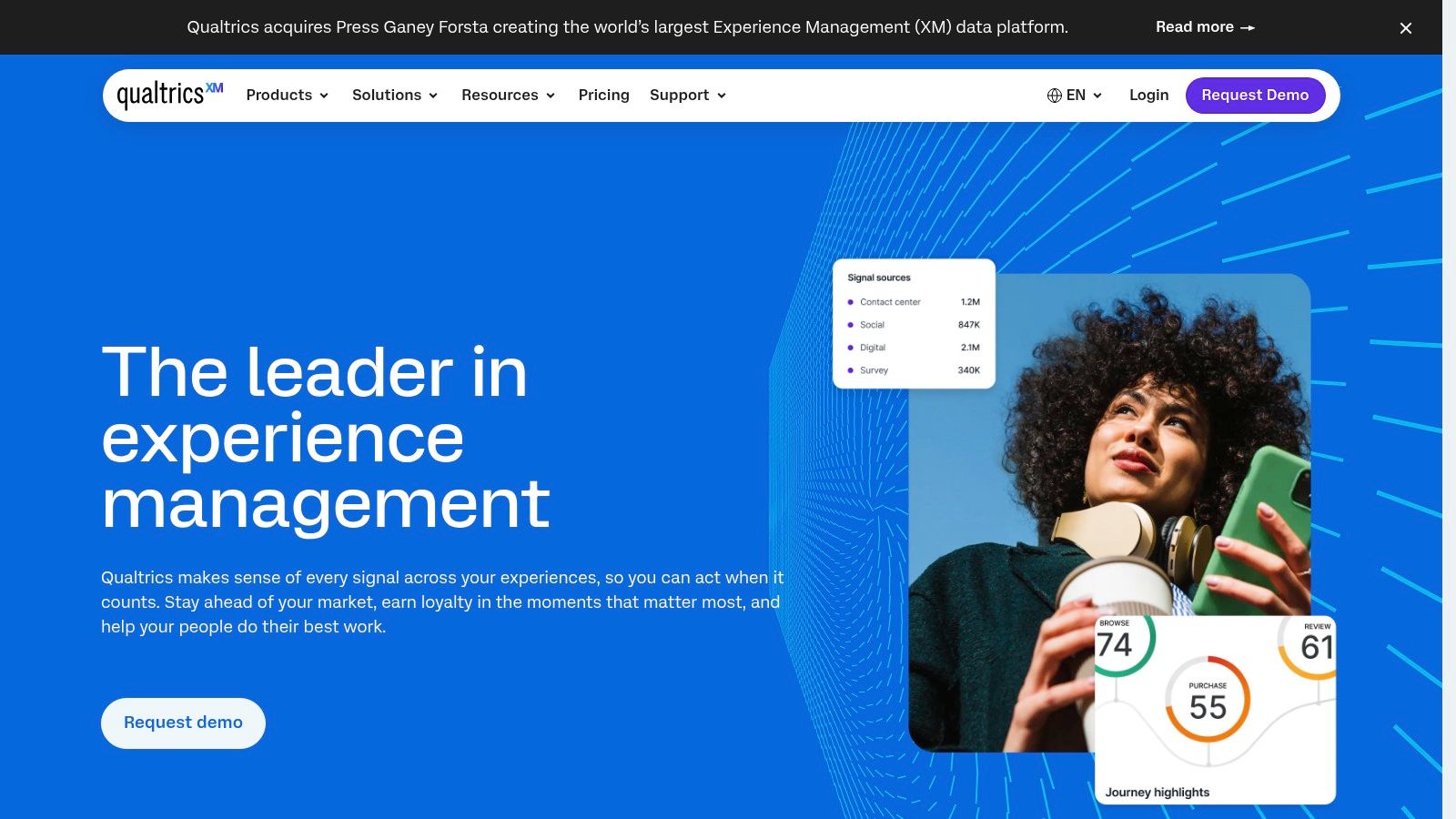
Qualtrics XM is built for organizations that need a governed, enterprise-grade voice-of-customer program rather than a basic survey form. It can collect feedback through web and app intercepts, email and SMS surveys, call-center interactions, video feedback, and research panels. Its text analysis capabilities can identify sentiment and recurring topics across open-ended responses, giving larger teams a way to work with feedback that doesn't fit neatly into rating scales.
The platform makes sense when several departments need to share one customer experience system. Marketing can monitor website friction, product teams can study feature reactions, and service leaders can route dissatisfied customers into follow-up workflows. Digital experience analytics and flexible intercepts can also connect feedback to specific pages, actions, or moments in a customer journey.
Practical rule: Don't buy an enterprise feedback platform just because it has more features. Buy it when multiple channels, formal governance, and assigned follow-up justify the implementation work.
Healthcare organizations should review Qualtrics' specific deployment and compliance documentation before collecting sensitive information. Qualtrics provides materials covering HIPAA-eligible deployments and frameworks such as HITRUST and FedRAMP, but the relevant terms depend on the selected arrangement and use case.
The trade-off is ownership. Quote-based pricing, configuration, permissions, reporting, and workflow design can require substantial internal effort or outside implementation support. A small legal practice or local retailer with one website and a modest review volume may get better results from a focused survey tool.
Teams also need readable reporting, not just advanced analytics. HDM's guidance on data visualization best practices is relevant here, because a complex feedback program only helps when business owners can see what changed and what action is assigned.
2. Medallia Experience Cloud
Medallia Experience Cloud is a strong fit for organizations that receive customer signals from many places and need to respond while the issue is still active. It brings together surveys, web and app feedback, messaging, social signals, contact-center interactions, and speech data. That breadth is especially useful for multi-location service businesses, healthcare networks, and larger teams where the customer journey crosses departments.
The important distinction is its action layer. Medallia supports alerts, workflows, case management, permissions, and follow-up processes, so feedback doesn't have to remain in an analyst's report. A negative interaction can be routed to a responsible team, while recurring themes can inform training, service design, or digital improvements.
Its value increases when the organization has enough operational complexity to need central control. A regional healthcare group, for example, may need location-level visibility while still enforcing common reporting and access rules. Healthcare buyers should examine Medallia's current materials on HIPAA and HITRUST support and confirm that the selected configuration matches their obligations.
Where Medallia earns its complexity
Medallia is less attractive when the goal is to ask a short post-purchase question or collect website comments. Enterprise-oriented pricing can exceed an SMB budget, and a successful rollout requires more than installing a script. Leaders need to define ownership, escalation rules, taxonomy, and review routines before the data starts arriving.
Customer feedback becomes operational only when someone knows which response requires action, who owns it, and how the business will confirm that the issue was addressed.
The platform's broad ingestion and enterprise controls are strengths, but they also create change-management work. A Cincinnati service company with several locations may appreciate that structure. A small law firm may not need it until feedback volume, reputation risk, or compliance requirements make centralized management worthwhile.
3. InMoment XI Platform
InMoment XI Platform combines customer feedback collection with experience analytics, reputation management, conversational intelligence, and advisory services. That combination makes it useful for service-heavy organizations where customer feedback doesn't arrive only through surveys. Reviews, support conversations, contact-center language, and direct responses can all contribute to the picture.
The platform is particularly relevant to multi-location businesses. A healthcare organization, home-services company, hospitality group, or franchise operator may need to compare patterns across locations without treating every complaint as an isolated event. Integrated reputation management also helps teams connect public reviews with broader voice-of-customer work, rather than managing online reputation in a separate silo.
InMoment's text analytics and AI-supported analysis can help categorize unstructured comments. That matters because customers rarely describe problems using the same terms an internal team uses. One person may complain about a confusing appointment process, another about slow confirmation, and a third about poor communication. A useful analysis layer should help identify the shared experience problem.
Platform plus advisory support
InMoment takes a services-plus-platform approach. That can reduce the internal burden for organizations that know they need better insight but don't have a dedicated research or CX team. Advisory support may help define listening posts, interpret themes, and establish an improvement program.
The downside is that this isn't primarily a self-serve SMB product. Pricing is quote-based, and teams seeking a simple survey subscription may find the platform heavier than necessary. Smaller businesses should first define whether they need reputation monitoring, conversational analysis, closed-loop case management, or only a structured feedback form.
For legal and professional-services firms, the platform can be useful when reputation and client experience need coordinated attention. It may be excessive for a firm that receives a manageable number of reviews and can follow up manually.
4. Alchemer
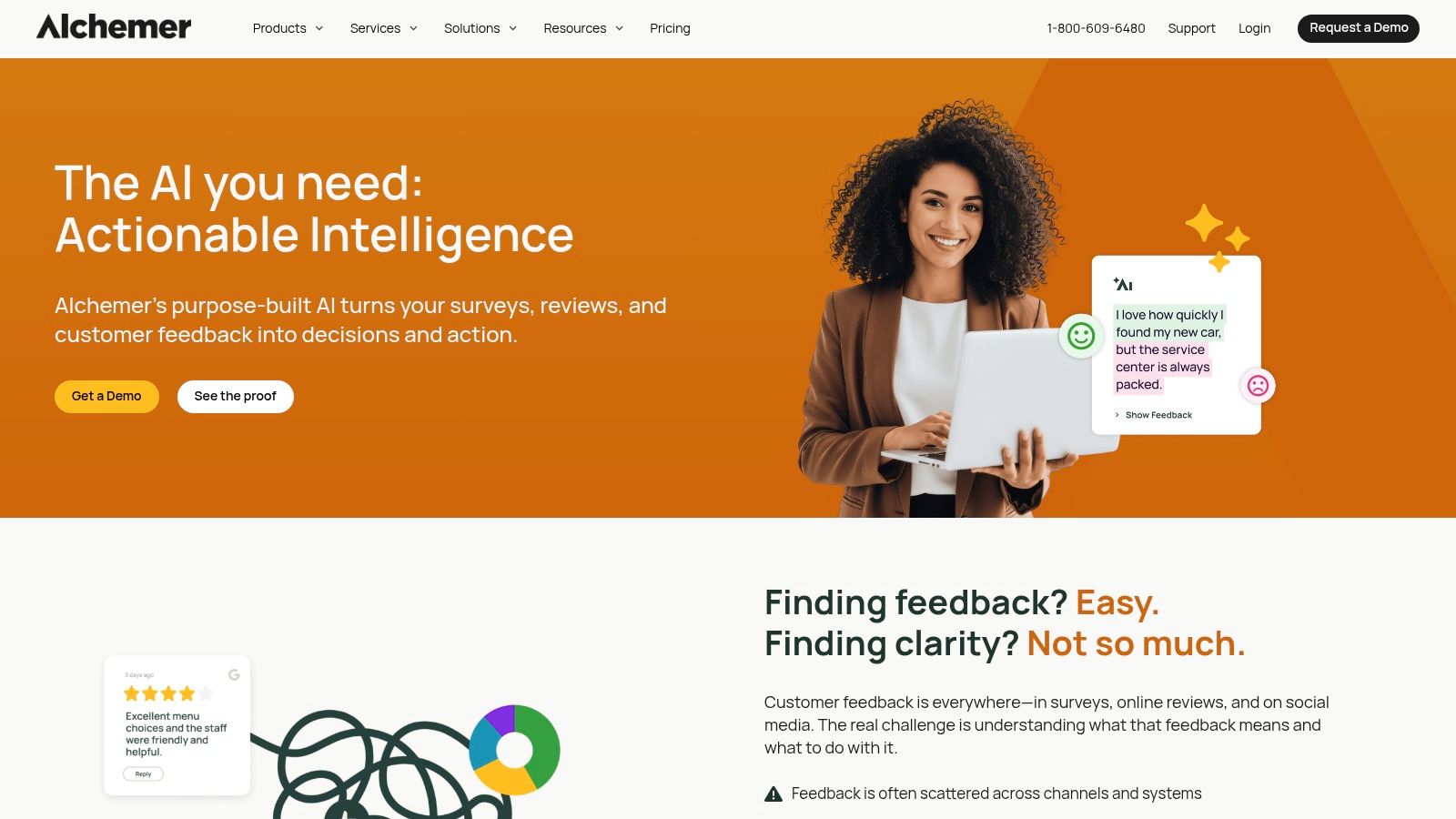
Alchemer, formerly SurveyGizmo, sits between basic form builders and large customer experience suites. It gives SMB and mid-market teams control over survey logic, branching, piping, quotas, branding, workflows, and integrations without requiring the full operating model of an enterprise VoC deployment.
That flexibility is its main advantage. A Cincinnati e-commerce company could send a post-purchase survey with different questions for new and returning customers. An agency could create branded feedback experiences for clients. A legal practice could build separate flows for consultation leads, active clients, and closed matters, while keeping the questions relevant to each relationship.
The platform also supports more advanced administration than a simple online form. Teams can control how respondents move through a survey, pass earlier answers into later questions, and connect responses with other business systems. Published security and compliance materials include HIPAA and SOC 2 references, but regulated organizations should verify the exact plan, configuration, and contractual terms before collecting protected information.
Why Alchemer works for mid-market teams
Alchemer is easier to own in-house than a mega-suite, but it isn't effortless. The interface and administrative depth can require onboarding, especially when several people build surveys or manage permissions. Some advanced capabilities are reserved for higher tiers, so the team should map required workflows before comparing plans.
Its tiered pricing pages make budgeting more straightforward than quote-only enterprise products, although the final cost still depends on the features and users needed. The best use case is a business that has repeatable feedback needs and wants customization, not a one-time poll.
Implementation advice: Design the feedback workflow before designing the survey. Decide where responses go, who reviews them, and what happens after a customer reports a problem.
5. SurveyMonkey Enterprise
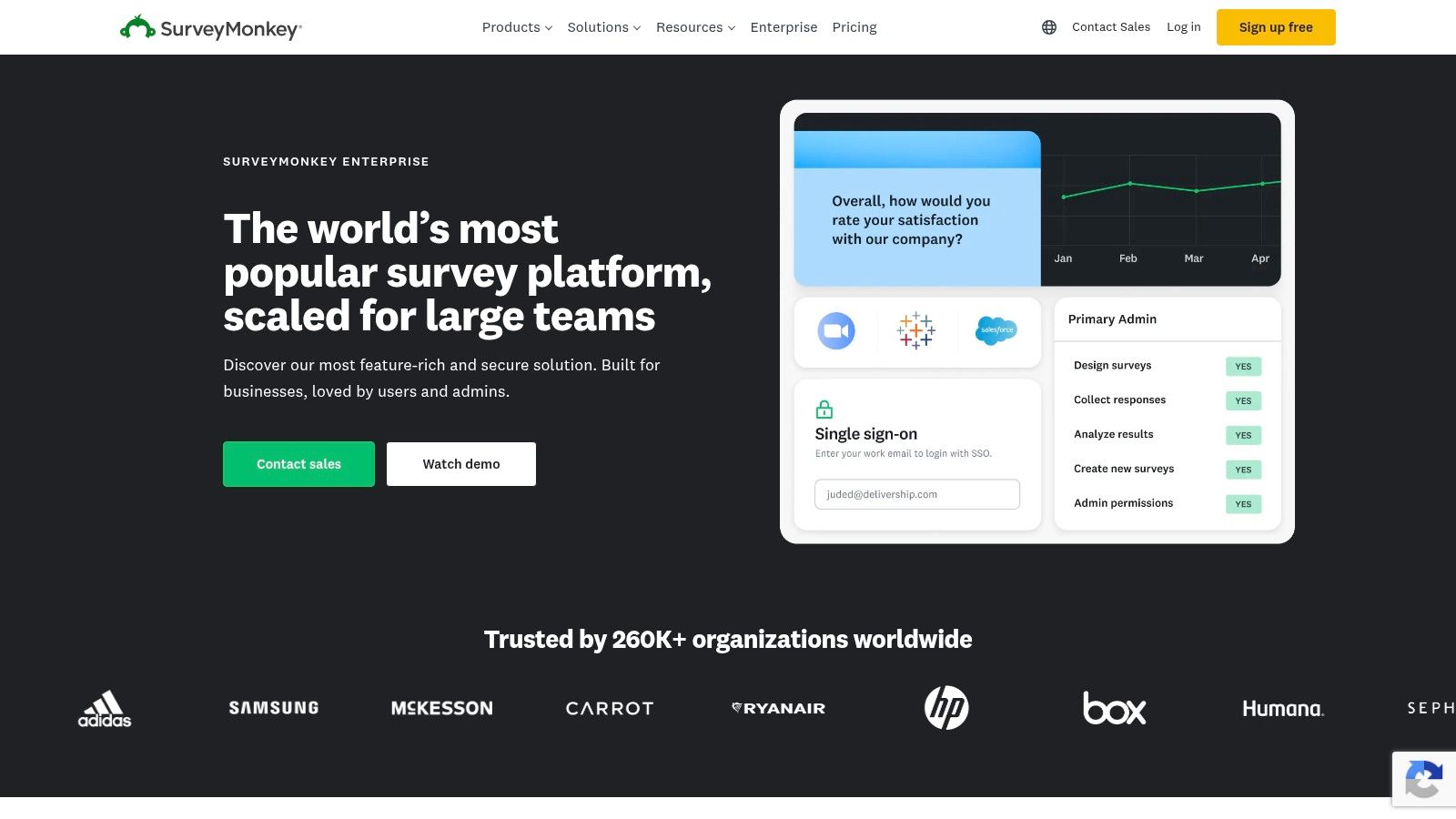
SurveyMonkey Enterprise is a practical choice for organizations that want familiar survey authoring with stronger administration, security, and team governance. Business users can create surveys from templates, manage access, use single sign-on, and export data in ways that fit organizational controls.
That familiarity matters. A company doesn't need a specialized research department to create a customer satisfaction survey, client onboarding questionnaire, event follow-up, or employee-facing service review. The respondent experience is polished, and the template library helps teams avoid starting every survey from an empty page.
Healthcare organizations should pay close attention to the account level. SurveyMonkey makes HIPAA availability part of its Enterprise offering and requires a signed business associate agreement. A lower-tier account shouldn't be treated as automatically suitable for protected health information. The organization should confirm the BAA, data handling, retention, access, and export conditions before launch.
The limits of a general survey suite
SurveyMonkey Enterprise is not the same as a full voice-of-customer platform. Its strengths are authoring, distribution, governance, and broad usability. Specialized suites generally offer deeper text analytics, case management, omnichannel ingestion, and closed-loop operational workflows.
For an SMB, that trade-off may be acceptable. A law firm measuring consultation quality or an e-commerce brand reviewing post-purchase friction may need clear answers quickly, not an enterprise analytics architecture. A healthcare organization with complex patient experience requirements may outgrow the survey-first approach.
Keep surveys short and tie each question to a decision. A survey that produces a score without a responsible owner won't improve service, regardless of how polished the interface looks.
6. Typeform
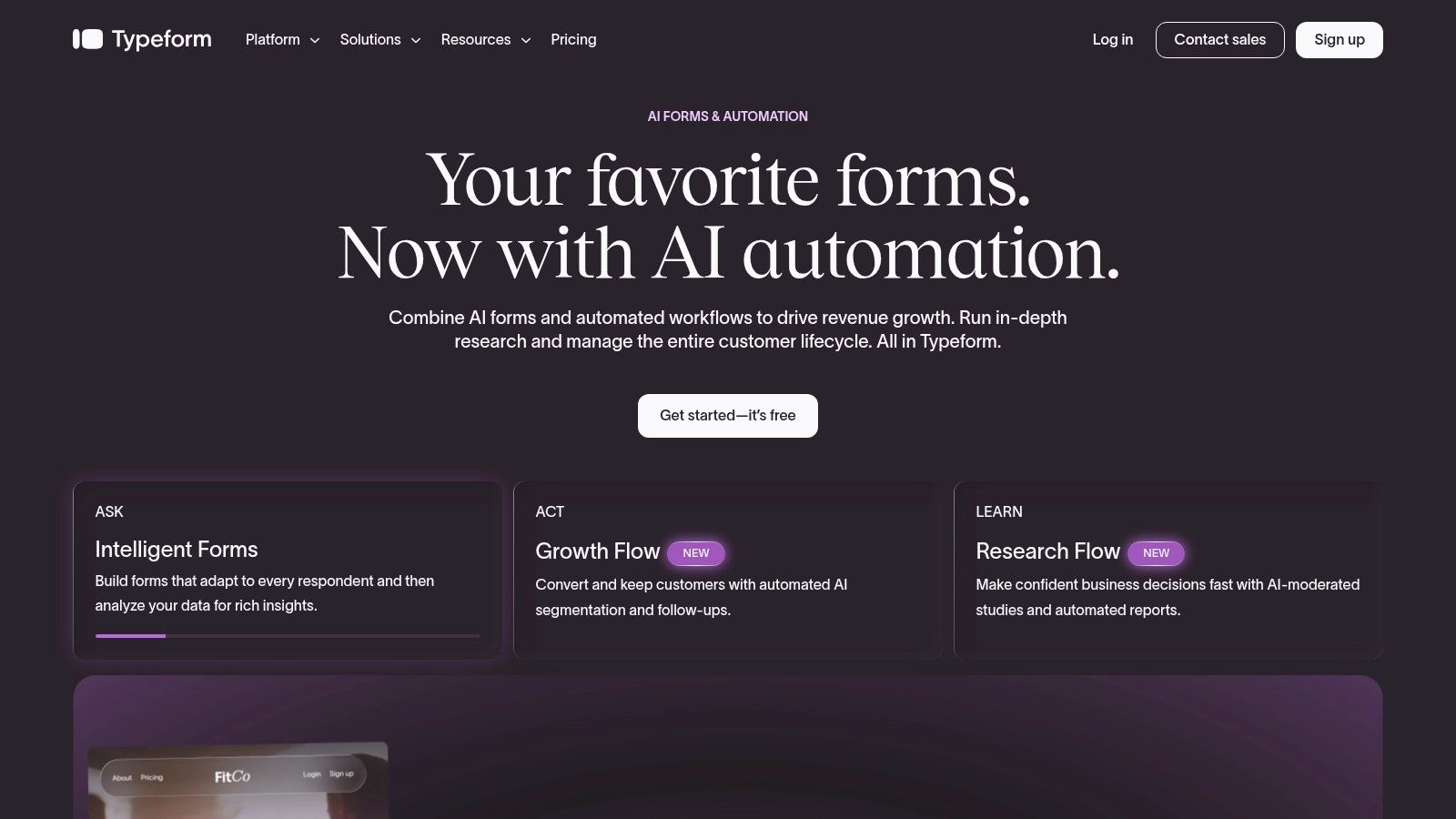
Typeform is designed for businesses that care about the experience of answering. Its one-question-at-a-time presentation, strong visual branding, mobile-first design, and website embedding options make it useful for short surveys, lead qualification, onboarding, and contextual website feedback.
For a small business, that can be more valuable than a large feature list. A Cincinnati service company can embed a brief post-appointment survey. An agency can create a branded client discovery form. An e-commerce team can ask a focused question after checkout without sending customers through a long, intimidating questionnaire.
Typeform also connects with a broad integration library, which helps route responses into marketing, CRM, or workflow tools. Non-technical marketers and designers can usually build and publish a form quickly, reducing the time between deciding what to learn and collecting the first responses.
Use Typeform for focused moments
Typeform isn't a complete VoC system. It has limited case management and closed-loop workflow depth, so teams may need another system to assign issues, track resolution, or analyze feedback across channels. It also isn't the right tool for analyzing a large volume of call transcripts, reviews, and support conversations.
Healthcare organizations need to be especially careful with plan selection. Enterprise or Growth Custom arrangements can include a business associate agreement on request, but that doesn't mean every Typeform plan is appropriate for sensitive information. Verify the current terms before collecting patient-related data.
The best Typeform surveys ask one clear question at an important moment, then provide a useful next step. If the goal is to understand why customers abandon a website, pair the response with analytics and review the affected page rather than treating the form score as the complete explanation.
7. GetFeedback by SurveyMonkey for Salesforce
GetFeedback is built for organizations that use Salesforce as the central record for customer relationships, service cases, and account activity. The platform can trigger surveys from CRM events, map responses into Salesforce objects, and use those responses in reporting, automation, and follow-up.
That native orientation changes the implementation question. Instead of asking how to export survey results into Salesforce, the team can design the feedback process around the CRM from the start. A support team might trigger a CSAT request after a case closes, store the response with the case, and route a poor experience to a manager. A customer success team can review feedback alongside account information rather than opening another platform.
Best fit for Salesforce-centered operations
GetFeedback supports mobile-friendly surveys, APIs, webhooks, Slack and email actions, and CRM-driven follow-up. These capabilities are useful when the business wants to reduce the distance between feedback collection and case resolution.
The trade-off is system dependence. The product offers its best value when Salesforce is already a core system of record. A business that doesn't use Salesforce may pay for integration depth it won't use. Pricing and packaging can vary, and advanced features may add cost, so teams should test the complete workflow rather than evaluating only the survey builder.
If Salesforce is where your team already works, feedback should appear there. A separate dashboard creates another place for important customer signals to disappear.
Legal teams, agencies, and professional-services firms often benefit from CRM-linked feedback when they need to connect client experience to account ownership. Before launch, define which Salesforce object stores the response, which fields are reportable, and who receives an alert.
8. Pendo Feedback
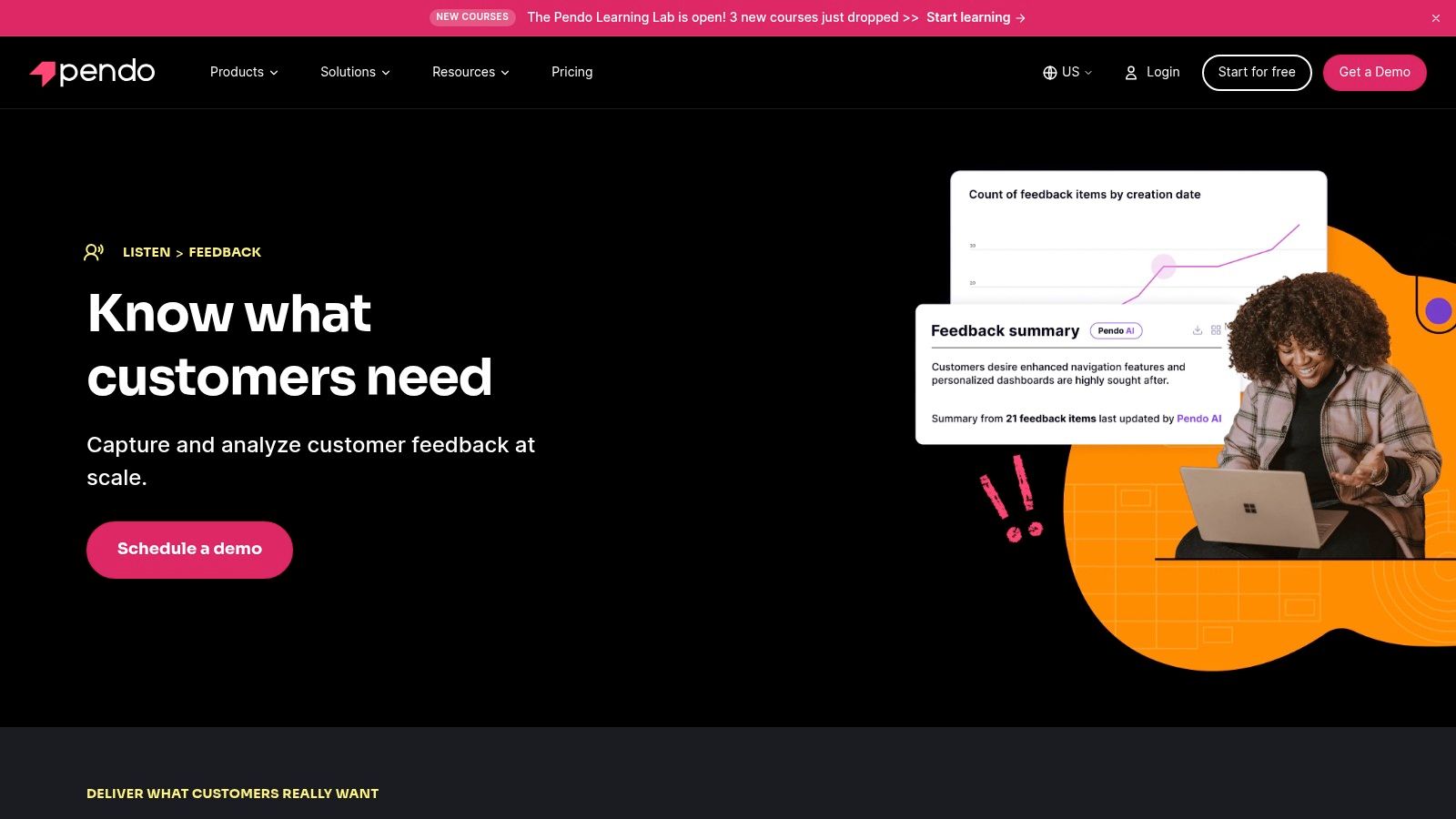
Pendo Feedback, part of Pendo's Listen offering, is designed for SaaS and product teams that need to connect customer requests with actual product usage. It provides in-app feedback widgets, a centralized request portal, AI-assisted theme detection, prioritization tools, and connections to Pendo analytics and in-app guides.
The key advantage is context. A feature request can be considered alongside usage behavior, account information, and the point in the product where the customer raised the issue. That gives product managers more than a list of popular requests. It helps them ask whether the request affects active users, blocked users, high-value accounts, or customers who aren't reaching an important workflow.
Pendo also reduces tool sprawl for teams already using its analytics and guides. Product teams can collect feedback, interpret themes, and communicate changes in a more connected environment rather than stitching together unrelated systems.
Product feedback needs disciplined prioritization
Pendo Feedback uses a monthly active user-based pricing model, and sales-led packaging can make it premium for startups. It may also be a poor fit for offline customer experience programs, legal-client surveys, or general website feedback.
Product teams should avoid letting the request portal become a popularity contest. Voting is useful, but it shouldn't replace product judgment, support evidence, usage data, or a clear understanding of the problem behind a request. A request from a small group of highly active users may matter more than a larger number of low-context votes.
For SaaS companies, Pendo is strongest when product feedback is part of a broader decision system. If the team only needs a public feature board, a lighter tool may be more efficient.
9. Canny
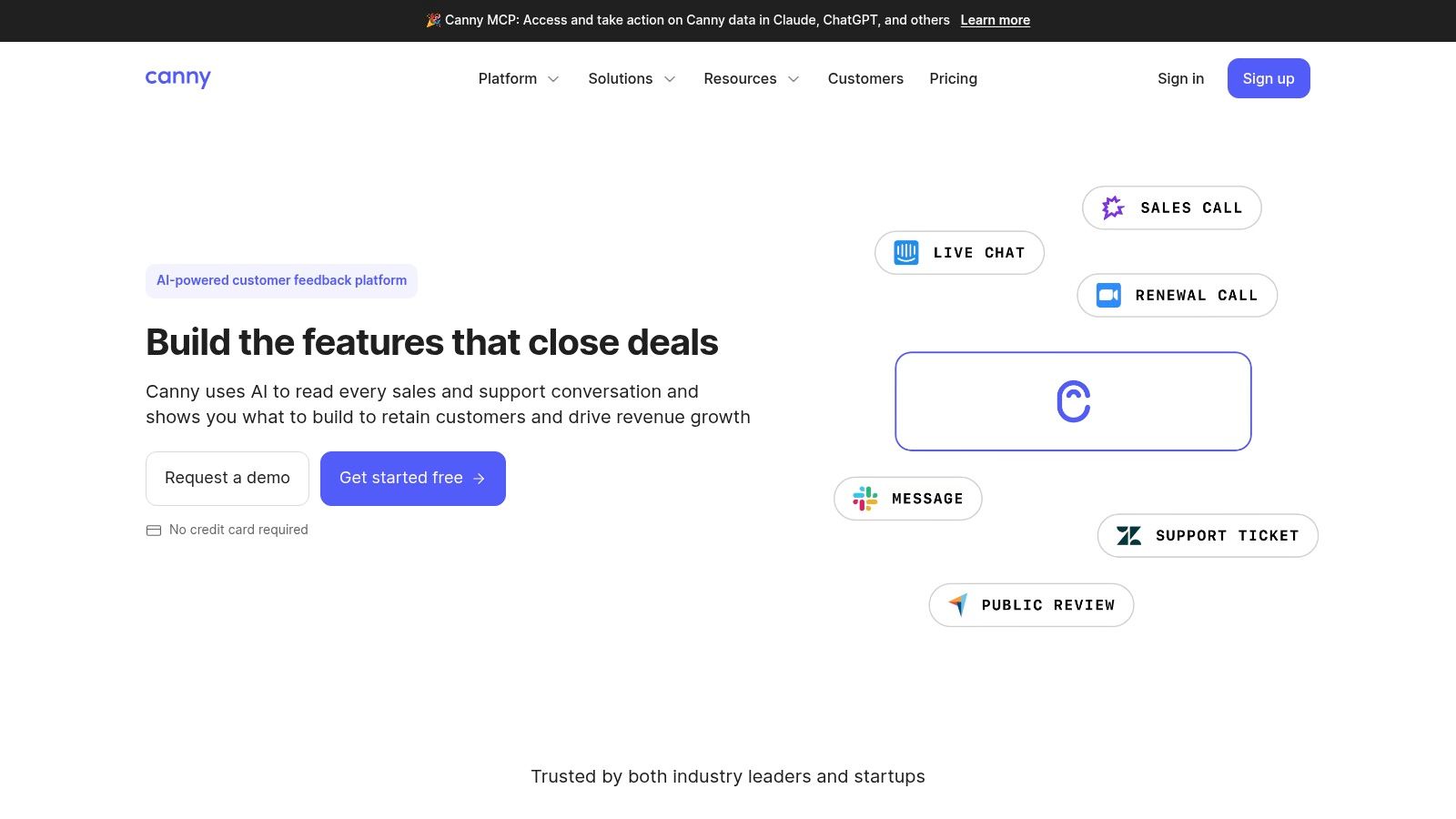
Canny gives SaaS teams a lightweight way to organize product requests, customer votes, roadmaps, and release communication. Feedback boards can be public or private, while status updates and roadmap views help customers understand what the product team is considering.
Its changelog is just as important as the board. When a release addresses a request, the company can announce what changed and notify interested subscribers. That closes a loop many businesses leave open. Customers want to know whether their feedback influenced the product, even when the answer is that a request isn't currently planned.
Canny also provides impact metrics that can help teams connect requests to business risk, including potential revenue or churn exposure. Those measures should inform prioritization, not dictate it. Product managers still need to consider feasibility, strategic fit, security, maintenance, and the needs of less vocal customers.
The public board trade-off
Canny is quick to implement and can reduce feedback chaos across email, support, and sales conversations. Its community-driven format gives customers visibility and can create useful momentum around shared needs.
Public voting can also bias the results toward customers who participate more often or communicate more forcefully. Moderation matters. The team should merge duplicate requests, clarify vague submissions, remove sensitive details, and explain decisions.
Canny isn't a complete VoC platform, and it doesn't offer the survey and analytics depth of a larger experience suite. For customer-facing product teams, though, it can create a clear feedback-to-roadmap connection with relatively low operational overhead. That connection supports broader customer retention programs, especially when release communication is consistent.
10. Sprig
Sprig focuses on in-product research for web and mobile applications. Product teams can target surveys to specific users, recruit participants for research, capture voice and video responses, test concepts or prototypes, and use AI-assisted synthesis to organize qualitative input.
The tool is most useful when timing matters. A user who has just completed onboarding, encountered a confusing screen, or used a new feature can provide feedback in context. That signal is often more actionable than a general email survey sent long after the experience.
Sprig offers Free and Starter plans for small teams, along with enterprise security and compliance options. Usage-based pricing can become expensive as adoption grows, so a product team should define the events, audiences, and research volume it needs before expanding deployment.
Fast insight without a full research operation
Sprig's modern user experience helps product teams move quickly. It can consolidate several lightweight survey and testing needs into one place, reducing the need to manage separate tools for concept feedback, in-product questions, and qualitative responses.
It isn't a replacement for an organization-wide VoC program. Offline service experiences, public reputation, contact-center analysis, and broad governance require other capabilities. A healthcare app team should also validate the exact security and compliance terms before collecting sensitive information inside the product.
Sprig works best when every study has a decision attached to it. Define whether the result will change onboarding copy, alter a workflow, influence a design choice, or trigger additional interviews. HDM's explanation of what user testing is can help non-technical teams distinguish between collecting opinions and observing how people use a digital experience.
Top 10 Customer Feedback Tools Comparison
| Product | Core focus / Use case | Key features | Best for (Target audience) | USP / Pricing & Deployment |
|---|---|---|---|---|
| Qualtrics XM | Enterprise VoC & research, DX analytics | Omnichannel feedback, Advanced Text iQ, DXA, intercepts | Large enterprises, regulated healthcare programs | Deep analytics & governance; HIPAA/HITRUST/FedRAMP options; quote-based pricing |
| Medallia Experience Cloud | Enterprise VoC, real-time experience ops | Unified signals (survey/digital/speech), alerts, case mgmt | Multi-location service orgs, healthcare | Strong real-time alerting and permissions; enterprise pricing and rollout governance |
| InMoment XI Platform | VoC + outcomes-focused advisory | Omnichannel listening, reputation, conversational AI, services | Multi-location/service-heavy businesses seeking vendor support | Services-plus-platform model reduces internal lift; quote-based pricing |
| Alchemer (SurveyGizmo) | Advanced surveys & mid-market feedback | Branching/logic, piping, quotas, white-label, integrations | SMBs and mid-market teams needing survey power | Powerful mid-market value, transparent tiers; enterprise/compliance options (HIPAA/SOC2) |
| SurveyMonkey Enterprise | Scalable surveys with governance | Templates, team governance, SSO, admin controls, BAA for HIPAA | Business users needing fast deployment, healthcare orgs on a familiar platform | Fast to deploy, polished UX; HIPAA via signed BAA on Enterprise tier |
| Typeform | Conversational, branded forms & micro-surveys | Mobile-first UX, embeds, integrations, design-focused | Marketers/designers, website intercepts, onboarding flows | High completion rates, easy build; Enterprise/Growth plans can include BAA (custom pricing) |
| GetFeedback (by SurveyMonkey) for Salesforce | CRM-triggered surveys & CRM-native feedback | Salesforce triggers, data mapping, webhooks, automated actions | Salesforce-centric orgs (Service/Experience Cloud) | Native CRM integration speeds case closure; pricing varies by package |
| Pendo Feedback (Listen) | In-app product feedback tied to analytics | In-app widgets, request portal, AI theme detection, Pendo analytics | Product/SaaS teams linking usage to requests | Connects behavior analytics to roadmap decisions; MAU-based, sales-led pricing |
| Canny | Product feedback boards & public roadmaps | Voting boards, status updates, changelog, impact metrics | SaaS teams running community-driven prioritization | Quick to implement, transparent community prioritization; lightweight pricing tiers |
| Sprig | Contextual in-product surveys & rapid research | Targeted in-app surveys, voice/video capture, AI synthesis | Product teams needing fast continuous insights | Fast time-to-insight, Free/Starter + enterprise security options; usage-based pricing can scale cost |
Turn Customer Feedback Into Your Next Growth Decision
The customer feedback software market has moved well beyond occasional enterprise surveys. One market estimate places the category at USD 4.38 billion in 2025 and forecasts USD 10.71 billion by 2031, implying a 16.50% CAGR from 2026 to 2031. The same estimate reports that cloud deployment held 71.26% of the market in 2025, websites and web applications represented 28.41% of feedback collection channel share, and North America accounted for 34.62% of global market share in 2025. These figures point to a mainstream digital operations category, not an experimental add-on. Typeform's customer satisfaction survey tools overview provides the cited market context.
Another industry report says more than half of organizations are investing in CX software and customer feedback management. A separate CX leader survey found that 47% of leaders collect feedback primarily to identify customer needs, 57% consider social media feedback and product reviews valuable for decision-making, and 50% consider customer support quality when choosing a feedback platform. Those findings reinforce a practical point: businesses increasingly use feedback to guide product, service, and vendor decisions, not just to produce survey scores. Mordor Intelligence's customer feedback software market report contains those cited findings.
Choose a large VoC platform such as Qualtrics, Medallia, or InMoment only when multiple channels, governance, analytics, and closed-loop action justify the implementation effort. These systems can be powerful, but a small business shouldn't adopt enterprise complexity without an operating plan.
Match the tool to the job
- Focused survey programs: Choose Alchemer when you need advanced logic and customization, SurveyMonkey Enterprise when governance and familiar authoring matter, or Typeform when the respondent experience and brand presentation are priorities.
- Salesforce-centered teams: Choose GetFeedback when Salesforce is the system where service cases, accounts, and follow-up already live.
- SaaS and product-led teams: Choose Pendo Feedback when product usage context matters, Canny when transparent requests and roadmaps are central, or Sprig when rapid in-product research is the priority.
- Healthcare organizations: Verify the exact plan, data handling, business associate agreement, and compliance terms before collecting sensitive information. A product's general compliance page isn't a substitute for reviewing the contract and configuration.
- Legal and professional-services teams: Start with a focused client-experience question tied to a defined stage, such as consultation, intake, communication, or matter closure. Keep access restricted and avoid collecting unnecessary confidential information.
- E-commerce teams: Place short feedback requests at meaningful moments, such as after purchase or delivery, and connect responses to order, product, and support context where appropriate.
- Agencies: Use branded, repeatable workflows and decide whether client responses should stay in a shared reporting system, a CRM, or a separate workspace.
The market also shows why embedded collection deserves attention. Websites and web applications represented 28.41% of channel share in 2025, while in-product interfaces are projected to expand at a 20.83% CAGR through 2031, according to Qualtrics' voice-of-customer guide. Website surveys and in-product prompts can capture the experience close to the moment it occurs, but they still need careful targeting so they don't interrupt important tasks.
Cloud-first deployment is also common. One market report places cloud deployment at 72.5% of market share in 2025, with software representing 58.2%. It identifies Asia Pacific as the leading region by revenue share at 38.7%, with retail at 22.6%, BFSI at 21.3%, and healthcare at 16.8% among the largest end-user segments. Those figures suggest that enterprise implementations often combine cloud delivery with substantial security, permission, and compliance requirements. Review the customer feedback software market analysis from Global Growth Insights before treating a market category figure as a buying recommendation.
A feedback workflow that produces action
Start with one business question. For example, ask why qualified visitors abandon a consultation form, why customers contact support after checkout, or which onboarding step prevents a SaaS user from reaching value.
Then select one measurable feedback signal that fits the question. A short open-text response may reveal a usability issue. A satisfaction question may help monitor a service moment. An interview may explain why a customer is considering cancellation. Behavioral analytics can show where people struggle, but it won't fully explain why without direct feedback.
Connect the response to the CMS, CRM, product analytics platform, or reporting system wherever possible. Assign an owner, review themes on a regular cadence, and record the decision that follows. Finally, communicate what changed. Customers are more likely to provide useful input when the business demonstrates that feedback has a destination.
The most overlooked challenge is unstructured feedback at scale. Call transcripts, chats, social media, reviews, and open-text responses contain context that fixed survey fields miss, but teams need a consistent process for tagging themes, protecting sensitive data, and distinguishing repeated problems from isolated opinions. The broader customer experience management market is projected to grow from USD 17.56 billion in 2026 to USD 58.36 billion by 2034, according to Market Intelo's customer feedback management report. That projection supports investment in analysis-heavy systems, but it doesn't eliminate the need for clear business questions and human ownership.
For Cincinnati-area businesses, HDM can help turn feedback into practical digital improvements. That may mean revising website navigation, improving SEO content around customer language, fixing conversion friction, connecting CRM and analytics data, or testing a new landing-page experience. The right tool is the one that helps your team make and measure the next growth decision, as part of a broader guide to customer-centric growth.
HDM helps Cincinnati-area businesses connect customer feedback to high-performance websites, SEO, analytics, digital marketing, and conversion optimization. Visit HDM to discuss a practical feedback and growth system for your business.