
A lot of Cincinnati business owners hit the same wall with ecommerce. The site is live. Products are up. Maybe a few orders came in early from friends, referrals, or branded searches. Then sales flatten out, and every marketing option starts to sound like a different way to spend money without knowing what will come back.
That frustration is reasonable. Ecommerce growth isn't about piling on random tactics. It's about building a system that brings in the right visitors, helps them buy without friction, and gives them a reason to come back.
Growing Your Online Store in Cincinnati
If your store feels stuck, the problem usually isn't that online demand disappeared. It's that your marketing and website aren't working together yet.
That matters because ecommerce keeps getting bigger, not smaller. The global market is projected to reach $7.5 trillion in 2025, up from $5.7 trillion in 2023, a 31.6% increase, and U.S. ecommerce sales hit $1.234 trillion in 2025 according to digital commerce market projections from Cimulate. For a local business owner, the takeaway is simple. Buyers are already comfortable purchasing online, and they expect the process to feel easy.
What stalled growth usually looks like
In practice, I usually see one of these situations:
-
Traffic is low: People aren't finding your store through Google, ads, or referrals.
-
Traffic is decent but sales are weak: Visitors arrive, browse, then leave.
-
Orders happen, but repeat sales don't: You win the first purchase and lose the longer-term customer.
-
The store is hard to market: Custom functionality, inventory quirks, or regulated workflows make off-the-shelf tactics fall apart.
For Cincinnati companies, that last one shows up more often than people think. Healthcare-related ecommerce, manufacturers selling replacement parts, and service businesses adding online transactions all have wrinkles that generic agencies tend to ignore.
A store doesn't need more activity. It needs fewer leaks and a clearer path to revenue.
What to focus on first
Before you buy a stack of services, get clear on three things:
-
How customers currently find you
-
Where they drop off
-
What a repeat customer is worth to your business
That gives you a much better starting point than chasing whatever platform is trending this month. If you're mapping out next steps, this guide on ecommerce growth strategies for online stores is a useful companion to the decisions covered here.
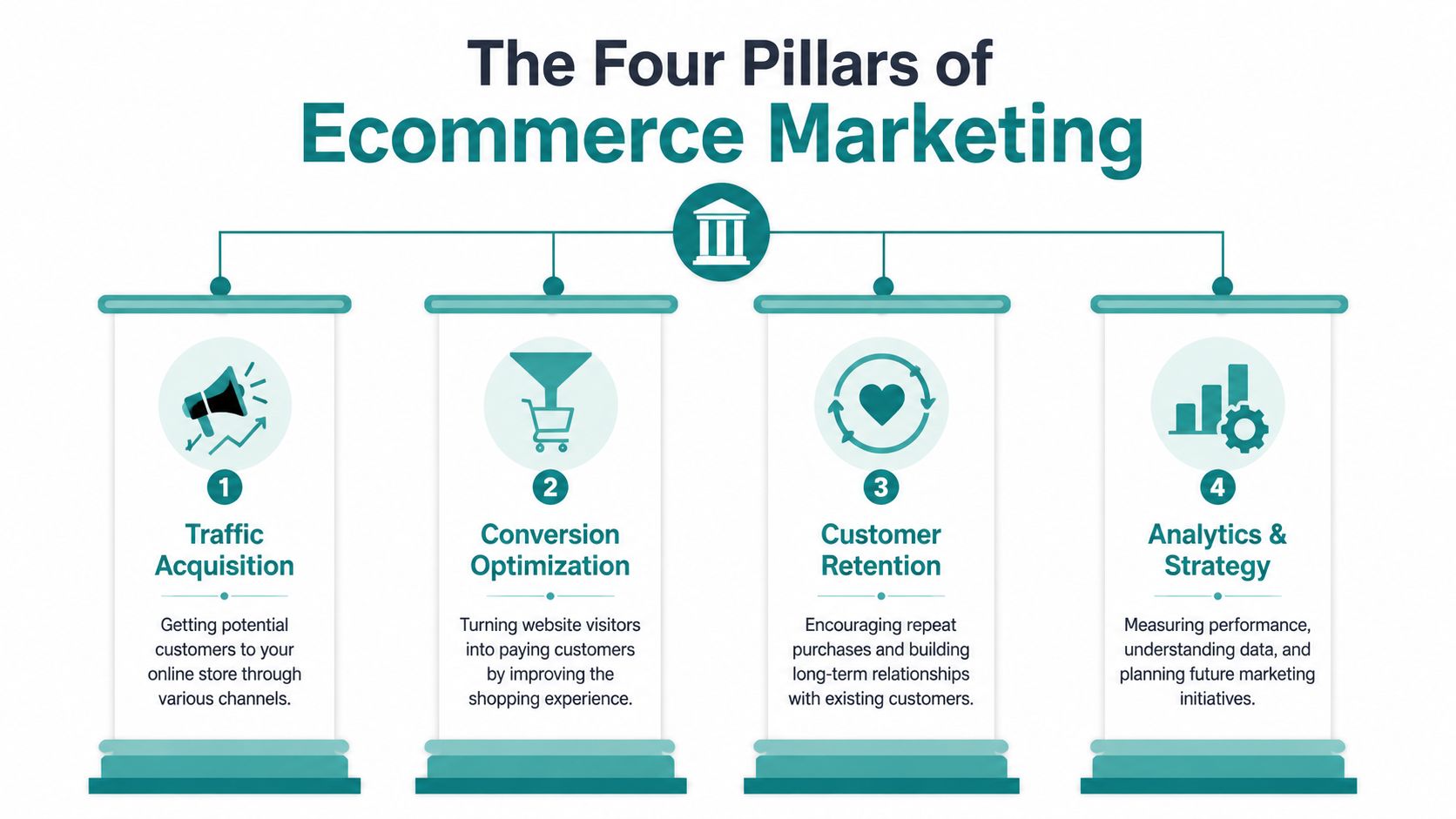
The Four Pillars of Ecommerce Marketing
The easiest way to think about digital marketing services for ecommerce is as a toolkit. Each tool has a job. Problems start when a business expects one tool to do all the work.
Traffic acquisition
This is how people discover your store. SEO, Google Ads, Shopping campaigns, social ads, local search visibility, and product feed management all sit here.
Search deserves special attention because organic search drives 23.6% of all ecommerce orders according to ecommerce marketing statistics compiled by SEOPROFY. If your product pages and category pages aren't visible when buyers are actively looking, you're missing high-intent traffic.
Conversion optimization
Getting visitors to the store is only half the job. Conversion work improves product pages, navigation, trust signals, mobile usability, checkout flow, and page speed so more of those visitors place an order.
Testing is essential for success. The same SEOPROFY data notes that businesses using A/B testing see an average 49% improvement in conversion rates. Because of these results, solid agencies don't just launch pages and hope. They test headlines, images, layout, calls to action, and checkout steps.
Practical rule: If your ad costs are rising, fix the store before raising the budget.
Customer retention
Most stores spend too much energy chasing first-time buyers and too little keeping the customers they already earned. Retention includes email flows, post-purchase messaging, reorder reminders, loyalty programs, and win-back campaigns.
A healthy ecommerce operation doesn't treat retention as an afterthought. It uses it to increase customer value over time.
Analytics and strategy
Analytics is the wiring behind all of it. This includes GA4, Google Search Console, ad platform reporting, heatmaps, product feed diagnostics, and channel attribution.
Without clean measurement, you can end up celebrating traffic that doesn't sell and cutting channels that drive profitable orders.
Ecommerce digital marketing services overview
| Service | Primary Goal | Key Metric for Business Owners |
|---|---|---|
| SEO | Capture buyers already searching for your products | Qualified organic revenue |
| PPC and Shopping ads | Generate fast visibility and controllable traffic | Return on ad spend |
| Email and retention marketing | Increase repeat purchases and recover lost sales | Repeat order revenue |
| CRO and UX | Turn more visitors into customers | Conversion rate |
| Analytics and reporting | Show what's working and what's wasting money | Revenue by channel |
For many businesses, the hard part isn't finding these services. It's getting them to operate as one system instead of five disconnected projects.
Attracting Qualified Buyers with SEO and PPC
SEO and PPC both bring traffic, but they do it in different ways. One is an asset. The other is a faucet.

PPC is rented visibility
PPC is like renting a billboard on I-75. You get attention right away, but only while you're paying for the spot.
For ecommerce, that speed can be valuable. New product launch? Seasonal push? Overstocked inventory? Paid search and Shopping campaigns can put your products in front of buyers quickly. According to Creative Code Tech's overview of ecommerce PPC results, well-managed PPC campaigns often see ROAS of 4:1 to 8:1.
That doesn't mean every campaign prints money. It means disciplined campaign structure, solid product data, clean landing pages, and real management can produce measurable returns.
SEO is a built asset
SEO is more like buying the land and building your storefront. It takes longer, but the value compounds if the work is done right.
For ecommerce, SEO isn't just blogging. It includes:
-
Category page strategy: Building pages around how customers search
-
Product page optimization: Titles, descriptions, internal links, schema, images, and FAQs
-
Technical health: Crawlability, indexation, duplication issues, and site speed
-
Content support: Guides, comparison pages, and educational content that helps buyers decide
If you want a deeper look at what that process involves, this complete guide to ecommerce SEO covers the moving parts in plain English.
What works and what doesn't
What works is using PPC and SEO together. PPC gives immediate feedback on what buyers click and buy. SEO builds long-term visibility around the same demand.
What doesn't work is treating them like isolated silos.
-
Bad approach: Run ads to weak pages, then blame the ad platform.
-
Better approach: Use ad data to identify top-converting products and strengthen those pages for both paid and organic traffic.
-
Bad approach: Chase broad vanity keywords.
-
Better approach: Target commercial intent terms tied to product categories, use cases, and buyer needs.
Later in the funnel, remarketing becomes important too. The same Creative Code Tech data notes that dynamic remarketing can recapture 20% to 30% of users who abandoned their carts. That's useful because many visitors won't buy the first time they land on your store.
A short walkthrough makes the difference clearer:
<iframe width="100%" style="aspect-ratio: 16 / 9;" src="https://www.youtube.com/embed/Mn-B16MZP7U" frameborder="0" allow="autoplay; encrypted-media" allowfullscreen></iframe>The key is balance. PPC buys speed. SEO builds staying power. Most Cincinnati businesses need both, but not always in equal proportions.
Turning Website Visitors into Customers
More traffic doesn't fix a weak store. It just sends more people into the same problems.
Fix the leaky bucket
Conversion Rate Optimization, or CRO, is the process of finding where shoppers get stuck and removing friction. The simplest analogy is a leaky bucket. Traffic is the water. Your website is the bucket. If the product page is confusing, the site is slow, or checkout feels annoying, you're paying to pour more water through holes.
According to DigisCorp's breakdown of ecommerce agency services, optimizing checkout flows by reducing steps can increase completions by up to 35%. The same source notes that a typical good ecommerce conversion rate benchmark falls in the 2% to 5% range. That's why even small improvements matter.
What good CRO work looks like
Real CRO isn't guessing. It's usually built on tools and observations like these:
-
GA4 and funnel analysis: Where people enter, where they leave, and which pages lose sales
-
Heatmaps and session recordings: What users click, where they hesitate, and what they ignore
-
A/B testing: Trying two versions of a page element to see which performs better
-
Checkout audits: Looking for extra fields, hidden costs, poor mobile layout, or unnecessary steps
If a shopper has to stop and figure out what to do next, the page is doing less selling than you think.
The platform matters more than many owners realize
A Shopify store with a clean theme and disciplined apps behaves very differently from a WooCommerce setup held together by plugins, or a custom build with fragmented tracking. The platform doesn't guarantee results, but it absolutely affects speed, flexibility, and what your marketing team can test.
That becomes even more important when the business has unusual requirements. A healthcare-related ecommerce flow may need privacy-minded forms and careful handling of customer interactions. A B2B seller may need account-based pricing, quote requests, or backend system connections. Template-first agencies often struggle here because they only know how to market what they can easily plug into.
For digital marketing services for ecommerce to pay off, the site has to support the marketing. Otherwise, every ad click and every SEO win is worth less than it should be.
Growing Revenue Beyond the First Purchase
A lot of owners still judge ecommerce mainly by new customer acquisition. That's incomplete math.

Repeat buyers are where margin gets healthier
For most ecommerce businesses, repeat customers generate 25% to 40% of total revenue despite representing a smaller share of the customer base, according to Growth Marketing Pro's analysis of ecommerce agency strategy. That matters because retention marketing usually costs less than repeatedly paying to reacquire the same kind of buyer.
If you sell consumables, replacement products, accessories, subscriptions, or anything with a natural reorder cycle, retention shouldn't sit in the background.
What retention marketing actually includes
This is bigger than sending the occasional newsletter. Strong retention work usually includes:
-
Welcome flows: Introduce the brand, answer objections, and guide first purchase behavior
-
Abandoned cart reminders: Recover shoppers who were close but didn't finish
-
Post-purchase sequences: Confirm the order, reduce buyer anxiety, and suggest relevant next steps
-
Win-back campaigns: Re-engage buyers who haven't ordered in a while
-
Loyalty and VIP segmentation: Treat your best customers like your best customers
The cheapest sale often comes after the first one, not before it.
Why Cincinnati businesses often miss this
Many local companies launch ecommerce as an extension of an existing business. They focus on the site build, then on traffic, and stop there. That leaves money sitting in the customer list.
A better approach is to build marketing around the customer lifecycle. First purchase. Second purchase. Refill. Upgrade. Referral. If your store has useful products and a real customer need, retention can become one of the steadiest revenue layers in the business.
This is also where industry nuance matters. A wellness brand, healthcare-adjacent seller, or specialty supplier may need different messaging rules, different timing, and more careful segmentation than a generic retail store. The retention strategy should match how customers buy, not how a template email platform says they buy.
How to Choose Your Ecommerce Marketing Partner
A Cincinnati business owner usually starts shopping for an agency after something goes sideways. Ad spend is up. Orders are flat. The site looks fine on the surface, but nobody can explain where buyers are dropping off or why tracking never quite matches the checkout system.

That is the point where partner selection matters. You need a team that can read the business, the platform, and the numbers together.
Ask how they measure revenue, not activity
Plenty of agencies can hand you a report full of impressions, click-through rates, and traffic charts. That is useful background, but it does not tell you whether the work is producing profitable sales.
Ask direct questions:
-
What do you track from first click to completed order?
-
How do you separate branded demand from true new-customer growth?
-
How do you report revenue by channel, campaign, and landing page?
-
What do you do when traffic goes up and conversion rate drops?
A good partner should answer in plain English. If they hide behind dashboards or platform jargon, expect confusion later when results are mixed.
Ask what happens on custom or complex stores
Many ecommerce relationships falter here. A template-driven agency may do fine on a standard store with clean data, default checkout, and simple product rules. Cincinnati companies often have more going on than that.
A healthcare seller may need HIPAA-conscious forms and stricter data handling. A manufacturer may have dealer logic, quoting steps, or restricted product access. Another business may run a custom storefront tied to an ERP, separate inventory system, or middleware layer. Marketing performance is affected by all of it.
Ask questions like:
-
Have you worked on custom ecommerce builds or headless storefronts?
-
How do you handle broken or incomplete conversion tracking?
-
Can you work with developers on schema, event tracking, feeds, and page templates?
-
Do you understand how backend decisions affect SEO, paid media, and reporting?
If an agency only knows campaign management, they may keep buying traffic into a store that has technical leaks everywhere. That gets expensive fast.
Ask about regulated and specialized industries
Cincinnati has a lot of businesses that do not fit the standard direct-to-consumer playbook. Healthcare ecommerce is the clearest example, but it is not the only one. Legal-adjacent services, industrial suppliers, and businesses with account-based purchasing all have rules that shape how marketing can work.
Compliance is not a side note. It affects forms, tracking, audience targeting, platform choices, email flows, and even how product pages are written. If the agency treats those limits like an inconvenience instead of a design requirement, you will spend money twice. Once on the campaign, then again fixing the avoidable mistakes.
A sound marketing plan has to fit the way the business operates.
Ask how they work, not just what they sell
Service model matters because it affects speed, accountability, and cost control. Some firms are strategy-heavy and expect your internal team to execute. Others run campaigns but cannot touch the site. Some can do both, which is often the better fit if your store needs technical fixes and marketing improvements at the same time.
Look for clarity on:
-
Ownership: Who is doing the work each month
-
Communication: How often you meet and who is in those meetings
-
Scope: What is included, what is extra, and what causes delay
-
Execution: Whether they can fix conversion blockers or only point them out
If you are comparing retainers, project work, and hybrid models, this guide to digital marketing pricing and service structures gives useful context.
For Cincinnati businesses that need both marketing execution and technical support, HDM is one local option. The team works across ecommerce development, SEO, paid media, analytics, and custom web systems, including HIPAA-conscious healthcare projects and more complex storefront setups.
Building Your Digital Growth Engine
A Cincinnati store owner launches a new campaign, sees traffic rise, and still wonders why sales feel stuck. Usually the problem is not one channel. It is the handoff between channels, the site, and the systems behind the site.
Stores that grow treat marketing like an operating system. Search brings in intent. Paid media fills gaps and tests offers faster. Conversion work removes friction at checkout, on product pages, and in forms. Retention keeps past buyers coming back instead of forcing you to buy the same customer again.
That matters even more for businesses here with edge-case requirements. A healthcare brand selling regulated products may need HIPAA-conscious lead handling. A manufacturer with a custom catalog may need marketing tied into inventory rules, quote flows, or backend software. A template-driven agency can run ads. It usually struggles when campaign performance depends on how the store is built.
The practical goal is simple. Build a sales system that gets more efficient over time.
That means knowing where revenue stalls and fixing that point first. Sometimes the issue is weak search visibility. Sometimes paid traffic is fine but product pages do not answer buying questions. Sometimes repeat purchase rates are low because post-purchase email is generic or disconnected from what customers bought. Good strategy connects those pieces instead of treating each one as a separate retainer.
For Cincinnati business owners, the right partner usually needs two skills at once. They need to drive traffic and improve the machinery behind the store. If they cannot touch tracking, templates, checkout flow, or custom integrations, they can spot problems but not solve them. That slows growth and drives up cost.
Good ecommerce growth is rarely flashy. It comes from steady work on the pages, offers, data, and follow-up that produce revenue.
If you want a local team to help identify what is holding back your store, HDM works with Cincinnati-area businesses on ecommerce strategy, custom development, SEO, paid media, and conversion-focused website improvements.