
If you're running a medical practice in Greater Cincinnati, this probably feels familiar. You know your website needs work. Your Google presence is inconsistent. You've heard you should be doing SEO, email, and maybe some paid ads. Then HIPAA enters the conversation and everything stalls.
That hesitation is reasonable. Healthcare marketing has a different risk profile than marketing a restaurant, law firm, or retail store. A normal playbook built around aggressive tracking, retargeting, and audience profiling can create real compliance problems if it's handled carelessly. But stopping all marketing isn't the answer either. Patients still search online, compare providers, read reviews, and decide whether to book based on what they find.
A practical digital marketing strategy for healthcare has to do two jobs at once. It has to earn trust and create appointments. In healthcare, those two goals are tightly connected.
Your Healthcare Practice Needs Marketing but HIPAA Is Scary
A common local scenario goes like this. A practice manager has a decent website, a few physician bios, maybe some service pages, and a contact form that's been there for years. They know they need more visibility. They also know one wrong setup with forms, analytics, or ad tracking could create a mess no one wants to explain later.
That fear often leads to one of two bad outcomes. Some practices avoid digital marketing almost entirely. Others hire a generalist agency that treats a healthcare website like any other lead generation site and installs tools without thinking through privacy, consent, or what data is being collected.
Neither approach works for long.
Digital channels are too important to ignore. One industry projection values the healthcare digital marketing market at $24.71 billion in 2026, which signals how much providers and healthcare brands are investing in online patient acquisition and education, according to StackAdapt's healthcare marketing overview. If your competitors are improving their search visibility, refining service pages, and making appointment booking easier, standing still becomes its own risk.
Practical rule: A compliant healthcare marketing strategy is usually a better strategy because it forces your practice to focus on clarity, consent, and patient trust instead of sloppy targeting.
That changes the mindset. HIPAA doesn't mean you can't market. It means you have to market with discipline.
For most Cincinnati-area practices, the safest path is also the most effective one. Build a site that explains services clearly. Create pages that answer the exact questions patients ask before they schedule. Use forms and analytics that are configured intentionally. Treat every digital touchpoint as part of the patient experience, not just a lead capture machine.
If you're reviewing your current site, start with the basics of HIPAA-compliant web design for healthcare organizations. The biggest problems usually aren't flashy. They're ordinary things left unexamined for too long.
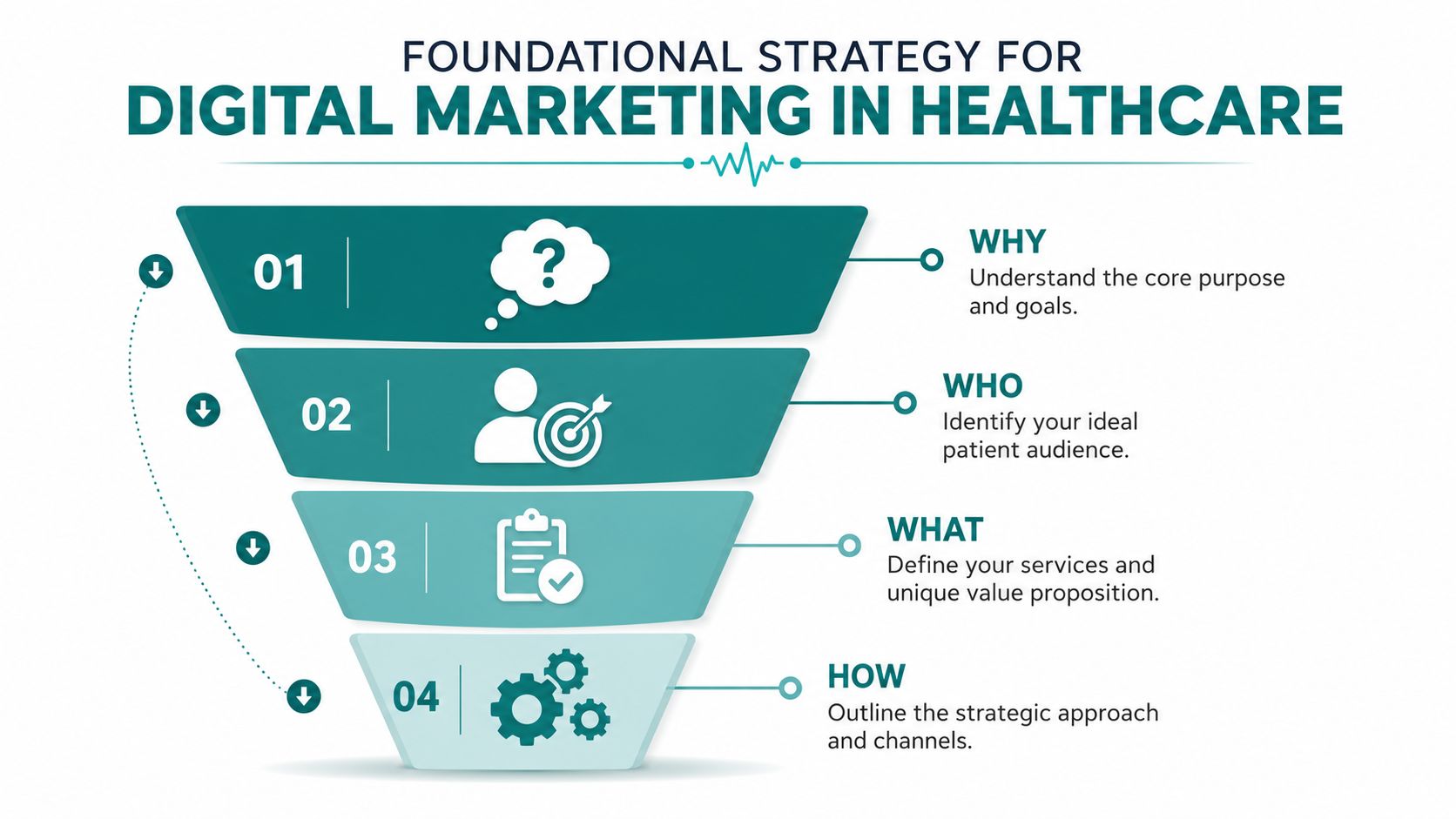
Lay the Foundation Strategy Before Tactics
A lot of healthcare marketing underperforms for one simple reason. The practice starts with channels instead of strategy. They buy Google Ads before they know which services deserve promotion. They post on social media before they know what patients need to hear. They redesign a website before they decide what action the site should drive.
A stronger digital marketing strategy for healthcare starts with intent.
Segment by patient intent
The most useful way to think about your audience isn't age first or income first. It's why they're here right now.
Some people are researching symptoms. Some are comparing providers. Some already know the service they need and want the fastest path to booking. One healthcare marketing source describes the most cost-effective 2026 approach as starting with audience segmentation by intent, then building nurture journeys based on actions such as brochure downloads or visits to a specific service page, as explained in Exposure Ninja's healthcare strategy guide.
That matters because a parent looking for a pediatrician, a patient evaluating physical therapy options, and someone ready to schedule a dermatology consult should not land in the same generic funnel.
A simple framework looks like this:
-
Informational intent means the visitor is still learning. They need educational pages, FAQs, provider credibility, and plain-language explanations.
-
Comparison intent means they're shortlisting options. They need clear service pages, insurance information, reviews, location details, and an easy way to contact the office.
-
Booking intent means they're ready to act. They need fast pages, obvious calls to action, and as little friction as possible between landing and scheduling.
Map the patient journey
Most practices think in departments. Patients think in moments.
They search a symptom or service. They click a result. They scan your site on a phone. They wonder whether you take their insurance. They decide whether your office feels trustworthy. Then they either book, call, or leave.
If a practice can't explain what a first-time visitor should do on each core page, the marketing isn't ready for paid traffic.
That patient journey usually includes several digital checkpoints:
-
Discovery through search, maps, referrals, or social media
-
Evaluation on your website, review profiles, and service pages
-
Conversion through a form, phone call, or appointment request
-
Follow-up through reminders, education, and retention messaging
When you map that path, content decisions get easier. A "what to expect" page belongs near evaluation. An appointment request page belongs at conversion. A newsletter sign-up belongs in lower-risk educational follow-up, not mixed into clinical communication.
Set goals that tie to revenue
"More traffic" isn't a strategy. It's an activity metric.
A better plan names the services that drive the practice, identifies which patient actions matter, and sets goals around those actions. If a service line has strong margins and open schedule capacity, that's where marketing should begin. If your website gets visits but few appointment requests, your real problem may be conversion, not awareness.
Use a short planning sheet before you spend anything:
| Question | Better answer |
|---|---|
| What are we promoting? | One or two priority services first |
| Who is it for? | Patients grouped by search and booking intent |
| What action matters? | Appointment request, qualified call, or newsletter opt-in |
| What would make this fail? | Slow website, weak service page, confusing forms, poor follow-up |
That's the foundation. Once that's in place, tactics finally have something useful to support.
Win the Search Your Digital Front Door
For most healthcare practices, search is the front door. A patient doesn't experience your branding first. They experience your search result, your Google Business Profile, or your map listing.
That's why local visibility tends to outperform clever campaigns.

Start with local intent
If your practice serves Cincinnati, Blue Ash, Mason, Hyde Park, West Chester, or Northern Kentucky, your search presence should reflect that geography directly. Patients often search by service plus location, or they search "near me" and compare the top few options.
Your Google Business Profile deserves regular attention because it often shapes first impressions before anyone even clicks to your site.
Focus on these basics:
-
Keep core details exact so your name, address, phone number, office hours, and service categories match everywhere.
-
Add real photos of your office exterior, waiting area, providers, and signage so patients know what to expect.
-
Use the Q&A area well by answering common questions about parking, scheduling, insurance, and first visits.
-
Gather reviews consistently from satisfied patients through a repeatable internal process that doesn't pressure anyone or invite public disclosure of medical details.
Local SEO isn't glamorous, but it's one of the most impactful things a healthcare practice can do.
Build service pages for real searches
Many healthcare sites bury services under vague menu labels or put multiple treatments on one thin page. That makes it harder for search engines to understand the page and harder for patients to know whether they're in the right place.
A better structure is simple. Give important services their own pages. Write each one for a specific search intent. Use plain language, not brochure copy.
A strong service page usually includes:
-
The condition or service name stated clearly in the headline
-
Who the service is for in the opening copy
-
What treatment or care involves in simple terms
-
What a first appointment looks like so uncertainty drops
-
Where you're located and the communities you serve
-
A clear next step such as call, request an appointment, or ask a question
If you want a practical baseline for technical and on-page improvements, review the SEO foundation every website needs. Healthcare sites don't need gimmicks. They need clarity, structure, and clean execution.
Publish content that answers patient questions
A lot of healthcare blogs miss the mark because they chase broad awareness topics with no local relevance and no connection to a service line. That creates content, but not much business value.
Patient-centric content works better when it removes friction before a first visit.
Examples that tend to be useful include:
| Content type | Why it works |
|---|---|
| First visit guides | Reduces anxiety and supports conversions |
| Provider comparison pages | Helps patients evaluate options with confidence |
| Location-specific service pages | Improves relevance for local searches |
| FAQ pages | Captures long-tail search intent and lowers phone friction |
Here's a good litmus test. If a patient read this page today, would it make booking easier tomorrow?
That's the standard.
A short visual walkthrough can help if you're reworking your search presence and site structure:
<iframe width="100%" style="aspect-ratio: 16 / 9;" src="https://www.youtube.com/embed/I1ZdClhFKAE" frameborder="0" allow="autoplay; encrypted-media" allowfullscreen></iframe>Avoid the search mistakes that waste time
Some practices invest heavily in homepage copy while neglecting service pages. Others publish generic blogs but never improve local listings. Some have beautiful sites that hide the phone number, bury appointment buttons, or make mobile navigation frustrating.
Those aren't branding issues. They're conversion leaks.
Search traffic matters only when the right patient lands on the right page and can take the next step without hesitation.
For healthcare, being findable and being trustworthy need to happen on the same page. If one is missing, the other can't do enough work on its own.
Actively Reach Patients with Paid Ads and Email
SEO takes time. Sometimes a practice needs to promote a new location, support a service line with open capacity, or create demand faster than organic search can deliver. That's where paid ads and email can help, but they need tighter controls in healthcare than they do in most industries.
The worst approach is broad, expensive, and lazy. It throws budget at generic keywords, sends traffic to weak landing pages, and measures success by impressions instead of booked appointments.
Why paid search often disappoints
One industry source reports that the average click rate for health-related Google Ads is 6.11%, while healthcare marketers allocate 85% of their budget to those ads. The same source says healthcare email averages a 21.5% open rate but only a 3% click-through rate, according to Healthgrades' healthcare marketing statistics.
Those numbers tell a useful story. Search ads can be valuable, but they're easy to overuse. Email can get attention, but attention doesn't automatically create action. In both channels, efficiency matters more than volume.
A small practice shouldn't try to compete on every possible healthcare search term in the region. It should focus on a narrow set of service-driven opportunities where the landing page, message, and scheduling path are all aligned.
What a safer paid strategy looks like
The safest healthcare ad strategy usually relies on context, geography, and service relevance, not invasive audience assumptions.
That means:
-
Target by location around the communities you serve
-
Bid on service-focused search terms that show intent without getting reckless in messaging
-
Use general ad language that promotes the practice or service category without exposing sensitive assumptions
-
Send clicks to dedicated landing pages that match the ad and make contact or booking easy
Many campaigns break down. The ads may be fine, but the landing page is generic. Or the campaign is technically compliant, but the conversion path is clumsy enough that the budget bleeds out with little to show for it.
Broad campaigns buy traffic. Focused campaigns create qualified inquiries.
Email works best as a nurture channel
Email can be useful in healthcare, but only when the list is built carefully and the messaging respects the difference between marketing and patient communication.
For prospective patients, a newsletter or educational opt-in can work well. A person downloads a guide, signs up for updates, or requests information about a non-sensitive service area. You follow up with helpful content, provider introductions, office updates, or answers to common first-visit questions.
For existing patients, the rules are tighter because communication can quickly move into protected health information territory. That's why secure systems and role separation matter. General marketing emails should not become a substitute for clinical messaging.
A practical email sequence for prospects often includes:
-
A welcome message that sets expectations and introduces the practice
-
A useful educational follow-up tied to the service they expressed interest in
-
A trust-building message with provider credibility, office details, or common questions
-
A clear invitation to book or call when they're ready
Don't let channels outrun operations
Paid traffic and email both fail when the front desk can't support the volume, the landing page doesn't answer obvious questions, or no one follows up quickly. Healthcare marketing is operational by nature.
That's why the best campaigns usually aren't the flashiest ones. They're the ones that match patient intent, use careful targeting, and connect directly to the practice's actual scheduling process.
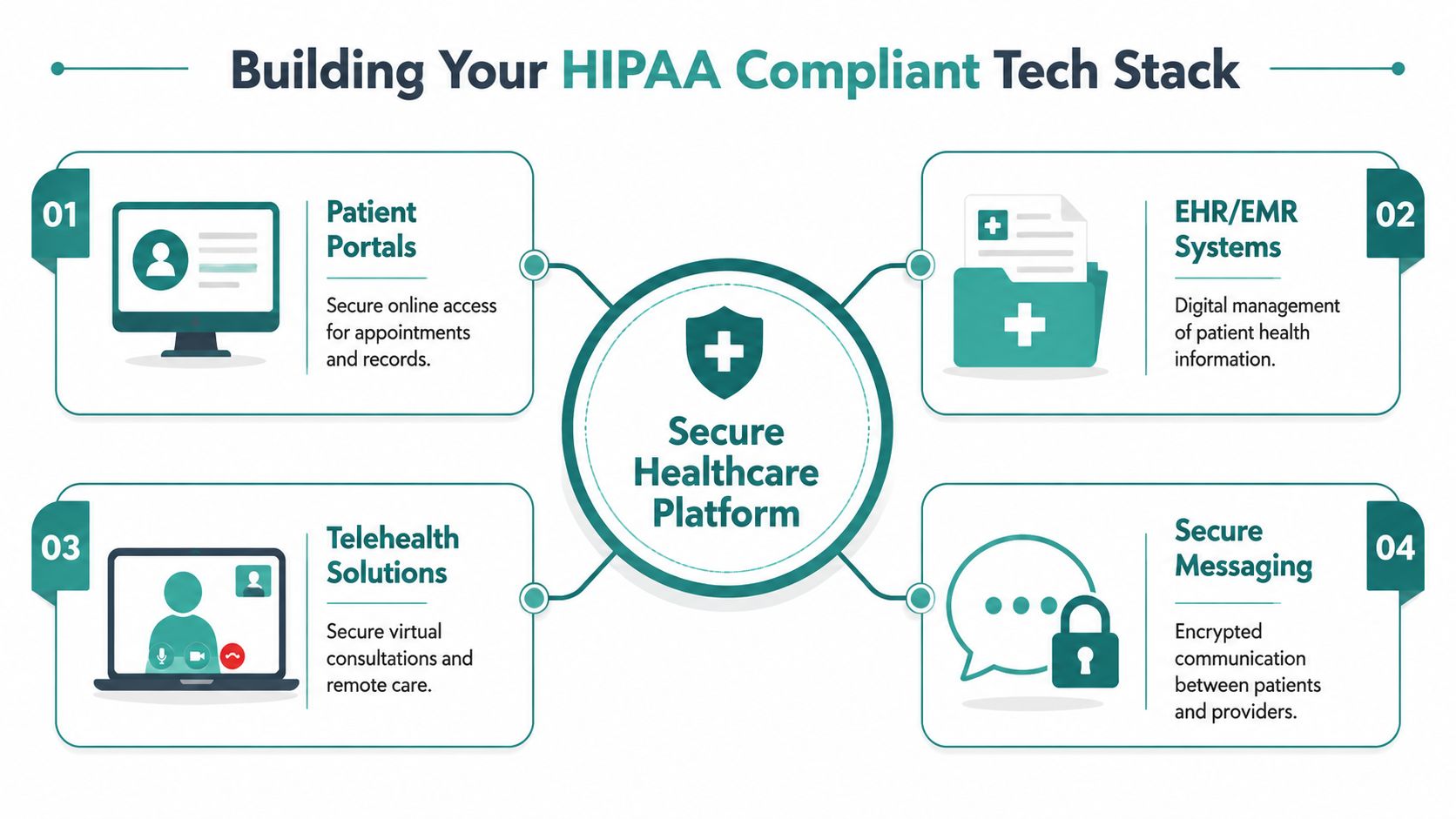
Build Your HIPAA Compliant Tech Stack
A healthcare practice can have smart messaging, solid SEO, and decent ad campaigns and still create risk if the underlying tools aren't set up correctly. A lot of trouble starts not in strategy meetings, but in the software.
Most problems come from ordinary tools used in the wrong way. A basic website form. A calendar widget. A chat plugin. An analytics setup copied from a non-healthcare site. None of these look dangerous at first glance. In the wrong environment, they can become liabilities.
Your website tools need a privacy-first setup
A standard lead form may be fine for a contractor or accounting firm. It may not be appropriate for a medical practice if it encourages users to submit detailed health information through an unsecured or poorly governed workflow.
The better approach is to decide what information the website needs at the marketing stage. Usually that means less, not more.
For example, a safer inquiry process often includes:
-
Basic contact information needed to respond
-
Service-interest selection framed broadly
-
Clear instructions telling users not to submit sensitive medical details through general forms
-
Secure routing into systems designed for healthcare operations
That same mindset applies to chat tools, booking requests, and downloadable resource forms. If a tool collects user information, you need to know where the data goes, who can access it, and whether the vendor relationship is appropriate for healthcare use.
Analytics should measure behavior without exposing patient data
Healthcare teams still need reporting. They need to know which pages lead to calls, which campaigns produce appointment requests, and where users drop off. The answer isn't to stop measuring. It's to measure with restraint.
One healthcare industry source notes that analytics can be configured to track broad categories such as "existing patient" versus "non-patient" using custom dimensions without relying on patient-level detail, and it also highlights privacy-conscious targeting methods such as contextual approaches in WebMD Ignite's discussion of the evolving role of digital marketing in healthcare.
That's a useful principle for smaller practices. Track patterns, not identities. Measure page performance, source performance, and conversions in aggregate. Keep your reporting focused on operational decisions, not personal dossiers.
Ask harder vendor questions
Healthcare practices sometimes assume a vendor is safe because the tool is popular. Popular doesn't mean appropriate.
Before you add any platform to your website or workflow, ask questions like these:
| Question | Why it matters |
|---|---|
| What data does this tool collect? | You need data minimization, not accidental over-collection |
| Where is the data stored? | Storage affects risk and internal governance |
| Who on our team can access it? | Access control limits unnecessary exposure |
| Does this vendor belong in our healthcare workflow? | A marketing tool may not fit a patient-facing use case |
Choose fewer tools, configure them carefully, and document how they're used. That's usually safer than stitching together a dozen plugins no one fully understands.
Compliance is a build decision
This is the part many practices learn too late. HIPAA compliance isn't something you sprinkle on after launch. It starts when the website is scoped, when forms are planned, and when analytics are selected.
If the stack is wrong, every campaign inherits that weakness. If the stack is sound, marketing gets easier because your team knows what can be measured, what can be automated, and what has to stay inside secure workflows.
Measure What Matters and Execute Your Plan
Healthcare practices don't need more dashboards. They need better questions.
The right reporting setup tells you whether marketing is creating appointment opportunities, which service pages convert, and where patient friction still exists. That's a much better use of time than staring at vanity metrics that never reach the scheduling calendar.
Use KPIs your front desk would care about
A benchmark-driven approach should be managed around explicit KPIs such as website appointment bookings, conversion rate, and traffic source performance. One source also notes that teams sometimes set goals like increasing inquiries by 20% in six months or appointment bookings by 15%, and that mobile optimization matters because more than 50% of web searches happen on mobile, according to Market Veep's healthcare digital marketing planning guide.
That's the right direction. Measure what connects to operations.
Useful KPIs often include:
-
Appointment requests from service pages and landing pages
-
Qualified phone calls generated by search and paid campaigns
-
Conversion rate by page, service, and traffic source
-
Mobile usability on the pages patients use most

Keep execution simple enough to sustain
A good plan for a smaller healthcare organization is usually boring in the best way. It's consistent. It's measurable. And it doesn't depend on a heroic internal marketing effort every month.
A manageable starting checklist looks like this:
-
Audit your current website for weak service pages, unclear calls to action, and mobile friction
-
Tighten your Google Business Profile so local patients can trust what they see
-
Pick one service line first instead of trying to market everything at once
-
Set one or two business KPIs tied to inquiries or bookings
-
Use automation carefully for content planning, scheduling, and reporting, not for anything that shortcuts judgment or compliance review
If you want a better framework for tying reporting to business outcomes, this guide to a data-driven marketing strategy is a useful next read.
The practices that grow steadily online usually aren't doing magic. They're doing the fundamentals well, measuring the right things, and protecting patient trust at every step.
If your practice needs a website, SEO plan, or growth strategy that fits healthcare realities, HDM can help. HDM works with organizations across Greater Cincinnati to build compliant, revenue-focused digital systems that turn visibility into appointments without treating patient privacy like an afterthought.