

A lot of agencies hit the same wall at the same time.
You build websites. You launch SEO campaigns. You manage ads. Work comes in waves, invoices look healthy for a month or two, then the pipeline thins out and the team starts chasing the next project. For small and mid-sized business owners around Cincinnati, that usually shows up on the buying side too. They hire an agency for a website redesign or local SEO push, but what they really want is steady lead flow and a simpler way to stay in front of customers without more manual work.
That gap is where marketing automation for agencies becomes more than a delivery tactic. It becomes a business model.
The agencies that make automation profitable don't sell "we'll set up some emails." They sell a system that connects web design, SEO, lead handling, follow-up, retention, and reporting. That changes the relationship from vendor to ongoing growth partner. It also creates service lines that are easier to retain, easier to expand, and easier to operationalize than one-off builds.
For business owners evaluating digital partners, this matters because the strongest agencies no longer treat your website as a standalone asset. They treat it as the front door to a process that captures demand, routes inquiries, nurtures leads, and supports sales. That's a much more durable investment than a pretty homepage with no follow-up engine behind it.
Beyond Projects to Partnerships
Project work has a built-in ceiling.
A website launch has a start and finish. A technical SEO cleanup ends. A paid campaign setup gets handed over. Even when the work is good, the agency often drops back into prospecting mode as soon as delivery wraps. Clients feel that too. They get a polished deliverable, then wonder why growth still depends on someone manually sending emails, checking forms, or remembering to follow up with old leads.
Marketing automation changes that dynamic because it sits in the middle of operations, sales, and marketing. It gives agencies something recurring to manage, improve, and report on. More important, it gives clients an actual system instead of a stack of disconnected tasks.
What the old model gets wrong
Many agencies still package services by output:
- Website build: pages, design revisions, launch support
- SEO retainer: rankings, content, technical fixes
- Email help: newsletters, basic sends
- CRM support: light setup, occasional cleanup
The client buys pieces. The agency delivers pieces. Nobody owns the full path from visitor to customer.
That's why a lot of service businesses end up with good-looking websites that don't reliably convert. It's also why e-commerce brands can drive traffic but still struggle with repeat purchases, abandoned carts, or customer reactivation.
Practical rule: If the service stops creating value the moment your team stops touching it, it's still labor. It isn't a system yet.
What a partnership model looks like
A partnership model starts with one question: what should happen after a prospect takes the first meaningful action?
That action could be a form fill, a booked call, a quote request, a download, a purchase, or even a missed appointment. Once an agency maps that point, automation turns into recurring value:
- Leads get routed faster
- Prospects receive relevant follow-up
- Sales teams get context, not just contact records
- Past customers hear from the business again
- The agency keeps improving the workflow over time
For Cincinnati businesses comparing web design, SEO, or digital marketing providers, this is often the difference between a firm that "builds stuff" and one that helps run growth.
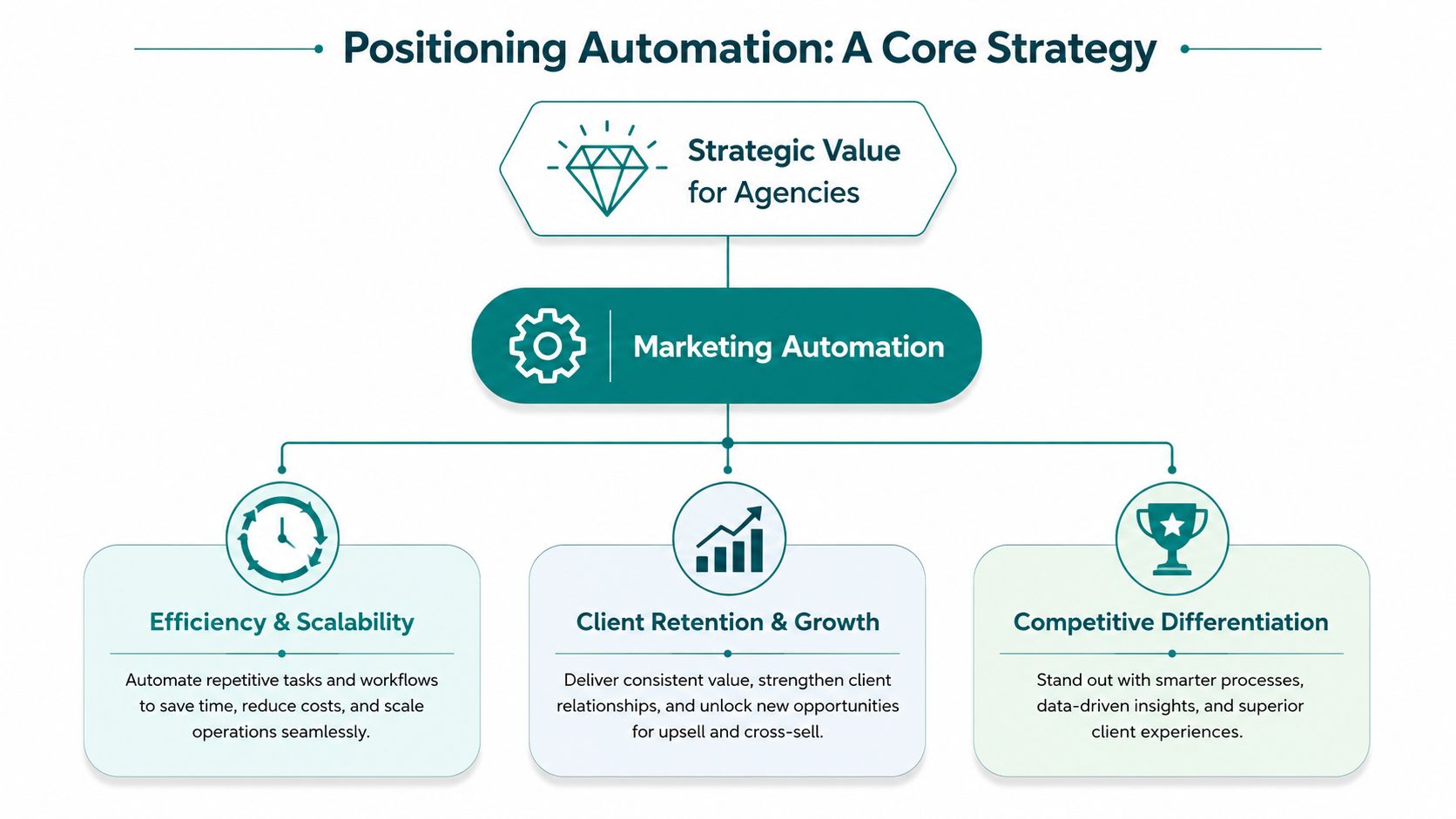
Positioning Automation as a Core Strategy
The mistake most agencies make is selling automation as an add-on.
They mention email sequences, CRM workflows, form notifications, or lead scoring as technical features. Clients hear complexity. They don't hear business value. Small business owners are rarely shopping for triggers and tags. They're shopping for fewer dropped leads, more consistent follow-up, and less chaos for their staff.
Sell the system, not the tasks
A better position sounds like this:
Your website shouldn't just collect inquiries. It should route them, segment them, follow up with them, and remind your team when human outreach needs to happen.
That framing works because it ties automation to an outcome. A restaurant group might need reservation follow-up and review requests. A law firm might need intake routing and long-term nurture. A home services company might need quote request handling and no-response follow-up. Different industries, same core promise. The business responds faster and more consistently than it could manually.
That also lets agencies connect automation to existing services:
- Web design becomes conversion infrastructure
- SEO becomes demand capture plus lead nurturing
- Paid media becomes the top of a follow-up funnel
- CRM work becomes sales enablement, not database cleanup
Explain it in language owners understand
Non-technical buyers usually understand automation faster when you compare it to staffing.
A simple analogy works: your marketing automation is like a reliable front desk and sales coordinator that never forgets to reply, never loses a form, and never skips a reminder. It doesn't replace your team. It handles the repeatable parts so your team can focus on conversations that need judgment.
That's especially useful when selling to local businesses that already know the pain of missed calls, delayed callbacks, or leads sitting untouched in an inbox over the weekend.
Automation works best when it handles timing, routing, and reminders. People should still own trust, closing, and relationship-building.
Find the right first clients
Not every client should be your first automation client. Start with businesses that already have demand and some operational discipline.
The best early candidates usually have a few traits:
- They already get leads: even if follow-up is messy
- They already use a CRM or contact list: even if it's underused
- They have repeatable customer journeys: consults, quotes, purchases, renewals
- They feel the pain clearly: slow response, no nurture, weak retention
Avoid starting with clients who have no traffic, no offers, and no internal owner. Automation won't fix a broken market fit problem. It amplifies what already exists.
Agencies also need to think one step ahead. Automation now overlaps with discovery in AI-driven search and assistant interfaces, not just traditional search and email funnels. That's one reason more firms are looking at optimizing client AI search engine presence as part of a broader systems strategy rather than treating channels in isolation.
Build your pitch around business friction
The strongest positioning usually starts with friction the owner already feels:
- leads go cold
- staff forget follow-up
- old customers disappear
- the website produces inquiries but not enough conversations
- reporting shows activity, not business impact
If you sell against that friction, automation becomes a core strategy. If you sell against software features, it becomes a tool demo.
Developing Your Core Automation Playbooks
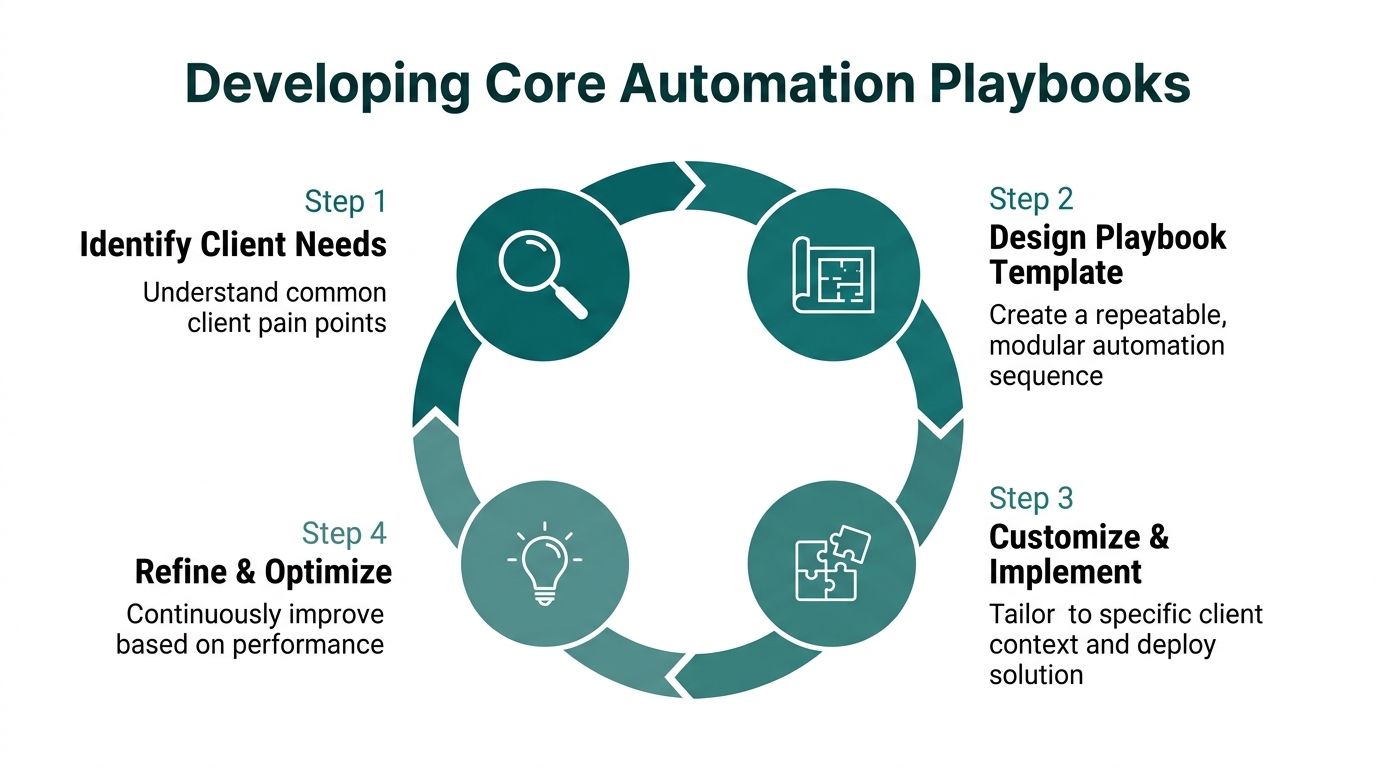
You don't need dozens of custom workflows to launch a service line. You need a small set of repeatable playbooks that fit most client situations, then customize from there.
The cleanest approach is to standardize around three patterns. One for lead generation. One for post-purchase retention. One for long sales cycles and re-engagement.
Lead generation and welcome
This is the playbook most service businesses need first.
Think law firms, HVAC companies, dentists, consultants, real estate teams, or any business where a form fill or booked call starts the sales process.
Core trigger set
Use one or more of these as the entry point:
- Website form submission
- Booked consultation
- Downloaded guide or lead magnet
- Paid ad lead form
- Inbound call that didn't connect
Core actions
The sequence should do several jobs at once:
- Send an immediate confirmation: reassure the lead that the inquiry was received
- Tag by interest or service line: legal case type, treatment category, service area, product category
- Create or update the CRM record: avoid duplicate manual entry
- Notify the right human: owner, intake coordinator, sales rep, office manager
- Start a short follow-up sequence: answer common questions and reduce delay
- Set a task if nobody responds: internal accountability matters more than another email
Agencies often overbuild. They create huge branches before validating the basics. Start with speed, routing, and a short nurture sequence. Add complexity after you confirm the business is using the workflow.
A practical extension of this model often includes connected internal ops. If your team is building more advanced lead routing, CRM syncing, and cross-platform workflow logic, HDM has a useful breakdown of AI workflow automation in agency and business operations.
Goal
The goal isn't "send more emails." The goal is to make sure every inquiry enters a clean process and gets a timely, relevant next step.
Here's a useful walkthrough on the mechanics side:
<iframe width="100%" style="aspect-ratio: 16 / 9;" src="https://www.youtube.com/embed/U6Uz4-PR5Fg" frameborder="0" allow="autoplay; encrypted-media" allowfullscreen></iframe>Post-purchase and retention
E-commerce agencies should treat this as a profit engine, not a courtesy sequence.
The first purchase is only the beginning. Clients usually need a structured system that confirms the order, improves the customer experience, encourages repeat buying, and captures reviews or referrals.
Trigger examples
A buyer enters this playbook after:
- Completed purchase
- Specific product purchase
- Subscription start
- Order delivered
- No repeat purchase within a set period
What happens next
A strong retention workflow often includes staggered touchpoints:
| Stage | Purpose | Example action |
|---|---|---|
| Immediate | Confirm and reduce anxiety | Send order confirmation and support info |
| Early use | Improve product experience | Share setup tips, care instructions, or FAQs |
| Mid-cycle | Cross-sell carefully | Recommend complementary items |
| Satisfaction check | Catch issues early | Ask for feedback before asking for a review |
| Repeat purchase | Bring the buyer back | Send replenishment or return prompts |
This isn't only for pure e-commerce. Cincinnati retailers, clinics with recurring appointments, membership businesses, and service plans all benefit from post-purchase automation when the customer journey repeats.
A retention workflow should feel like service first and promotion second. If every message asks for another sale, people tune out quickly.
Long-term nurture and re-engagement
Some businesses don't close fast. Professional services, higher-ticket home services, B2B providers, and many healthcare or legal practices deal with long consideration windows. Prospects inquire, go quiet, then come back months later.
That's where agencies need a slower, more thoughtful playbook.
Typical entry points
This sequence fits contacts who:
- Requested information but didn't convert
- Attended a consultation without moving forward
- Opened previous emails but stopped replying
- Haven't engaged in a long time
- Are former clients who may need the service again
Sequence design
This playbook should be educational, not pushy.
Use a cadence built around relevance:
- Start with useful content: FAQs, decision guides, process explanations
- Segment by intent: active evaluator versus dormant contact
- Add occasional human checkpoints: a personal note or call task
- Re-engage with a clear reason: new service, seasonal need, policy change, reminder
- Suppress unengaged contacts when needed: list health matters
For a law firm, that might mean sending intake guidance, case process education, and a later re-engagement message tied to a common legal need. For a B2B manufacturer, it might mean educational follow-up after a quote request and a later check-in around budget cycles.
Build templates, not one-off art projects
Agencies get profitable when they create modular playbooks with replaceable parts:
- trigger library
- tag taxonomy
- email blocks
- task rules
- branch logic
- reporting views
That lets you adapt fast without rebuilding from scratch every time. Your client gets a custom fit. Your team gets standard operating logic.
Choosing Your Agency Tech Stack
The wrong stack makes automation expensive to deliver. The right one makes it manageable, repeatable, and easier to support across multiple clients.
Agencies usually end up choosing between three archetypes. An all-in-one platform. A connector-first stack. Or a channel-focused platform supported by integrations.
What to evaluate first
Before comparing tools, answer these questions:
- Can you separate client data cleanly?
- Can your team manage multiple accounts without chaos?
- Can you white-label dashboards or the client experience if needed?
- Can the system integrate with common CRMs, websites, forms, and commerce tools?
- Does the pricing model still work as client complexity grows?
If the answer is no to most of those, the platform may still be good software, but it probably isn't good agency software.
For businesses with custom systems or multiple platforms that need to talk to each other, integration work often becomes the hidden requirement. That's why agencies should understand practical web app integrations and connected workflows before locking themselves into a tool stack they can't extend.
Agency marketing automation stack comparison
| Platform Archetype | Best For | White-Label Friendly? | Integration Strength | Typical Cost Structure |
|---|---|---|---|---|
| All-in-one platform like HubSpot | Agencies that want CRM, email, automation, and reporting in one place | Sometimes, but usually limited by platform branding rules | Strong native ecosystem | Platform tiers that rise as usage and features expand |
| Connector-first stack like Zapier or Make paired with other tools | Agencies that need flexibility across many client systems | Usually indirect, since the connector sits behind the scenes | Very strong across apps and custom flows | Usage-based plus separate app costs |
| Email-centric platform like ActiveCampaign | Agencies focused on email nurture, segmentation, and sales follow-up | Limited compared with full agency platforms | Good, especially around CRM and forms | Contact- or feature-based pricing |
Trade-offs that matter in real delivery
All-in-one platforms simplify training and reporting. They also reduce the number of moving parts. The downside is lock-in. If one feature is weak, you may still keep paying because the rest of the system is convenient.
Connector-first stacks give you freedom. You can pair the right form tool, CRM, email platform, and reporting layer for each client. The trade-off is support burden. More pieces mean more points of failure, more QA, and more documentation.
Email-centric systems can be great for nurture and retention. They're often easier for smaller teams to grasp. But they may struggle when you need stronger sales pipelines, advanced attribution, or deep multi-client governance.
A practical stack rule
Choose the least complicated stack that still handles your most common client journey.
That usually means avoiding two extremes. Don't buy enterprise-level software for simple local service clients. Don't try to run a complex multi-brand operation through a lightweight email tool that can't support your workflow model.
Your stack should match your service model. If your offer includes white-label delivery, multi-client reporting, and custom routing logic, choose software that supports that from day one.
Packaging and White-Labeling Your Services
Once the workflows and stack are in place, the next question is simple. How do you turn automation into something clients can understand and buy?
Most agencies make this harder than it needs to be. They scope every opportunity from scratch, write long custom proposals, and end up pricing the work like consulting even when much of the delivery is repeatable.
Start with three packages
A tiered model is easier to sell and easier to manage.

Starter
This package fits businesses that need the foundation in place.
Include items like:
- Core setup: CRM connection, forms, tags, basic segmentation
- One primary workflow: lead intake, welcome, or post-purchase
- Basic reporting: simple monthly review
- Light training: enough for the client to use the system properly
This works well for local companies that are investing in a new website or improving lead capture and don't need deep branching logic yet.
Growth
Here, recurring revenue gets stronger.
The Growth tier usually adds:
- Additional workflows: nurture, re-engagement, review requests, retention
- Ongoing optimization: subject lines, timing, segmentation, copy refinement
- Cross-channel coordination: website forms, CRM, email, SMS, internal tasks
- Monthly strategy support: not just maintenance
For many agencies, this becomes the core retainer because it combines technical support with strategic oversight.
Enterprise or strategic partner
This is for clients with more moving parts or higher stakes.
That often includes:
- Multiple funnels or business units
- Advanced routing and lifecycle segmentation
- Custom integrations
- Cross-team coordination with sales or operations
- Compliance-sensitive workflows
- Executive reporting and roadmap planning
This isn't merely "more emails." It's broader operational ownership.
Price for complexity, not just labor
The easiest way to underprice marketing automation for agencies is to bill only for build time.
Pricing should reflect at least four variables:
-
Workflow complexity A simple welcome flow is not the same as a branched nurture system tied to lifecycle stages and task routing.
-
Data environment Clean systems are faster to work with. Messy CRMs, duplicate records, and unclear ownership add real delivery cost.
-
Contact volume and sending responsibility More contacts can mean more segmentation, more monitoring, and more platform expense.
-
Strategic involvement If the client expects the agency to think, recommend, test, and improve continuously, that belongs in the fee.
White-labeling can be its own revenue stream
White-label automation is one of the cleaner expansion paths for agencies that already have strong systems.
A branding agency may design websites but not want to own CRM automation. A PR firm may handle messaging but not workflow logic. A paid media shop may generate leads and need a partner to build the follow-up machine behind the campaigns.
In those cases, the automation agency becomes the backend delivery partner. The partner firm keeps the client relationship. You provide the technical and strategic engine.
That model works best when you standardize:
- onboarding checklists
- handoff documents
- naming conventions
- approval workflows
- report templates
- support boundaries
White-label work gets messy when roles are vague. Decide early who owns strategy, who owns communication, and who approves changes.
For local businesses, this matters even if you never hear the term "white label." A website company, SEO firm, or creative agency may be relying on a specialist partner behind the scenes. That's not a bad thing if the process is mature and accountability is clear.
Measuring Success and Ensuring Compliance
Clients don't keep paying for automation because it looks advanced. They keep paying because they can see what it's doing for the business.
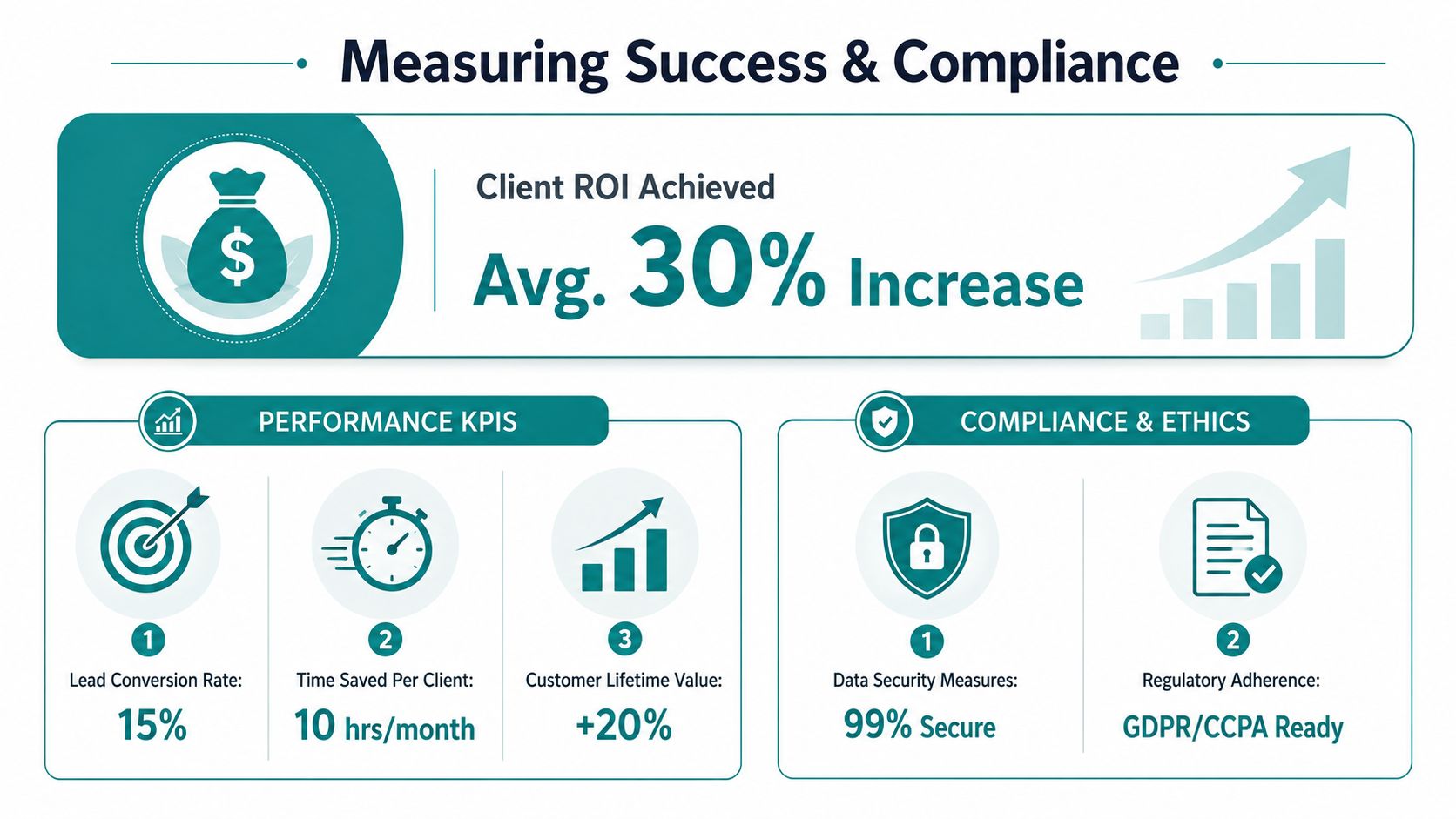
That means your reporting has to move past vanity metrics. Open rates and click rates can be useful diagnostics, but most owners care more about whether leads are followed up, whether conversations improve, and whether existing customers come back.
What to report
A useful monthly automation report usually centers on business movement, not platform activity.
Track outcomes such as:
- Lead response consistency: are inquiries entering the system and getting follow-up
- Lead-to-customer progression: are qualified leads moving forward more reliably
- Sales cycle friction: are prospects stalling less often
- Retention behavior: are previous customers returning or re-engaging
- Operational savings: has the client reduced manual admin work
You can still include email and workflow health metrics, but they should support the story, not become the story.
Keep reporting simple enough to use
A strong reporting format often has three parts:
| Report Section | What it should show | Why it matters |
|---|---|---|
| Workflow activity | Which automations ran and whether anything failed | Proves the system is functioning |
| Pipeline movement | What happened after leads entered the process | Connects automation to revenue activity |
| Next actions | What the agency recommends changing next | Reinforces strategic value |
A short monthly summary usually lands better than a giant dashboard with no interpretation.
Compliance is part of the offer
Automation touches customer data, and that makes compliance part of service delivery, not an afterthought.
This is especially important for healthcare, legal, financial, and multi-region businesses. If you're collecting patient inquiries, handling sensitive legal intake, or communicating with contacts across different jurisdictions, sloppy automation can create serious risk.
Agencies need clear policies on:
- What data enters the system
- Who can access it
- How long it's retained
- Which tools are approved
- Where human review is required
For firms serving privacy-sensitive markets, GDPR requirements are often the first compliance checkpoint to formalize. This practical GDPR compliance checklist is a useful baseline for agencies building forms, tracking, and contact workflows.
Healthcare raises the bar further. If an agency can support HIPAA-conscious workflows, secure intake patterns, and disciplined vendor selection, that becomes a differentiator. Many agencies avoid regulated environments because they don't want the operational burden. That leaves room for firms that take compliance seriously and build repeatable standards around it.
Clients trust automation more when they know you've thought through data handling, not just campaign logic.
If you're a Cincinnati-area business owner weighing web design, SEO, or digital marketing partners, ask how each agency handles follow-up systems, retention workflows, integrations, and compliance, not just deliverables. If you want a team that can connect strategy, websites, automation, and custom development into one growth system, HDM is worth a look.