

Your website brings in inquiries, but your staff still move customer details between email, spreadsheets, and separate billing tools. You're considering a client portal or subscription platform, and every proposal seems to promise a fast launch without explaining what you'll receive along the way.
That's where a clear SaaS development process matters. Software as a service means customers access an application online while your team keeps it running, secure, and useful. For a Cincinnati-area business owner, the buying decision shouldn't come down to a polished demo. It should come down to checkable deliverables, including evidence that real users can complete their work and customers can't access each other's information.
The Eight Stages of a SaaS Build at a Glance
Building a SaaS product is like building an apartment block. You survey the land, draw plans, pour the foundation, and fit out units people can occupy. Afterward, someone still needs to maintain the building and plan improvements.
Software needs the same discipline. Starting with attractive screens before validating workflows is like ordering kitchen cabinets before deciding where the plumbing goes.
Cloud delivery is already mainstream. 45.2% of EU enterprises purchased cloud-computing services in 2023, up 4.2 percentage points from 2021, according to Eurostat. That's European adoption data, not a Cincinnati market estimate, but it illustrates how established internet-delivered software has become.
SaaS development stages and what each produces
Use this table as a purchasing checklist. Each stage needs an output you can inspect, not an assurance that development is progressing.
| Stage | What Happens | Output to Check |
|---|---|---|
| Discovery and product-market fit | Test the problem, the buyer and willingness to pay | Problem statement and interview notes |
| Requirements | Turn workflows into user stories and acceptance criteria | Prioritized backlog with a defined first release |
| Architecture and stack | Choose hosting, data model, tenant isolation and integrations | Written architecture sketch and technology choices |
| MVP build | Build the smallest version users can complete a task with | Working build demonstrated at the end of each development cycle |
| CI/CD and testing | Automate builds, tests and security checks on every change | Pipeline that blocks releases when checks fail |
| Deployment and release | Ship through staged environments with a rollback path | Release checklist and tested rollback plan |
| Security and scaling | Harden access, data and capacity before growth | Access review and load test results |
| Monitoring and iteration | Track errors, usage and support load, then feed them back | Post-launch backlog ranked by business impact |
The stages describe responsibilities, not isolated departments. Your designer needs permission requirements before drawing administrative screens. Your developer needs deployment requirements before choosing services that could be difficult to operate.
Buying rule: Approve evidence, not activity. “We worked on billing” isn't the same as demonstrating a successful payment, a failed payment, and the correct account access afterward.
For each output, name the person who approves it and the evidence they'll use. A workflow might need staff approval; a recovery plan needs a successful technical demonstration.
This process also forms a loop. Customer feedback changes requirements, integrations introduce new risks, and growth changes capacity needs. A release is a checkpoint, not permission to stop planning.
Discovery and Requirements Before Any Code Is Written
The first job isn't choosing a programming framework. It's proving that a specific problem deserves a custom application. Building features nobody will pay for can leave you with functioning software and no viable business.
Discovery should also test whether you need SaaS at all. An existing booking system, a better website form, or a focused integration might solve the problem without creating another platform to maintain.
Turn assumptions into a signed scope
-
Write the problem in a sentence. Name the user, the task, and the cost of the current approach. For example, a property manager needs to approve maintenance requests without chasing attachments across email. Weak version: a feature wish list with no business problem.
-
Interview target users and observe their work. I'd start with at least five representative participants, then expand if their needs differ substantially. Watch the task happen and test willingness to pay with a concrete offer. Weak version: asking only the owner what employees need.
-
Map the workflow. Include spreadsheets, duplicate entry, missing information, and unofficial workarounds. Weak version: copying the procedure manual without checking what people do.
-
Write user stories with acceptance criteria. A story explains what someone needs; acceptance criteria define how you'll prove it works. A team manager seeing only their team's records is testable. Weak version: “build a dashboard” with no definition of done.
-
Cut the first release to a complete task. A minimum viable product, or MVP, should let someone finish useful work, not browse disconnected demonstration screens. Weak version: including every department's future requests.
-
Agree on scope, deliverables, timeline, and a fixed price. Document exclusions and how changes receive approval. Weak version: an estimate that leaves testing, hosting setup, and handover undefined.
Use the discovery flow to keep the build decision tied to evidence.
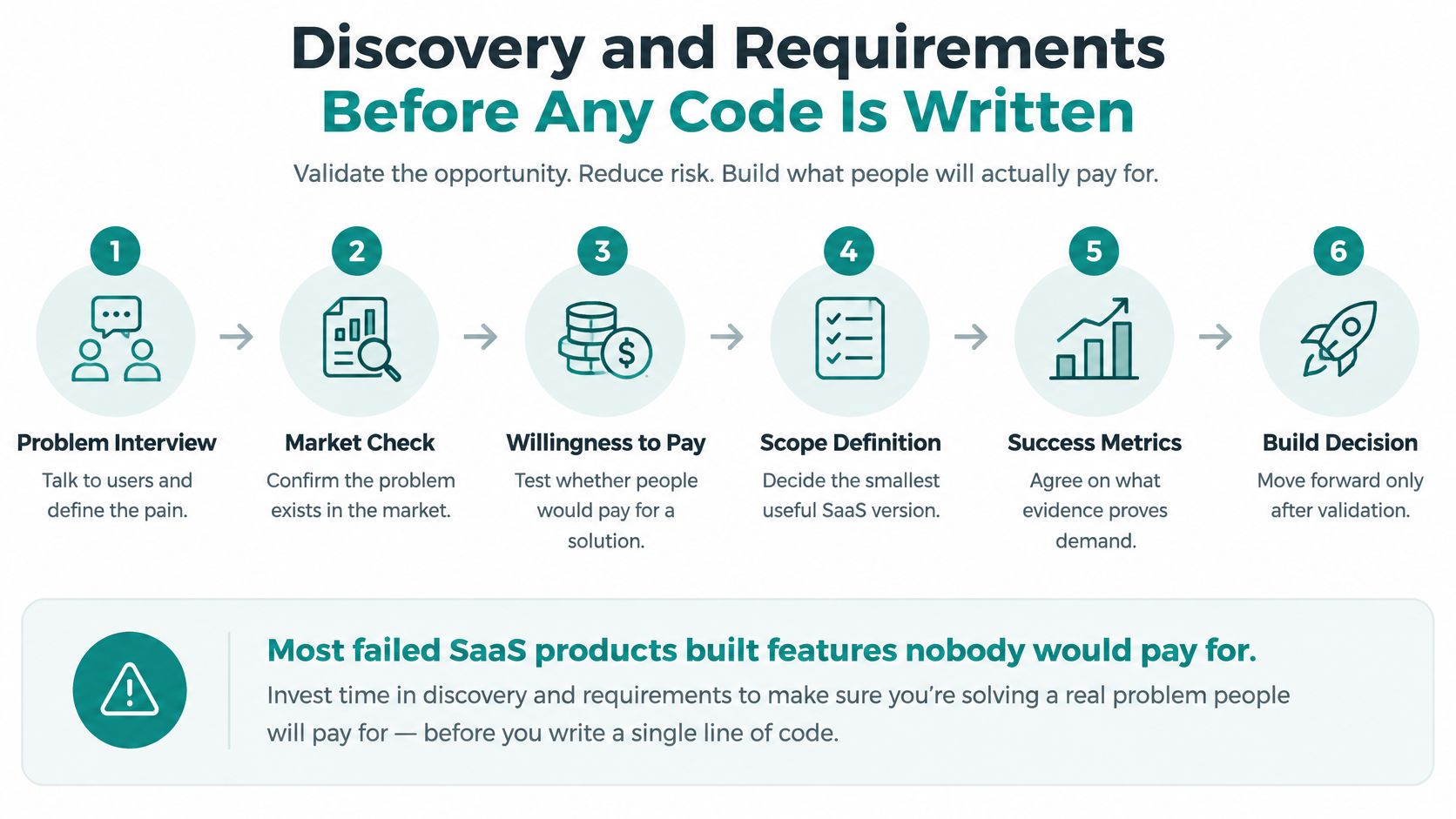
Contract for learning, not just coding
Research on clinical decision-support development describes one-to-four-week agile iterations, with working software and progressively refined requirements, in the Journal of the American Medical Informatics Association. Specify what you'll be able to try at each demonstration.
Write user research into the agreement too. Include a minimum number of prototype reviews, named participant groups, documented findings, and a decision log. A multi-company study of usability work in agile development found that tight schedules made traditional user testing difficult, so don't assume it's included.
If the proposed product needs information from public websites, evaluate a web data api from Context.dev during discovery. Define permitted sources, freshness requirements, and failure handling before making external data essential to the workflow.
At Helbling Digital Media, our Greater Cincinnati project process follows Discovery & Scoping, Detailed Proposal, Clear Agreement, and Build & Launch. We document every deliverable in the agreement step. Discovery is ready for approval when everyone can explain the first release in a short paragraph and the buyer signs it off.
Architecture and Tenant Decisions That Are Hard to Reverse
A multi-tenant application resembles an apartment building: customers share the building, but each customer's door must remain locked to everyone else. Shared software can be efficient. Shared access to private records is a defect.
A tenant usually means a customer organization and its users. Deciding how tenants share infrastructure is an architectural choice, not something to leave to whoever builds the first screen.
This illustration captures the distinction between shared infrastructure and private customer spaces.

Three starting architectures compared
I'd usually start an MVP with a well-organized codebase rather than separate services. A modular monolith is still a single application, but its internal product areas have deliberate boundaries.
| Starting shape | Best fit | Main trade-off |
|---|---|---|
| Single well-organized codebase | First release with a small team | Fastest to build, harder to split later |
| Modular monolith | Growing team with clear product areas | Needs discipline to keep modules separate |
| Separate microservices | Several teams with real scaling pressure | Most flexible, highest cost and complexity to run |
Microservices let teams operate parts independently, but they also introduce network failures, distributed troubleshooting, and more deployment work. Don't buy that complexity without a concrete reason.
The written architecture should explain database separation, login and permission ownership, billing connections, integration boundaries, and data-storage locations. Healthcare and legal workflows also need explicit decisions about sensitive information and applicable customer requirements.
For the interface layer, HDM's guide to building scalable React applications provides related architectural context. A front-end framework, however, doesn't establish tenant security by itself.
Require authorization at the record boundary
OWASP's API Security Top 10 identifies Broken Object Level Authorization as a critical API risk. Login proves who someone is; authorization determines which particular records and actions they're allowed to access.
Require the server to take the tenant from the authenticated session and enforce it on every read, update, deletion, export, and background job. Apply role and ownership rules centrally, with deny-by-default behavior. Hiding an identifier or button in the interface isn't a security control.
Field-level permissions matter too. Someone allowed to update a customer's address shouldn't automatically be allowed to change billing status or grant administrator access.
Before launch, require automated attempts to use another tenant's record identifiers, submit unauthorized fields through mass assignment, escalate privileges, and access administrative functions directly. The expected result is rejection, with legitimate operations still passing. Your deliverable is the test result, not a statement that the application uses secure login.
CI/CD, Testing and How Often to Release
“How often can we ship without breaking things?” is the right question. “How quickly can we launch more features?” leaves out the cost of disruption.
Throughput and stability are separate objectives. A team can release frequently while creating incidents, or release cautiously while accumulating an expensive queue of unfinished work.
DORA delivery metrics and elite benchmarks
The following historical elite benchmarks and metric definitions come from DORA's metrics history. Treat them as reference points, not a contractual demand that a small business must deploy constantly.
| Metric | What It Measures | Elite Benchmark |
|---|---|---|
| Deployment frequency | How often code reaches production | Multiple times per day |
| Change lead time | Time from code commit to successful production deployment | Under one hour |
| Change failure rate | Share of deployments that need remediation | 0-15% |
| Recovery time | Time needed to restore service after a failed deployment | Under one hour |
The useful distinction is how quickly changes arrive versus how safely they behave.
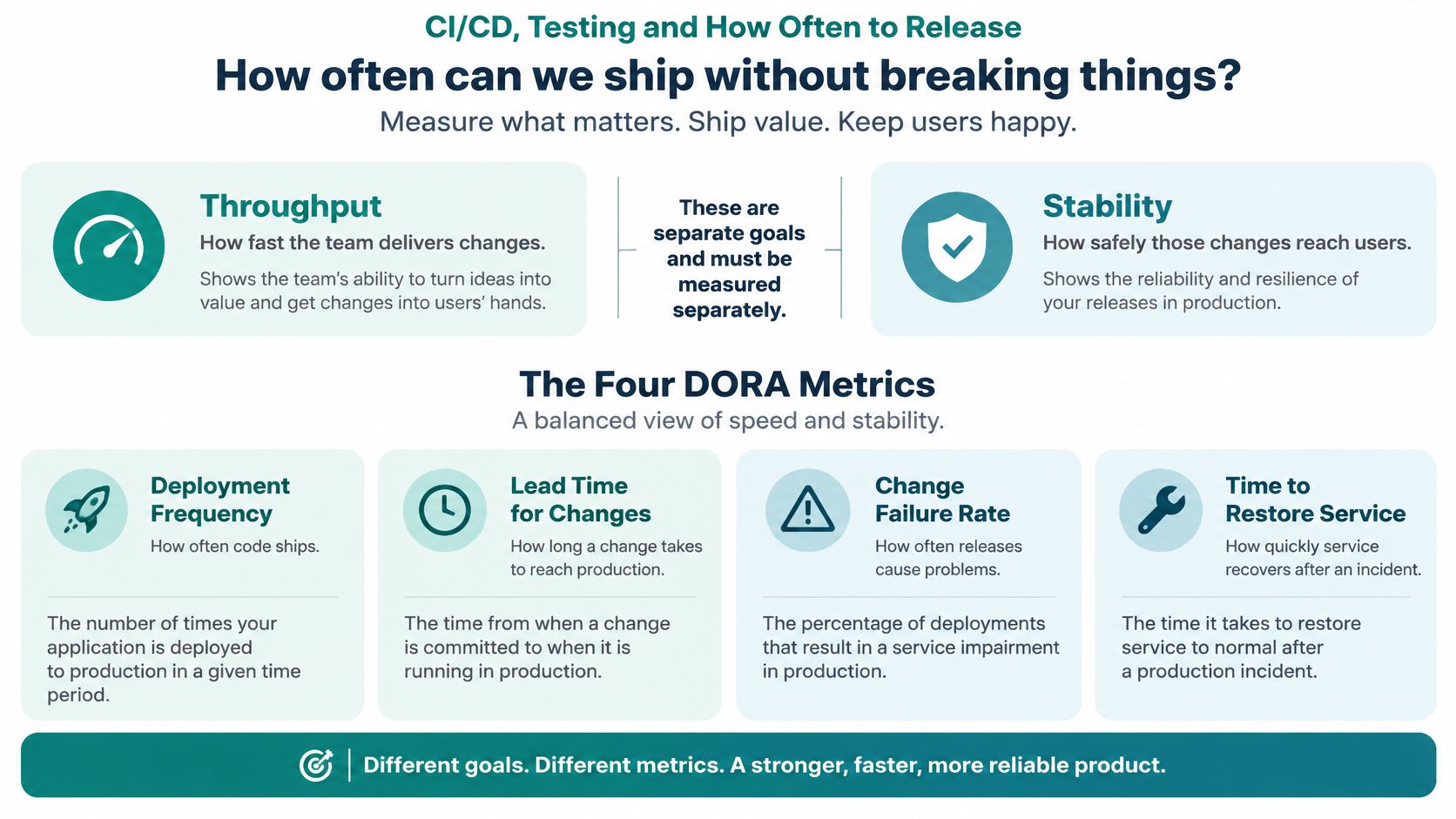
CI/CD means continuous integration and continuous delivery or deployment. In plain English, developers combine changes regularly, automated checks validate them, and a repeatable process prepares or releases the software.
Build a safe release routine
-
Keep changes small enough to review properly. Separate unrelated work so a reviewer can understand the purpose and a developer can reverse it without removing other features.
-
Run automated checks on every commit. Unit tests check individual pieces; integration tests check cooperating components. Security checks inspect risks, while contract tests verify that connected systems still exchange data in the agreed format.
-
Put new behavior behind feature flags. A flag is an on/off switch that lets the team disable a feature without publishing another release.
-
Release to a limited group first. A canary release exposes new code to a small customer group before wider rollout. Choose participants deliberately, especially when workflows involve sensitive information.
-
Automate rollback where it's safe. Define the error conditions that trigger reversal. Database changes need particular care because restoring older application code doesn't necessarily reverse changed data.
For implementation planning, AppJet's explanation can help you streamline your deployment workflow. HDM's DevOps best practices offers additional context for connecting development and operations.
Faster delivery only counts as improvement when failed releases and recovery time stay flat or improve.
Log commit, build, deployment, incident, and rollback timestamps by service and environment. Rising lead time with stable failure rates points toward queues or slow tests. Frequent failures alongside short lead times calls for closer inspection of validation and change size.
Testing also starts before implementation. Research on agile software testers describes testers reviewing user stories and architecture early in an iteration while developers perform unit testing.
Require a written plan covering permissions, billing states, integrations, mobile behavior, accessibility, backups, and failure recovery. Release readiness should include a defect report, a staged deployment checklist, and a demonstrated rollback path, not just approval of how the screens look.
Security Built Into Every Stage of the Lifecycle
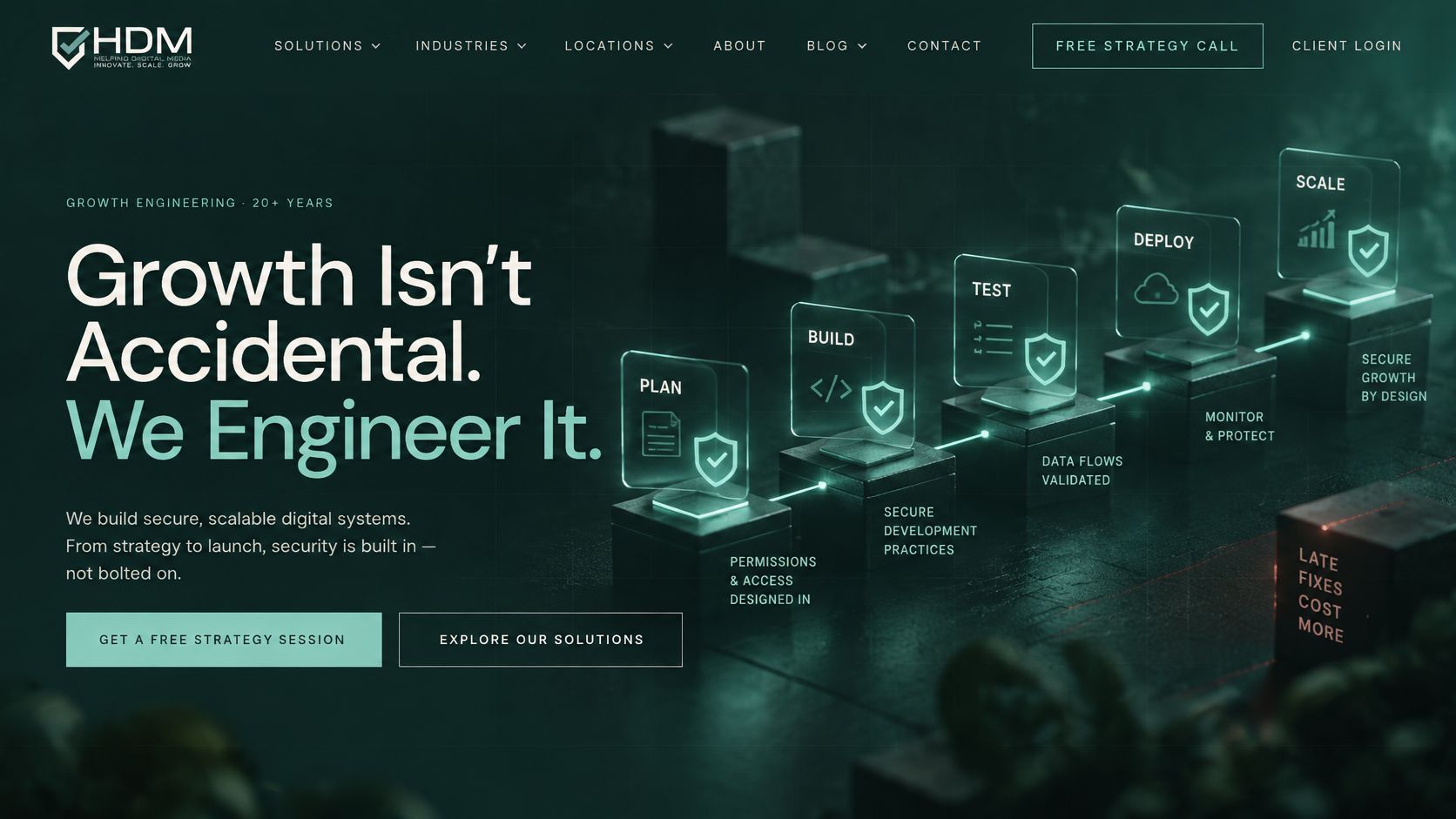
Leaving security until the pre-launch review creates a predictable problem: developers have already embedded permissions and data flows throughout the application. Correcting a foundational access decision then means changing more than a settings screen.
Security belongs in discovery, design, development, release, and ongoing support. This lifecycle view is more useful than treating penetration testing as a final certificate of safety.
Turn the framework into deliverables
In February 2022, NIST published Special Publication 800-218, the Secure Software Development Framework, recommending secure practices throughout the existing software development lifecycle. Its four practice groups give owners a practical way to examine coverage.
-
Prepare the Organization. Assign security responsibilities before coding. Document data classifications, access requirements, integration approvals, and who can accept unresolved risks. The output is a security requirements register tied to user stories.
-
Protect the Software. Guard source code, build systems, and release files against unauthorized access or tampering. Restrict production publishing, protect credentials in a secrets manager, and remove access when a contributor leaves. Require an access review and a documented release approval process.
-
Produce Well-Secured Software. Review designs and code, scan dependencies for known vulnerabilities, test the running application, and configure secure defaults. Require review for changes affecting access rules. Keep evidence of resolved findings and document any accepted exceptions.
-
Respond to Vulnerabilities. Define how the team receives reports, ranks weaknesses, applies fixes, and investigates underlying causes. The deliverables should include an incident response plan, a vulnerability backlog, and ownership for remediation after launch.
The important distinction is between buying a security tool and assigning responsibility. A scanner can flag a vulnerable dependency, but someone still has to decide whether the affected component is exposed and verify the fix.
Make governance visible to the owner
Audit logs should record meaningful access and changes without unnecessarily copying sensitive information into another system. Backup procedures should specify what's protected, who can restore it, and how restoration is tested.
For regulated customers, translate retention, access, incident response, and audit obligations into testable acceptance criteria. Have the responsible legal or compliance adviser confirm the requirements rather than assuming a hosting provider's features establish compliance.
Use the video alongside a discussion of who owns these responsibilities.
<iframe src="https://www.youtube.com/embed/SxCu-EgEyhM" width="100%" height="400" frameborder="0" allowfullscreen></iframe>HDM's cybersecurity best practices can support that discussion, but the project still needs its own evidence.
Contract checkpoint: For each security practice group, identify the responsible person, the required document, and the approval condition.
Ask the development team which groups its process covers and which document proves each one. An unanswered responsibility is a scope gap to resolve before it becomes an incident.
Monitoring, Scaling and Post-Launch Iteration
Launch begins the most informative phase of development. Real customers use unexpected devices, enter incomplete information, and take paths that prototype participants didn't try.
Monitoring needs to connect technical behavior with customer outcomes. An application can be online while users can't finish checkout, upload documents, or invite colleagues.
Post-launch signals and the action each one triggers
| Signal | What It Tells You | Action to Take |
|---|---|---|
| Error rate by tenant | Whether failures hit one customer or all of them | Roll back the release if errors rise across tenants |
| Workflow completion | Where users stop before finishing a task | Fix the screen or step with the highest drop-off |
| Support ticket themes | Which features confuse people | Rank the themes and add the top ones to the next iteration |
| Activation rate | How many new accounts reach first real use | Compare against the target set during discovery |
| Cost per active customer | Whether hosting and support costs grow more slowly than revenue | Review query efficiency and hosting plans if costs outpace revenue |
Review system health, including errors, response times, and uptime; product use, including completed workflows; and business health, including activation, support demand, and customer costs.
Define activation as a useful action, not merely an account registration. For a document portal, that might mean a customer successfully submitting the material staff need to begin work.
Scale the constraint you can measure
Don't add servers just because the application feels slow. Inspect database queries, indexes, large file handling, and background jobs first. If a report repeatedly scans unnecessary records, more application servers won't remove that inefficiency.
Set alerts around customer impact and assign someone to respond. Track the workload growing fastest, whether that's stored files, report generation, integration requests, or concurrent users.
- Review feedback weekly. Group related complaints and rank them by effects on revenue, retention, and operational effort.
- Select the next useful change. Move the highest-value work into the next development iteration with clear acceptance criteria.
- Keep a decision log. Record what was fixed, deferred, or rejected, along with the reason.
- Reserve maintenance capacity. Keep monitoring, security reviews, dependency updates, and backup restoration work on the schedule.
For businesses investing in SEO or paid media, connect campaign traffic to completed product actions. More signups aren't useful if new accounts stall before receiving value.
Treating release as finished leaves nobody accountable for these decisions. Assign an operational owner and recheck the lifecycle stage table quarterly so changing customer needs don't outgrow the original plan.
Confirm Your Discovery Scope Before Committing to a Build
A full build shouldn't be the first expensive experiment. Discovery should resolve the decisions that determine whether the application is worth building and whether your business can operate it afterward.
You don't need to understand every technical choice. You do need clear answers about customers, boundaries, evidence, and ownership.
Answer the questions that change the investment
- Who is the paying user? Distinguish the buyer from employees or customers who'll use the application. Identify who authorizes payment and what result justifies it.
- What must the first release let that user finish? Describe the complete task and the evidence that it worked. Keep optional enhancements outside that commitment.
- Which choices are difficult to reverse? Include customer-data separation, permission ownership, critical integrations, and any restrictions on where information can be stored.
- How will testing and security be demonstrated? Specify the reports, demonstrations, and unresolved-issue decisions required at each review.
- Who owns the product and code after launch? Document repository access, infrastructure accounts, third-party licenses, data exports, and the handover process.
Request a written discovery scope, a fixed price for that scope, and an outline of the first three iterations. That outline should name intended outcomes and major uncertainties, not pretend the team can predict every task before investigation.
Staffing choices come afterward. If you already have product leadership and are comparing ways to extend development capacity, LatHire's Hire LATAM developers resource is an option to evaluate. Additional developers don't replace an agreed scope, accountable technical leadership, or clear ownership terms.
Make the first commitment bounded
At HDM, paid discovery costs $1,000 and is credited toward the build if you proceed. For an existing website, our PHP, Security & AI-Readiness Audit has a fixed price agreed up front and checks the PHP, CMS, and plugins it runs, what's publicly exposed, and whether AI search tools can read and understand it.
These address different starting points. Discovery clarifies what a new application should accomplish; an audit examines the existing site before you add more dependencies or connect it to a platform.
Our detailed proposal establishes deliverables, a timeline, and a fixed price. Changes outside the agreed package scope receive separate approval, rather than altering the commitment without notice.
Gather your problem statement, workflow examples, and interview notes before the next sales conversation. Have the provider fill in the stage table for your project and mark every missing output. You'll leave with a more useful buying decision than a feature list alone can provide.
Helbling Digital Media helps Greater Cincinnati businesses plan and build SaaS platforms, client portals, dashboards, and integrations around focused business needs. Visit Helbling Digital Media with your problem statement and current workflow to discuss a discovery scope, the outputs you'll receive, and the decisions to settle before development begins.