A lot of Cincinnati firms are in the same spot. They've built a solid reputation through referrals, repeat business, and years of doing good work, but their website isn't helping much. It looks fine. It has the right logo, the partner bios, maybe a few service pages. Yet when a prospective client searches for the exact problem that firm solves, somebody else shows up.
That gap is where seo for professional services firms matters. Not because rankings are exciting. They aren't. What matters is whether the right person finds your firm at the right moment, trusts what they see, and takes the next step.
For lawyers, consultants, accountants, architects, financial firms, healthcare providers, and other high-trust businesses, SEO works differently than it does for an online store. You're not trying to sell a low-risk impulse purchase. You're helping someone choose an expert. That means your website has to do more than attract traffic. It has to reduce doubt.
Why Your Firm Is Invisible Online
A Cincinnati business owner gets a referral, looks up your firm, lands on your site, and still is not sure whether you handle their exact problem. That prospect goes back to Google and clicks a competitor who made the answer obvious.

That is what invisibility looks like for a professional services firm. It is not always a traffic problem. It is often a clarity problem, a trust problem, or a fit problem.
Good reputation offline, weak visibility online
I see this across Greater Cincinnati. A firm has a strong name in Blue Ash, Mason, Covington, or downtown. Referral sources know the team. Past clients speak highly of them. But search engines cannot infer expertise from reputation alone. They rely on what your site says, how it is organized, and whether each page clearly matches a real client need.
Many firms still write like a brochure. Phrases such as "full-service consulting," "trusted legal solutions," or "detailed financial guidance" sound polished, but they do very little to connect with search intent.
Prospects search in more concrete terms:
-
Specific need: "estate planning attorney Cincinnati"
-
Industry context: "accounting firm for construction companies"
-
Urgency signal: "business litigation lawyer near me"
-
Compliance concern: "HIPAA-compliant website development for healthcare"
That gap costs leads. If your language stays broad, Google has a harder time matching your pages to the searches that bring in consultations, not just visits.
Invisible does not mean unqualified
A lot of strong firms assume weak visibility means a stronger competitor has better credentials, better people, or better results. In practice, the issue is usually presentation. The competitor explained their services more clearly, built pages around real buying intent, and gave prospects fewer reasons to hesitate.
That is an important distinction because it changes the fix. You do not need gimmicks. You need a site that makes your expertise easy to understand, easy to verify, and easy to contact.
A good starting point is to review the SEO foundation every website needs before adding more content on top of a weak structure.
Trust has to show up before the first call
Professional services buyers rarely make a quick decision. They compare firms, scan credentials, review service pages, and look for proof that you have handled similar situations before. In high-trust categories, SEO has to support that evaluation process.
Your site should answer the questions a serious prospect is already asking:
| What the prospect is thinking | What your site should show |
|---|---|
| Have you handled this kind of issue before? | Specific service pages and relevant examples |
| Do you understand my industry or situation? | Sector-focused content and language |
| Are you legitimate and established? | Clear bios, credentials, reviews, and contact details |
| Can you help someone in my area? | Local pages and Google Business Profile signals |
In Cincinnati, local context matters more than many firms expect. A business owner in West Chester may want a nearby advisor. A family looking for an attorney may prefer someone who knows Hamilton County courts and can meet in person. A healthcare group may want a partner who already understands the regional referral network.
Visibility is not the finish line. The goal is getting found by the right prospects, earning enough trust to start a conversation, and turning search into qualified opportunities.
Building Your SEO Foundation
Before you publish another article or pay for another campaign, make sure the site underneath it can carry the load.

A lot of firms skip this part because it feels technical. That's a mistake. If your website is hard to use, slow on mobile, or poorly organized, every dollar you spend on content or ads works less efficiently.
A useful audit for a business owner comes down to three questions.
Know where you stand
First, get clear on what's already happening. Not what you hope is happening. What's happening.
Look at:
-
Organic traffic quality: Are visitors landing on pages tied to real services, or just drifting into old blog posts?
-
Top-performing pages: Which pages bring in attention now?
-
Keyword intent: Are you appearing for searches that suggest buying intent, or only for general information?
-
Lead paths: Which pages lead to calls, form fills, or consult requests?
The point isn't to drown in reports. The point is to spot patterns. A service page that attracts a small amount of the right traffic can be more valuable than a blog post that gets attention from people who will never hire you.
A practical starting point is this guide on the SEO foundation every website needs, which lays out the baseline pieces in plain language.
See what's broken
This is the part owners often feel but can't always name. The site "just isn't doing much." Usually there are concrete reasons.
A structured foundation approach for professional services starts with an audit, then competitor analysis, then a strategy built around technical fixes like site speed and mobile-friendliness. According to Blue Cactus on SEO for professional services firms, that process can produce triple-digit ranking improvements and a 100%+ increase in revenue within the first year in the example they cite.
That doesn't mean every firm gets the same outcome. It does show that basics matter more than owners often think.
Check these first:
-
Mobile usability: If a page is clumsy on a phone, prospects leave.
-
Page speed: Slow load times create friction before trust has even started.
-
Navigation: Can a visitor quickly find the exact service they need?
-
Duplicate or vague pages: Thin pages make your expertise look shallow.
-
Broken conversion paths: If forms are awkward or phone numbers are buried, leads leak out.
Here's a simple comparison:
| Weak foundation | Strong foundation |
|---|---|
| One generic "Services" page | Separate pages for each core offering |
| Slow mobile experience | Fast, clean mobile browsing |
| Old pages with overlapping topics | Clear architecture and focused intent |
| Contact form hidden in footer | Visible calls to action throughout |
Make a plan before you make more content
A lot of content underperforms because the site structure is weak. Owners keep adding blog posts to a bad framework and wonder why nothing changes.
That's like repainting a storefront while the front door sticks and won't open. The paint isn't the issue.
Key Insight: Most firms don't need more pages first. They need a clearer system for the pages they already have.
Competitor analysis matters here too. Search your main services in Cincinnati and nearby suburbs. See who appears. Study how they've organized their services, industries, locations, and trust signals. Don't copy them. Use them to spot the standard you need to beat.
What a sensible first sprint looks like
If I were advising a local owner over coffee, I'd keep the first sprint tight.
-
Fix service page clarity — Rewrite weak pages so each one targets a distinct service and client problem.
-
Repair the user experience — Tighten mobile layout, improve speed, and remove friction from forms and calls.
-
Map the site architecture — Organize services, industries, and locations so search engines and people can follow the logic.
-
Set reporting before expansion — Track calls, form submissions, and page-level performance before publishing lots of new content.
For firms evaluating outside support, agencies like HDM typically work on this layer through SEO-ready website structure, analytics, content strategy, and technical improvements. That's useful when the issue isn't just rankings. It's that the site isn't helping the business generate qualified opportunities.
A Keyword and Content Strategy for Experts
The biggest keyword mistake professional firms make is chasing prestige terms.
They want to rank for "lawyer," "consultant," "CPA," "business advisor," or "wealth management." Those words are broad, expensive in effort, and often weak in intent. They also hide the nuance that makes one firm different from another.
Broad traffic feels good, but specific intent pays
A search like "consultant" tells you almost nothing. A search like "HR consultant for multi-location healthcare practice" tells you a lot.
That second query signals context, urgency, and fit. It gives you a chance to meet a buyer who already understands the problem and is screening for expertise.
According to Agile Digital's guide to SEO for professional services, an effective strategy now requires a shift from generic keywords to long-tail, commercially-driven queries, supported by dedicated service, sector, and location pages. The same source notes that technical fundamentals still matter because a slow site can increase bounce rates by 20-30%.
That trade-off is important. Better keywords won't save a clumsy website. Better technical performance won't help if the wrong page targets the wrong search.
How your clients actually search
Most high-value prospects search in layers.
They often start with a problem, then narrow by specialty, then location, then trust signals. Your website should mirror that behavior.
A clean professional services content architecture usually includes:
-
Service pages for each primary offer
-
Industry pages for the types of clients you understand well
-
Location pages for the markets you actively serve
-
Supporting articles that answer pre-hire questions
-
Proof pages such as case studies, process pages, credentials, and team bios
Here's what that can look like in practice:
| Weak approach | Better approach |
|---|---|
| One page for "Legal Services" | Separate pages for business litigation, estate planning, employment counsel |
| One page for "Consulting" | Separate pages for operations consulting, growth strategy, compliance consulting |
| One generic blog | Articles tied to buying questions and service-line concerns |
| One "Areas We Serve" paragraph | Distinct location pages with local relevance |
Build pages around buyer decisions
A strong page doesn't just target a phrase. It helps a reader decide.
For example, a firm serving Cincinnati manufacturers shouldn't stop at "accounting services." It should answer questions buyers ask before they call:
-
What kinds of businesses do you work with?
-
What problems do you solve repeatedly?
-
What does your process look like?
-
What mistakes should we avoid?
-
Why choose a specialist over a generalist?
That's where content earns its keep. It moves a prospect from uncertainty to a conversation.
Key Insight: The best-performing content for professional services usually sounds less like advertising and more like a sharp first consultation.
Content that proves expertise
Google and human buyers both look for signals of experience, expertise, authoritativeness, and trustworthiness. You don't build that with fluffy blog titles and generic advice.
Useful formats include:
-
Decision guides that compare approaches or options
-
Regulatory explainers for industries with compliance pressure
-
Scenario-based articles drawn from real client questions
-
Case studies that show the type of work you've handled
-
FAQ pages that remove hesitation before contact
-
Author bios that make clear who's behind the advice
For many firms, the best content ideas already exist inside the business. They show up in intake calls, sales meetings, and recurring client concerns. If your team answers the same question every month, that's usually a page waiting to be written.
One practical resource for organizing those topics is HDM's content strategy approach, especially if you need to tie content planning to service-line growth rather than publishing for the sake of publishing.
What doesn't work anymore
Some habits still show up on professional services sites even though they add little value.
Generic city stuffing
Writing "Cincinnati lawyer, Cincinnati attorney, Cincinnati legal services" ten times on a page doesn't make you local. It makes the page sound unnatural.
Thin service pages
If every page has the same paragraph with a different headline, you're not signaling expertise. You're signaling template content.
Blogging without commercial relevance
A stream of loose educational posts can attract visitors who never become clients. For a local business owner, that's activity without impact.
One page serving five jobs
Trying to make a single page rank for multiple services, industries, and locations usually weakens all of them. Clear separation wins.
A practical content filter
Before publishing any page, ask four questions.
-
Does this page match a real search a buyer would make?
-
Does it show why your firm is credible for that issue?
-
Does it fit one clear place in the site structure?
-
Does it give the reader a logical next step?
If the answer is no on two or more of those, the page probably needs rework.
For seo for professional services firms, keyword strategy isn't about finding the highest search volume. It's about matching your website to the language serious prospects use when they're close to hiring.
Winning the Local Battle in Cincinnati
A Cincinnati business owner searches for your service on a phone between meetings. Google shows a map, three firms, review counts, and office locations before any standard organic result. If your firm is missing from that view, you are not just losing traffic. You are losing high-intent prospects who were ready to call.
That matters more in professional services because local visibility affects trust and response speed at the same time. A nearby office, recent reviews, and a clear service category help a prospect decide whether to contact you now or keep looking.
Local search affects lead quality, not just visibility
For a professional firm, local SEO is usually less about chasing broad traffic and more about getting in front of buyers who want a provider in Cincinnati, Hyde Park, Blue Ash, West Chester, or Northern Kentucky. In legal, accounting, healthcare, consulting, and advisory work, proximity still shapes buying behavior even when some service delivery happens remotely.
I see this often with firms that rank reasonably well in standard search results but still miss lead opportunities because their local signals are weak. They may have a decent website and solid expertise, but an incomplete Google Business Profile, scattered reviews, or inconsistent location details keep them out of the most visible local placements.
Your Google Business Profile pulls more weight than many firms realize
Your Google Business Profile often works like the first consultation room. Prospects form an opinion there before they read a service page.
A setup that supports lead generation usually includes:
-
Accurate core business details — Business name, address, phone number, hours, and website need to match what appears on your site and other directories.
-
Specific primary and secondary categories — Choose the closest fit to the actual service line you want to grow. Broad categories can dilute relevance.
-
Service descriptions written for buyers — Use plain language. List what clients hire you for, not internal terminology only your peers use.
-
Real photos — Office exterior, lobby, conference room, and team photos help confirm that the business is active and local.
-
Ongoing maintenance — Holiday hours, staffing changes, suite updates, and service changes should be corrected quickly.
For firms that want a practical reference, this Cincinnati guide to getting found on Google covers the local visibility basics in more detail.
Location relevance needs judgment
Some firms hear "local SEO" and start building a page for every suburb in the metro. That usually creates thin content and weakens trust.
A better approach is to build location pages only where the firm has a real business case. Maybe you have an office there, a concentrated client base, attorneys licensed across that market, or a service line that regularly closes business in that area. If you cannot add useful local context, the page is probably not worth publishing.
Cincinnati is a good example of why this matters. Search behavior for downtown business litigation is not the same as search behavior for family law in Mason or therapy services in Anderson Township. The service intent, competition, and client expectations shift by area. Your local pages should reflect that.
Reviews influence both clicks and conversions
Reviews do two jobs. They help visibility in local search, and they help a prospect decide whether your firm feels credible enough to contact.
In high-trust services, prospects often compare several firms with similar credentials. Reviews become the shortcut. They look for signs of responsiveness, professionalism, follow-through, and whether clients felt taken care of during a stressful process.
A review process that works usually looks like this:
-
Ask after a meaningful win — Good timing beats high volume. A satisfied client after a positive milestone is more likely to leave a useful review.
-
Send a direct link — Friction kills follow-through. Make the request easy to complete on a phone.
-
Request honesty and specificity — Encourage clients to describe communication, clarity, and experience. Avoid scripts.
-
Reply like a professional — Thank happy clients. Address criticism without getting defensive.
No recent reviews sends a message too. It suggests inactivity, inconsistency, or a lack of client follow-up, even when the firm does strong work.
Your site, profile, and local signals need to support the same decision
The firms that win locally usually make the decision easy. Their Google Business Profile matches their website. Their service pages match the searches they want. Their reviews reinforce the same strengths the site claims. The result is not just better rankings. It is more qualified inquiries from people who already trust what they see.
Building Authority with Digital PR and Partnerships
A lot of owners hear "link building" and think of spam emails, sketchy directories, and agencies promising hundreds of backlinks. That's the wrong frame.
In professional services, authority grows more like reputation. You earn it through visibility in credible places, relevant relationships, and useful expertise.
Think of links as reputation signals
If a respected local publication mentions your firm, that matters. If a trade association lists you as a speaker, that matters. If a nonprofit board page includes your profile, that matters.
Those mentions can help SEO, but the bigger point is that they reflect real standing. Google is trying to assess authority. Reputable mentions make that easier.
This matters in a crowded market. The US SEO and internet marketing consultants sector has grown to 362,753 businesses by 2025, with 19.1% projected growth in 2025, according to IBISWorld's industry data on SEO and internet marketing consultants. More competition in digital marketing means more firms are investing in visibility. Professional services firms can't afford to look absent outside their own websites.
What good authority building looks like
This is usually less glamorous than people expect. It looks a lot like steady business development.
Consider these channels:
-
Local media mentions — Contribute useful commentary when local outlets cover your area of expertise.
-
Industry publications — Write contributed articles or analysis for trade groups and niche outlets.
-
Podcast appearances — Join credible shows where your buyers or referral partners pay attention.
-
Community partnerships — Support organizations, events, and charities you already care about.
-
Professional associations — Keep profiles active and complete on association sites.
A Cincinnati firm doesn't need national press to build authority. A mention from the right regional source can be more valuable than a random placement on a site nobody reads.
What to avoid
Bad link building usually has one thing in common. It tries to manufacture authority instead of earning it.
That includes:
| Weak tactic | Better alternative |
|---|---|
| Buying low-quality links | Earning mentions through real expertise |
| Submitting to irrelevant directories | Using only credible local or industry directories |
| Publishing generic guest posts everywhere | Contributing original insight where your audience already looks |
| Chasing quantity | Prioritizing relevance and trust |
Key Insight: A backlink from a source your clients actually recognize is worth more than a pile of links from sites no serious buyer would ever visit.
Partnerships can multiply trust
Professional services often grow through networks. Accountants refer attorneys. Consultants refer developers. Healthcare providers work with specialized vendors. Financial professionals collaborate with business advisors.
Those relationships can support SEO when they lead to legitimate online mentions, co-authored resources, webinars, event pages, and professional listings. That's digital PR in plain clothes.
If your firm already sponsors local events, speaks at association meetings, serves on boards, or contributes to community work, you may already have authority-building assets. They just haven't been translated into digital visibility yet.
Measuring SEO Success and Planning for Growth
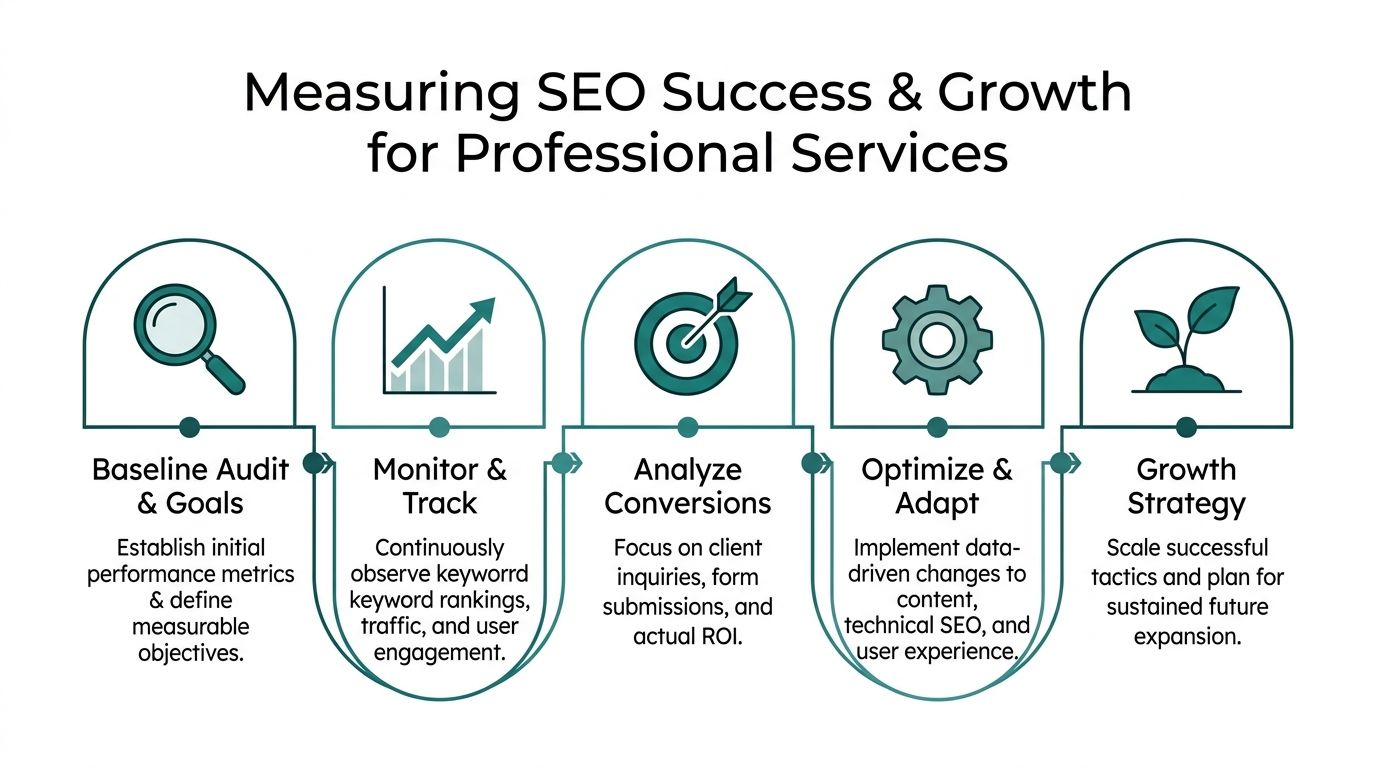
The biggest reporting mistake in professional services SEO is confusing visibility with business impact.
Rankings can improve while revenue stays flat. Traffic can rise while lead quality drops. A page can attract attention from the wrong audience and still look good in a dashboard.
That's why measurement needs to start with business outcomes, not vanity metrics.
What to track instead of just rankings
A major gap in most SEO guidance is connecting activity to revenue. Firms need attribution models that link organic traffic to the CRM pipeline and lead quality scoring, according to Agile Digital's guide to professional services SEO.
That gap is especially important for firms with long sales cycles. If someone reads three articles, returns through a service page, then contacts you two months later, a simple traffic report won't tell that story.
Track metrics in layers.
Layer one: visibility signals
These are useful, but they're not the finish line.
-
Organic impressions
-
Search rankings for high-intent terms
-
Click-through trends
-
Landing page engagement
Layer two: lead actions
Reporting gets more useful here.
-
Form submissions from organic traffic
-
Calls from organic visitors
-
Consultation requests
-
Contact page visits tied to service pages
Layer three: sales quality
Owners should focus here.
-
Which leads fit your ideal client profile
-
Which service lines generate the best inquiries
-
Which pages influence closed opportunities
-
Which topics attract poor-fit leads you don't want more of
A practical reporting model
For a Cincinnati business owner, I'd keep monthly reporting simple enough to use in real decisions.
| Reporting question | What to review |
|---|---|
| Are we becoming more visible for buyer-intent searches? | Service page impressions, ranking direction, CTR |
| Are more people taking action? | Calls, forms, consult requests from organic |
| Are these the right prospects? | Lead quality by service line and location |
| What content is influencing pipeline? | Assisted conversions and top-entry pages |
| What needs work next? | Pages with traffic but weak conversion, or strong conversion but weak visibility |
A clean report should help you answer where to invest next. More content. Better page design. Stronger local signals. Tighter follow-up. Faster mobile experience.
What progress usually looks like
SEO is slow compared to paid ads, but that doesn't mean nothing happens for months. It means the early wins are often operational before they become dramatic.
A realistic timeline from the earlier guidance in this article looks like this:
-
Early phase — Technical fixes, page clarity improvements, and baseline tracking go in place. Visibility may begin to move.
-
Middle phase — Service pages, location pages, and trust content begin to pick up traction. Better-quality inquiries should become easier to spot.
-
Compounding phase — As authority, content depth, and local relevance stack together, the channel becomes more dependable.
Key Insight: If an SEO report can't tell you which pages are producing qualified inquiries, it's a marketing report, not a growth report.
The operational side most firms miss
SEO performance often depends on what happens after the click.
If a page attracts the right visitor but your intake process is slow, weak, or inconsistent, SEO gets blamed for a sales problem. If forms don't route well, phone calls go unanswered, or CRM notes are incomplete, attribution falls apart.
That's why strong SEO for professional services firms has to connect with operations. The website brings the opportunity in. Your process determines whether that opportunity turns into revenue.
Your Top SEO Questions Answered
How much should I budget for SEO?
There isn't one right number for every firm, and I won't fake precision where it doesn't belong. A better question is this: how competitive is your market, how many service lines are you trying to grow, and how much internal support do you have?
A small local firm with a narrow focus can often make progress with a tighter scope. A multi-service firm serving Cincinnati plus surrounding markets usually needs a broader investment because the site architecture, content, tracking, and local presence all take work.
Can I do this myself?
Some of it, yes.
If you can write clearly, know your clients well, and have time to stay consistent, you can absolutely improve service pages, publish useful answers, ask for reviews, and tighten your Google Business Profile. Many owners should do at least part of that work because nobody knows the client better than the firm itself.
But DIY usually breaks down in three places:
-
Technical cleanup gets neglected
-
Tracking and attribution stay incomplete
-
Consistency disappears when the business gets busy
What red flags should I watch for when hiring help?
Be careful with any provider who promises guaranteed rankings, floods you with jargon, or talks only about traffic. For professional services, the conversation should include lead quality, service-line goals, local visibility, page strategy, and reporting tied to real business outcomes.
Ask simple questions:
-
How will you measure qualified leads from organic search?
-
What pages will you prioritize first, and why?
-
How will you handle local SEO for my market?
-
What does month-to-month reporting show?
-
Who writes the content, and how do they capture our expertise?
If the answers are vague, keep looking.
Is SEO still worth it for referral-based firms?
Yes, because referrals now validate online. Even when somebody hears your name from a trusted source, they still search you, compare you, and inspect your digital presence before they call.
That means SEO doesn't replace referrals. It helps close the trust gap after the referral happens.
If you want a clearer picture of where your firm stands, HDM can help you assess your website, local visibility, and content structure through a revenue-focused lens. The goal isn't to chase random traffic. It's to build a search presence that supports qualified lead generation for your firm in Cincinnati and beyond.