You're closed on time, open on tabs. One vendor wants you on TikTok, another is pitching a website rebuild, your inbox has an AI tool promising leads while you sleep, and your actual phone hasn't rung more this week. That's normal for owners in Greater Cincinnati right now. The problem usually isn't effort. It's that every tactic was bought separately, so nothing connects to booked work.
Why Small Business Digital Marketing Feels Overwhelming in 2026
A roofer in West Chester, a law office downtown, and a boutique in Hyde Park don't have the same sales cycle, but they often get sold the same stack. SEO, Google Ads, social posts, email, a chatbot, maybe e-commerce. Each tool sends its own report, uses its own vocabulary, and claims credit for the same customer. You end up managing vendors instead of running a system.
That channel first habit is costly because presence isn't the bar anymore. The OECD's research on the digital transformation of SMEs found that by 2017, 21% of small firms were making e-commerce sales compared with 44% of large firms, and more than 50% of small and medium sized enterprises used social media compared with more than 80% of large firms. In other words, your bigger competitors got online earlier and built deeper benches. Having a website and an Instagram account puts you in the game. It doesn't put you ahead.
Recent European numbers show the same execution gap. According to Eurostat data on digitalisation in Europe in 2025, 76.66% of EU small enterprises had a website in 2025 compared with 95.65% of large enterprises, and e-sales represented 12% of SME turnover versus 24% for large businesses. The tools are widely adopted. The returns aren't evenly distributed.
What an operating system looks like instead
Treat small business digital marketing as one connected loop, not a shopping list.
- A clear offer: One service, audience, and next action per campaign, written in plain language.
- A findable foundation: Your website, Google Business Profile, and reviews agree on who you are and where you work.
- One or two active channels: Enough focus to learn what works before you add another platform.
- A measurement habit: Calls, forms, bookings, and sales tracked back to the campaign that started them.
Key Insight: If a tactic can't tell you which of those four jobs it does, pause it. You don't need more activity. You need fewer, connected moves.
The sections ahead work in that order. Goals first, channels second, local visibility, budget, a 90 day plan, then the measurement, AI, accessibility, and privacy work that keeps the system honest. Read straight through if you're building from scratch, or jump to the decision you're facing this quarter.
Setting Goals and KPIs That Actually Move the Business
Most dashboards fail owners because they report what's easy to count. Followers, impressions, and sessions can rise while revenue stays flat. Start from the money and work backward, using three tiers you can track in a spreadsheet before you buy any software.
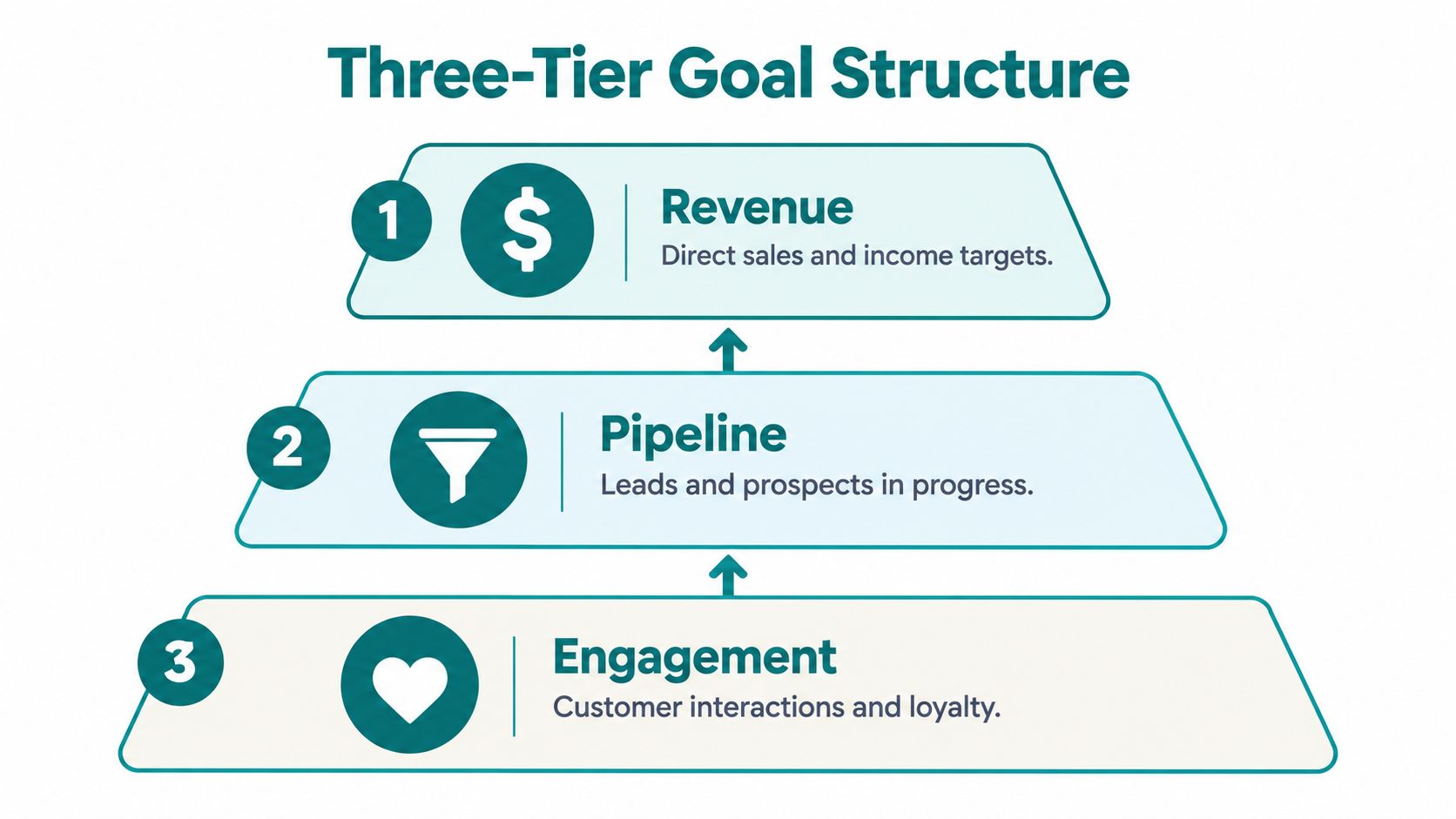
Revenue sits at the top. For a retailer that's online and in store sales tied to a campaign. For a service business it's closed jobs and collected invoices, not estimates sent. Pipeline is the middle tier, qualified leads, booked consultations, quote requests, and how fast they move to a signed contract. Engagement is the bottom tier, calls started, form starts, email replies, and repeat visits. Engagement only matters when it predicts pipeline.
Pick one north star per quarter
A Mason dental practice might choose booked new patient appointments. A B2B firm in Blue Ash might choose qualified discovery calls that reach a second meeting. One number forces trade offs. If a social post gets attention but produces no calls, it's content, not growth. If a plain service page produces steady quote requests, it deserves more budget even if it looks boring in a report.
Set a baseline before you launch anything new. Pull the last full month of calls, forms, and sales from your CRM, point of sale system, or even your front desk log. Write down where each lead said they found you. That messy first count is more useful than a polished dashboard nobody trusts. For a practical walkthrough of connecting spend to outcomes, the tips from Keywordme on improving marketing ROI pair well with a data driven marketing strategy built around tracked outcomes.
Metrics worth your Monday morning
- Qualified leads: Count only inquiries that fit your service area, budget range, and timeline. Raw form fills flatter bad campaigns.
- Cost per acquisition: Total campaign cost divided by new customers won, not clicks bought.
- Customer lifetime value: What a typical customer spends over the full relationship, which tells you how much you can afford to pay for the first sale.
- Pipeline velocity: How many days pass between first contact and signed work. Faster follow up often beats more traffic.
Review those four weekly, review revenue monthly, and ignore the rest until a number changes enough to affect a decision. If a metric wouldn't change what you do next week, it's decoration.
Choosing the Right Channels for Your Stage and Budget
You don't need seven channels. You need the right one or two, run well, plus a foundation that doesn't leak. Here's how the main options behave for a small team.
| Channel | Monthly Cost Range | Time to Result | Best For |
|---|---|---|---|
| SEO and content | Low cash, high time | Slow, compounding | Service firms that win on expertise and search intent |
| Paid media | Medium to high | Fast | Testing offers, filling capacity, seasonal pushes |
| Low | Fast once a list exists | Repeat buyers, referrals, reactivation | |
| Social media | Low cash, steady time | Medium | Trust building, visual proof, retargeting audiences |
| E-commerce | Medium | Medium | Products people can compare and buy without a call |
| AI driven discovery | Low to medium | Medium, still shifting | Businesses customers research through ChatGPT, Gemini, or Perplexity |
Channel Comparison for Small Businesses in 2026
SEO and content are the slow compounder. A well built service page keeps producing inquiries long after you publish it, but it won't rescue next month's schedule. Paid media is the opposite. Google Ads or Meta campaigns can send traffic this week, and the traffic stops the day you stop paying. Use paid spend to test which offer and landing page convert, then let SEO and content lower your cost over time.
Email is the channel owners underrate most. You own the list, nobody can change the algorithm on you, and past customers already trust you. A short monthly email with one useful answer and one clear offer will usually beat a daily social grind for a service business. Social still earns its place, but as proof and presence. Real job photos, faces, and short explanations make a prospect comfortable calling. Treat it as your secondary homepage, not your sales team.
A simple allocation rule
Put most of your effort into the channel closest to a sale at your current stage.
- No steady lead flow yet: Fix your website and Google Business Profile first, then run one paid test against a single service.
- Leads but no follow up system: Build email capture and a simple nurture sequence before buying more traffic.
- Booked but invisible in search: Invest in SEO and content so referrals aren't your only pipeline.
- Selling products: Prioritize product pages, checkout speed, and remarketing before expanding to new platforms.
AI driven discovery now sits across all of this. Customers increasingly ask an AI assistant who to hire instead of scrolling ten blue links. Clear service pages, consistent business information, reviews, and useful answers give those systems something accurate to cite. You don't need a separate AI strategy. You need content a machine can understand and a human would trust.
Whatever you choose, maintain the rest lightly. A dormant profile with correct hours beats an abandoned one with last year's holiday schedule.
Local SEO That Gets a Cincinnati Business Found
For a business that serves a geographic area, local search is usually the highest value work you'll do. Google explains local rankings through relevance, distance, and prominence, according to Google's Search documentation on how local results work. Relevance is how closely your profile matches what someone searched. Distance is how far you are from the searcher, which you can't change. Prominence reflects how well known you are, including links and the number and quality of reviews.

The checklist that moves relevance and prominence
Start with your Google Business Profile. Pick the primary category that matches your main service, not every service you offer. Add secondary categories carefully, publish current hours including holidays, set your service area accurately, and upload real photos of your team and work. This Google Business Profile optimization guide walks through profile setup in useful detail, and a Cincinnati focused guide to getting found on Google covers the regional specifics.
Reviews are the prominence lever you control most. Ask at the moment the customer is happiest, make it one tap, and respond to every review, including the critical ones, in a calm and specific way. Steady recent reviews matter more than a burst from two years ago. Keep your name, address, and phone number identical across your website and major directories. Inconsistencies make you harder to verify.
On your website, give each core service its own page that names the service and the area naturally. Then verify the technical basics. Google's SEO starter guide points to XML sitemaps, internal links, crawlable pages, and clear titles and descriptions. In plain terms, link your important service pages from your navigation, submit a sitemap, make sure no page is accidentally set to noindex, and check Google Search Console for indexing problems.
Key Insight: Honest limit: Nobody can pay or apply for a better local ranking, and any agency guaranteeing first position is selling you something Google doesn't offer.
A realistic first month looks like this. Week one, clean up the profile and categories. Week two, fix directory inconsistencies and start a review habit. Week three, rewrite your top service pages. Week four, check Search Console and fix what it flags. That's a foundation you can verify yourself, whoever does the work.
Budgets, ROI, and the Hidden Cost of a Slow Site
Budget conversations get vague because nobody wants to name what money can't do. These three tiers are realistic for Cincinnati area small businesses, assuming the work is focused.
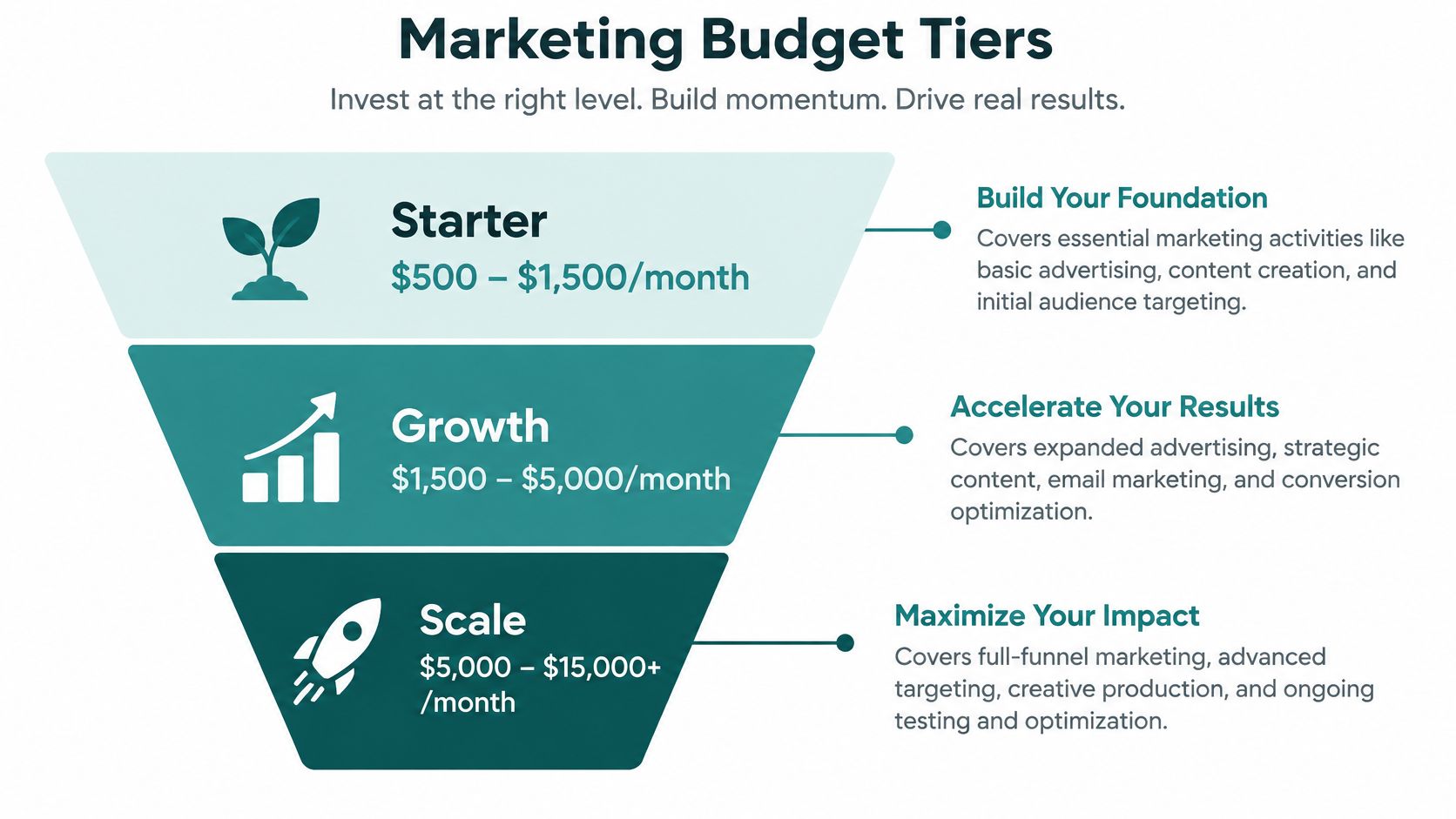
At the starter level, expect a maintained website, a solid local presence, basic SEO, and one small paid test. You're buying consistency and learning, not market dominance. At the growth level, you can add regular content, meaningful ad spend across a couple of services, email campaigns, and conversion work on key pages. At the scale level, you're funding multiple channels at once, faster testing, and the analytics help to know which dollar did what. Even then, creative quality and follow up speed decide more than spend does.
ROI math stays simple. Take the revenue you can reasonably attribute to marketing, divide by what the marketing cost, and be honest about the attribution. A customer who saw an ad, read a review, and called three weeks later wasn't produced by one click. Use ranges and trends instead of pretending to have precision you don't. If revenue per lead and close rate are rising while cost per acquisition falls, the system is working.
The slow page tax
The most expensive line item is often one you never see. In Google's analysis of mobile advertising landing pages covering approximately 900,000 pages across 126 countries, increasing load time from 1 to 7 seconds raised the probability of a mobile bounce by 113%. Separate research in Google's Milliseconds Make Millions report found that a delay from 1 to 3 seconds increases bounce probability by 32%, and each additional second of load delay on retail sites can reduce conversions by up to 20%.
Read that as an owner. Your ad cost per click stays the same. Fewer of those clicks survive to your form. Your cost per lead climbs, and the ad platform gets blamed for a website problem.
- Compress and resize images: The oversized hero photo is usually the first offender.
- Cut unused scripts and tags: Every plugin and tracker makes the phone work harder.
- Load key content first: The headline, offer, and call button should appear before anything decorative.
- Test on a mid range phone: Your office WiFi hides what customers on cellular data experience.
Our breakdown of Core Web Vitals optimization for business websites covers the technical side in more depth. Each month, check mobile load time, form completion rate, and revenue per session together. Fix one bottleneck, rerun the same campaign, and compare qualified conversions, not just a speed score.
Planning a 90-Day Campaign Step by Step
Ninety days is long enough to learn something real and short enough that a bad idea doesn't eat your year. Run it in overlapping phases rather than rigid steps.
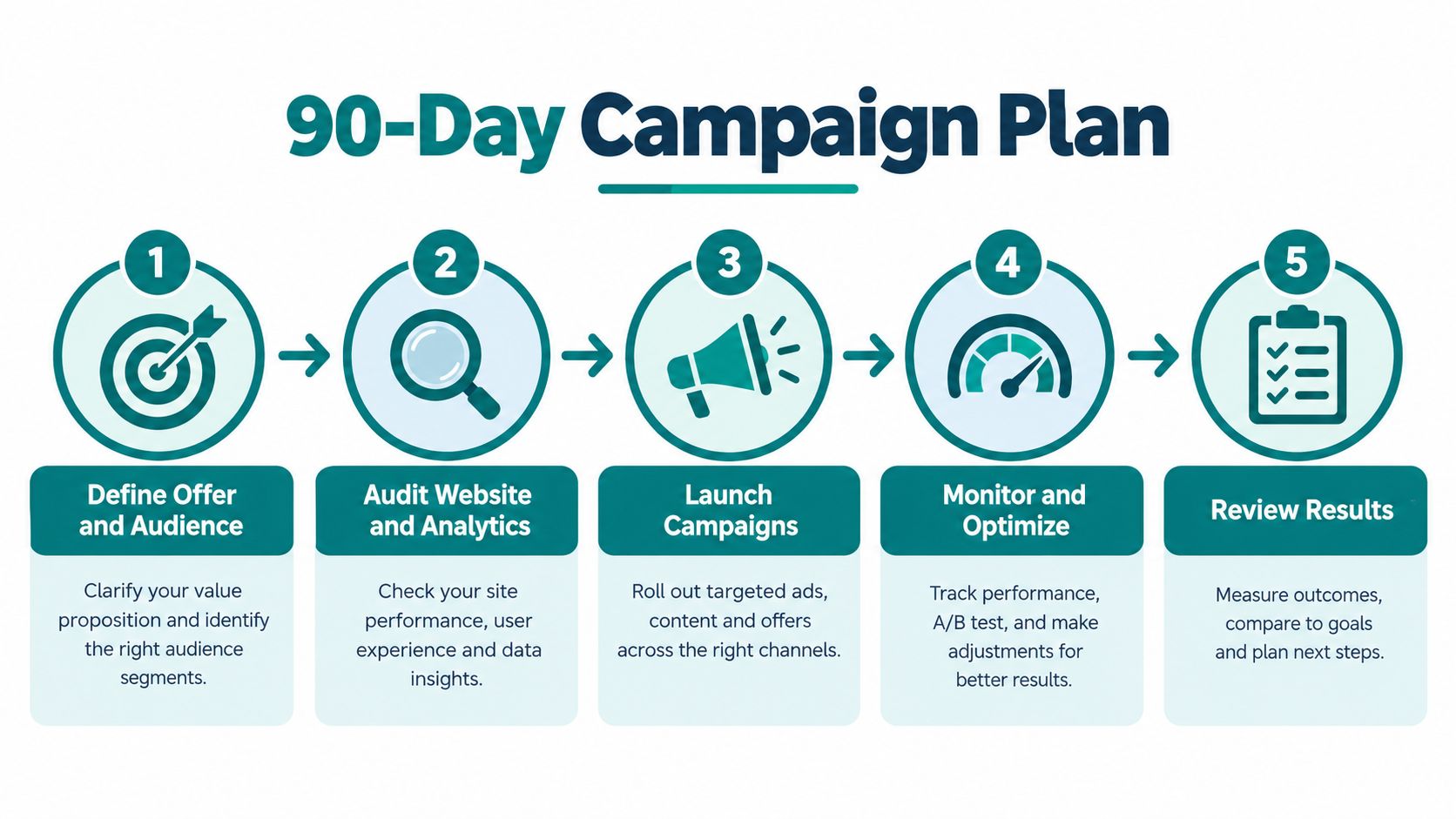
The first two weeks are definition and audit. Write down one offer, one audience, and one action you want taken. Then look at what a prospect experiences. Search your business on your phone, click your own ad if you're running one, and try to complete your form in a parking lot. Check that analytics and call tracking record the result. Record your baseline numbers from the goals section before anything launches, or you'll have nothing to compare against.
Weeks three through six are build and launch. Write the landing page so it matches the ad or post that sends people there, same promise, same words. Produce a small set of creative, not twenty variants you'll never evaluate. If social content supports the campaign, batch it ahead of time. You can plan content with Social Media Scheduler so posting doesn't compete with running the business. Launch to a limited audience first, watch for broken forms and confusing pages, then widen.
This walkthrough shows how a focused campaign comes together in practice.
<iframe width="100%" style="aspect-ratio: 16 / 9;" src="https://www.youtube.com/embed/iRC2KNI_eCQ" frameborder="0" allow="autoplay; encrypted-media" allowfullscreen></iframe>Weeks seven through twelve are where the money is made or wasted. At day 30, ask only whether the mechanics work. Are leads being tracked, followed up quickly, and qualified consistently? At day 60, ask whether the offer works. Change one variable at a time, the headline, the audience, or the budget, never all three. At day 90, decide with evidence. Scale what produced qualified pipeline, fix what's close, and kill what produced cheap clicks and no customers.
A brief your team can actually use
- Offer and audience: One sentence each, no internal jargon.
- Success metric: The single KPI from your goals, plus the baseline.
- Owner and deadline: One named person per deliverable, agency or staff.
- Follow up plan: Who responds to leads, how fast, and what they say first.
That last item decides more campaigns than ad settings do. A lead answered in five minutes by a prepared human will outperform a clever campaign answered tomorrow.
Measurement, AI Tooling, Accessibility, and Compliance
These four topics look like back office chores. Together they decide whether the rest of your marketing can be trusted. Measurement tells you what's working. AI changes how customers find you. Accessibility decides who can buy from you. Compliance decides whether your data practices hold up when someone asks.
On AI, adoption is already ahead of measurement. OnDeck's small business trends research found 56% of surveyed small businesses had incorporated AI by late 2025, with marketing the leading use case at 63%, while 37% reported measurable marketing performance improvements. Generating content is the easy part. Knowing whether a customer discovered you through ChatGPT or Gemini, never clicked a search result, and then called you directly is the harder, more valuable problem.
Instrument for AI era discovery
- Ask on every form and call: Add a plain "How did you hear about us?" field and log the answer in your CRM. Self reported attribution catches what click tracking misses.
- Tag what you can: Where referrals from AI tools are identifiable in analytics, segment them instead of burying them in direct traffic.
- Judge assisted conversions: Compare branded search, direct visits, and calls over time, not just last click credit.
- Keep first party data clean: Consented email and CRM records are the asset no platform change can take away.
Key Insight: AI makes content cheaper. It doesn't make it accountable. If you can't connect the output to pipeline, you're scaling volume, not growth.
Accessibility deserves the same revenue framing. Research summarized in 2025 web accessibility statistics found that in an audit of 9,752 sites, only 10.47% were fully accessible, and 95.9% of the top one million home pages had at least one detected WCAG failure, with low color contrast affecting 83.9%. For a healthcare practice, law firm, or store, an unlabeled form field or unreadable button isn't a compliance detail. It's a customer who can't book. Prioritize keyboard navigation, form labels and error messages, readable contrast, captions, and screen reader compatibility on your money pages first. An overlay widget doesn't fix your templates or documents, so test with real assistive technology and, where possible, disabled users.
Compliance ties it together. The FTC's fair information practices, referenced in guidance on fair information practices for online businesses, call for notice about your information practices, meaningful choice over how personal data is used, access to collected data, and security for that data. Before a campaign launches, list what each form collects, explain why in your privacy notice, stop collecting what you don't need, and decide how long submissions are kept. Healthcare businesses should also confirm that any partner handling patient information works within HIPAA requirements. Your agency can implement controls. The responsibility stays with you.
Putting It All Together and Choosing the Right Help
In the next 30 days, do five things. Audit your website on your phone, fix the worst speed problem, complete your Google Business Profile, start tracking one KPI in your CRM, and launch one focused campaign against one service. That's a start you can judge at 90 days.
Hire help when the bottleneck is expertise or hours, not clarity. An in house generalist works if strategy is set and execution is steady. An agency earns its fee when you need web, SEO, ads, and measurement run as one system. Firms like Helbling Digital Media in the Cincinnati area typically work in an audit, strategy, build, measure, iterate cycle. Ask any partner what they'll measure, what they won't promise, and what success looks like at 90 and 180 days. Judge the answers, not the pitch.
If you want that audit done with you rather than sold to you, Helbling Digital Media builds websites, local SEO, paid media, and analytics for Cincinnati area businesses as one connected program, starting with what's already working on your site. Visit the site to see the services and request a conversation about your next 90 days.