You search Google for your own service. A few competitors show up first with the small “Sponsored” label, then the map pack, then the regular listings. You know your business does solid work, but online, it feels like you're standing in the back row while someone else gets the front counter.
That's usually the moment paid search starts to make sense.
For a Cincinnati business owner, this isn't really a question of digital jargon. It's a question of visibility, lead flow, and whether the right people can find you when they're ready to act. If you've been weighing web design, SEO, or digital marketing support, understanding paid search helps you decide where it fits and whether it's worth your budget.
What Is Paid Search and Why Should Cincinnati Businesses Care
Paid search marketing is advertising on search engines where you bid to show up for specific searches. It is commonly known as PPC, or pay-per-click. You don't pay just to exist on the page. You usually pay when someone clicks.
The simplest analogy is grocery shelf space. Organic SEO is earning your place on the shelf over time. Paid search is paying for the eye-level shelf where buyers notice you first. If someone in West Chester searches for “roof repair near me” or someone in downtown Cincinnati searches for “family law attorney,” paid search can put your business in front of them immediately.
That speed matters for small and mid-sized businesses. SEO is valuable, but it takes time to build. Paid search gives you a direct line to people who are already looking.
Why owners lean on it when leads matter now
Paid search is often the fastest way to test demand, launch an offer, or increase qualified traffic without waiting for rankings to climb. It also gives you control that many other channels don't. You can choose the keywords, set the geography, write the message, and adjust spending based on what's working.
That's one reason it remains such a large part of digital marketing. Businesses generate an average return of $2 in revenue for every $1 spent on Google Ads, and traffic from PPC ads converts 50% better than traffic from organic search, according to paid search performance data compiled by Digital Applied.
Practical rule: Paid search works best when you need qualified visibility now, not someday.
What it looks like in real life
A local service business usually doesn't need to “win the internet.” It needs to get in front of the right searcher at the right moment. That could mean:
- Emergency intent: Someone needs help today and searches for a provider nearby.
- Comparison intent: A buyer is comparing options and clicking the businesses that look most credible.
- Commercial intent: A searcher knows what they want and is looking for pricing, availability, or a consultation.
For Cincinnati-area companies, paid search is often less about broad awareness and more about catching demand when it's already forming. That's where agencies like HDM often step in, not to make the channel mysterious, but to turn it into something measurable and manageable.
How the Paid Search Auction Really Works
Most business owners assume paid search is simple. Pay the most, get the top spot. That isn't how it works.
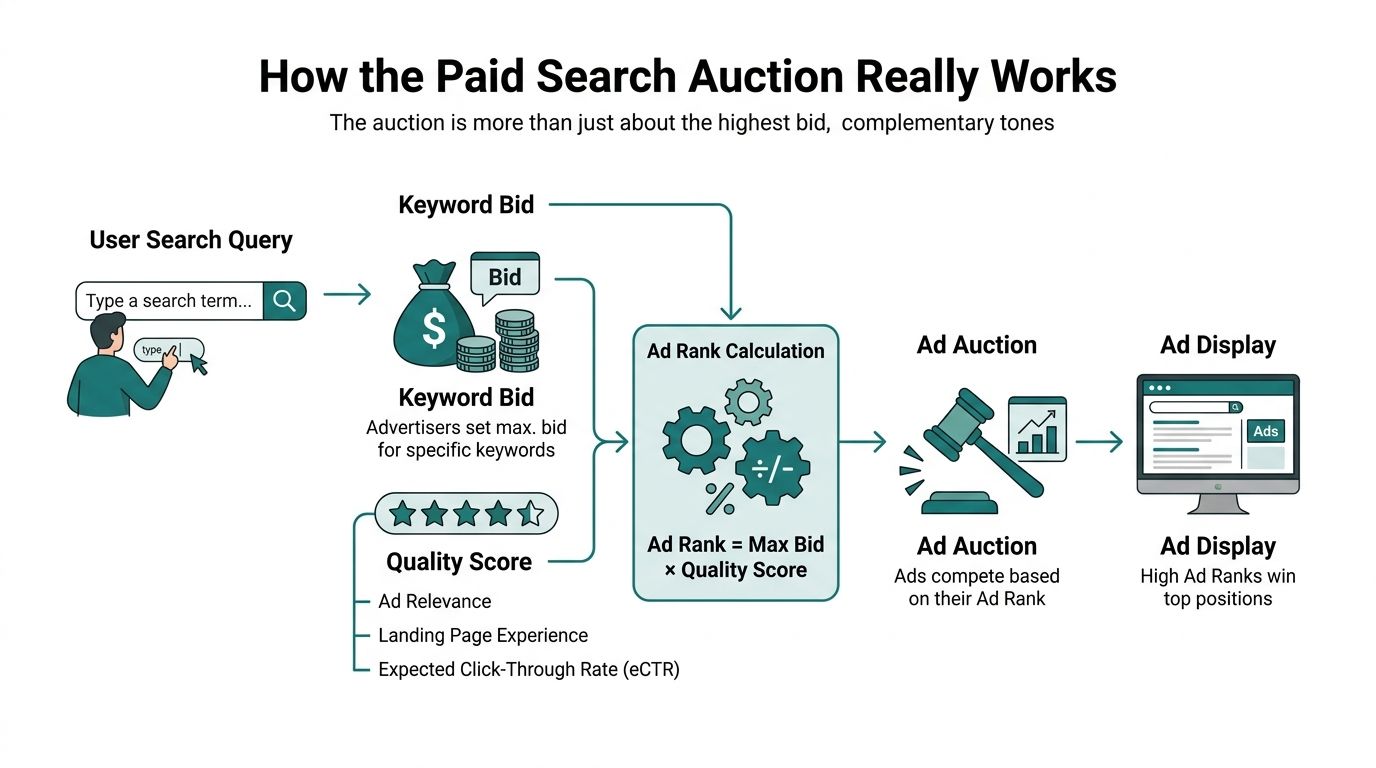
Google runs a real-time auction every time someone searches. Your ad position depends on your bid and your Quality Score. In plain terms, Google looks at what you're willing to pay and how good your ad experience is for the searcher.
The two inputs that matter most
It functions as a school grading system paired with an auction.
- Your bid is what you're willing to pay for a click.
- Your Quality Score is Google's grade for how relevant and useful your ad is.
That grade comes from three practical things:
| Factor | What it means in plain English |
|---|---|
| Ad relevance | Does your ad actually match what the person searched for? |
| Expected click-through rate | Is Google likely to think people will click your ad? |
| Landing page experience | After the click, does the page load well and answer the searcher's need? |
If you bid aggressively on the wrong keyword with a weak landing page, Google won't reward that. If your ad is tightly matched to the search and leads to a useful page, you can often compete more efficiently.
Why smart accounts beat big spenders
The auction happens in milliseconds, and Google recalculates it for every query. That's why paid search is part strategy, part operations discipline. A cleaner account structure and a better landing page can change costs without increasing budget.
A 10% improvement in Quality Score can reduce cost-per-click by up to 20% without changing the bid amount, and campaigns with a Quality Score of 8+ achieve 35% higher conversion rates, based on paid search auction and Quality Score benchmarks from Improvado.
If your ads don't match the search and your landing page feels disconnected, you're paying a penalty whether you realize it or not.
A Cincinnati example
Say a Mason-based HVAC company bids on “AC repair Cincinnati.” If the ad headline says “Trusted AC Repair in Cincinnati” and the landing page clearly covers repair service, service area, phone number, and appointment options, Google sees a strong match.
If that same company sends clicks to a generic homepage with mixed services, weak mobile usability, and no obvious next step, Quality Score suffers. The business may still show up, but it often pays more for less efficient traffic.
That's the part many owners miss. Paid search isn't just buying attention. It's proving relevance.
Paid Search vs Organic SEO and Social Media Ads
Business owners often compare these three channels as if they do the same job. They don't.
Paid search captures existing demand. SEO builds long-term visibility. Social ads put your business in front of people who may not be looking yet.
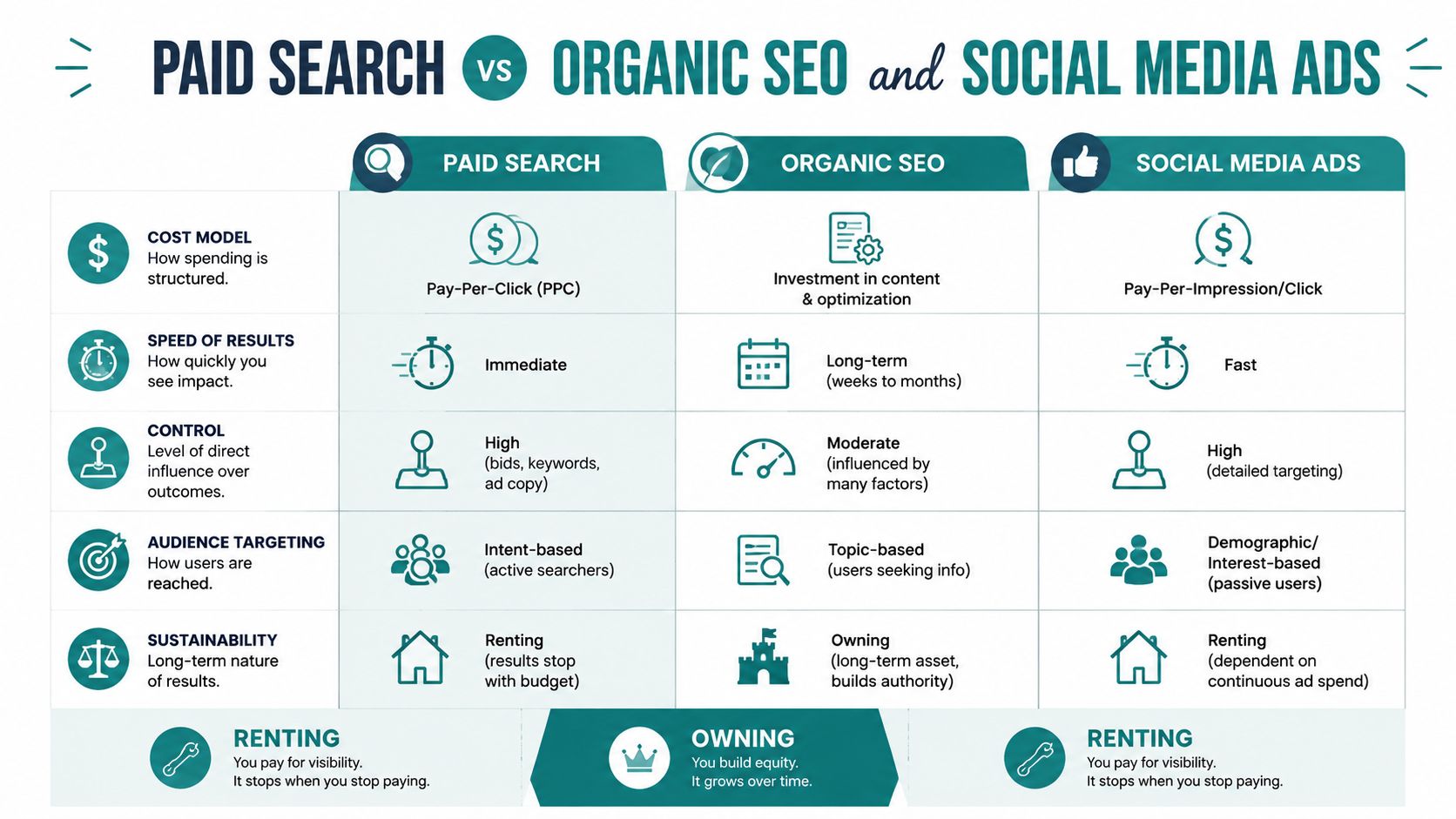
Renting versus owning
The clearest way to explain it is real estate.
Paid search is renting a strong location. You can move in fast, but when spending stops, visibility drops with it.
SEO is owning the property. It takes longer to build value, but the asset can keep working long after the initial investment. If you want a broader breakdown of how local businesses get found across channels, HDM has a useful Cincinnati business guide to getting found on Google.
Side-by-side view
| Channel | Best use | Speed | Targeting style | Long-term value |
|---|---|---|---|---|
| Paid Search | Capture active buyers | Fast | Intent-based | Lower if ads stop |
| Organic SEO | Build lasting visibility | Slower | Topic and relevance-based | Higher over time |
| Social Media Ads | Create awareness and demand | Fast | Demographic and interest-based | Lower if ads stop |
What each one is good at
- Use paid search when someone is already searching for your service and you want to intercept that demand.
- Use SEO when you want compounding visibility, stronger authority, and a durable traffic source.
- Use social ads when you need awareness, retargeting, or demand generation before someone starts searching.
A person searching “commercial electrician Cincinnati” has different intent than someone scrolling Instagram during lunch. Treating those clicks the same is where budgets get wasted.
For most small and midsized companies, the strongest approach isn't choosing one forever. It's using each channel for the job it does well.
Core Platforms and Winning Strategies for 2026
A Cincinnati roofing company can waste half its budget in a month by showing up for the wrong searches. The platform matters, but account structure matters more.
For most local businesses, Google Ads is still the first place to start because that is where the highest-intent search volume usually sits. Microsoft Advertising deserves attention too, especially for B2B companies, older demographics, and campaigns where lower competition can improve efficiency. I usually advise owners to get one platform working before adding a second, because two weak accounts create more noise than one disciplined account.

Match types control how tight your targeting stays
Keyword match types tell Google how much freedom it has when matching your ads to a search.
For a Cincinnati plumber, the difference is practical:
- Exact match keeps targeting narrow and closer to service intent.
- Phrase match allows some variation while staying reasonably aligned.
- Broad match gives Google much more room, which can help you find new queries but can also pull in research traffic, DIY searches, or jobs-related clicks.
That trade-off matters. Broad match is not automatically bad. It just needs tighter oversight, better conversion data, and a stronger negative keyword list. Without that control, a search term like “water heater” can pull in people looking for parts, repair guides, or YouTube tutorials instead of someone ready to book service in Mason or West Chester.
Negative keywords protect margin
Negative keywords tell the platform which searches to avoid.
They do a lot of cleanup work inside an account. A family law firm may want to exclude terms like “free,” “template,” “salary,” or “school.” A contractor may need to block “DIY,” “jobs,” “Home Depot,” and cities outside the service radius. That kind of filtering is often the difference between paying for leads and paying for curiosity.
Earlier benchmark research from Darkroom also noted two useful patterns in the same analysis: tighter keyword control with strong negative lists can lower acquisition costs, and faster mobile landing pages can improve conversion performance.
Ad copy and landing pages need message match
A good paid search ad should make the click feel obvious. Clear offer. Clear relevance. Clear next step.
If someone searches “Cincinnati payroll software for small business,” the ad should speak to payroll, small business needs, and a logical action like scheduling a demo. The landing page should continue that exact conversation. Sending that visitor to a generic homepage usually hurts conversion rate because the user has to hunt for the answer after already telling you what they want.
I explain this to owners like this: the keyword starts the conversation, the ad gets the handshake, and the landing page closes the appointment. If any one of those pieces is off, lead quality drops.
Tight targeting gets the right visitor. Message match gives that visitor a reason to act.
A useful way to pressure-test campaigns is to run your structure through specialized tools. For teams that want help spotting optimization gaps, The AI CMO Google Ads solution is one practical resource for analyzing Google Ads inputs and performance opportunities.
What tends to work best in 2026
The accounts getting better results are usually doing the basics with discipline, then adding automation carefully.
That often looks like this:
- Build campaigns around services, not one giant keyword bucket. Separate plumbers, drain cleaning, water heater repair, and emergency service if those lines have different economics.
- Write ads that reflect local intent. Cincinnati searchers often include neighborhoods, suburbs, or service qualifiers. Ad copy should reflect that reality.
- Use automation where conversion tracking is clean. Smart bidding can work well, but only if the account is feeding Google reliable lead data.
- Review search terms often. Wasted spend often becomes apparent there first.
- Fix the landing page before raising budget. More traffic to a weak page just scales the problem.
Platform setup is only part of the job. Good performance usually requires campaign structure, search term management, conversion tracking, landing page testing, and regular optimization. That broader scope is what HDM covers in its paid media services for business growth.
A quick explainer can help if you're still sorting through the mechanics:
<iframe width="100%" style="aspect-ratio: 16 / 9;" src="https://www.youtube.com/embed/h_k_xrmqfT8" frameborder="0" allow="autoplay; encrypted-media" allowfullscreen></iframe>Budgeting for Paid Search and Measuring What Matters
The question usually isn't “How much should I spend?” It's “How much can I spend profitably?”
That's a better question, because paid search isn't a fixed expense like rent. It's an adjustable investment. You can scale it up, pull it back, split it by service line, or focus it on your most profitable geography.
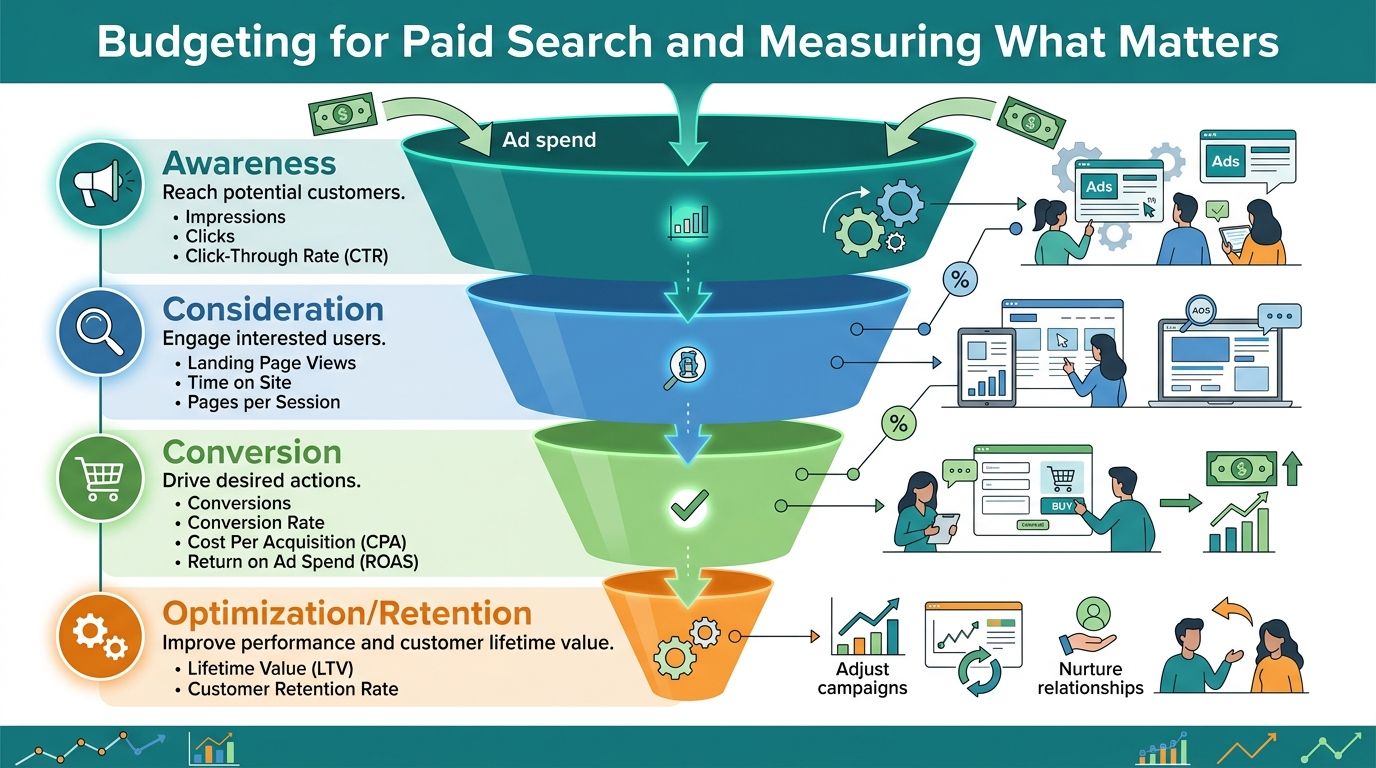
The metrics that actually answer business questions
Clicks and impressions have a place, but they don't tell you whether the campaign is paying for itself. The core metrics that matter are:
- CTR, or click-through rate. This shows whether people find the ad compelling enough to click.
- CVR, or conversion rate. This shows how often clicks turn into actual actions.
- CPA, or cost per acquisition. This is Total Spend ÷ Conversions.
- ROAS, or return on ad spend. This is Total Profit ÷ Total Spend.
Those definitions come from this paid search metrics overview by Proximity Marketing.
Translate the metrics into owner language
Here's how I'd frame them for a business owner:
| Metric | The business question it answers |
|---|---|
| CTR | Are searchers interested in the ad? |
| CVR | Does the page persuade visitors to act? |
| CPA | What does it cost to generate one lead or sale? |
| ROAS | Is the campaign producing enough return to justify spend? |
If CPA is too high, the problem may be keyword quality, ad quality, landing page quality, or close rate after the lead comes in. If ROAS is weak, you may be paying for the wrong traffic or sending good traffic into a weak sales process.
Tracking is not optional
Conversion tracking is the backbone of all of this. Without it, you're making budget decisions based on surface activity instead of business outcomes. Google Ads' guidance makes the point clearly: conversion measurement connects ad interactions to on-site actions and drives campaign efficiency and revenue attribution, as noted in Skai's overview of paid search conversion measurement.
If calls, form fills, purchases, or booked appointments aren't being tracked cleanly, the account can look busy while underperforming.
For healthcare, legal, and other sensitive industries, tracking needs extra care. In healthcare especially, measurement and lead handling may need to align with HIPAA-compliant workflows. That isn't a reason to avoid paid search. It's a reason to set it up correctly.
If you're trying to estimate spend levels and what drives ad costs, HDM's guide to online advertising cost is a good starting point.
DIY Management vs Hiring a Cincinnati-Based Agency
Some businesses should start in-house. Others shouldn't.
If your budget is modest, your service offering is simple, and you have time to learn the platform, a DIY approach can work. You can launch a tightly scoped campaign, keep geography narrow, and learn how your market responds. That's a reasonable path if you treat it as an active discipline, not a set-it-and-forget-it task.
When DIY is usually fine
- Simple offer: One core service, one location, one main conversion action
- Time to manage: Someone can review search terms, landing pages, and conversion data regularly
- Tolerance for testing: You're willing to make mistakes while learning
When agency support usually pays for itself
As soon as campaigns get more complex, the margin for error shrinks. That matters even more because the cost per click increased for 87% of industries in 2025, with some sectors seeing a 40% CPC rate increase, according to WordStream's digital marketing statistics roundup.
That kind of pressure changes the math. If clicks cost more, loose targeting, weak landing pages, and slow optimization get expensive fast.
A Cincinnati-area agency can help when you need tighter budget control, stronger conversion tracking, better landing pages, or local market judgment about service areas and search behavior. The value isn't just pushing buttons in Google Ads. It's connecting campaign strategy to sales outcomes, website performance, and lead quality.
If you're at the point where paid search needs to support real growth instead of side experimentation, it's worth having a conversation with a team that works in that space every day.
If you want a clear read on whether paid search fits your business, HDM can help you evaluate the channel, your website readiness, and what kind of campaign structure makes sense for your goals in the Cincinnati market.