
A Cincinnati business owner comparing three AI proposals usually sees the same promises: save time, get more leads, serve customers faster. But if one proposal sells a chatbot, another promises AI-generated content, and the third offers a custom automation, the owner still needs a way to tell which one will improve the business. The deciding question isn't which tool sounds most advanced. It's what result the vendor will measure, how the system will fit existing work, and who will own it after launch.
Short answer: AI optimization services apply tools like automation, chatbots or AI-assisted content to a specific business problem, then measure whether it helped. The right starting point is the process you want to improve, not the tool.
That's the case for AI optimization services. The useful work starts with a business problem, then connects the right AI capability to a process, data, and measurement plan. Without that layer, a new tool can become one more subscription employees barely use.
Why Smart Businesses Buy AI Optimization Services
Buying AI doesn't automatically change how a business operates. OECD data show that businesses using AI across member countries grew from 5.6% in 2020 to 14% in 2024, while AI use in core business operations remained below 10% in G7 countries in 2024. That gap points to the challenge: moving from trying a tool to embedding it in work such as customer service, marketing, or forecasting. (OECD data on AI adoption by businesses)
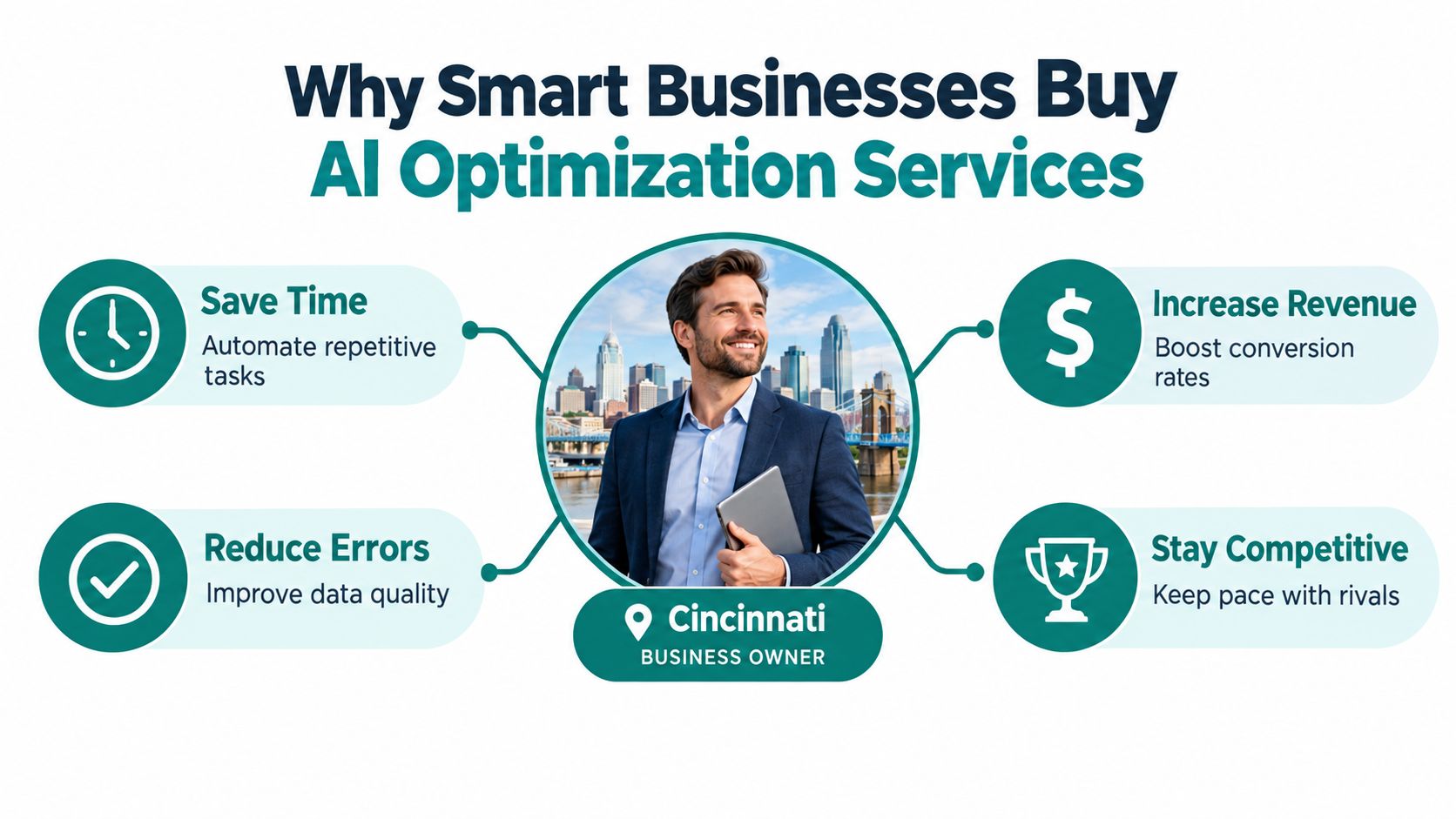
An optimization engagement should connect four things: a specific business goal, a workable process, the systems and data needed to do the work, and a way to measure the outcome. The service may involve selecting or configuring a tool, connecting it to a CRM or website, setting review rules, training staff, and monitoring results. The point is not to buy more AI. It's to make a defined task work better.
Compare proposals by the work they own
Ask each vendor to show what changes after implementation. If a chatbot is proposed, will it answer routine questions, collect the details needed to qualify a lead, and pass complex requests to a person? If AI-generated content is the pitch, who checks accuracy and brand fit, and how will the business track whether that content attracts useful inquiries?
For each proposal, get clear answers to these questions:
- What outcome is the project meant to change? Choose a business measure, such as qualified inquiries or time spent handling repetitive requests.
- What will the vendor configure or build? Ask which systems it will connect and what work your employees must do.
- How will you know whether it worked? Require a baseline and a plan to review results after launch.
- Who handles errors and upkeep? Find out what happens when the AI gives a wrong answer, a tool changes, or your process evolves.
Practical rule: If a proposal leads with tool names and leaves ownership, measurement, and maintenance vague, it isn't ready to sign.
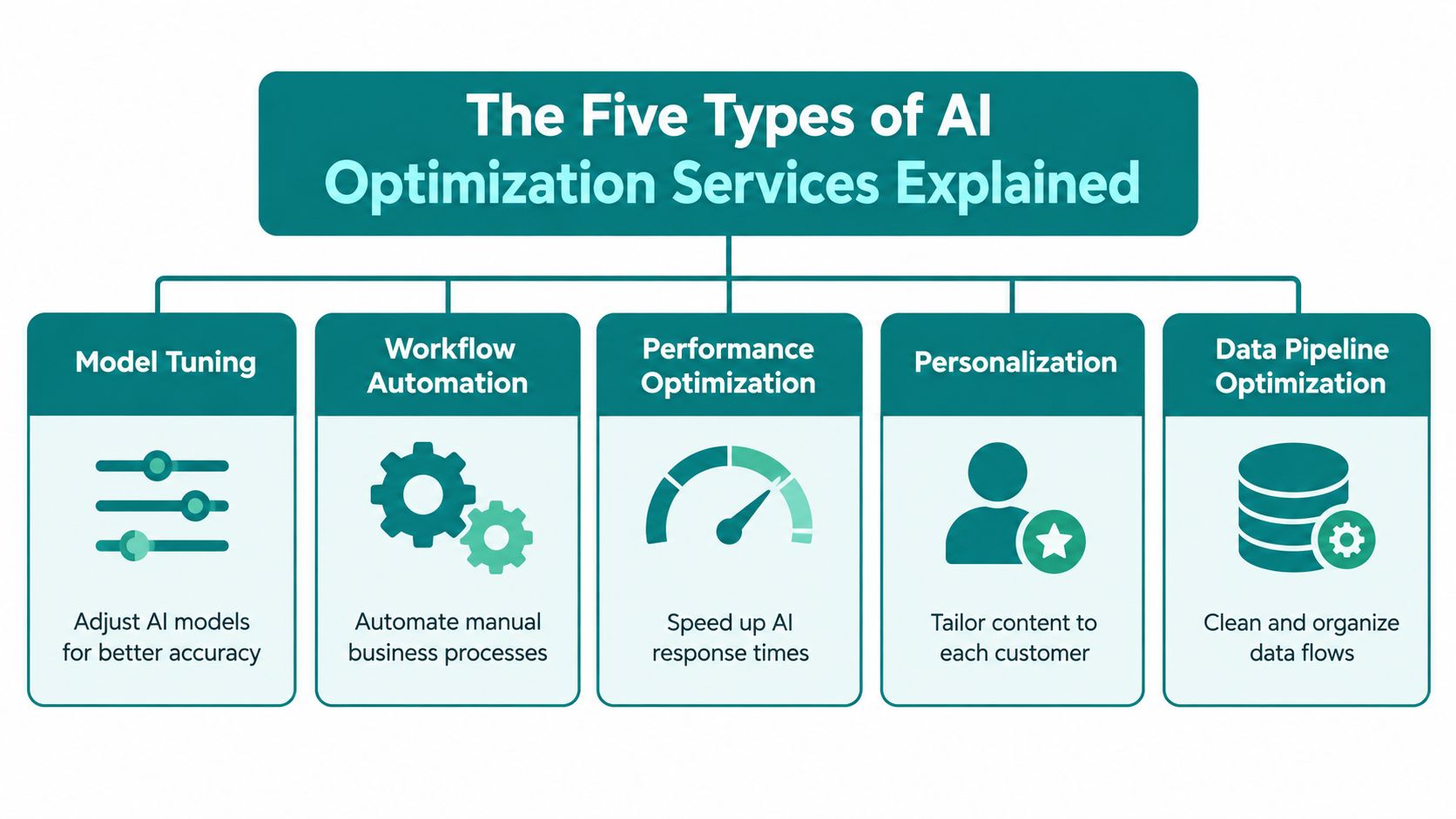
The Five Types of AI Optimization Services Explained
The label “AI optimization” covers different kinds of work. Identify the business bottleneck first, then decide which service addresses it. A Cincinnati dental practice, for example, may need to handle routine patient questions more efficiently, while a home services company may need to respond to incoming leads with the right next step.
Match the service to the work
- Model tuning adjusts how an AI model handles a particular task. A dental practice might need a question-answering assistant to use approved office information and direct clinical questions to staff, rather than improvising.
- Workflow automation connects steps people currently handle by hand. A home services company could route a new inquiry to the right team, capture key details, and prompt a staff member to follow up. Good automation removes handoffs, not human judgment where it matters.
- Performance optimization improves how quickly and efficiently an AI application responds. That may mean choosing a suitable model for routine requests and reserving more capable options for harder ones.
- Personalization adapts content or recommendations to a customer's needs. A retailer might tailor product suggestions based on what a shopper is viewing, provided the recommendations are relevant and the business can tell whether they help.
- Data pipeline optimization organizes information as it moves between business systems. If a CRM, website form, and reporting tool hold inconsistent customer details, better data flows can make automation and analysis more dependable.
A vendor should explain which people and systems each change affects. “We'll add AI to your marketing” isn't a useful scope. “We'll connect your inquiry form to your CRM, classify requests, and send uncertain cases to staff for review” is specific enough to evaluate.
For businesses looking at marketing workflows, a useful primer on marketing automation with governance can help clarify why automation rules, review responsibilities, and data practices belong in the same conversation. If search visibility is the main concern, HDM's overview of AI-driven SEO services is a relevant place to explore how AI search fits into a broader SEO effort.
Where AI Optimization Actually Pays Off for SMBs
AI earns its keep when it changes a business outcome, not just a dashboard. For a service company, that might mean responding to qualified leads sooner. For an online store, it could mean more completed purchases or a better average order value. For a support team, the measure might be resolved requests, with quality checks to ensure faster responses still help customers.
| Business Function | What the Service Changes | Primary Metric |
|---|---|---|
| Lead handling | Captures, routes, and prioritizes inquiries | Qualified leads and response time |
| Customer support | Drafts answers or handles routine questions with escalation rules | Resolved requests and customer feedback |
| Ecommerce | Improves product discovery or recommendations | Revenue per visitor and completed orders |
| Marketing | Assists with research, content workflows, or reporting | Qualified traffic and conversions |
| Internal operations | Reduces repetitive entry or handoffs | Staff hours spent and error corrections |
Measure the complete cost, not just the tool bill
Stanford's 2025 AI Index reports that the cost of querying a model with GPT-3.5-equivalent performance on the MMLU benchmark fell from $20.00 to $0.07 per million tokens between November 2022 and October 2024, a reduction of more than 280×. Lower inference prices can create room to optimize, but they don't guarantee a cheaper process. Model selection, repeated prompts, context size, and the cost of correcting bad outputs all matter. (Stanford's 2025 AI Index)
Website work needs the same discipline. Google's Core Web Vitals measure loading, responsiveness, and visual stability using real-user data. Its “Good” thresholds are LCP at or below 2.5 seconds, INP at or below 200 milliseconds, and CLS at or below 0.1. For a business owner, the practical test is whether key pages, such as a service page or contact form, perform well for actual visitors, not just in a lab test. (Google's Core Web Vitals guidance)
Before you approve a project, score it on cost, time to impact, and measurability. Include implementation, staff review, ongoing monitoring, integration maintenance, and the time needed to correct errors. A practical guide to AI automation for business can help you consider where automation fits, but the investment decision should rest on a specific process and a metric your team can track.
<iframe width="100%" style="aspect-ratio: 16 / 9;" src="https://www.youtube.com/embed/mSyiqMEM_Ko" frameborder="0" allow="autoplay; encrypted-media" allowfullscreen></iframe>The Vendor Evaluation Checklist a Non-Technical Owner Can Use
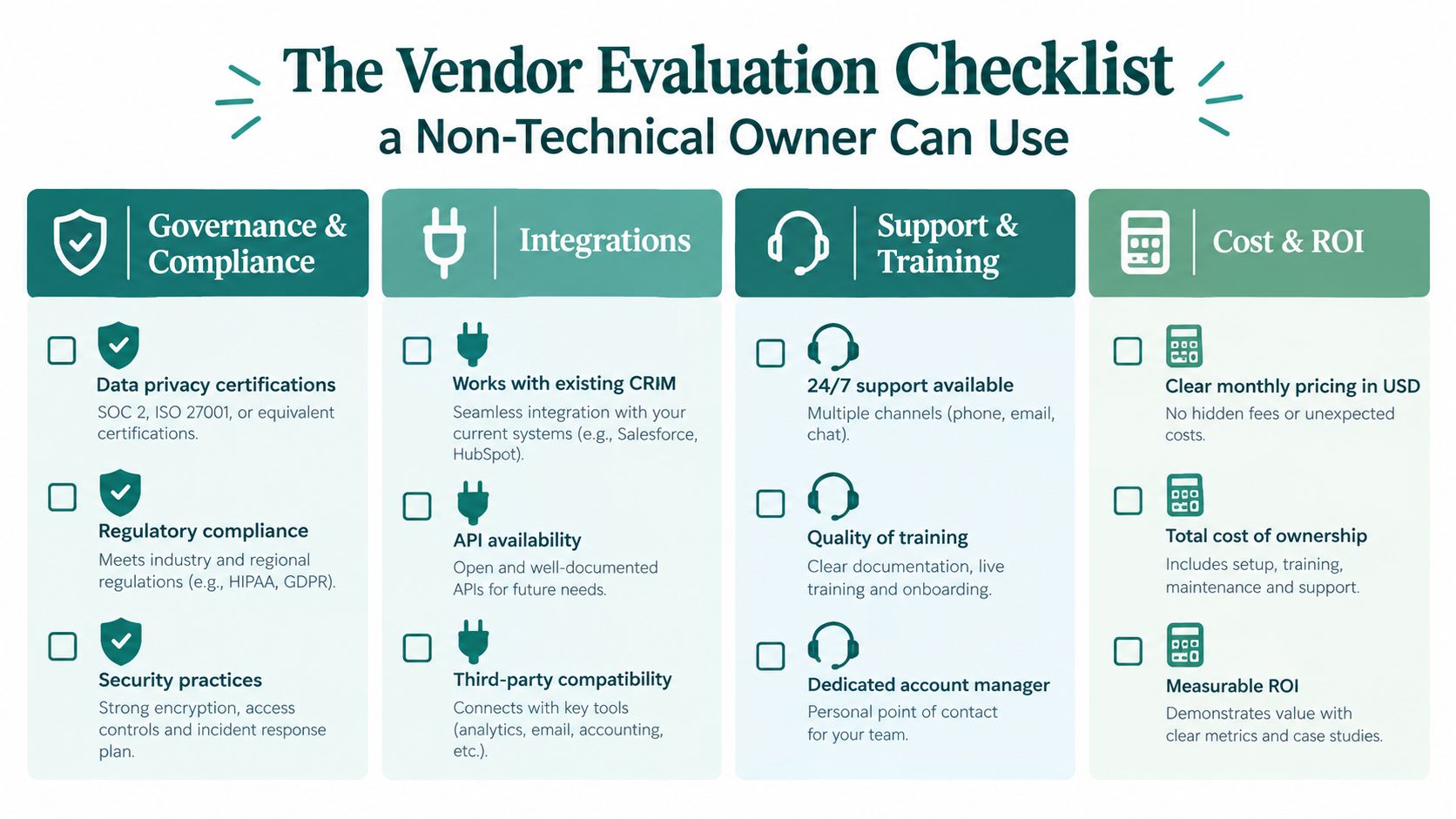
Treat a vendor pitch like a scorecard, not a demo. A polished chatbot can hide a weak plan for privacy, system access, or ongoing support. Ask every agency or provider the same questions, then compare what they can demonstrate.
NIST's voluntary AI Risk Management Framework, released on January 26, 2023, organizes trustworthy AI work into Govern, Map, Measure, and Manage. Those functions translate into plain questions: Who owns this system? What is it supposed to do, and where could it fail? How will you test its output? Who responds when a problem occurs? (NIST AI Risk Management Framework)
Ask vendors to prove the basics
Governance and compliance: Ask what information the tool collects, where it is processed, who can access it, and how long it is retained. For a healthcare-related workflow, ask how the proposed setup supports your HIPAA obligations. If your business serves European customers or uses AI in a regulated context, ask how the vendor assesses applicable EU AI Act requirements. The law entered into force on August 1, 2024, with obligations phased in through August 2, 2028; applicability depends on the use case and relevant rules, not whether a company uses AI. (EU AI Act implementation timeline)
Integrations: Have the vendor name the systems it will connect, such as your CRM, website forms, scheduling tool, or ecommerce platform. Ask what access it needs and how it will handle failed connections or duplicate records.
Support and training: Find out who reviews outputs, how employees learn the new process, and what happens when the model makes a mistake. “The AI learns over time” isn't a response plan.
Cost and measurement: Require a written scope that separates setup, software, usage, support, and future changes. Ask which baseline and business metric will determine whether the engagement is working.
A provider should be able to explain the system's intended use, limits, human review, and post-launch monitoring in language your team understands. HDM's guide to AI tools for Ohio small businesses can also help you think through tools before deciding whether a vendor's implementation proposal is worth pursuing.
An Implementation Roadmap and Realistic Timelines
A manageable AI rollout starts with one process, one owner, and one definition of success. Don't begin by automating everything that looks repetitive. First confirm that the workflow is stable enough to improve and that the information it depends on is usable.
Put the work on a calendar
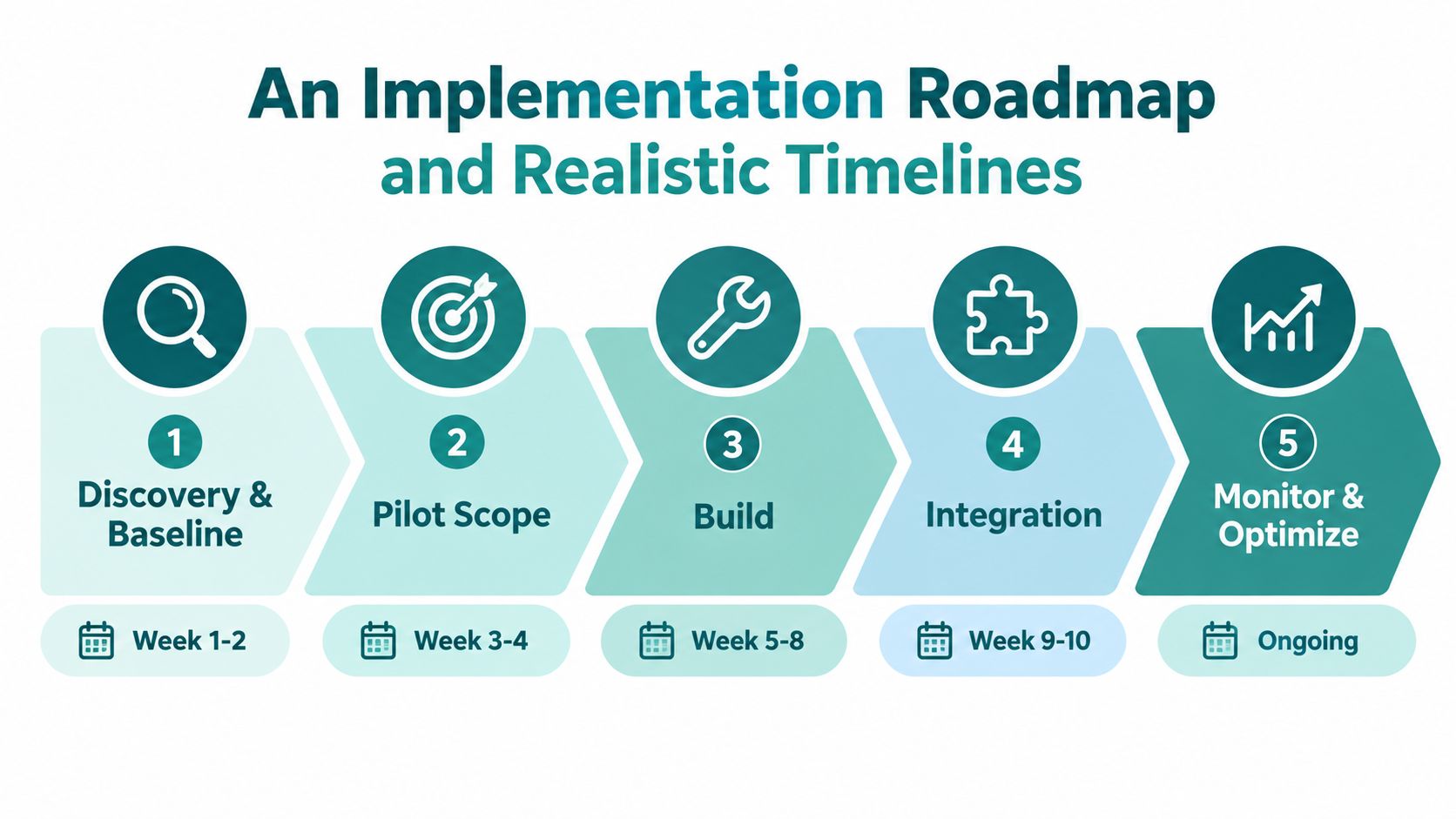
- Discovery and baseline: Document how the task works now, who handles it, and what it costs in staff time or missed opportunities. Record a baseline before changing the process.
- Pilot scope: Choose a narrow use case and set boundaries. Decide which requests AI can handle, which require a person, and what counts as a successful result.
- Build: Configure the tool, prompts, data access, and review rules. Test it on realistic examples, including cases where it should decline or escalate.
- Integration: Connect the AI workflow to the systems employees already use. Confirm that records reach the right place and that staff know what action to take.
- Monitor and optimize: Review outputs, errors, adoption, and the business metric. Adjust the process when customer needs, data, or tools change.
The infographic's timeline is a useful planning example, not a promise that every project fits the same schedule. A small pilot may move quickly when the workflow and data are ready. Missing data, unclear ownership, and expanding scope can slow even a straightforward project.
Before kickoff, assign an internal owner for the business process, someone responsible for technical access, and a decision-maker who can approve changes. Write down the definition of done. If the project is a website or performance engagement, agree in advance how field measurements for key revenue pages will be reviewed, using the Core Web Vitals thresholds discussed earlier as possible acceptance criteria.
HDM works with businesses in the Greater Cincinnati area on digital strategy, development, marketing, and AI implementation. Ask any prospective partner, including a local agency, to explain how it will move from discovery to a controlled launch and who will monitor the result afterward.
Case Examples and Lessons From Real Rollouts
Consider a regional healthcare-adjacent service that receives many routine questions through its website. The team introduces an AI assistant to collect a visitor's needs, answer approved administrative questions, and route requests that need a staff member. The useful result isn't that the assistant replies. It's whether the team receives clearer inquiries, responds to appropriate requests promptly, and keeps clinical or sensitive questions with qualified staff.
That rollout has a clear owner and a boundary between administrative help and professional judgment. The team checks whether the assistant's answers are accurate, whether staff can see the conversation history, and whether the process improves the handling of qualified appointments. If the system can't reliably tell when to hand off, the right move is to narrow its role, not expand it.
A metric can move without helping the business
Now consider a retailer that adds a personalization tool and sees more product recommendations displayed. Without a baseline or a revenue measure, the team can't tell whether shoppers bought more, found products more easily, or saw more suggestions. The retailer eventually scales the feature back because the activity metric never established commercial value.
That's an attribution problem, not proof that personalization can't work. Recent reporting says 45% of marketing leaders can't accurately measure brand visibility in AI-generated answers, while only 9% have tools that track every relevant metric across AI platforms. (Reporting on AI visibility measurement) The practical lesson is to connect visibility or engagement to real outcomes, such as qualified inquiries, transactions, or booked consultations. More mentions are not automatically more business.
In both cases, the rollout depends on a named owner, a narrow scope, and a measure tied to the customer or the bottom line. If a vendor can only report activity inside its own tool, ask how that activity connects to your analytics and sales process.
How AI Optimization Services Are Priced
Pricing usually follows the shape of the work. A one-time project fee can fit an assessment, a defined integration, or a limited pilot. A monthly retainer makes more sense when the provider will monitor performance, adjust workflows, review outputs, and help your team respond to changes. Usage-based billing may apply to software or model calls, so ask what drives the bill and how the vendor will prevent unnecessary usage.
White-label work is another option for agencies that need a partner to deliver AI implementation under their own client relationship. In each model, the label matters less than the written scope: what's included, what counts as a change request, and who pays for software, support, and maintenance.
Compare proposals on the same basis
Don't accept a price comparison unless both quotes cover the same outcome and responsibilities. A low setup fee may exclude data cleanup, integration, staff training, monitoring, or content review. A monthly retainer may look expensive until you learn that it includes the ongoing work another provider bills separately.
Ask for a breakdown of setup, recurring service, software, usage, and out-of-scope work. Require a clear deliverable and a measurement plan for each cost. If you're considering a fractional AI leadership role, the Head of Agents fractional AI cost guide offers context for evaluating that operating model alongside project or agency support.
I wouldn't choose a provider on the lowest opening quote. Choose the proposal that makes the total cost visible and gives you a credible way to decide whether the work is paying off. If the vendor won't define what happens after launch, assume that responsibility will fall to your team.
Your First 90 Days and What to Do This Week
Don't adopt AI just to say your business is using AI. Start with a process that wastes time or loses opportunities, then test whether a focused change can improve it.
Use a simple 30-60-90-day plan:
- First 30 days: Audit the AI tools you already pay for. Pick one workflow, document its current performance, and identify who owns it.
- Next 30 days: Run a limited pilot with clear review rules. Track one business outcome alongside errors and staff effort.
- By 90 days: Decide whether to expand, revise, or stop. Keep ongoing costs and ownership in the decision.
This week, list your current tools, ask your team where work gets delayed, and choose one candidate process for a baseline conversation. If your business serves customers in Europe, handles sensitive health information, or uses AI to support consequential decisions, ask the provider about intended-use limits, data handling, documentation, and human review. The EU AI Act's staged obligations make jurisdiction and use case important parts of that discussion.
Say no to any project that can't name its intended outcome, owner, and measurement plan. One diagnostic, one narrow pilot, and one reliable way to measure the result are better starting points than a stack of disconnected tools.
Frequently asked questions
- What are AI optimization services?
- Help choosing, building and measuring AI tools such as automations, chatbots and AI-assisted workflows for a specific business need.
- How do I compare AI proposals?
- Ask what process each one improves, how success will be measured, who owns the data and what happens if it doesn't work.
- Do I need custom AI software?
- Not always. Many needs are met by configuring existing tools; custom builds make sense when your process is unique.
HDM works with businesses on AI consulting, workflow automation, web development, SEO, and performance marketing, with a focus on measurable digital growth. If you're evaluating an AI or digital marketing project in Greater Cincinnati, start a conversation with HDM about the workflow you want to improve and how to measure the result.