
A Cincinnati business owner can't open an inbox or attend a networking event without hearing about AI. One vendor promises an AI chatbot, another recommends automated content, and a third suggests a custom system that will supposedly transform the company. Meanwhile, the core question is often simpler: does this business have a problem that AI is the right tool to solve?
For a manufacturer in Springboro, a professional-services firm in downtown Cincinnati, or a healthcare practice serving patients across Greater Cincinnati, the answer won't be the same. AI strategy consulting should help you make that decision before you spend money on software, integrations, or training.
What AI Strategy Consulting Actually Means for Your Business
Suppose a Cincinnati company receives a steady stream of quote requests, but staff members copy information between emails, spreadsheets, and a CRM. An AI consultant shouldn't begin by recommending a chatbot. They should first examine the workflow, identify where delays and errors occur, and compare AI with simpler options such as a better form, a CRM rule, or a redesigned approval process.
That distinction matters because AI strategy consulting isn't primarily about choosing a model or buying a tool. It's about connecting a business objective to a practical workflow, then deciding whether artificial intelligence can improve that workflow without creating unacceptable risk.

A healthcare practice might explore AI-assisted patient communication, but privacy controls and human review must shape the recommendation. A law firm might investigate document classification, while preserving confidentiality and attorney oversight. An online retailer could assess AI for product descriptions, customer support, or merchandising, but only if the process connects to useful business metrics.
Practical rule: Start with the business problem, define the no-AI alternative, and only then evaluate technology.
The case for a strategic approach is stronger than it was during the early wave of experimentation. McKinsey's 2024 State of AI research reported that 65% of respondents said their organizations regularly used generative AI in at least one business function, compared with roughly 33% ten months earlier. The same research reported overall AI adoption at 72%, showing that businesses are considering AI alongside automation, analytics, and decision-support systems.
For an owner evaluating digital marketing or web services, that doesn't mean every process needs AI. It means the decision deserves the same care as a website redesign. You need a clear audience, a defined outcome, realistic constraints, and a way to judge whether the investment worked. Tools such as CitationOS intelligence analysis can add useful research context, but the final recommendation still has to fit your customers, staff, data, and operating model.
The Core Services You Can Expect from AI Consulting
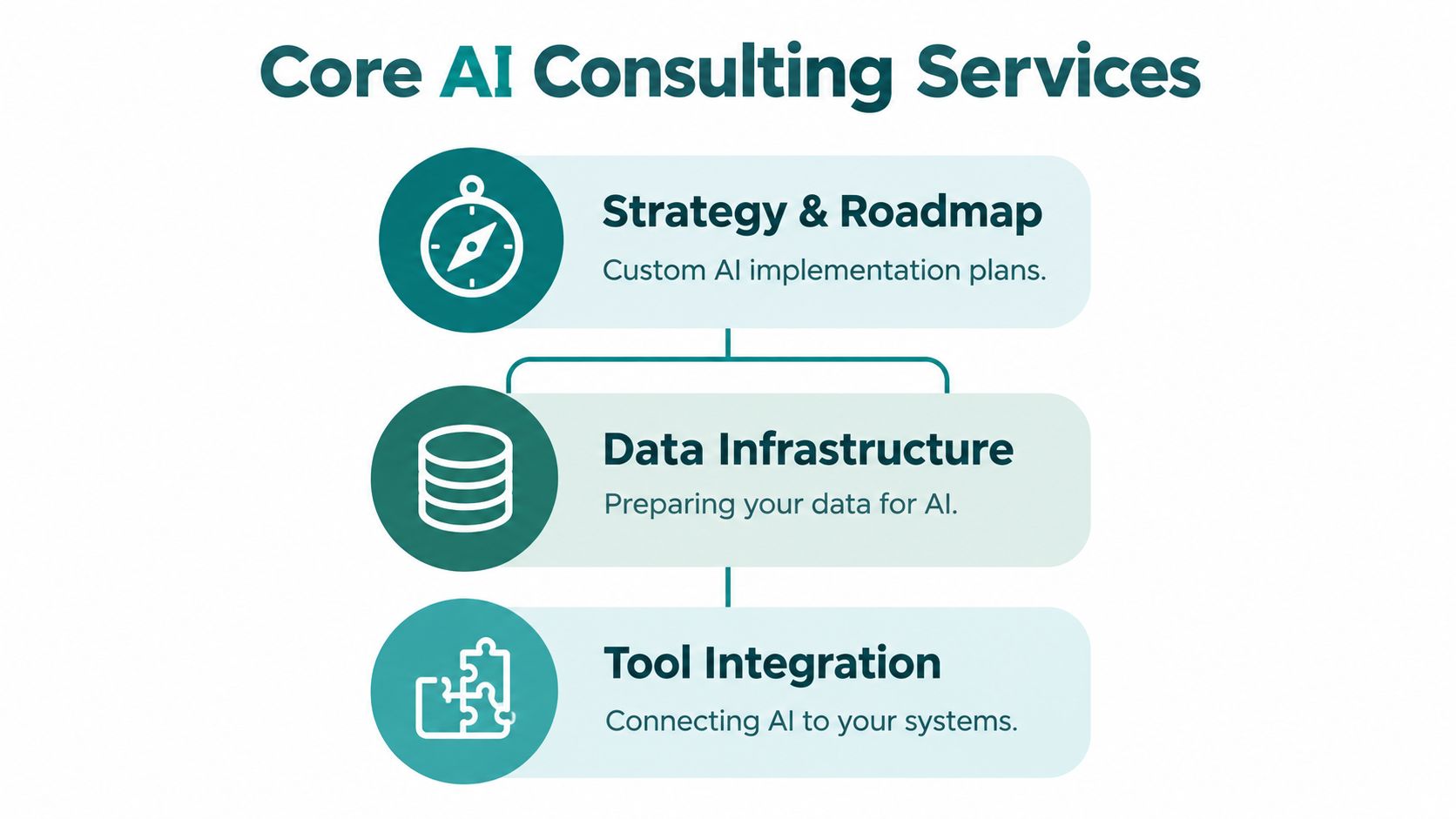
A serious consulting engagement produces more than a list of popular tools. It connects strategy, data, workflow design, governance, implementation, and measurement so your team can make a defensible decision.
Discovery comes before recommendations
The first task is usually a business and workflow review. A consultant may examine how leads enter the company, how employees prepare proposals, how customer questions are answered, how reports are assembled, and where information is stored. Interviews with staff often reveal practical obstacles that don't appear in software documentation, such as inconsistent naming, duplicate records, or an approval step that exists only in one employee's memory.
The output should be a prioritized use-case inventory. Each opportunity needs a business owner, a problem statement, required data, likely human involvement, integration needs, and a clear success measure. A high-volume, repeatable task with reliable information may rank ahead of an impressive but vague idea about “transforming” the customer experience.
The roadmap must include the foundations
Data preparation doesn't always require a large data warehouse. It may mean cleaning a product catalog, organizing internal documents, defining access permissions, or deciding which customer fields may enter an external service. Vendor selection should compare off-the-shelf tools with custom development, including subscription costs, maintenance, export options, security practices, and the effort required to change providers later.
Governance also belongs in the roadmap, not in a footnote. NIST's AI Risk Management Framework guidance emphasizes documented test sets, evaluation metrics, human evaluation, and measurable approaches to significant risks. For a small organization, that can become a practical release checklist covering accuracy, groundedness, privacy leakage, bias, cost per task, refusal behavior, and escalation to a person.
A customer-service assistant may be a sensible starting point, provided it has approved information, clear handoff rules, and an audit trail. Businesses assessing that use case can review this guide to AI chatbots for customer service. For a broader comparison of service models and implementation approaches, Ai consulting solutions offers another useful reference point.
How Engagements Typically Unfold and What to Expect
The strongest AI consulting projects move from diagnosis to a controlled decision. They don't begin with a long software demonstration, and they don't end with a strategy document that no one owns.
Start with an assessment
During the opening phase, the consultant should meet the people who perform the work, not only the owner or technology lead. They'll review current tools, data flows, customer touchpoints, and business goals. Ask for a written summary of the workflows considered, the assumptions made, the risks identified, and the reasons some ideas were rejected.
That first deliverable might recommend a pilot, a process redesign, a conventional software purchase, or no AI at all. A useful strategy explains the choice in business language. It should also identify who will provide data, approve outputs, manage access, and respond when the system fails.
Move into design and implementation planning
The next phase turns a promising use case into an operating design. The team defines the workflow before configuring software. That means deciding what triggers the process, what information the system may use, what the AI produces, who reviews it, where the result is recorded, and what happens when confidence is low.
For example, an agency might design an intake process that summarizes a new inquiry, routes it to the right person, and drafts a response. The employee still verifies the information before sending it. A practical overview of AI workflow automation can help business owners distinguish a connected workflow from a standalone experiment.
Treat deployment as the beginning of learning
After launch, staff members need training, approved templates, support, and a way to report failures. Logs and review notes show whether the process saves time or shifts work from one employee to another. Retainer support can make sense when the system changes regularly, while a fixed-scope engagement may suit a narrowly defined assessment.
Before signing, ask for the scope, decision points, deliverables, ownership responsibilities, support model, and stopping conditions in writing. A reputable consultant should explain what happens if the pilot fails to meet its agreed criteria.
Measuring Real ROI from AI Strategy Initiatives
AI creates business value only when it changes a metric that matters. “We use AI now” isn't a return-on-investment measure.
A Cincinnati professional-services firm might track the time required to prepare a proposal, then check whether staff can handle more qualified opportunities without lowering quality. An e-commerce company could examine inquiry response time, completed forms, customer-service escalations, or conversion behavior. A manufacturer may focus on scheduling accuracy, inventory information, or the time required to assemble operational reports.
The right measure depends on the workflow. Don't force every project into revenue attribution when the immediate benefit is reduced administrative effort, and don't accept time savings if employees must spend those hours correcting unreliable output.
Use benchmarks carefully
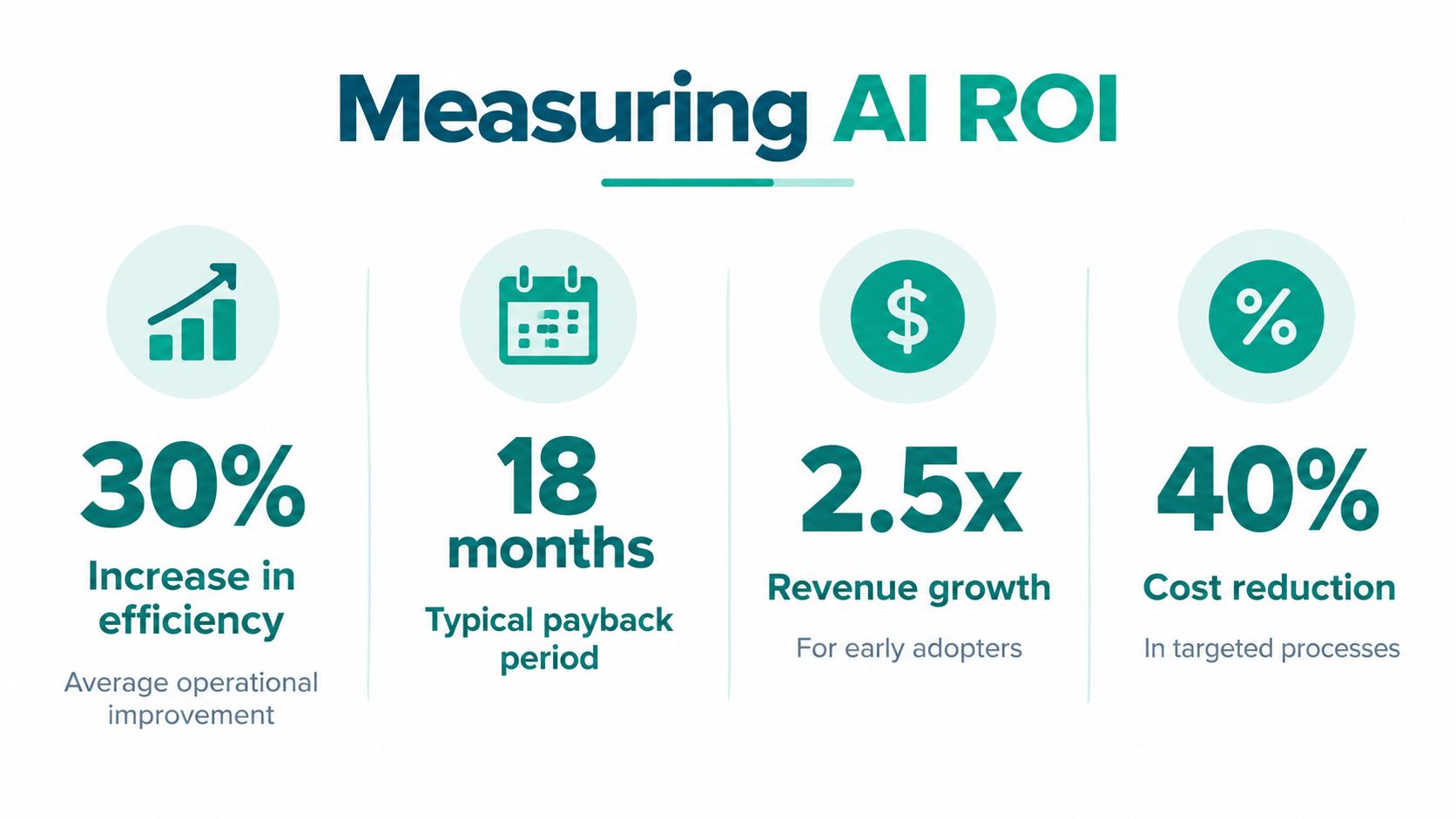
OECD research found that 54% of surveyed SMEs experienced at least moderate value from AI integration, while 15% reported a significant positive effect on efficiency, productivity, or decision-making. Six percent described AI as transformational, according to the OECD analysis of SMEs and AI.
Those findings are useful because they show variation rather than promising a universal result. Your consultant should establish a baseline before implementation and specify how the result will be reviewed. A 60-day or 90-day review period may be appropriate for some workflows, but the period should reflect the task's volume and learning curve, not an arbitrary promise.
Track both benefits and costs:
- Time saved: Record the current effort and the effort required after deployment.
- Quality maintained: Define acceptable error rates and require review for customer-facing work.
- Adoption achieved: Check whether employees use the workflow as designed.
- Risk controlled: Monitor privacy incidents, unsupported answers, and inappropriate actions.
- Economics improved: Compare software, integration, training, and maintenance costs with measurable gains.
A project that produces fast drafts but introduces frequent corrections may have negative value. A modest automation that employees trust and use consistently may be the better investment.
When AI Strategy Makes Sense and When It Doesn't
AI isn't automatically the right answer for a small business. The most useful consulting conclusion may be that a process needs clearer ownership, better templates, improved search, or conventional automation first.
U.S. Small Business Administration research cited in the available business analysis found that nearly 82% of businesses with fewer than five employees that weren't planning to use AI believed AI wasn't applicable to their business. Lack of knowledge and privacy concerns were each reported by only about 7%. That finding points to a practical issue: many owners aren't waiting for a better tool. They don't see a sufficiently valuable problem.
Apply a relevance test
Start by examining the workflow rather than the industry label. Ask these questions:
- Frequency: Does the task happen often enough to justify setup and oversight?
- Repeatability: Do employees follow a recognizable process, or does every case require unusual judgment?
- Data quality: Is the information accessible, current, and structured well enough to support the result?
- Sensitivity: Would the workflow involve health, legal, financial, employment, or personally identifiable information?
- Human review: Can a qualified person check the output before it affects a customer?
- Economic value: Would the result save meaningful effort, reduce errors, support revenue, or improve service?
- Downside exposure: What happens if the system is wrong, unavailable, biased, or misused?
A Cincinnati law firm handling a large volume of similar documents may have a stronger case for classification assistance than a small consultancy producing highly individualized work. The consultancy may get a faster return from reusable templates, improved site search, or better project management.
The correct comparison isn't AI versus doing nothing. It's AI versus the simplest reliable way to improve the process.
This approach also prevents tool accumulation. If a form redesign solves the problem with less maintenance and lower risk, choose the form. If an existing CRM rule handles the handoff, don't add an AI agent merely because the capability is available.
How to Evaluate and Hire the Right AI Consultant
Choose an AI consultant with the same care you'd use for a web development or SEO partner. The important question isn't whether a firm can demonstrate advanced technology. It's whether the team can understand your operation, explain trade-offs, and stay accountable after implementation.

Ask each candidate to describe a project with a similar workflow, company size, data environment, or regulatory concern. A consultant experienced with enterprise deployments may have strong technical skills but still struggle with the limited staff, fragmented systems, and cash-flow discipline of a Cincinnati small business.
Compare consultants by evidence
| Evaluation area | What to ask | Warning sign |
|---|---|---|
| Business fit | How will you decide whether AI is relevant? | Every discussion begins with a tool |
| Workflow design | Who will interview employees and map the current process? | The proposal skips current-state analysis |
| Measurement | Which baseline and success metrics will you establish? | The promise uses transformation language without measures |
| Governance | How will you handle privacy, access, review, and incidents? | Governance is described as a generic policy |
| Implementation | Who configures, integrates, tests, and trains? | The consultant delivers a report and leaves |
| Communication | Can you explain the recommendation to nontechnical staff? | The proposal depends on unexplained technical terms |
For healthcare organizations, ask how the engagement handles HIPAA-related privacy requirements and human review. For law firms, discuss confidentiality and attorney-client privilege. Marketing teams should ask who verifies public-facing claims, brand language, accessibility, and SEO accuracy.
Healthcare leaders have a particularly clear reason to ask detailed governance questions. A healthcare technology survey reported that 77% of healthcare leaders felt uneasy about generative-AI data privacy and security, 62% identified governance as a leading concern, and only 9% said their current governance framework was well-established and complete, according to the healthcare governance findings.
A good interview should end with a realistic first engagement, not pressure to approve a large transformation. Ask what the consultant won't recommend, how failed use cases will be stopped, and what your staff will own when the project ends.
The following video provides another perspective on evaluating the role and value of consulting in AI-enabled operations:
<iframe width="100%" style="aspect-ratio: 16 / 9;" src="https://www.youtube.com/embed/7JUkvPrBwRs" frameborder="0" allow="autoplay; encrypted-media" allowfullscreen></iframe>Taking Your First Steps Toward AI Strategy
You don't need to begin with a large technology purchase. Begin with an honest inventory of work that consumes staff time, creates delays, or limits your ability to respond to customers.
Write down the process, the people involved, the systems used, and the result produced. Include repetitive marketing tasks, lead follow-up, reporting, website updates, customer questions, proposal preparation, and internal knowledge retrieval. Then mark where errors occur and where employees depend on manual copying or tribal knowledge.
Build a short decision brief
Use one page for each promising workflow:
- Business problem: State what isn't working and who feels the impact.
- Current process: Describe the steps, tools, handoffs, and approval points.
- No-AI option: List a simpler redesign, template, software feature, or outsourcing alternative.
- AI possibility: Describe what the system could draft, classify, summarize, predict, or route.
- Data and privacy: Identify the information involved and who may access it.
- Human responsibility: Specify who checks the result and handles exceptions.
- Success measure: Choose the operational, service, or revenue metric that will determine whether the project continues.
This document gives a consultant something concrete to evaluate and helps your team avoid buying disconnected tools. It also makes it easier to compare proposals because each candidate is responding to the same business context.
For Cincinnati-area owners evaluating web design, SEO, analytics, or automation, AI consulting services in Cincinnati can be one local option to investigate alongside other providers. The right partner should connect AI decisions to your website, customer journey, internal workflows, and measurable growth goals rather than treating AI as a separate technology project.
The best first step may be a focused assessment of one workflow. If the numbers, risks, and staff experience support the idea, move forward with a controlled pilot. If they don't, keep the process improvement and leave the AI purchase for another problem.
HDM helps businesses evaluate AI use cases, plan workflow automation, improve customer experiences, and connect digital strategy with measurable growth. Visit HDM to discuss your Cincinnati-area business goals and identify whether AI belongs in your next web, SEO, or marketing initiative.